The Energy Cost of Commercial Lighting in Dubai
Lighting represents a significant element of the energy cost of commercial buildings in Dubai, operating long hours across large floor plates in a city where electricity is a meaningful expense. For developers, building operators, and facility managers, reducing this energy cost improves the economics of the building directly. LED lighting is the principal means of achieving this reduction, and understanding how it does so supports the case for LED specification and upgrade across Dubai commercial buildings.
This guide examines how LED lighting reduces electricity costs in Dubai commercial buildings, exploring the mechanisms of the saving and the factors that determine its scale across the range of commercial building types in the city.
The Efficiency Advantage
The fundamental mechanism of the saving is the efficiency of LED, which delivers the required light using far less energy than the technologies it replaces. Where halogen and fluorescent lighting wasted much of their energy, LED converts most of it to light, requiring far less power to deliver the same illumination. This efficiency advantage is the foundation of the electricity cost saving LED delivers.
For Dubai commercial buildings, this efficiency translates directly into reduced electricity consumption and cost. The lighting that delivers the same illumination using a fraction of the energy reduces the electricity bill substantially, a saving that accumulates across the long operating hours and large floor areas of commercial buildings, delivered by efficient LED lights for commercial buildings.
Savings Across Long Operating Hours
Commercial buildings operate their lighting for long hours, often twelve or more each day, multiplying the effect of the efficiency saving. The reduction in power, applied across these long hours, accumulates into a substantial reduction in energy consumed and cost incurred. The long operating hours of commercial lighting make the efficiency saving particularly valuable, compounding the per hour reduction across the operating day.
For Dubai commercial buildings with long operating hours, the efficiency saving accumulates significantly across the day and the year. The reduction in power, sustained across the long hours, delivers a large reduction in the annual energy cost, making the efficiency of the lighting a major factor in the operating economics of the building.
The Cooling Load Reduction
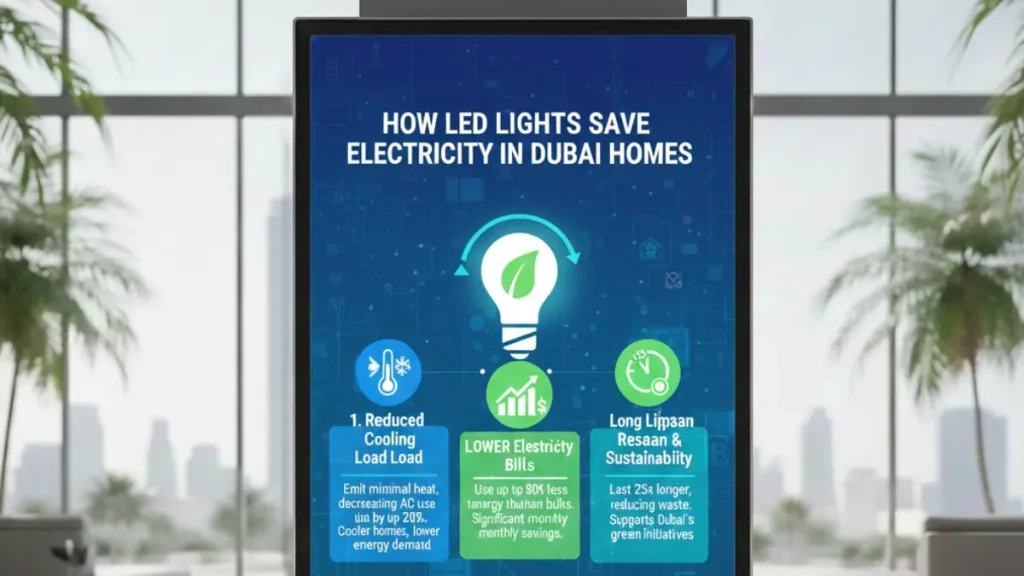
In Dubai climate, where air conditioning dominates building energy use, the heat that lighting generates adds to the cooling load and the energy required to remove it. LED, generating far less heat than the alternatives, reduces this cooling load, delivering a second saving alongside the direct lighting efficiency. This cooling load reduction compounds the energy saving in the cooling dominated Dubai climate.
For Dubai commercial buildings, the cooling load reduction is a significant additional saving. The lighting that generates less heat requires less cooling to remove it, reducing the air conditioning energy and cost. This compounding of the saving, through the reduced cooling load, makes the energy advantage of LED particularly valuable in the Dubai climate.
The Impact of DEWA Tariffs
The DEWA tariffs that govern Dubai electricity pricing make the energy saving particularly valuable, with the cost of consumption incentivising reduction. For commercial buildings, the tariff structure makes every unit of energy saved a meaningful cost reduction, enhancing the value of the efficiency that LED delivers. The DEWA tariffs make the energy saving of LED a significant economic benefit.
For Dubai commercial operators, the DEWA tariffs translate the energy saving of LED into a meaningful cost reduction. The reduction in consumption, valued at the tariff rate, delivers savings that improve the building economics, making the efficiency of LED a valuable economic benefit in the context of Dubai electricity pricing.
Controls and Further Savings
Beyond the efficiency of the fixtures, lighting controls deliver further savings by reducing consumption when full lighting is not needed. Daylight harvesting dims the lighting where natural light is available, occupancy control switches it in unoccupied spaces, and scheduling matches it to operating hours. These controls reduce the energy consumed beyond the fixture efficiency, delivering additional savings.
For Dubai commercial buildings, controls multiply the saving that LED delivers. The lighting that consumes less per hour, dimmed and switched to match daylight and occupancy, consumes even less across the day, delivering savings beyond the fixture efficiency alone. The combination of efficient LED and intelligent control maximises the electricity cost reduction.
Savings in Office Buildings
Office buildings, with their large floor plates and long operating hours, deliver substantial savings from LED. The lighting of open plan floors, operating throughout the working day, consumes significant energy, and the efficiency of LED reduces this consumption substantially. Combined with daylight and occupancy controls, LED delivers major savings in the office building, improving its operating economics.
For office developments in Dubai, the LED saving improves the building economics and the competitiveness of its occupancy cost. The reduction in lighting energy lowers the service charges and supports the appeal of the building to tenants conscious of their occupancy cost, making the LED saving a benefit to both the operator and the occupiers.

Savings in Hospitality and Commercial
Commercial and hospitality buildings, operating long hours with significant lighting, deliver substantial savings from LED. The extensive lighting of commercial floors and hospitality spaces, operating throughout the trading day and evening, consumes significant energy that LED efficiency reduces. The saving improves the operating economics of these intensively lit environments across Dubai.
For hospitality and commercial operators, the LED saving reduces the operating cost of the intensive lighting these environments require. The efficiency of LED, applied across the long operating hours and extensive lighting, delivers meaningful savings that improve the economics of the hospitality and commercial operation across Dubai.
Savings in Industrial Facilities
Industrial facilities, lighting vast spaces for long hours, deliver large savings from LED. The high output lighting of warehouses and factories, operating across continuous shifts, consumes substantial energy that LED efficiency reduces significantly. The saving in these large, intensively lit facilities is among the most substantial that LED delivers, improving the operating economics of the industrial facility, complemented by industrial LED lighting for warehouse facilities.
For industrial operators in Dubai, the LED saving reduces the significant energy cost of lighting large facilities. The efficiency of LED, applied across the vast spaces and long hours of industrial operation, delivers substantial savings that improve the economics of the facility, a major benefit in the energy intensive industrial environment.
Calculating the Saving
Estimating the saving a building will achieve from LED requires the current consumption, the efficiency improvement, the operating hours, and the tariff. These factors together determine the energy saved and the cost reduction delivered. A calculation based on the specific building provides an estimate of the saving and the payback period, supporting the decision to specify or upgrade to LED.
For developers and operators evaluating LED, a calculation of the expected saving supports the decision. The estimate of the energy and cost reduction, based on the building consumption and operation, demonstrates the value of the LED investment and the period over which it pays back, informing the decision to specify or upgrade to LED.
The Payback of LED Investment
The saving LED delivers repays the investment in it over a period determined by the saving and the cost. For many commercial buildings, particularly those replacing inefficient halogen or operating long hours, the payback is attractive, with the energy saving repaying the investment within a reasonable period and delivering savings thereafter. The payback makes LED an attractive investment for many buildings.
For building operators, the payback of the LED investment, repaid by the energy saving, makes the upgrade or specification financially attractive. The saving that repays the investment and continues thereafter delivers a return that justifies the LED specification, particularly for buildings with significant lighting energy cost across their operation.
Sustainability Alongside Saving
The energy saving LED delivers reduces not only the cost but the carbon footprint of the building, supporting the sustainability objectives that commercial operators increasingly pursue. The reduced energy consumption translates into reduced emissions, contributing to the sustainability performance and ESG positioning of the building alongside the cost saving. The saving serves both the economic and the environmental interest.
For commercial operators, the alignment of cost saving and sustainability makes the LED saving doubly valuable. The reduced energy reduces both the cost and the carbon, serving the economic and the environmental objectives together. This alignment makes the energy saving of LED a contribution to the sustainability of the building as well as its economics.
Realising the Saving With Quality LED
The saving depends on quality LED properly specified; inferior products may deliver less saving and fail to endure, undermining the economics. Quality LED, efficient and reliable, delivers the full saving across its long life, realising the value of the investment. Specifying quality LED ensures the saving is delivered and sustained across the building life.
For operators seeking the saving, specifying quality LED is essential to realising it. The efficient, reliable products deliver the full saving across their life, while inferior products disappoint. As an authorised OPPLE distributor, Tricircle supplies the quality LED that delivers and sustains the electricity cost saving across Dubai commercial buildings.
Reduce Your Electricity Cost With Tricircle
Reducing the electricity cost of a Dubai commercial building through LED requires quality, efficient products and knowledgeable support. As an authorised OPPLE distributor, Tricircle supplies quality LED lighting that delivers substantial electricity cost savings across Dubai commercial buildings, supporting operators in reducing their energy cost and carbon footprint.
To discuss reducing the electricity cost of your commercial building through LED, contact our team at aysha@tricirclegroup.ae or call +971 50 578 1325. We supply quality, efficient LED lighting in project quantities across Dubai, Sharjah, Abu Dhabi, and the wider Emirates.