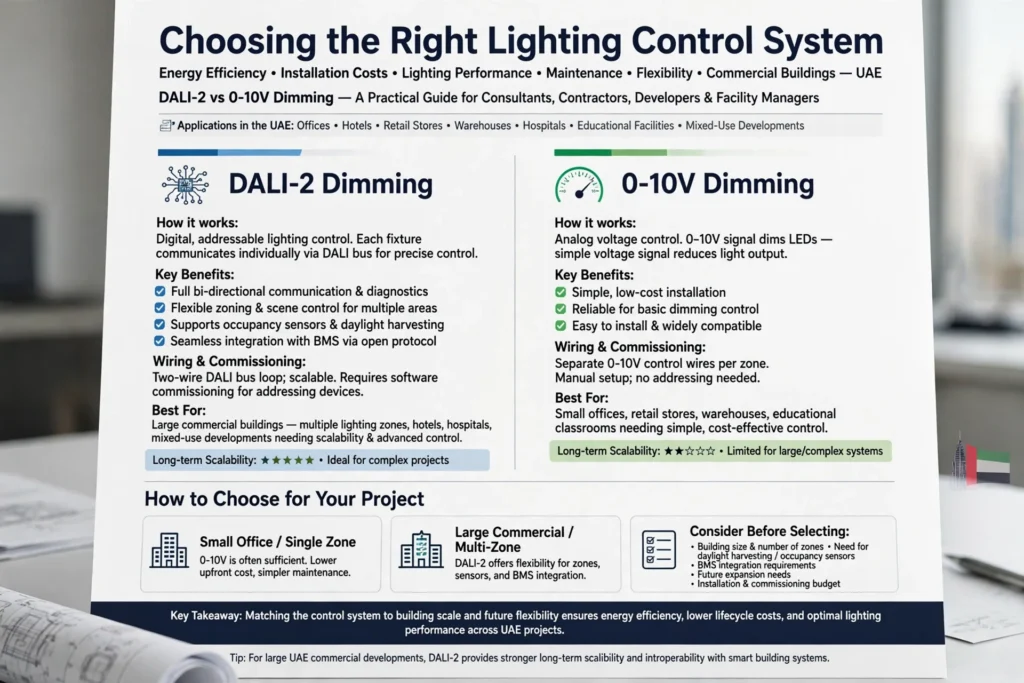
Choosing the right lighting control system affects energy efficiency, installation costs, lighting performance, maintenance, and the flexibility of a commercial building. Two common options are DALI-2 and 0–10V dimming. Both allow users to adjust LED light output, but they differ in communication, control capabilities, wiring requirements, commissioning, and long-term scalability.
For lighting projects in the UAE, the decision can be particularly important in offices, hotels, retail stores, warehouses, hospitals, educational facilities, and mixed-use developments. A system that works well in a small office may not provide the flexibility needed for a large commercial building with multiple lighting zones, occupancy sensors, daylight harvesting, and a building management system (BMS).
This guide explains the differences between DALI-2 and 0–10V dimming, how each system works, where each option performs best, and what consultants, contractors, developers, and facility managers should consider before selecting a lighting control solution.
What Is DALI-2 Lighting Control?
DALI-2 stands for Digital Addressable Lighting Interface version 2. It is a standardized digital communication system used to control lighting equipment, including LED drivers, sensors, application controllers, and other compatible devices.
Unlike conventional analogue dimming, DALI-2 allows compatible devices to communicate digital commands over a dedicated control bus. Each addressable lighting device can receive instructions, and supported equipment can report information back to the control system.
This two-way communication makes DALI-2 suitable for commercial projects that require detailed lighting management, flexible zoning, automated scenes, and improved maintenance visibility.
How DALI-2 Works
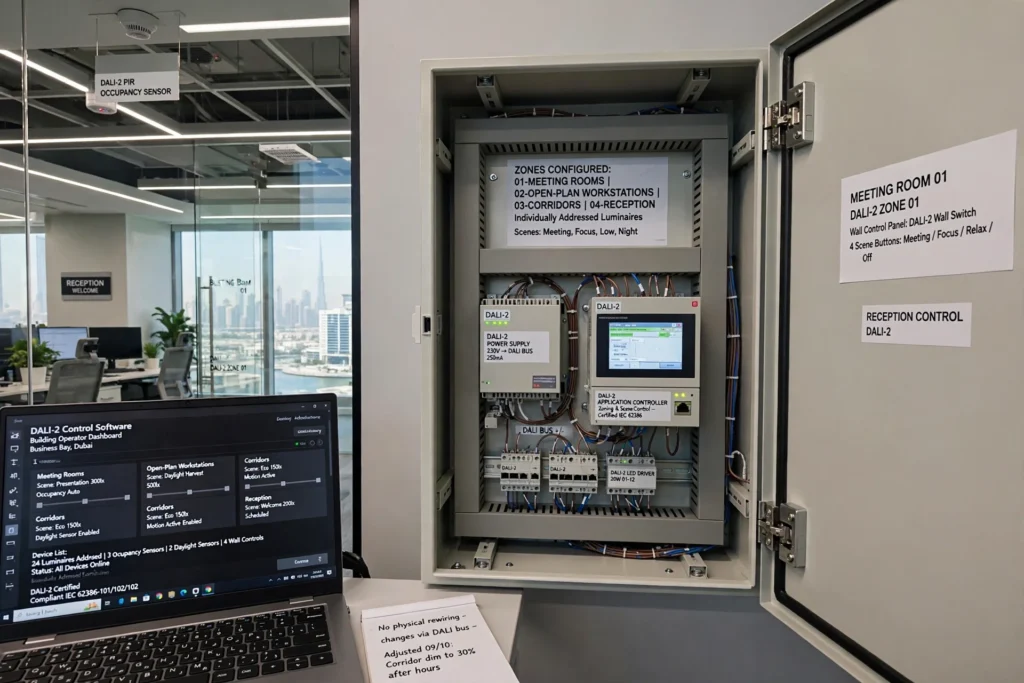
A DALI-2 installation typically includes DALI-2-compatible LED drivers, a DALI bus power supply, an application controller, and compatible input devices such as occupancy sensors, daylight sensors, or wall controls.
The controller sends commands through the DALI bus to the relevant lighting devices. Depending on the equipment and system configuration, luminaires can be individually addressed or organized into groups and scenes. Facility managers can change lighting settings without necessarily changing the physical control wiring.
For example, an office in Business Bay, Dubai, may require separate lighting settings for meeting rooms, open-plan workstations, corridors, and reception areas. With DALI-2, these zones can be configured digitally, allowing the building operator to adjust lighting behaviour as workplace requirements change.
DALI-2 also supports standardized testing and certification for compatible control devices. However, the level of functionality available depends on the DALI device types, application controller, software, and installed equipment.
What Is 0–10V Dimming?
0–10V dimming is an analogue lighting control method that adjusts the light output of compatible LED drivers using a low-voltage control signal. It is widely used in commercial and industrial lighting because of its straightforward operation and availability across many lighting products.
A 0–10V control device sends a voltage signal to a compatible driver. The driver interprets that signal and adjusts the LED output accordingly. The exact relationship between the control voltage and light output depends on the driver and dimming standard being used.
In many conventional 0–10V systems, a higher control voltage corresponds to higher light output, while a lower voltage reduces brightness. However, installers should verify the driver’s specified control curve and minimum dimming level rather than assuming every product behaves identically.
How 0–10V Dimming Works
A typical 0–10V installation includes dimmable LED drivers, a compatible dimmer or lighting controller, and low-voltage control wiring connecting the controller to the drivers.
When a user adjusts a dimmer, the control signal changes and the connected luminaires respond by increasing or reducing their brightness. Depending on the controller and wiring arrangement, several luminaires may respond together as one zone.
This approach can work well in a warehouse in Jebel Ali, a retail unit in Dubai, or an office with a small number of lighting zones. It is especially practical when the project needs basic dimming without complex digital addressing or extensive lighting-management functions.
However, conventional 0–10V control generally offers less standardized two-way device communication than DALI-2. Additional equipment may be required for occupancy-based control, daylight response, status monitoring, or integration with other building systems.
DALI-2 vs 0–10V Dimming: Key Differences
Both systems can provide effective LED dimming, but they are designed around different control approaches. DALI-2 uses digital communication and supports addressable devices, while 0–10V uses an analogue signal to control brightness.
| Feature | DALI-2 | 0–10V |
|---|---|---|
| Control method | Digital communication | Analogue voltage signal |
| Individual luminaire addressing | Supported with compatible equipment | Not normally available through the analogue signal alone |
| Group control | Configurable digitally | Usually determined by control wiring and controller arrangement |
| Two-way communication | Supported for compatible devices and functions | Conventional systems primarily send dimming commands |
| Lighting scenes | Supported through suitable controllers | Possible with additional or compatible control equipment |
| Occupancy and daylight control | Supported through compatible sensors and controllers | Possible with suitable external control equipment |
| Reconfiguration | Often possible through software or controller settings | May require wiring or controller changes, depending on the installation |
| Fault and status information | Available for compatible devices and systems | More limited through conventional 0–10V control alone |
| Installation considerations | Requires compatible DALI equipment, bus design, and commissioning | Requires compatible drivers, controllers, and correctly installed control wiring |
| Best fit | Projects needing flexible, scalable lighting management | Projects needing straightforward dimming and simpler zoning |
The best choice depends on the intended functions, the number of luminaires, project budget, installation conditions, and expected future changes. Neither technology automatically guarantees better energy savings or lower maintenance costs; results depend on the complete lighting design and how the system is operated.
Communication: Digital Control vs Analogue Dimming
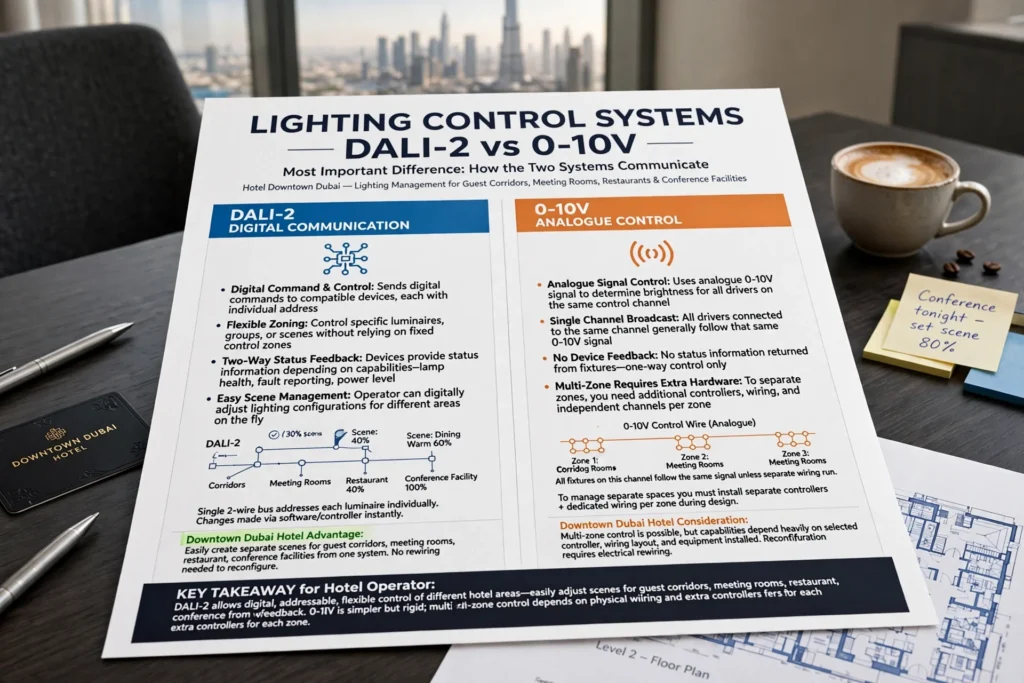
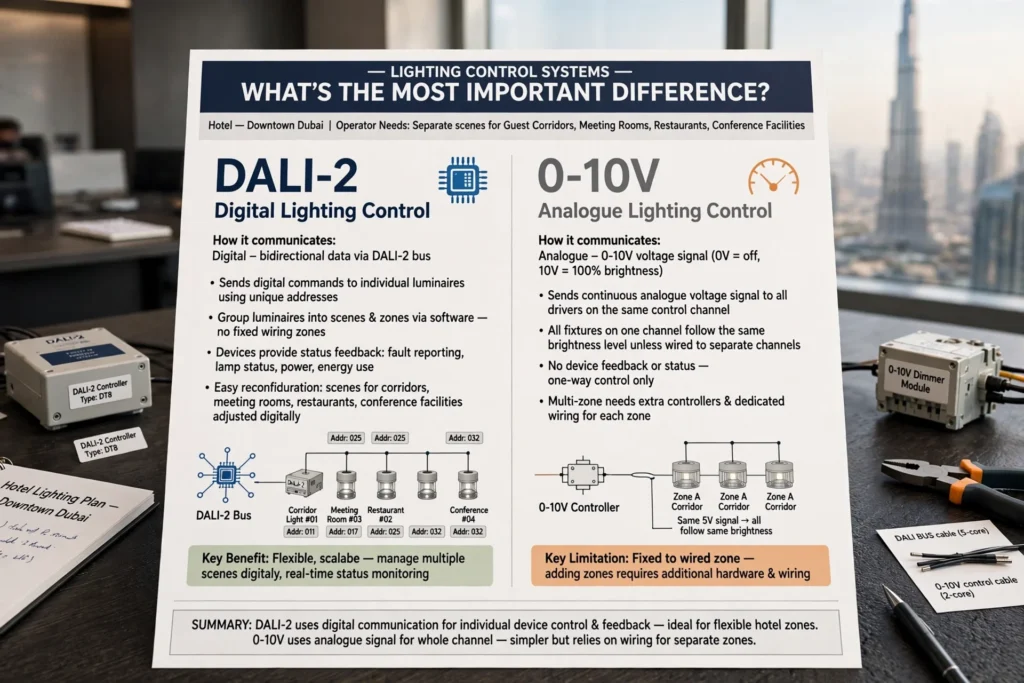
The most important difference is how the two systems communicate with lighting equipment.
DALI-2 sends digital commands to compatible devices. Because devices can have individual addresses, the control system can manage particular luminaires, groups, or scenes without relying entirely on fixed control zones. Compatible devices can also provide status information, depending on their capabilities.
By contrast, a conventional 0–10V system uses an analogue signal to determine brightness. All drivers connected to the same control channel generally follow that signal, unless the design includes additional controllers or independent channels.
Consider a hotel in Downtown Dubai. The operator may want separate lighting scenes for guest corridors, meeting rooms, restaurants, and conference facilities. DALI-2 can make it easier to manage these different areas and adjust their lighting configurations digitally. A 0–10V system can also support multi-zone control, but each zone’s capabilities depend more heavily on the selected controller, wiring arrangement, and connected equipment.
Installation and Wiring Requirements
Installation planning should happen before lighting equipment is ordered. The control method influences driver selection, cable routing, controller requirements, commissioning time, and coordination with electrical contractors.
DALI-2 Installation Requirements
A DALI-2 system uses a dedicated two-wire control bus in addition to the appropriate power wiring for the luminaires. The control bus connects compatible devices and controllers according to the applicable DALI requirements.
Designers and installers need to consider bus power supply capacity, cable lengths, voltage drop, device quantities, topology, polarity requirements where applicable, and electrical separation rules under the relevant product instructions and local regulations. DALI bus design should follow the applicable standard and manufacturer documentation.
Commissioning is also important. Devices must be discovered or addressed as required, grouped correctly, and assigned to the intended scenes and control functions. Project documentation should record device addresses, groups, controller settings, and any special operating requirements.
For large commercial projects in Dubai Marina, Dubai South, or Abu Dhabi, this configuration work can provide flexibility during handover and future space changes. However, it requires suitable technical expertise and commissioning time.
0–10V Installation Requirements
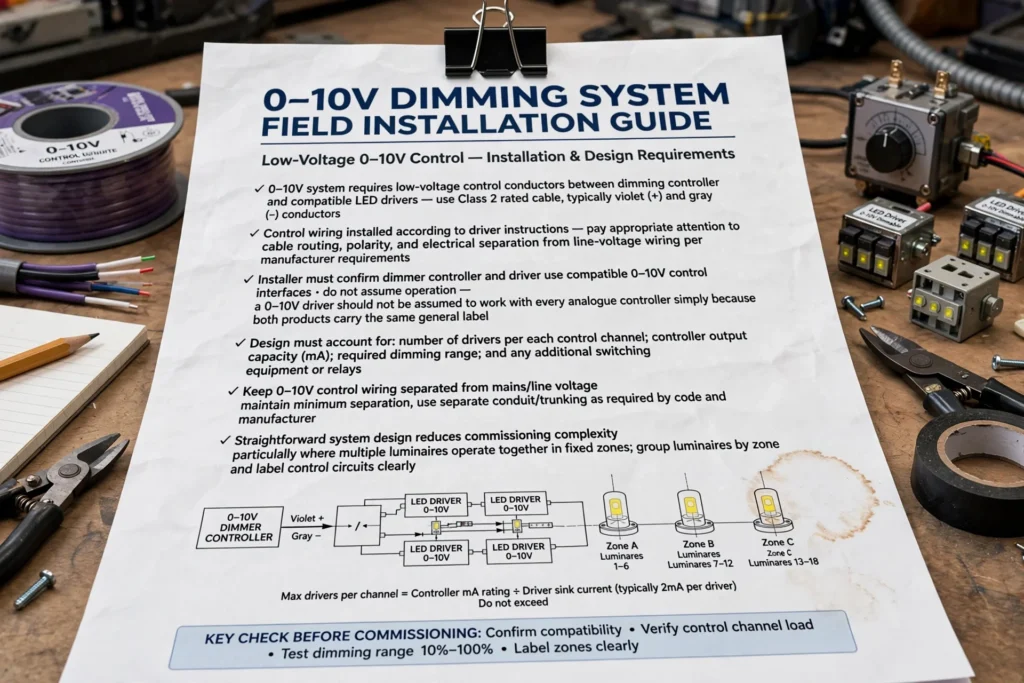
A 0–10V system usually requires low-voltage control conductors between the dimming controller and compatible LED drivers. The control wiring must be installed according to the driver’s instructions, with appropriate attention to cable routing, polarity, electrical separation, and the manufacturer’s requirements.
The installer must confirm that the dimmer, controller, and driver use compatible control interfaces. A 0–10V driver should not be assumed to work with every analogue controller simply because both products carry the same general label.
The design must also account for the number of drivers on each control channel, the controller’s output capacity, the required dimming range, and any additional switching equipment. A straightforward system can reduce commissioning complexity, particularly where multiple luminaires operate together in fixed zones.
Dimming Performance, Flicker, and Minimum Light Output
Lighting control quality is not determined by the communication protocol alone. The LED driver, dimming interface, LED module, control equipment, and electrical supply all influence the final result.
A poorly matched combination can cause flicker, unstable dimming, delayed response, uneven brightness, or lights that switch off unexpectedly near the bottom of the dimming range.
With DALI-2, the system can issue digital dimming commands, but the driver’s design still determines its achievable minimum output and performance. With 0–10V, performance depends on the driver’s response to the control voltage and the controller’s compatibility.
Before approving either system, consultants should review the manufacturer’s dimming curves, minimum dimming percentage, compatibility information, and any published flicker performance data. Where flicker-sensitive tasks are involved, testing should use appropriate measurement methods rather than relying only on visual inspection.
For offices, classrooms, healthcare spaces, and video production areas, these checks are especially valuable because occupants may notice inconsistent light levels or flicker-related discomfort. If smooth low-end dimming is essential, request a sample installation or conduct a mock-up test using the actual proposed equipment.
Energy Efficiency and Operating Costs
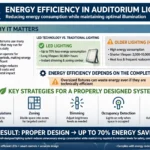
DALI-2 and 0–10V are both control technologies; neither saves energy simply by being installed. Savings come from reducing unnecessary lighting output, switching off lights when areas are unoccupied, responding to available daylight, scheduling operation, and setting appropriate light levels for each task.
DALI-2 can support advanced lighting strategies when paired with suitable sensors, controllers, and software. For example, a daylight sensor near windows can allow luminaires to dim when sufficient natural light enters the space. Occupancy sensors can reduce lighting in meeting rooms or service areas when they are empty.
A 0–10V system can also support occupancy and daylight control if the required sensors and controllers are included. For a smaller office with limited zoning requirements, this may be a cost-effective way to reduce energy use without introducing a more extensive digital control system.
For UAE buildings, where lighting operates alongside significant cooling loads, reducing lighting energy may also reduce some internal heat gains. The actual impact on cooling energy depends on the building, lighting load, HVAC efficiency, operating hours, and control strategy. Energy savings should therefore be estimated from the project’s operating conditions rather than using a universal percentage.
Integration with Building Management Systems
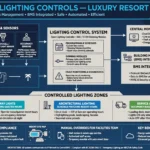
Building management system integration can be an important factor in offices, hotels, hospitals, campuses, and large mixed-use developments.
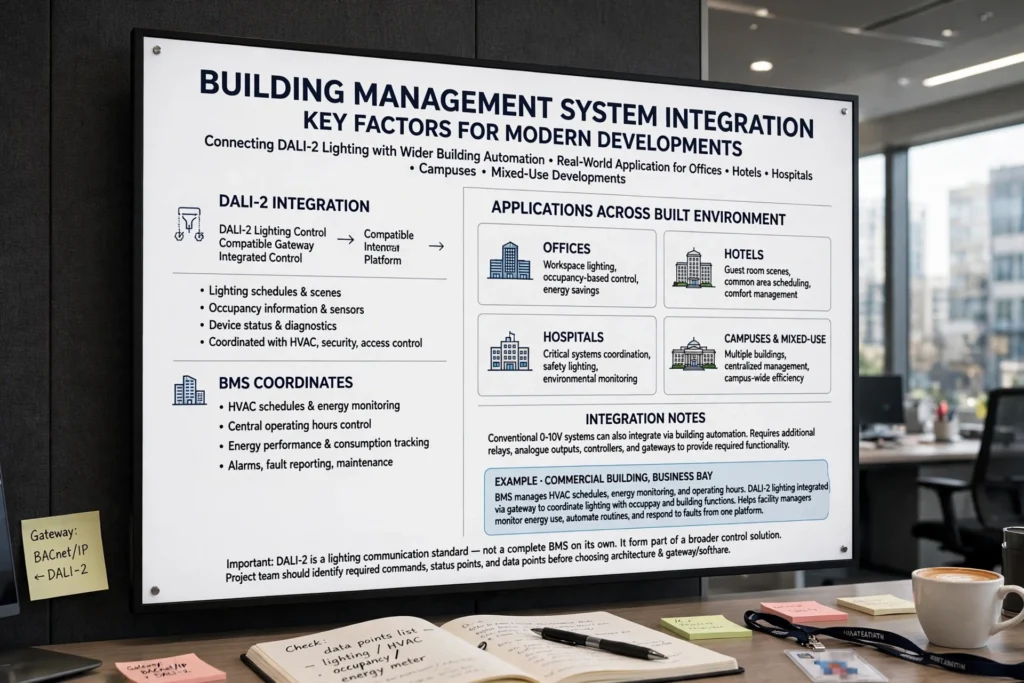
DALI-2 can connect with wider building automation through a compatible gateway or integrated control platform. Depending on the selected equipment, this may allow lighting schedules, occupancy information, scenes, and device status to be coordinated with other building functions.
For example, a commercial building in Business Bay may use a BMS to manage HVAC schedules, energy monitoring, and central operating hours. A compatible lighting integration can help facility managers coordinate these functions, but the actual features depend on the gateway, software, network architecture, and supported data points.
A conventional 0–10V system can also be integrated with building automation. However, the design may require additional relays, analogue outputs, controllers, or gateways to provide the required functionality. The project team should identify which commands and status points are needed before choosing the architecture.
DALI-2 should not be treated as a complete building management system by itself. It is a lighting communication standard that can form part of a broader control solution.
Which System Is More Cost-Effective?
The initial cost comparison should include more than the price of the LED driver. A complete cost assessment considers control devices, sensors, gateways, wiring, installation labour, commissioning, programming, testing, and future maintenance.
For a small shop, basic office, or storage room with a few fixed dimming zones, 0–10V may be more economical because the control architecture is relatively simple. If the lighting layout is unlikely to change, the additional flexibility of a digital system may not justify the extra initial investment.
DALI-2 may offer greater long-term value in buildings that need frequent reconfiguration, detailed lighting scenes, individual luminaire control, or status monitoring. A tenant fit-out that changes every few years may benefit from being able to modify groups and scenes through software rather than relying on physical control-zone changes.
However, DALI-2 is not automatically the cheaper option over the building’s lifetime. The final cost depends on project size, device selection, commissioning requirements, operational needs, and the cost of maintaining the system.
The most reliable approach is to request a complete bill of quantities and compare both systems against the same lighting and control requirements.
Best Applications for DALI-2
DALI-2 is a strong candidate for projects where lighting management needs to be flexible, scalable, and integrated with other building systems.
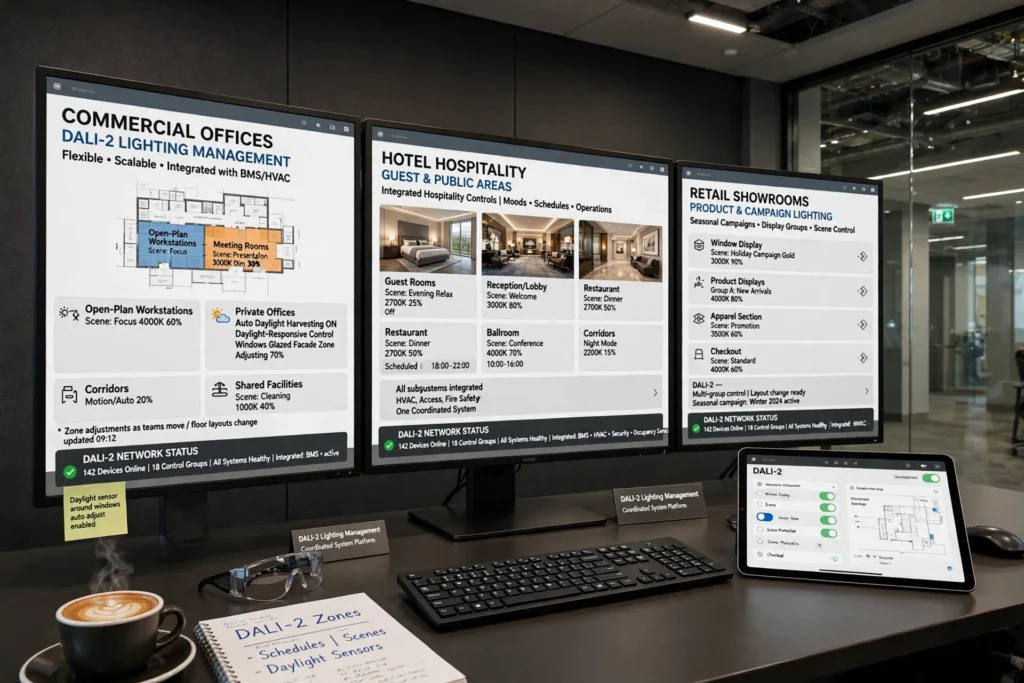
Commercial Offices
Offices often contain meeting rooms, open-plan workstations, private offices, corridors, and shared facilities. DALI-2 can support different lighting scenes and zone adjustments as teams move or floor layouts change. Daylight-responsive control can also be useful around windows and glazed façades.
Hotels and Hospitality
Hotels may require separate lighting scenes for guest rooms, reception areas, restaurants, ballrooms, and corridors. Compatible digital controls can help operators manage different moods, schedules, and operating requirements from one coordinated system.
Retail and Showrooms
Retail lighting changes with product displays, seasonal campaigns, and store layouts. DALI-2 can help manage different lighting groups and scenes, provided the selected luminaires and control platform support the required functions.
Hospitals and Educational Facilities
Hospitals, clinics, universities, and schools may require different lighting levels for treatment rooms, classrooms, corridors, staff areas, and administrative spaces. Control design must consider the activity in each room, user requirements, maintenance procedures, and applicable project standards.
Large Mixed-Use Developments
In large developments across Dubai, Abu Dhabi, and Sharjah, a digital lighting control system may be useful where many areas need coordinated schedules, monitoring, or flexible zone control. System selection should be based on the project’s control requirements and not on building size alone.
Best Applications for 0–10V Dimming
0–10V is often a practical option where the lighting control requirements are straightforward and the project does not need extensive digital communication.
Warehouses and Industrial Areas
Warehouses, workshops, and storage facilities may need dimming across defined zones. A 0–10V solution can work well when compatible high-bay luminaires and controllers meet the required operating conditions.
Small and Medium-Sized Offices
A smaller office may only need a few independently dimmable zones. If the lighting layout is stable and advanced reporting is unnecessary, 0–10V can provide the required adjustment without a complex control architecture.
Retail Units and Back-of-House Areas
Stockrooms, staff rooms, service corridors, and simple retail layouts can benefit from analogue dimming when the control requirements are limited. Where scenes, individual addressing, or detailed monitoring are required, the full project should be assessed before choosing this option.
Retrofit Projects
A retrofit may favour 0–10V if existing control infrastructure and selected replacement drivers are compatible. However, existing wiring should be inspected and tested, and the proposed system must be checked against the actual installed equipment. Retaining old control wiring does not guarantee compatibility.
Important Considerations for UAE Lighting Projects
Lighting control selection in the UAE should account for the building’s operating conditions, project specifications, installation quality, and maintenance arrangements.
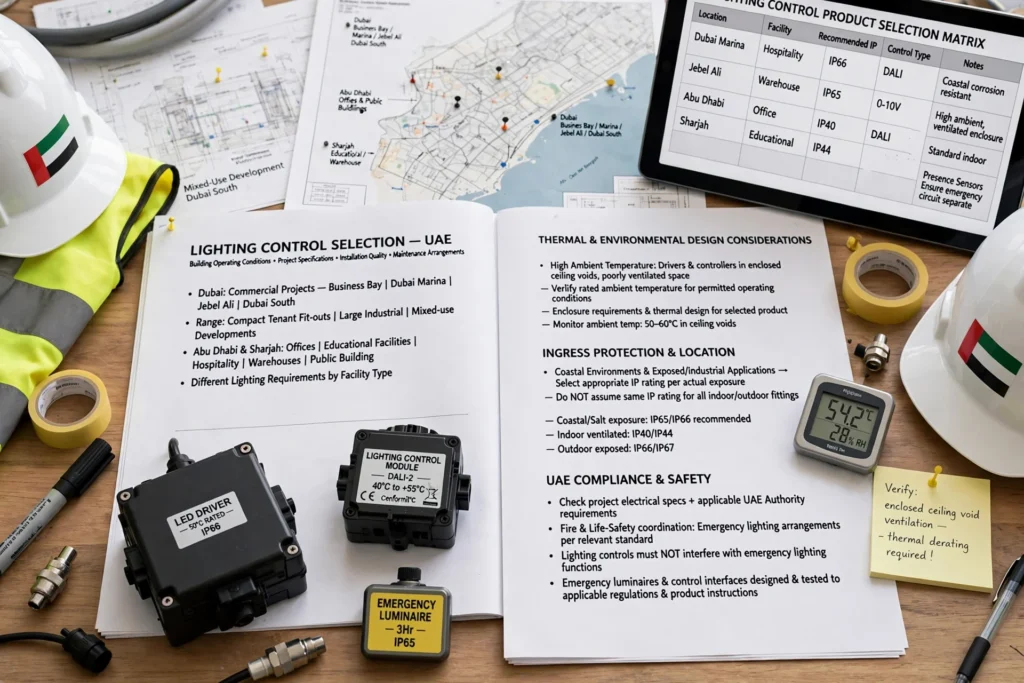
In Dubai, commercial projects in areas such as Business Bay, Dubai Marina, Jebel Ali, and Dubai South can range from compact tenant fit-outs to large industrial and mixed-use developments. Abu Dhabi and Sharjah also include offices, educational facilities, hospitality projects, warehouses, and public buildings with different lighting requirements.
High ambient temperatures can affect electronic equipment, particularly where drivers and controllers are installed in enclosed ceiling voids or poorly ventilated spaces. The project team should verify the rated ambient temperature, permitted operating conditions, enclosure requirements, and thermal design of the selected products.
For coastal environments or exposed industrial applications, appropriate ingress protection and environmental suitability should be specified for the location. IP ratings should be selected according to actual exposure conditions rather than assuming every indoor or outdoor fitting needs the same rating.
Consultants and contractors should also check the project’s electrical specifications, applicable UAE authority requirements, fire and life-safety coordination, emergency lighting arrangements, and relevant standards. Lighting controls must not interfere with required emergency lighting functions. Emergency luminaires and control interfaces should be designed and tested according to the applicable regulations and product instructions.
When sourcing products, work with a reliable Lighting Control System Supplier that can provide compatible drivers, controllers, sensors, technical datasheets, wiring diagrams, commissioning support, and product documentation. Replace this link with the specific supplier or lighting-control service page if a more relevant URL is available.
Checklist Before Selecting DALI-2 or 0–10V
Before finalizing the lighting control specification, the consultant, electrical contractor, and facility manager should agree on the required functions.
First, establish whether the project needs basic dimming or more advanced functions such as individual luminaire addressing, lighting scenes, daylight harvesting, occupancy sensing, and device-status reporting. The answer helps determine whether a conventional analogue system is sufficient.
Next, confirm the compatibility of every major component. Review the LED driver, luminaire, dimmer, sensor, controller, and gateway specifications. Check the required dimming range, control interface, maximum device or channel capacity, and installation conditions.
The project team should also consider future changes. If partitions, workstations, tenant layouts, or room functions are likely to change, a digitally configurable system may provide useful flexibility. If the layout is fixed and only a few dimming zones are required, a simpler solution may be adequate.
Finally, define commissioning and handover requirements. The contractor should test dimming performance, sensor response, scenes, schedules, and any BMS integration. The client should receive updated drawings, device schedules, configuration records, operating instructions, and maintenance information.
Common Mistakes to Avoid
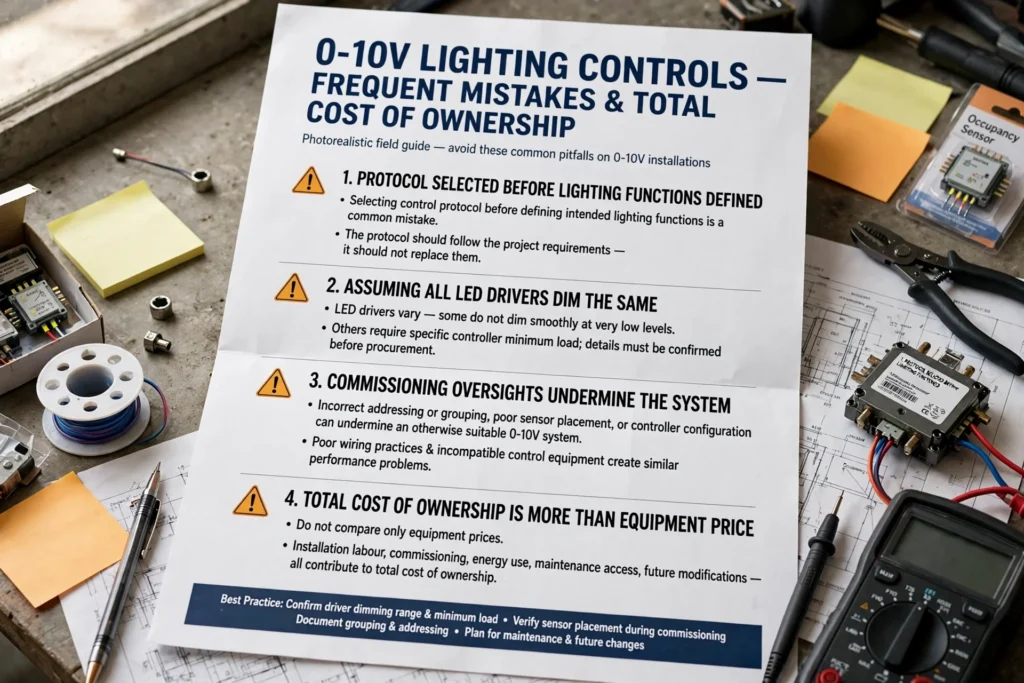
One frequent mistake is selecting a control protocol before defining the intended lighting functions. The protocol should follow the project requirements, not replace them.
Another mistake is assuming all LED drivers support the same dimming range. Some products may not dim smoothly to very low levels, and others may require a specific controller or minimum load. These details should be confirmed before procurement.
It is also risky to overlook commissioning. Incorrect addressing, grouping, sensor placement, or controller configuration can undermine an otherwise suitable system. For 0–10V installations, poor wiring practices or incompatible control equipment can create similar performance problems.
Finally, do not compare only equipment prices. Installation labour, commissioning, energy use, maintenance access, and the cost of future modifications all contribute to the total cost of ownership.
Frequently Asked Questions
Is DALI-2 better than 0–10V dimming?
DALI-2 is generally better suited to projects requiring digital addressing, flexible groups and scenes, and compatible device-status reporting. 0–10V is often suitable for simpler installations that need reliable analogue dimming. The better choice depends on the project’s functions, budget, and future requirements.
Is DALI-2 more energy-efficient than 0–10V?
Not inherently. Both can reduce energy use when paired with suitable controls and an effective operating strategy. Occupancy sensing, daylight harvesting, schedules, and appropriate light levels usually have a greater influence on savings than the control protocol alone.
Can DALI-2 and 0–10V be used in the same building?
Yes. A building can use different control technologies in separate areas, provided each installation has compatible equipment and appropriate control architecture. A gateway or integrated control platform may be required where centralized monitoring or coordination is needed.
Does DALI-2 require special commissioning?
Yes. DALI-2 systems typically require devices to be discovered or addressed as needed, assigned to groups, and configured for the intended scenes and control functions. Proper commissioning and documentation help ensure the system works as designed.
Can 0–10V dimming support occupancy sensors?
Yes. Compatible occupancy sensors and controllers can be used with 0–10V dimming to adjust or switch lighting based on occupancy. The exact arrangement depends on the controller, sensor outputs, switching requirements, and driver compatibility.
Which system is better for a UAE commercial building?
Either system can be appropriate. DALI-2 is worth evaluating for larger offices, hotels, and mixed-use buildings with multiple lighting zones or advanced automation requirements. 0–10V may suit smaller offices, warehouses, and straightforward retrofit projects. The specification should reflect the actual building use and local project requirements.
Final Recommendation
DALI-2 and 0–10V dimming can both deliver effective lighting control, but they address different levels of complexity. DALI-2 provides digital communication, flexible addressing, and broader possibilities for lighting automation. 0–10V offers a straightforward analogue approach that can be cost-effective for basic dimming and defined lighting zones.
For commercial projects in Dubai, Abu Dhabi, Sharjah, and other UAE locations, start by defining the required lighting scenes, occupancy and daylight controls, BMS integration, maintenance needs, and future space changes. Then compare compatible equipment, installation costs, commissioning requirements, and long-term operational value.
Selecting the control system around these practical requirements helps deliver comfortable lighting, reliable operation, and a solution that remains suitable as the building evolves.