LED lighting submittal approval is an important stage in commercial construction projects across Dubai and the wider UAE. Before lighting fixtures are purchased, delivered to the site or installed, MEP consultants need to verify that the proposed products comply with the project’s technical specifications, lighting design, electrical requirements and applicable authority requirements. A complete lighting submittal helps prevent specification mismatches, procurement delays, installation problems and costly replacements.
For developers, main contractors, MEP contractors, lighting suppliers and project consultants, understanding the lighting submittal process can improve coordination between design, procurement and site installation teams. From LED luminaires and drivers to photometric reports, emergency lighting documentation and lighting control systems, each submitted document should provide evidence that the proposed solution is suitable for the intended application.
What Is an LED Lighting Submittal?
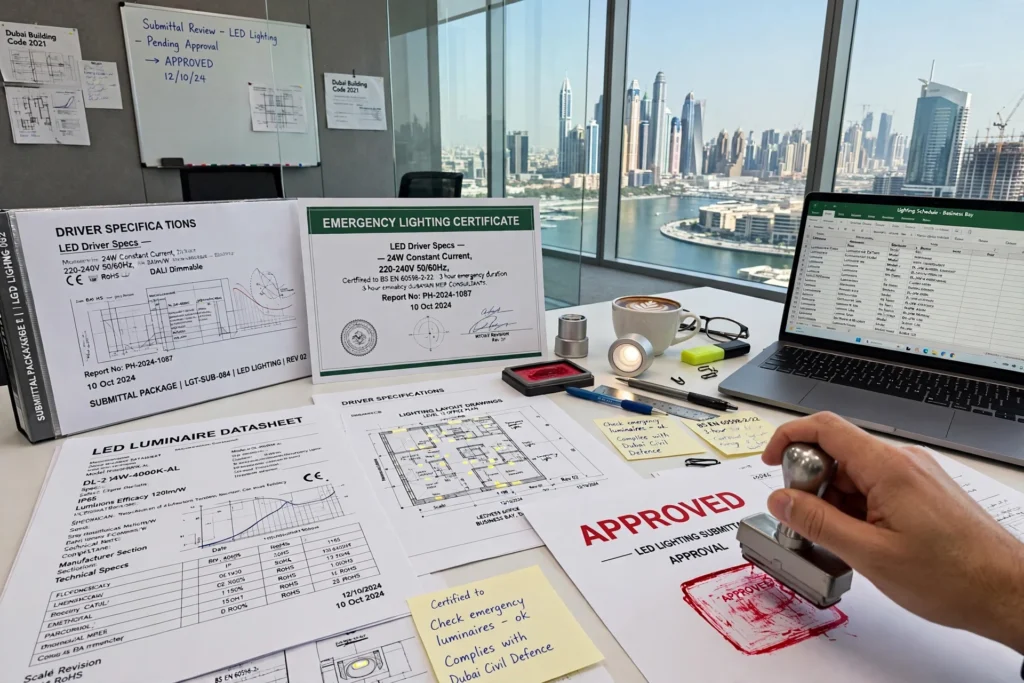
An LED lighting submittal is a technical package submitted for review and approval before a proposed lighting product is purchased or installed. It typically includes manufacturer datasheets, luminaire schedules, photometric files, compliance certificates, installation details, warranty information and other documents required by the project’s specifications.
The purpose is to demonstrate that the proposed LED lighting fixtures meet the design intent and contractual requirements. A submittal may cover indoor luminaires, outdoor LED lights, high-bay fixtures, downlights, linear lighting, emergency luminaires, LED drivers, dimming systems and lighting controls.
In Dubai construction projects, lighting submittals are commonly coordinated between the MEP contractor, lighting supplier, consultant and main contractor. The required approval workflow depends on the project’s specifications, contract documents, consultant procedures and applicable authority requirements.
Approval of a product submittal should not automatically be treated as approval of every aspect of the installation. Shop drawings, material approvals, mock-ups, inspection requests and commissioning documents may require separate review.
Why LED Lighting Submittal Approval Matters in UAE Projects
Commercial buildings in Dubai, Abu Dhabi, Sharjah and other UAE locations require careful coordination between lighting design, electrical infrastructure, architectural finishes and building operations. A luminaire that looks suitable in a catalogue may not satisfy the required light output, glare limits, colour characteristics, electrical performance or installation constraints.
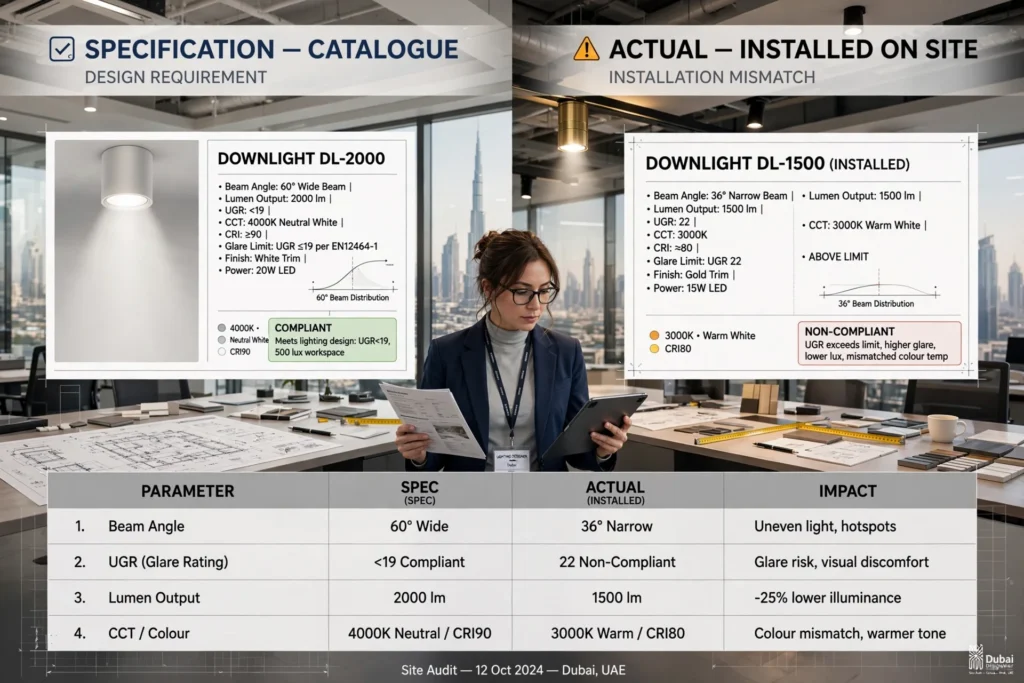
A structured review helps identify these differences before the project commits to bulk procurement. For example, a proposed office downlight may have a similar appearance to the specified model but a different beam angle or Unified Glare Rating (UGR) performance. A warehouse high-bay light may offer adequate lumen output but distribute light poorly across the storage aisles.
Submittal review also helps project teams assess whether proposed drivers are compatible with DALI, 0–10V or other specified dimming systems. For outdoor projects, ingress protection, environmental exposure, mounting arrangements and relevant product certifications must also be checked.
Early technical verification can reduce material rejection, reordering, programme delays and disagreements between contractors and suppliers. It also creates a documented record of the product accepted for the project.
Essential Documents in an LED Lighting Submittal Package
The exact documents depend on the project specifications and the type of luminaire being proposed. However, a typical commercial lighting submittal should include the following information.
1. Manufacturer’s Technical Datasheet
The manufacturer’s technical datasheet is one of the first documents an MEP consultant should review. It identifies the proposed luminaire and provides its principal technical characteristics, allowing the reviewer to compare the product against the specified requirements.
The datasheet should clearly state the manufacturer, model number, product type, rated input power, luminous flux, luminous efficacy, colour temperature, colour rendering index, beam angle, operating voltage, power factor and relevant environmental ratings. Dimming capability, driver information, operating temperature and product dimensions should also be included where applicable.
Consultants should check the actual model and configuration being offered rather than relying on a general product brochure. Manufacturers may offer several versions of the same fixture, with different optics, outputs, drivers and control options.
If a required parameter is missing, the supplier should provide supporting technical evidence instead of assuming compliance.
2. Lighting Fixture Schedule
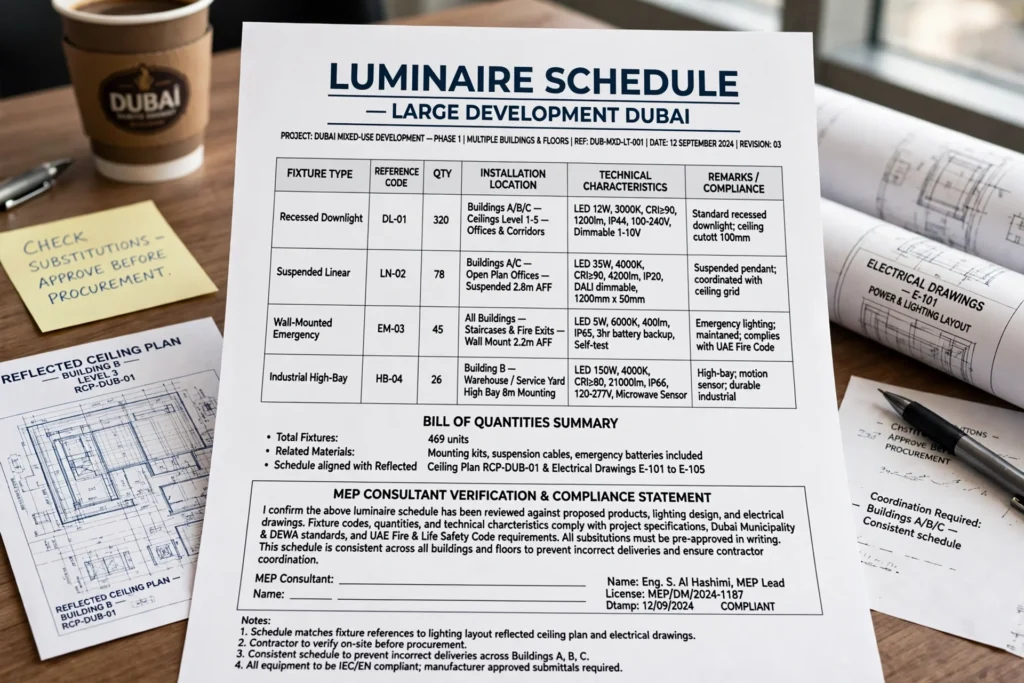
A luminaire schedule connects the proposed products to the lighting design and electrical drawings. It identifies each fixture type, its reference code, quantity, installation location and key technical characteristics.
The schedule should match the fixture references used in the lighting layout, reflected ceiling plan, electrical drawings and bill of quantities. For example, a project may specify separate fixture codes for recessed downlights, suspended linear luminaires, wall-mounted lights, emergency fittings and industrial high-bay fixtures.
The MEP consultant should verify that the proposed manufacturer and model correspond to each specified fixture code. Any substitutions should be clearly identified, with differences explained in a compliance statement.
This comparison is particularly important for large developments in Dubai, where multiple buildings, floors and contractors may be involved. A consistent luminaire schedule helps prevent incorrect fixture deliveries and installation in the wrong locations.
3. Photometric Report and IES or LDT Files
Photometric documentation demonstrates how a luminaire distributes light. It is particularly important when the consultant needs to confirm that a proposed fixture can achieve the design’s illuminance and uniformity requirements.
A photometric report may include luminous intensity distribution, beam characteristics, luminous flux and other lighting performance data. IES and LDT files provide digital photometric information that can be used in lighting design software, depending on the software and file format.
The consultant should verify that the submitted photometric file corresponds to the exact luminaire model, optics, output and operating configuration. A report for a different variant may not accurately represent the proposed fixture.
Lighting calculations should then be reviewed against the project’s requirements, including maintained illuminance, uniformity, glare control and relevant task-specific criteria. Office lighting, warehouse aisles, retail displays and industrial work areas may have different performance requirements.
A high lumen output alone does not prove that a lighting design is suitable. Distribution, mounting height, spacing, surface reflectance and room geometry all influence the final result.
4. LED Driver Specifications
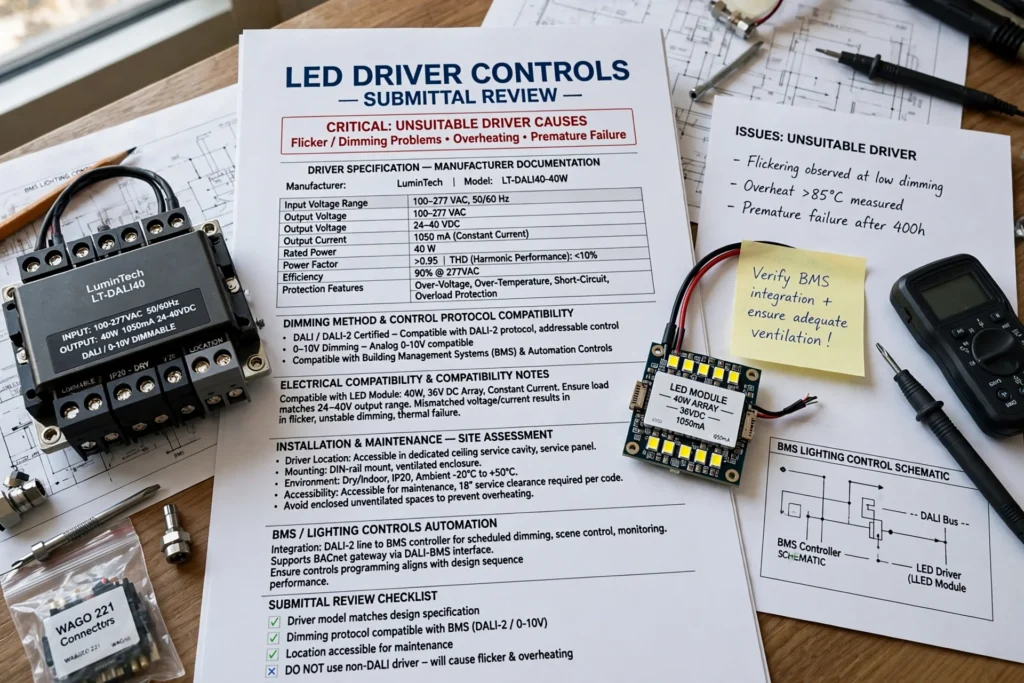
The LED driver controls the electrical supply to the LED module, making its characteristics an important part of the submittal review. An unsuitable driver can cause flicker, dimming problems, overheating or premature component failure.
The documentation should identify the driver manufacturer and model, input voltage range, output current, output voltage, rated power and relevant protection features. Where required, it should also state power factor, harmonic performance, dimming method and electrical compatibility.
If the project uses DALI, DALI-2, 0–10V or another control protocol, the proposed driver must support the specified method. Compatibility should be confirmed through manufacturer documentation rather than inferred from the fixture description.
Consultants should also consider the driver’s location, accessibility for maintenance and suitability for the installation environment. For projects involving building management systems, the lighting controls and driver requirements should be coordinated with the wider electrical and automation design.
5. Product Compliance Certificates and Test Reports
Compliance documents help demonstrate whether the proposed lighting equipment meets the standards and contractual requirements specified for the project. The required evidence varies according to the product type, project location and applicable regulations.
Depending on the specification, the submittal may require relevant IEC or EN standard references, test reports, declarations of conformity, and applicable UAE conformity documentation. Documents may address electrical safety, electromagnetic compatibility, photobiological safety or other product characteristics.
Consultants should check that the documents identify the correct manufacturer and product family and that their scope covers the proposed model. A certificate for a different product or an unrelated component should not be accepted as evidence of compliance.
Where a project requires Emirates conformity documentation or other UAE-specific approvals, the supplier should provide the relevant evidence applicable to that product. Consultants should verify the current requirements rather than assuming that one certificate automatically satisfies every project or authority condition.
6. IP Rating and Environmental Suitability
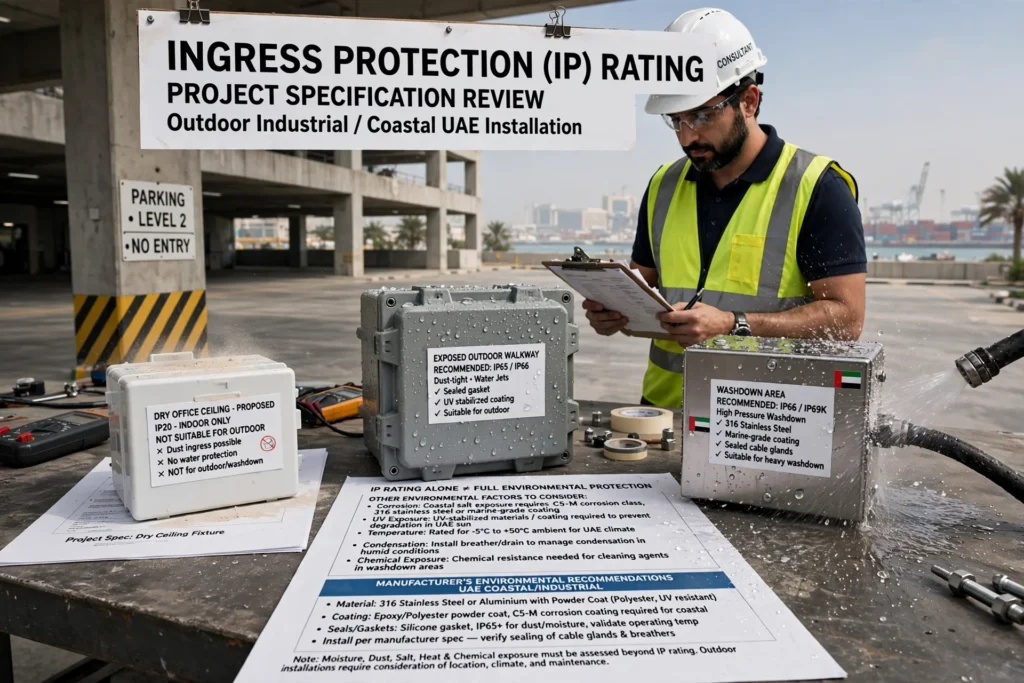
The Ingress Protection (IP) rating describes the level of protection provided by an enclosure against solid objects and water under specified test conditions. It is an important consideration when selecting lighting for outdoor areas, parking facilities, industrial environments and locations exposed to moisture or dust.
The consultant should compare the proposed IP rating with the project specification and installation conditions. A fixture intended for a dry office ceiling may not be appropriate for an exposed outdoor walkway or a washdown area.
An IP rating alone does not establish resistance to every environmental condition. Depending on the application, additional factors may include corrosion resistance, UV exposure, ambient temperature, condensation and chemical exposure.
For coastal developments, industrial facilities or outdoor installations in the UAE, the project team should review the manufacturer’s environmental recommendations and any specified material or coating requirements.
7. Colour Temperature and Colour Rendering Index
Colour temperature and colour rendering influence the visual appearance of a space. Correlated Colour Temperature (CCT), measured in kelvin, describes whether light appears warmer or cooler. The Colour Rendering Index (CRI) indicates how accurately colours are rendered compared with a reference source under defined conditions.
The proposed values should match the lighting design and project specifications. A warm-white fixture may be suitable for hospitality areas, while a neutral or cooler appearance may be specified for offices, service areas or industrial applications. The correct choice depends on the design intent and functional requirements.
Consultants should check whether the proposed CCT and CRI are documented for the exact fixture model. If colour consistency between luminaires is important, the specification may also require information about colour variation, such as MacAdam step or SDCM performance.
Mixing luminaires with noticeably different colour characteristics can create an inconsistent appearance across offices, hotel corridors, retail spaces and public areas. Submittal review provides an opportunity to identify such differences before installation.
8. Warranty and Product Lifetime Information
Warranty documentation helps project teams understand the manufacturer’s stated coverage, duration, conditions and exclusions. It should identify the product or product family covered and explain the process for reporting faults or requesting replacement components.
The consultant should distinguish between the warranty period and the rated lifetime of the LED system. A stated LED lifetime does not necessarily mean that the entire luminaire, including its driver and other components, is guaranteed to operate without failure for the same period.
Where specified, lifetime information may include an L-value such as L70 or L80, which describes the remaining luminous flux under stated test or projection conditions. Any lifetime claim should be supported by appropriate manufacturer documentation.
For large commercial developments and facilities with high operating hours, accessible driver replacement, spare-parts availability and maintenance arrangements may also affect the suitability of the proposed product.
9. Installation Instructions and Mounting Details
Installation documents help confirm that the luminaire can be installed safely and correctly within the intended ceiling, wall, canopy or structural arrangement.
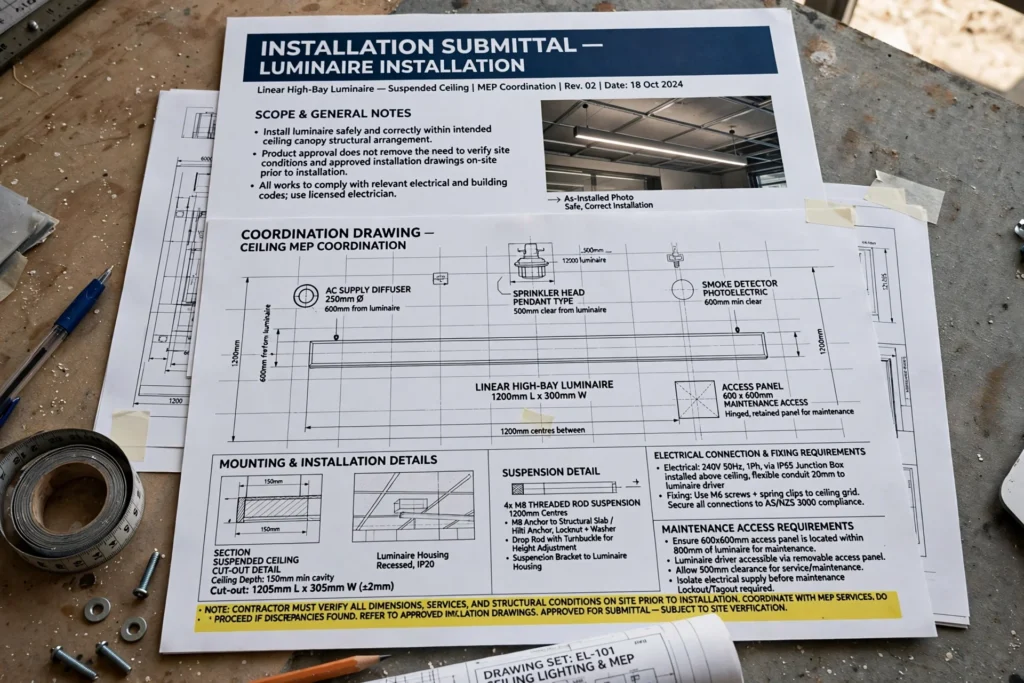
The submittal should include relevant mounting dimensions, cut-out sizes, suspension details, fixing requirements, electrical connection information and maintenance access requirements. Where necessary, coordination drawings should show the relationship between the luminaire and adjacent services.
This is particularly important in suspended ceilings where lighting fixtures must coordinate with air-conditioning diffusers, sprinkler heads, smoke detectors, access panels and other MEP components.
For recessed fixtures, the consultant should verify the required ceiling depth and cut-out dimensions. For suspended linear lights or high-bay luminaires, suspension points, mounting accessories and maintenance access must be considered.
Product approval does not remove the need to verify site conditions and follow the approved installation drawings.
How MEP Consultants Should Review an LED Lighting Submittal
A structured review process helps consultants identify technical gaps and communicate decisions clearly to the contractor and supplier.
Step 1: Compare the Submission With the Project Specification
Start by identifying the specified fixture type, performance criteria, manufacturer requirements, approved-equivalent provisions and applicable standards. Review the contract documents, luminaire schedule, lighting design and relevant electrical drawings.
Record each requirement and compare it with the submitted product. Avoid approving a luminaire based only on a similar appearance or a supplier’s general statement that it is equivalent.
Step 2: Check Technical Compliance
Review the datasheet, driver specifications, photometric information, dimensions, colour characteristics, environmental ratings and required certificates. Identify any missing evidence or differences from the specification.
A compliance statement should indicate whether each requirement is met, not met or awaiting clarification. This makes it easier for the consultant to identify deviations that could affect safety, performance, maintenance or project cost.
Step 3: Review Lighting Calculations
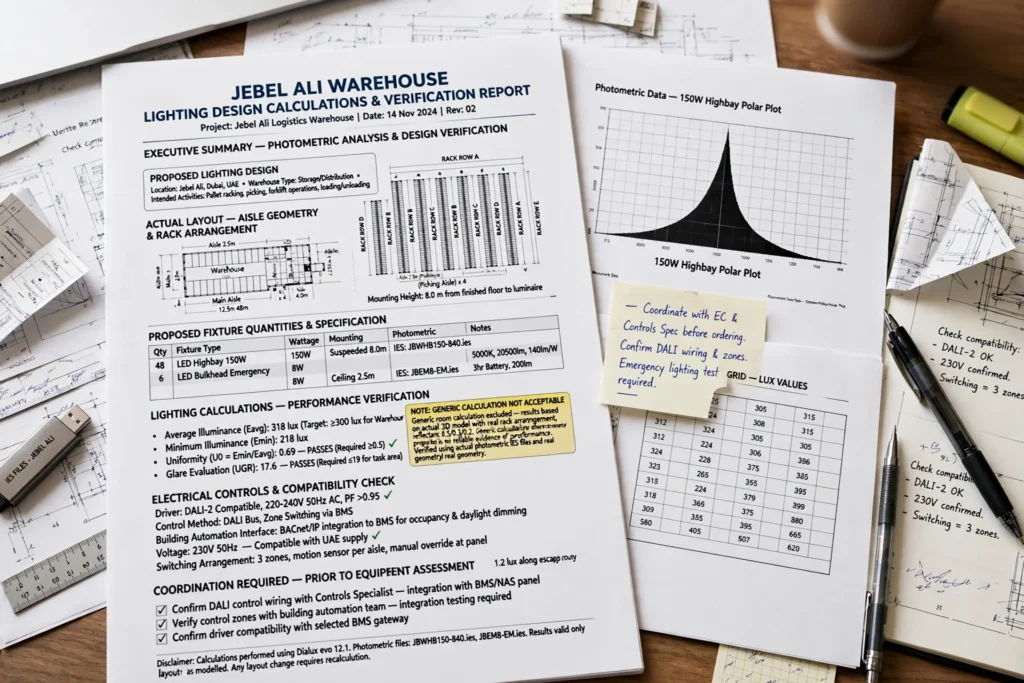
Where the project requires lighting calculations, check that the correct photometric files and proposed fixture quantities have been used. Verify the relevant illuminance, uniformity and glare criteria for each space.
For a warehouse in Jebel Ali, for example, the lighting design should reflect the actual aisle geometry, rack arrangement, mounting height and intended activities. A generic calculation that does not represent the proposed layout may not provide reliable evidence of performance.
Step 4: Check Electrical and Controls Compatibility
Confirm the proposed luminaire and driver are compatible with the project’s voltage, control method, switching arrangement and any specified building automation interfaces. Review emergency lighting requirements separately where applicable.
Coordination with the electrical contractor and controls specialist can help identify integration issues before equipment is ordered.
Step 5: Review Deviations and Proposed Alternatives
If the supplier proposes an alternative luminaire, the submission should clearly identify every material difference from the specified product. Relevant differences may include dimensions, light output, efficacy, glare performance, driver type, control compatibility, finish, warranty and certification.
The consultant should evaluate the proposed alternative against the project’s approval procedure and contractual requirements. An alternative should not be treated as approved merely because it has a higher lumen output or lower purchase price.
Step 6: Record the Review Outcome
The review outcome should be documented according to the project’s established procedure. Depending on the workflow, the result may be approval, approval subject to comments, revision and resubmission, or rejection.
Comments should identify the specific issue, the required corrective action and any supporting documents needed. Clear records help the procurement and site teams understand whether they can proceed and what conditions remain outstanding.
Common Reasons LED Lighting Submittals Are Rejected
Incomplete documentation is one of the most avoidable causes of submittal delays. If the datasheet does not identify the exact model or the required certificates are missing, the consultant may be unable to verify compliance.
Another common issue is a mismatch between the submitted product and the lighting design. Different optics, beam angles, lumen packages or fixture dimensions can affect the lighting calculations and installation arrangement.
Driver incompatibility is another potential problem. A fixture may meet the required light output but fail to support the specified dimming protocol or control system.
Submittals may also require revision when warranty conditions are unclear, the proposed IP rating is unsuitable, photometric files do not match the product, or a proposed alternative has not been adequately justified.
To reduce these risks, suppliers should assemble a complete technical package before submission and contractors should check it against the project’s requirements.
LED Lighting Submittal Requirements for Dubai and UAE Projects
For projects in Dubai, Abu Dhabi, Sharjah and other UAE emirates, the review process should account for the project specifications, the relevant authority requirements and the contract’s approval procedures. Requirements may vary by project type, building use and approving authority.
Developers and contractors should confirm any applicable requirements with the project consultant and relevant authority, including requirements associated with electrical safety, energy efficiency, emergency lighting and product conformity. A general compliance statement should not replace verification of the specific requirements that apply to the project.
Local environmental conditions can also influence product selection. Outdoor and coastal installations may require careful review of IP ratings, corrosion resistance, UV exposure and ambient operating temperatures. High operating hours in warehouses, retail facilities and commercial buildings may make maintenance access, driver replacement and warranty support important procurement considerations.
For projects in areas such as Business Bay, Dubai Marina, Jebel Ali, Dubai South and Abu Dhabi’s commercial districts, the key principle is the same: the submitted product must be evaluated against the actual design, installation conditions and documented project requirements.
How a Complete Submittal Improves Procurement and Project Delivery
A complete lighting submittal gives procurement teams a clearer basis for ordering the correct products. It reduces uncertainty about model numbers, quantities, driver configurations, accessories and installation requirements.
It also improves coordination between the lighting supplier, MEP contractor, consultant and main contractor. When technical deviations are identified early, the project team can evaluate alternatives before the delivery schedule or installation programme is affected.
Clear documentation supports quality assurance during material inspections and site installation. The approved model can be checked against delivered products, while commissioning teams can refer to the submitted control and performance information during testing and handover.
For larger developments, consistent documentation across fixture schedules and building areas also makes maintenance planning and future replacement easier. Keeping approved datasheets, warranty details and product references in the handover records can help facility managers identify compatible replacement components later.

Choosing LED Lighting Submittal Approval Solutions
A well-managed submittal process combines technical product verification, lighting design review, electrical coordination and clear documentation. MEP consultants should assess each proposed luminaire against the project’s requirements rather than relying solely on catalogue descriptions or price comparisons.
For developers, consultants, contractors and lighting suppliers working in the UAE, LED Lighting Submittal Approval Solutions can be used as the internal link anchor for the relevant Tricircle Group service page. A dedicated service page should explain the scope of assistance offered, the types of documents reviewed and how project teams can request support.
Before proceeding with bulk procurement, ensure that the submitted products, supporting certificates, photometric data, drivers, installation details and warranty documentation have been reviewed through the project’s formal approval process. This approach supports better specification compliance, fewer avoidable revisions and more reliable lighting project delivery.

Frequently Asked Questions
What documents are required for LED lighting submittal approval?
A typical package includes the manufacturer’s datasheet, luminaire schedule, photometric report or IES/LDT files, LED driver specifications, relevant compliance certificates, warranty information and installation details. Additional documents may be required by the project specifications or approving authority.
Who reviews LED lighting submittals in construction projects?
The review normally involves the appointed MEP consultant and the contractor’s established approval workflow. The lighting supplier prepares the product documentation, while the main contractor and other project stakeholders may coordinate the submission according to the contract requirements.
Why are photometric files important for lighting approval?
Photometric files provide information about a luminaire’s light distribution. They allow lighting designers and consultants to use the correct product data in lighting calculations and assess whether the proposed arrangement can meet specified illuminance, uniformity and glare requirements.
Can an alternative LED light be submitted for approval?
Yes, where the project contract and approval procedure permit alternatives. The supplier should identify deviations from the specified product and provide sufficient technical evidence for the consultant to assess performance, dimensions, controls, compliance, warranty and other relevant requirements.
Does an approved lighting submittal mean installation is automatically approved?
No. Product submittal approval generally addresses the proposed product and its documented compliance. Installation drawings, site inspections, mock-ups, testing and commissioning may require separate approvals or verification under the project procedures.
How can contractors reduce LED lighting submittal delays?
Contractors can reduce delays by using the correct fixture references, submitting complete datasheets and certificates, checking driver and control compatibility, providing matching photometric files and clearly identifying any deviations before sending the package for review.