Cold storage facilities depend on reliable lighting to support safe movement, accurate stock identification, efficient picking operations and routine inspections. However, lighting a refrigerated warehouse is different from illuminating a conventional commercial building. Chilled rooms, freezer warehouses and blast-freezing facilities expose electrical equipment to low temperatures, moisture, condensation, cleaning procedures and repeated temperature changes.
Choosing the right LED fixtures for cold storage requires more than comparing wattage or brightness. The complete luminaire—including its LED driver, seals, housing, lens, electrical connections and emergency components—must be suitable for the lowest operating temperature and the conditions in which it will be installed. The lighting design must also account for ceiling height, rack layout, required illuminance, food hygiene and maintenance access.
This guide explains how to select cold storage LED lighting, compare fixture types, understand IP ratings and colour temperature, plan light levels, reduce energy consumption and avoid common specification mistakes.
What Is Cold Storage Lighting?
Cold storage lighting refers to lighting systems designed for refrigerated and frozen environments where conventional indoor fixtures may not operate reliably. These systems are installed in cold rooms, freezer warehouses, refrigerated distribution centres, food processing plants, pharmaceutical storage facilities and temperature-controlled logistics buildings.
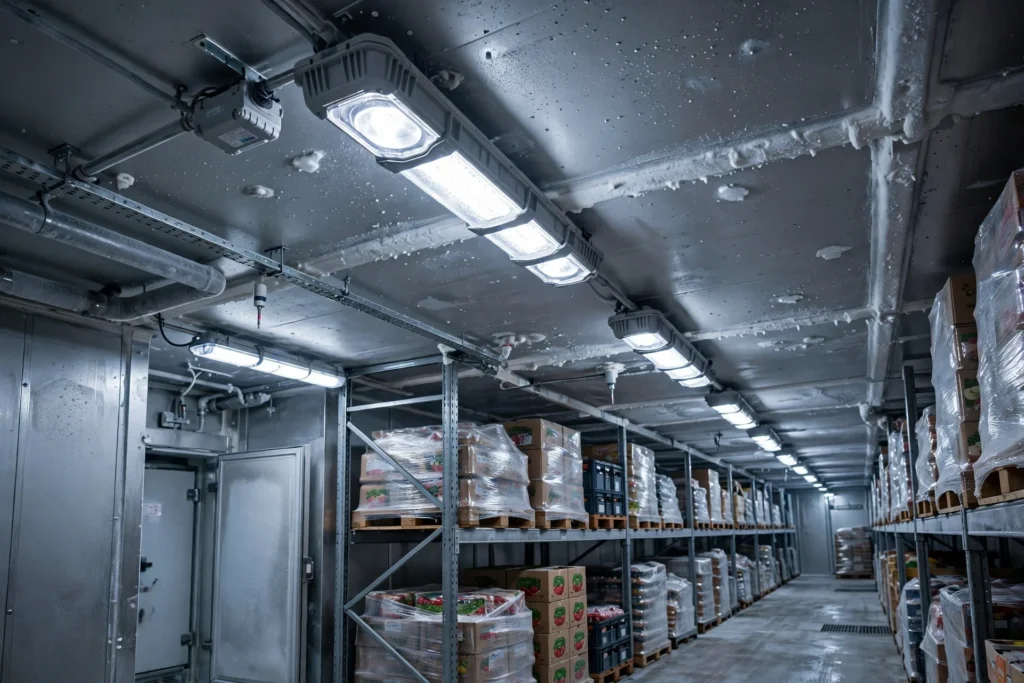
A cold storage lighting system must provide sufficient illumination while withstanding the environment surrounding the fixture. Depending on the application, this can involve sub-zero temperatures, high humidity, condensation, frost, washdown water, cleaning chemicals and accidental impacts from warehouse equipment.
LED technology is widely used in these environments because LEDs can perform well at low ambient temperatures, provide instant illumination and consume less electricity than many older lighting technologies. However, not every LED fixture is suitable for a freezer. A standard commercial LED panel may have a driver, gasket or lens that cannot tolerate the required temperature range.
The correct choice is therefore a purpose-designed, low-temperature LED luminaire with verified technical specifications for the intended application.
Why Lighting Requirements Differ in Cold Storage Facilities
Low Ambient Temperature and Cold Starting
The operating temperature of a cold room can range from a few degrees above freezing to approximately -40°C in specialised deep-freeze applications. A fixture that works in a normal warehouse may fail to start, flicker or experience reduced reliability when installed in an environment outside its specified temperature range.
The LED chips themselves often tolerate cold conditions well, but the electronic driver and other components require particular attention. Capacitors, seals, wiring insulation and connection materials must be suitable for the actual temperature exposure.
When selecting a fixture, check both its operating temperature and its minimum starting temperature. These specifications are not necessarily identical. A luminaire must be capable of starting when the room is at its coldest, not simply continuing to operate after it has already warmed up.
Condensation and Moisture
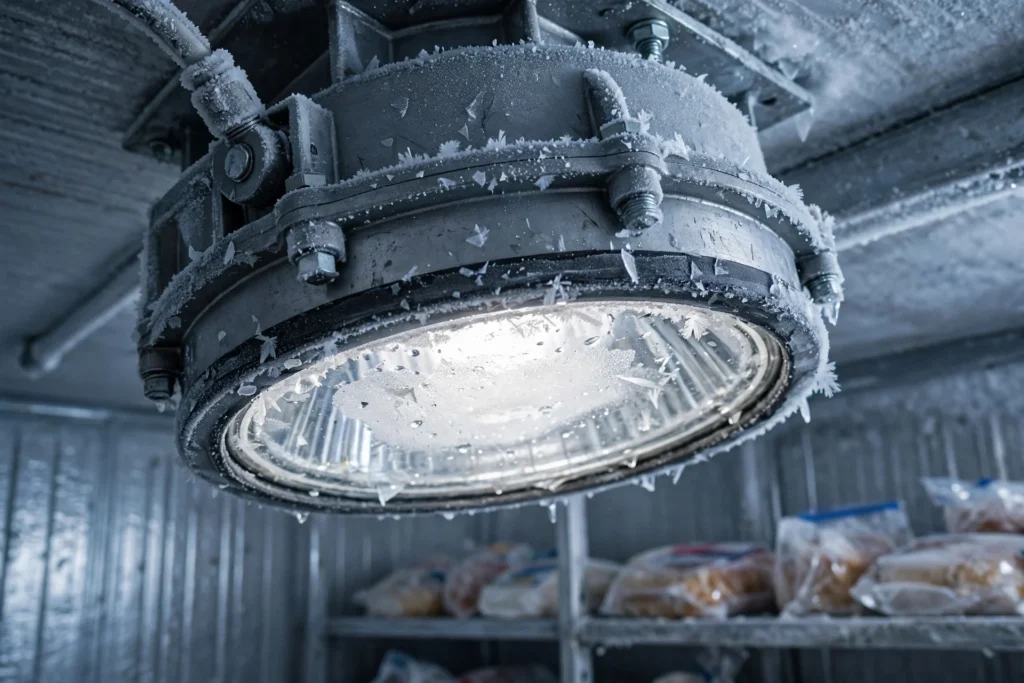
Condensation is a major consideration in refrigerated warehouses. When warm, humid air enters a cold room, moisture may form on chilled surfaces, including lighting housings, cable glands and electrical connections. The risk is especially important around loading doors, airlocks and transitions between ambient and refrigerated spaces.
Fixtures need appropriate sealing, compatible gaskets and correctly installed cable entries. The design should also consider pressure changes and temperature cycling that may affect moisture movement inside the enclosure.
An IP rating helps indicate protection against dust and water ingress, but it does not automatically prove resistance to condensation, frost or every cleaning chemical. The manufacturer’s installation instructions and environmental ratings remain essential.
Frost, Ice and Thermal Cycling
Freezer rooms may experience frost accumulation, while some food facilities undergo periodic defrost cycles. During these cycles, the temperature and moisture conditions around the luminaire can change significantly.
Repeated cooling and warming can stress seals, lenses, housing materials and electrical connections. A fixture intended for deep-freeze applications should use components tested for the expected temperature range and thermal cycling conditions.
The lens should remain secure and intact, and the housing should be designed for the mechanical and environmental demands of the site. Where ice formation is possible, the lighting designer should also consider whether the fixture location could create shadows or interfere with cleaning and maintenance.
Hygiene and Food Safety
Food storage and processing areas need lighting that supports inspection, cleaning and safe handling. In areas where exposed food is present, fixtures should be designed to minimise contamination risks if a lens or component is damaged.
Smooth surfaces, secure covers, cleanable housings and resistance to the facility’s cleaning agents are important considerations. The appropriate hygiene certification or declaration should be verified against the applicable food safety programme and intended installation.
Facilities using HACCP-based procedures should assess lighting as part of their cleaning, maintenance and contamination-control practices. A waterproof fixture is not automatically food-safe; hygiene suitability must be established separately.
Types of LED Fixtures for Cold Storage
Vapor-Tight LED Linear Fixtures
Vapor-tight LED linear fixtures are a common option for chilled rooms, freezer rooms and food-processing areas. Their enclosed construction helps protect internal components from dust and moisture, provided the selected model has the correct ingress protection rating and temperature specification.
Linear fixtures can distribute light evenly along aisles, packing areas and workstations. They are particularly useful where operators need to read product labels, check cartons or work with items on shelves and conveyor belts.
When comparing products, review the gasket material, lens construction, cable-entry design, cleaning compatibility and cold-start rating. A fixture marketed as vapor-tight should not be assumed suitable for every freezer temperature without checking its data sheet.
LED High-Bay Lights
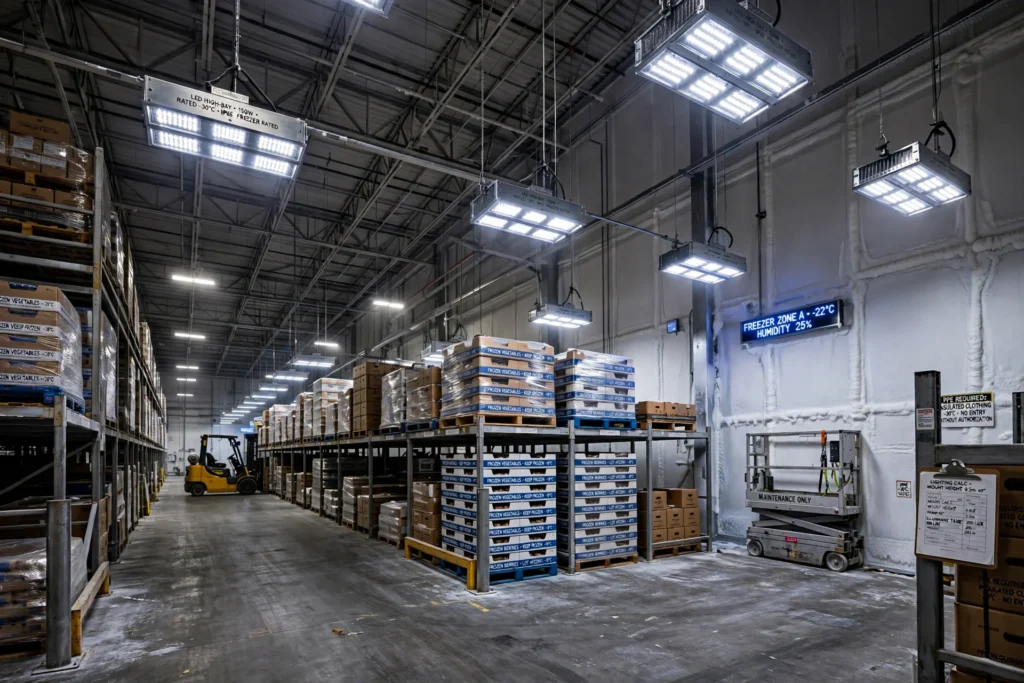
LED high-bay fixtures are useful in large cold storage warehouses with high ceilings and extensive pallet racking. They can deliver concentrated illumination over broad areas when selected and positioned using a lighting calculation.
High-bay lighting must account for mounting height, beam angle, rack configuration and aisle width. A powerful fixture does not necessarily provide good visibility at floor level if its beam distribution is unsuitable or the shelves create deep shadows.
For freezer warehouses, confirm that the complete high-bay luminaire is rated for the room’s minimum temperature. Also consider whether the installation height protects the fixture from forklifts, pallet movement and maintenance equipment.
Low-Temperature LED Battens
LED batten fixtures can suit smaller cold rooms, refrigerated preparation areas and back-of-house storage. Their slim shape makes them practical where ceiling space is limited or where a straightforward linear lighting arrangement is required.
The key consideration is not the fixture’s shape but its suitability for the environment. A standard indoor batten should not be installed in a freezer simply because it has an LED light source.
Choose a model with a documented temperature range, suitable sealing and the correct photometric output for the area. In food environments, verify that the cover and housing are easy to clean and appropriate for the site’s hygiene requirements.
LED Fixtures for Food Processing and Washdown Areas
Food preparation, meat processing, seafood handling and packaging facilities may expose luminaires to frequent cleaning and water jets. These locations can require higher protection against water ingress and materials that tolerate approved cleaning chemicals.
IP65 or IP66 may be appropriate in many installations, depending on the actual water exposure. High-pressure, high-temperature washdown can require a different level of protection and specific manufacturer approval. An IP69K rating, where applicable, addresses particular high-pressure cleaning conditions; it should not be treated as a universal requirement for every cold room.
The fixture must also satisfy hygiene and impact requirements relevant to the food production process. Always match the product specification to the cleaning method rather than choosing a rating based only on the word “waterproof.”
Emergency LED Lighting
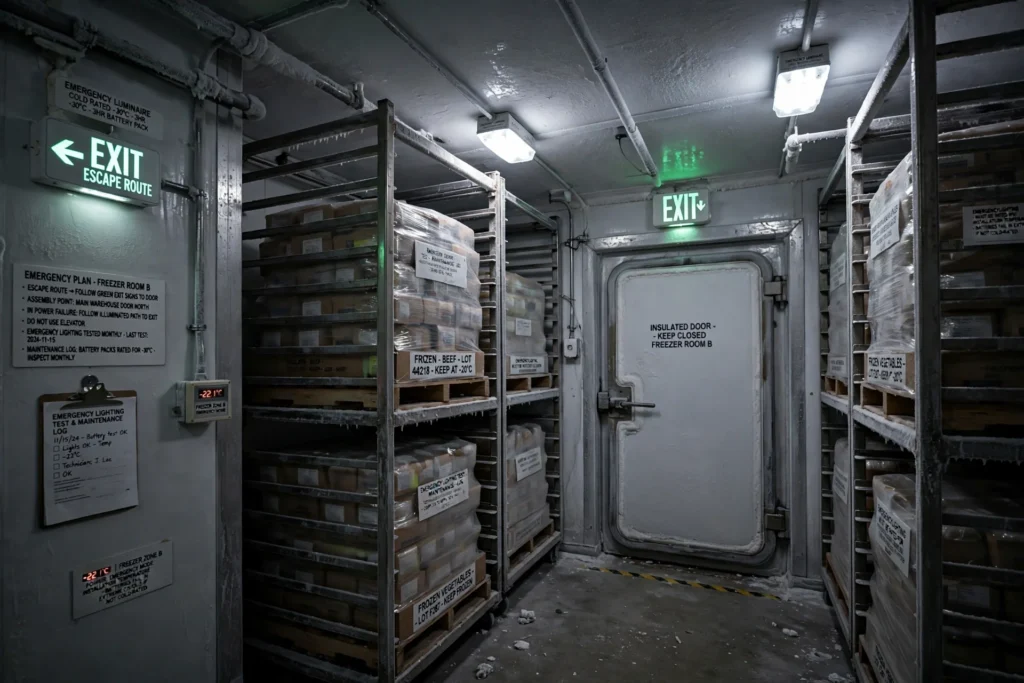
Emergency lighting is important wherever a loss of normal power could leave workers unable to exit safely. Cold storage facilities may have enclosed rooms, tall racking, insulated doors and limited visibility, making emergency planning particularly important.
Emergency luminaires and battery packs must be rated for the actual temperature at their installation location. Some battery systems cannot deliver their normal performance when exposed to extreme cold, even if the main LED fixture operates correctly.
The design should identify escape routes, exit signs, door locations and areas where workers may be present during a power failure. Emergency lighting must comply with the applicable local fire and life-safety requirements, and its testing and maintenance procedures should be documented.
Key Specifications to Check Before Buying Cold Storage LED Fixtures
1. Operating and Starting Temperature
The first specification to verify is the fixture’s rated ambient temperature range. For a chilled room, a product rated for temperatures around 0°C may be sufficient, depending on the actual room conditions. A freezer operating at -20°C or a blast freezer reaching -40°C needs equipment explicitly rated for those conditions.
Confirm that the rating applies to the entire luminaire and its driver, not only the LED module. Ask the supplier for technical documentation showing minimum operating and starting temperatures, especially when the facility undergoes defrost cycles or rapid temperature changes.
Do not assume all LED fixtures perform identically in the cold. The driver’s design, component selection and enclosure construction can significantly influence reliability.
2. IP Rating for Dust and Water Protection
The Ingress Protection rating, defined under IEC 60529, describes the degree of protection provided by an enclosure against solid particles and water. The first digit relates to solid-object and dust protection, while the second relates to water protection.
IP65 fixtures are dust-tight and protected against water jets under the specified test conditions. IP66 provides protection against more powerful water jets. Higher ratings may be relevant for specific washdown or immersion risks, but the correct choice depends on the installation.
For many cold rooms, an IP65 or IP66 luminaire is a practical starting point for evaluation. However, the final specification should reflect humidity, cleaning methods, condensation exposure, cable entries and manufacturer instructions. An IP rating alone does not guarantee suitability for low temperatures or food hygiene.
3. Light Output and Illuminance
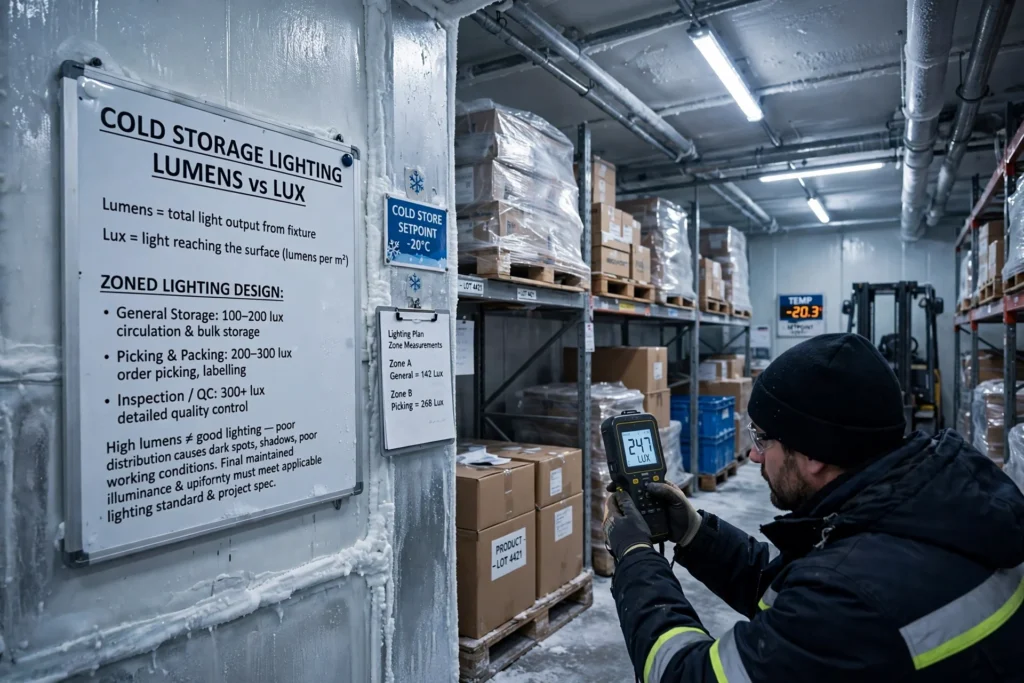
Light output is commonly measured in lumens, while illuminance describes the amount of light reaching a surface and is measured in lux. These are related but different measurements. A fixture with a high lumen rating can still produce poor working conditions if the light is distributed badly.
Cold storage lighting should be designed around the activities taking place in each zone. General circulation requires different illumination from order picking, product inspection, labelling, packing or detailed quality control.
A useful preliminary design may consider approximately 100–200 lux for some general storage areas and higher levels, such as 200–300 lux, for picking and inspection tasks. These figures are planning examples, not universal legal requirements. Final maintained illuminance and uniformity should be checked against the applicable lighting standard, workplace requirements and project specification.
4. Colour Temperature
Correlated colour temperature (CCT), measured in kelvin, describes the appearance of white light. A 4000K neutral-white source often provides a balanced appearance for general warehouse work. A 5000K source produces a cooler white appearance and may be selected where clear visual contrast is helpful.
The best colour temperature depends on the activity, product appearance, worker comfort and surrounding lighting. Using a consistent colour temperature throughout connected work zones can help create a visually coherent environment.
Do not select colour temperature in isolation. Light distribution, glare, colour rendering, illuminance and visual comfort are also important. The design should support the task rather than simply choosing the whitest available light.
5. Colour Rendering Index
The Colour Rendering Index (CRI or Ra) indicates how accurately a light source renders colours compared with a reference source under defined conditions. CRI 80 or above is often a useful target for picking, inspection and packaging environments where product colours, labels and markings must be distinguished.
Some general storage applications may not require the same colour-rendering performance as food inspection or quality-control stations. The project designer should identify where accurate colour recognition is important and specify suitable fixtures accordingly.
CRI is only one measure of colour performance. Where colour discrimination is critical, consult the project requirements and consider whether additional colour-rendering data is needed.
6. Energy Efficiency and Lumen Maintenance
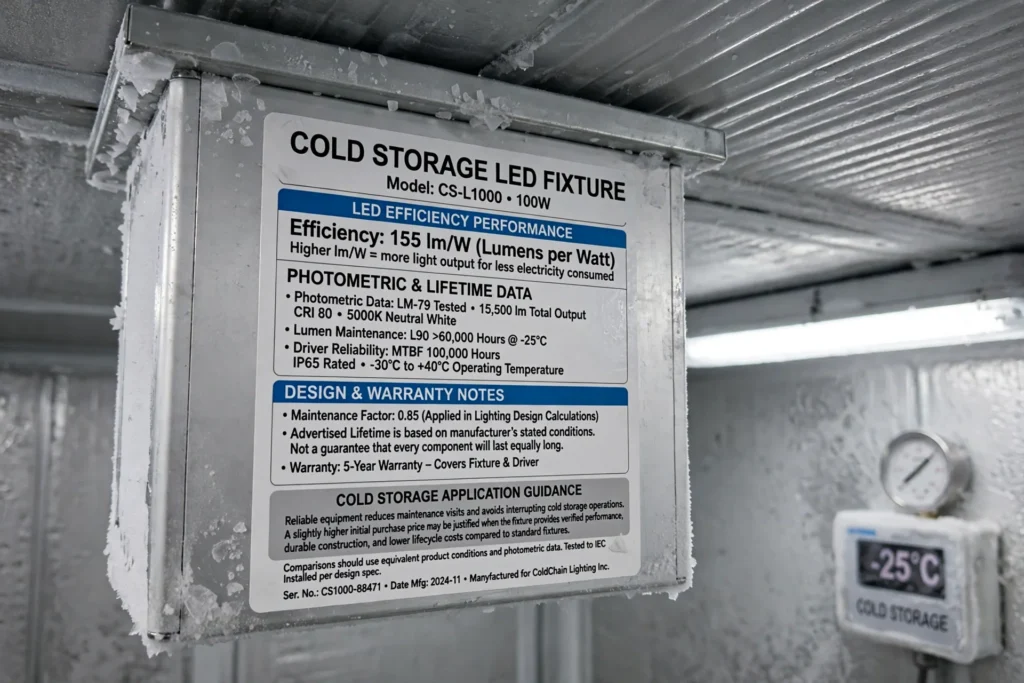
LED efficiency is commonly expressed in lumens per watt (lm/W). A higher value can indicate that a fixture produces more light for the electricity it consumes, but comparisons should use equivalent product conditions and photometric data.
Also review lumen maintenance, rated lifetime, driver reliability, warranty terms and the maintenance factor used in the lighting design. The advertised lifetime should be understood in the context of the manufacturer’s stated conditions rather than treated as a guarantee that every component will last equally long.
In cold storage, reliable equipment can reduce maintenance visits and avoid the need to interrupt storage operations. A slightly higher initial purchase price may be justified if the fixture provides verified performance, durable construction and lower lifecycle costs.
7. Impact Resistance and Housing Materials
Cold rooms and warehouse aisles may expose lights to vibration, accidental impacts and handling equipment. The IK rating, defined under IEC 62262, classifies the degree of protection an enclosure provides against mechanical impact.
Where forklifts, tall pallet loads or maintenance equipment create a risk, the designer should consider a suitable impact rating and mounting position. The lens and housing materials must remain appropriate for the expected temperature and cleaning conditions.
Polycarbonate lenses, glass covers and metal housings each have different performance characteristics. The correct material depends on impact resistance, hygiene, thermal cycling, chemical compatibility and the manufacturer’s tested design.
How to Plan Light Levels and Fixture Layout
Assess Each Temperature Zone Separately
A refrigerated distribution centre may include ambient storage, chilled storage, freezer rooms, picking areas, loading docks, packing stations and transition corridors. These zones have different environmental conditions and visual tasks, so they should not automatically share one fixture specification.
Start by documenting the minimum and maximum temperature, humidity, cleaning procedures, ceiling height, operating hours and required work activities for every zone. Note where exposed food is handled, where forklifts operate and where condensation is likely.
This assessment helps the lighting designer select appropriate fixture families and avoid installing equipment that is suitable for one area but unsuitable for another.
Consider Racking, Aisles and Obstructions
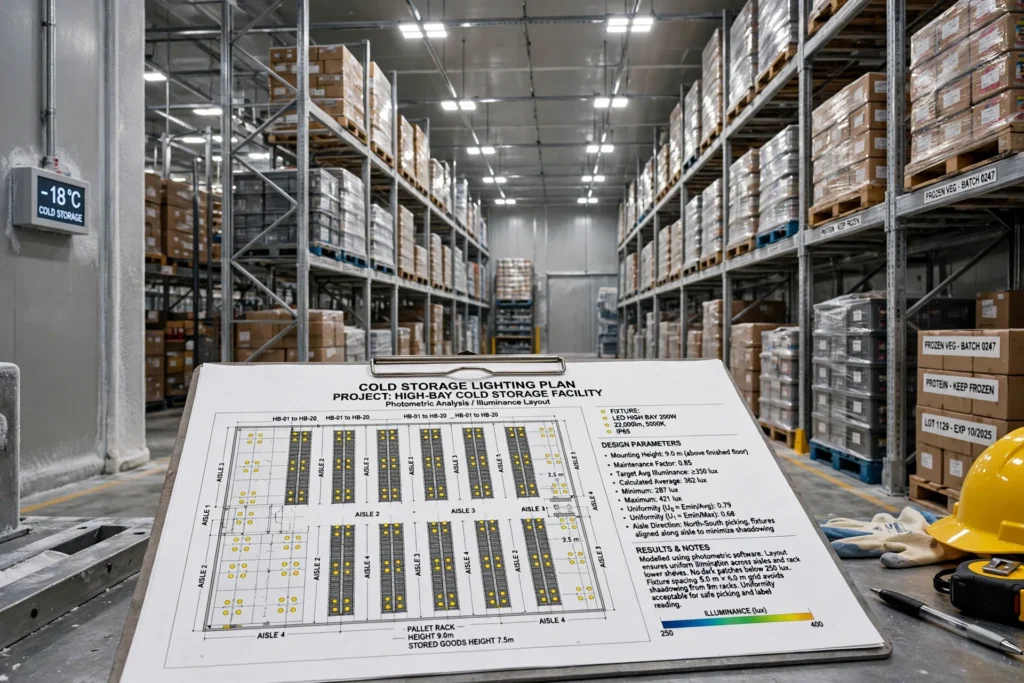
High-bay cold storage facilities often use tall pallet racks that can block light from reaching lower shelves and aisle floors. Lighting calculations should account for the position of racks, the height of stored goods, aisle widths and the direction in which workers pick products.
A layout that produces sufficient average illuminance may still leave dark patches or strong contrasts. Uniformity is important because workers need to move between aisles, read labels and identify products without repeatedly adapting to major changes in brightness.
Photometric software can model the light distribution before installation. Ask for a layout showing fixture positions, mounting heights, maintained lux levels and uniformity values, rather than relying only on a list of fixture wattages.
Check Glare and Visual Comfort
Glare can make it difficult to read labels or operate equipment safely, particularly when bright fixtures are visible at the end of a long aisle. The beam angle, lens design, mounting position and viewing direction all affect visual comfort.
Fixtures should be positioned to reduce direct glare and minimise reflections from glossy packaging, reflective surfaces and equipment. Where workers spend long periods at a picking station, the design should consider their normal viewing direction and task height.
A lighting calculation should evaluate both the quantity and quality of illumination. The goal is useful, comfortable light—not simply the maximum possible lumen output.
Account for the Maintenance Factor
LED output can decline over time, and dirt on the lens can reduce the light reaching the working surface. The lighting design should include a maintenance factor based on the product’s performance data, environmental conditions and planned cleaning schedule.
Cold storage can make maintenance more difficult because access may require special procedures, temporary shutdowns or movement of stored goods. Selecting durable fixtures and planning realistic maintenance intervals can help maintain adequate illumination throughout the installation’s service life.
The commissioning process should verify actual light levels against the design. Periodic checks can identify degraded output, damaged lenses, failed drivers or areas where changes to the racking layout have created shadows.
Energy Savings and Refrigeration Efficiency
Lighting consumes electricity directly, and the heat released by lighting equipment can also contribute to the refrigeration load. LED fixtures generally use less electricity than many older lighting technologies and produce less unwanted heat than less efficient alternatives for comparable lighting tasks.
The exact savings depend on the existing system, the proposed fixture efficacy, operating hours, control strategy, maintenance and electricity tariff. A proper comparison should use the same maintained illuminance and working conditions rather than comparing wattages alone.
For example, a facility replacing older fluorescent or high-intensity discharge fixtures can estimate annual lighting energy by multiplying the installed load in kilowatts by the annual operating hours. The proposed LED system can be assessed using the same method. Any additional reduction in refrigeration energy should be estimated separately using site-specific engineering assumptions rather than presented as a guaranteed saving.
Lighting Controls for Cold Storage Warehouses
Occupancy Sensors
Occupancy sensors can reduce energy use in aisles and storage zones that are not continuously occupied. When a worker enters an area, the system activates or increases the lighting; after the area becomes vacant, the controls reduce or switch off lighting according to the operating strategy.
Sensor selection and placement require care. Tall racks can obstruct detection, and very cold environments may affect the suitability of some sensor models. Verify the sensor’s operating temperature and detection performance under actual site conditions.
Controls must also avoid switching lights off while workers remain in the area. Time delays, detection coverage, minimum illumination and safe movement requirements should be considered during commissioning.
Dimming and Building Management Systems
Dimmable LED fixtures can be integrated with suitable controls, such as compatible 0–10V or DALI systems, where the driver and control equipment support the selected method. Integration with a building management system may allow operators to schedule lighting, monitor operating conditions or coordinate lighting zones.
Not every cold room needs an advanced control system. For a small walk-in freezer, reliable switching may be sufficient. For a large distribution centre with long operating hours and multiple storage zones, controls may provide better energy management.
The control design should remain simple enough for staff to operate and maintain. Confirm compatibility among drivers, sensors, emergency lighting and the building’s control system before procurement.
Installation and Maintenance Best Practices
Use Suitable Cable Entries and Connections
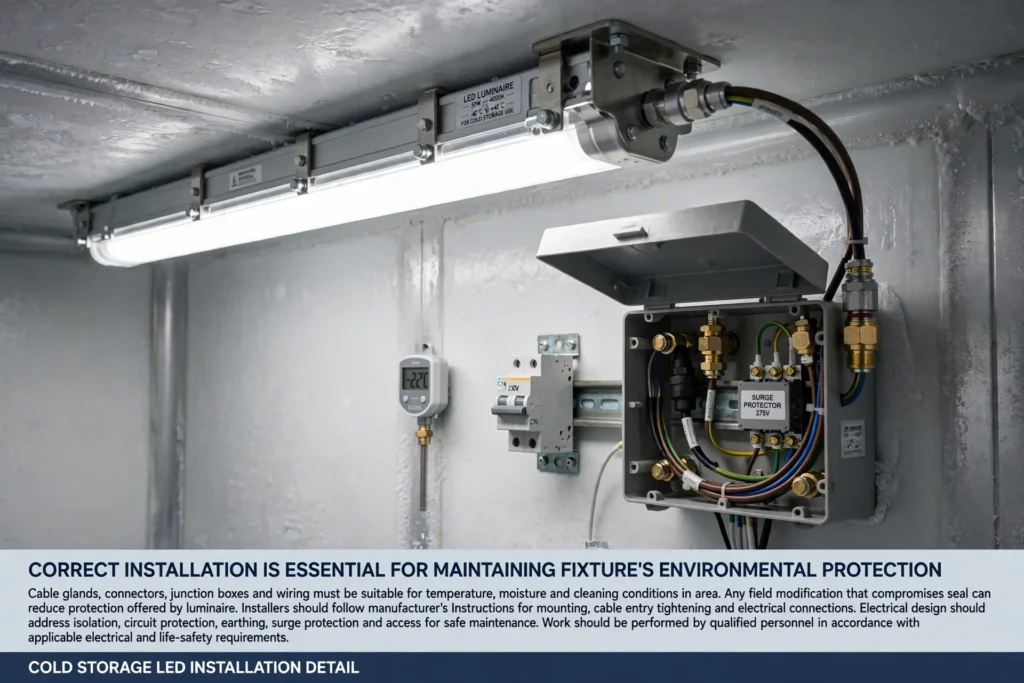
Correct installation is essential for maintaining the fixture’s environmental protection. Cable glands, connectors, junction boxes and wiring must be suitable for the temperature, moisture and cleaning conditions in the area.
Any field modification that compromises a seal can reduce the protection offered by the luminaire. Installers should follow the manufacturer’s instructions for mounting, cable entry, tightening and electrical connections.
The electrical design should also address isolation, circuit protection, earthing, surge protection and access for safe maintenance. Work should be performed by qualified personnel in accordance with the applicable electrical and life-safety requirements.
Reduce Unnecessary Maintenance Entry
Opening a freezer room for repairs can affect temperature control and operational efficiency. Selecting reliable fixtures, accessible mounting arrangements and appropriate warranties can help reduce maintenance frequency.
Where practical, plan fixture positions so technicians can inspect or replace equipment without disrupting racking, stored products or critical operations. Remote drivers may be appropriate in some specialist designs, but only when the manufacturer supports the configuration and the installation remains compliant.
Keep records of fixture models, circuit locations, warranty terms, commissioning readings and maintenance activities. Accurate records make it easier to diagnose faults and plan future replacements.
Inspect Lenses, Seals and Light Output
Routine inspections should check for cracked covers, damaged seals, loose fittings, corrosion, water ingress and visible deterioration. In food facilities, cleaning procedures should be consistent with the fixture’s material and manufacturer guidance.
Avoid using cleaning chemicals or pressure-washing methods that have not been approved for the luminaire. A product’s IP rating should not be interpreted as permission to use every cleaning method.
Where lighting levels are important for safety or quality control, periodic measurements can confirm that maintained illuminance remains adequate. Replace damaged components promptly and investigate repeated driver failures rather than treating each failure as an isolated event.
Common Mistakes When Choosing Cold Storage Lighting
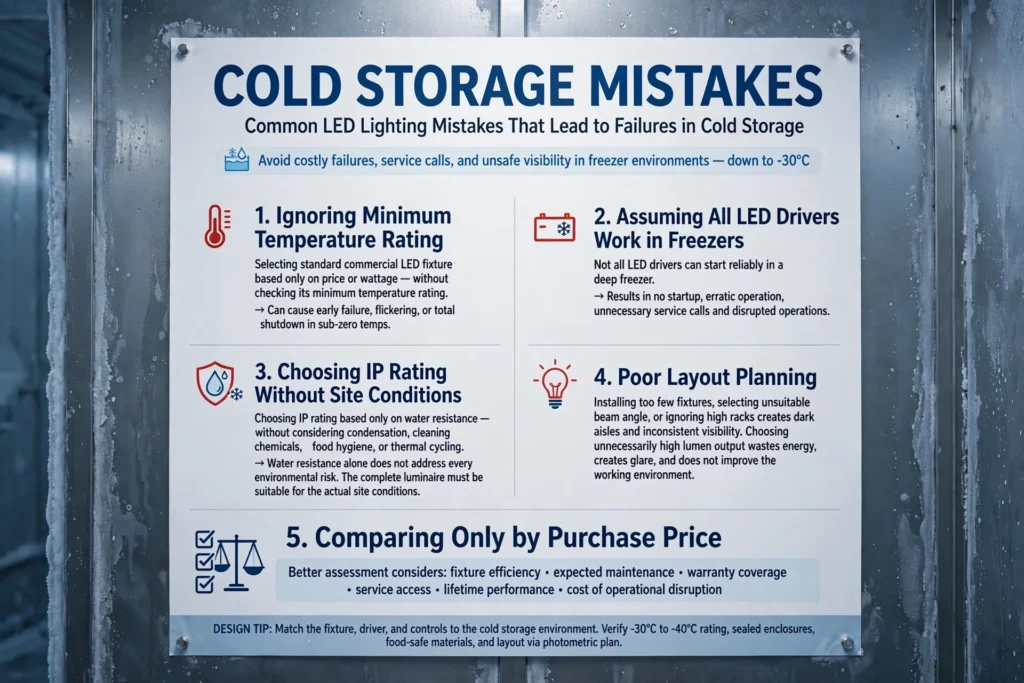
One frequent mistake is selecting a standard commercial LED fixture based on price or wattage without checking its minimum temperature rating. A second is assuming that all LED drivers can start reliably in a deep freezer. Both can result in early failures, unnecessary service calls and disrupted operations.
Another mistake is choosing an IP rating without considering condensation, cleaning chemicals, food hygiene or thermal cycling. Water resistance is important, but it does not address every environmental risk. The complete luminaire must be suitable for the actual site conditions.
Poor layout planning is also common. Installing too few fixtures, selecting an unsuitable beam angle or ignoring high racks can produce dark aisles and inconsistent visibility. Similarly, choosing an unnecessarily high lumen output may waste energy and create glare without improving the working environment.
Finally, buyers sometimes compare products only by purchase price. A better assessment considers fixture efficiency, expected maintenance, warranty coverage, service access, lifetime performance and the cost of operational disruption.
Cold Storage LED Lighting in the UAE
The UAE’s food distribution, hospitality, pharmaceutical, retail and logistics sectors rely on temperature-controlled storage to protect products and maintain supply chains. Facilities in Dubai, Sharjah, Abu Dhabi, Ajman and the wider Emirates may contain chilled food rooms, frozen warehouses, supermarket back-of-house areas, central kitchens and refrigerated distribution centres.
Although the internal storage temperature is controlled, the surrounding environment can be hot and humid, particularly around loading docks and building entrances. This creates a significant difference between the ambient environment and the cold room, increasing the importance of transition-zone design, sealing and condensation management.
Projects should assess the local site’s temperature profile, operating schedule, cleaning method, fire and life-safety requirements, and electrical design requirements. Lighting specifications should be coordinated with refrigeration contractors, warehouse designers, electrical consultants and food safety teams.
For projects involving new construction or refurbishment, procurement teams should obtain the fixture data sheets and photometric calculations before approval. A suitable lighting supplier can help compare low-temperature LED linear lights, high-bay fixtures, emergency luminaires, control systems and replacement options against the project requirements.
Businesses evaluating products and technical specifications can consult a Complete Led lighting Supplier to compare fixture performance, temperature ratings, ingress protection, photometric data and installation suitability. The final selection should always be based on documented product specifications and the actual environmental conditions of the facility.
How to Compare Cold Storage LED Lighting Suppliers
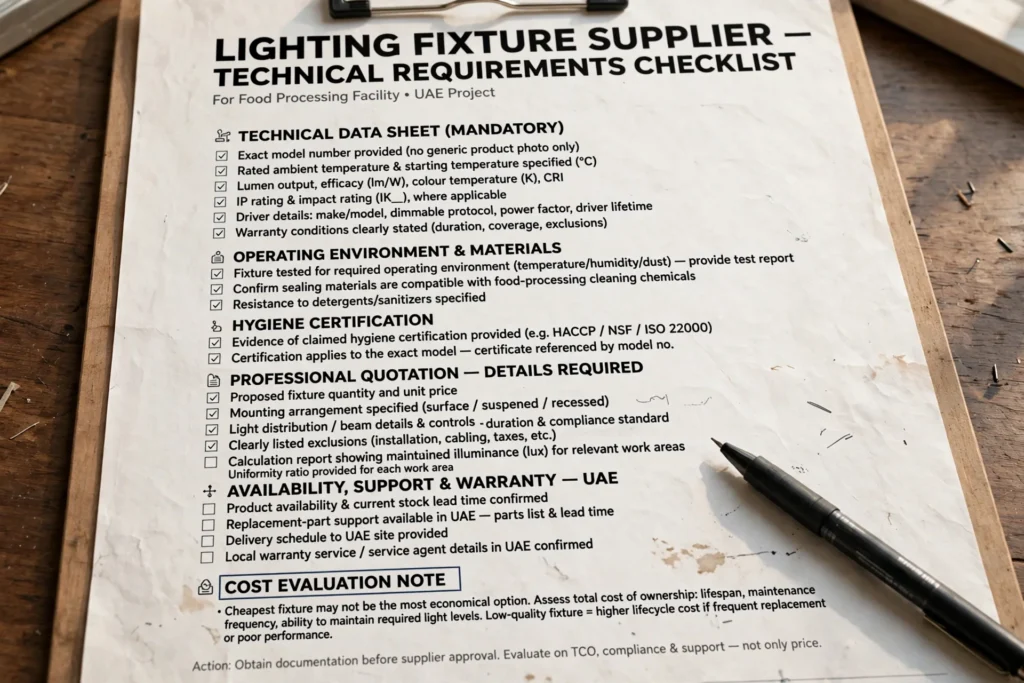
A supplier should be able to provide more than a product photograph and a wattage figure. Request a technical data sheet that identifies the exact model, rated ambient temperature, starting temperature, lumen output, efficacy, colour temperature, CRI, IP rating, impact rating where applicable, driver details and warranty conditions.
Ask whether the proposed fixture has been tested for the required operating environment and whether its sealing materials are suitable for the expected cleaning chemicals. For food processing, request evidence of any claimed hygiene certification and confirm that it applies to the exact model.
A professional quotation should identify the proposed fixture quantity, mounting arrangement, light distribution, controls, emergency lighting provisions and any exclusions. A lighting calculation should show the expected maintained illuminance and uniformity for the relevant work areas.
Also confirm product availability, replacement-part support, delivery schedule and warranty service in the UAE. The cheapest fixture may not be the most economical option if it requires frequent replacement or cannot maintain the required light levels.
Practical Checklist Before Ordering
Before purchasing LED fixtures for a cold storage project, confirm the lowest operating temperature and the minimum temperature at which each fixture can start. Check the complete luminaire rating, including its driver, seals, lens, battery components and electrical connections where applicable.
Determine the required maintained illuminance for storage aisles, picking areas, packing stations, loading bays and emergency escape routes. Review the photometric layout for mounting height, rack shadows, uniformity and glare. Verify the IP rating against moisture and cleaning conditions, and assess impact resistance wherever equipment or stored goods may strike a fixture.
For food-related operations, confirm cleanability, material compatibility and the relevant hygiene requirements. For controlled lighting, verify driver, sensor and building management system compatibility. Finally, obtain the technical documents, warranty information and maintenance recommendations before approving the order.
Conclusion
Choosing LED fixtures for cold storage requires a coordinated approach to temperature ratings, moisture protection, light levels, fixture layout, hygiene and maintenance. The best solution is not simply the brightest or lowest-priced luminaire; it is the system that reliably supports the facility’s tasks under its actual operating conditions.
Cold-rated LED linear fixtures, vapor-tight luminaires and suitable high-bay lights can provide efficient illumination when correctly specified. IP ratings, cold-start capability, colour rendering, impact resistance and emergency lighting performance should all be checked against the project requirements. Lighting calculations and commissioning measurements help confirm that workers can move safely, identify products accurately and perform tasks without excessive glare or dark areas.
For cold stores, freezer warehouses and temperature-controlled facilities across the UAE, investing time in specification and supplier evaluation can help reduce avoidable failures, maintenance disruption and energy consumption while supporting safe, reliable operations.
Frequently Asked Questions
What type of LED light is best for a cold storage room?
Cold-rated, sealed LED linear fixtures are often suitable for chilled rooms and many freezer applications. High-bay LED fixtures may be better for large warehouses with high ceilings. The correct product depends on temperature, moisture, cleaning requirements, mounting height and the work being performed.
Can standard LED lights be used in a freezer?
Only if the manufacturer explicitly rates the complete fixture for the freezer’s operating and starting temperatures. A standard indoor LED light may have a driver, gasket or housing that is unsuitable for sub-zero conditions.
What IP rating is recommended for cold storage LED lights?
IP65 is a common starting point for evaluation in many cold storage environments, while IP66 or another suitable rating may be needed for stronger water exposure or washdown. The final choice depends on the cleaning method, condensation risk, installation details and manufacturer specifications.
What colour temperature is suitable for cold storage lighting?
A colour temperature of around 4000K is often used for general warehouse tasks, while 5000K may be appropriate for some picking and inspection areas. The choice should consider worker comfort, product inspection and the overall lighting design.
How many lux are needed in a cold storage warehouse?
The required illuminance varies by task. Some general storage areas may use approximately 100–200 lux as an initial planning range, while picking, packing and inspection areas may need around 200–300 lux or more. The final design must follow applicable standards and project-specific requirements.
Do LED lights reduce refrigeration costs?
LED fixtures generally use less electricity than many older lighting technologies and release less unwanted heat for comparable lighting tasks. This can reduce the lighting load and may reduce some refrigeration demand, but actual savings depend on the existing system, operating hours, fixture efficiency and refrigeration performance.
What should be checked before buying freezer LED lights?
Verify the minimum operating and starting temperature, IP rating, driver specification, lumen output, colour temperature, CRI, housing materials, impact resistance, cleaning compatibility, warranty and photometric design. For food facilities, also confirm the relevant hygiene requirements and any certification claims.