Data centres operate around the clock, supporting cloud computing, enterprise applications, telecommunications, financial services and digital platforms. Their infrastructure includes server racks, network cabinets, power distribution units, uninterruptible power supply (UPS) systems, cooling equipment, cable pathways and monitoring facilities. While power and cooling usually receive the most attention during data centre planning, lighting also plays an important role in safe access, equipment maintenance, operational efficiency and emergency response.
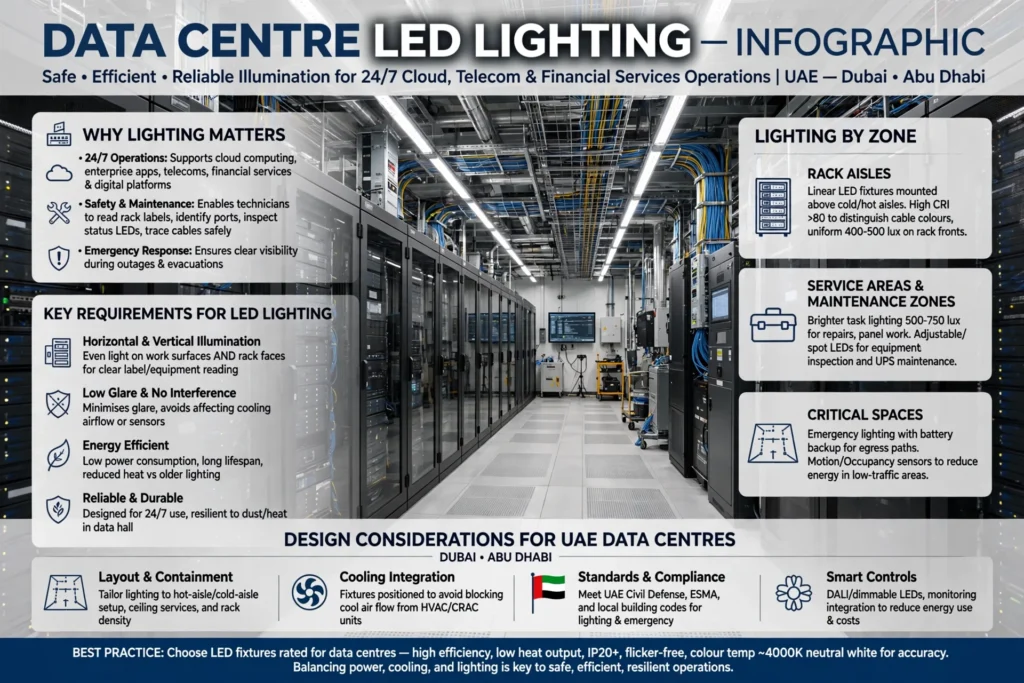
LED lighting for data centres must do more than illuminate the floor. Technicians need to read rack labels, identify network ports, inspect status indicators, trace cables and work safely around electrical and mechanical equipment. A well-designed lighting system provides appropriate illumination on both horizontal work surfaces and vertical rack faces while minimising glare, unnecessary energy use and interference with cooling infrastructure.
The right solution depends on the layout of the data hall, rack density, hot-aisle and cold-aisle containment, ceiling services, maintenance activities and local building requirements. This guide explains how to choose LED fixtures for rack aisles, service areas, maintenance zones and other critical spaces in modern data centres, including facilities in Dubai, Abu Dhabi and across the UAE.
Why LED Lighting Is Important in Data Centres
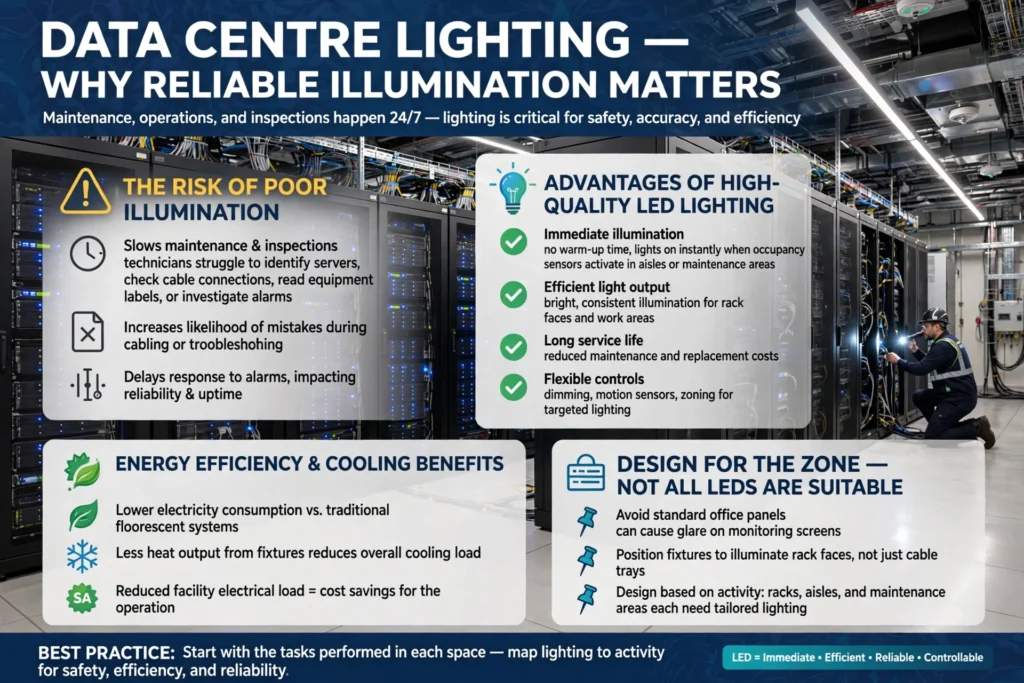
Data centres require reliable lighting because maintenance and operational work can take place at any time. Even a short inspection may require a technician to identify a server, check a cable connection, read an equipment label or investigate an alarm. Poor illumination can slow these activities and increase the likelihood of mistakes.
LED technology offers several advantages for these environments. High-quality LED luminaires can provide immediate illumination, efficient light output, long service life and flexible control options. Unlike traditional fluorescent systems, LEDs do not require a warm-up period to reach normal brightness. This is useful when occupancy sensors activate lighting in a rack aisle or maintenance area.
Energy efficiency is another consideration. Lighting contributes to the facility’s electrical load, and the heat released by lighting equipment ultimately becomes part of the room’s cooling demand. Replacing inefficient fixtures with properly designed LED systems can reduce lighting electricity consumption and may also reduce some associated cooling load.
However, not every LED fixture is suitable for every data centre zone. A standard office panel may create glare on monitoring screens, while a fixture positioned directly above a cable tray may waste light that should reach the rack faces. Successful design begins with the activities performed in each space.
Understanding Lighting Requirements in Data Centre Environments
Rack Aisles and Server Cabinets
Rack aisles are among the most important areas to consider when planning data centre lighting. Technicians frequently work at the front and rear of server racks, where they need to read asset labels, identify ports, inspect indicator lights and replace components.
The design should provide enough horizontal illuminance for safe movement and sufficient vertical illuminance for work on cabinet faces. A floor that appears bright may still leave rack labels difficult to read if most of the light falls directly downward.
ASHRAE’s data centre guidance recommends locating luminaires over aisles rather than directly above equipment cabinets or cable trays, where a greater proportion of the light may be obstructed. It also discusses light distribution that supports visibility along cabinet faces. The exact layout should be confirmed using the installed rack plan and a photometric calculation.
Cold Aisles and Hot Aisles
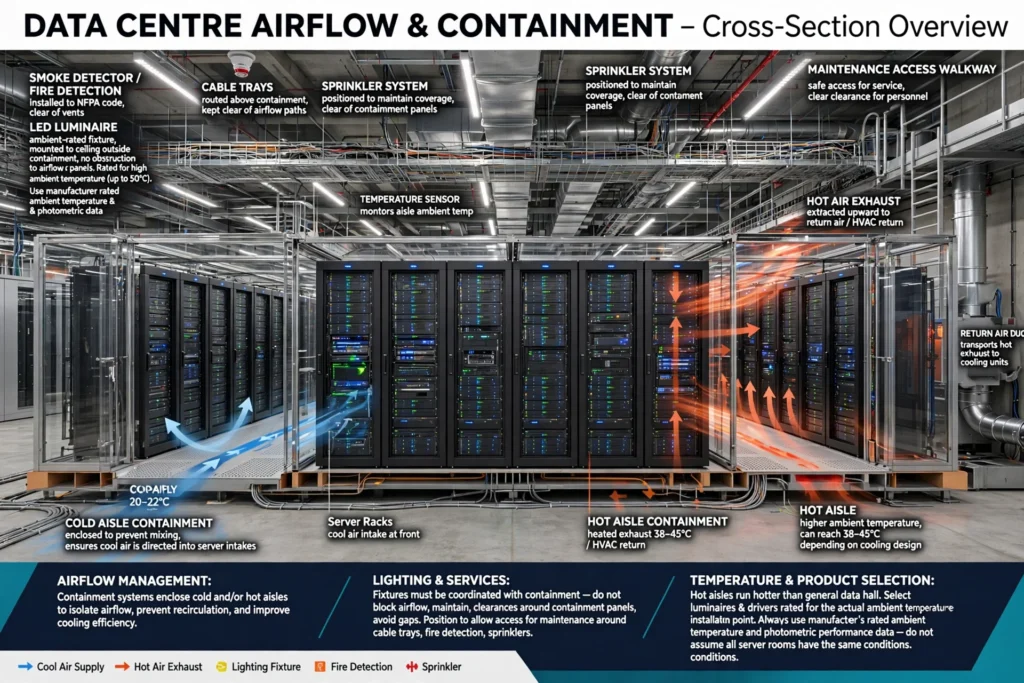
Many data centres arrange server racks to create cold aisles, where cool air enters equipment, and hot aisles, where heated exhaust air is discharged. Containment systems may enclose one or both types of aisle to improve airflow management.
Lighting must be coordinated with these containment arrangements. Fixtures should not obstruct airflow, interfere with containment panels or create unnecessary gaps in the system. Their location must also account for cable trays, fire detection devices, sprinkler systems and maintenance access.
Hot aisles can have higher ambient temperatures than the general data hall, depending on the cooling design and containment arrangement. The luminaire and driver must therefore be suitable for the actual ambient temperature at the installation point. Product selection should use the manufacturer’s rated ambient temperature and photometric performance data rather than assuming all server rooms have the same conditions.
Service and Maintenance Areas
Data centres include spaces for staging equipment, preparing cables, unpacking replacement components, storing tools and performing repairs. These areas may require more detailed task lighting than general circulation routes.
Technicians may need to inspect small connectors, read serial numbers, compare cable colours or work with precision tools. A well-positioned LED luminaire over a workbench can provide better visibility than relying entirely on general ceiling lighting.
Maintenance areas should be assessed according to the tasks carried out there. The design may require higher illuminance, good colour rendering, controlled glare and convenient switching. If a workbench is moved or a new maintenance activity is introduced, the lighting arrangement should be reviewed to ensure the working surface remains adequately illuminated.
Choosing the Right LED Fixtures for Data Centres
LED Linear Lights for Rack Aisles
LED linear luminaires are a practical choice for many data hall aisles because they can provide continuous, evenly distributed illumination along rows of cabinets. Their narrow form can also simplify integration with ceiling grids and selected containment arrangements.
The most suitable optical distribution depends on the aisle width, fixture mounting height and cabinet arrangement. A fixture with an appropriate distribution pattern can direct light towards rack faces rather than wasting excessive output on cabinet tops or overhead infrastructure.
Before specifying linear fixtures, check lumen output, efficacy, glare performance, colour rendering, driver quality and rated ambient temperature. The proposed layout should also consider future changes to rack positions and the addition of overhead cable trays.
LED Battens for Technical Rooms
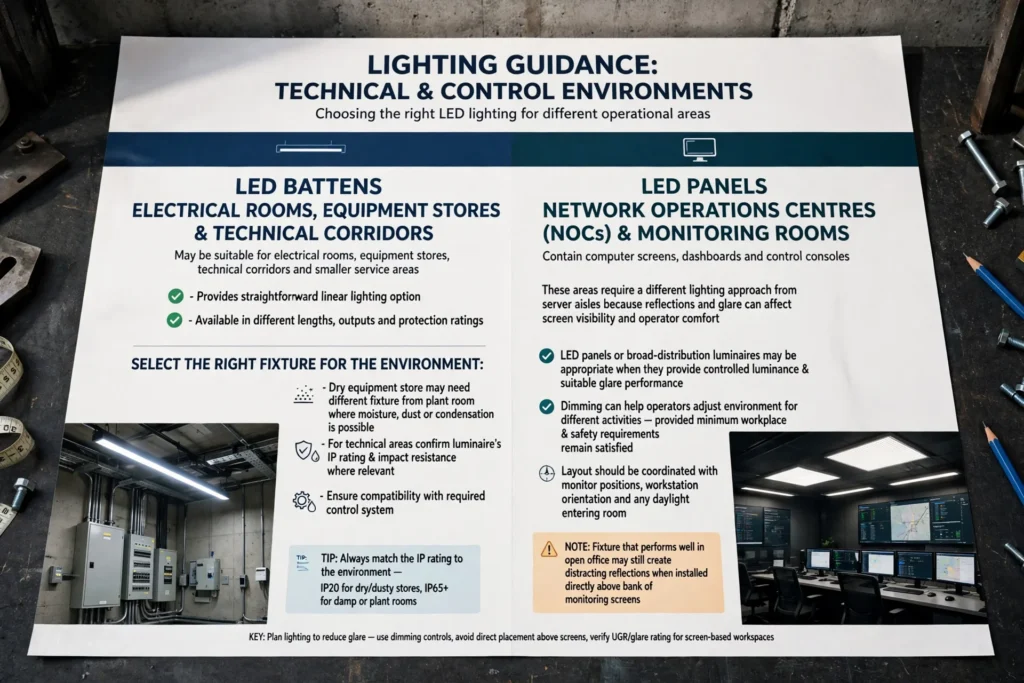
LED battens may be suitable for electrical rooms, equipment stores, technical corridors and smaller service areas. They provide a straightforward linear lighting option and can be available in different lengths, outputs and protection ratings.
The choice should reflect the environment. A dry equipment store may need a different fixture from a plant room where moisture, dust or condensation is possible. For technical areas, confirm the luminaire’s IP rating, impact resistance where relevant and compatibility with the required control system.
LED Panels for Network Operations Centres
Network operations centres (NOCs) and monitoring rooms contain computer screens, dashboards and control consoles. These areas require a different lighting approach from server aisles because reflections and glare can affect screen visibility and operator comfort.
LED panels or other broad-distribution luminaires may be appropriate when they provide controlled luminance and suitable glare performance. Dimming can help operators adjust the environment for different activities, provided minimum workplace and safety requirements remain satisfied.
The layout should be coordinated with monitor positions, workstation orientation and any daylight entering the room. A fixture that performs well in an open office may still create distracting reflections when installed directly above a bank of monitoring screens.
Emergency LED Luminaires
Emergency lighting supports safe evacuation when normal lighting or power is lost. Data centres may contain long corridors, enclosed rack aisles, electrical rooms and restricted-access spaces, so emergency lighting needs to be planned for the actual escape routes and occupancy conditions.
The system may use self-contained emergency luminaires, central battery arrangements or another approved design. Selection depends on the project’s life-safety strategy, applicable local regulations and the required duration of emergency operation.
Emergency fixtures should be positioned so that exit signs, changes in direction, doors and potential hazards remain visible. Commissioning and routine testing are essential to confirm that the system works as intended. Emergency lighting should not be treated as an optional extension of normal aisle illumination.
Recommended Illuminance for Different Data Centre Zones
Illuminance is measured in lux and describes how much light reaches a surface. Data centre lighting design should consider both horizontal illuminance on work surfaces and vertical illuminance on rack faces.
The following figures are preliminary planning references, not universal legal requirements. Actual maintained illuminance, uniformity and glare limits must be confirmed against the applicable lighting standards, project specification, local authority requirements and the activities performed in each zone.
| Data centre area | Example planning range | Main lighting objective |
|---|---|---|
| General data hall circulation | 200–300 lux | Safe movement and general visibility |
| Rack aisles | 300–500 lux | Equipment access and maintenance |
| Rack faces | Assess vertical illuminance separately | Read labels, ports and indicators |
| Maintenance benches | 300–500 lux or task-specific levels | Cable preparation and detailed work |
| Electrical and UPS rooms | Around 200–300 lux, subject to task | Safe access to panels and equipment |
| Network operations centre | 300–500 lux, with glare control | Screen-based monitoring and operator comfort |
| Technical corridors | Around 100–200 lux, subject to requirements | Movement, access and safe egress |
| Stores and equipment staging | 200–300 lux, subject to tasks | Identify parts, labels and equipment |
These ranges should not be applied without a lighting calculation. A data hall with high racks and dense overhead services may need a different layout from a small server room. The designer should document the measurement plane, maintained illuminance, uniformity, glare considerations and maintenance factor.
A useful starting point is to assess the requirements of each zone individually rather than applying one lux value throughout the building. This avoids underlighting work areas and overlighting spaces where lower levels are sufficient.
Vertical Illuminance: A Critical Factor for Rack Aisles
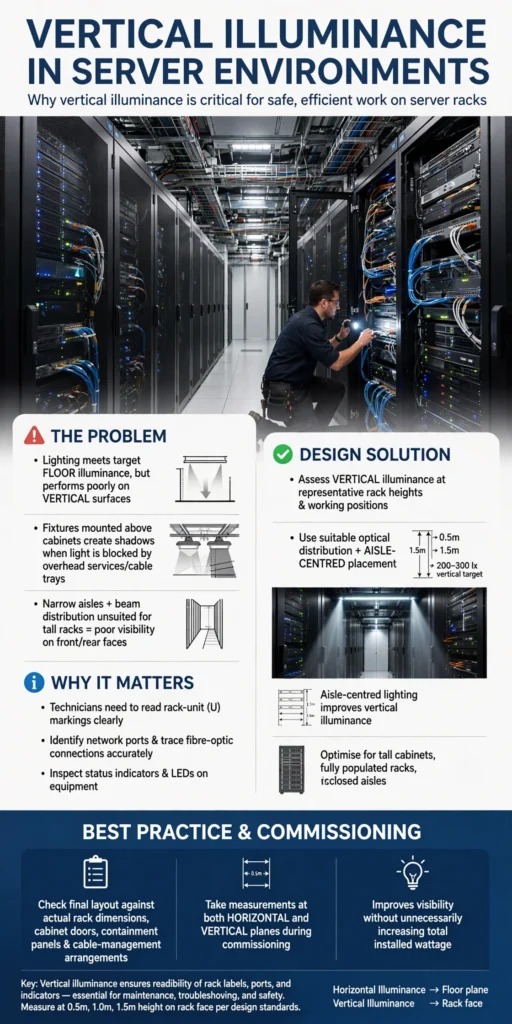
Vertical illuminance is especially important in server environments because much of the work takes place on the front and rear faces of cabinets. Technicians need to read rack-unit markings, identify network ports, trace fibre-optic connections and inspect status indicators.
A lighting scheme can meet its target floor illuminance yet perform poorly on vertical surfaces. This often happens when fixtures are placed above cabinets, light is blocked by overhead services, or the beam distribution does not suit narrow aisles.
The lighting designer should assess vertical illuminance at representative rack heights and working positions. This is particularly important for tall cabinets, fully populated racks and enclosed aisles. A suitable optical distribution and aisle-centred placement can improve visibility without unnecessarily increasing total installed wattage.
The final layout should be checked against actual rack dimensions, cabinet doors, containment panels and cable-management arrangements. Where possible, commissioning should include measurements at both horizontal and vertical planes.
Colour Temperature, Colour Rendering and Glare Control
Choosing Colour Temperature
Correlated colour temperature (CCT), measured in kelvin, describes whether light appears warm, neutral or cool. Neutral-white sources around 4000K are commonly considered for technical work areas, while cooler-white sources around 5000K may be selected for some equipment environments.
The best choice depends on the design objective, staff preferences, visual tasks and consistency across adjoining spaces. Using one coordinated colour temperature across similar zones can create a consistent appearance and simplify future fixture replacements.
Colour temperature should not be confused with brightness. A higher kelvin value does not automatically mean a fixture produces more light or provides better visibility. The design must also consider illuminance, distribution and colour rendering.
Colour Rendering Index
The Colour Rendering Index (CRI or Ra) describes how accurately a light source renders colours compared with a reference source under defined conditions. A CRI of 80 or above is a common specification for general technical and commercial spaces.
Good colour rendering can help technicians distinguish coloured network cables, wire markings, warning labels and component indicators. Where accurate colour identification is particularly important, the project team should verify that the selected source meets the task’s requirements.
Reducing Glare
Glare can make it harder to see rack labels and can create reflections on monitoring screens. It may result from exposed bright LEDs, unsuitable mounting positions or excessive contrast between fixtures and surrounding surfaces.
Optical diffusers, suitable beam distribution, careful mounting and appropriate glare ratings can improve visual comfort. In network operations centres, glare control should be considered alongside monitor orientation, screen brightness and dimming.
The objective is balanced illumination rather than maximum brightness. A well-designed system supports accurate work while avoiding unnecessary visual discomfort.
Energy Efficiency and Lighting Controls
LED lighting can reduce the electricity required to achieve a specified lighting level, particularly when replacing older fluorescent or other less efficient systems. However, savings depend on the existing installation, the efficacy of the replacement luminaires, operating hours and the control strategy.
Lighting power should be calculated using the actual connected load and operating schedule. Annual energy consumption can be estimated by multiplying installed lighting load in kilowatts by annual operating hours. A proposed LED system can then be compared against the existing system under equivalent lighting conditions.
Occupancy and Presence Sensors
Presence sensors can reduce unnecessary lighting in aisles, stores and technical rooms that are not continuously occupied. When movement is detected, the system can increase illumination; after the area becomes vacant, it can reduce the lighting or switch it off according to the control sequence.
In a critical facility, controls must not compromise safe access. Sensor coverage should account for enclosed aisles, tall racks, obstructions and technicians who may remain stationary while working. Time delays and manual overrides should be chosen to prevent lights switching off unexpectedly during maintenance.
Dimming and Intelligent Controls
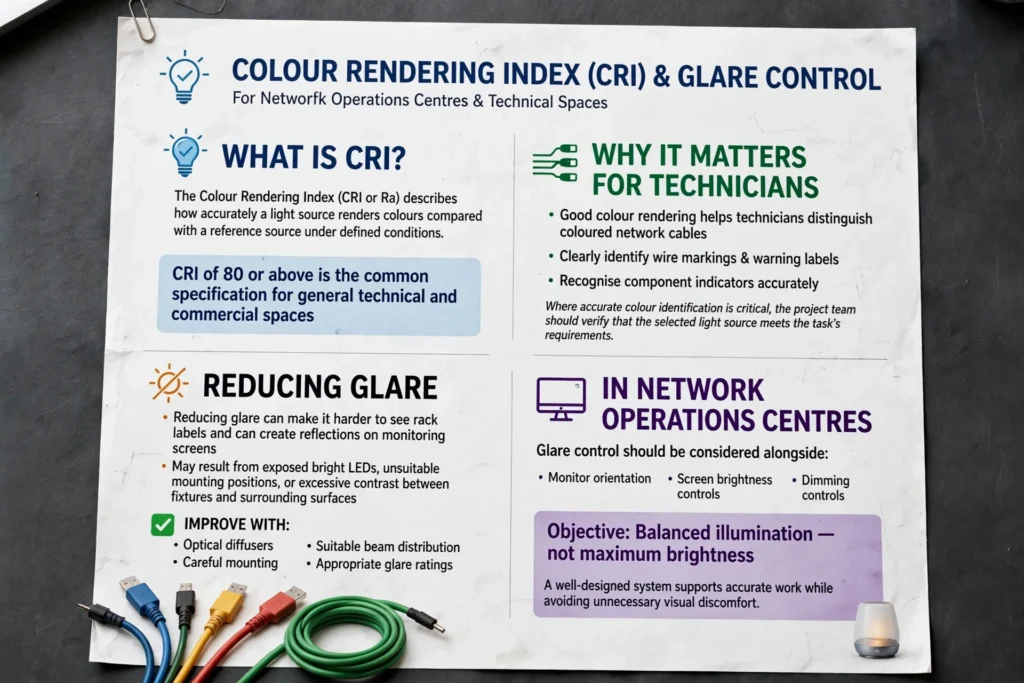
Dimmable LED drivers allow lighting levels to be adjusted when the system and luminaires are designed for that function. Controls may be integrated with a building management system (BMS), a lighting management platform or a compatible digital control protocol such as DALI.
Power over Ethernet (PoE) lighting can also be considered for selected projects, allowing compatible luminaires and control devices to use a network-based power and control architecture. However, PoE requires its own assessment of network infrastructure, power supplies, resilience, compatibility and emergency operation.
A control strategy should specify normal operation, maintenance mode, sensor behaviour, override functions and failure response. For a data centre, predictable lighting behaviour is more important than adding controls that create unnecessary complexity.
Coordinating Lighting with Cooling and Critical Infrastructure
Lighting installation must be coordinated with the data centre’s mechanical and electrical design. Fixtures compete for space with cable trays, busways, fire detection, sprinkler piping, containment panels and air distribution equipment.
Poor coordination can obstruct airflow, make maintenance difficult or cause light to be blocked by overhead services. The lighting layout should therefore be reviewed alongside the reflected ceiling plan, rack arrangement and mechanical design.
Data centres in the UAE also need careful consideration of the ambient conditions around plant rooms and building service spaces. Facilities in Dubai, Abu Dhabi and other Emirates may operate under high external temperatures, but the temperature at each luminaire depends on whether it is installed in an air-conditioned data hall, a hot aisle or a separate technical area. Fixture ratings should be based on the actual local conditions.
The design should also preserve access to electrical panels and cooling equipment. Lighting fixtures and their drivers must not interfere with maintenance clearances, equipment replacement routes or life-safety systems.
Maintenance and Reliability of Data Centre LED Lighting
Data centres are designed for continuous operation, so lighting maintenance should be planned to minimise disruption. Long-life LED luminaires can reduce replacement frequency, but service life depends on driver quality, operating temperature, component design and installation conditions.
A maintenance plan should include visual inspections, checks for damaged lenses or loose fittings, verification of emergency lighting and periodic assessment of light levels where required. Drivers and control components should be accessible for servicing without unnecessary disturbance to critical equipment.
The facility team should retain fixture schedules, technical data sheets, warranty details, circuit information and commissioning records. This documentation makes it easier to identify compatible replacement products and maintain consistent lighting performance as the data hall changes.
When adding racks or changing containment, review the lighting arrangement. A configuration that worked before a layout change may create shadows or insufficient vertical illuminance afterwards.
LED Lighting for Data Centres in the UAE
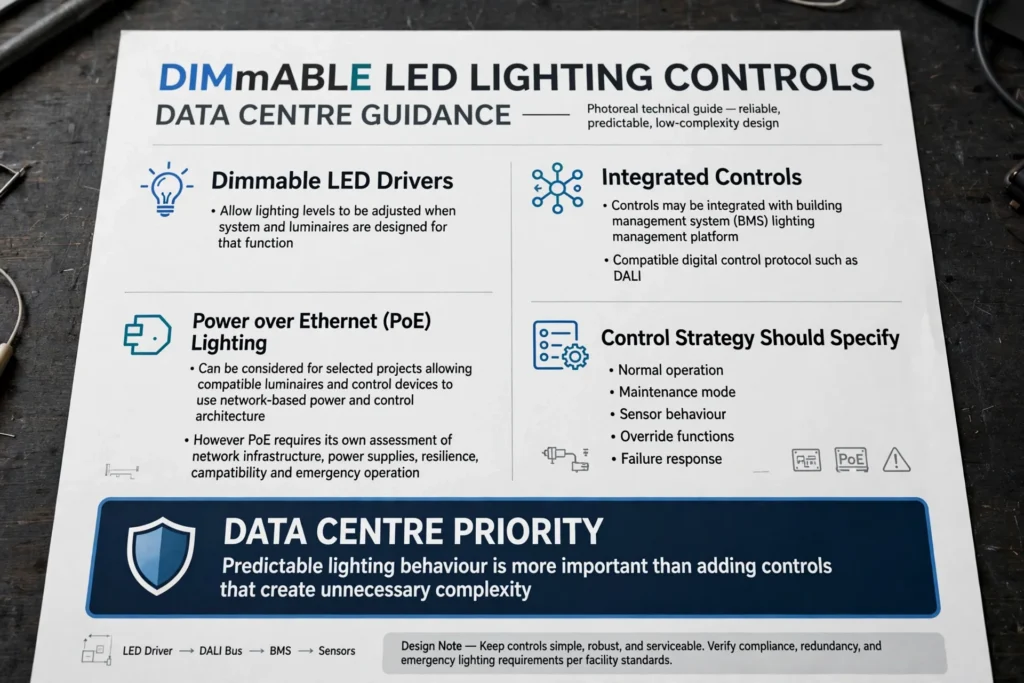
The UAE is an important regional location for cloud services, telecommunications, enterprise IT and digital infrastructure. Data centre projects in Dubai, Abu Dhabi and other technology and business hubs must coordinate lighting with electrical resilience, cooling design, physical security and facility operations.
Local projects should identify the relevant authority requirements, fire and life-safety provisions, electrical standards and contractual design criteria at the beginning of the project. International guidance from ASHRAE, ISO/IEC data centre infrastructure standards and relevant indoor workplace lighting standards may support the design, but they do not replace applicable local regulations or project-specific approval requirements.
For a new data hall or refurbishment, consultants should request photometric calculations, fixture data sheets, control descriptions and emergency lighting details before approving the equipment. The design should clearly distinguish rack aisles, maintenance zones, electrical rooms, NOCs, stores and escape routes.
A specialist LED Lighting for Data Centres Supplier can help project teams compare linear fixtures, technical-room luminaires, low-glare panels, emergency lighting and control-compatible products. The supplier should be able to provide documented performance data and support coordination with electrical consultants, mechanical contractors and facility operators.
How to Select a Reliable Data Centre Lighting Supplier
A reliable supplier should understand the difference between lighting a conventional office and illuminating a mission-critical technical facility. Product selection should be supported by a clear specification, not just a catalogue image or a wattage comparison.
Request the luminaire’s lumen output, efficacy, CRI, colour temperature, glare data, photometric files, driver details, rated ambient temperature, ingress protection and expected maintenance requirements. Where relevant, confirm compatibility with dimming protocols, presence sensors, emergency systems and the site’s building management platform.
Ask for a lighting layout that shows fixture positions, horizontal and vertical illuminance, uniformity and relevant glare criteria. The proposal should identify fixture quantities, control zones, emergency lighting provisions and any exclusions.
For UAE projects, also verify product availability, delivery schedules, warranty support and access to replacement components. A supplier that understands the operational requirements of data centres can help reduce specification gaps and make future maintenance easier.
Conclusion
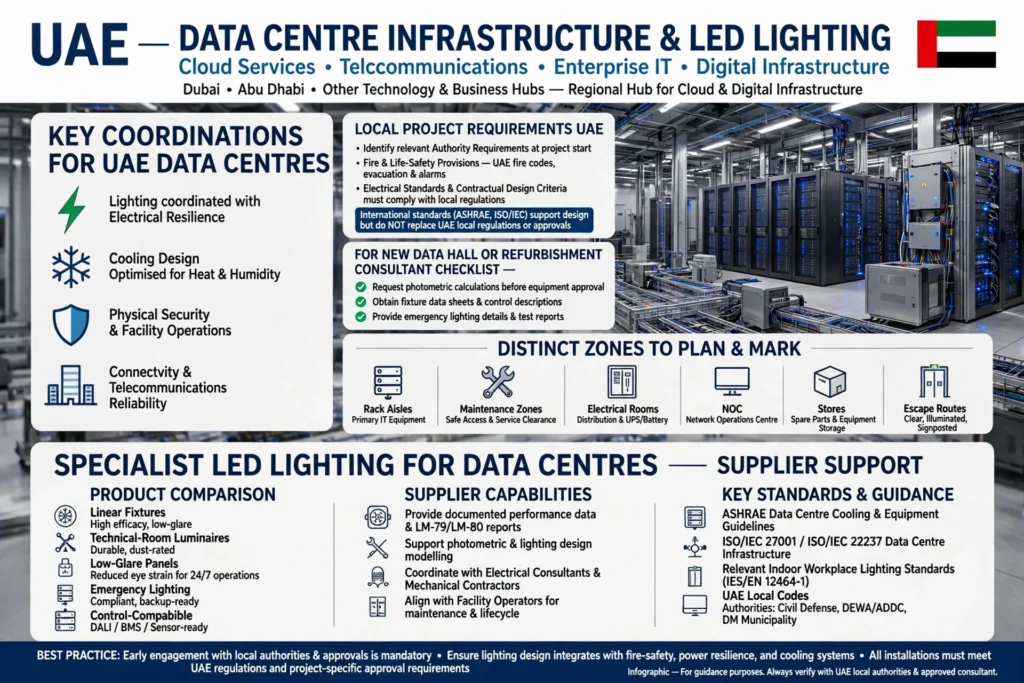
LED lighting for data centres should be designed around the work performed in each area. Rack aisles need effective vertical illumination for equipment access, maintenance zones require suitable task lighting, and network operations centres need controlled glare for screen-based work. Emergency routes and electrical rooms must also be addressed as part of the complete lighting strategy.
The best results come from combining appropriate LED fixtures with accurate photometric calculations, intelligent controls, careful coordination with cooling and cable infrastructure, and a practical maintenance plan. Lux levels should be selected according to the task and applicable requirements, while fixture ratings should reflect the actual environment.
For data centres across Dubai, Abu Dhabi and the wider UAE, a properly specified LED lighting system can improve technician visibility, reduce avoidable energy use and support safer, more maintainable operations without compromising the requirements of critical infrastructure.
Frequently Asked Questions
What type of LED lighting is best for data centres?
LED linear luminaires are often suitable for rack aisles because they can distribute light along cabinet rows. LED battens may suit technical rooms and corridors, while low-glare LED panels can be appropriate for network operations centres. The final selection depends on the task, layout and environmental conditions.
How many lux are required in a data centre?
The required illuminance depends on the area and task. General circulation may use lower levels than rack maintenance or detailed equipment work. As preliminary design references, some rack aisles are planned around 300–500 lux, while maintenance benches may require similar or higher task-specific levels. The final values must be verified against applicable standards and the project specification.
Why is vertical illuminance important in server rooms?
Vertical illuminance helps technicians read rack labels, identify ports, inspect status indicators and trace connections. Adequate floor lighting alone does not guarantee that the front and rear faces of server cabinets are clearly visible.
Can motion sensors be used in data centres?
Yes. Presence sensors can reduce unnecessary lighting in selected areas, but the control sequence must keep the space safely illuminated while technicians are working. Sensor coverage, time delays, manual overrides and emergency lighting must be considered.
Does LED lighting reduce data centre cooling costs?
LED fixtures can reduce lighting electricity consumption and the heat generated by the lighting system compared with less efficient alternatives. Any resulting cooling savings depend on the facility’s cooling design, operating conditions and the amount of lighting energy saved.
What standards should be considered for data centre lighting?
The design team should review relevant indoor workplace lighting standards, applicable electrical and life-safety codes, project requirements and appropriate data centre infrastructure guidance, such as ASHRAE recommendations and the ISO/IEC 22237 series. The exact requirements depend on the jurisdiction and project.
What should be included in a data centre lighting quotation?
A technical quotation should identify the exact fixture models, quantities, lumen output, efficacy, colour temperature, CRI, glare performance, driver and control compatibility, photometric calculations, emergency lighting provisions, warranty and delivery details. Installation conditions and exclusions should also be clear.