Heritage buildings carry architectural, cultural, and historical value that cannot be recreated once it is lost. Their façades, arches, columns, courtyards, decorative details, stonework, wooden elements, and traditional construction methods often tell the story of a city and its people. Lighting these structures therefore requires a different approach from lighting a modern commercial building.
Heritage building LED lighting should reveal architectural character without overwhelming it. The objective is to make historical features visible at night while protecting the building’s appearance, minimizing glare, controlling energy consumption, and respecting the surrounding environment.
Modern LED technology provides designers with much greater control over brightness, colour temperature, beam angles, dimming, controls, and fixture placement. When carefully specified, LED illumination can highlight heritage architecture while maintaining a subtle and authentic nighttime appearance.
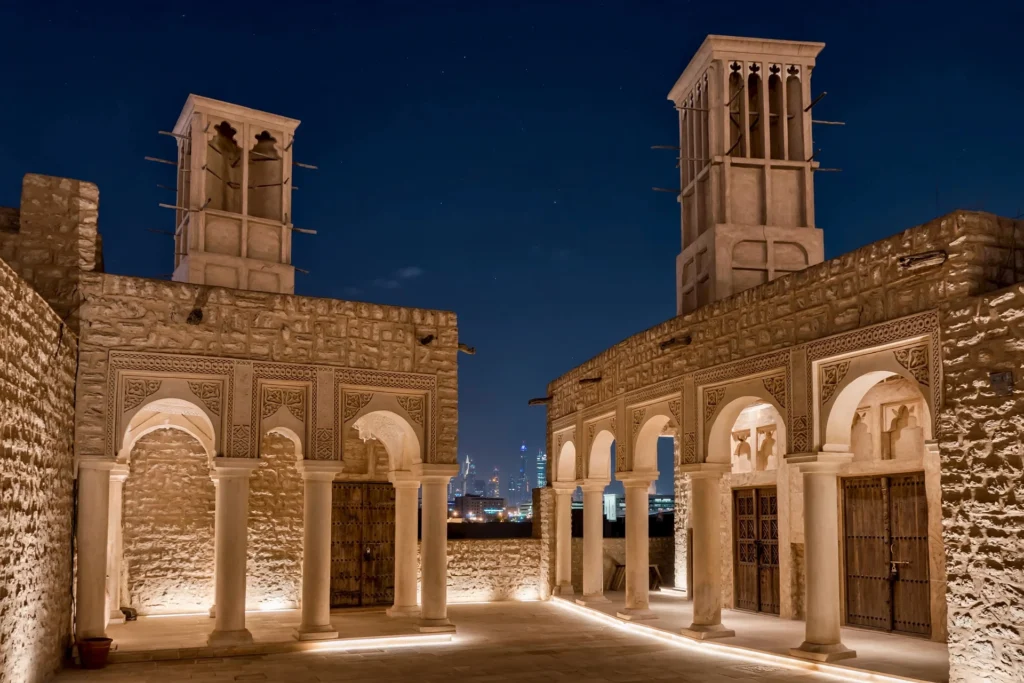
This approach is particularly valuable in the UAE, where historic districts and restored architectural sites exist alongside modern developments. Areas such as Al Fahidi Historical Neighbourhood, Deira, Bur Dubai, Al Shindagha, Sharjah Heritage Area, and Abu Dhabi’s heritage destinations demonstrate how traditional architecture can coexist with contemporary urban environments.
What Is Heritage Building LED Lighting?
Heritage building LED lighting involves using energy-efficient LED fixtures and carefully planned illumination techniques to highlight the architectural and cultural features of historic structures.
Unlike conventional façade lighting, heritage illumination generally requires more detailed consideration of the building’s materials and proportions.
A lighting designer may study:
- Historic façade materials
- Stone and masonry
- Decorative plasterwork
- Arches and columns
- Courtyards
- Wooden doors
- Traditional windows
- Carved details
- Rooflines
- Cultural motifs
- Existing electrical infrastructure
- Visitor movement
- Surrounding buildings
The lighting system should complement these features rather than competing with them.
Why Heritage Buildings Need Specialized Lighting
Historical structures can be sensitive to physical intervention. Drilling, cable routing, fixture mounting, heat generation, excessive brightness, or poorly positioned equipment can negatively affect architectural elements.
A modern building may accommodate extensive surface-mounted equipment, while a heritage property may require discreet installation.
Lighting should therefore be planned alongside conservation requirements.
The objective is not to make every architectural element equally bright. Instead, designers can establish a hierarchy that guides attention toward significant features.
For example, a traditional entrance may receive slightly stronger illumination than secondary walls, while decorative arches can be highlighted with narrow-beam fixtures.
Understanding the Architecture Before Lighting
The first step in a heritage lighting project should be architectural assessment.
Designers should understand the building’s original form, materials, important details, restoration history, and relationship with its surroundings.
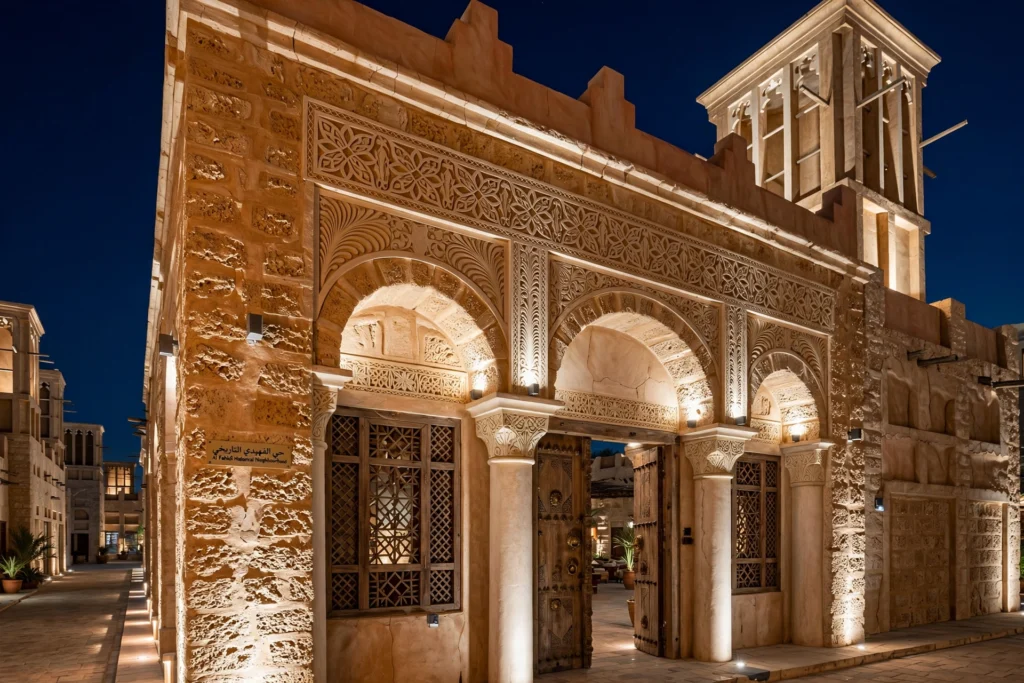
A stone façade absorbs and reflects light differently from painted plaster. Rough surfaces create shadows, while smooth surfaces may produce stronger reflections.
Traditional wooden elements can require particularly careful fixture positioning because harsh lighting can make them appear visually flat.
Understanding the architecture helps determine whether to use wall washing, grazing, uplighting, downlighting, accent lighting, silhouette lighting, or concealed illumination.
LED Technology for Heritage Architecture
LED technology is well suited to heritage applications because fixtures are available in many sizes and configurations.
Options include:
LED floodlights for broader façade illumination.
Linear LED fixtures for architectural edges and concealed applications.
LED spotlights for columns, arches, entrances, and decorative features.
In-ground uplights for selected landscape and architectural elements where appropriate.
Wall washers for relatively uniform façade illumination.
Miniature LED fixtures where discreet installation is required.
The fixture should be selected according to the architectural feature rather than choosing one lighting type for the entire building.
Colour Temperature and Historical Character
Colour temperature has a major influence on the appearance of heritage architecture.
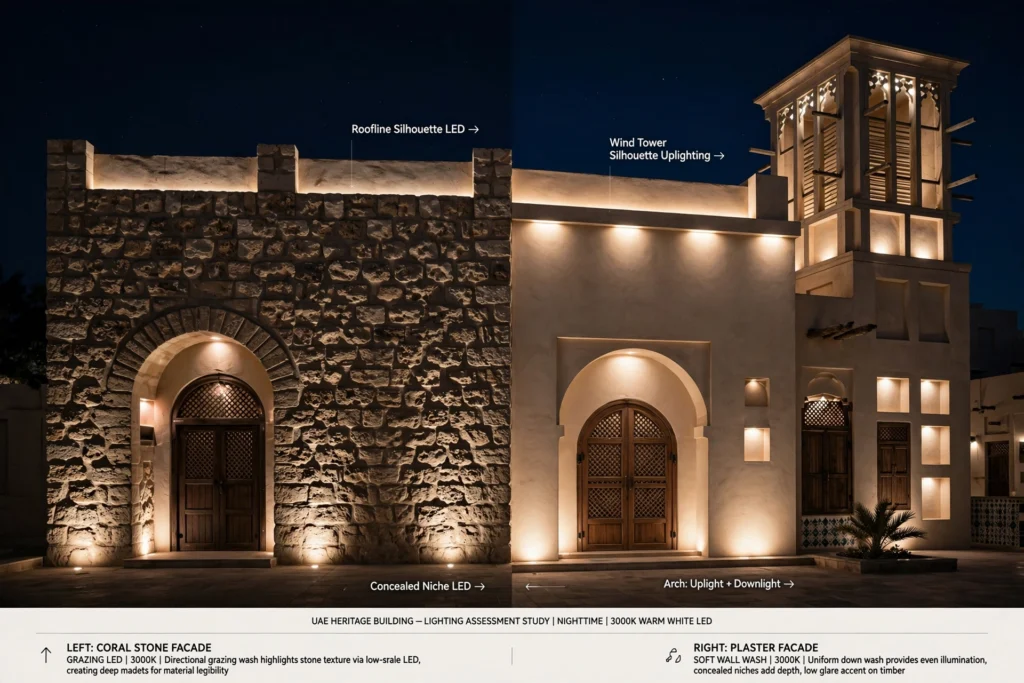
Warm white light, typically around 2700K to 3000K, can create a welcoming and traditional appearance. It can work particularly well with sandstone, warm plaster, wood, and traditional architectural finishes.
Neutral white light may be appropriate where greater visual clarity is required, although excessive coolness can make historical materials appear unnatural.
The correct colour temperature depends on the building’s materials, surroundings, intended atmosphere, and cultural context.
In many heritage environments, a restrained warm-white approach can help preserve the visual character of the architecture.
Colour Rendering and Architectural Detail
Colour rendering is another important consideration.
A high-quality LED fixture with good colour-rendering performance can reproduce the appearance of stone, timber, paint, textiles, and decorative materials more accurately.
This matters when the building contains detailed craftsmanship.
Poor-quality lighting may make natural materials appear dull or distorted. High-quality architectural LEDs can reveal subtle differences in surface texture and colour.
For heritage buildings that attract visitors at night, accurate colour reproduction can also improve photography and visual documentation.
Highlighting Architectural Features
Heritage buildings often contain features that deserve individual attention.
These may include:
- Arched doorways
- Domes
- Minarets
- Columns
- Cornices
- Decorative screens
- Wooden doors
- Carved stone
- Traditional windows
- Courtyard walls
- Roof structures
- Historical signage
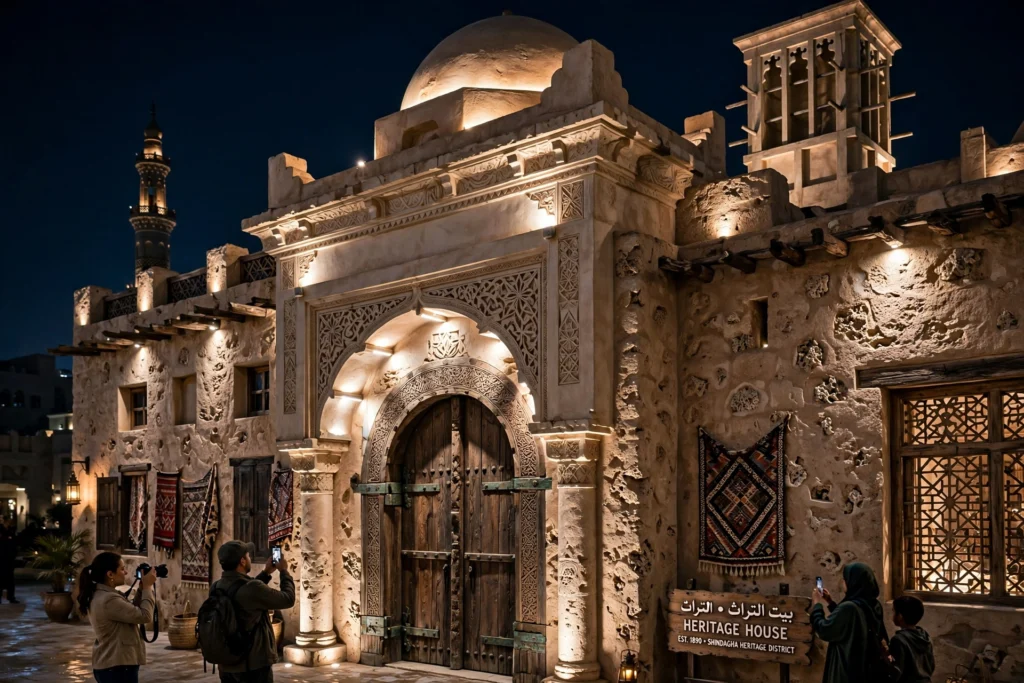
Rather than flooding the entire building with intense light, designers can use accent fixtures to emphasize selected elements.
This creates depth and helps viewers understand the building’s architecture.
Façade Lighting Techniques
Several techniques can be combined depending on the building.
Wall Washing
Wall washing provides relatively uniform illumination across a façade. It can be useful for large surfaces where the architectural texture is not extremely deep.
Grazing
Grazing places the light close to a textured surface, emphasizing stone, brick, plaster, or decorative relief.
This can be highly effective for historic masonry because shadows reveal the depth of the material.
Uplighting
Uplighting directs light upward from the ground or lower architectural levels. It can emphasize columns, walls, trees, arches, and vertical structures.
Downlighting
Downlighting can provide a subtle effect from rooflines, balconies, or architectural projections when fixtures can be installed without damaging the building.
Accent Lighting
Accent lighting focuses on specific architectural details such as doors, artwork, carvings, or decorative motifs.
A successful heritage lighting scheme often combines several techniques instead of relying on one method.
Protecting Historic Materials
Heritage lighting should avoid unnecessary physical or thermal impact on the building.
LEDs generally produce less heat at the illuminated surface than many older lighting technologies, but fixture selection and installation still matter.
Fixtures should not be mounted directly onto fragile decorative elements without appropriate assessment.
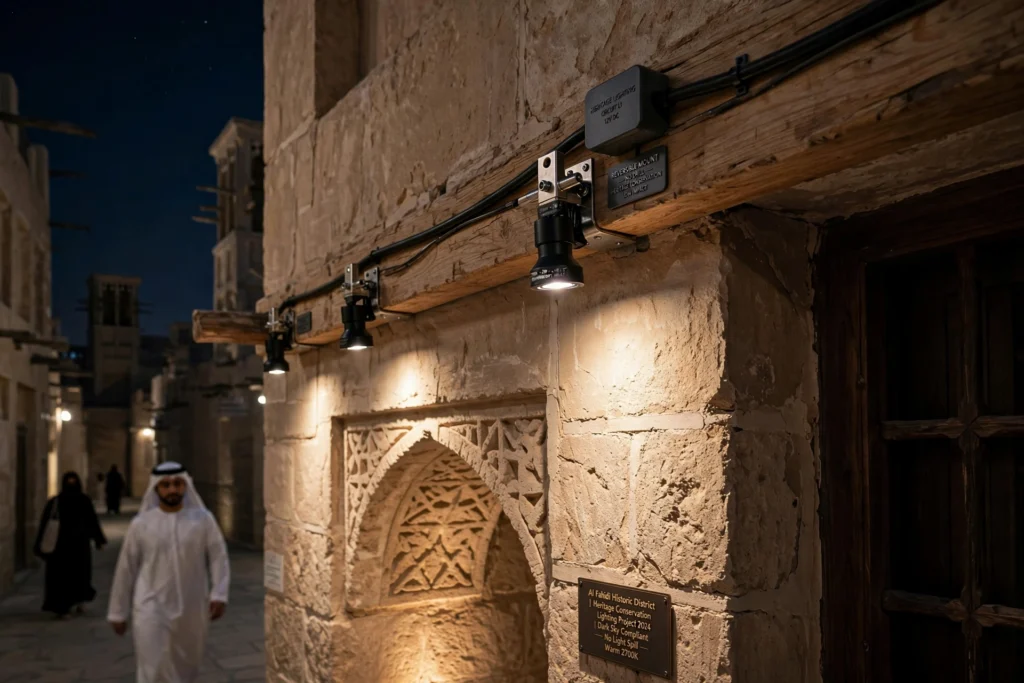
Cable routes should also be planned carefully to minimize visual impact and avoid damaging historic fabric.
Where possible, mounting systems should use existing architectural structures or reversible solutions that can be removed without permanent damage.
Controlling Light Pollution
Heritage buildings are often located in established urban districts where surrounding residents, businesses, pedestrians, and wildlife may be affected by excessive illumination.
Poorly aimed floodlights can send light into windows, roads, neighbouring properties, or the night sky.
Good lighting design uses appropriate beam angles, shielding, aiming, dimming, and fixture positioning to direct light only where it is needed.
The goal is architectural visibility without unnecessary spill light.
Energy Efficiency and LED Technology
One of the major advantages of LED lighting is energy efficiency.
Heritage buildings that operate exterior lighting for several hours every evening can potentially benefit from efficient LED fixtures and intelligent controls.
Energy performance can be improved further through:
- Timed operation
- Dimming
- Photocells
- Astronomical clocks
- Occupancy controls where appropriate
- Central lighting management
- Zoned switching
- Remote monitoring
A heritage lighting project should therefore consider not only the initial installation but also long-term operating costs.
Smart Controls for Heritage Lighting
Modern control systems allow heritage lighting to become more responsive.
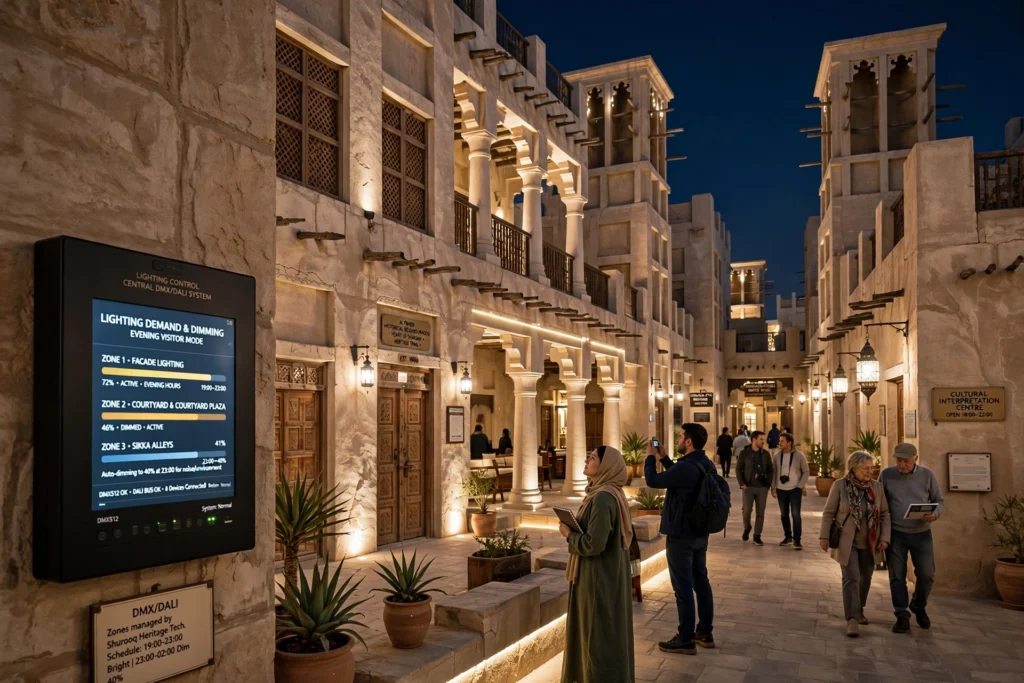
A central lighting control system can manage different zones and schedules.
For example, a heritage façade might operate at a higher level during evening visitor hours and automatically dim later at night.
Special events can use temporary lighting scenes without permanently changing the installation.
DMX, DALI, wireless controls, and other technologies can be considered depending on project requirements.
Control selection should remain appropriate to the building’s scale and operational needs.
Heritage Lighting and Tourism
Architectural lighting can contribute to the nighttime visitor experience.
Historic districts often become more visually engaging after sunset when important buildings, streets, courtyards, and public spaces are appropriately illuminated.
In destinations such as Al Fahidi Historical Neighbourhood in Dubai and the Heart of Sharjah, lighting can help visitors appreciate architectural details that may be less visible at night.
However, lighting should support cultural interpretation rather than turning heritage architecture into an overly bright spectacle.
Subtle illumination can often create a stronger sense of authenticity.
Heritage Building Lighting in Dubai
Dubai’s history extends well beyond its modern skyline.
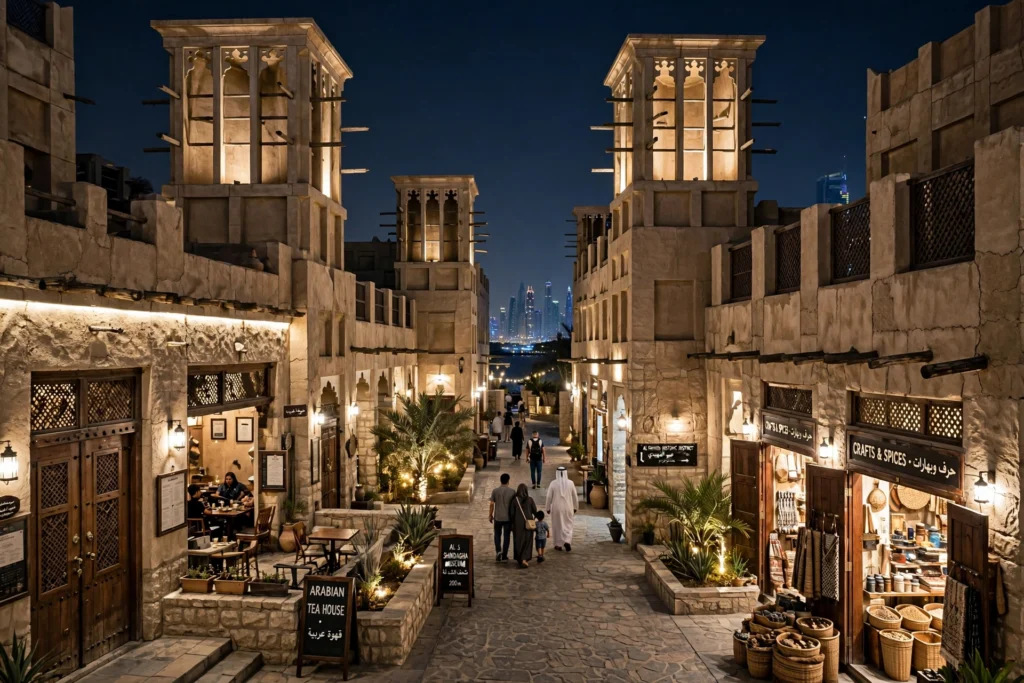
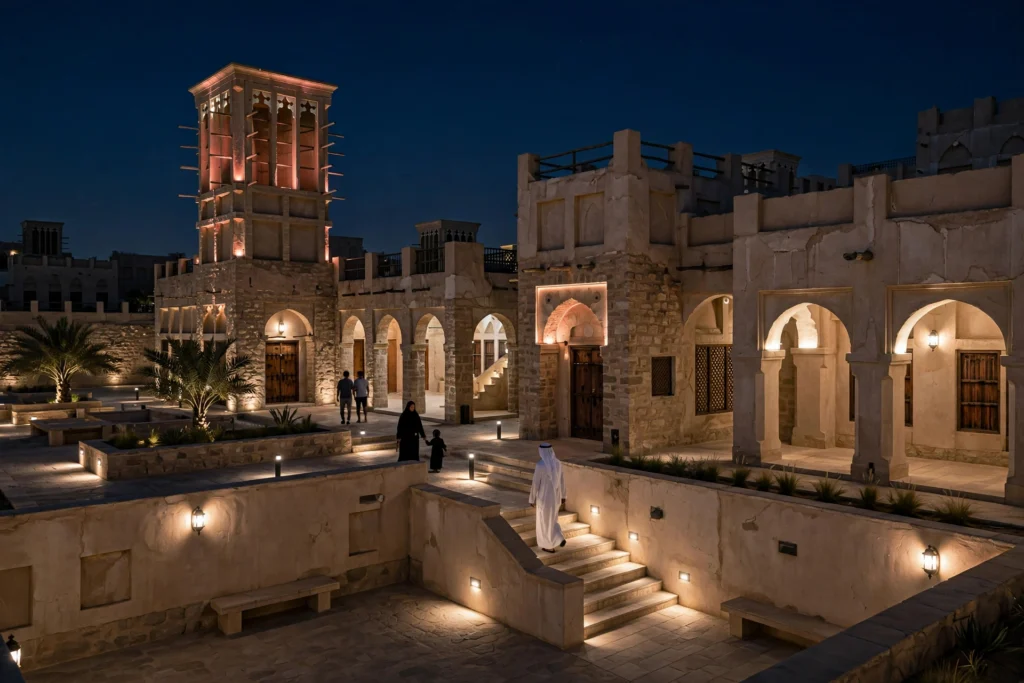
Traditional architecture can be found in areas such as Al Fahidi, Al Shindagha, Bur Dubai, and Deira, where historic buildings, courtyards, wind towers, traditional doors, and narrow streets provide a contrast to the city’s contemporary architecture.
Lighting these environments requires sensitivity to their traditional character.
Warm architectural lighting, concealed fixtures, controlled beam angles, and low-glare solutions can help highlight traditional details without creating an artificial appearance.
The lighting should also work with nearby pedestrian routes, public spaces, signage, landscaping, and commercial activity.
Heritage Lighting in Sharjah
Sharjah has invested heavily in preserving and presenting its cultural heritage.
Historic areas such as the Heart of Sharjah contain traditional buildings and restored urban environments where architectural lighting can support evening tourism and cultural activity.
Lighting designers must consider the relationship between individual buildings and the broader streetscape.
A single brightly illuminated structure can appear disconnected if neighbouring buildings remain dark. A coordinated district-level strategy can create a more cohesive experience.
Heritage Lighting in Abu Dhabi and Al Ain
Abu Dhabi and Al Ain also contain cultural and historic sites that require carefully planned lighting.
Al Ain Oasis, Al Jahili Fort, Al Ain Palace Museum, and other heritage destinations demonstrate the importance of preserving the relationship between architecture, landscape, and cultural identity.
Landscape lighting can complement architectural illumination by revealing pathways, trees, courtyards, walls, and outdoor gathering areas.
The lighting should remain appropriate to the historical character of the destination.
Lighting Heritage Mosques and Religious Architecture
Religious heritage buildings require particular sensitivity.
Mosques and other religious structures may contain domes, minarets, arches, geometric patterns, calligraphy, and decorative façades.
Lighting should highlight these elements respectfully while avoiding excessive brightness.
The colour temperature, fixture placement, beam control, and operating schedule should be carefully considered.
Where buildings remain active places of worship, lighting design must also consider worshippers, neighbours, pedestrian movement, and the building’s functional requirements.
Landscape Lighting Around Heritage Buildings
The surrounding landscape is part of the architectural experience.
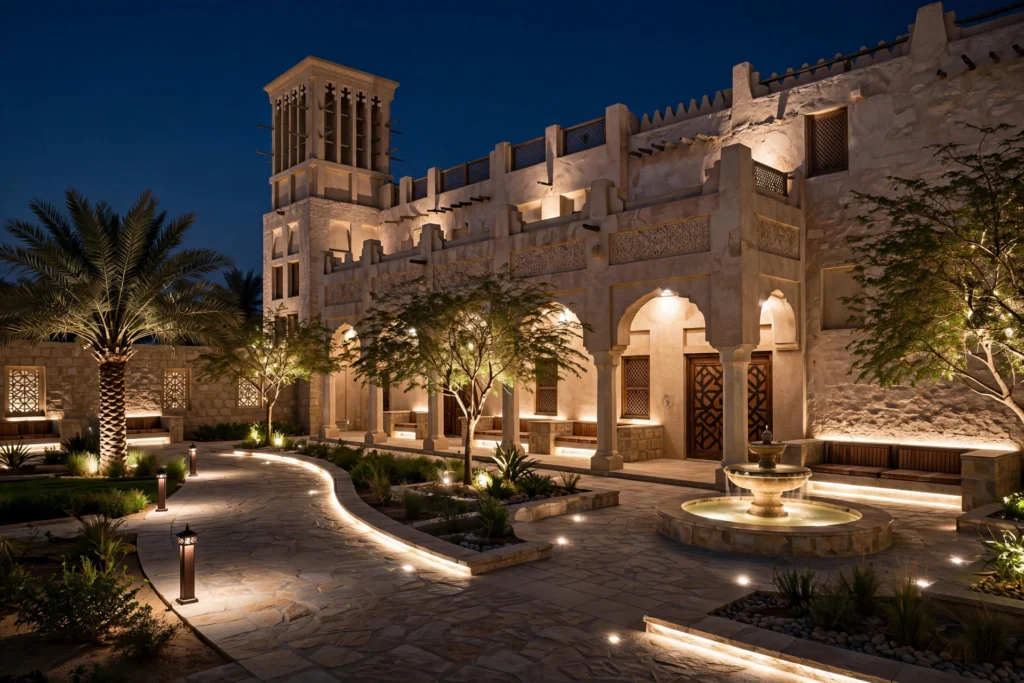
Trees, pathways, courtyards, walls, fountains, seating areas, and gardens can be illuminated to provide context around the building.
However, landscape lighting should not overpower the architecture.
A balanced approach may use lower-level pathway lighting combined with carefully positioned accent fixtures for trees and architectural elements.
The relationship between landscape and building lighting should be evaluated from the main visitor viewpoints.
Choosing Heritage Building LED Lighting Supplies
Selecting suitable fixtures is critical to achieving reliable and visually appropriate results.
Heritage Building LED Lighting Supplies should be selected according to fixture quality, colour consistency, optical performance, durability, environmental protection, mounting requirements, control compatibility, and maintenance access.
Outdoor heritage applications may require fixtures with appropriate IP ratings, corrosion resistance, UV resistance, and robust construction.
The supplier should also provide accurate technical information regarding lumen output, beam angle, colour temperature, colour rendering, power consumption, operating life, and control compatibility.
Selecting equipment based solely on price can create problems later if fixtures fail, colours vary, or replacement products become difficult to source.
IP Ratings and Outdoor Protection
Exterior heritage lighting is exposed to weather conditions, dust, humidity, and temperature changes.
Fixtures should therefore have an appropriate ingress protection rating for their installation environment.
For example, lighting installed in exposed outdoor locations may require greater protection from water and dust than fixtures installed beneath sheltered architectural elements.
Corrosion-resistant housings can also be important in coastal areas such as Dubai Marina, Palm Jumeirah, Abu Dhabi Corniche, and other locations exposed to marine conditions.
Heritage Lighting Maintenance
A lighting installation is only successful if it remains functional and visually consistent.
Maintenance planning should consider:
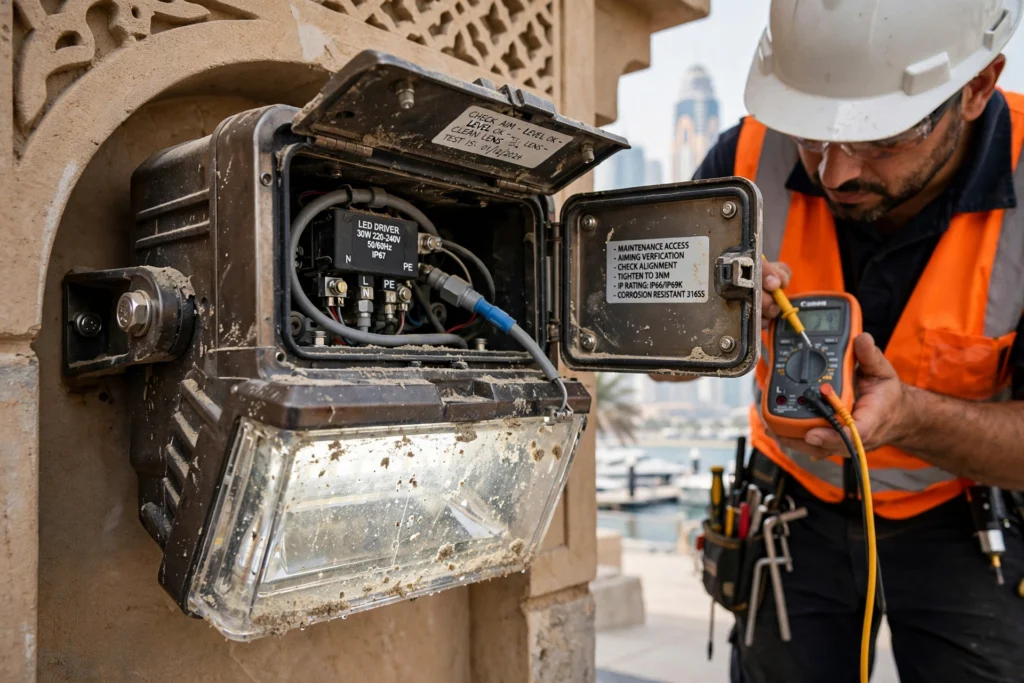
Fixture cleaning, lens inspection, cable inspection, driver replacement, control-system checks, aiming verification, and performance testing.
Dust accumulation can reduce light output, while changes in fixture position can affect the intended architectural effect.
Maintenance access should be considered during the original design. Fixtures that are impossible to access safely can create unnecessary long-term costs.
LED Drivers and Power Supplies
The quality of LED drivers and power supplies is important for reliability.
A high-quality LED fixture can still experience performance problems if the driver is poorly matched or installed in unsuitable conditions.
Designers should consider driver location, ventilation, electrical protection, voltage requirements, dimming compatibility, and access for future maintenance.
For larger heritage sites, centralized or distributed driver strategies may be considered according to the installation.
Heritage Lighting and Safety
Architectural lighting should also support safety.
Entrances, pathways, stairs, courtyards, and changes in level should have suitable illumination.
However, safety lighting and decorative architectural lighting should not necessarily be treated as the same system.
A comprehensive lighting strategy can coordinate functional illumination with architectural accents while avoiding excessive brightness.
Electrical installations should also be designed and installed according to applicable local requirements and professional standards.
Common Heritage Lighting Mistakes
One of the biggest mistakes is using excessive brightness.
A heritage building does not need to be illuminated like a modern advertising façade.
Another problem is using too many fixture types or colours. Excessive variation can destroy visual consistency.
Poor fixture placement can also create glare, visible equipment, unwanted shadows, and light spill.
Ignoring the building’s materials is another common issue. A lighting technique that works beautifully on modern concrete may not be appropriate for historic stone or delicate plasterwork.
How to Plan a Heritage LED Lighting Project
A successful project usually begins with a site and architectural assessment.
The lighting team should identify significant architectural features, visitor viewpoints, surrounding light sources, electrical infrastructure, access limitations, and conservation requirements.
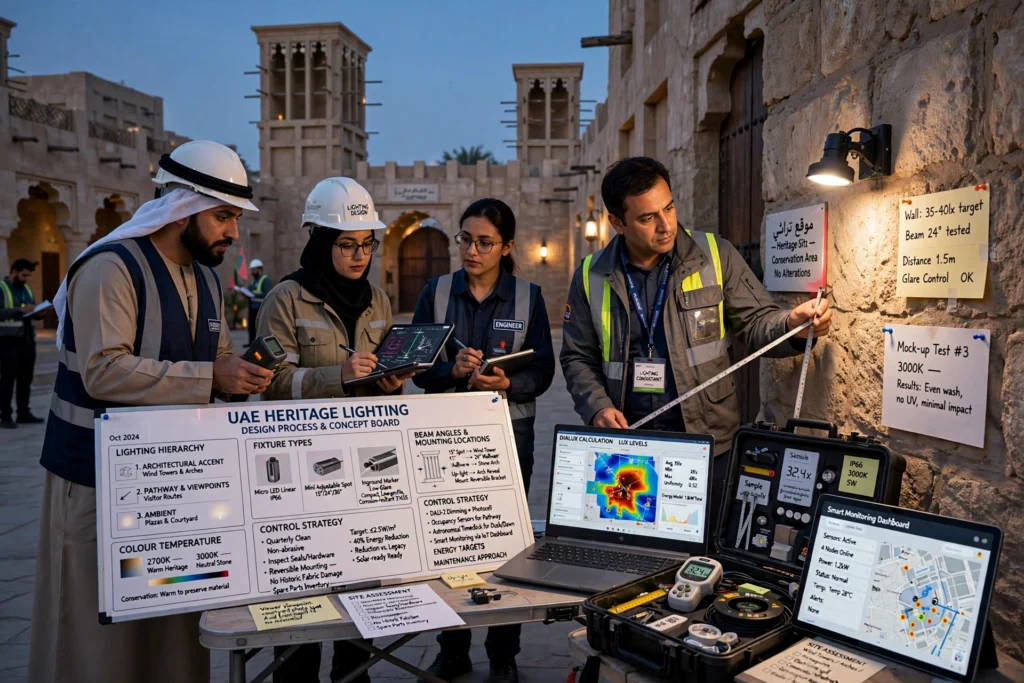
A concept can then establish:
Lighting hierarchy → colour temperature → fixture types → beam angles → mounting locations → control strategy → energy targets → maintenance approach.
Lighting calculations and mock-ups can help evaluate the proposed effect before full installation.
On-site testing is particularly valuable because heritage materials can react differently to light than expected from drawings alone.
Future of Heritage Building LED Lighting
The future of heritage illumination will increasingly combine architectural sensitivity with intelligent technology.
LED fixtures are becoming more efficient, compact, controllable, and optically precise. Smart controls can reduce energy use, while monitoring systems can help identify equipment problems.
Dynamic lighting may also become more common for cultural festivals and special events, but permanent heritage illumination is likely to remain focused on subtle architectural enhancement.
The most successful projects will balance conservation, technology, energy efficiency, visitor experience, and cultural identity.
Frequently Asked Questions
What colour temperature is best for heritage buildings?
Warm white LED lighting around 2700K–3000K is often suitable for traditional architecture because it can complement stone, plaster, wood, and other warm materials. The final choice should depend on the building and surroundings.
Can LED lighting damage heritage buildings?
LED technology can be suitable for heritage applications, but improper installation can still cause physical or visual problems. Fixture placement, heat, mounting methods, brightness, and conservation requirements should be assessed professionally.
Is LED lighting suitable for outdoor heritage buildings?
Yes. Outdoor-rated architectural LED fixtures can be used when their protection, construction, optical performance, and mounting method are appropriate for the environment.
How can heritage buildings reduce lighting energy consumption?
Efficient LEDs combined with dimming, scheduling, zoning, photocells, and intelligent controls can reduce unnecessary operating hours and energy consumption.
Why is beam angle important?
Beam angle determines how light spreads across an architectural surface. Narrow beams can highlight specific details, while wider beams can illuminate larger façades.
Conclusion
Heritage building LED lighting is about more than making an old structure visible after sunset. It is a careful process of revealing architectural character while respecting historical materials, cultural identity, surrounding communities, and the nighttime environment.
Modern LED technology gives designers powerful tools for achieving this balance. Warm colour temperatures, high-quality colour rendering, precise beam angles, discreet fixtures, intelligent controls, efficient drivers, and appropriate outdoor protection can transform the nighttime appearance of a heritage building without making it feel disconnected from its history.
In the UAE, heritage environments across Dubai, Sharjah, Abu Dhabi, and Al Ain provide valuable opportunities to combine conservation with modern lighting technology. From traditional courtyards and wind towers to forts, mosques, historic streets, and restored cultural districts, each building requires an approach based on its architectural identity.
The right lighting strategy should begin with understanding the building rather than selecting fixtures. Once the architecture, materials, visitor experience, operational requirements, and conservation considerations are understood, LED technology can be used to create a subtle and effective nighttime environment.
For project owners, architects, conservation teams, developers, and lighting designers, investing in reliable Heritage Building LED Lighting Supplies and professional planning can support long-term performance while preserving the visual character that makes historic architecture valuable.
The future of heritage lighting is therefore not about replacing traditional character with modern technology. It is about using modern technology quietly and intelligently to reveal, protect, and celebrate the architecture that already exists.