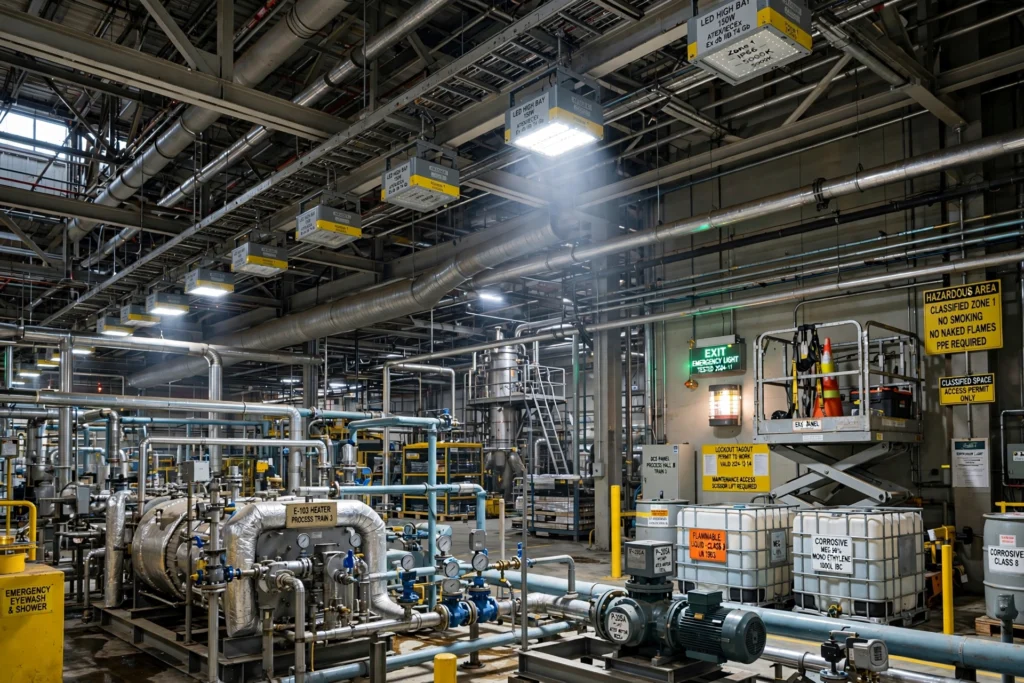
Lighting in an industrial facility is normally treated as an electrical and operational requirement. In a hazardous area, however, lighting becomes part of the site’s process safety and ignition-control strategy. A conventional LED fixture that performs perfectly well in a warehouse or office may be unsuitable for an area where flammable gases, vapors, combustible dust, or other explosive atmospheres can be present.
This is why explosion-proof LED lighting must be selected according to the actual hazardous-area classification, gas or dust characteristics, equipment protection method, temperature requirements, ingress protection, installation conditions, and applicable certification.
For industrial facilities across the UAE, including Dubai, Abu Dhabi, Sharjah, Jebel Ali, Ruwais, Mussafah, Al Quoz, and Hamriyah, this distinction is particularly important because the region contains oil and gas facilities, petrochemical plants, chemical processing sites, fuel terminals, warehouses, manufacturing facilities, and other industrial environments where hazardous-area electrical equipment may be required.
The IECEx system specifically covers equipment intended for use in explosive atmospheres, with standards including IEC 60079-0 for general requirements, IEC 60079-10-1 for classification of areas with explosive gas atmospheres, IEC 60079-10-2 for combustible dust atmospheres, and IEC 60079-14 for electrical installation design, selection, and erection.
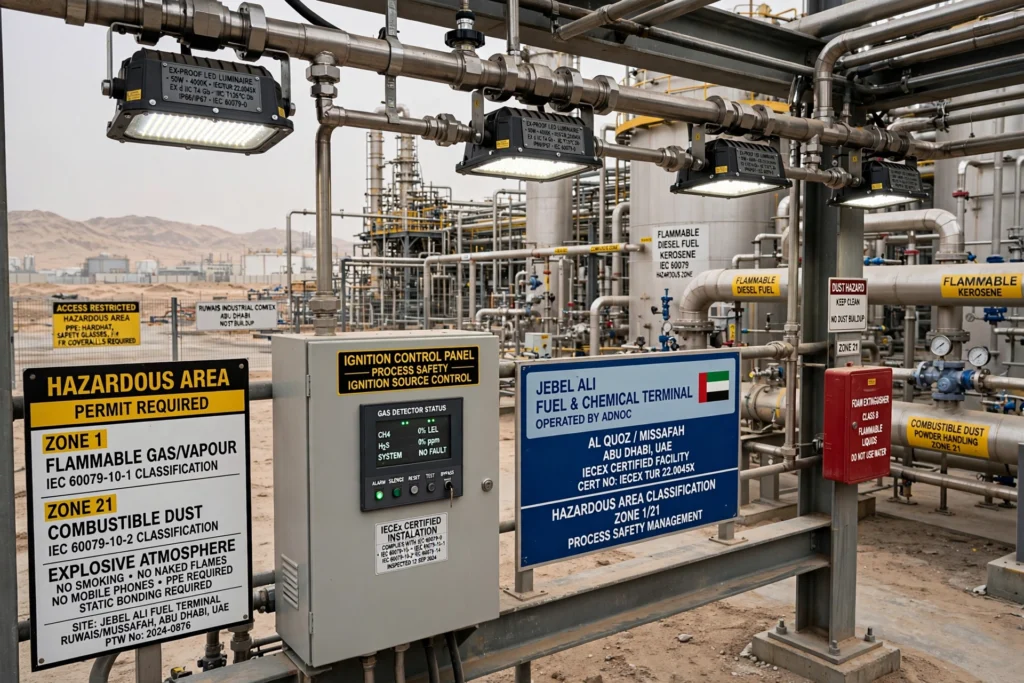
What Is Explosion-Proof LED Lighting?
Explosion-proof LED lighting refers to specially engineered lighting equipment designed and certified for use in specified hazardous locations.
The important point is that “explosion-proof” should not simply mean that a fixture has a strong metal housing.
A hazardous-area luminaire must have a protection concept and certification appropriate for the classified location.
Depending on the design, protection may involve methods such as flameproof enclosures, increased safety, encapsulation, pressurization, or protection by enclosure against combustible dust. IECEx identifies several of these protection concepts within the IEC 60079 series.
The correct fixture therefore depends on the hazardous-area classification rather than simply the fact that a facility is called an “industrial site.”
Why Conventional LED Lights May Be Unsuitable
A standard commercial LED high-bay fixture can contain electrical components that may produce heat, electrical arcs, sparks, or other potential ignition sources under particular failure conditions.
In a normal warehouse, these characteristics may not create an explosive-atmosphere concern.
In a classified hazardous area, the situation is different.
If a flammable gas, vapor, mist, or combustible dust is present in an appropriate concentration, an ignition source can create a serious incident.
Hazardous-area luminaires are therefore designed around controlled ignition risk.
This is why simply purchasing a heavy-duty IP65 or IP66 LED light does not automatically make it suitable for an explosive atmosphere.
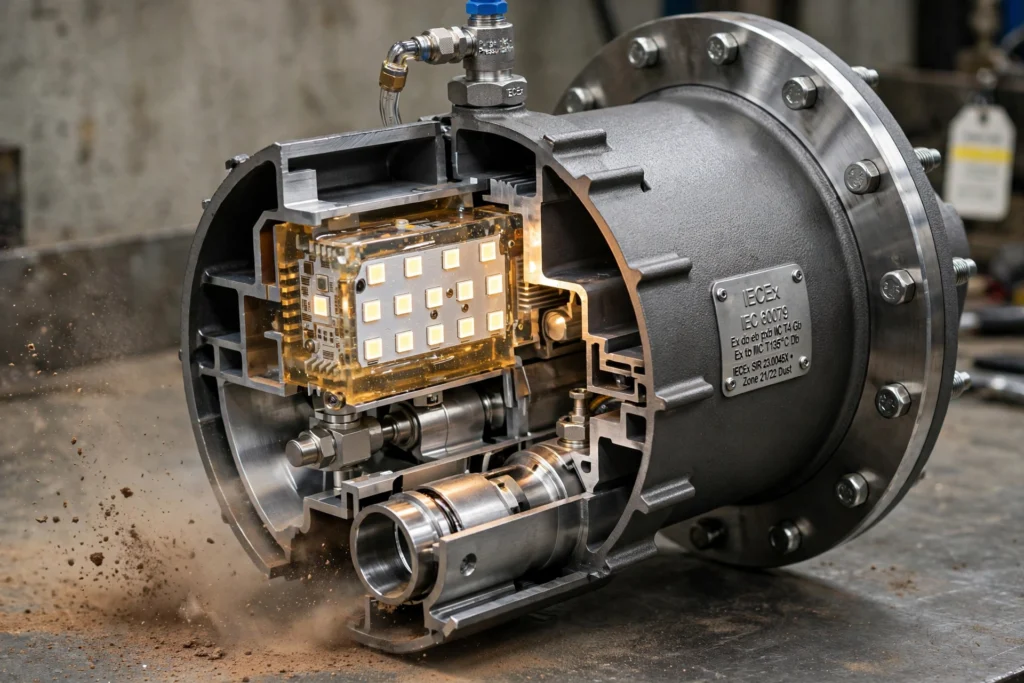
Ingress protection and hazardous-area certification are different requirements.
Understanding Hazardous Areas Before Selecting Lighting
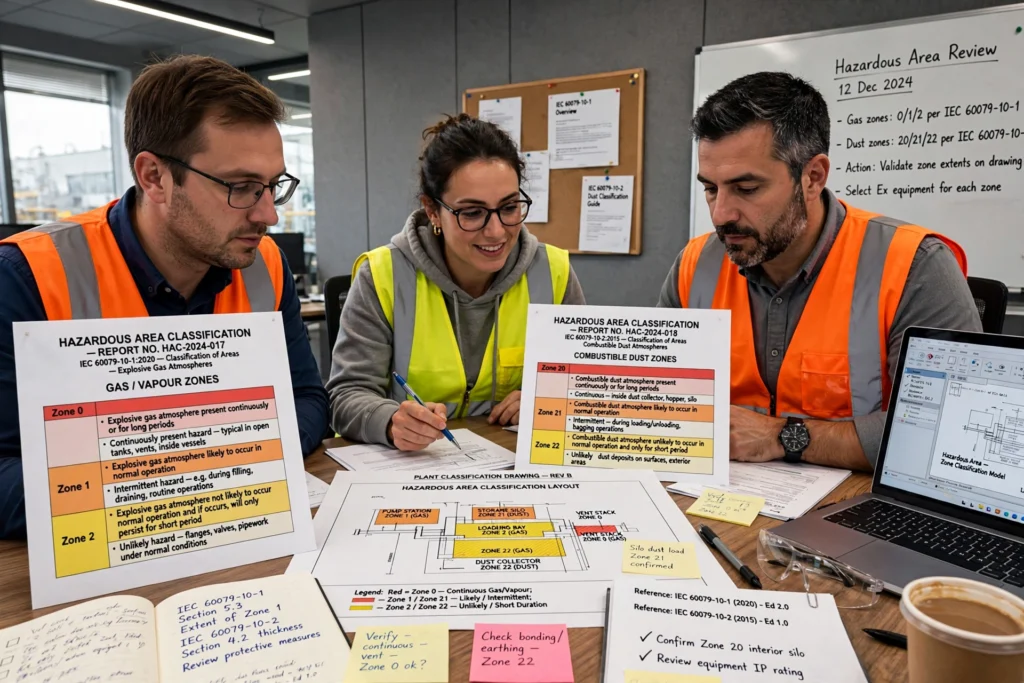
One of the most important professional lessons in hazardous-area lighting is to start with the area classification, not the fixture.
The electrical design team should understand what type of hazardous atmosphere may exist and how frequently it can occur.
For gas and vapor environments, hazardous locations may be classified using concepts such as:
- Zone 0
- Zone 1
- Zone 2
For combustible dust environments, classifications include:
- Zone 20
- Zone 21
- Zone 22
The exact classification must come from the project’s hazardous-area classification documentation and applicable standards.
IEC 60079-10-1 addresses classification of areas containing explosive gas atmospheres, while IEC 60079-10-2 addresses explosive dust atmospheres.
This classification determines what equipment can safely be installed.
Gas, Vapor, and Dust Require Different Considerations
Not all hazardous environments behave in the same way.
A refinery processing volatile hydrocarbons has different hazards from a grain-processing facility where combustible dust may accumulate.
Similarly, a chemical plant handling solvents may require different equipment characteristics from a fuel-storage terminal.
The engineering process should therefore identify:
The hazardous substance, its physical characteristics, release source, concentration potential, temperature, ventilation conditions, and area classification.
For combustible gases and vapors, the equipment’s gas group and temperature classification can be important.
For combustible dust, the dust characteristics and equipment surface-temperature limitations become particularly important.
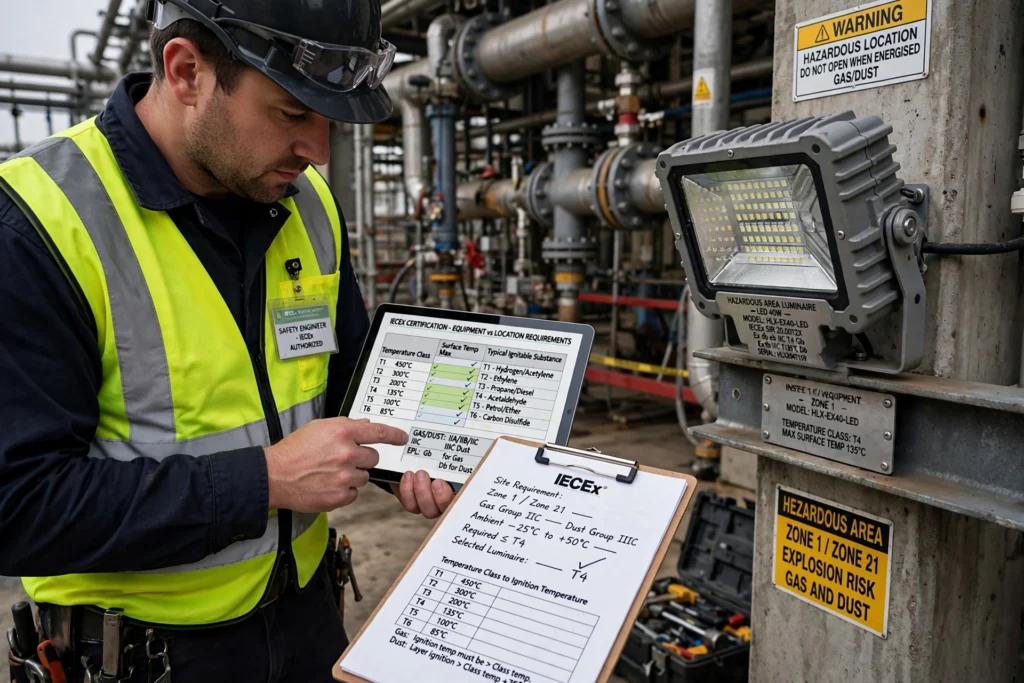
Temperature Classification Matters
Temperature is one of the most important technical parameters in hazardous-area lighting.
An electrical fixture produces heat during operation.
In a hazardous environment, the maximum surface temperature must remain appropriate for the classified atmosphere and the ignition characteristics of the hazardous material.
This is why hazardous-area equipment may carry a temperature class, such as T1, T2, T3, T4, T5, or T6, depending on the applicable equipment classification.
The selection cannot be made simply by choosing the fixture with the lowest operating temperature from a catalog.
The engineer must compare the equipment’s certified temperature characteristics against the requirements of the hazardous location.
IECEx certification processes explicitly address parameters such as equipment groups, Equipment Protection Levels, ambient temperature, and temperature classification.
Why LED Technology Is Valuable in Hazardous Areas
LED technology offers several operational advantages for industrial facilities.
One of the most important is energy efficiency.
Hazardous-area facilities can contain large spaces requiring continuous illumination, including:
- Process areas
- Pipe racks
- Tank farms
- Loading terminals
- Compressor areas
- Pump stations
- Maintenance zones
- Industrial warehouses
- Access platforms
Reducing electrical consumption can produce meaningful lifecycle savings when lighting operates for long periods.
LEDs can also provide long operating life, high-quality illumination, instant startup, and reduced maintenance compared with some older lighting technologies.
However, these benefits should never replace hazardous-area certification.
A fixture must first be suitable for the classified environment.
Explosion-Proof LED High Bay Lighting
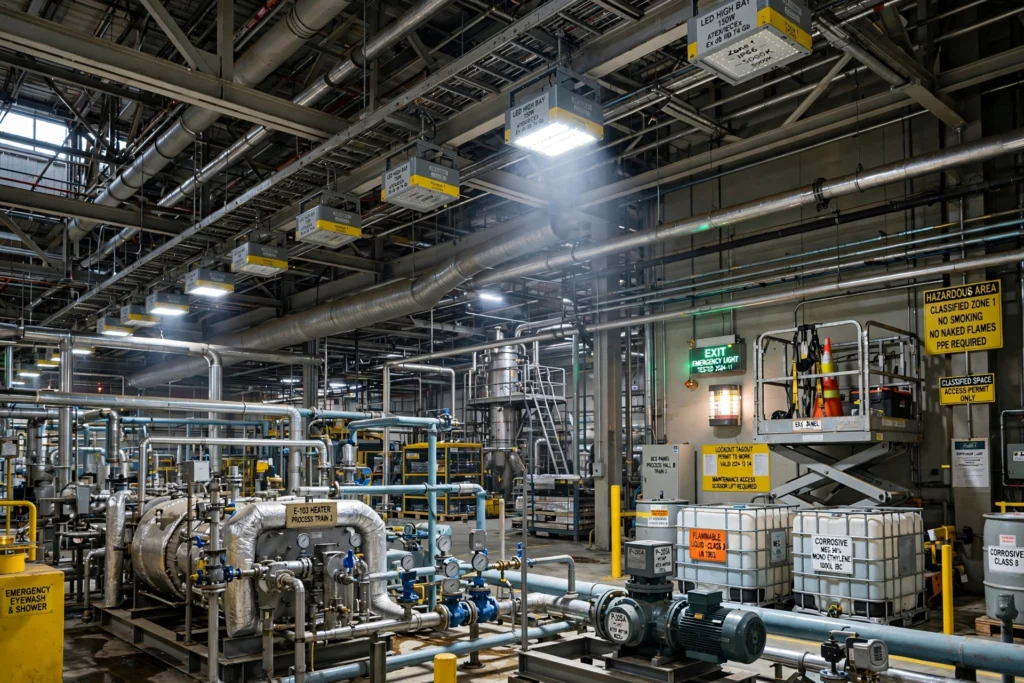
High-bay lighting is commonly required in industrial facilities with high ceilings.
In hazardous environments, specialized LED high-bay luminaires can provide illumination across larger areas while meeting the relevant hazardous-location requirements.
Applications can include:
Petrochemical production buildings, industrial processing halls, chemical plants, manufacturing facilities, storage areas, and other classified industrial spaces.
The lighting design should consider mounting height, beam distribution, obstruction from process equipment, maintenance access, illumination requirements, and emergency lighting requirements.
Simply increasing lumen output is not necessarily the best solution.
The beam distribution should be matched to the geometry of the space.
Hazardous Area LED Floodlights
Floodlights can be useful where broad-area illumination is required.
They may be installed around:
- Tank farms
- Loading areas
- Perimeter zones
- Process equipment
- Access roads
- Maintenance areas
- Industrial yards
The fixture’s certified protection method, mounting arrangement, cable entry system, and environmental rating must all be considered.
For outdoor installations in the UAE, the design should additionally account for high temperatures, UV exposure, dust, humidity, corrosion, and weather conditions.
Explosion-Proof LED Linear Lighting
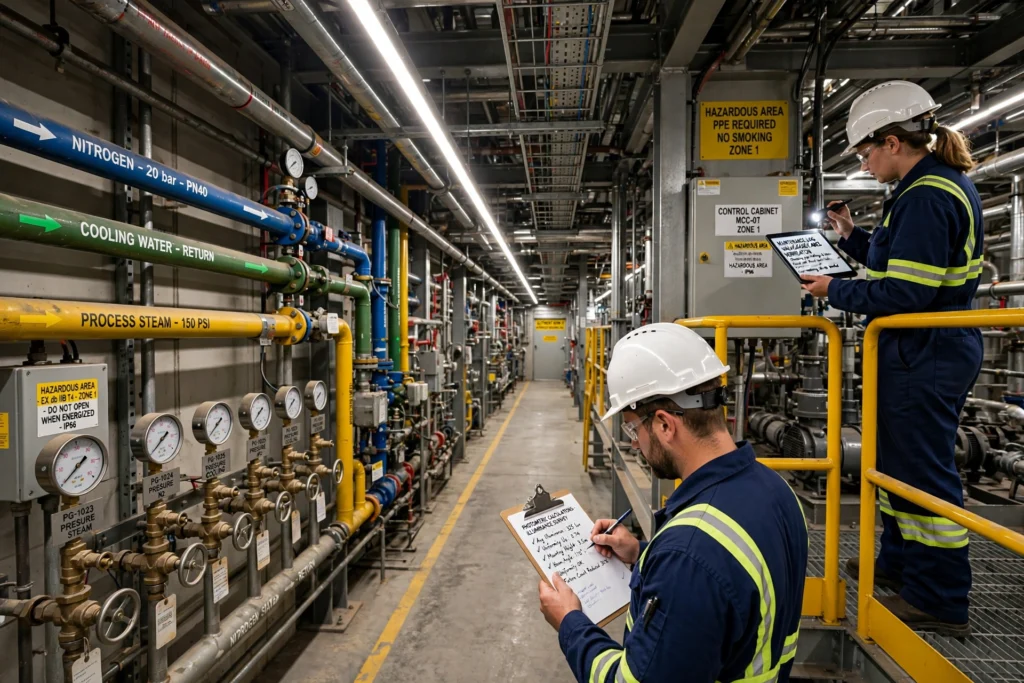
Linear LED luminaires can be useful in industrial areas where long, continuous illumination is required.
They can provide relatively uniform illumination across:
- Industrial corridors
- Processing areas
- Workshops
- Access platforms
- Equipment rooms
- Production areas
The advantage is not simply appearance.
Linear distribution can sometimes reduce the number of individual fixtures required while creating more consistent illumination.
The final decision should be based on photometric calculations rather than fixture quantity alone.
Optical Performance Is Still Important
Safety certification does not automatically guarantee good lighting design.
A certified hazardous-area luminaire can still be poorly positioned.
Professional lighting design should consider:
Illuminance, uniformity, glare, beam angle, mounting height, shadows, visual tasks, color rendering, and maintenance requirements.
For industrial workers, adequate visibility can affect the ability to identify:
- Valves
- Gauges
- Labels
- Pipe markings
- Equipment condition
- Warning signs
- Walkways
- Maintenance points
The objective is therefore to achieve both hazardous-area compliance and useful visual performance.
Hazardous-Area Lighting in UAE Oil and Gas Facilities
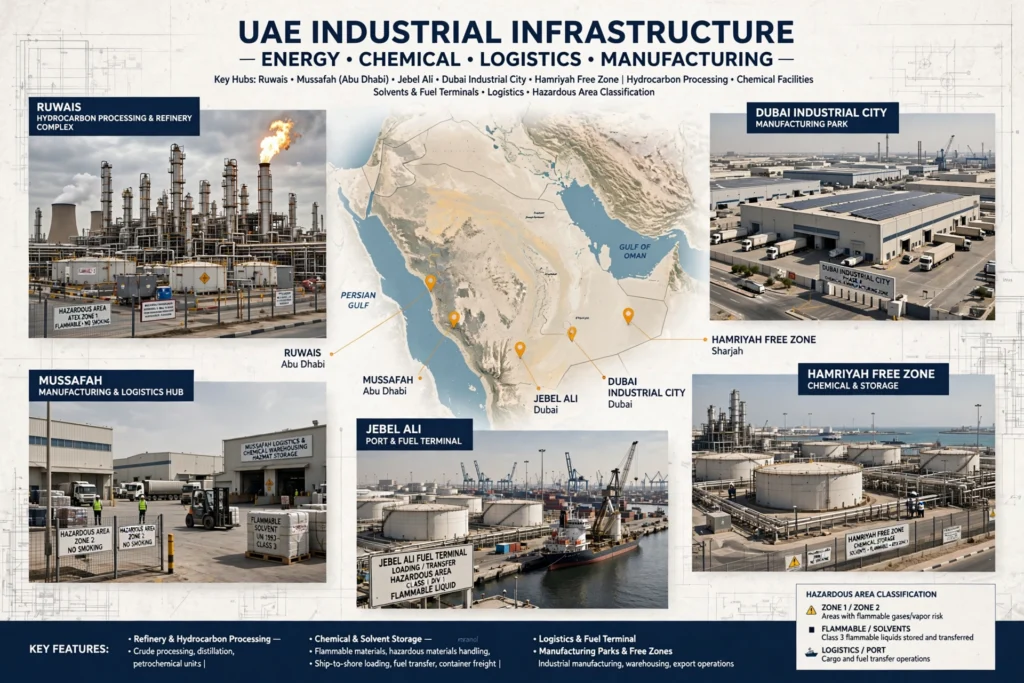
The UAE has a significant industrial and energy infrastructure, making hazardous-area electrical equipment relevant to many projects.
Industrial locations such as Ruwais, Abu Dhabi, Mussafah, Jebel Ali, Dubai Industrial City, and Hamriyah Free Zone contain different types of manufacturing, energy, logistics, chemical, and industrial operations.
A project in a refinery environment may involve hydrocarbon processing and storage.
A chemical facility may handle solvents or other flammable substances.
A fuel terminal may contain loading and transfer areas where hazardous-area classification is critical.
Each project must therefore be assessed individually.
A lighting supplier should not assume that one hazardous-area luminaire is suitable for every industrial site.
Explosion-Proof Lighting for Refineries
Refineries contain numerous process areas where flammable hydrocarbons may be present.
Lighting may be required around:
Distillation units, pumps, compressors, pipe racks, tank farms, loading facilities, process skids, control areas, and maintenance locations.
In these environments, equipment selection must follow the site’s hazardous-area documentation and engineering requirements.
The lighting system may also need to integrate with broader electrical infrastructure, including cable glands, junction boxes, conduits, distribution systems, emergency lighting, and control equipment.
The luminaire cannot be considered separately from the installation.
Chemical and Petrochemical Plants
Chemical processing facilities can contain a wide range of hazardous substances.
The relevant properties may include:
- Flash point
- Auto-ignition temperature
- Vapor characteristics
- Gas group
- Dust properties
- Release frequency
- Operating temperature
This information influences equipment selection.
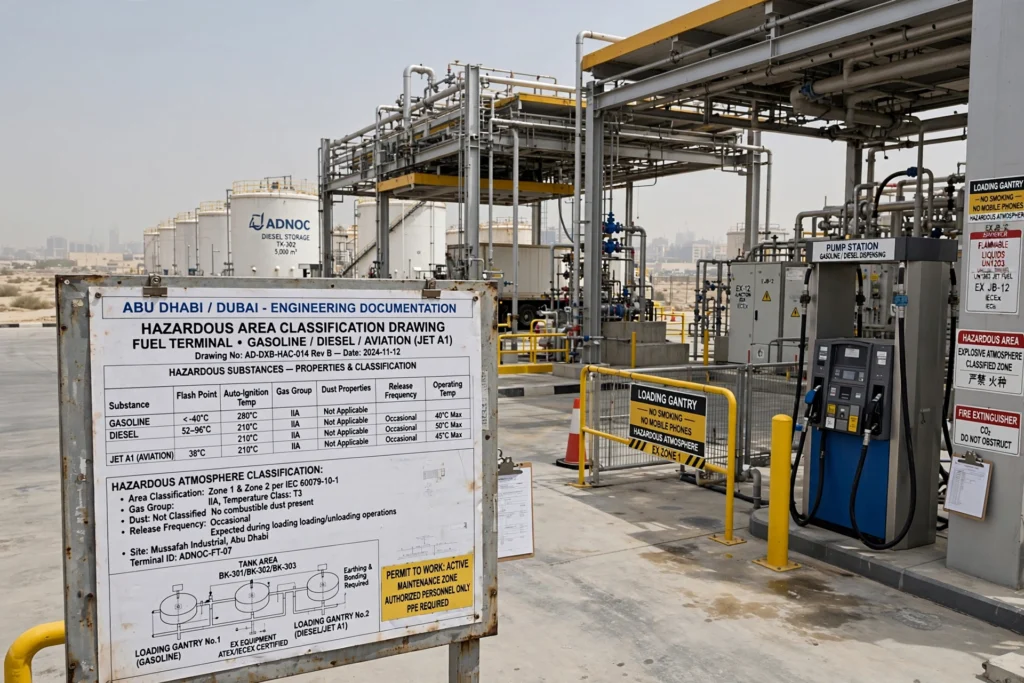
For a chemical plant in Abu Dhabi or Dubai, the lighting design team should obtain the hazardous-area classification drawings and equipment schedules before specifying luminaires.
This is one of the areas where engineering documentation is more valuable than generic product descriptions.
Fuel Stations and Fuel Terminals
Fuel-handling areas require careful consideration because gasoline, diesel, aviation fuel, and other petroleum products can create hazardous atmospheres under specific conditions.
Lighting may be required around:
- Fuel pumps
- Tank areas
- Loading gantries
- Transfer stations
- Canopies
- Maintenance zones
The applicable hazardous-area classification and local project requirements should determine the equipment specification.
A conventional outdoor LED floodlight should never be substituted for certified hazardous-area equipment simply because it has a high IP rating.
IP Rating and Explosion Protection Are Not the Same
This distinction deserves special attention.
IP65, IP66, or IP67 describes protection against ingress of solids and water under defined test conditions.
It does not by itself establish suitability for an explosive atmosphere.
A fixture can have an excellent IP rating and still be inappropriate for a Zone 1 or Zone 2 hazardous area.
Hazardous-area equipment requires the appropriate protection concept and certification.
This is one of the most common misunderstandings when industrial lighting is purchased through general electrical channels.
What Should Buyers Check on an Ex LED Luminaire?
A professional buyer should request the complete technical documentation.
Important information can include:
Hazardous-area certification
Protection concept
Zone suitability
Gas or dust group
Equipment Protection Level (EPL)
Temperature classification
Ambient temperature range
Ingress protection
Electrical rating
Photometric data
Cable entry requirements
Mounting method
Operating life
Warranty
IECEx provides an online certification framework intended to provide confidence in certified Ex equipment, with certificates and associated technical documentation available through its certification system.
Cable Glands and Installation Components Matter
One of the biggest practical mistakes is selecting a certified luminaire but ignoring the rest of the installation.
Hazardous-area electrical systems can involve specialized:
- Cable glands
- Junction boxes
- Conduit systems
- Cable entries
- Connectors
- Mounting hardware
- Isolation equipment
The installation method needs to maintain the required protection concept.
IEC 60079-14 specifically addresses the design, selection, and erection of electrical installations in explosive atmospheres.
Therefore, a compliant luminaire does not automatically make an entire installation compliant
Maintenance of Explosion-Proof LED Lighting
Maintenance is another important part of hazardous-area safety.
IECEx identifies IEC 60079-17 as the standard dealing with inspection and maintenance of electrical installations in explosive atmospheres.
Maintenance programs should consider:
Physical damage, enclosure condition, cable entries, seals, mounting, corrosion, electrical connections, lens condition, and certification integrity.
Workers should not modify certified equipment in ways that invalidate its certification.
For example, drilling an enclosure, using an incorrect cable gland, or replacing components with non-approved alternatives can compromise the protection concept.
Corrosion Protection in UAE Industrial Environments
UAE industrial sites can be harsh environments for electrical equipment.
Outdoor luminaires may experience:
- High ambient temperatures
- Sand and dust
- Humidity
- Salt-laden air near coastal locations
- Industrial pollutants
- UV exposure
- Chemical atmospheres
This makes enclosure material and corrosion resistance important.
A lighting specification for a coastal industrial site near Jebel Ali, Abu Dhabi, or Hamriyah may need to consider environmental exposure differently from an indoor industrial facility.
The hazardous-area certification remains essential, but environmental durability should also be evaluated.
Emergency Lighting in Hazardous Areas
Emergency lighting presents another layer of design consideration.
Industrial facilities need sufficient visibility during power interruptions, emergencies, evacuation, and maintenance situations.
Where emergency luminaires are required within hazardous areas, the equipment must be appropriate for the classified location.
Designers should consider:
Emergency duration, battery arrangement, escape routes, illumination levels, equipment certification, testing procedures, and integration with the facility’s emergency systems.
Emergency lighting should be addressed during the initial electrical design rather than added after the main lighting installation.
How to Choose an Explosion-Proof LED Lighting Supplier
Selecting a supplier should involve more than comparing lumen output and price.
A technically capable supplier should understand:
- Hazardous-area classifications
- IEC 60079 concepts
- IECEx certification
- Temperature classes
- Gas and dust groups
- Equipment Protection Levels
- Industrial photometric requirements
- Cable entry systems
- Environmental conditions
- Installation requirements
A supplier should also be able to provide the relevant certification and technical documentation rather than simply claiming that a product is “explosion-proof.”
For projects in Dubai, Abu Dhabi, Sharjah, Ruwais, Jebel Ali, Mussafah, and other UAE industrial areas, technical support can be particularly valuable when the project involves consultants, EPC contractors, electrical contractors, and facility operators.
Businesses evaluating an Explosion-Proof LED Lighting Supplier should therefore assess certification, engineering support, product traceability, documentation, availability, and after-sales support alongside price.
Common Mistakes in Hazardous-Area Lighting Projects
Several avoidable mistakes can increase project risk.
Selecting by IP Rating Alone
IP protection does not equal hazardous-area certification.
Ignoring the Zone
A product suitable for one hazardous-area classification may not be suitable for another.
Ignoring Gas or Dust Group
The hazardous substance matters.
Ignoring Temperature Class
The equipment’s maximum surface temperature must be appropriate for the application.
Modifying Certified Equipment
Unauthorized drilling, alterations, or component substitutions can compromise certification.
Forgetting Cable Entries
The cable gland and entry system are part of the installation.
Focusing Only on Wattage
Lighting quality depends on distribution and illuminance, not just power consumption.
Buying Without Documentation
Certification claims should be supported by verifiable technical documents.
A Better Procurement Process for UAE Industrial Projects
A practical procurement process can follow this sequence:
First, obtain the hazardous-area classification documents.
Second, identify the hazardous substance and relevant gas or dust characteristics.
Third, establish the required zone, equipment group, EPL, and temperature classification.
Fourth, define the lighting performance requirements.
Fifth, select certified luminaires matching those requirements.
Sixth, verify cable glands, mounting accessories, and installation requirements.
Finally, review certification and technical documentation before procurement and installation.
This approach reduces the risk of purchasing a fixture that looks appropriate on paper but cannot legally or technically be installed in the intended location.
Final Thoughts
Explosion-proof LED lighting is a specialized industrial lighting solution where electrical safety, hazardous-area certification, photometric performance, environmental durability, and installation engineering must work together.
For facilities handling flammable gases, vapors, liquids, or combustible dust, the correct lighting specification begins with understanding the hazardous area—not with choosing a fixture from a catalog.
IECEx and the IEC 60079 series provide an internationally recognized framework covering equipment requirements, hazardous-area classification, installation, inspection, and maintenance.
For UAE projects in Dubai, Abu Dhabi, Ruwais, Jebel Ali, Mussafah, Sharjah, Al Quoz, and other industrial locations, the selection process should also consider the region’s heat, dust, humidity, corrosion exposure, and operational requirements.
The most important principle is simple: never treat “industrial-grade,” “weatherproof,” or “high IP rating” as a substitute for hazardous-area certification.
A professional project should verify the zone, gas or dust group, temperature classification, Equipment Protection Level, protection concept, ambient temperature, ingress protection, certification, cable entries, installation method, and photometric performance before equipment is approved.
When these factors are evaluated together, LED technology can provide efficient, reliable, and effective illumination while supporting the demanding requirements of hazardous industrial environments.