Separating Myth From Fact in Linear Lighting
Misconceptions about LED linear lighting persist among commercial buyers and specifiers in the UAE, and acting on them leads to poor decisions and disappointing installations. From assumptions about product equivalence to misunderstandings about dimming and colour, these myths shape specifications in ways that undermine the result. This guide examines the common myths and sets out the facts, helping developers, consultants, and procurement teams specify on accurate understanding rather than misconception.
It addresses the misconceptions that most commonly affect commercial linear lighting decisions, replacing them with the technical facts that support sound specification across commercial, hospitality, and institutional projects in the Emirates.
Myth: All Linear Products Are Equivalent
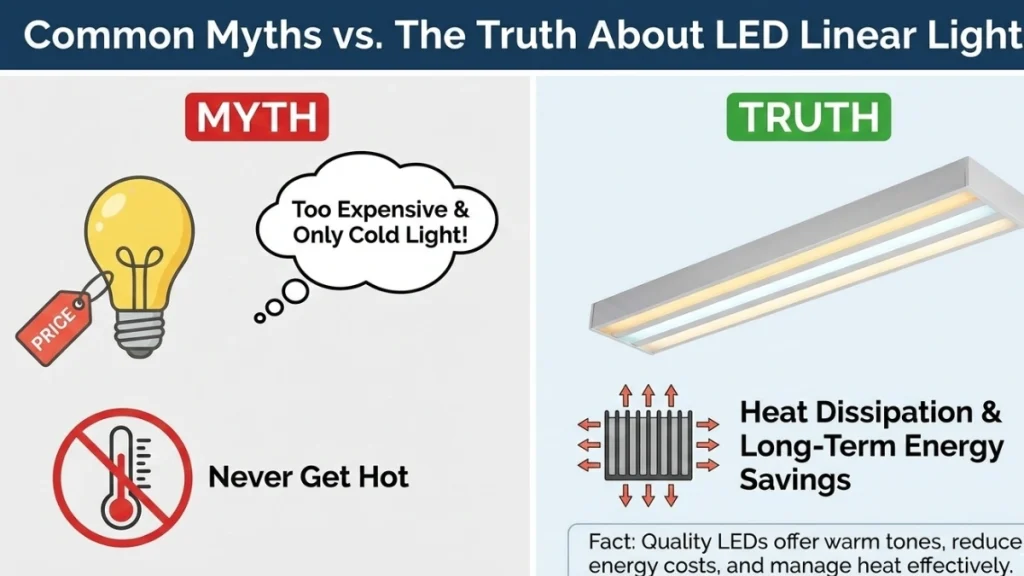
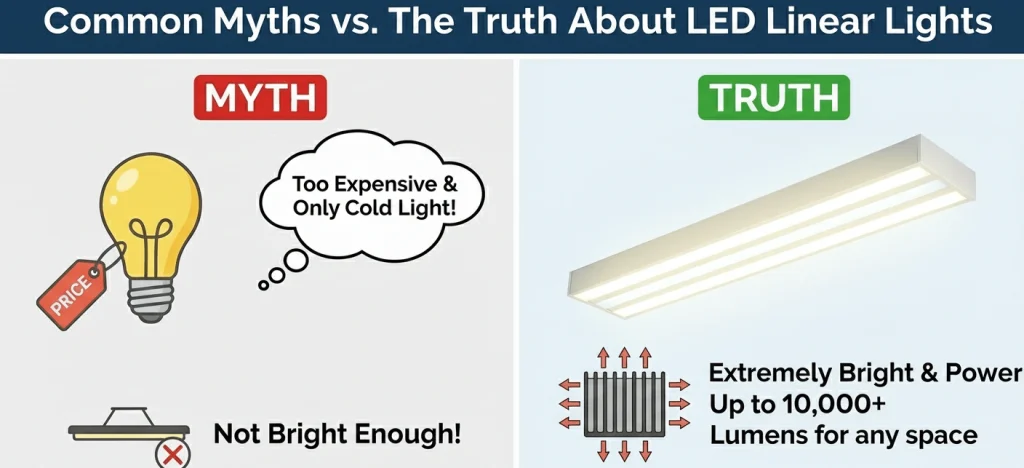
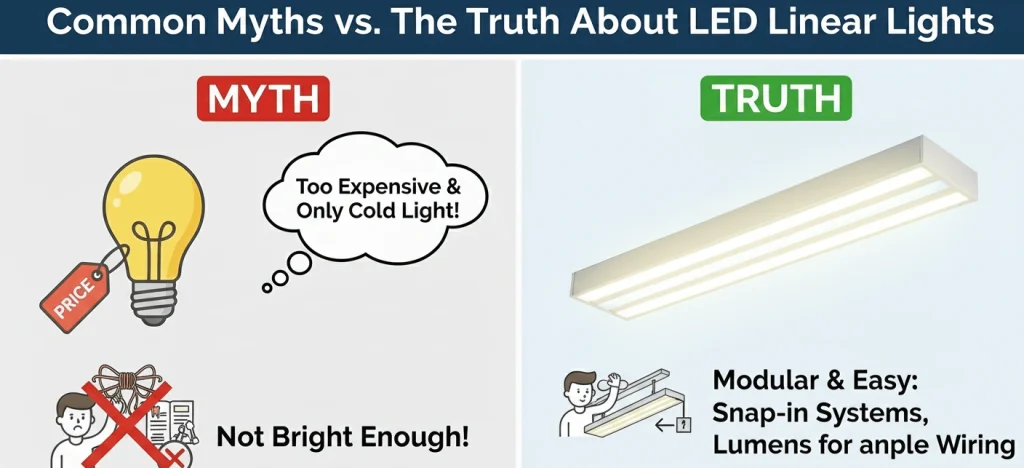
Perhaps the most damaging misconception is that LED linear products are interchangeable commodities differing only in price. In reality, linear fixtures vary enormously in driver quality, module efficacy, optical performance, colour consistency, and thermal design. Products that appear similar on a specification sheet perform very differently in service, particularly in demanding UAE conditions where quality differences become starkly apparent.
The fact is that quality matters profoundly in linear lighting, and specifying on price alone risks a poor outcome. Evaluating products on their genuine quality, the driver, the thermal design, the colour consistency, the certification, rather than treating them as equivalent, protects against the disappointing installations that the equivalence myth produces across commercial projects.
Myth: Higher Wattage Means More Light
A common misconception equates wattage with light output, leading specifiers to compare products on wattage alone. In fact, the relationship between wattage and light output depends on efficacy, and a high efficacy fixture at lower wattage can deliver more usable light than a low efficacy fixture at higher wattage. Comparing wattage without efficacy misleads the specification.
The fact is that luminous output and efficacy, not wattage, determine the light a fixture delivers and its energy performance. Comparing products on lumens and efficacy, particularly important for the energy calculations UAE green building regulations require, supports accurate specification, while comparing on wattage alone misleads it.
Myth: LED Linear Cannot Dim Reliably
Some specifiers believe LED linear lighting cannot dim smoothly or reliably, an assumption based on early or poorly matched systems. In fact, modern linear systems with appropriate drivers dim smoothly across the full range when paired with compatible controls. The dimming problems that occur, flicker, minimum load issues, arise from incompatibility, not from inherent LED limitations.
The fact is that correctly specified linear systems dim reliably and smoothly. Matching the driver to a compatible control system, DALI, 0 to 10 volt, or phase cut as appropriate, delivers the smooth dimming that commercial and hospitality applications require, dispelling the myth that LED linear cannot dim well, supported by quality LED linear lights for commercial dimming applications.
Myth: Colour Temperature Is Fixed Forever
A persistent misconception holds that LED colour temperature is fixed at manufacture and cannot be changed. In fact, tunable white systems adjust colour temperature across a wide range, supporting circadian lighting and the flexible use of spaces. The assumption that colour temperature is permanently fixed overlooks the tunable systems that modern linear lighting offers.
The fact is that tunable white linear systems provide colour temperature flexibility, adjusting from warm to cool to suit different times, uses, and occupant needs. This capability, valuable for circadian lighting and multipurpose spaces, dispels the myth of fixed colour temperature and expands the possibilities of linear lighting in commercial environments.
Myth: LED Means No Maintenance
The long life of LED lighting leads some to assume it requires no maintenance at all. In fact, while LED linear lighting requires far less maintenance than the systems it replaced, it still benefits from cleaning, driver replacement, and planned replacement to sustain its performance across the building life. The no maintenance assumption neglects the maintenance that sustains the installation.
The fact is that LED linear lighting is low maintenance, not no maintenance, and informed maintenance maximises its life and sustains its performance. Cleaning to maintain output, replacing failed drivers, and planning replacement deliver the best from the installation, dispelling the myth that LED lighting can simply be installed and forgotten.
Myth: Cheap and Premium Perform the Same
Related to the equivalence myth is the belief that cheap and premium linear products perform identically, making the cheap option the rational choice. In fact, the performance, reliability, and longevity of cheap and premium products differ substantially, particularly in UAE conditions. The cheap product often consumes more energy, fails earlier, and disappoints in ways the premium product does not.
The fact is that the difference between cheap and premium products, though not always visible on paper, is real and significant. The premium product delivers better efficiency, reliability, and longevity, proving the more economical choice across the installation life despite the higher purchase price, dispelling the myth that cheap and premium perform the same.
Myth: Certification Is Just Paperwork
Some treat certification, DEWA approval, CE marking, RoHS compliance, as mere paperwork to be satisfied. In fact, certification represents independent verification of safety and performance, and it is a genuine requirement for UAE commercial projects, essential for authority submission and occupancy. Treating certification as a formality risks specifying products that fail compliance and delay the project.
The fact is that certification matters, both as verification of quality and safety and as a requirement for compliance. Specifying certified products from recognised manufacturers ensures both genuine quality and regulatory compliance, dispelling the myth that certification is mere paperwork and recognising it as an essential element of sound commercial specification.
Myth: Linear Lighting Is Only for Offices
Some associate linear lighting solely with offices, overlooking its broad application. In fact, linear lighting serves commercial, hospitality, healthcare, education, and industrial environments, each benefiting from its efficiency, quality, and flexibility. The association with offices alone overlooks the versatility that makes linear lighting valuable across the full range of commercial environments.
The fact is that linear lighting is versatile, serving environments far beyond the office. Understanding its application across commercial, hospitality, healthcare, and industrial spaces reveals the breadth of its usefulness, dispelling the myth that it is an office only solution and recognising its value across the diverse commercial environments of the UAE.
Myth: More Light Is Always Better
A misconception holds that more light is always better, leading to over illumination that wastes energy and creates discomfort. In fact, the right amount of light for the task and environment, neither too little nor too much, delivers the best result. Over illumination wastes energy, creates glare, and undermines comfort, while appropriate illuminance serves the space well.
The fact is that appropriate illumination, matched to the task and environment, is the objective, not maximum light. Specifying the right illuminance for each space, following the established standards for different environments, delivers comfort and efficiency, dispelling the myth that more light is always better and supporting considered, appropriate lighting design.
Myth: Specification Does Not Affect Outcome
Some treat lighting specification as a formality with little effect on the outcome, assuming any reasonable product will do. In fact, the specification profoundly affects the outcome, determining the quality, efficiency, comfort, compliance, and longevity of the installation. A careless specification produces a poor result, while a considered specification delivers lighting that serves the building well.
The fact is that specification matters greatly, shaping every aspect of the lighting outcome. Investing care in the specification, matching products to requirements and selecting on genuine quality, delivers far better results than treating specification as a formality, dispelling the myth that specification does not affect the outcome.
Why These Myths Persist
These myths persist partly because the differences they obscure are not always visible, and partly because acting on them appears to save cost or effort. The equivalence and price myths in particular appeal because they simplify decisions and promise savings. Yet the savings prove illusory and the simplification produces poor outcomes, perpetuating the disappointment that the myths cause.
Understanding why these myths persist, and recognising the genuine factors they obscure, helps specifiers resist them. The discipline of specifying on accurate understanding, evaluating genuine quality and matching products to requirements, overcomes the appeal of the myths and delivers the better outcomes that sound specification produces.
Specifying on Fact, Not Myth
The antidote to these myths is specification grounded in fact, evaluating products on their genuine quality and performance, matching them to the requirements of each space, and respecting the requirements of compliance. This factual approach, informed by an understanding of the technology and the application, delivers the quality, efficiency, and compliance that commercial projects require.
Adopting this factual approach, and resisting the myths that mislead specification, allows developers, consultants, and procurement teams to deliver lighting that genuinely serves their buildings. The facts support better decisions than the myths, and specifying on them delivers the results that quality commercial projects require across the UAE.
The Value of Knowledgeable Support
Navigating the myths and specifying on fact benefits from knowledgeable support, a supplier who provides accurate technical information and honest advice. Such a partner helps specifiers understand the genuine factors that matter, evaluate products accurately, and avoid the myths that mislead. This support is particularly valuable for teams without deep lighting expertise.
As an authorised OPPLE distributor, Tricircle provides this knowledgeable support, supplying accurate technical information and quality products that perform as represented. Our team helps specifiers across the UAE specify on fact rather than myth, delivering the lighting that their commercial projects genuinely require.
Sound Specification With Tricircle
Specifying linear lighting on fact, with quality products and knowledgeable support, delivers the results that commercial projects require. As an authorised OPPLE distributor, Tricircle supplies certified, quality linear lighting across the UAE, supported by the accurate technical information that sound specification depends upon.
To discuss linear lighting specification for your commercial project, contact our team at aysha@tricirclegroup.ae or call +971 50 578 1325. We support developers, consultants, and procurement teams across Dubai, Sharjah, Abu Dhabi, and the wider Emirates with quality products and honest advice.