Commercial lighting for supermarkets and hypermarkets is an important part of modern retail design. In large-format stores, lighting does much more than illuminate aisles and products. It affects product visibility, customer navigation, food presentation, employee productivity, energy consumption, safety, merchandising, and the overall shopping experience.
A well-planned supermarket lighting system helps customers see products clearly, compare options comfortably, identify promotional displays, and move naturally through different departments. For operators, the right lighting solution can improve energy efficiency, reduce maintenance requirements, support merchandising strategies, and contribute to a consistent brand environment across multiple stores.
This is particularly relevant in the UAE, where supermarkets and hypermarkets operate for extended hours and cooling and lighting systems can represent significant operational loads. Retailers in Dubai, Abu Dhabi, Sharjah, Ajman, and other Emirates therefore need lighting solutions that combine visual quality, efficiency, durability, and reliable performance.
Modern LED technology has transformed commercial retail illumination. LED linear lights, LED panels, track lighting, spotlights, high-bay fixtures, refrigerated-display lighting, accent lighting, emergency lighting, and smart lighting controls can now be coordinated into a comprehensive retail lighting strategy.
Why Lighting Matters in Supermarkets and Hypermarkets
Supermarkets contain many different retail environments within one building. Fresh produce, bakery sections, meat counters, seafood displays, beverages, packaged foods, household products, electronics, cosmetics, promotional areas, checkout zones, and storage areas all have different illumination requirements.
A single lighting fixture or lighting level cannot provide the best visual result for every department.
General aisle lighting needs to provide uniform illumination and comfortable visibility. Fresh-food areas may benefit from carefully selected colour rendering. Promotional displays require accent lighting to attract attention. Checkout areas need clear visibility for customers and employees.
The lighting strategy should therefore be based on the store’s layout, merchandise categories, ceiling height, shelving arrangement, customer flow, branding, and operational requirements.
LED Lighting for Modern Retail Stores
LED technology has become a preferred solution for many supermarket and hypermarket applications because it can provide high efficiency, long operating life, controllable light output, and a wide range of colour temperatures and beam distributions.
LED fixtures can replace older fluorescent and high-intensity discharge systems while providing opportunities to redesign the lighting layout.
Common retail LED solutions include:
LED linear lights, LED panel lights, track lights, spotlights, downlights, high-bay lights, strip lighting, refrigerated cabinet lighting, canopy lights, and outdoor luminaires.
The correct fixture depends on mounting height, application, required illuminance, beam angle, colour rendering, operating schedule, and maintenance access.
Aisle Lighting and Product Visibility
Aisles form the core of a supermarket’s shopping environment.
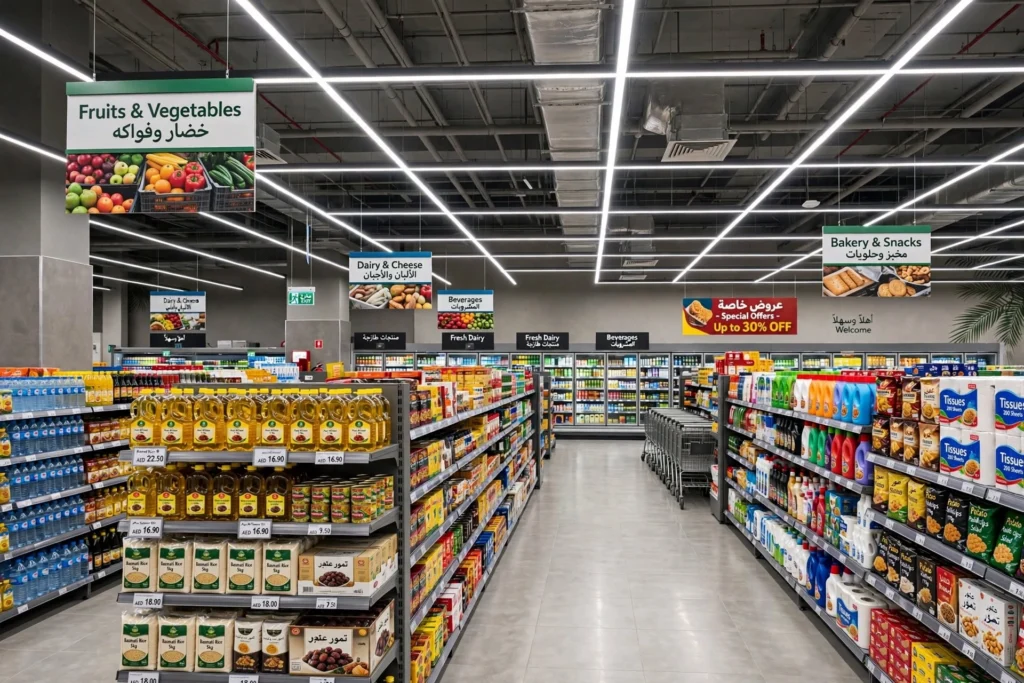
Lighting should provide consistent illumination along the walking path while ensuring that products on shelves remain clearly visible.
The position of luminaires relative to shelving is important. Poor positioning can create shadows across products, excessive brightness at eye level, or uneven illumination between aisles.
Linear LED fixtures are often suitable for aisle applications because they can provide continuous illumination and work effectively with long shelving layouts.
Lighting layouts should be developed alongside the merchandising plan so that fixtures illuminate products rather than simply the floor.
Colour Temperature for Supermarkets
Colour temperature affects the visual atmosphere of a store.
Cooler white light can create a clean and energetic appearance and may be suitable for general retail areas.
Neutral white lighting can provide a balanced environment for product visibility and colour accuracy.
Warmer light may be appropriate for selected food, bakery, café, or premium sections where a more welcoming atmosphere is desirable.
Rather than choosing one colour temperature for the entire store, retailers can use different lighting characteristics to distinguish departments while maintaining overall visual consistency.
Colour Rendering and Fresh Food Displays
Colour rendering is particularly important in fresh-food departments.
Customers often evaluate produce, meat, seafood, bakery products, and prepared foods visually. If lighting causes products to appear dull or unnatural, it can negatively affect presentation.
A high Colour Rendering Index (CRI) can help reproduce product colours more accurately.
However, CRI should not be considered in isolation. Retailers and lighting designers should also evaluate spectral characteristics, visual comfort, energy efficiency, fixture temperature, and the specific merchandise being illuminated.
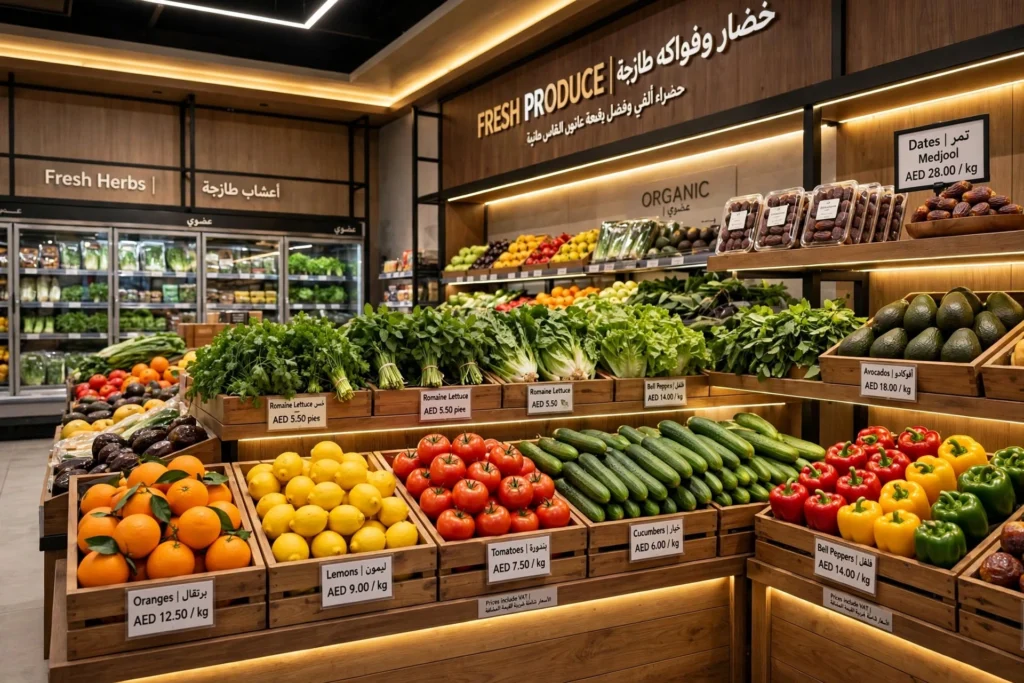
Fresh Produce Lighting
Fruit and vegetable departments benefit from bright, clear, visually comfortable lighting.
The objective is to make products appear fresh and appealing while maintaining natural-looking colours.
Lighting should be distributed across the display rather than producing strong highlights in isolated areas.
Vertical illumination can be important because produce displays often extend upward rather than remaining at floor level.
Careful beam control can reduce unnecessary light spill into adjacent aisles.
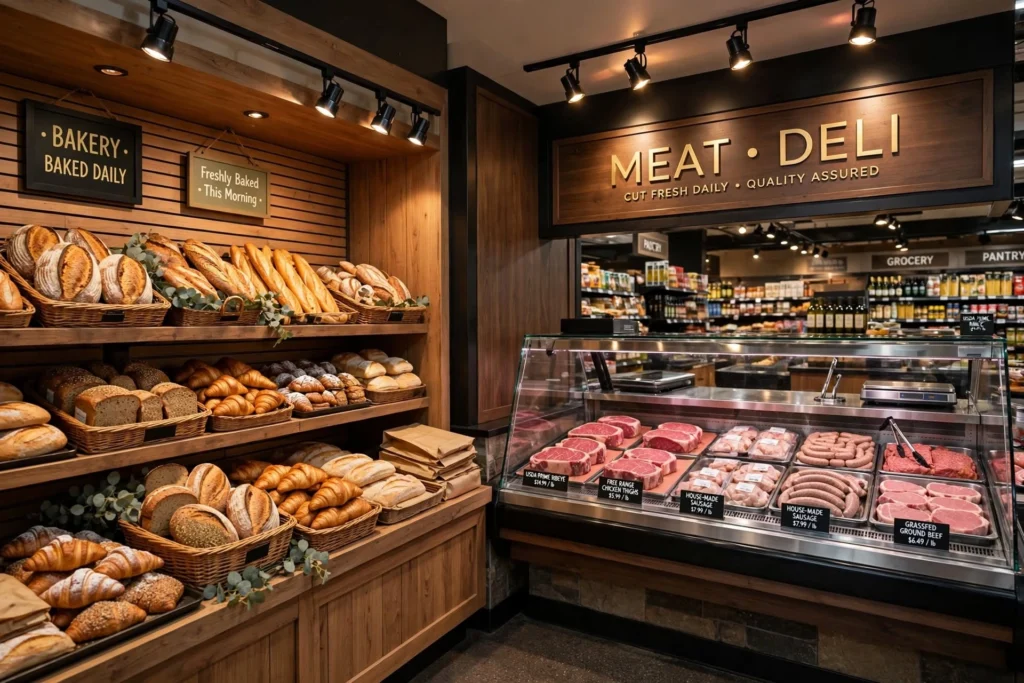
Bakery and Prepared Food Lighting
Bakery areas often benefit from a warmer and more inviting visual environment.
Lighting can highlight bread, pastries, cakes, and prepared foods while supporting the atmosphere of the department.
Pendant fixtures, decorative elements, recessed lighting, and accent illumination can be used alongside general LED lighting.
The lighting should remain coordinated with refrigeration equipment, display cases, signage, and food-service infrastructure.
Meat and Seafood Department Lighting
Meat and seafood displays require careful lighting because colour perception can strongly influence product presentation.
Specialised retail lighting can be used where appropriate to create attractive product appearance while maintaining realistic visual quality.
Fixtures should also be selected for the environmental conditions of the display area, including temperature, moisture, cleaning requirements, and refrigeration equipment.
Lighting design should always consider the operational and food-safety requirements of the specific department.
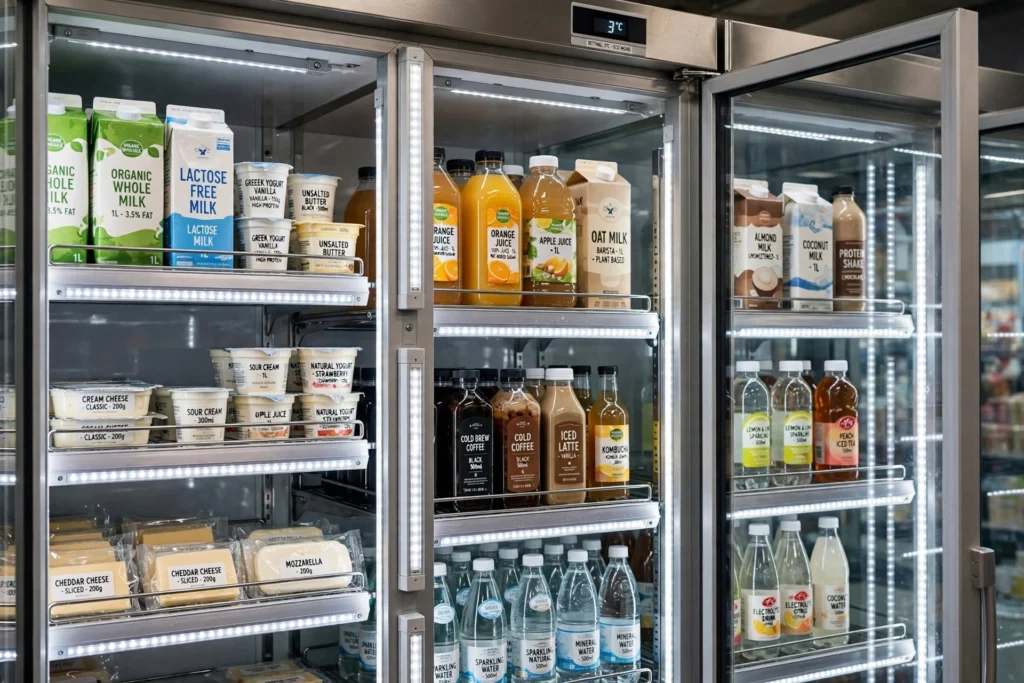
Refrigerated Display Lighting
Refrigerated cabinets require compact and efficient lighting systems.
LED modules and linear LED systems can be integrated into display cases to illuminate products without consuming excessive energy.
Good placement provides consistent vertical and horizontal illumination while minimising glare on glass doors.
Because refrigerated displays operate continuously, efficient lighting can contribute to lower operating costs.
The selected equipment should also be suitable for the temperature and moisture conditions associated with refrigerated environments.
Lighting for Promotional Displays
Promotional areas are designed to attract attention.
Lighting can create contrast between promotional displays and surrounding general illumination.
Track-mounted spotlights provide flexibility because their direction can be adjusted when merchandise or promotional graphics change.
Accent lighting can also be integrated with:
End-cap displays, promotional islands, seasonal displays, branded stands, digital signage, and feature installations.
This makes lighting part of the merchandising strategy rather than simply a building service.
Digital Signage and Retail Lighting
Modern supermarkets increasingly combine physical merchandising with digital communication.
Digital signage, LED displays, interactive screens, and promotional monitors can become important visual elements.
Lighting around these displays should be controlled carefully.
Excessive ambient brightness can reduce screen visibility, while excessive contrast can make the surrounding environment uncomfortable.
A coordinated lighting strategy can help digital content remain readable without making the screens visually overwhelming.
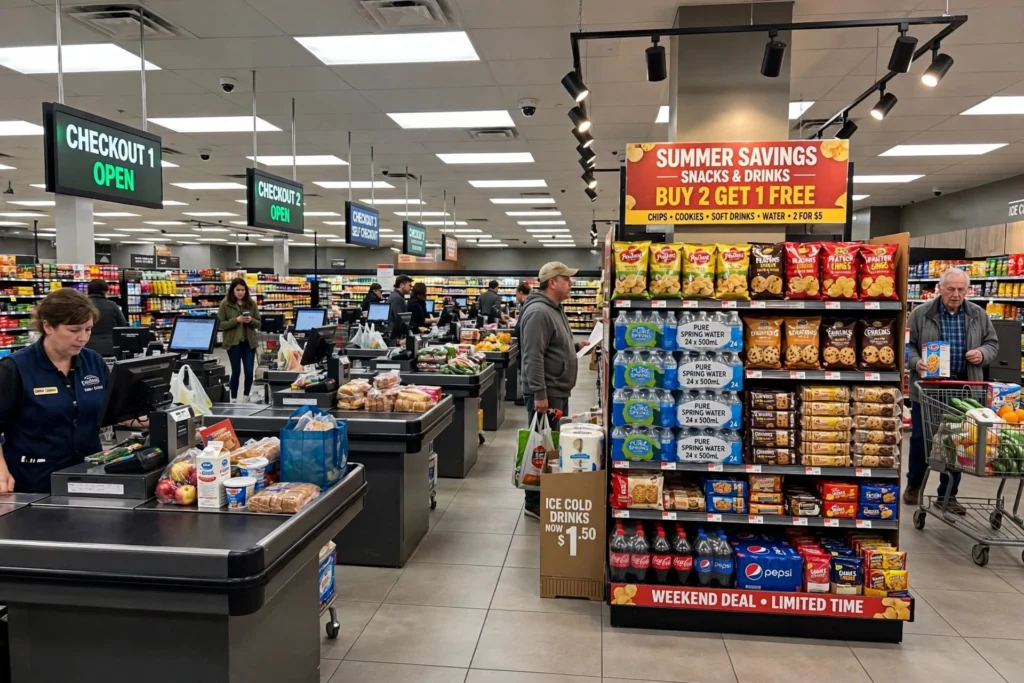
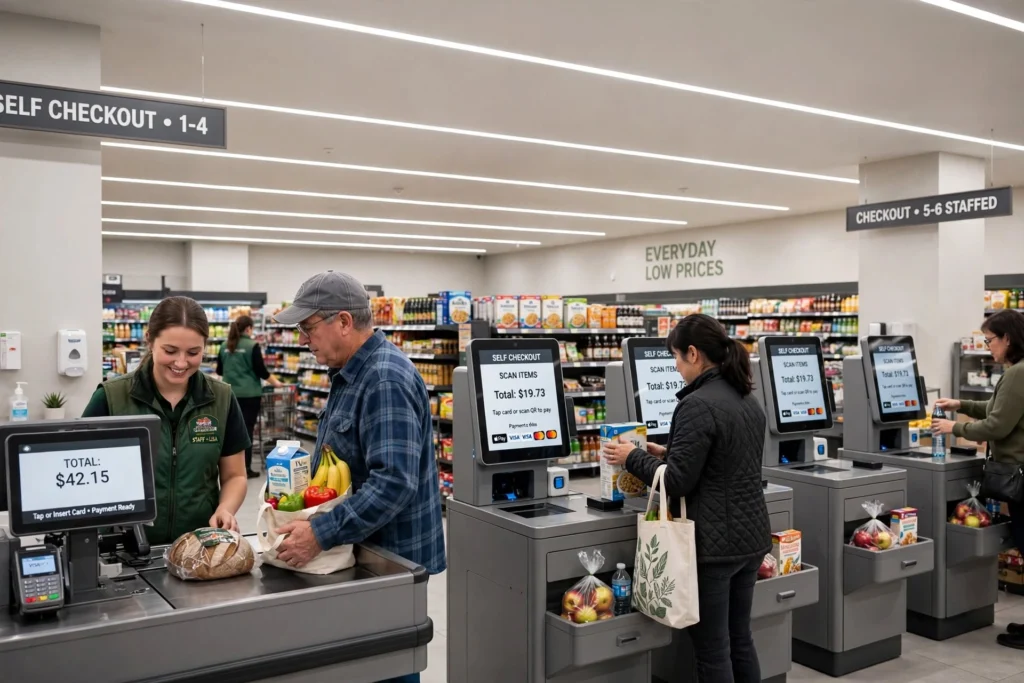
Checkout Area Lighting
Checkout zones require clear and comfortable illumination.
Customers and employees need to see payment terminals, receipts, products, bags, and transaction areas easily.
Lighting should minimise shadows across checkout counters and avoid glare on digital payment screens.
Linear lighting, recessed fixtures, or carefully positioned downlights can provide consistent illumination.
Self-checkout areas may require additional consideration because customers interact directly with scanners, displays, payment terminals, and bagging areas.
Entrance and Exit Lighting
The entrance creates the first visual impression of a supermarket.
Exterior and entrance lighting should support safety, visibility, branding, and customer orientation.
The transition between outdoor daylight and indoor illumination should be considered carefully.
During bright UAE daytime conditions, the entrance area may receive significant daylight, while evening conditions require artificial illumination.
Automatic lighting controls can adjust selected systems according to operating schedules and environmental conditions.
Parking and Exterior Retail Lighting
Hypermarkets often occupy large sites with extensive parking areas.
Exterior lighting needs to support:
Pedestrian safety, vehicle circulation, entrances, loading zones, signage visibility, parking orientation, and security.
LED parking luminaires can provide efficient illumination with long operating lives.
Lighting distribution should be designed to reduce dark zones and excessive glare.
The exterior lighting scheme should also align with applicable site and development requirements.
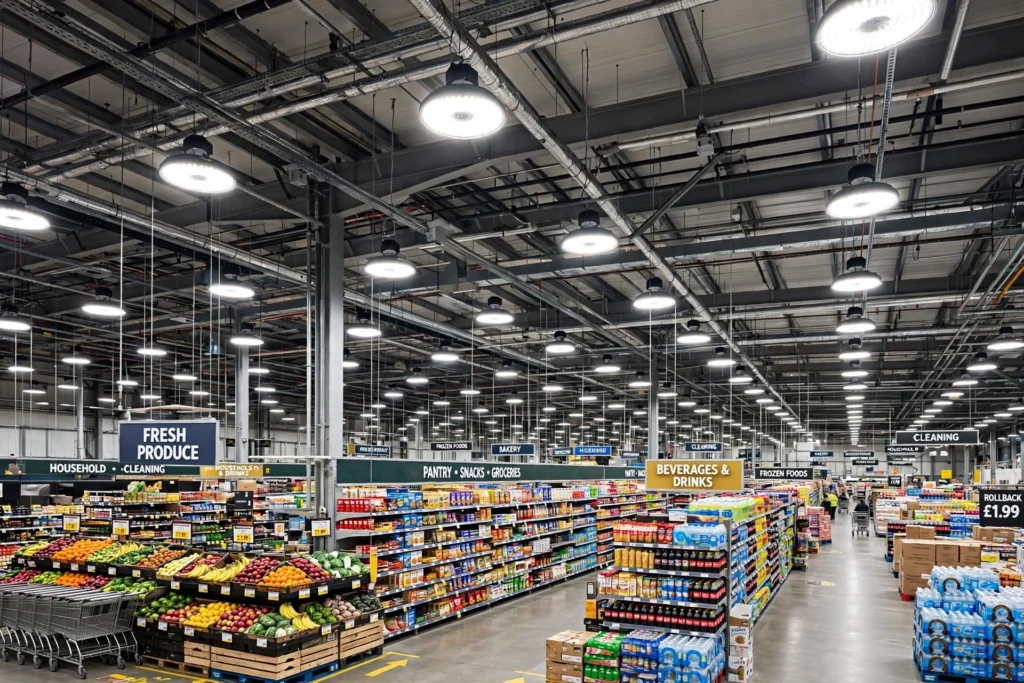
High-Bay Lighting for Hypermarkets
Hypermarkets often have high ceilings, particularly in large-format retail environments.
High-bay LED fixtures can provide efficient illumination from significant mounting heights.
The optical distribution needs to match the aisle configuration and ceiling height.
Narrower beam angles can be useful for concentrating light in specific zones, while wider distributions may be appropriate for open areas.
Photometric calculations are important because installing fixtures based solely on wattage can lead to over-lighting or under-lighting.
Lighting Uniformity and Visual Comfort
Uniformity is one of the most important characteristics of supermarket lighting.
Large differences between bright and dark areas can create visual fatigue and make navigation less comfortable.
A good design considers:
Average illuminance, minimum illuminance, uniformity ratios, glare, vertical illumination, colour quality, and contrast.
Lighting should also avoid direct glare into customers’ eyes.
UGR and other appropriate photometric considerations can help designers evaluate visual comfort depending on the fixture and application.
Energy Efficiency in UAE Retail Environments
Energy efficiency is particularly relevant to supermarkets and hypermarkets because these facilities often operate for long hours.
LED technology can significantly improve lighting efficiency compared with older lighting systems, especially when combined with intelligent controls.
Potential energy-saving strategies include:
High-efficacy LED fixtures, occupancy sensors, daylight harvesting, dimming, scheduling, zoning, and central lighting controls.
Because supermarkets also require substantial refrigeration and HVAC capacity, reducing lighting heat load can potentially provide additional benefits for cooling demand.
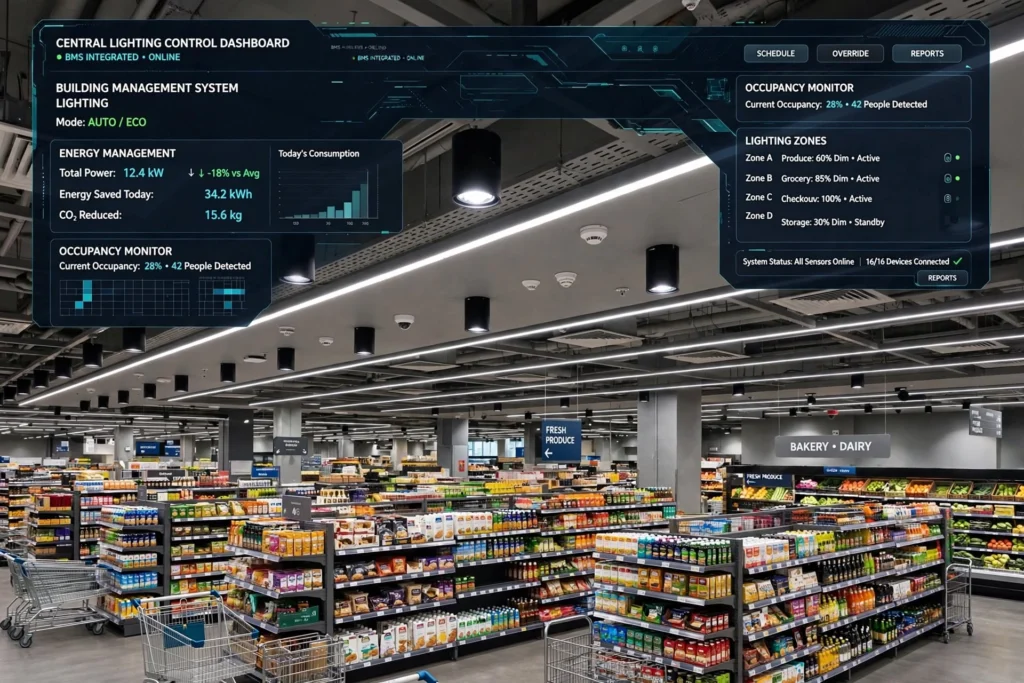
Smart Lighting Controls
Smart lighting systems can provide greater control over retail environments.
A central lighting management platform can allow operators to control different zones according to operating schedules.
Sensors can detect occupancy or daylight conditions.
Dimming can reduce output during periods when full illumination is unnecessary.
Advanced systems may integrate with a Building Management System (BMS), allowing lighting performance to be monitored alongside HVAC and other building services.
This can support energy management and facility operations.
Lighting and Customer Psychology
Retail lighting can influence how shoppers perceive a store.
Bright, uniform lighting can create a sense of cleanliness and accessibility.
Accent lighting can draw attention toward products or promotions.
Warm lighting can create a more intimate atmosphere in selected departments.
Contrast can help customers identify visual priorities.
However, lighting should not manipulate customers through excessive brightness or visual discomfort. The best retail lighting creates an environment that is easy to navigate and pleasant to spend time in.
Lighting and Wayfinding
Large hypermarkets can be difficult to navigate without clear visual organisation.
Lighting can support wayfinding by reinforcing major circulation routes and department transitions.
Changes in fixture type, lighting intensity, ceiling features, or colour temperature can help distinguish different areas.
For example, a main circulation corridor may use a consistent linear lighting system while specialty departments use decorative or accent fixtures.
Lighting can therefore become part of the store’s environmental wayfinding system.
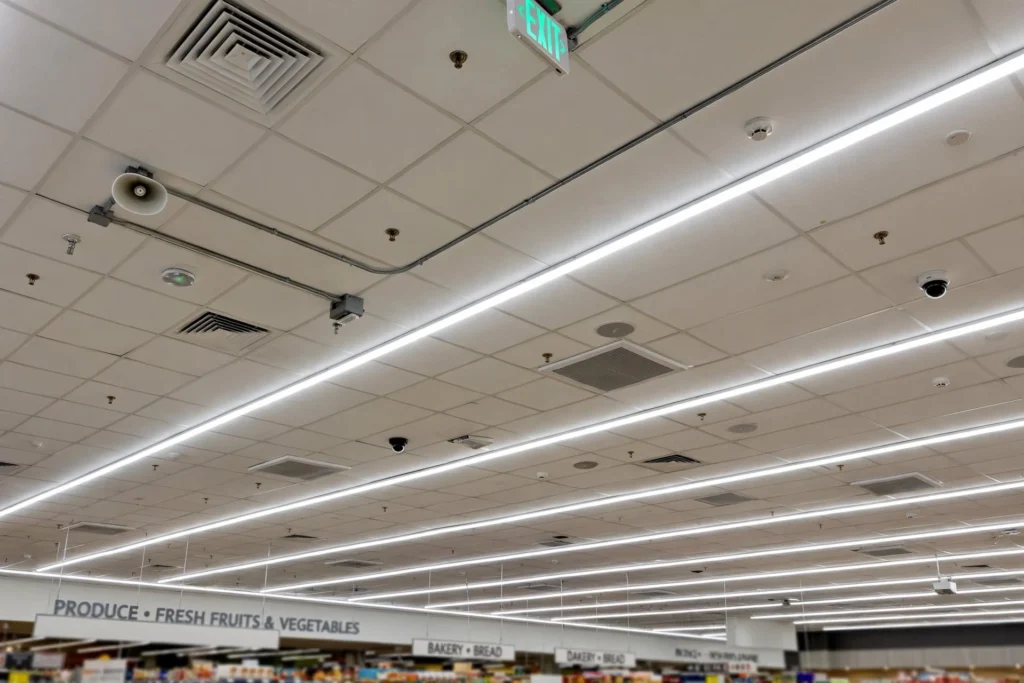
Ceiling Coordination in Supermarket Lighting
Retail lighting must be coordinated with the ceiling.
Ceilings may include:
HVAC diffusers, fire sprinklers, smoke detectors, speakers, cameras, signage, electrical services, and access panels.
Poor coordination can result in an overcrowded ceiling or fixtures positioned incorrectly relative to shelving.
A reflected ceiling plan should therefore be coordinated with architectural, electrical, mechanical, and merchandising layouts before installation.
Lighting for Warehouses and Back-of-House Areas
Supermarkets and hypermarkets also contain non-customer areas.
Storage rooms, receiving areas, staff facilities, offices, cold stores, preparation areas, and loading zones require practical illumination.
Warehouse high-bay LED lighting can support visibility while reducing maintenance requirements.
Service areas should not necessarily use the same decorative lighting approach as customer-facing spaces.
Instead, fixtures should be selected based on task requirements, ceiling height, operating conditions, safety, and energy efficiency.
Emergency and Safety Lighting
Emergency lighting is an essential component of commercial retail facilities.
Supermarkets need suitable emergency illumination and exit signage to support safe evacuation during power interruptions or emergency conditions.
Emergency systems should be planned in coordination with fire and life-safety requirements and applicable UAE regulations.
These systems should also be tested and maintained according to the relevant requirements and manufacturer’s recommendations.
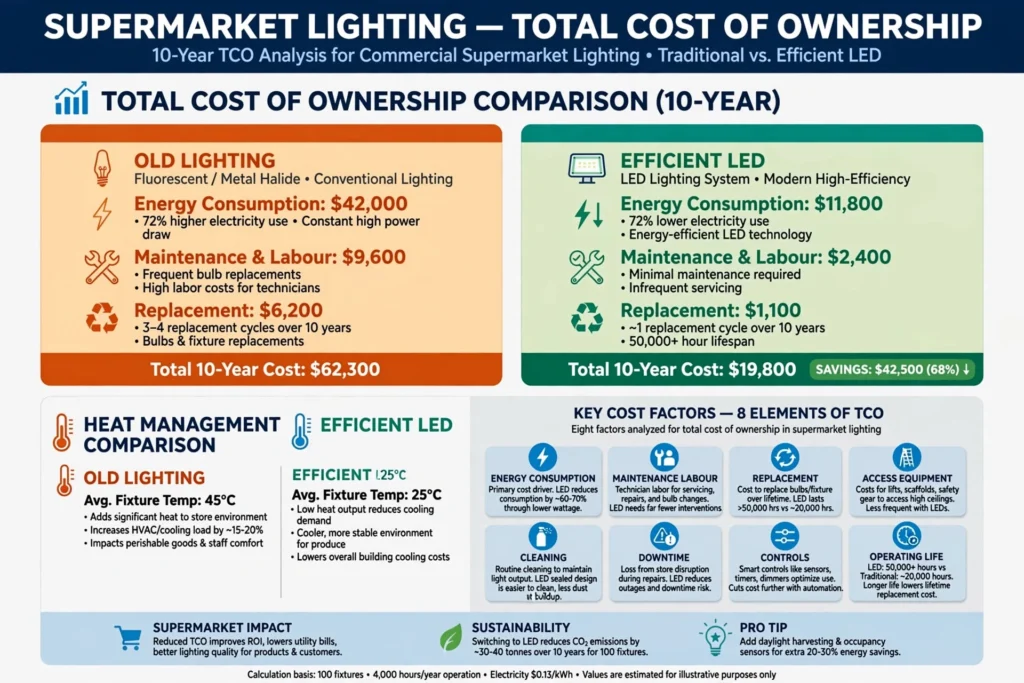
Lighting Maintenance and Lifecycle Costs
Initial purchase price should not be the only consideration when selecting supermarket lighting.
Retailers should evaluate the total cost of ownership.
This can include:
Energy consumption, maintenance labour, replacement components, access equipment, cleaning, downtime, control systems, and expected operating life.
High-quality commercial fixtures may have a higher initial cost but can provide better performance and lower maintenance requirements over the long term.
This is particularly important in supermarkets where replacing fixtures can interfere with customer operations.
Heat Management and Refrigeration
Lighting produces heat, and supermarkets already have substantial cooling requirements because of refrigeration systems, display cases, and air-conditioning.
Efficient LED fixtures generally produce less heat than older lighting technologies for comparable illumination.
Reducing lighting heat gain can help the overall building energy strategy.
The interaction between lighting, HVAC, refrigeration, and building envelope should therefore be considered when evaluating energy performance.
Lighting for Different Store Formats
A neighbourhood supermarket, premium grocery store, hypermarket, warehouse club, and specialty food store may all require different lighting strategies.
A smaller supermarket may prioritise flexible track lighting and compact LED fixtures.
A hypermarket may require high-bay systems combined with aisle lighting and extensive promotional illumination.
A premium grocery store may use decorative lighting and carefully controlled accent illumination to create a more sophisticated shopping environment.
Lighting should therefore reflect the retail format and brand positioning.
Commercial Lighting Standards and Professional Design
Professional lighting design should be based on recognised lighting principles and applicable regulations.
Designers may use photometric software to calculate illumination levels, uniformity, glare, power density, and fixture performance before installation.
Product specifications should be reviewed for:
Lumen output, efficacy, colour temperature, CRI, beam angle, IP rating, operating temperature, driver quality, dimming compatibility, emergency options, warranty, and expected lifetime.
This helps ensure that the proposed system is appropriate for its intended environment.
Sustainable Retail Lighting
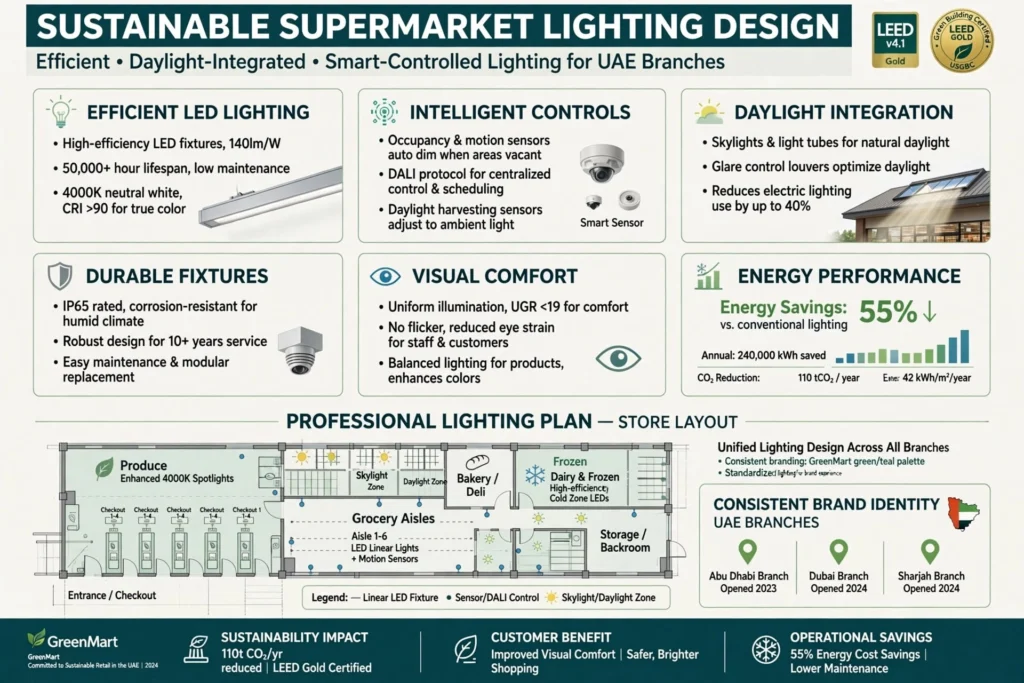
Sustainability is becoming increasingly relevant to commercial property owners and retailers.
Efficient LED lighting, intelligent controls, daylight integration, durable fixtures, and responsible maintenance can contribute to lower energy consumption and reduced operational waste.
Lighting can also support broader green building objectives where a supermarket or hypermarket is pursuing an environmental certification strategy.
The strongest approach considers lighting as part of the building’s complete energy and environmental system.
Why Professional Lighting Planning Matters
Retail lighting involves more than selecting fixtures based on wattage.
Professional planning considers:
Store layout, shelf heights, merchandise, ceiling conditions, customer circulation, colour quality, visual comfort, energy performance, controls, maintenance, HVAC coordination, emergency systems, and future flexibility.
This integrated approach can prevent common problems such as dark aisles, excessive glare, uneven illumination, poor product presentation, and unnecessary energy consumption.
For retailers operating multiple branches, standardised lighting specifications can also help maintain consistent brand identity while allowing individual stores to adapt to their architectural conditions.
Future Trends in Supermarket and Hypermarket Lighting
The future of retail illumination is likely to become increasingly intelligent and adaptable.
Potential developments include:
Connected LED systems, sensor-based dimming, occupancy analytics, daylight-responsive controls, wireless lighting networks, digital signage integration, energy monitoring, and data-driven facility management.
Retailers may also increasingly use lighting to support experiential shopping environments.
As physical stores compete with digital commerce, the in-store environment becomes an important part of the customer experience.
Lighting can help create attractive, comfortable, and flexible environments while supporting efficient operations.
How to Choose the Right Commercial Lighting System
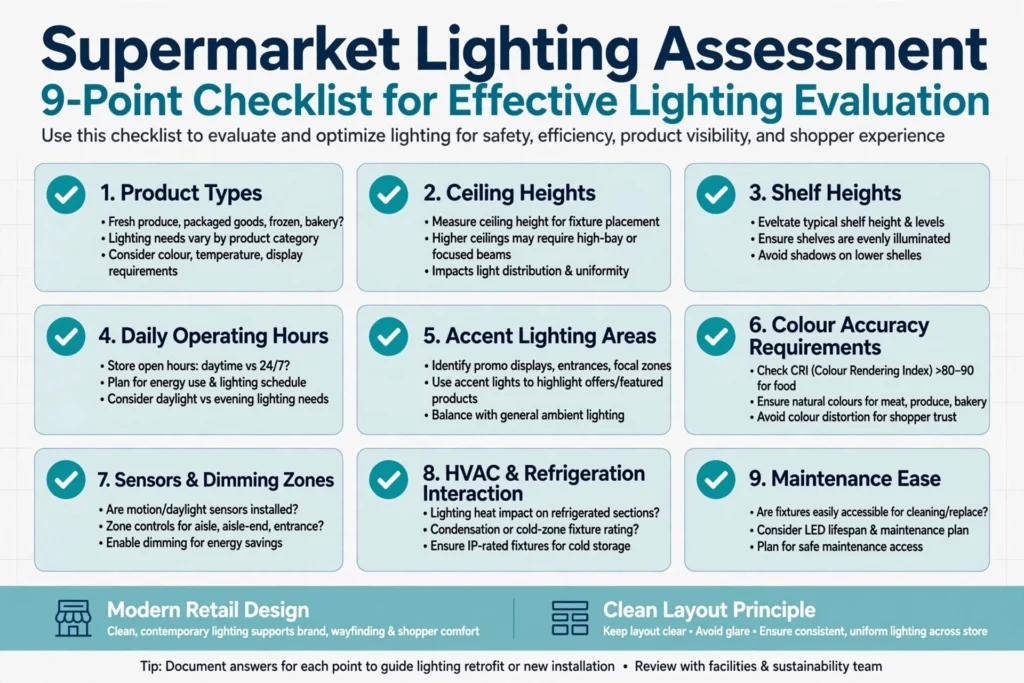
Retailers should begin with a detailed assessment of the property and business requirements.
Important questions include:
What type of products will be displayed?
What are the ceiling heights?
How tall are the shelves?
How long will the store operate each day?
Which areas require accent lighting?
What level of colour accuracy is required?
Which areas can use sensors or dimming?
How will lighting interact with HVAC and refrigeration?
How easy will the fixtures be to maintain?
Answering these questions allows the lighting design to be based on actual operational requirements rather than assumptions.
Final Thoughts
Commercial lighting for supermarkets and hypermarkets is a strategic investment in customer experience, merchandising, safety, energy efficiency, and operational performance.
The most effective lighting schemes combine general illumination with specialised solutions for aisles, fresh-food displays, refrigerated cabinets, checkout areas, promotional displays, entrances, warehouses, and exterior spaces.
LED technology provides a flexible foundation for these environments, while smart controls, daylight management, high-quality optics, appropriate colour rendering, and professional photometric planning can further improve performance.
For UAE retailers, local climate conditions, long operating hours, energy costs, HVAC loads, building requirements, and customer expectations should all influence the lighting strategy.
Ultimately, the right commercial lighting system should make products easier to see, stores easier to navigate, employees more comfortable, and operations more efficient. A carefully engineered approach to commercial lighting for Supermarkets can turn lighting from a basic building requirement into an important component of retail design and business performance.