Printing and packaging facilities depend on accurate visibility, consistent working conditions, and reliable equipment to maintain production quality. From prepress departments and digital printing rooms to offset presses, packaging production lines, finishing areas, warehouses, inspection stations, and dispatch zones, lighting influences how employees see materials, operate machinery, inspect printed products, and identify defects.
Commercial lighting for these environments needs to do more than simply make a factory floor bright. The lighting system should provide suitable illumination for detailed visual tasks, minimize glare, maintain consistent colour appearance, reduce distracting shadows, support worker comfort, and operate efficiently across long production hours.
In the UAE, printing and packaging businesses in Dubai, Abu Dhabi, Sharjah, Ajman, and other industrial areas operate in demanding commercial environments where energy consumption, maintenance access, heat management, and operational reliability are important considerations. A carefully planned lighting system can therefore contribute to a safer, more productive, and visually consistent workplace.
For businesses planning a new facility, upgrading an existing factory, or improving production-floor visibility, commercial lighting for Printing Industries should be considered as part of the wider industrial lighting strategy rather than as a simple fixture replacement exercise.
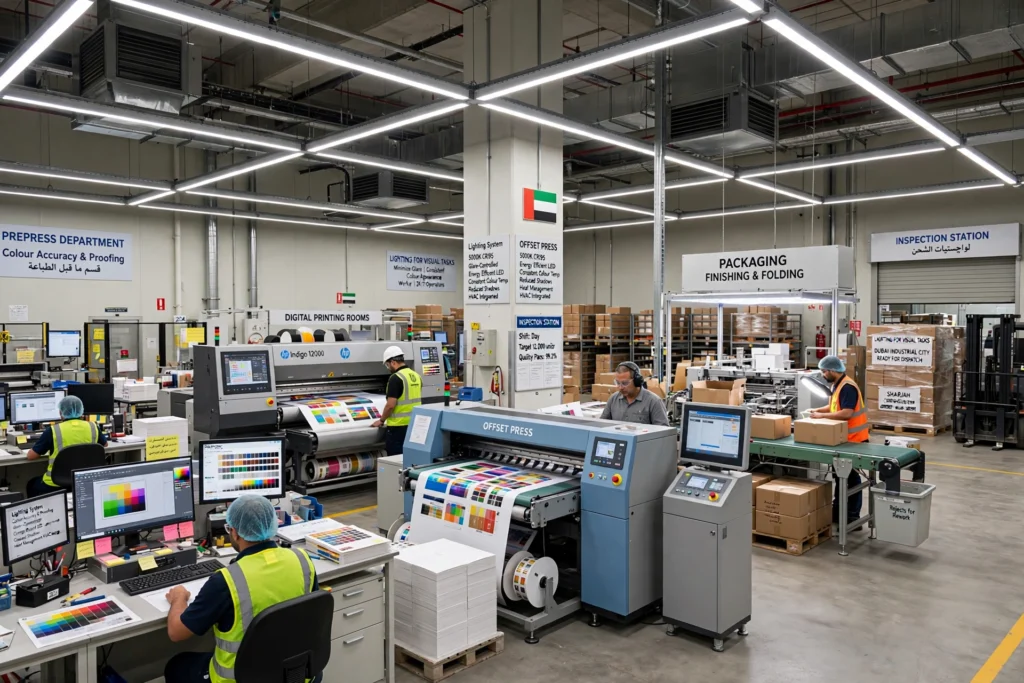
Why Lighting Matters in Printing and Packaging Facilities
Printing and packaging operations involve many tasks that require employees to distinguish fine details.
Operators may need to inspect registration, printed colours, text, graphics, surface finishes, folds, cuts, labels, barcodes, and packaging defects. Poor illumination can make these tasks more difficult.
Inadequate lighting may create dark areas around machinery, while excessive brightness or glare can make reflective surfaces difficult to inspect.
A properly designed lighting system provides balanced illumination across production areas while considering the specific visual requirements of each process.
Lighting Requirements for Printing Facilities
A printing facility can contain several departments with different lighting requirements.
A typical facility may include:
- Prepress and artwork preparation
- Digital printing
- Offset printing
- Flexographic printing
- Gravure printing
- Screen printing
- Large-format printing
- Paper handling
- Cutting and trimming
- Folding and binding
- Quality inspection
- Packaging
- Warehouse storage
- Dispatch areas
Each space should be evaluated according to the tasks performed there.
A general warehouse area does not necessarily require the same lighting approach as a colour inspection station.
Lighting for Prepress Departments
Prepress areas involve artwork preparation, file checking, plate preparation, proofing, and other detailed activities.
Employees may work with computer screens, printed proofs, colour references, and technical production information.
Lighting should provide comfortable ambient illumination without creating excessive reflections on monitors.
Glare control is particularly important because strong light reflected from a display can reduce screen readability and contribute to visual discomfort.
A combination of appropriate ambient lighting and task lighting can create a more comfortable working environment.
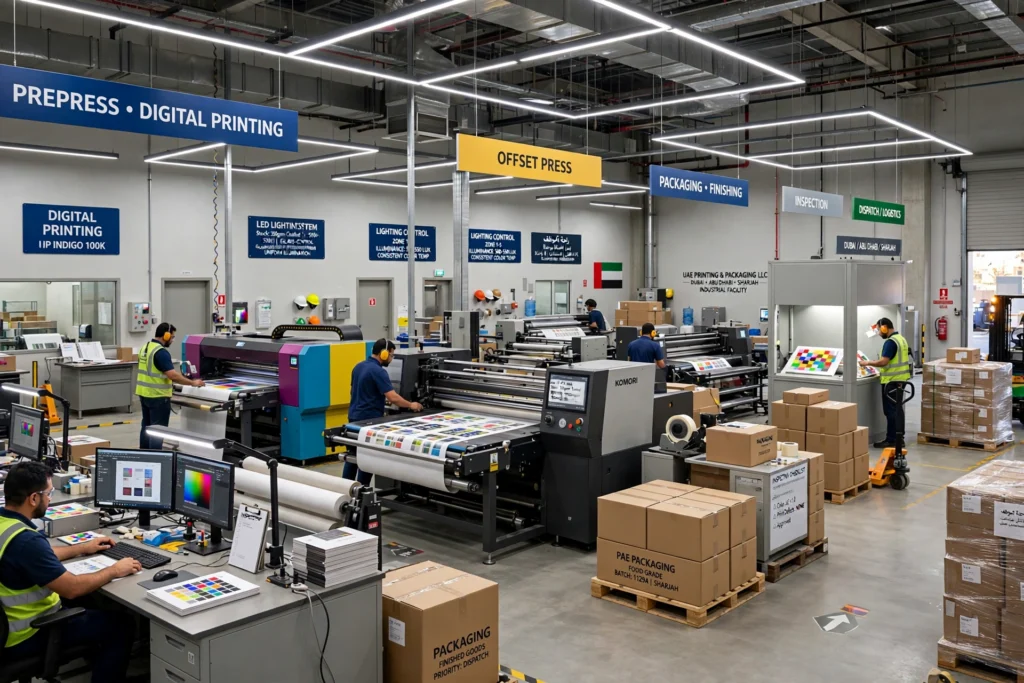
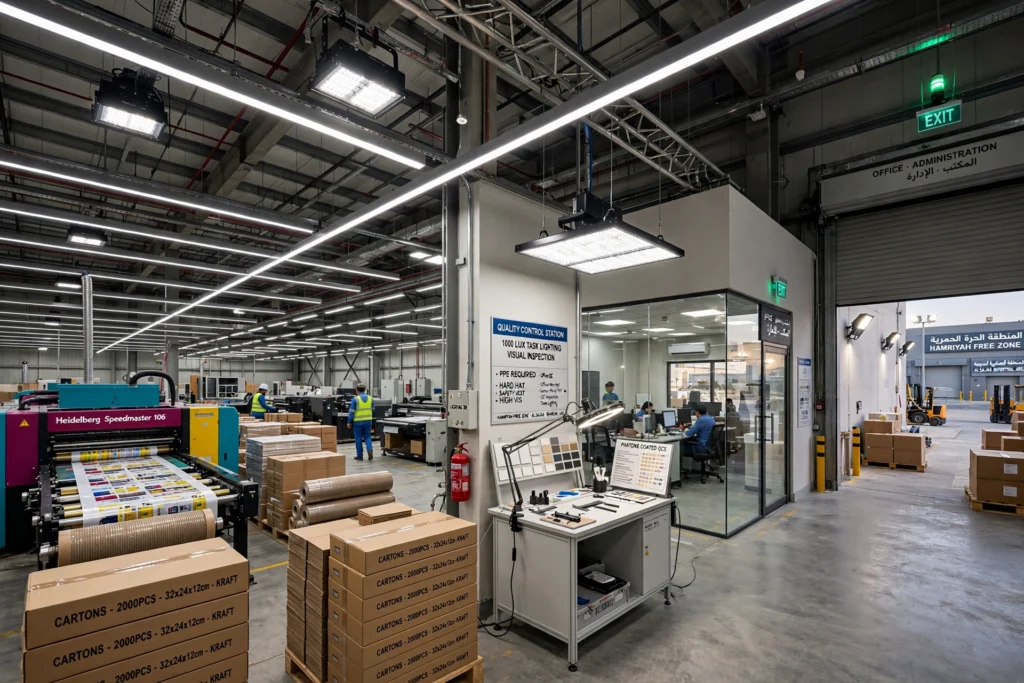
Lighting Around Printing Presses
Printing presses are large industrial machines containing multiple operating and inspection points.
Operators need to monitor paper or substrate movement, ink application, rollers, controls, sensors, and finished output.
Lighting around a press should provide sufficient visibility without creating distracting reflections on metal surfaces or glossy substrates.
Linear LED fixtures are often useful in industrial environments because they can provide continuous, evenly distributed illumination along production areas.
The final fixture arrangement should be determined according to ceiling height, machinery layout, maintenance access, and the visual tasks performed by operators.
Offset Printing Lighting
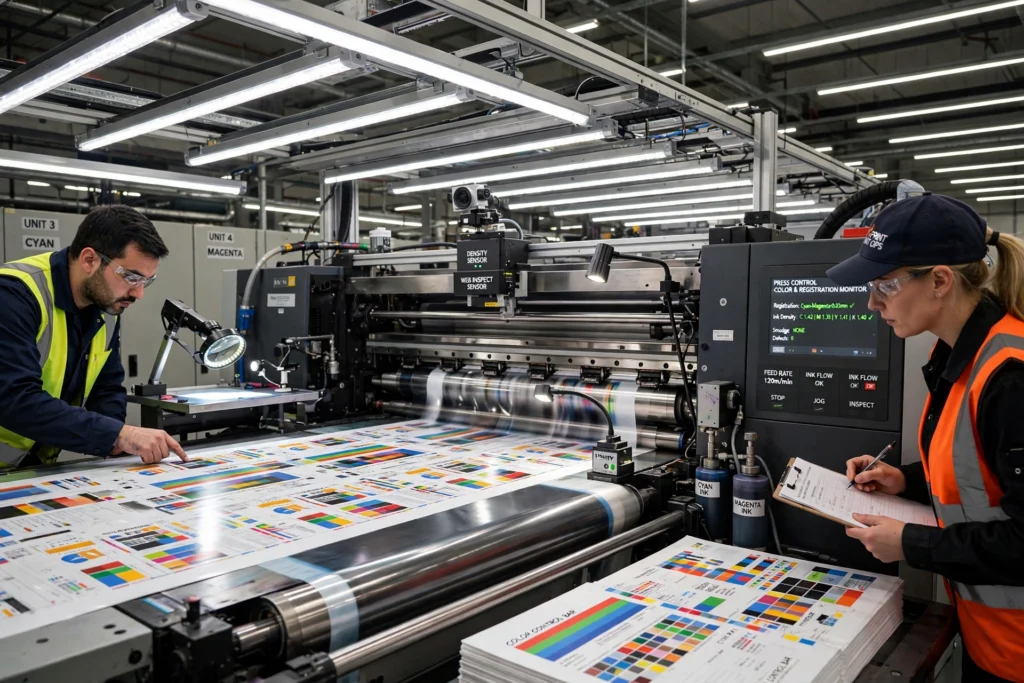
Offset printing requires careful monitoring of paper, plates, ink, registration, and printed output.
Operators may need to identify issues such as:
- Registration errors
- Ink density variations
- Smudging
- Paper damage
- Surface defects
- Print inconsistencies
Balanced illumination can make visual inspection easier.
Where colour evaluation is a critical part of production, lighting specifications should be selected carefully because different light sources can affect how colours appear to the human eye.
Digital Printing Lighting
Digital printing environments can include high-speed production printers, finishing equipment, paper handling systems, and inspection stations.
Operators often move between digital presses and computer-controlled systems.
The lighting design should provide consistent visibility across the work area while avoiding glare on digital displays and control panels.
LED lighting can also provide flexibility for facilities that require long operating hours and reliable illumination.
Packaging Production Lighting
Packaging manufacturing introduces additional visual requirements.
Employees may inspect:
- Printed cartons
- Labels
- Flexible packaging
- Corrugated products
- Folding cartons
- Bags
- Pouches
- Bottles
- Product sleeves
- Printed promotional materials
Packaging defects can involve very small differences in colour, printing, cutting, folding, or alignment.
Good lighting supports visual quality control throughout these stages.
Colour Inspection and Lighting
Colour accuracy is particularly important in printing.
A printed product may need to match approved artwork, brand guidelines, colour references, or customer samples.
The perceived appearance of a colour can change depending on the light source illuminating it.
This is why colour-critical inspection areas may require carefully specified lighting rather than relying on general factory illumination.
Where formal colour assessment is required, lighting should be selected according to the relevant production and quality-control procedures.
Colour Rendering and LED Lighting
Colour rendering describes how accurately a light source allows colours to appear compared with a reference light source.
For general industrial areas, the priority may be reliable illumination and energy efficiency.
For print inspection, artwork evaluation, packaging quality control, or product presentation, colour rendering can become much more important.
High-quality LED systems can offer strong colour performance, but the exact specification should be selected according to the task.

Colour Temperature in Printing Facilities
The colour temperature of a light source affects the visual character of the environment.
Different areas may require different lighting characteristics depending on the task.
For example, a general production area may use a neutral white appearance, while a colour-critical inspection environment may require a carefully controlled lighting condition.
Consistency is important.
Using dramatically different light sources in adjacent production areas can make visual comparison more difficult.
Glare Control Around Machinery
Industrial machinery often contains reflective metal surfaces, glass panels, polished components, and digital displays.
If lighting is positioned incorrectly, these surfaces can produce glare.
Glare can make equipment controls harder to read and reduce visual comfort.
Lighting designers should consider fixture orientation, mounting height, beam distribution, diffuser characteristics, and machinery position.
This is particularly important in facilities where employees spend long periods near production equipment.
Reducing Shadows on Production Floors
Shadows can make it difficult to see machinery components, substrates, printed materials, and work surfaces.
A single high-intensity fixture may create strong shadows around equipment.
A more distributed lighting arrangement can reduce these problems.
Linear fixtures, multiple lighting points, and appropriate mounting positions can help create more uniform illumination.
The goal is not simply maximum brightness but useful and balanced visibility.
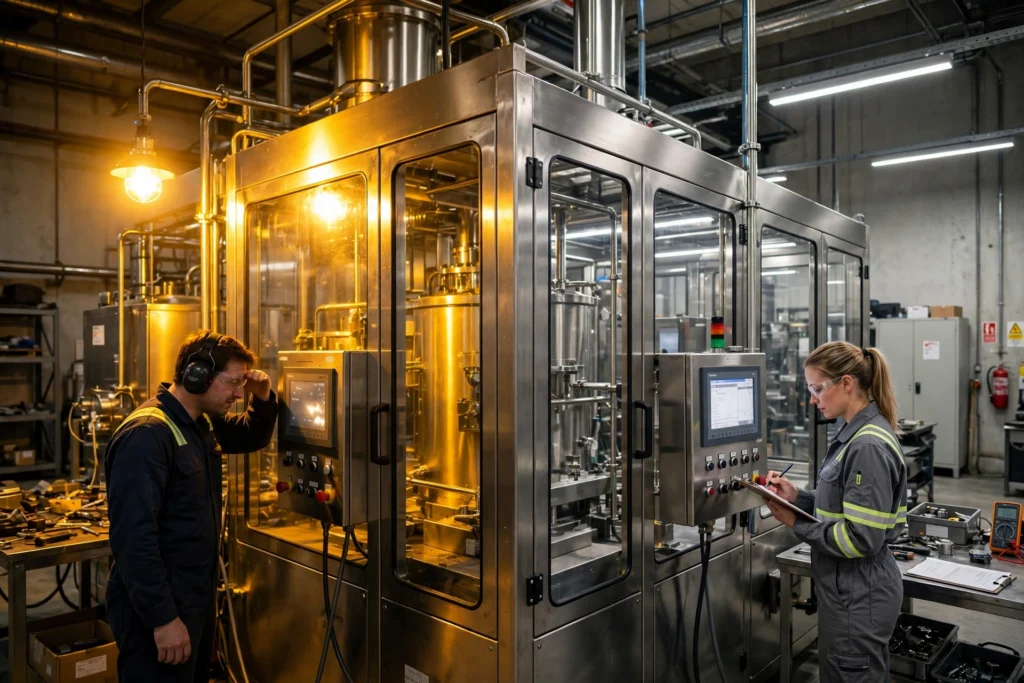
High-Bay Lighting for Printing Warehouses
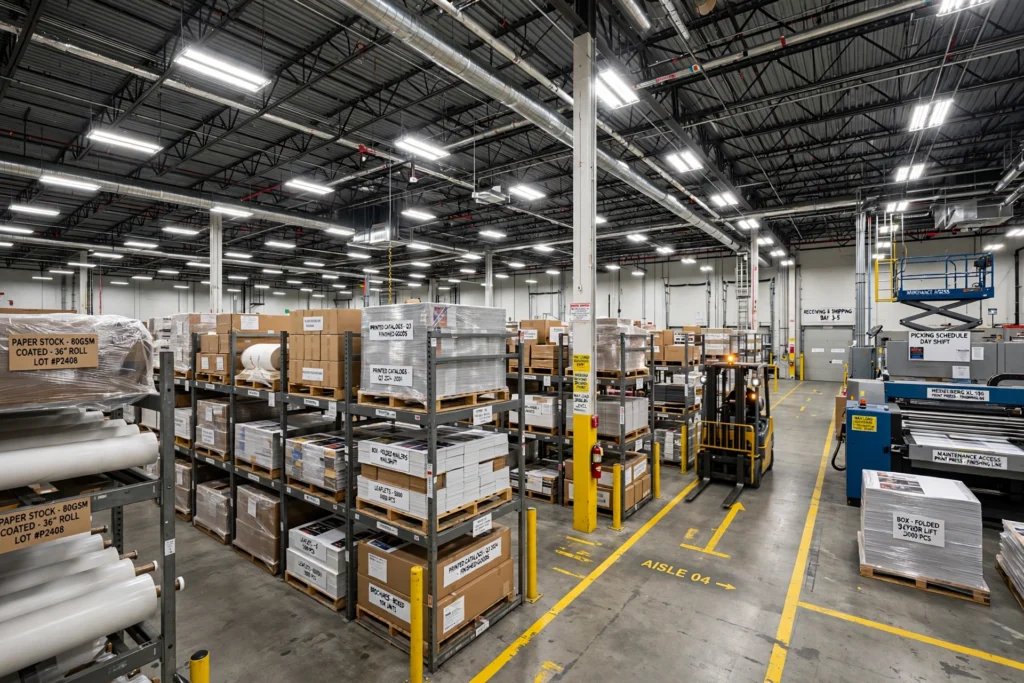
Many printing and packaging facilities have high ceilings and large storage areas.
High-bay LED lighting is commonly considered for these spaces because fixtures can provide illumination from significant mounting heights.
The lighting layout should account for:
- Ceiling height
- Rack arrangement
- Aisle widths
- Storage levels
- Forklift movement
- Maintenance access
- Required illumination
Lighting should be designed around the actual warehouse layout rather than installed according to a generic grid.
Warehouse Lighting for Packaging Materials
Packaging facilities may store paper rolls, cartons, corrugated sheets, films, inks, labels, adhesives, and finished products.
Warehouse lighting should provide clear visibility for stock identification, picking, movement, and inspection.
Vertical illumination can also matter because employees need to read labels and identify products stored on shelving.
Lighting for Quality Control Areas
Quality control stations require more focused attention than general production areas.
Inspectors may examine printed sheets, packaging surfaces, labels, colour consistency, dimensions, cuts, folds, and finishes.
Task-oriented lighting can help provide the visual conditions required for these inspections.
In some environments, adjustable task lighting can complement general ambient illumination.
Lighting for Cutting and Finishing Departments
After printing, many products undergo cutting, trimming, folding, binding, laminating, gluing, or other finishing processes.
Employees need to see cutting lines, alignment marks, folds, edges, and material surfaces.
Good lighting around finishing equipment can support accurate operation and reduce visual strain.
Fixtures should be positioned so that operators are not working directly underneath intense glare sources.
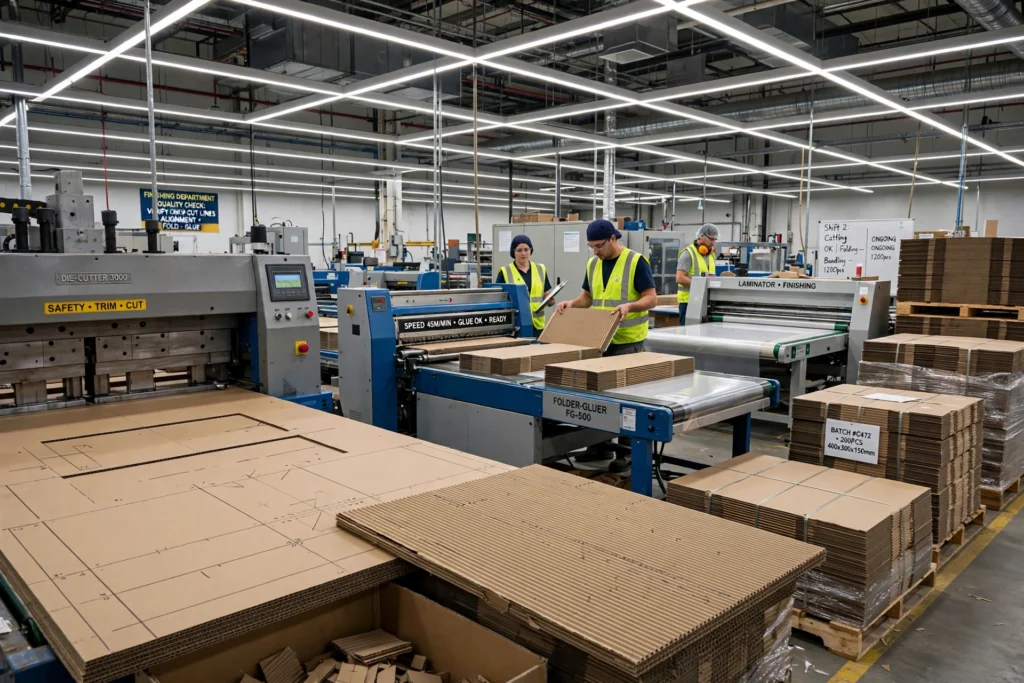
Lighting for Corrugated Packaging Production
Corrugated packaging production involves large sheets, printing equipment, die-cutting, folding, gluing, and bundling.
The production floor can be physically large, with machinery occupying significant areas.
Uniform lighting is particularly valuable because employees need to move between different stages of production.
Well-distributed LED lighting can help reduce dark areas around machinery and material stacks.
Lighting for Flexible Packaging
Flexible packaging can involve films, laminates, printed rolls, labels, and other lightweight substrates.
Glossy films can create reflections under poorly positioned lighting.
Lighting design should therefore consider the reflective nature of the materials being inspected.
Controlled beam angles and glare management can improve visibility.
Lighting for Printing Machine Control Panels
Modern printing equipment often includes electronic displays and digital control interfaces.
The surrounding lighting should allow operators to read these interfaces without reflections washing out the display.
Excessively bright fixtures positioned directly opposite screens can create unnecessary glare.
Careful fixture placement can make control panels easier to read while maintaining adequate general illumination.
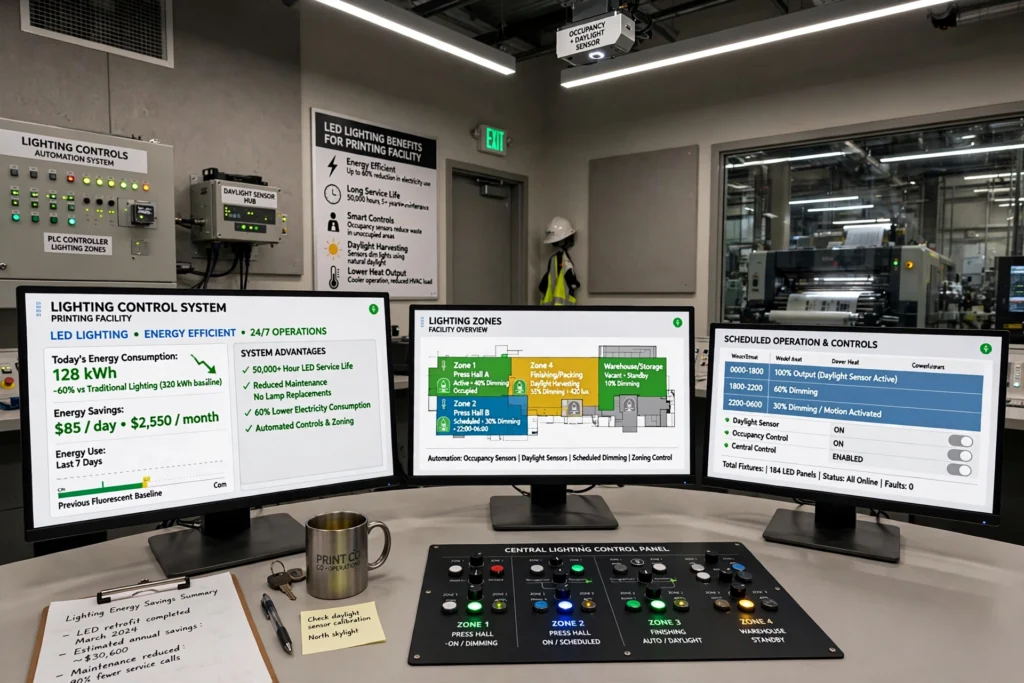
Energy-Efficient Lighting for Printing Facilities
Printing and packaging plants can operate for long hours, making energy consumption an important operational consideration.
LED lighting can offer several advantages compared with older lighting technologies, including efficient electricity use, long service life, and reduced maintenance requirements.
Energy savings depend on factors such as fixture efficiency, operating hours, controls, existing lighting technology, and the overall design.
Replacing fixtures without reviewing the entire lighting layout may not produce the best result.
Lighting Controls and Automation
Lighting controls can help reduce energy consumption in suitable areas.
Possible strategies include:
- Occupancy sensors
- Daylight sensors
- Dimming
- Scheduled operation
- Zoning
- Central lighting control
Not every production area should operate with the same control strategy.
Production floors may require continuous illumination during operating hours, while storage rooms, offices, meeting areas, and low-occupancy spaces may benefit more from occupancy-based control.
Smart Lighting for Industrial Facilities
Larger facilities may integrate lighting controls with building automation systems.
A smart lighting system can allow facility teams to monitor and manage lighting zones from a central platform.
In modern commercial developments, lighting can potentially be coordinated with broader building management systems, depending on the project’s infrastructure.
This can improve operational control and simplify monitoring.
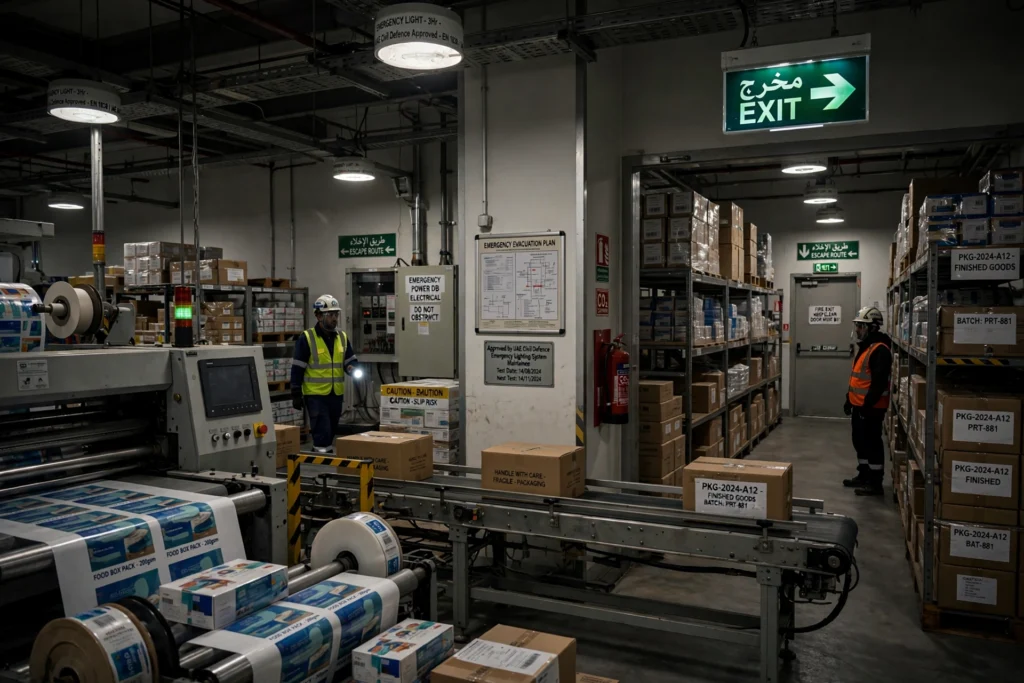
Emergency Lighting in Printing and Packaging Facilities
Emergency lighting is an important part of commercial and industrial building safety.
Production areas may contain machinery, storage racks, conveyors, electrical equipment, and other obstacles.
Emergency illumination should help occupants identify escape routes and exit locations when normal lighting is unavailable.
The design and installation should follow applicable UAE requirements and the relevant authority’s regulations.
Lighting and Worker Comfort
Employees in printing and packaging facilities may spend long shifts performing visually demanding tasks.
Lighting that is too dim, excessively bright, uneven, or highly reflective can contribute to visual discomfort.
Balanced illumination, appropriate colour characteristics, glare control, and consistent distribution can create a more comfortable working environment.
Worker comfort should therefore be considered alongside energy efficiency and production requirements.
Lighting Maintenance in Printing Facilities
Even high-quality lighting requires maintenance.
Dust can accumulate on fixtures, reducing light output.
Industrial environments can also expose equipment to paper dust, packaging particles, ink residue, and other contaminants.
A maintenance programme should include inspection and cleaning according to the fixture manufacturer’s recommendations.
Failed fixtures should be replaced promptly, particularly in areas where uniform illumination is essential.
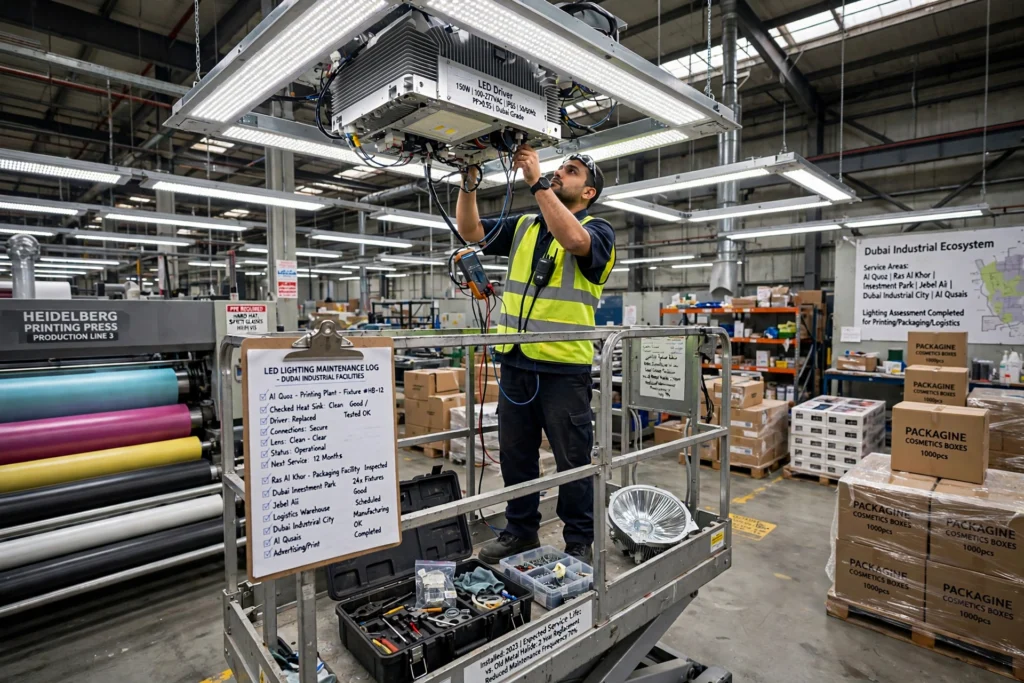
LED Lighting and Maintenance Costs
One advantage of modern LED systems is that they can reduce the frequency of lamp replacement compared with older technologies.
However, LED fixtures still require proper maintenance.
Drivers, electrical connections, mounting systems, lenses, and heat-management components should remain in good condition.
The quality of the fixture is also important. Industrial facilities should select products appropriate for their operating environment.
Lighting for Printing Plants in Dubai
Dubai has a large commercial and industrial ecosystem that includes printing companies, packaging manufacturers, advertising businesses, retail suppliers, logistics facilities, and manufacturing operations.
Industrial areas such as Al Quoz, Ras Al Khor, Dubai Investment Park, Jebel Ali, Dubai Industrial City, and Al Qusais contain diverse commercial and industrial facilities where appropriate lighting can support production and warehouse operations.
Each site should be assessed according to its ceiling height, machinery, production processes, operating schedule, and building structure.
Lighting for Printing Companies in Abu Dhabi
Abu Dhabi’s industrial and commercial sectors also include printing, packaging, manufacturing, logistics, and distribution facilities.
Areas such as Mussafah, ICAD, KIZAD, and Abu Dhabi Industrial City contain industrial properties where high-bay, linear, task, warehouse, and exterior lighting can form part of a complete lighting strategy.
The appropriate system depends on the facility’s production requirements and building configuration.
Printing and Packaging Lighting in Sharjah
Sharjah has a significant industrial and commercial ecosystem, particularly around areas such as Industrial Area, Al Sajaa, and Hamriyah Free Zone.
Printing and packaging businesses operating in these locations can require lighting for production floors, warehouses, offices, quality-control stations, loading areas, and exterior spaces.
A coordinated lighting plan can help maintain consistent visibility throughout the facility.
Choosing the Right Commercial Lighting Fixtures
The best fixture depends on the location and task.
Potential options include:
- Linear LED lights
- LED high bays
- LED panels
- Industrial floodlights
- Task lighting
- Adjustable spotlights
- Surface-mounted fixtures
- Emergency lighting
- Exterior wall lights
The selection should consider illumination requirements, mounting height, operating conditions, beam distribution, colour performance, maintenance access, and energy consumption.
Lighting Design for Printing and Packaging Machinery
Machinery layout should be considered before fixture placement.
Large presses, conveyors, cutting machines, packaging lines, storage racks, and production stations can create physical obstructions.
A lighting layout designed without considering machinery may leave important working surfaces in shadow.
Coordination between the lighting designer, electrical contractor, facility manager, and production team can produce a more practical result.
Lighting for Inspection and Packaging Lines
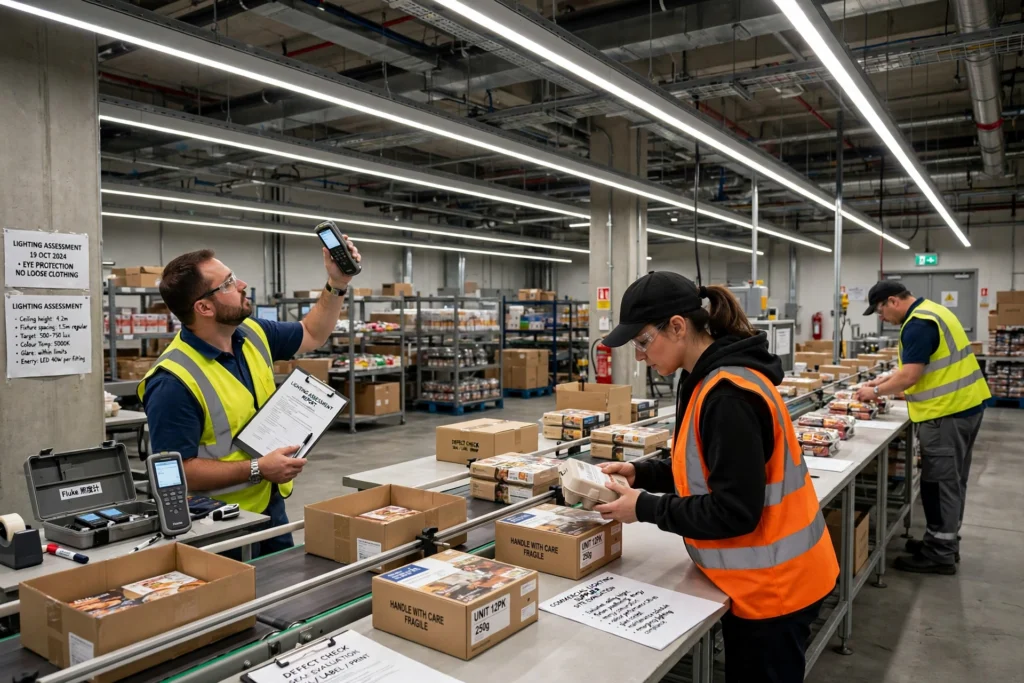
Inspection and packaging lines require consistent visibility along the complete working area.
Employees may inspect products while they move along conveyors or production tables.
Uneven lighting can make defects easier to see in one section and harder to detect in another.
Continuous or regularly distributed fixtures can help provide more consistent illumination.
Choosing a Commercial Lighting Supplier
Printing and packaging businesses should consider suppliers that understand industrial and commercial applications rather than focusing only on fixture sales.
A suitable supplier can help evaluate:
- Existing lighting
- Production requirements
- Ceiling height
- Fixture positioning
- Energy consumption
- Colour performance
- Glare
- Maintenance
- Controls
- Emergency requirements
A proper site assessment can be more valuable than selecting fixtures from a catalogue without considering the facility.
Planning a Lighting Upgrade
A lighting upgrade should begin with an assessment of the existing system.
Review the current fixtures, illumination levels, energy consumption, maintenance history, production layout, and areas where employees experience visibility problems.
The new design can then be developed around actual operational requirements.
For larger facilities, lighting calculations and simulations can help evaluate fixture quantity and distribution before installation.
Frequently Asked Questions
What type of lighting is suitable for printing facilities?
LED linear fixtures, high-bay lighting, task lighting, and specialized inspection lighting can all be suitable depending on the production area. The correct choice depends on ceiling height, machinery, visual tasks, and required illumination.
Why is colour rendering important in printing?
Printed colours can appear different under different light sources. Good colour rendering and consistent lighting conditions can therefore support more reliable visual inspection and comparison.
Is LED lighting suitable for packaging factories?
Yes. LED lighting is widely suitable for industrial environments because it can provide efficient illumination, long service life, and various optical and colour-performance options.
How can glare be reduced around printing machinery?
Glare can be reduced through appropriate fixture positioning, beam distribution, diffusers, mounting height, and orientation relative to machinery, screens, and reflective materials.
Does warehouse lighting need to be different from production lighting?
Often, yes. Warehouses may prioritize aisle visibility, storage identification, and vertical illumination, while production and inspection areas may require more controlled and task-specific lighting.
Can lighting controls reduce energy consumption?
Lighting controls such as occupancy sensors, scheduling, zoning, and dimming can reduce energy use in suitable areas. The best control strategy depends on how each part of the facility operates.
Conclusion
Commercial lighting is an important part of modern printing and packaging facilities. The right lighting system supports production visibility, quality inspection, machinery operation, worker comfort, warehouse activities, and day-to-day facility management.
Printing environments have unique visual requirements because employees may need to evaluate colours, registration, printed surfaces, packaging finishes, labels, cuts, folds, and other fine details. A lighting system that simply produces high brightness may not provide the visual quality required for these tasks.
For facilities in Dubai, Abu Dhabi, Sharjah, and other UAE industrial locations, lighting should be planned around the building’s actual production processes, machinery arrangement, ceiling height, storage systems, operating hours, maintenance requirements, and site conditions.
From printing presses and prepress departments to packaging lines, quality-control stations, warehouses, and dispatch areas, each zone can benefit from a lighting approach suited to its function.
Energy-efficient LED technology, suitable colour rendering, glare control, uniform illumination, intelligent controls, emergency lighting, and planned maintenance can all contribute to a more effective commercial environment.
Businesses looking to upgrade an existing facility or develop a new printing and packaging plant should treat lighting as an integrated part of the building and production design. With proper planning, Commercial Lighting for Printing Industries can provide reliable illumination while supporting productivity, product inspection, operational efficiency, and a more comfortable workplace.