Commercial lighting plays an important role in the way Abu Dhabi’s offices, retail spaces, hotels, restaurants, healthcare facilities, showrooms, and mixed-use developments operate and appear after dark. In a modern business district, lighting is not simply about making an interior or exterior space bright. It influences employee productivity, customer experience, architectural visibility, energy consumption, safety, navigation, and the overall identity of a commercial property.
Abu Dhabi has developed into a major business and commercial destination, with districts such as Al Maryah Island, Abu Dhabi Global Market (ADGM), Al Reem Island, Downtown Abu Dhabi, Corniche Area, Masdar City, Yas Island, and Al Raha Beach containing a diverse range of commercial properties. Each location presents different requirements for office lighting, retail illumination, hospitality lighting, façade lighting, parking-area illumination, and smart building systems.
For developers, facility managers, architects, contractors, and business owners, selecting suitable Commercial Lighting Supplies is therefore an important part of creating efficient and visually effective commercial environments.
Understanding Commercial Lighting Requirements in Abu Dhabi
Commercial properties have different lighting requirements depending on their function, occupancy, architecture, operating hours, and interior layout. A corporate office requires comfortable illumination for computer-based work, meeting rooms, circulation areas, and collaborative spaces. A retail store needs stronger visual emphasis around merchandise, while a hotel may require decorative and atmospheric lighting alongside functional illumination.
The Abu Dhabi climate also influences lighting design. High outdoor temperatures, strong sunlight, dust, and long periods of air-conditioning use mean that lighting systems should be selected with appropriate thermal management and reliable components.
A professional lighting strategy considers the complete environment rather than simply calculating the number of fixtures required. Lumen output, colour temperature, colour rendering, glare control, beam angle, mounting height, energy efficiency, controls, maintenance access, and operating schedules should all be evaluated.
Office Lighting for Abu Dhabi Business Centres
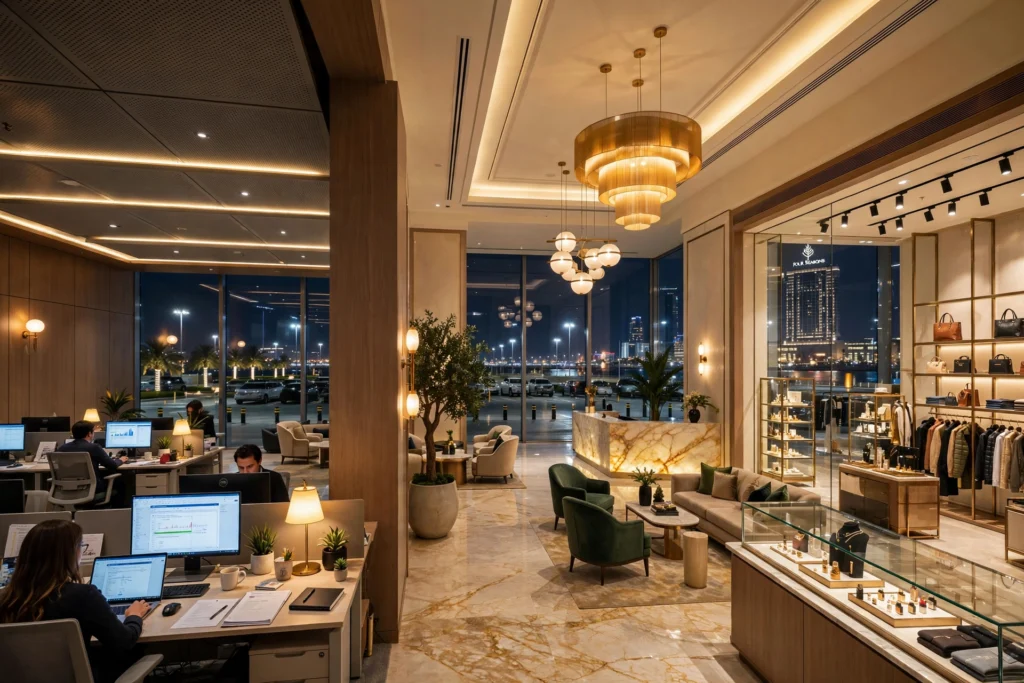
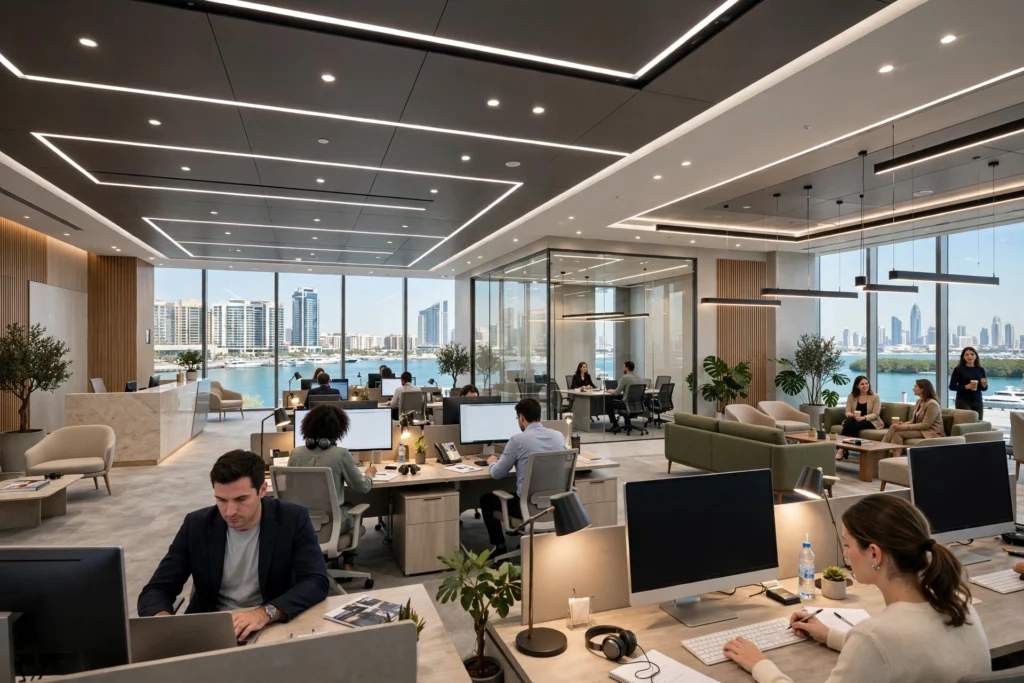
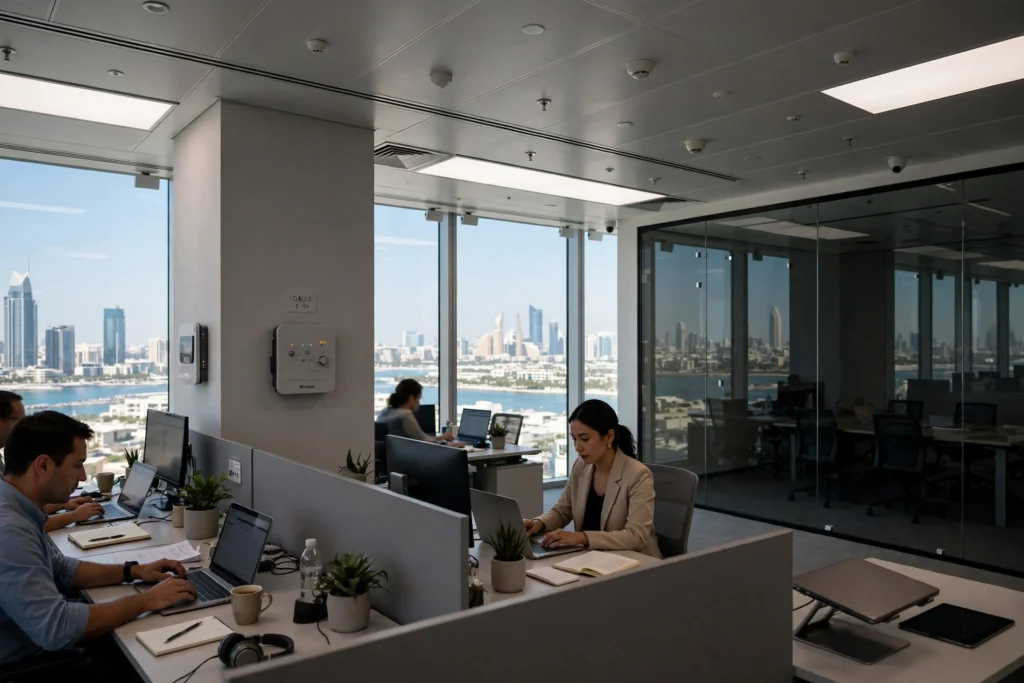
Office buildings are among the largest users of commercial lighting. Modern workplaces require illumination that supports concentration while minimizing visual discomfort and unnecessary energy consumption.
LED panel lights, recessed downlights, linear lighting, suspended fixtures, and task lighting can be combined to create balanced illumination across workstations, meeting rooms, corridors, reception areas, and breakout spaces.
In premium offices around Al Maryah Island and Al Reem Island, architectural lighting can also contribute to the corporate identity of the workplace. Linear LED systems integrated into ceilings or architectural features can create a contemporary appearance without overwhelming the working environment.
Lighting design should also consider computer screens. Excessive glare or poorly positioned fixtures can create reflections that affect visual comfort for employees.
Lighting for Al Maryah Island
Al Maryah Island is one of Abu Dhabi’s prominent business and financial districts, with corporate offices, financial institutions, hospitality properties, retail environments, and mixed-use developments.
Commercial lighting in this environment often needs to combine premium aesthetics with high operational reliability. Office reception areas, meeting spaces, corridors, retail zones, restaurants, and public areas can all require different lighting layers.
Energy-efficient LED systems can support long operating hours while architectural accent lighting can emphasize building interiors and public spaces.
For high-end commercial developments, lighting controls can also be integrated with building management systems to create scheduled lighting scenes and improve energy management.
Lighting for Al Reem Island Commercial Properties
Al Reem Island contains residential, commercial, retail, and mixed-use developments. Commercial properties in this area may include offices, clinics, restaurants, shops, fitness centres, and professional service businesses.
Lighting requirements vary significantly between these applications.
A medical clinic may prioritize uniform, comfortable illumination and accurate colour rendering. A restaurant may use warm decorative lighting to create atmosphere. A retail store may require adjustable spotlights and display lighting to highlight products.
Flexible LED systems are particularly useful for commercial properties where tenant layouts and interior designs may change over time.
Commercial Lighting in Downtown Abu Dhabi
Downtown Abu Dhabi contains established commercial streets, offices, retail businesses, hotels, restaurants, banks, and professional service companies.
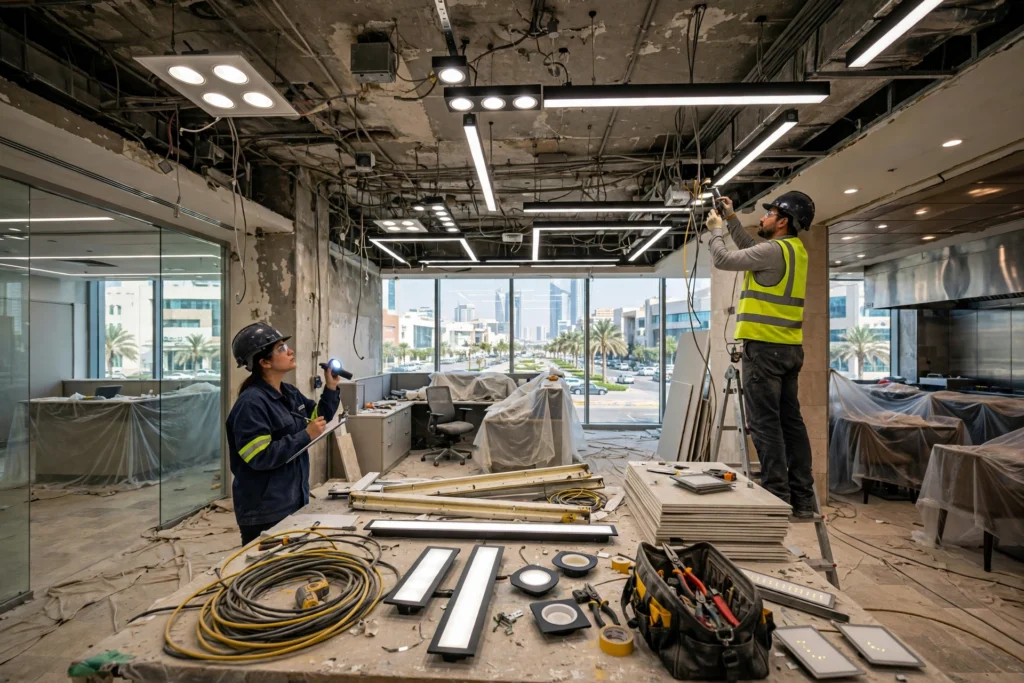
Lighting upgrades in older commercial buildings can provide opportunities to improve both appearance and energy performance. Replacing outdated fluorescent or halogen fixtures with efficient LED alternatives can reduce maintenance requirements and provide more consistent illumination.
However, retrofit projects should begin with an assessment of existing wiring, ceiling construction, electrical loads, fixture positions, and lighting levels.
A direct fixture replacement is not always the best solution. A redesigned lighting layout may provide better results by placing light where it is actually required.
Retail Lighting for Abu Dhabi Businesses
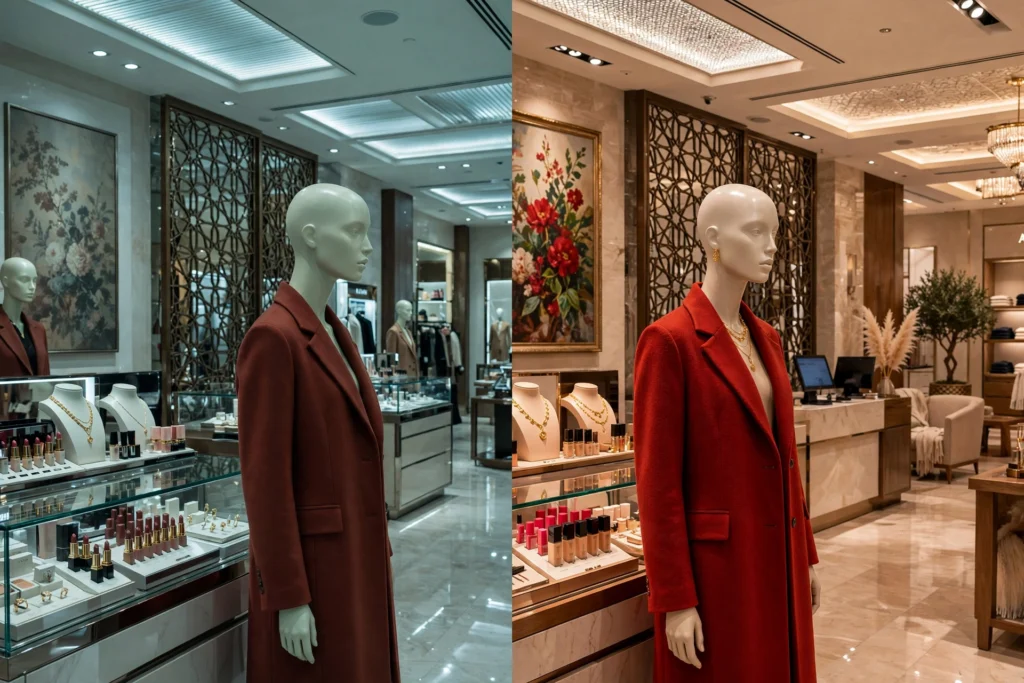
Retail lighting directly influences how products are perceived. Clothing, jewellery, electronics, furniture, cosmetics, food, and luxury products can each require different lighting characteristics.
Retail environments often use a combination of ambient lighting, accent lighting, display lighting, track spotlights, linear LEDs, and decorative fixtures.
High colour rendering is particularly important where customers need to distinguish product colours accurately. Adjustable track lighting can also allow retailers to change the emphasis of displays when merchandise or store layouts change.
In shopping environments such as The Galleria Al Maryah Island, Yas Mall, and other Abu Dhabi retail destinations, lighting must also complement the architectural identity and customer experience of the property.
Hospitality and Hotel Lighting
Hotels require some of the most diverse commercial lighting solutions because they contain multiple environments within one property.
A hotel may include a reception lobby, guest corridors, restaurants, cafés, conference rooms, ballrooms, spas, outdoor terraces, parking areas, and service spaces.
Each zone requires a different combination of functional and decorative illumination.
Warm ambient lighting can create a welcoming lobby, while task-oriented lighting may be more suitable for reception desks and business centres. Restaurants can use decorative pendants, concealed LED strips, wall lighting, and accent fixtures to create atmosphere.
Lighting controls can allow hotels to adjust illumination according to time of day and occupancy.
Restaurant and Café Lighting
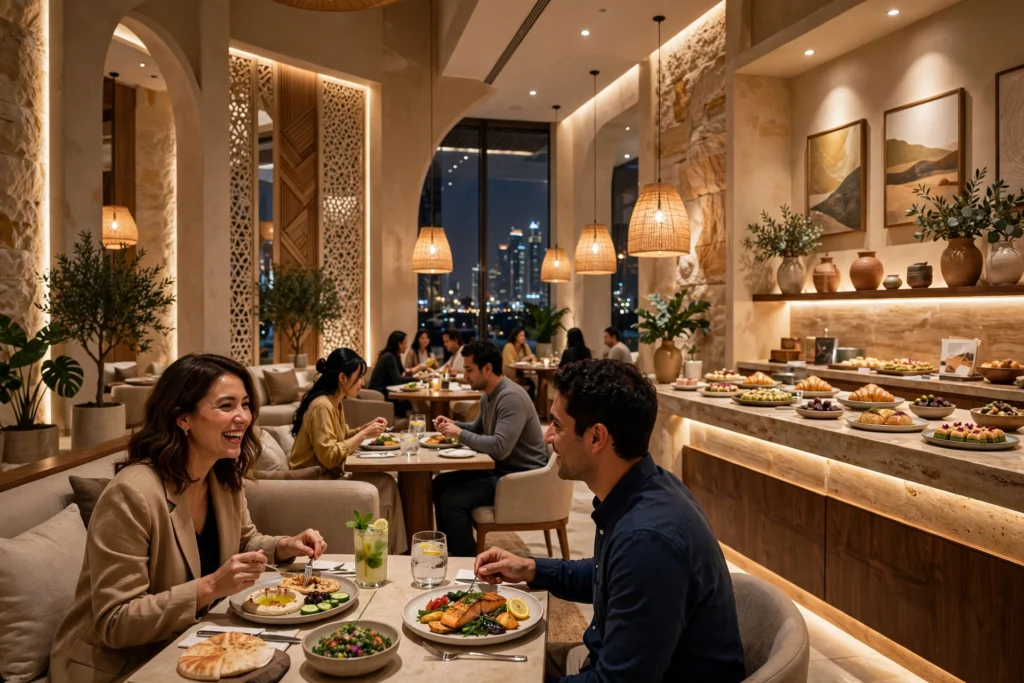
Restaurants and cafés depend heavily on atmosphere. Lighting can influence how customers perceive the interior, tables, food presentation, and overall brand.
Warm colour temperatures are often used to create a relaxed environment, while accent lighting can highlight architectural elements, artwork, counters, or selected tables.
Glare should be carefully controlled because customers should not have bright LED sources directly within their normal field of view.
Pendant lights, recessed downlights, wall washers, linear LED profiles, decorative fixtures, and concealed lighting can all be incorporated depending on the design concept.
Healthcare and Clinic Lighting
Healthcare environments require lighting that supports both patient comfort and professional tasks.
Clinics, dental practices, diagnostic centres, pharmacies, and medical offices can benefit from high-quality LED lighting with good colour rendering and controlled glare.
Reception and waiting areas can use softer, comfortable illumination, while examination rooms require more functional lighting.
Lighting selection should also consider cleaning requirements, ceiling construction, maintenance access, and the operational needs of medical staff.
Industrial and Warehouse Lighting
Abu Dhabi’s commercial and industrial areas also require reliable high-bay and industrial lighting.
Warehouses, logistics facilities, workshops, manufacturing plants, and storage areas often have high ceilings where traditional low-output fixtures may not provide adequate illumination.
LED high-bay lights, low-bay fixtures, linear industrial lighting, floodlights, and emergency lighting can provide more suitable solutions.
Lighting layouts should consider rack heights, aisle widths, machinery, loading zones, pedestrian routes, and vehicle movement.
Uniformity is particularly important because significant differences between bright and dark areas can affect visibility and worker comfort.
Commercial Outdoor Lighting
Commercial properties require outdoor lighting for entrances, walkways, parking areas, loading zones, signage, landscaping, and building façades.
Outdoor LED lighting should be selected according to the environmental conditions and installation location. Appropriate IP ratings, corrosion resistance, thermal management, impact resistance, and optical performance can be important for long-term reliability.
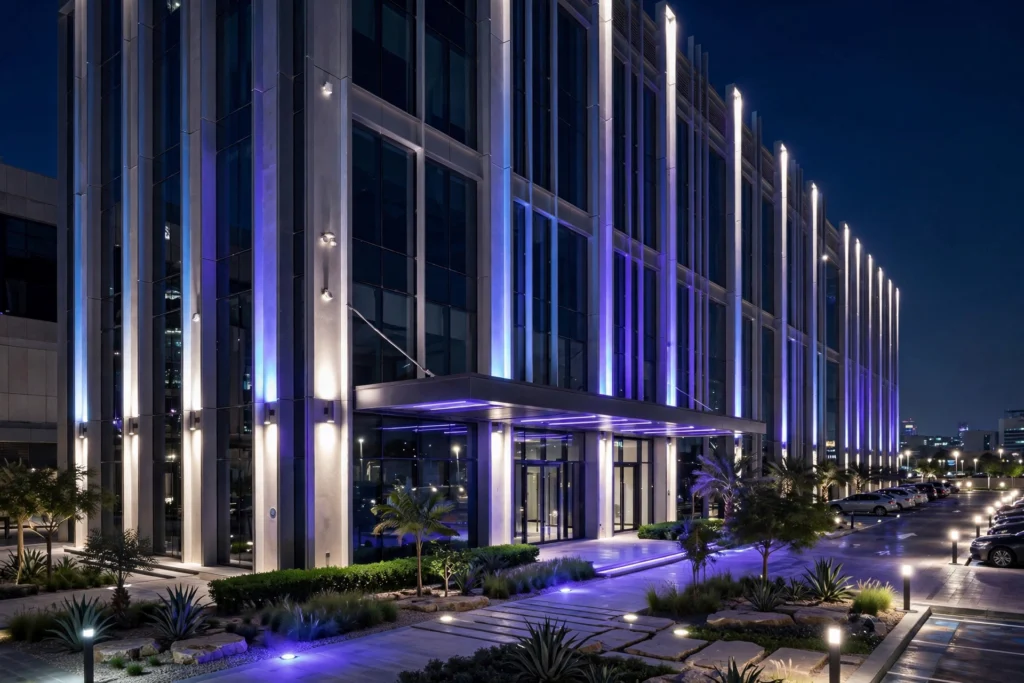
Architectural façade lighting can also enhance the visual identity of commercial buildings after sunset. Wall washers, linear LED profiles, floodlights, spotlights, and in-ground fixtures can highlight architectural features without creating excessive glare or light spill.
Façade Lighting for Abu Dhabi Buildings
Modern commercial architecture often uses lighting to create a recognizable nighttime appearance.
Façade lighting can emphasize vertical lines, structural elements, entrances, glazing, architectural textures, and building signage.
However, façade lighting should be carefully controlled. Excessive brightness can create visual discomfort and unnecessary energy use. Light spill should also be considered when buildings are close to residential areas or other commercial properties.
Dynamic lighting systems can provide programmable colour scenes for special events or corporate occasions where appropriate.
Parking and Security Lighting
Parking areas require reliable illumination for vehicle movement, pedestrian safety, access control, and security.
LED parking lights, pole-mounted fixtures, wall packs, bollards, canopy lights, and floodlights can be used depending on the site layout.
Lighting should provide suitable uniformity rather than creating isolated bright spots surrounded by dark areas.
Motion sensors and smart controls can reduce energy consumption in selected low-traffic zones while maintaining required safety levels.
Smart Commercial Lighting and Building Automation
Smart lighting is becoming increasingly relevant to modern commercial properties.
Lighting systems can be connected to occupancy sensors, daylight sensors, timers, DALI controls, 0-10V dimming systems, wireless controls, and Building Management Systems (BMS).
These technologies allow building operators to monitor and adjust lighting according to occupancy and operating schedules.
For example, a commercial office may automatically reduce lighting in unoccupied meeting rooms. Daylight sensors can also adjust artificial illumination near windows when sufficient natural light is available.
Integration with BMS can create a centralized approach to energy and facility management.
Energy Efficiency and LED Technology
Energy efficiency is a major consideration for businesses with long operating hours.
LED technology can provide efficient illumination while reducing the need for frequent lamp replacement compared with many older lighting technologies. However, efficiency depends on the entire system rather than the LED chip alone.
High-quality drivers, appropriate lumen output, optical design, dimming, occupancy controls, and proper maintenance all influence energy performance.
Over-lighting should also be avoided. Installing excessive wattage does not necessarily improve a commercial environment. Good lighting design aims to achieve the required visual performance with the appropriate amount of light.
Colour Temperature in Commercial Lighting
Colour temperature affects the atmosphere and visual character of a commercial space.
Warm white lighting can create a comfortable and hospitality-oriented environment. Neutral white is commonly suitable for offices, retail environments, and many professional spaces. Cooler lighting can provide a crisp appearance but may feel less appropriate for certain hospitality or luxury interiors.
The ideal colour temperature depends on the application, interior finishes, brand identity, natural daylight, and desired customer experience.
Consistency is also important. Mixing visibly different colour temperatures within one space can make the environment appear poorly coordinated.
Colour Rendering and Product Visibility
Colour rendering becomes especially important in retail, hospitality, healthcare, and showroom environments.
A high-quality LED with strong colour-rendering performance can reveal colours more naturally. This helps customers evaluate merchandise and allows businesses to present products accurately.
Retailers selling fashion, cosmetics, jewellery, furniture, artwork, and other visually sensitive products should pay particular attention to colour-rendering specifications.
CRI should be evaluated alongside other metrics such as R9, colour consistency, chromaticity, and product testing.
Glare Control for Commercial Spaces
Glare occurs when excessively bright sources create discomfort or reduce visibility.
Commercial environments can be particularly sensitive to glare because employees and customers may spend several hours inside the space.
Recessed fixtures, suitable optics, diffusers, louvres, shielding, and carefully positioned spotlights can reduce direct glare.
Office lighting requires particular attention because reflected glare from computer screens can affect employees. Retail lighting also needs careful control around mirrors, glass display cases, polished flooring, and metallic surfaces.
Choosing Commercial Lighting Fixtures
Selecting the right fixture requires more than comparing wattage and price.
Important considerations include lumen output, efficacy, CRI, colour temperature, beam angle, UGR, IP rating, IK rating where applicable, driver quality, dimming compatibility, lifetime, warranty, installation method, and maintenance requirements.
The fixture should also match the environmental conditions of the installation location.
For example, an indoor office fixture does not necessarily have the same specifications required for an outdoor façade or industrial warehouse.
Working with an experienced lighting supplier can help businesses identify products appropriate for the actual application.
Commercial Lighting Supplies for Abu Dhabi Projects
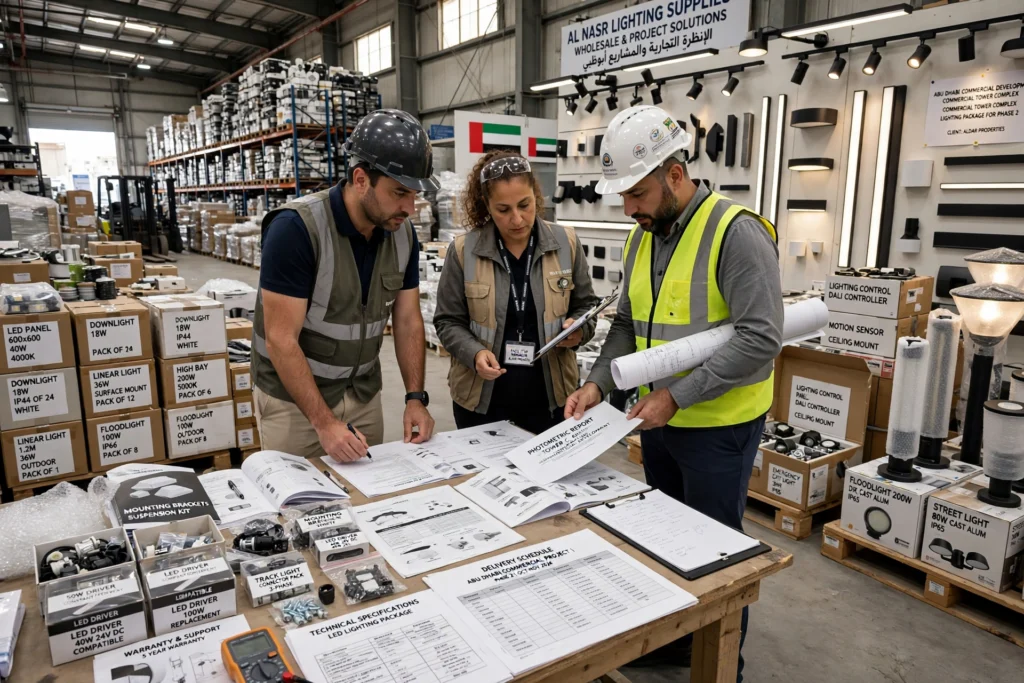
A reliable supply chain is important for commercial projects because large developments may require hundreds or thousands of fixtures.
Professional Commercial Lighting Supplies should cover a broad range of applications, including LED panels, downlights, track lights, linear lighting, high-bay fixtures, floodlights, street and area lighting, emergency lighting, architectural LEDs, and lighting controls.
Availability of replacement drivers, compatible accessories, and matching fixtures can also be important for long-term maintenance.
For contractors and facility managers, product documentation, photometric files, technical specifications, warranties, and delivery schedules should be reviewed before finalizing procurement.
Lighting for Masdar City
Masdar City is associated with sustainable development, technology, and energy-conscious urban planning. Commercial lighting projects in this environment can benefit from efficient LED systems combined with intelligent controls and daylight management.
Lighting design can support the broader sustainability objectives of a building by reducing unnecessary energy use and coordinating artificial lighting with natural daylight.
The correct system should still be selected according to the building’s actual architecture and operational requirements.
Lighting for Yas Island Commercial Developments
Yas Island contains entertainment, hospitality, retail, leisure, and commercial properties where lighting contributes strongly to the visitor experience.
Retail and hospitality venues can use architectural lighting, façade illumination, decorative fixtures, accent lighting, and programmable systems to create distinctive environments.
Outdoor lighting must also be designed for reliability under UAE environmental conditions while maintaining suitable visual comfort.
Lighting Design for Al Raha Beach
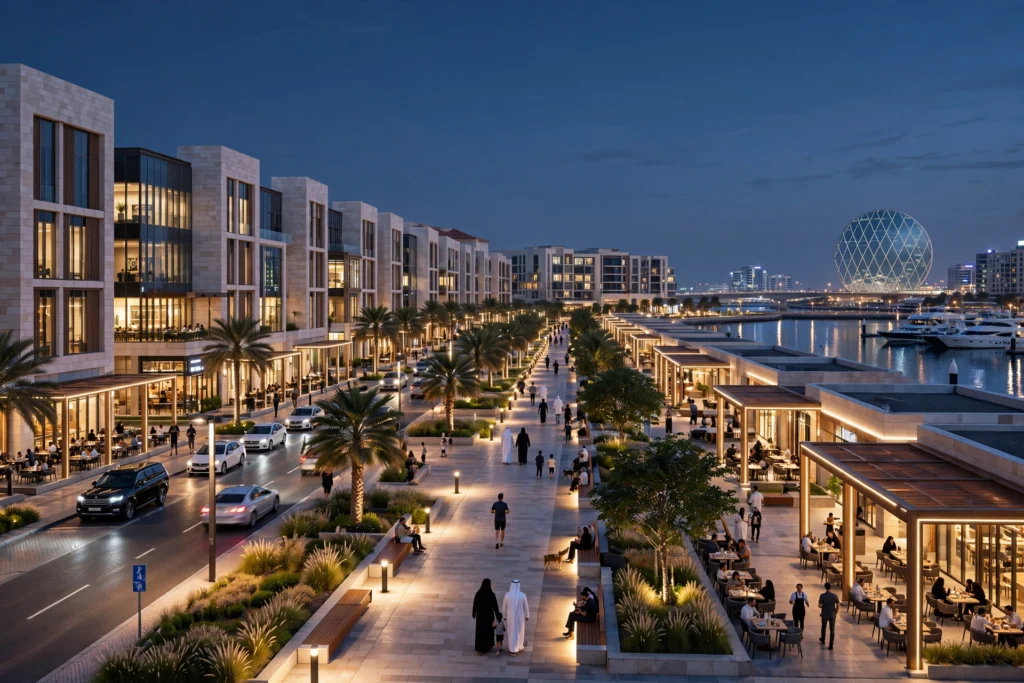
Commercial properties around Al Raha Beach can include offices, restaurants, retail spaces, hospitality venues, and mixed-use developments.
Lighting should complement the area’s modern architecture while providing practical illumination for customers, employees, vehicles, and pedestrians.
Outdoor landscape lighting can also be integrated with commercial entrances and public areas to create a cohesive visual identity.
Maintenance of Commercial Lighting Systems
Even high-quality LED lighting requires maintenance.
Dust accumulation can reduce fixture output, particularly in exposed environments. Damaged lenses, failing drivers, loose connections, and control-system faults can also affect performance.
A commercial lighting maintenance plan can include fixture cleaning, electrical inspection, control-system checks, replacement of failed components, emergency-light testing, and periodic assessment of illumination levels.
Maintenance schedules should be based on the environment, operating hours, fixture type, and manufacturer’s recommendations.
Common Commercial Lighting Mistakes
Businesses often make the mistake of selecting fixtures only according to price. A low-cost fixture with poor driver quality or inadequate thermal management may create higher maintenance costs later.
Another common mistake is installing too many fixtures without a proper lighting calculation. This can increase energy consumption without producing better illumination.
Ignoring glare, using inconsistent colour temperatures, selecting unsuitable IP ratings, and failing to consider maintenance access can also create long-term problems.
Lighting should be designed before the final ceiling and interior finishes are installed so that fixture positions can be coordinated properly.
How to Plan a Commercial Lighting Project
A successful project should begin with a site assessment and understanding of the building’s purpose.
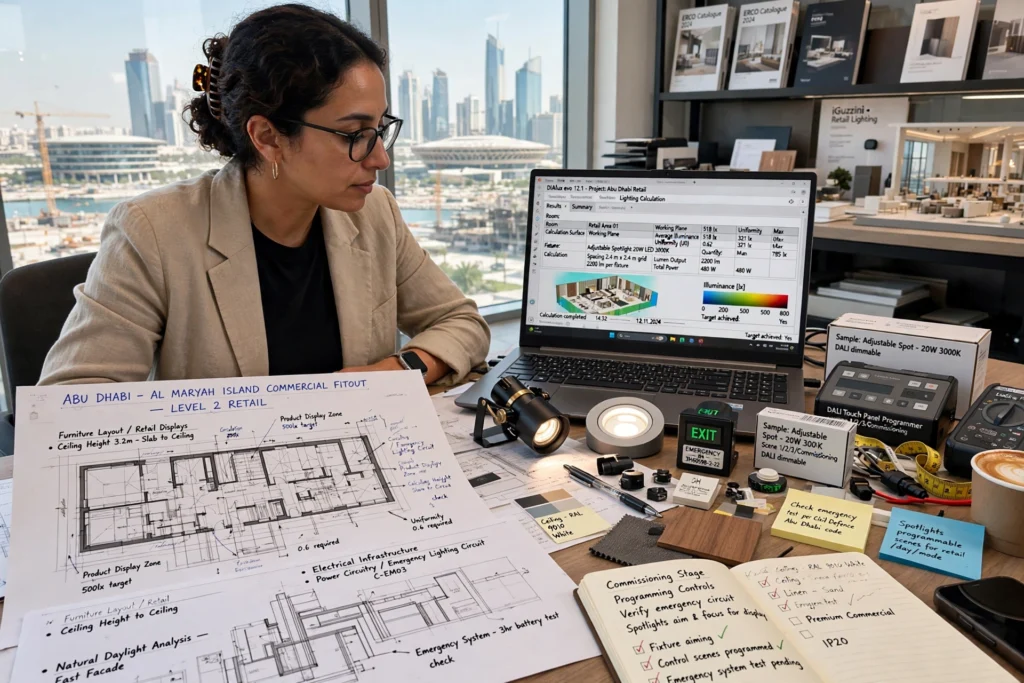
The lighting designer or consultant can evaluate floor plans, ceiling heights, natural daylight, furniture arrangements, working areas, product displays, architectural features, and electrical infrastructure.
A lighting calculation can then determine fixture quantities, spacing, lumen output, uniformity, and other performance parameters.
Samples or mock-ups are valuable for premium commercial interiors because they allow stakeholders to assess the actual appearance before large-scale installation.
The final stage should include commissioning, aiming adjustable fixtures, programming controls, checking emergency systems, and verifying that the installed lighting matches the approved design.
The Future of Commercial Lighting in Abu Dhabi
Commercial lighting is increasingly moving toward connected, efficient, and data-driven systems.
Smart sensors, wireless controls, automated scheduling, daylight harvesting, occupancy detection, and BMS integration can help building operators understand and manage lighting consumption.
Architectural LED systems are also becoming more flexible, allowing businesses to create dynamic environments without replacing the entire lighting infrastructure.
For Abu Dhabi’s evolving business districts, the combination of efficient LED technology, intelligent controls, architectural integration, and professional maintenance can create commercial spaces that are more adaptable and operationally efficient.
Frequently Asked Questions
What type of lighting is best for commercial buildings?
LED lighting is widely used because it can provide efficient, long-lasting illumination across offices, retail stores, warehouses, hospitality venues, and outdoor applications. The specific fixture should be selected according to the space and lighting requirements.
Why is commercial lighting important for businesses?
Commercial lighting affects visibility, productivity, customer experience, safety, architectural appearance, energy consumption, and the perceived quality of a business environment.
What LED lighting is suitable for offices?
LED panels, linear fixtures, recessed downlights, suspended lighting, and task lighting can be suitable depending on the office layout, ceiling height, workstation arrangement, and glare requirements.
Is smart lighting suitable for Abu Dhabi commercial buildings?
Smart lighting can be highly useful for commercial buildings because occupancy sensors, daylight controls, dimming, scheduling, and BMS integration can help manage energy consumption and operating schedules.
How should outdoor commercial lighting be selected?
Outdoor fixtures should be selected according to environmental exposure, IP rating, corrosion resistance, temperature conditions, mounting location, optical requirements, and maintenance accessibility.
Conclusion
Commercial lighting is an essential part of Abu Dhabi’s modern business environment. From corporate offices and financial centres to retail stores, hotels, restaurants, warehouses, healthcare facilities, and mixed-use developments, each property requires a lighting strategy based on its specific function.
Districts such as Al Maryah Island, Al Reem Island, Downtown Abu Dhabi, Masdar City, Yas Island, Al Raha Beach, and the Corniche Area demonstrate the diversity of commercial environments across the emirate. Effective lighting must therefore combine functionality with architectural design, energy efficiency, visual comfort, and long-term maintainability.
High-quality LED panels, downlights, track lights, linear systems, high-bay fixtures, floodlights, façade lighting, display lighting, and smart controls can address different commercial requirements. However, selecting the right product is only one part of the process. Proper lighting calculations, installation, commissioning, controls, and maintenance are equally important.
Businesses and contractors sourcing Commercial Lighting Suppliers should evaluate technical specifications, product reliability, energy performance, warranty, availability, and suitability for the intended application. A properly planned commercial lighting system can support better working environments, stronger retail presentation, safer public spaces, and more efficient building operations across Abu Dhabi.