Why LED Panels Dominate Commercial Ceilings in the UAE
Walk through any modern office, hospital, school, or government building in the UAE and you will see the same lighting solution overhead: the LED panel. This is not an accident of fashion. The LED panel has become the default specification for commercial ceilings across the Emirates because it solves the practical problems that developers, facility managers, and MEP consultants face every day, uniform illumination, energy efficiency, visual comfort, regulatory compliance, and low maintenance, in a single, ceiling integrated format. For the professionals responsible for the performance and economics of a building, understanding the LED panel in depth is essential to specifying it well.
This guide approaches LED panels not as a product to be sold but as a building system to be understood. It examines the operational benefits, the financial case, the compliance requirements, and the specification factors that determine whether a panel installation serves a commercial building well across a decade of operation or becomes a source of cost and complaint.
Energy Efficiency and the Operating Cost Case
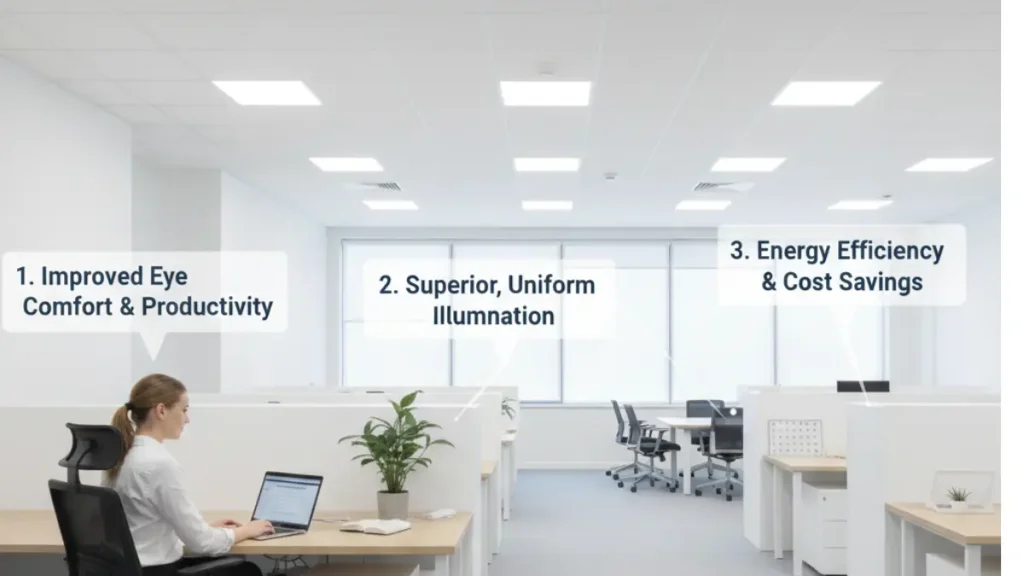
The first and most quantifiable benefit of LED panels is energy efficiency. A commercial LED panel consumes a fraction of the energy of the fluorescent troffer it replaces while delivering equal or superior illumination. Across a large commercial floor plate operating lighting for twelve or more hours a day, this efficiency translates into a substantial reduction in electricity consumption and a measurable improvement in the building operating economics.
In the UAE, where electricity tariffs are significant and commercial buildings run long hours, the energy saving is particularly valuable. For a building operator, every kilowatt hour saved on lighting reduces service charges, improves the competitiveness of total occupancy cost for tenants, and contributes to net operating income. The efficiency of the panel also reduces the heat it adds to the space, lowering the cooling load and compounding the energy saving in a climate where air conditioning dominates building energy use.
Maintenance Reduction Across Building Portfolios
For facility managers responsible for large commercial portfolios, the maintenance economics of LED panels are transformative. A quality commercial LED panel is rated for tens of thousands of hours of operation, eliminating the frequent tube replacement programmes that fluorescent systems demanded. Across a building with hundreds or thousands of fittings, this dramatically reduces the labour, materials, and disruption associated with lighting maintenance.
The maintenance saving is not merely financial. In occupied commercial buildings, lamp replacement programmes disrupt tenants, require access equipment, and consume facility management resources that could be deployed on higher value tasks. LED panels that simply work, year after year, free facility teams to focus on the issues that genuinely require their attention. For developers building to sell, a building with low maintenance lighting infrastructure is a more attractive proposition than one facing imminent replacement costs.
Visual Comfort and Occupant Productivity
Beyond energy and maintenance, the quality of light an LED panel delivers directly affects the people who work beneath it. Commercial environments, particularly offices, require glare controlled illumination that supports screen based work without causing the eye fatigue that reduces productivity and comfort. The Unified Glare Rating quantifies this, and panels with a UGR below 19 are the benchmark for office and educational environments across the UAE.
Premium corporate occupiers increasingly recognise the link between lighting quality and workplace performance, and they specify low glare environments in their fit out requirements. A building delivered with high quality, glare controlled LED panels meets these expectations from the outset, supporting the workplace quality positioning that attracts and retains premium tenants. For meeting rooms and circulation areas that complement open plan panel lighting, developers often add LED downlights for commercial meeting areas to complete the scheme.
Backlit Versus Edge Lit Panels
Not all LED panels are equal, and the distinction between backlit and edge lit construction matters for commercial specification. Edge lit panels position the LEDs around the perimeter and use a light guide plate to distribute light across the surface, achieving a slim profile suited to shallow ceiling voids. Backlit panels position the LEDs across the full rear surface behind a diffuser, achieving higher luminous efficacy, more uniform distribution, and better resistance to the hot spotting that can develop in edge lit panels over time.
For commercial applications where quality and longevity are priorities, backlit panels are generally the superior specification. They deliver more light per watt, distribute it more evenly, and maintain their appearance better across a long service life. Edge lit panels retain a role where ceiling void depth is constrained, particularly in refurbishment projects, but developers specifying for the long term increasingly favour backlit construction for its performance advantages.
Colour Temperature and Rendering for Commercial Environments
The colour characteristics of an LED panel must suit the function of the space it serves. Commercial offices typically specify neutral 4000K light, which balances alertness and comfort for productive work. Healthcare clinical areas may specify cooler temperatures for visual acuity, while hospitality and premium reception areas favour warmer 3000K light for a welcoming atmosphere. Specifying the right colour temperature for each space is a basic but important element of a successful panel installation.
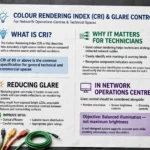
Colour rendering, expressed as CRI, determines how faithfully the panel reveals the colours of surfaces, furnishings, and the people in the space. A CRI of 80 is acceptable for general commercial use, while CRI 90 or above is specified where accurate colour matters, in commercial, healthcare assessment, and premium commercial environments. Across large installations, colour consistency between panels is equally important, because visible variation between adjacent fittings undermines the quality of the whole ceiling.
DEWA Approval and UAE Regulatory Compliance
LED panels specified for commercial developments in the UAE must satisfy regulatory requirements, and compliance is not optional. In Dubai, DEWA approval is required for electrical equipment installed in buildings, and panels carrying DEWA certification give developers and consultants the assurance needed for authority submission and certificate of occupancy. CE marking and RoHS compliance demonstrate adherence to the electrical safety and environmental standards adopted as the baseline for UAE commercial procurement.
Beyond product certification, panels contribute to the energy performance documentation required under Dubai Green Building Regulations, Estidama in Abu Dhabi, and emirate level sustainable building requirements. The efficiency of the panel installation directly affects whether a building meets the lighting power density limits these regulations impose. Specifying certified, efficient panels is therefore both a compliance requirement and a contribution to the sustainability positioning that premium developments depend upon.

Emergency Lighting and Life Safety Integration
UAE fire and life safety regulations require maintained emergency lighting along commercial building escape routes, and LED panels integrate this function cleanly. Emergency panels with self contained battery backup modules provide maintained illumination on mains failure, satisfying civil defence requirements while integrating invisibly into the ceiling design. Coordinating which panel positions require emergency provision at specification stage avoids costly retrofitting and ensures the escape lighting scheme is delivered correctly.
For facility managers, emergency lighting also brings ongoing compliance obligations, periodic function testing and annual discharge testing of battery systems, that must be documented to satisfy civil defence inspection. Specifying quality emergency panels with reliable battery systems reduces the burden of this compliance and the risk of test failures across the building life.
Sizing and Format for UAE Ceiling Systems
Commercial LED panels are manufactured in standard formats that integrate with the modular ceiling grid systems used across UAE commercial construction. The 600 by 600 millimetre panel suits the standard modular grid, while the 1200 by 300 millimetre format suits linear plasterboard ceilings and corridors. Smaller formats serve feature areas and meeting rooms. Selecting formats that align with the ceiling system avoids costly adaptation and ensures a clean, integrated ceiling plane.
For projects combining grid ceilings with plasterboard and feature areas, a coordinated panel specification across formats maintains visual consistency throughout the development. Where premium areas call for continuous illumination rather than discrete panels, developers frequently combine panels with LED linear lights for premium office areas to elevate the design in public facing spaces while retaining cost effective panels elsewhere.
Control Integration and Smart Building Capability
Modern commercial developments increasingly require panels that integrate with building control systems. DALI and DALI 2 addressable panels enable individual fitting control, daylight harvesting, occupancy based dimming, and the energy monitoring that supports both operating cost reduction and sustainability certification. For a building management system, addressable panels provide the granular control and data that efficient, responsive building operation depends upon.
Daylight harvesting is particularly valuable in the UAE, where abundant natural light can offset artificial lighting near facades for much of the day. Panels that dim automatically in response to available daylight consume only the energy genuinely needed, delivering ongoing savings without occupant intervention. These control capabilities position the panel installation as part of the smart building infrastructure that premium developments now treat as standard rather than premium.
Application Across Commercial Building Types
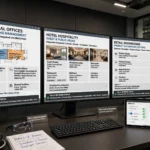
The versatility of the LED panel is evident in the range of commercial buildings it serves. In offices, panels deliver the glare controlled ambient illumination that productive workspaces require. In hospitals, high CRI panels support accurate clinical assessment while IP rated variants serve clean and wet areas. In schools and universities, efficient long life panels minimise maintenance across large campus footprints. In government buildings and commercial back of house areas, panels provide reliable, economical illumination.
This breadth of application makes the panel a foundational element of almost every commercial lighting specification in the UAE. Understanding how the panel performs in each context, and specifying the appropriate variant for each space, allows developers and consultants to deliver lighting that serves the building and its occupants well across its operating life.
Total Cost of Ownership Versus Initial Price
A common error in commercial lighting procurement is to evaluate panels on initial price alone. The more rigorous and more accurate approach considers total cost of ownership across the building life, incorporating energy consumption, maintenance frequency, expected service life, and compliance. Viewed this way, a quality panel that costs more at tender frequently proves the more economical choice, because its lower energy and maintenance costs accumulate to outweigh the initial price difference many times over.
For developers and facility managers making capital decisions, framing the panel specification as a total cost of ownership analysis reveals the true economics. A budget panel that fails early in UAE conditions, delivers inconsistent colour, or lacks the certification required for compliance creates costs far exceeding its apparent saving. Specifying quality, certified panels is the economically rational choice across the building life.
Sourcing Panels for UAE Commercial Projects
Delivering panels at the scale a commercial project requires demands a supply partner able to provide consistent product quality across large quantities, complete technical and compliance documentation, and delivery scheduling aligned to the construction programme. Inconsistent quality across a project supply batch produces the visible colour and performance variation that undermines a large installation, making the choice of supply partner as important as the choice of product.
As an authorised OPPLE distributor, Tricircle supplies commercial developments across the UAE with certified, consistent LED panels, complete with the photometric data, energy calculations, and DEWA compliance documentation that project submissions require. We support developers, MEP consultants, and facility managers from specification through delivery, ensuring the panel installation performs as designed.
Speak to Tricircle About Your Panel Project
If you are specifying LED panels for an office, hospital, school, government, or commercial development anywhere in the UAE, our commercial team can provide product recommendations, technical documentation, and project pricing tailored to your requirements. We supply panels in project quantities across Dubai, Sharjah, Abu Dhabi, and the wider Emirates, with the consistency and certification that professional commercial projects demand.
To discuss your panel specification or request a project quotation, contact our team at aysha@tricirclegroup.ae or call +971 50 578 1325. We will help you specify panel lighting that serves your building, your tenants, and your operating economics across its full service life.