Bathroom mirror lighting has evolved dramatically over the past decade. Where households once relied on fluorescent tubes, halogen bulbs, or incandescent fixtures, modern bathrooms now increasingly use LED mirror lighting for clarity, precision, efficiency, and aesthetics. But is LED always the better choice? Are traditional lighting types still relevant? And which option truly suits your bathroom setup?
What Is the Difference Between LED and Traditional Bathroom Mirror Lighting?

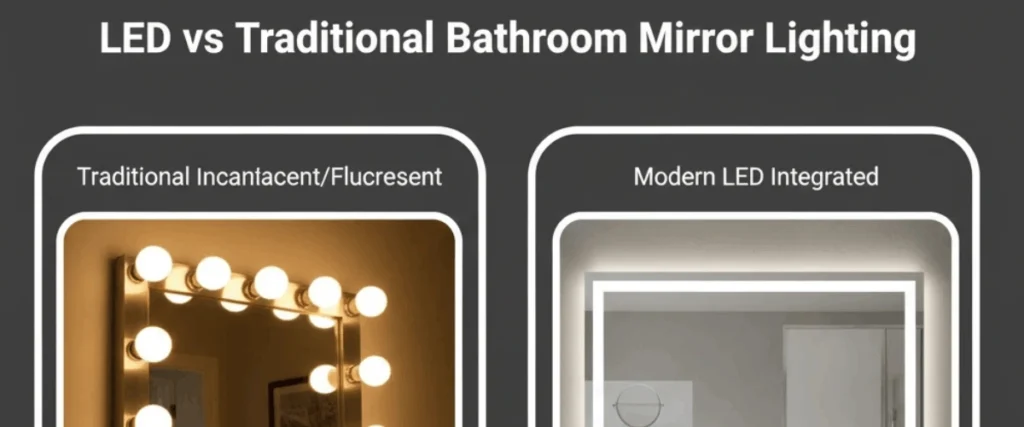
Before comparing benefits, it’s important to understand what separates LED from traditional lighting:
LED Lighting:
- Uses light-emitting diodes
- Highly energy-efficient
- Long lifespan
- Available in adjustable temperatures and brightness levels
- Emits minimal heat
- Often integrated into modern mirror designs
Traditional Lighting:
- Includes incandescent, halogen, and fluorescent fixtures
- Higher heat output
- Uses more energy
- Often requires more frequent bulb replacements
- Limited adjustability
- Common in older bathrooms or budget setups
The core difference is that LED lighting is designed for longevity, efficiency, and versatility, while traditional lighting is a legacy solution with limited features and higher energy consumption.
Why Are LEDs Becoming More Popular in Bathroom Mirror Lighting?
LED bathroom mirror lights have become a dominant choice because they solve many of the problems traditional lighting never addressed.
People searching on this topic often ask:
“Why are LED mirror lights better?”
“Are LED mirrors worth it?”
“Is LED light good for makeup?”
The answers almost always lead to the same benefits:
Longer Lifespan
LED bulbs typically last anywhere from 25,000 to 50,000 hours, compared to roughly 1,500 hours for incandescent and 8,000–10,000 for fluorescent bulbs.
Better Energy Efficiency
LEDs use up to 75–85% less electricity than incandescent lights. Over several years, this means significant savings on energy bills.
Better Lighting Accuracy
LEDs produce clearer, more focused, and more natural lighting, which is ideal for grooming, makeup application, and shaving.
Aesthetically Modern
LED mirror lights often feature sleek frames, edge lighting, and integrated touch controls, elevating both style and practicality.
Are LED Bathroom Mirror Lights Safe to Use in Wet or Humid Areas?

This is a common search query and also frequently discussed on Reddit threads related to bathroom upgrades.
LED bathroom mirror lights are designed with moisture resistance in mind. Most have IP44 or higher ratings, ensuring safe operation in damp conditions.
Traditional lighting, especially older fluorescent or halogen fixtures, may not meet modern moisture standards and can be risky in high-humidity environments if not properly sealed.
If your bathroom requires enhanced safety, explore led weatherproof lights for optimal performance and durability.
Which Type of Lighting Gives the Best Visibility for Shaving or Makeup?
This is frequently asked in beauty, grooming, and home-improvement communities online.
LEDs offer:
- More accurate color rendering
- Adjustable brightness
- Customizable color temperature
- Even lighting distribution
- No flickering
Good grooming requires consistent, natural light. LED bathroom mirror lighting can be set to mimic daylight, highlighting true skin tones without distortion.
Traditional halogen bulbs give warm, flattering tones but lack adjustability. Fluorescent mirrors often flicker or produce harsh coloring, making precise grooming difficult.
For the best grooming experience, LEDs outperform every traditional lighting option.
Do LEDs Provide Better Color Temperature Options?
This is one of the most searched questions regarding LED bathroom lighting.
LEDs offer a wide range of color temperatures:
- 2700K: Warm, soft, calming
- 3000K–4000K: Natural white, ideal for daily grooming
- 5000K–6500K: Cool daylight, excellent for makeup detail
Traditional bulbs provide limited temperature variety:
- Incandescent and halogen: Warm light only
- Fluorescent: Usually cold, harsh, and less accurate
LEDs provide significantly more versatility.
Are LED Bathroom Lights More Expensive Than Traditional Lights?
Initial Cost:
LED mirrors or LED fixtures may have a higher upfront price compared to incandescent or halogen lights.
Long-Term Savings:
LEDs last many times longer and consume far less electricity. Over 5–7 years, LEDs almost always cost less overall.
Traditional bulbs require continuous replacement and consume higher energy, increasing long-term costs.
Can LED Lights Be Too Bright for a Bathroom?
People often ask online, “Are LED bathroom lights too harsh?” or “How do I soften LED mirror lighting?”
LEDs can be bright, but the benefit is adjustability. Most modern LED mirror lights include:
- Dimmers
- Touch switches
- Warm-to-cool color adjustment
- Smart memory settings
With proper adjustment, LEDs strike the ideal balance between clarity and comfort.
Traditional lighting typically lacks these features, meaning the brightness level is fixed.
Do LED Mirror Lights Increase Home Value?
Real estate experts and homeowners often mention that modern LED bathroom upgrades can improve perceived property value.
A bathroom equipped with LED mirror lighting appears newer, more luxurious, and more energy-efficient. Every homebuyer or renter appreciates updated lighting, regardless of budget.
Traditional lighting, in contrast, can make a bathroom feel outdated.
How Hard Is It to Install LED Mirror Lighting Compared to Traditional Lighting?
Many people wonder whether LED mirrors require professional installation.
LED Installation:
- Hardwired LED mirrors usually require an electrician
- Plug-in LED mirrors can be installed easily
- Integrated LED fixtures simplify the number of components required
Traditional Lighting Installation:
Traditional fixtures are generally simpler to replace but often require compatible bulbs, more frequent maintenance, and more space.
Homeowners upgrading to LED mirror lighting often see long-term benefits that outweigh the initial installation effort.
Which Lighting Works Best for Small vs Large Bathrooms?
Small Bathrooms:
LED lighting is ideal because:
- It produces high brightness using minimal space
- Edge-lit or backlit mirrors visually expand the room
- Mirrors with integrated LEDs reduce clutter from bulky fixtures
Large Bathrooms:
You may combine:
- LED mirror lighting
- Ceiling fixtures
- Ambient wall sconces
Traditional lighting, due to limited brightness and poor distribution, is not ideal for small spaces.
Is LED or Traditional Lighting Better for Modern Bathroom Styles?
Modern bathroom design favors:
- Clean lines
- Minimalist fixtures
- Soft ambient glow
- Smart touch features
- Integrated lighting
LED mirrors and LED vanity lights seamlessly achieve all of these goals.
Traditional lights tend to create a more dated aesthetic. They may suit vintage or rustic designs but lack the advanced functionality preferred in contemporary spaces.
What Are the Downsides of Traditional Bathroom Mirror Lighting?
For full topical authority, it’s important to compare disadvantages clearly.
Disadvantages of Traditional Lighting:
- Short lifespan
- Higher energy bills
- Higher heat output
- Limited color temperature options
- Bulky fixtures
- Flickering (fluorescent)
- Potential moisture safety issues
Traditional lights also do not support modern features like anti-fog integration, touch controls, dimming, or brightness memory.
What Are the Downsides of LED Bathroom Mirror Lighting?
To present a fair comparison:
Possible Downsides of LED:
- Higher upfront cost
- Some ultra-bright LEDs may require dimming
- Lower-quality LED strips (cheap brands) may discolor over time
Choosing high-quality LEDs is essential to avoid color shift or brightness drop. This is where consulting guides on specific led bathroom lights is helpful to ensure long-term reliability.
So, LED vs Traditional: Which Is Best for Your Bathroom?
LED lighting is the best option for nearly every modern bathroom. Its advantages include:
- Better visibility
- Energy savings
- Longer lifespan
- Customizable brightness
- Adjustable color temperature
- Safer operation in humid environments
- Aesthetic appeal
Traditional lighting still has a place in vintage or budget setups, but LEDs remain superior for performance, efficiency, and design.