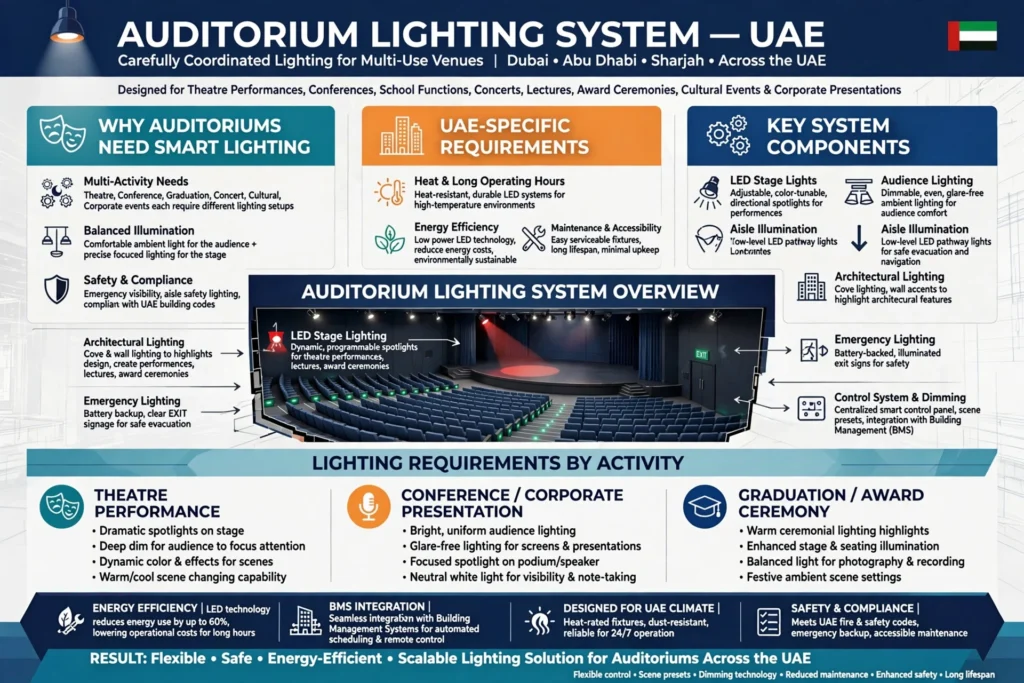
Auditoriums require a carefully coordinated lighting system because they are designed for many different activities, including theatre performances, conferences, school functions, concerts, lectures, award ceremonies, cultural events and corporate presentations. Auditorium lighting solutions need to provide comfortable audience illumination while also delivering precise stage lighting, architectural illumination, emergency visibility and flexible control.
Unlike ordinary commercial lighting, an auditorium lighting system must respond to changing scenes and activities. The lighting requirements for a theatre performance are different from those of a conference or graduation ceremony. A well-designed system therefore combines LED stage lights, audience lighting, aisle illumination, architectural lighting, emergency lighting, control systems and dimming technology.
For venues in Dubai, Abu Dhabi, Sharjah and across the UAE, auditorium lighting also needs to consider energy efficiency, long operating hours, heat, maintenance accessibility and integration with modern building management systems.
What Are Auditorium Lighting Solutions?
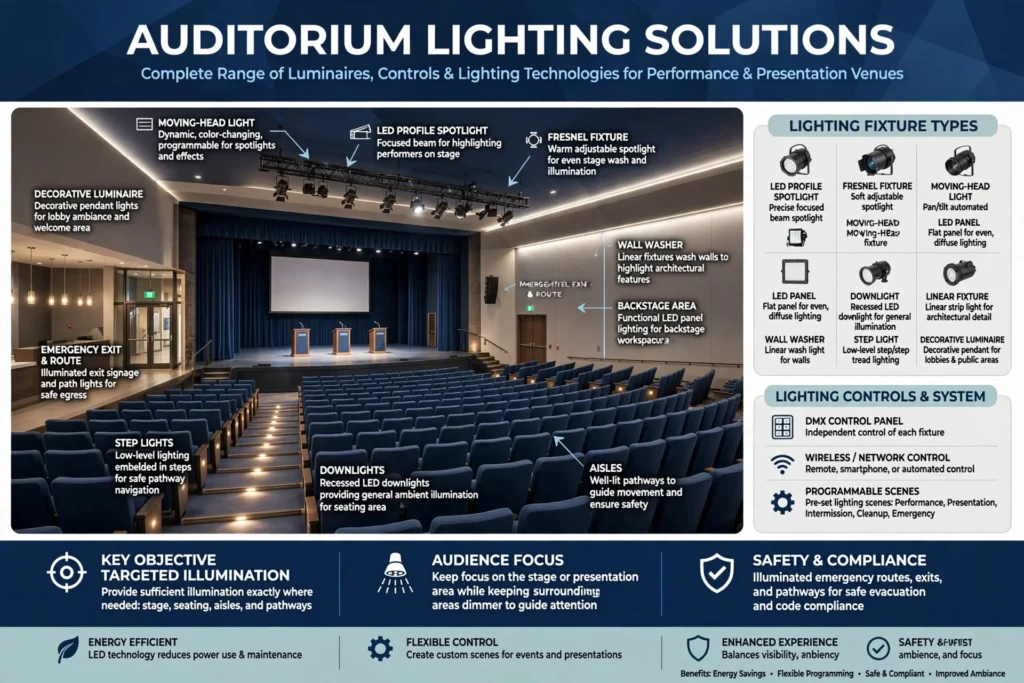
Auditorium lighting solutions include the complete range of luminaires, controls and lighting technologies used to illuminate a performance or presentation venue. The system can cover the stage, seating area, aisles, entrances, lobby, backstage spaces, ceilings, walls, architectural features and emergency routes.
A professional auditorium may use LED profile spotlights, Fresnel fixtures, moving-head lights, LED panels, downlights, linear fixtures, wall washers, step lights and decorative luminaires. These fixtures can be controlled independently or combined into programmable scenes.
The objective is to create sufficient illumination where people need it while keeping the audience focused on the stage or presentation area.
Why Auditorium Lighting Design Matters
Lighting has a major influence on how an audience experiences a performance. Poorly positioned fixtures can create glare, shadows, uneven illumination or uncomfortable viewing conditions. In contrast, a well-designed system can direct attention, create atmosphere and improve visibility.
For presenters and performers, appropriate lighting helps cameras capture clear images and allows audiences to see facial expressions, costumes, stage scenery and movement.
Lighting also contributes to the architecture of an auditorium. Carefully illuminated ceilings, walls, columns and entrances can give the venue a distinctive identity when the stage is not being used.
Main Types of Auditorium Lighting
An auditorium normally requires several layers of lighting rather than one type of fixture. The major categories include stage lighting, audience lighting, aisle lighting, architectural lighting, lobby lighting, backstage lighting and emergency lighting.
Each layer has a different purpose. Stage lighting focuses on performers and presentation areas, while audience lighting provides comfortable visibility before and after an event. Architectural lighting emphasizes the interior design, and emergency lighting supports safe evacuation.
Combining these systems gives venue operators greater flexibility and control.
LED Stage Lighting for Auditoriums
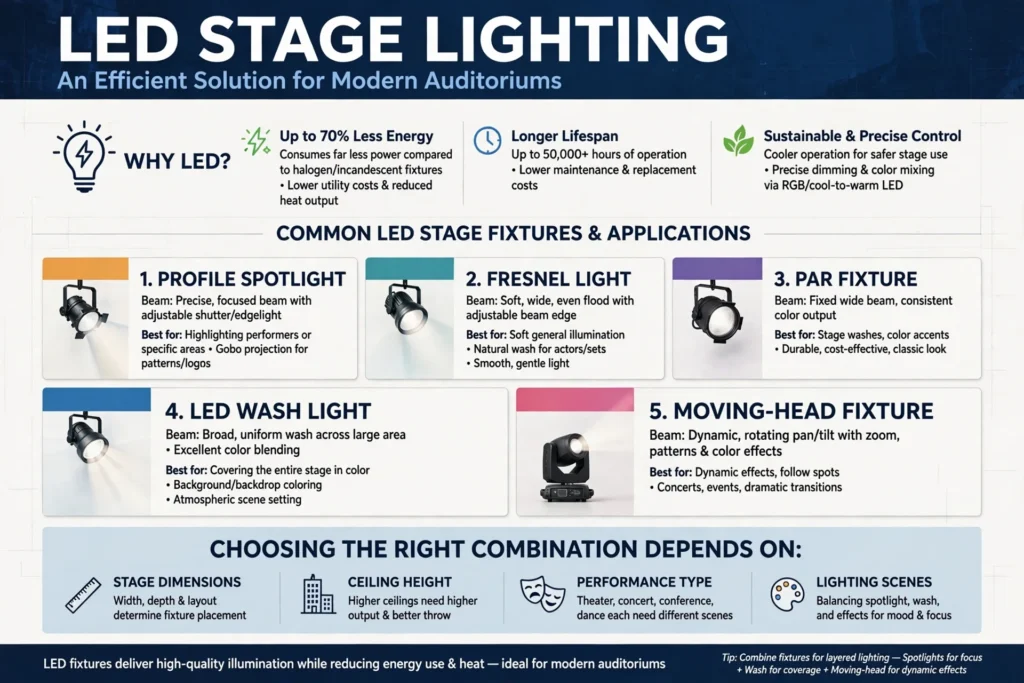
LED stage lighting has become an important solution for modern auditoriums because LED fixtures can provide high-quality illumination while consuming less energy than many conventional lighting technologies.
Common LED stage fixtures include profile spotlights, Fresnel lights, PAR fixtures, LED wash lights and moving-head fixtures. Each has a different beam characteristic and application.
Profile fixtures can provide precise beams and are useful for highlighting performers or specific areas. Fresnel fixtures create softer illumination, while LED wash lights can provide broad coverage across the stage.
The correct combination depends on the stage dimensions, ceiling height, performance type and required lighting scenes.
Front of House Lighting
Front-of-house lighting illuminates performers from the audience side of the auditorium. It is important for creating clear facial visibility and reducing harsh shadows.
The position, beam angle and colour quality of front lights should be carefully considered. Fixtures may be mounted on lighting bridges, ceiling structures or other suitable positions depending on the auditorium architecture.
For video recording and live streaming, consistent and high-quality illumination is particularly important because poor lighting can affect camera exposure and skin tones.
Stage Wash Lighting
Stage wash lighting provides broad, even illumination across a performance area. It can be used for theatre, conferences, lectures, school performances and other events.
LED wash fixtures allow operators to create different colours and lighting levels without replacing physical lamps. RGB, RGBW and tunable-white technologies can provide additional flexibility where colour-changing effects are required.
A properly designed wash system should provide consistent coverage while minimizing dark areas and unwanted spill into the audience.
Spot and Profile Lighting
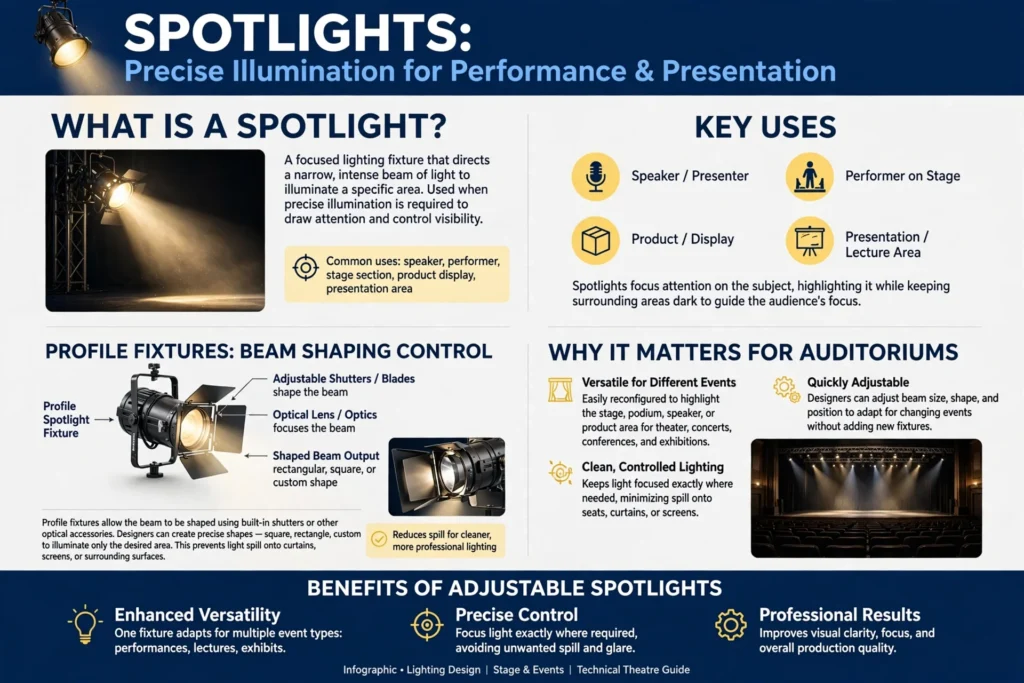
Spotlights are used when precise illumination is required. They can focus attention on a speaker, performer, stage section, product or presentation area.
Profile fixtures are especially useful because their beam can often be shaped using shutters or other optical accessories. This allows lighting designers to illuminate a defined area while reducing spill onto curtains, screens or surrounding surfaces.
For auditoriums hosting different events, adjustable fixtures can make the stage much more versatile.
Audience Area Lighting
Audience lighting needs to balance comfort, visibility and atmosphere. During entry and seating, the auditorium may require relatively bright general illumination. During a performance, lighting can be dimmed significantly to direct attention toward the stage.
LED downlights, recessed fixtures and indirect lighting can provide comfortable audience illumination. Dimming systems allow operators to transition gradually between different levels instead of switching abruptly between bright and dark environments.
This creates a more professional visitor experience.
Aisle and Step Lighting
Aisle and step lighting plays an important safety role in auditoriums. Audience members need to move safely through seating areas even when the main lights are dimmed.
Low-level LED step lights, aisle lights and recessed floor fixtures can provide sufficient guidance without distracting from a performance.
The fixtures should be carefully positioned to minimize glare and avoid creating excessive visual contrast. In large auditoriums, illuminated pathways can also help visitors locate exits, seating sections and accessible routes.
Emergency Lighting for Auditoriums
Emergency lighting is an essential component of auditorium safety. If the normal electrical supply fails, emergency illumination helps occupants identify escape routes and exit points.
Exit signs, emergency luminaires, stair lighting and escape-route lighting should be incorporated into the overall building design while remaining visually unobtrusive during normal operation.
The emergency system should comply with applicable UAE regulations and the requirements established by the relevant authority and project consultant.
Architectural Lighting in Auditoriums
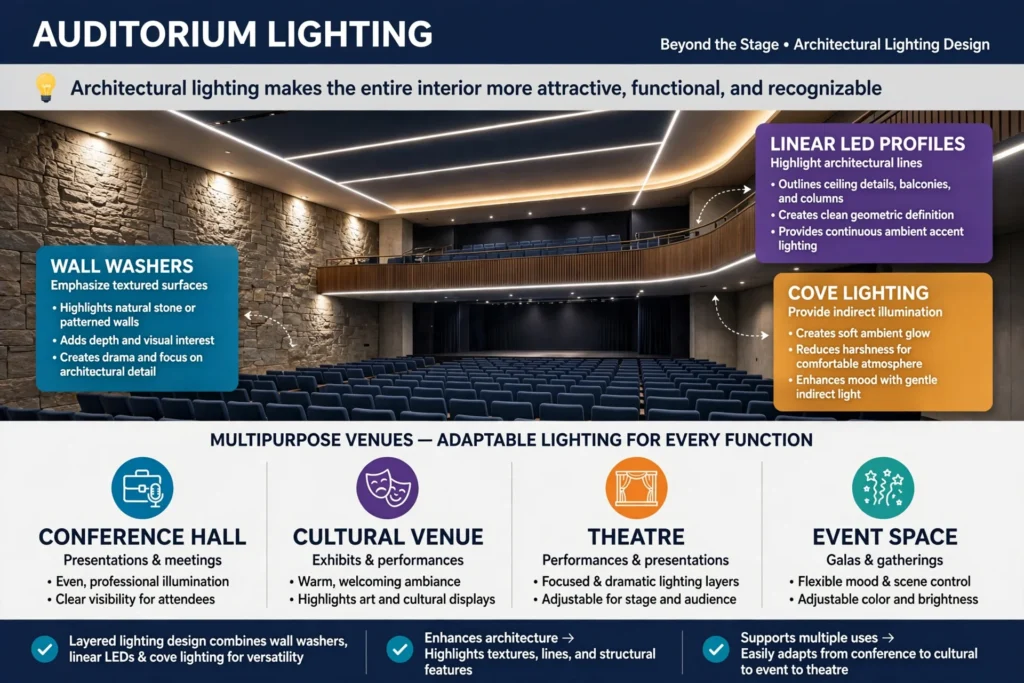
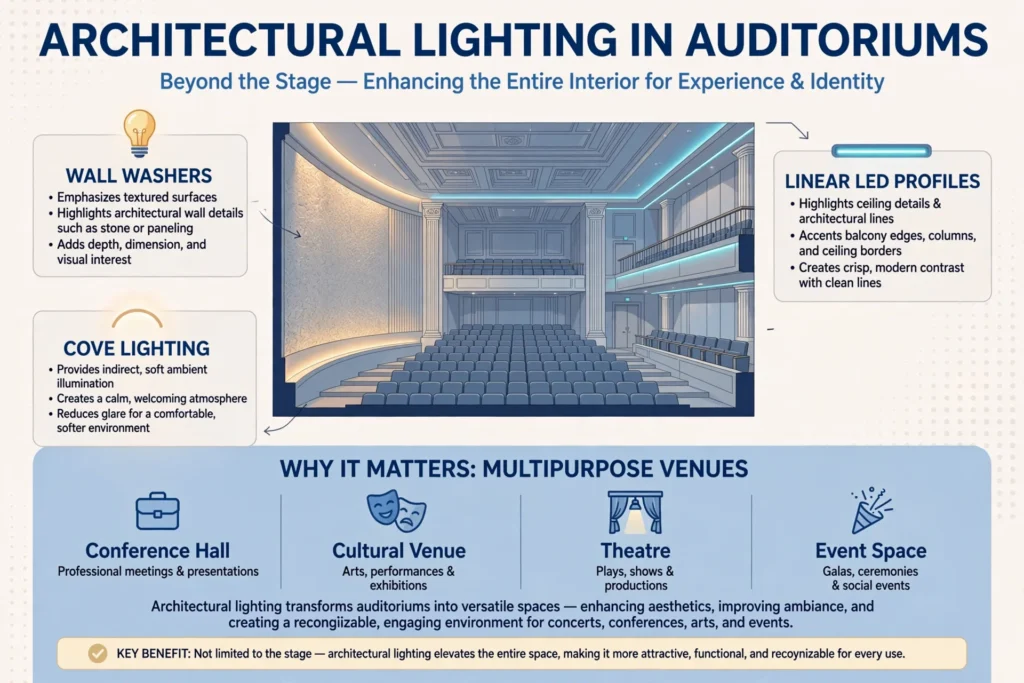
Auditorium lighting is not limited to the stage. Architectural lighting can make the entire interior more attractive and recognizable.
Wall washers can emphasize textured surfaces, while linear LED profiles can highlight ceiling details, balconies, columns and architectural lines. Cove lighting can provide indirect illumination and create a softer environment.
Architectural lighting is especially valuable in multipurpose venues where the auditorium needs to function as a conference hall, cultural venue, theatre or event space.
Lobby and Entrance Lighting
The visitor experience begins before people enter the auditorium. Lobby lighting should make entrances, ticket counters, reception areas and circulation routes easy to identify.
Pendant fixtures, downlights, linear LED systems and decorative luminaires can be combined to create a welcoming environment.
In theatres and cultural venues, lobby lighting can also be used to display posters, artwork, sponsor branding and architectural features.
Lighting for Conference and Corporate Auditoriums
Corporate auditoriums have different requirements from traditional theatres. They frequently host conferences, keynote presentations, seminars, product launches and panel discussions.
The lighting system needs to support speakers, presentation screens and cameras simultaneously. Excessive illumination on projection screens can reduce image visibility, while insufficient light on presenters can produce poor video quality.
Tunable and dimmable LED lighting can help operators create dedicated scenes for presentations, panel discussions, networking and audience entry.
Auditorium Lighting for Schools and Universities
Educational auditoriums often host lectures, examinations, graduation ceremonies, student performances and community events. Flexibility is therefore important.
A programmable lighting control system allows staff to save different scenes for different activities. General classroom-style illumination may be appropriate for lectures, while stage-focused lighting can be selected for performances.
Durable LED fixtures and simple controls are also valuable because educational facilities may have different staff members operating the system.
Theatre and Performing Arts Lighting
Performing arts venues require more advanced lighting systems because theatrical productions can involve complex transitions, colour changes, movement and special effects.
Moving-head fixtures, LED profiles, Fresnel fixtures, followspots and intelligent lighting controllers can be integrated into a professional theatre lighting system.
The control architecture should allow lighting designers to program cues and synchronize different fixtures. Depending on the venue, systems may also interface with theatrical control protocols such as DMX512 and Art-Net.
Lighting for Cultural and Community Auditoriums
Cultural centres, community halls and public auditoriums often host a broad range of activities. These may include concerts, cultural performances, government events, workshops, lectures and community celebrations.
A flexible lighting design is particularly valuable in these facilities. Instead of installing separate lighting systems for every event type, programmable LED fixtures can provide multiple scenes from one integrated control system.
This can reduce operational complexity and increase the long-term usefulness of the venue.
Colour Temperature and Colour Rendering
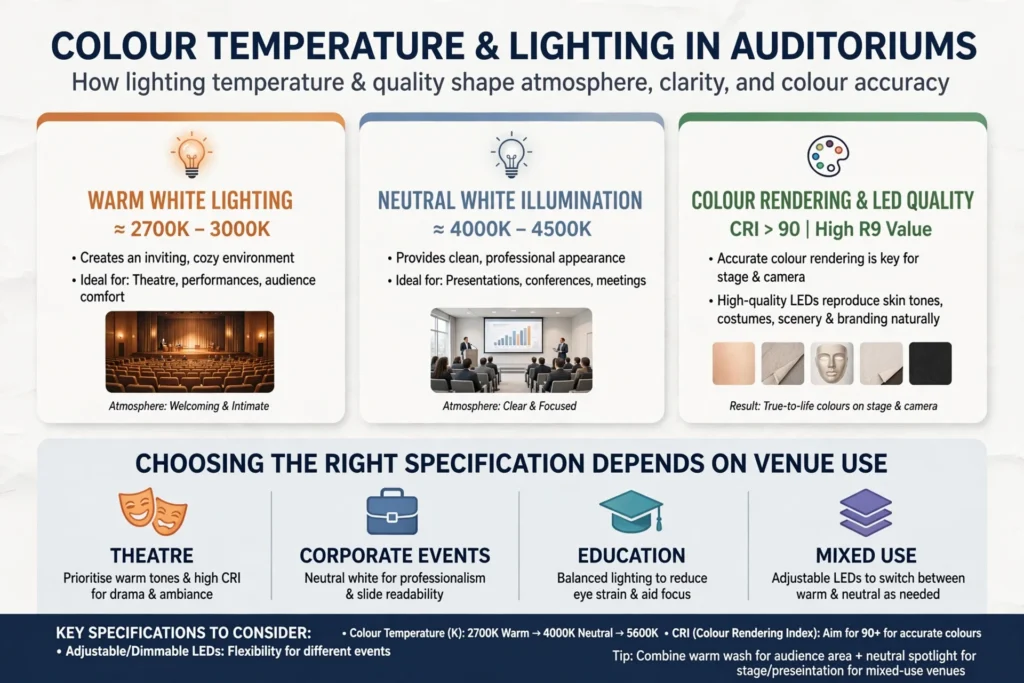
Colour temperature influences the atmosphere of an auditorium. Warm white lighting can create an inviting environment, while neutral white illumination can provide a clean and professional appearance for presentations and conferences.
Colour rendering is particularly important for stage and camera applications. High-quality LED fixtures can reproduce skin tones, costumes, scenery and branding more naturally.
The appropriate specification depends on the venue’s activities and whether the auditorium is designed primarily for theatre, corporate events, education or mixed use.
Dimming and Lighting Control Systems
A modern auditorium should provide detailed lighting control. Dimming enables operators to adjust illumination gradually and create transitions between different event scenes.
Lighting control systems can organize fixtures into zones such as:
- Stage
- Audience
- Aisles
- Lobby
- Architectural lighting
- Backstage
- Emergency systems
Programmable scenes can then be created for events such as audience entry, presentation, performance, interval, cleaning and closing.
Advanced systems can integrate with building automation platforms, allowing facility managers to monitor and control lighting alongside HVAC and other building systems.
Smart Auditorium Lighting
Smart lighting can improve operational efficiency by allowing auditorium staff to manage fixtures through centralized control interfaces.
Scheduling can automatically activate lobby lighting before an event. Occupancy sensors can reduce lighting in areas that are not being used, while daylight sensors can adjust illumination in spaces with windows.
For larger UAE venues, centralized control can simplify management across multiple halls, corridors and public areas.
Energy-Efficient Auditorium Lighting
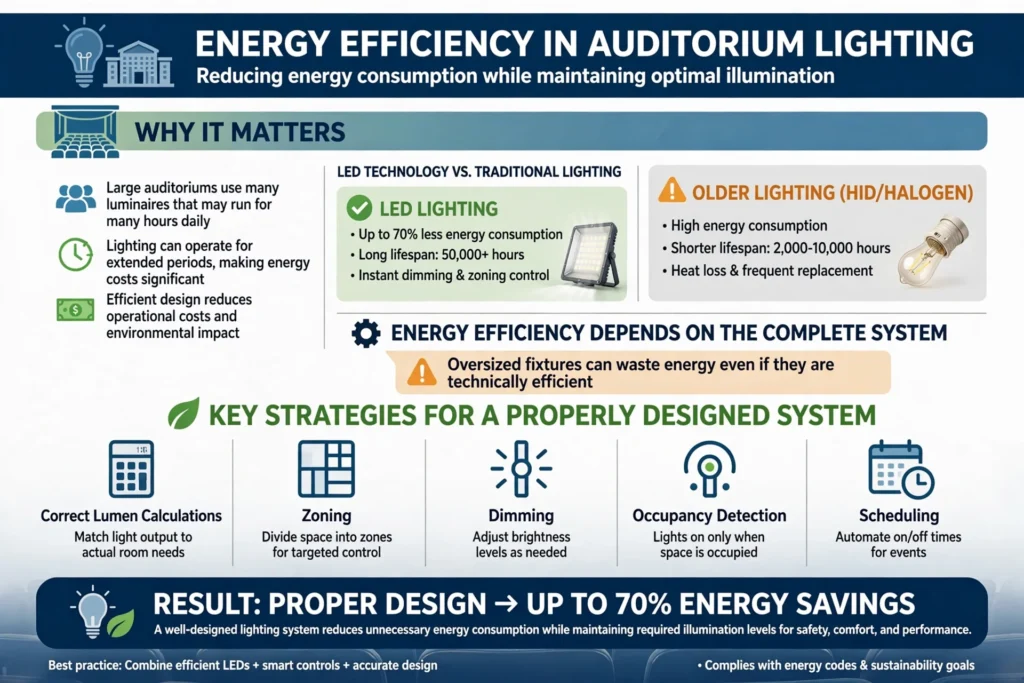
Energy efficiency is particularly important for auditoriums because large numbers of luminaires may operate for many hours. LED technology can significantly reduce energy consumption compared with older lighting technologies when appropriately designed.
However, energy efficiency depends on the complete system. Oversized fixtures can waste energy even if they are technically efficient. Correct lumen calculations, zoning, dimming, occupancy detection and scheduling are therefore important.
A properly designed lighting system can reduce unnecessary energy consumption while maintaining required illumination levels.
Auditorium Lighting in Dubai
Auditoriums across Dubai serve corporate, educational, cultural and entertainment purposes. Venues in areas such as Downtown Dubai, Dubai World Trade Centre, Dubai Design District and other commercial and cultural districts can require highly flexible lighting systems.
Dubai’s event industry also means that many venues need lighting systems capable of supporting conferences, exhibitions, product launches and entertainment events.
Professional LED auditorium lighting can provide the flexibility required for rapidly changing event formats while helping operators manage energy and maintenance costs.
Auditorium Lighting in Abu Dhabi
Abu Dhabi has a broad range of conference facilities, educational institutions, cultural venues and performance spaces. Auditorium lighting in Abu Dhabi needs to support both large-scale events and everyday operations.
Large auditoriums may require sophisticated stage lighting, digital controls, emergency systems and architectural illumination. Smaller venues can often benefit from simpler programmable LED systems with appropriate zoning.
Lighting specifications should always be coordinated with the architectural, electrical, audiovisual and fire-safety requirements of the project.
Auditorium Lighting in Sharjah
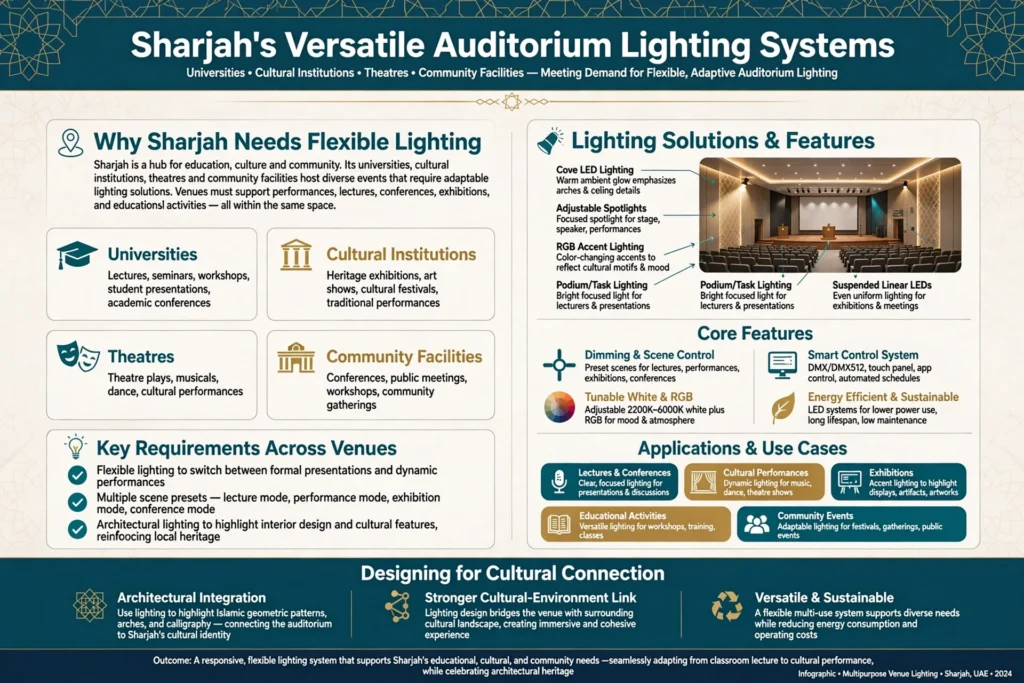
Sharjah’s universities, cultural institutions, theatres and community facilities create demand for versatile auditorium lighting systems. Venues may need to accommodate cultural performances, lectures, conferences, exhibitions and educational activities.
Lighting should therefore be flexible enough to accommodate both formal presentations and performance environments.
For cultural venues, architectural lighting can also be used to emphasize interior design elements and create a stronger connection between the auditorium and the surrounding cultural environment.
Auditorium Lighting and AV Integration
Lighting should be coordinated with the auditorium’s audiovisual system. Projectors, LED displays, cameras and presentation screens can all be affected by lighting levels and direction.
For example, excessive front lighting can create reflections on screens, while uncontrolled stage lighting can cause camera exposure problems.
Integrating lighting with AV systems, digital signage and presentation technology can create a more consistent event environment. Professional control systems can allow operators to manage different technologies from a central interface.
Glare Control in Auditoriums
Glare is one of the most common problems in poorly designed auditorium lighting. Direct views of bright LED sources can cause discomfort and distract the audience.
Optical lenses, shutters, diffusers, louvers and appropriate fixture positioning can help control glare. Designers should also consider reflective surfaces such as polished flooring, screens, glass and decorative materials.
A lighting calculation should evaluate illumination and visual comfort rather than simply counting the number of fixtures.
Lighting Maintenance and Reliability
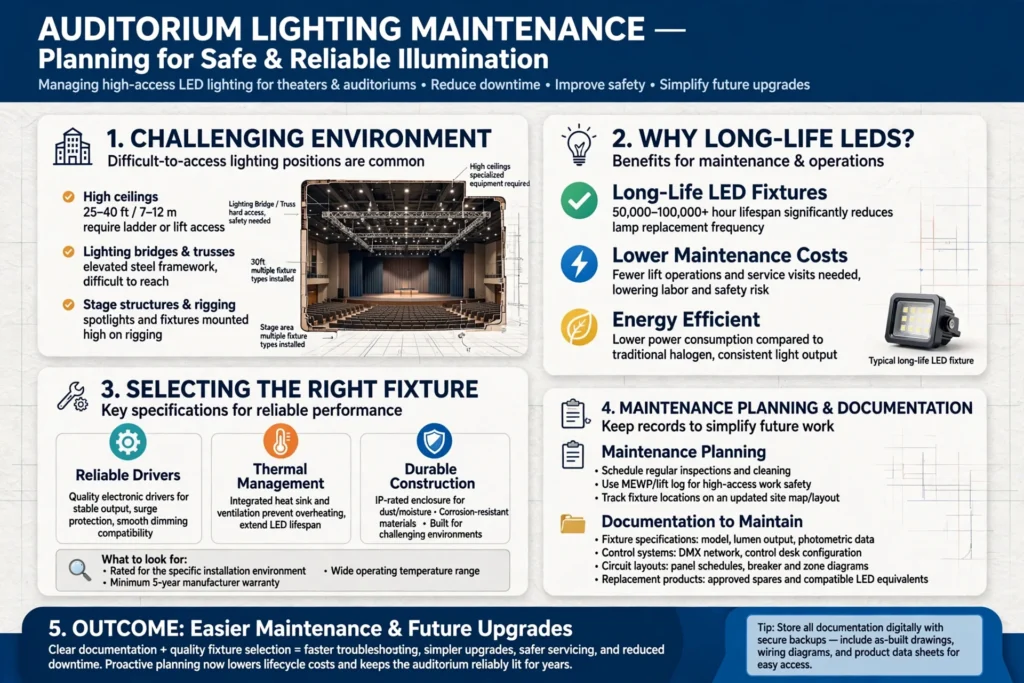
An auditorium may have difficult-to-access lighting positions, including high ceilings, lighting bridges and stage structures. Long-life LED fixtures can reduce the frequency of lamp replacement, but maintenance planning remains important.
Fixtures should be selected with reliable drivers, appropriate thermal management and suitable construction for the installation environment.
Facility managers should also maintain documentation covering fixture specifications, control systems, circuit layouts and replacement products. This makes future maintenance and upgrades easier.
How to Choose an Auditorium Lighting Solutions Supplier
Selecting an experienced Auditorium Lighting Solutions Supplier is an important part of a successful project. The supplier should understand the difference between general architectural lighting and specialist stage lighting.
A capable supplier can help with fixture selection, beam angles, photometric calculations, colour rendering, dimming compatibility, control protocols and installation coordination.
For UAE projects, it is also useful to work with a supplier that can provide local technical assistance and after-sales support in Dubai, Abu Dhabi, Sharjah, Ajman and other Emirates.
Before choosing products, project teams should evaluate technical specifications, warranties, expected operating hours, maintenance requirements and compatibility with existing electrical and control systems.
Future Trends in Auditorium Lighting
Auditorium lighting is becoming increasingly intelligent and adaptable. Modern venues are moving toward programmable LED systems, networked lighting controls, tunable-white technology, energy monitoring and integration with building automation.
Wireless control technologies and centralized management platforms can make smaller venues easier to operate, while larger auditoriums can benefit from sophisticated networked control systems.
Another important trend is improved camera compatibility. As more events are livestreamed and recorded, lighting systems need to provide stable illumination without undesirable flicker or inconsistent colour reproduction.
Conclusion
Professional auditorium lighting solutions need to combine stage illumination, audience comfort, architectural presentation, safety and energy efficiency. The best system is not simply the brightest one; it is the system that gives venue operators precise control over light levels, direction, colour and atmosphere.
LED stage lighting, profile fixtures, Fresnel lights, wash lights, downlights, aisle illumination, architectural LEDs and intelligent controls can work together to create a flexible auditorium suitable for theatre, conferences, cultural performances, education and corporate events.
For venues across Dubai, Abu Dhabi, Sharjah and the wider UAE, professional planning is particularly important because auditoriums often operate for long hours and host many different types of events. Working with an experienced Auditorium Lighting Solutions Supplier can help project owners select appropriate fixtures, develop efficient lighting layouts, integrate controls and maintain consistent performance throughout the facility’s operating life.
When lighting is designed as part of the overall auditorium architecture and AV environment, it improves more than visibility. It shapes the audience experience, supports performers and presenters, enhances the venue’s identity and creates a more efficient and adaptable space.