Lighting Requirements Vary by Building Type
Every commercial building has lighting requirements determined by its function, occupancy, and the standards expected of it. The lighting that suits an office differs from that of a hospital, a hotel, or a warehouse, each demanding an approach matched to its requirements. For developers, consultants, and facility managers, understanding the lighting requirements of each building type supports the appropriate specification. This guide examines the LED lighting requirements of the major commercial building types across the UAE.
It explores the lighting requirements of offices, hotels, hospitals, commercial, industrial, and other commercial buildings, supporting the professionals who specify lighting matched to the function of each building type across the Emirates.
Commercial Office Buildings
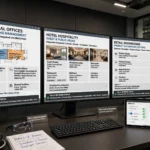
Commercial offices require lighting that supports productive work, satisfies visual comfort, contributes to sustainability, and attracts premium tenants. The standard specification provides glare controlled ambient lighting at appropriate illuminance, supplemented by task and accent lighting and supported by controls. The office lighting shapes the workplace experience and the appeal of the building to tenants across the UAE office market.
Specifying lighting for commercial offices delivers the productive, comfortable, efficient workplace that tenants require. The glare controlled ambient lighting, the task and accent layers, and the controls together create the quality workplace that supports productivity and attracts tenants, the lighting that the office building requires across UAE developments, built on LED panel lights for office buildings.
Hotels and Hospitality Buildings
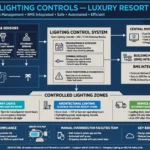
Hotels and hospitality buildings require lighting that creates atmosphere and supports the guest experience while operating efficiently. The lighting ranges from the warm, atmospheric illumination of guest rooms and dining to the functional lighting of back of house, each suited to its space. The hospitality lighting shapes the guest experience that drives the commercial performance of the venue across UAE hospitality.
Specifying lighting for hospitality buildings delivers the atmosphere and experience the venue requires. The warm, atmospheric lighting of the guest spaces and the functional lighting of the operations together support the guest experience and the efficient operation, the lighting that the hospitality building requires across UAE hotels and resorts.
Hospitals and Healthcare Facilities
Hospitals and healthcare facilities require lighting that supports clinical function, patient wellbeing, and reliable operation. The lighting provides high illuminance and colour rendering for clinical tasks, flicker free operation for wellbeing, and reliable performance across continuous operation. The healthcare lighting supports the clinical function and the patient environment that these facilities require across the UAE.
Specifying lighting for healthcare facilities delivers the clinical function and patient wellbeing the facility requires. The high quality clinical lighting, the flicker free operation, and the reliability together support the demanding healthcare environment, the lighting that the hospital and healthcare facility require across UAE developments.
Commercial and Shopping Centres
Commercial buildings and shopping centres require lighting that presents merchandise, expresses brand, and creates an engaging environment. The lighting combines ambient illumination with the accent lighting that highlights merchandise and the atmosphere that engages customers. The commercial lighting supports the commercial performance of the store and the centre across the competitive UAE commercial market.
Specifying lighting for commercial delivers the presentation and environment that drive sales. The ambient and accent lighting that presents merchandise and the atmosphere that engages customers support the commercial performance, the lighting that the commercial building and shopping centre require across UAE commercial developments.
Industrial and Warehouse Facilities
Industrial and warehouse facilities require high output, robust lighting that illuminates large spaces from height and endures the industrial environment. The lighting provides the intense, uniform illumination that safe, productive industrial operation requires, in durable fixtures that withstand the conditions. The industrial lighting supports the safe, efficient operation of the facility across UAE industrial zones.
Specifying lighting for industrial facilities delivers the high output, durable illumination that operations require. The robust fixtures that illuminate the large spaces from height, enduring the industrial environment, support the safe, productive operation, the lighting that the warehouse and factory require across UAE industrial developments, served by industrial LED lighting for warehouses.
Educational Buildings
Schools and universities require lighting that supports learning, minimises maintenance across large campuses, and operates efficiently. The lighting provides glare controlled illumination for reading and study, durability across heavy use, and efficiency across the large footprint. The educational lighting supports the learning environment and the efficient operation of the campus across UAE educational developments.
Specifying lighting for educational buildings delivers the learning environment and efficient operation the campus requires. The glare controlled, durable, efficient lighting that supports study and minimises maintenance across the campus serves the educational facility, the lighting that the school and university require across UAE developments.
Government and Institutional Buildings
Government and institutional buildings require lighting that supports their function, meets the sustainability standards expected of public buildings, and operates reliably. The lighting provides the functional illumination the building requires, the efficiency that public sustainability standards demand, and the reliability that institutional operation requires. The institutional lighting supports the function and the standards of the public building across the UAE.
Specifying lighting for government and institutional buildings delivers the function and standards the building requires. The functional, efficient, reliable lighting that supports the operation and meets the public sustainability standards serves the institutional building, the lighting that the government and institutional facility require across UAE developments.
Mixed-Use Developments
Mixed use developments, combining office, commercial, hospitality, and residential functions, require a coordinated lighting strategy across the different uses. Each function receives appropriate lighting, while the coordinated approach maintains quality and coherence across the development. The mixed use lighting addresses the diverse functions within a coherent strategy across the development in the UAE.
Specifying lighting for mixed use developments delivers appropriate lighting across the diverse functions within a coordinated strategy. Each use receiving its appropriate lighting, coordinated for coherence, delivers the quality across the development, the lighting that the mixed use development requires across its varied functions in the UAE.
The Common Requirement for Quality LED
Across all these building types, the common requirement is quality LED lighting matched to the function of the building. While the specific requirements vary, every building type benefits from the efficiency, quality, and reliability of quality LED, specified to suit its function. The quality LED lighting, matched to the building type, serves the function and the standards of every commercial building across the UAE.
Specifying quality LED lighting matched to each building type delivers the lighting that every commercial building requires. The efficiency, quality, and reliability of quality LED, specified to suit the function of the building, serves every building type, the common requirement across the diverse commercial buildings of the UAE.
Specifying for the Building Function
Effective specification matches the lighting to the function of the building, understanding the requirements of the building type and specifying accordingly. This matching, understanding what each building type requires and specifying the appropriate lighting, delivers lighting that serves the function of the building. The matching of lighting to building function is the foundation of effective specification across the building types.
Specifying lighting matched to the building function delivers lighting that serves each building type. The understanding of the requirements and the specification of the appropriate lighting produces the effective scheme, the foundation of considered specification across the diverse commercial building types of the UAE.
The Value of Specialist Knowledge
Specifying lighting appropriate to each building type benefits from specialist knowledge of the requirements and the products that serve them. A knowledgeable supplier provides this knowledge, helping the specifier match the lighting to the building function and select the appropriate products. This specialist support is valuable in delivering lighting appropriate to each building type across the project.
The specialist knowledge that a knowledgeable supplier provides supports the specification of lighting appropriate to each building type. As an authorised OPPLE distributor, Tricircle provides this knowledge and the full range of products, supporting specifiers in delivering lighting matched to the function of every commercial building type across the UAE.
Building-Appropriate Lighting From Tricircle
Delivering lighting appropriate to each commercial building type requires the full range of products and the knowledge to match them to the building function. As an authorised OPPLE distributor, Tricircle supplies the complete range of commercial LED lighting across UAE building types, supporting developers and consultants in specifying lighting matched to each building function.
To discuss lighting for your commercial building, whatever its type, contact our team at aysha@tricirclegroup.ae or call +971 50 578 1325. We supply quality commercial LED lighting in project quantities across Dubai, Sharjah, Abu Dhabi, and the wider Emirates.