Public infrastructure lighting plays an essential role in the development of modern cities across the United Arab Emirates. Roads, bridges, tunnels, pedestrian walkways, parks, public squares, transport facilities, waterfronts and other civic spaces depend on reliable lighting to improve visibility, safety, navigation and the overall urban environment.
The UAE has developed some of the most recognisable urban environments in the Middle East, particularly in Dubai, Abu Dhabi, Sharjah, Ajman, Ras Al Khaimah, Fujairah and Umm Al Quwain. As cities expand and infrastructure becomes more connected, public lighting is no longer simply about installing street lamps. Modern infrastructure lighting projects increasingly involve LED technology, smart lighting controls, energy management, connected systems, architectural illumination and sustainable design.
For government authorities, infrastructure developers, engineering consultants and contractors, selecting the appropriate lighting system is important for achieving long-term performance, energy efficiency and public safety. A successful project must consider road classification, pedestrian movement, environmental conditions, maintenance requirements, lighting levels, glare control and integration with other infrastructure systems.
This guide explores the major considerations involved in public infrastructure lighting projects in the UAE and explains how modern lighting technology is helping create safer, more efficient and visually attractive urban environments.
The Importance of Public Infrastructure Lighting
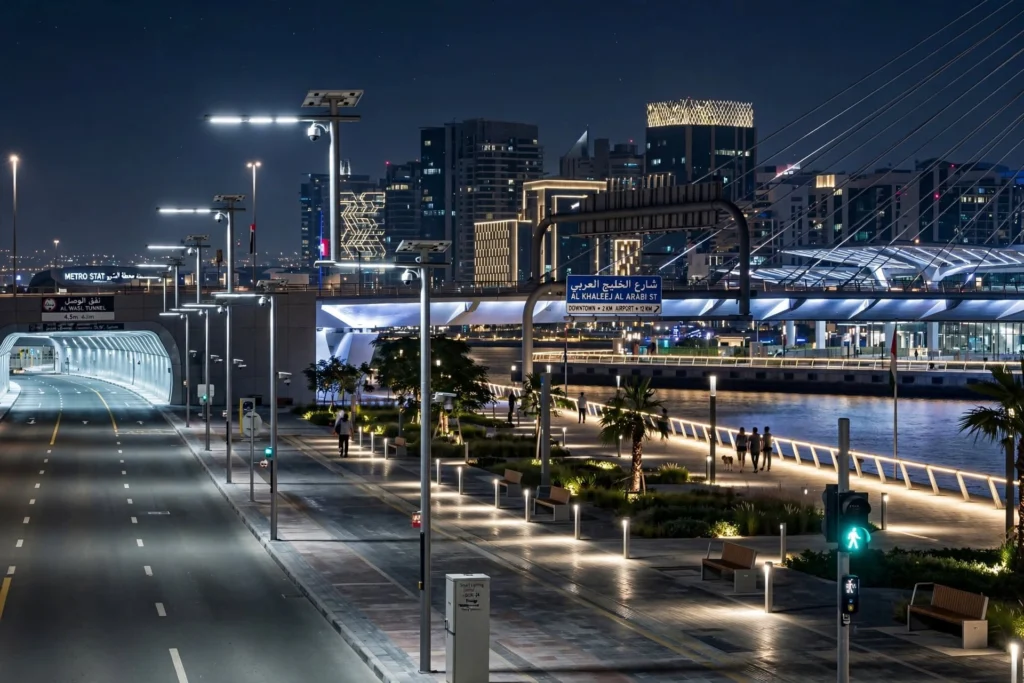
Public lighting affects how people experience and use urban spaces after sunset. Properly designed illumination can improve visibility for drivers, pedestrians and cyclists while helping people navigate roads, intersections, public facilities and recreational areas.
Road lighting is particularly important because inadequate illumination can reduce visibility of vehicles, pedestrians, road markings and obstacles. Lighting design therefore needs to provide consistent illumination without creating excessive glare or distracting drivers.
Public lighting also contributes to the visual identity of a city. Landmark roads, bridges, waterfronts and public spaces can use architectural lighting to create distinctive night-time environments while maintaining functional illumination.
In the UAE, where major urban developments often combine residential, commercial, hospitality and recreational destinations, infrastructure lighting needs to support both practical and aesthetic requirements.
LED Lighting for UAE Infrastructure
LED lighting has become an important technology for modern infrastructure projects because it can provide efficient illumination, long operating life and greater control compared with traditional lighting technologies.
LED street lights can be designed for different road widths, mounting heights and lighting requirements. Optical systems can distribute light across the road surface while helping minimise unnecessary illumination outside the intended area.
For large infrastructure projects, the reduction in energy consumption can become significant because thousands of luminaires may operate for extended periods every night.
Modern LED luminaires can also integrate with lighting management systems, allowing operators to monitor performance, schedule operating conditions and identify certain faults remotely.
The combination of efficient luminaires and intelligent controls can therefore support broader energy-management objectives for municipalities and infrastructure operators.
Street Lighting Projects Across the UAE
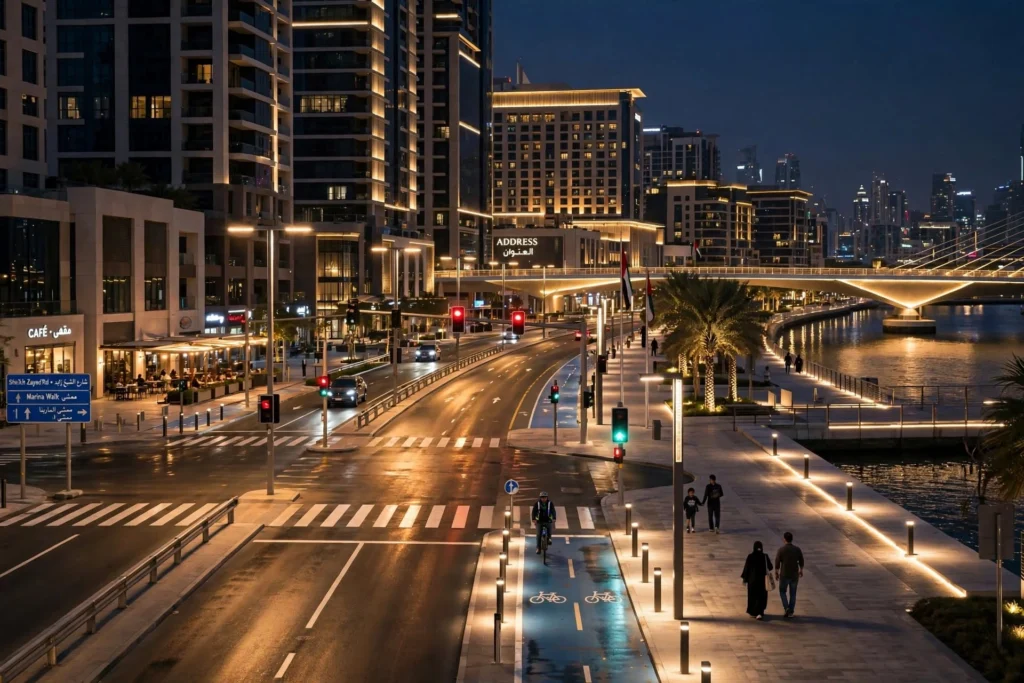
Street lighting is one of the largest categories of public infrastructure lighting. It covers highways, urban roads, residential streets, service roads, roundabouts, intersections and access routes.
A street lighting project starts with understanding the road environment. Engineers may consider road width, traffic volume, vehicle speed, surrounding development, pedestrian activity and the presence of intersections.
Lighting poles and luminaires must then be positioned to provide appropriate coverage while considering existing utilities, landscaping, signage, drainage and other infrastructure.
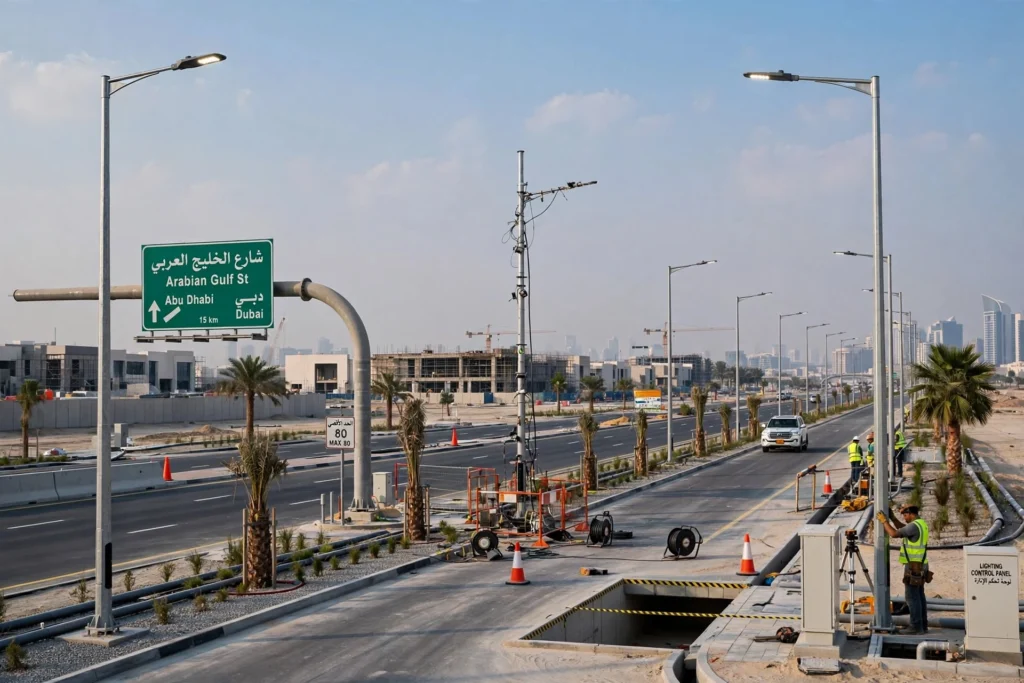
In rapidly developing areas of Dubai and Abu Dhabi, new road networks may require lighting systems to be incorporated from the early stages of infrastructure planning. Existing roads may also require lighting upgrades as traffic patterns and surrounding developments change.
Highway and Expressway Lighting
Highways require carefully planned lighting because vehicles travel at higher speeds and visibility conditions can change quickly.
Lighting design can involve high-mast poles, conventional road lighting columns, LED luminaires and specialised systems for interchanges and complex junctions.
Interchanges can be particularly challenging because multiple carriageways, ramps and merging lanes create different visual environments. Lighting needs to provide sufficient visibility while avoiding excessive glare or confusing patterns.
Major UAE transport corridors such as Sheikh Zayed Road, E11, E311 and other strategic routes demonstrate the importance of coordinated infrastructure design. Lighting is one component of a wider system that includes road markings, traffic signals, signage, barriers and intelligent transport infrastructure.
Bridge and Underpass Lighting
Bridges, flyovers and underpasses require specialised lighting considerations because their physical structures can create shadows and changes in visibility.
Bridge lighting can combine functional roadway illumination with architectural elements. Structural components such as bridge arches, columns and parapets may be illuminated to create a distinctive night-time appearance.
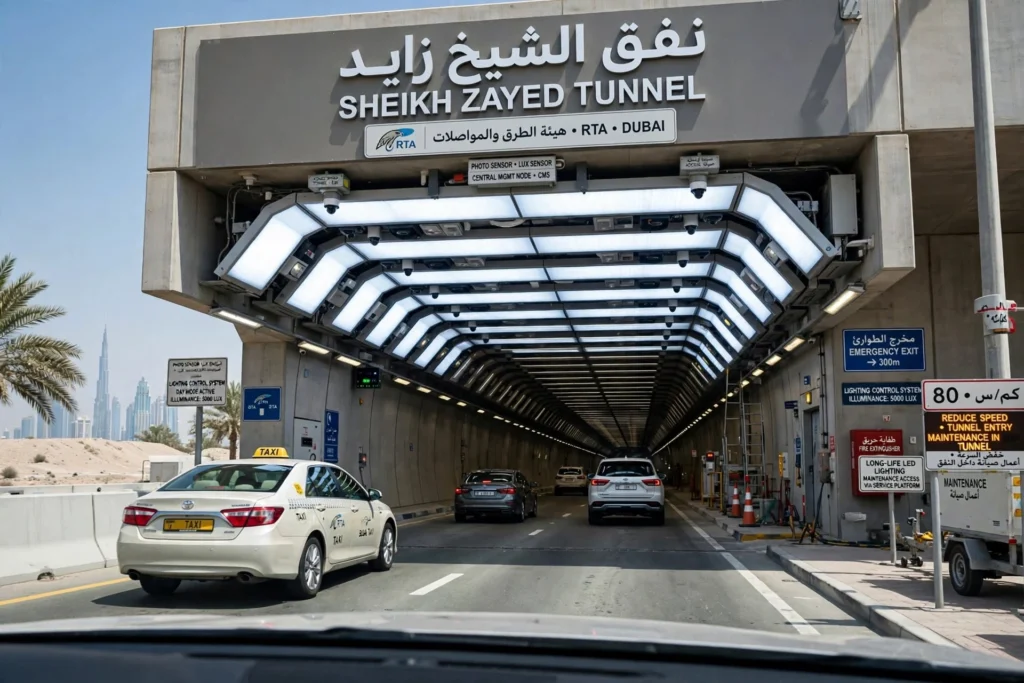
Underpasses and tunnels require particularly careful lighting because drivers transition between different brightness levels. Tunnel lighting systems can include entrance, transition and interior lighting designed to support visual adaptation.
Lighting controls can also adjust output according to traffic, time and environmental conditions where the system supports these functions.
Tunnel Lighting in the UAE
Tunnel lighting is more complex than conventional street lighting because there is limited natural light within the enclosed environment.
The entrance zone requires special attention because drivers approaching a tunnel from bright daylight need sufficient illumination to see the interior. During the day, lighting requirements may differ considerably from night-time conditions.
LED tunnel luminaires can provide controlled illumination and can be integrated with sensors and central management systems. Properly designed tunnel lighting can improve visual comfort and support safe driving conditions.
Maintenance is also a major consideration because replacing equipment inside a busy tunnel may require lane closures or traffic management. Long-life lighting equipment and accessible maintenance strategies can help reduce disruption.
Smart Street Lighting Systems
Smart lighting is changing the way infrastructure operators manage public lighting networks.
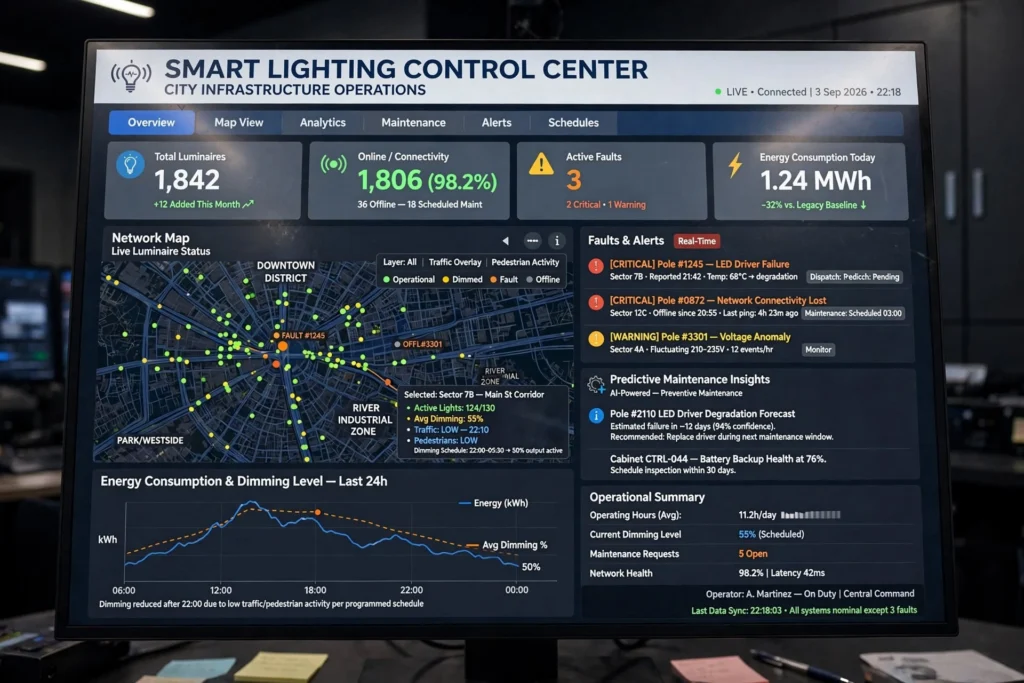
Instead of operating every luminaire at a fixed output throughout the night, connected systems can allow lighting levels to be managed according to programmed schedules, traffic conditions, pedestrian activity or other operational requirements.
A smart lighting network can potentially provide information about:
- Luminaire operating status
- Energy consumption
- Fault conditions
- Operating hours
- Dimming levels
- Maintenance requirements
- Network connectivity
Centralised monitoring can help infrastructure managers identify faults more quickly than traditional inspection methods.
Smart controls can also support preventive maintenance by providing information about equipment performance before a complete failure occurs.
Solar Street Lighting for Remote Infrastructure
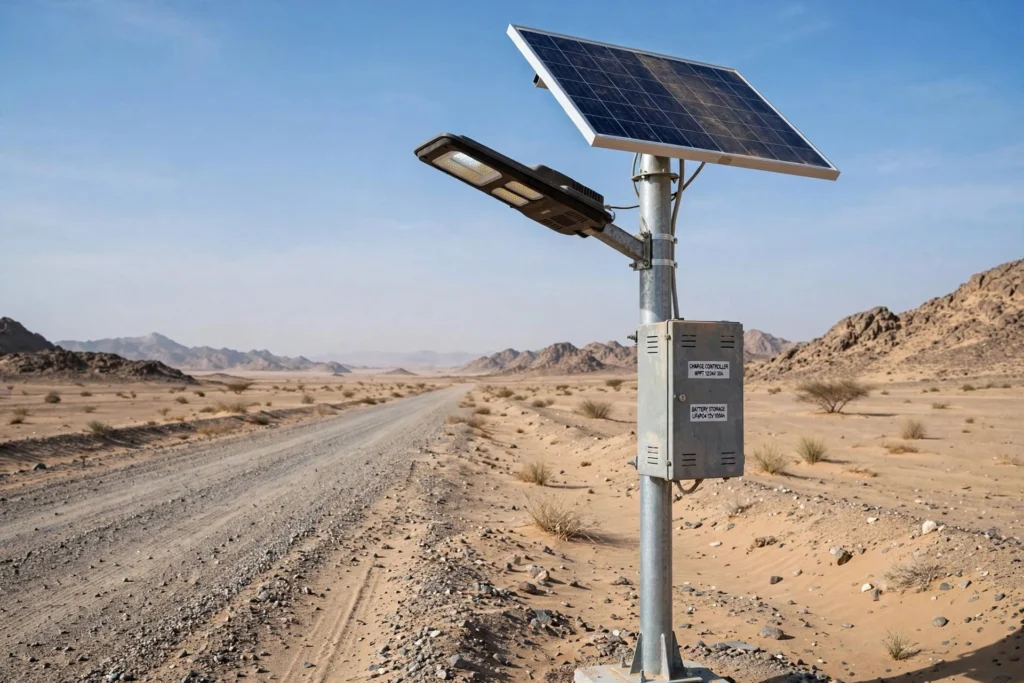
Solar-powered street lighting can be useful in locations where extending conventional electrical infrastructure is difficult or expensive.
A typical solar lighting system may include a photovoltaic panel, battery storage system, LED luminaire, charge controller and mounting structure.
During daylight hours, the photovoltaic panel generates electricity that is stored in the battery. The stored energy can then power the LED luminaire after sunset.
Solar lighting can be considered for remote roads, pedestrian paths, parks, temporary infrastructure and other locations where grid connectivity presents challenges.
However, system sizing must account for local solar conditions, required operating hours, battery capacity, LED power consumption and maintenance requirements.
Lighting for Public Parks and Pedestrian Areas
Public infrastructure lighting extends beyond roads. Parks, promenades, pedestrian paths and public squares require lighting designed around human movement rather than vehicle speeds.
Pedestrian lighting can help people identify pathways, entrances, stairs, seating areas and potential obstacles.
In urban destinations such as Dubai Marina, Downtown Dubai, Al Seef and waterfront developments, lighting can also contribute to the atmosphere of the public realm.
Landscape lighting can highlight trees, planting, architectural features and water elements, while pathway lighting provides functional illumination.
The best public-space lighting designs create a balance between visibility and visual comfort. Excessively bright lighting can reduce the quality of the environment and create unnecessary glare.
Architectural Lighting for Public Infrastructure
Architectural lighting is increasingly used to enhance the visual identity of bridges, buildings, monuments and public structures.
Unlike standard street lighting, architectural illumination focuses more heavily on how a structure appears at night. Different beam angles, colour temperatures, mounting positions and control systems can be used to highlight architectural details.
Bridges, cultural buildings and civic landmarks can become recognisable night-time features through carefully planned illumination.
In cities such as Abu Dhabi and Dubai, architectural lighting can support tourism, placemaking and the visual identity of major destinations while remaining part of a broader public infrastructure strategy.
Energy Efficiency and Sustainable Lighting
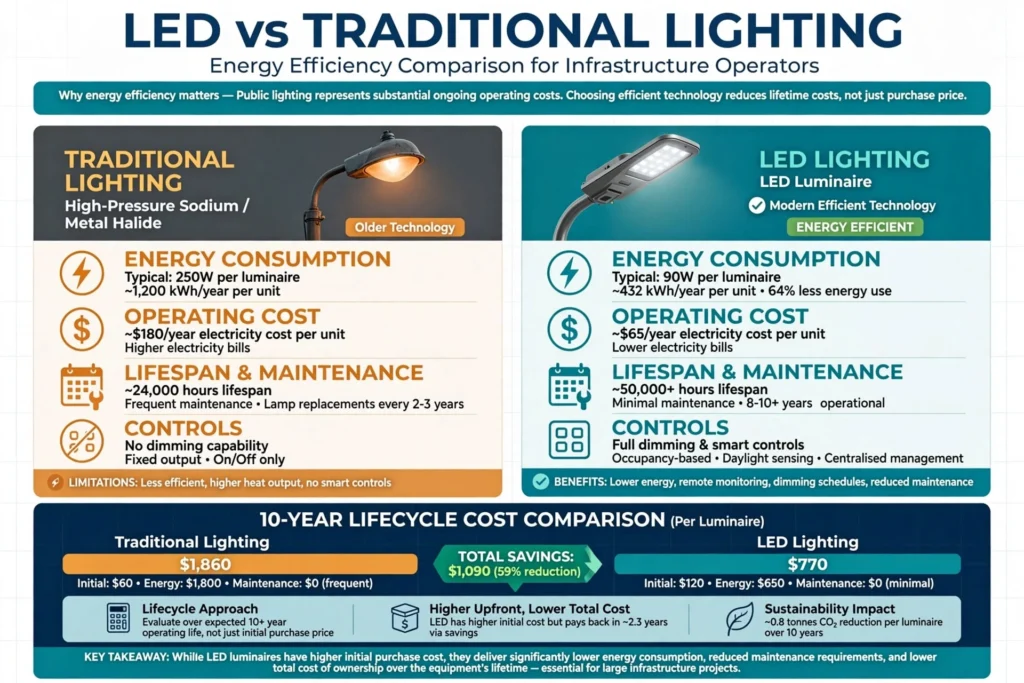
Energy efficiency is an important consideration for infrastructure operators because public lighting can represent a substantial ongoing operating cost.
LED luminaires can reduce energy consumption compared with older lighting technologies while providing controllable illumination.
Further savings may be achieved through dimming schedules, occupancy-based controls, daylight sensing and centralised management where appropriate.
For a large infrastructure project, energy performance should be evaluated over the expected operating life rather than simply comparing the initial purchase price of luminaires.
A more efficient system may have a higher initial cost but deliver lower electricity consumption and maintenance requirements over time.
Lighting Design and Glare Control
More light does not automatically mean better lighting. Poorly controlled illumination can create glare, discomfort and unwanted light spill.
Infrastructure lighting design should consider the direction of light, optical distribution, mounting height and surrounding environment.
For roads, luminaires should illuminate the required surface without unnecessarily directing light toward drivers’ eyes, nearby properties or sensitive areas.
For residential communities, careful glare control can improve the experience of residents while maintaining adequate illumination on roads and pedestrian paths.
Good lighting design therefore focuses on where the light goes, not simply how much light a luminaire produces.
Colour Temperature and Visual Comfort
Colour temperature influences how an infrastructure environment looks and feels.
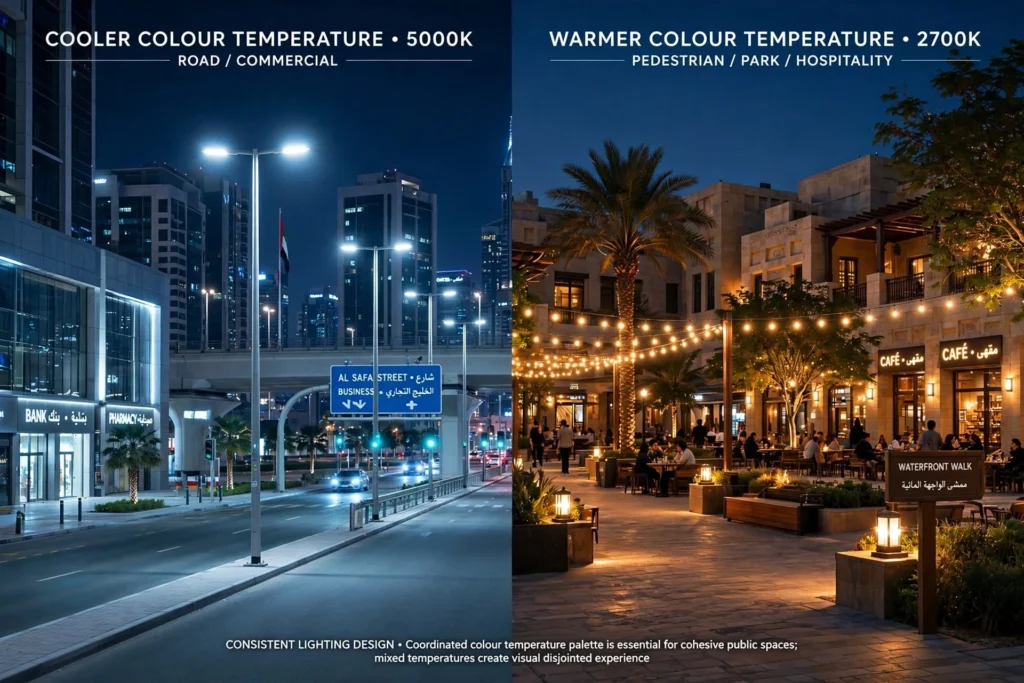
Cooler white light can create a crisp appearance and may be suitable for certain road and commercial environments. Warmer colour temperatures can create a more comfortable atmosphere in pedestrian areas, parks and hospitality-oriented public spaces.
The appropriate choice depends on the project’s purpose, surrounding architecture and lighting strategy.
Consistency is also important. A public area containing multiple unrelated colour temperatures can appear visually disjointed.
Lighting designers should therefore establish a coordinated lighting palette across roads, pathways, architectural elements and public spaces.
Lighting Controls and Central Management
Modern infrastructure lighting can be connected to central management platforms that allow operators to monitor and control large networks.
A central management system can potentially show which lighting points are operating, identify faults and provide information about energy consumption.
Dimming profiles can also be scheduled according to time. For example, lighting output can be adjusted during periods of lower traffic where regulations and safety requirements permit.
For large municipal networks, centralised control can improve operational visibility and reduce the need for manual inspections.
Lighting Poles, Columns and Infrastructure
The lighting pole is an important structural component of a street lighting installation. Pole height, spacing, material, foundation and mounting configuration all influence the performance and appearance of the lighting system.
Galvanised steel poles and other corrosion-resistant materials may be selected according to the environment and project requirements.
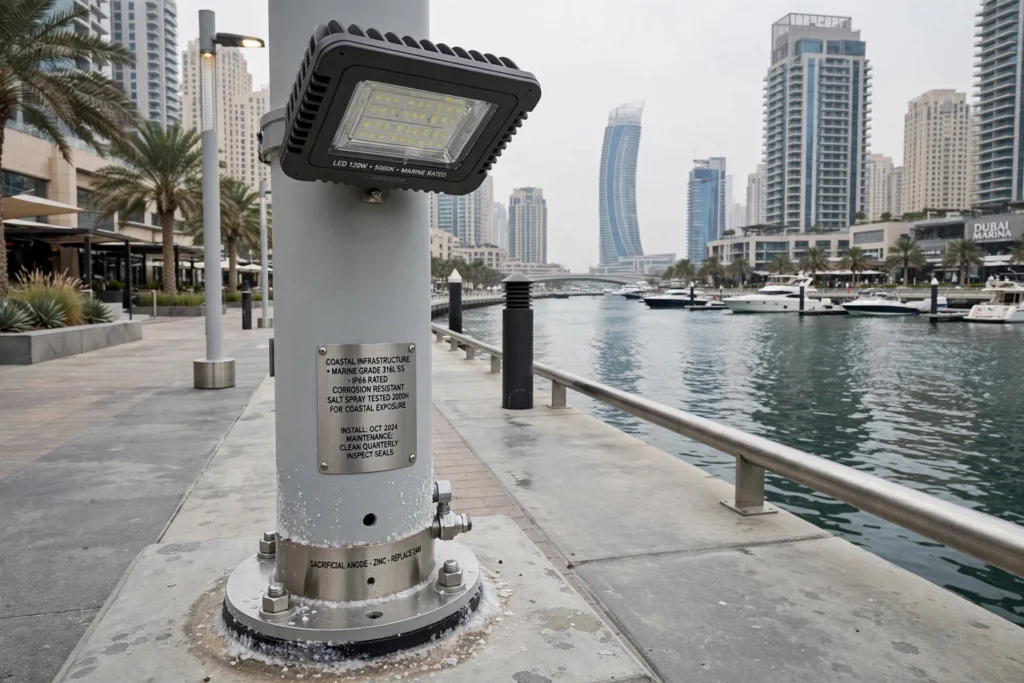
Coastal areas can present additional environmental considerations because salt and humidity can accelerate corrosion of unsuitable materials.
Pole foundations must also be designed according to structural requirements, wind loads and ground conditions.
For major infrastructure projects, lighting poles need to coordinate with road barriers, signs, trees, utilities and other roadside equipment.
Lighting for UAE Coastal Areas
Coastal locations such as Dubai Marina, Palm Jumeirah, Abu Dhabi Corniche and Fujairah require attention to environmental exposure.
Salt-laden air, humidity and moisture can contribute to corrosion, particularly when unsuitable materials or inadequate protective finishes are used.
Lighting specifications for coastal infrastructure should therefore consider corrosion resistance, ingress protection, material selection and maintenance requirements.
Selecting equipment based on the actual environmental conditions can help improve reliability and reduce premature deterioration.
Lighting Maintenance and Asset Management
Even high-quality infrastructure lighting requires maintenance.
Common maintenance activities can include cleaning luminaires, checking electrical connections, inspecting poles, testing control systems, replacing failed LED drivers and checking foundations and mounting hardware.
For smart lighting networks, maintenance teams can use system data to identify faults and prioritise repairs.
A planned maintenance programme is generally more effective than relying entirely on reactive repairs. Regular inspections can identify problems such as water ingress, corrosion, loose connections and damaged equipment before they result in complete failure.
Asset management is particularly important for large public networks where thousands of lighting points may be distributed across a city.
Safety and Electrical Considerations
Public lighting installations must be designed with electrical safety and relevant project standards in mind. Outdoor equipment needs appropriate protection against environmental exposure, while electrical distribution systems require suitable protection and grounding.
Cable routes, junction boxes, control panels and feeder pillars should be planned carefully to support safe operation and future maintenance.
Infrastructure projects also need to coordinate lighting installation with civil works, utility networks, road construction and traffic management.
Early coordination can prevent conflicts between underground services and lighting foundations or cable routes.
Lighting for Smart Cities in the UAE
The UAE has invested heavily in smart-city development, and connected lighting can form part of the wider digital infrastructure.
Smart luminaires can potentially provide a platform for additional urban services, depending on the technology used. Lighting poles may support sensors, communication equipment, environmental monitoring devices and other connected systems.
This creates opportunities to transform lighting infrastructure from a standalone electrical network into a component of a connected urban environment.
For future infrastructure projects, scalability and interoperability should therefore be considered alongside the immediate lighting requirements.
Planning Lighting Projects in Dubai and Abu Dhabi
Infrastructure lighting projects require coordination between multiple stakeholders. Government authorities, municipalities, developers, engineering consultants, electrical contractors, lighting manufacturers and maintenance teams may all have roles in a project.
In Dubai, projects may involve coordination with relevant local authorities and infrastructure stakeholders. Abu Dhabi projects similarly require consideration of the applicable local requirements and project specifications.
A successful project typically begins with a detailed assessment of the site and lighting objectives. Engineers can then develop lighting calculations, pole layouts, electrical designs, equipment specifications and control strategies.
For large developments, lighting should be integrated into the masterplan rather than added after roads and landscaping have already been finalised.
How to Choose Lighting Products for Infrastructure Projects
Product selection should be based on project performance requirements rather than appearance alone.
Important considerations may include:
- LED efficiency
- Optical distribution
- IP and IK protection
- Surge protection
- Operating temperature
- Corrosion resistance
- Colour rendering
- Colour temperature
- Dimming capability
- Driver quality
- Expected service life
- Warranty
- Maintenance requirements
- Smart-control compatibility
For large projects, consistency between luminaires is also important. Using standardised equipment can simplify spare-parts management and maintenance.
Lighting manufacturers and suppliers should be able to provide technical documentation, photometric data, certifications and installation guidance relevant to the project.
The Role of Professional Lighting Suppliers
Professional lighting suppliers can help project teams identify products that meet the technical and environmental requirements of a specific infrastructure application.
For road and public-space projects, suppliers may provide LED street lights, floodlights, high-mast luminaires, bollards, architectural lighting, tunnel lighting, control systems and associated electrical equipment.
A technically suitable product should also be available with appropriate documentation and after-sales support.
For contractors and developers working on infrastructure projects in the UAE, local availability of replacement components can be an important consideration because lighting networks may need to remain operational for many years.
Future of Public Infrastructure Lighting in the UAE
The future of public infrastructure lighting is moving toward greater efficiency, connectivity and adaptability.
LED technology is likely to remain central to infrastructure lighting, while smart controls, sensors, remote monitoring and data-driven maintenance can increasingly influence how lighting networks are operated.
Future projects may integrate lighting with intelligent transportation systems, pedestrian monitoring, environmental sensors and other smart-city technologies.
The emphasis is also shifting from simply installing lighting equipment toward managing lighting as a long-term infrastructure asset.
This approach can help municipalities and developers improve energy performance, maintenance planning, public safety and the overall quality of urban spaces.
Conclusion
Public infrastructure lighting is a fundamental part of the UAE’s rapidly developing urban environment. From highways and bridges to parks, pedestrian areas, tunnels and waterfronts, properly designed lighting supports safety, navigation, energy efficiency and the visual identity of modern cities.
The growth of LED street lighting, smart controls, solar lighting, connected infrastructure and architectural illumination is creating new opportunities for municipalities, developers and infrastructure operators across Dubai, Abu Dhabi and the wider UAE.
For companies involved in Lighting Projects in UAE, success depends on combining appropriate technology with accurate lighting design, reliable electrical infrastructure, environmental protection and long-term maintenance planning.
Whether a project involves a new road network in Dubai, a public realm development in Abu Dhabi, a waterfront destination in Sharjah or an industrial access road in Ras Al Khaimah, the lighting system should be designed around the specific environment and operational requirements.
A well-engineered public lighting network does more than illuminate roads after dark. It contributes to safer transportation, more attractive public spaces, smarter cities and a more sustainable built environment across the UAE.