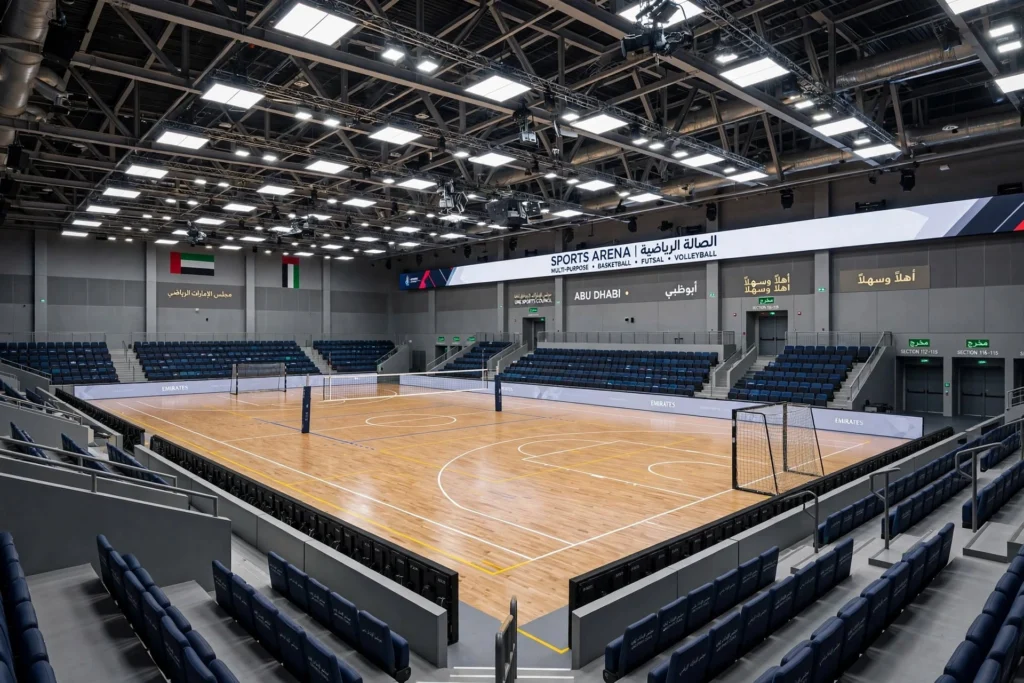
LED lighting has become an important part of modern indoor sports arena design. Whether the venue is used for basketball, football, volleyball, badminton, tennis, futsal, cricket training, martial arts, or multi-purpose events, lighting directly affects visibility, player performance, spectator comfort, safety, photography, broadcasting, and energy consumption.
Indoor sports facilities have requirements that are very different from ordinary commercial buildings. Athletes need consistent illumination across the playing surface, spectators need comfortable viewing conditions, officials need to see movement and markings clearly, and cameras require suitable light levels and colour quality for live broadcasting.
In the UAE, these requirements are especially relevant as indoor sports facilities provide a controlled environment away from the country’s hot climate. Dubai, Abu Dhabi, Sharjah, and other Emirates have a growing network of sports clubs, fitness centres, schools, universities, community facilities, training academies, and large multi-purpose venues.
A professionally engineered LED lighting system can provide efficient illumination while supporting the technical requirements of modern sports environments.
Why LED Lighting Matters in Indoor Sports Facilities
Lighting is one of the most important technical systems inside a sports arena because athletes depend on clear visual information.
Players need to track fast-moving objects such as balls, shuttlecocks, and other equipment. Uneven illumination, glare, shadows, or flicker can interfere with visual performance.
Good sports lighting should provide:
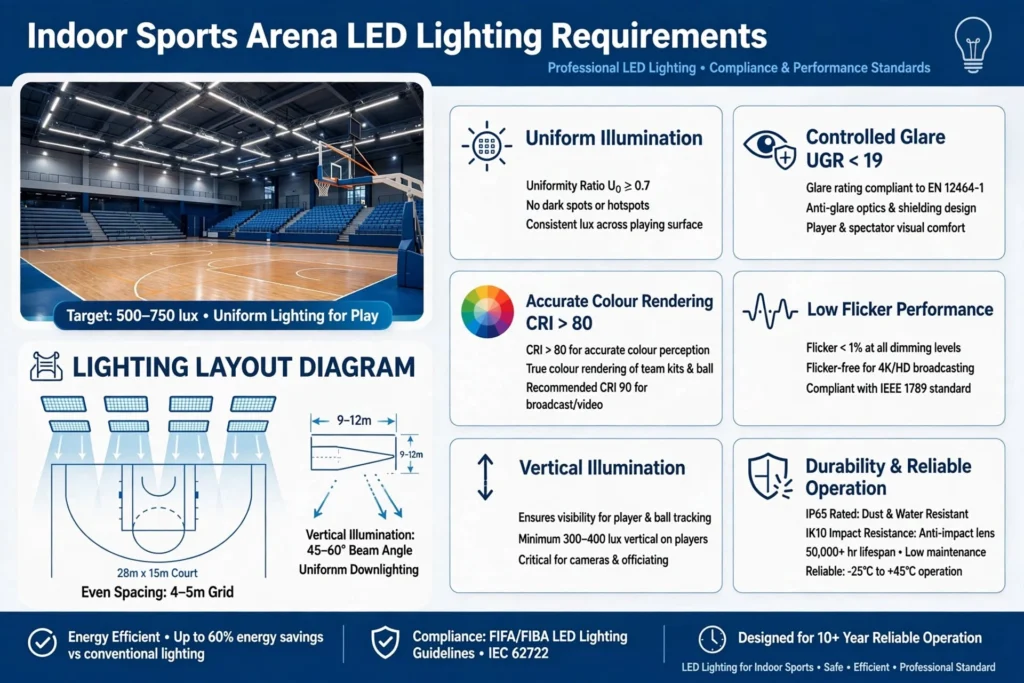
Uniform illumination, appropriate brightness, controlled glare, accurate colour rendering, low flicker, reliable operation, and suitable vertical illumination.
The system should also be durable enough to withstand long operating hours and, depending on the sport, occasional impact from balls or other equipment.
LED technology provides a flexible platform for achieving these objectives.
What Makes Sports Lighting Different From General Indoor Lighting?
A conventional office or retail lighting system is not automatically suitable for a sports arena.
Sports lighting needs to account for the dimensions of the playing area, athlete movement, spectator sightlines, camera positions, ceiling height, wall reflectance, ball trajectory, and sport-specific requirements.
A basketball court, for example, has different visual requirements from a badminton court.
Badminton involves a fast-moving shuttlecock that can travel through different vertical zones, making glare control and vertical illumination particularly important.
Similarly, indoor football requires good visibility across a larger playing surface.
Therefore, lighting should be designed around the actual sporting activity rather than simply installing high-output fixtures.
LED High Bay Lighting for Sports Arenas
High-bay LED luminaires are widely used in facilities with high ceilings.
They can deliver substantial light output from elevated mounting positions while offering different beam distributions to suit the arena layout.
High-bay fixtures can be suitable for:
Indoor football facilities, basketball arenas, volleyball courts, multipurpose halls, indoor cricket centres, warehouses converted into sports facilities, and large training centres.
The beam angle must be selected carefully.
A narrow beam may concentrate illumination in a specific area, while a wider beam can provide broader coverage.
Photometric calculations should determine the appropriate arrangement rather than relying only on fixture wattage.
Uniformity Across the Playing Surface
Uniformity is critical in sports lighting.
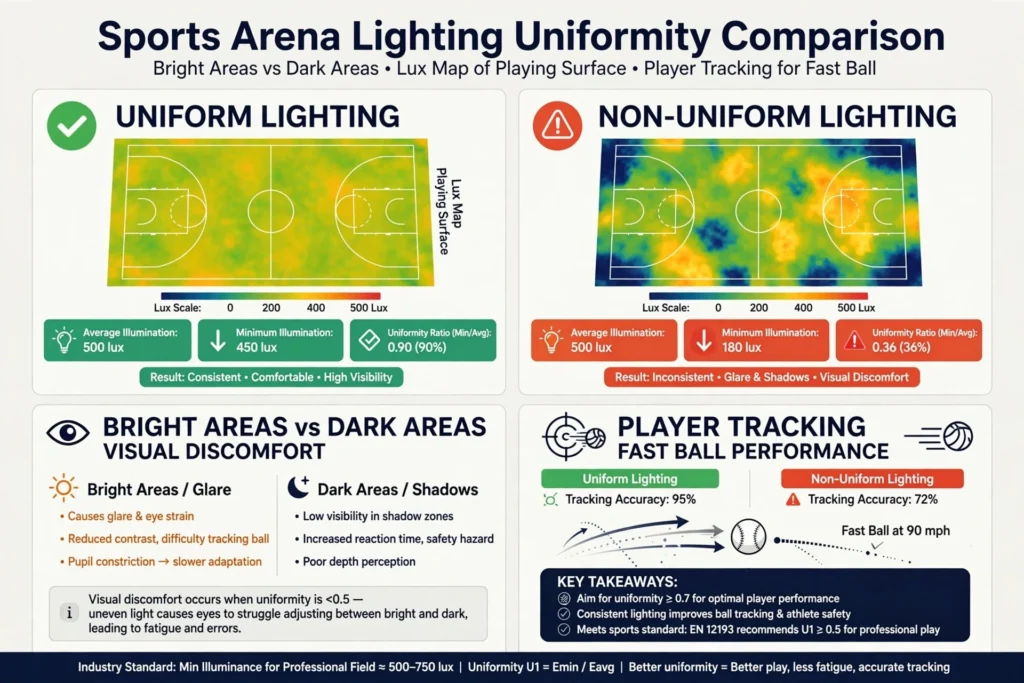
An arena with very bright areas next to significantly darker areas can create visual discomfort and affect player performance.
Lighting designers evaluate the relationship between minimum and average illumination across the playing surface.
The objective is to create a consistent visual environment.
Uniformity becomes even more important for sports involving rapid movement because players need to track objects without constantly adapting to changing brightness.
Glare Control for Athletes
Glare can be one of the biggest problems in indoor sports lighting.
Fixtures positioned incorrectly can enter an athlete’s field of view when they look upward.
This is particularly problematic for sports such as:
Basketball, volleyball, badminton, tennis, and indoor football.
Sports lighting should therefore consider the typical viewing angles of athletes.
Optical control, fixture placement, shielding, beam distribution, and mounting positions can all help minimise glare.
Colour Rendering and Visual Accuracy
Colour rendering affects how naturally colours appear under artificial light.
High-quality LED fixtures with appropriate colour rendering can help athletes distinguish:
Players, uniforms, court markings, balls, equipment, advertising boards, and surrounding objects.
Colour quality is also important for spectators and cameras.
A sports arena that hosts televised competitions may require more stringent colour performance than a small recreational training facility.
Flicker and Camera Performance
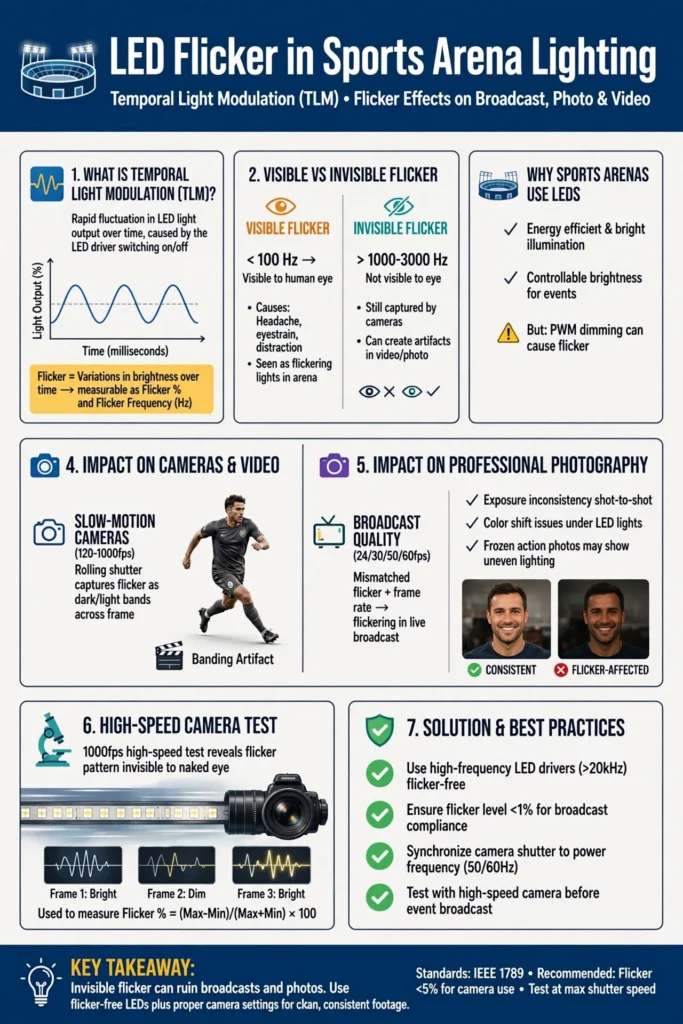
LED drivers and power systems can influence temporal light modulation.
Visible flicker can be distracting, while invisible modulation may become noticeable through slow-motion or high-speed cameras.
For sports venues used for:
Live broadcasts, television production, video recording, professional photography, and social media content
lighting should be selected with suitable flicker performance.
Broadcast-quality sports lighting requires careful coordination between fixture specifications and camera requirements.
Lighting for Basketball Courts
Basketball requires strong visual conditions because players frequently look upward while tracking the ball.
Ceiling-mounted fixtures should be positioned to reduce glare in the athlete’s upward field of view.
Uniform illumination across the court is important, while spectator areas can use different lighting levels.
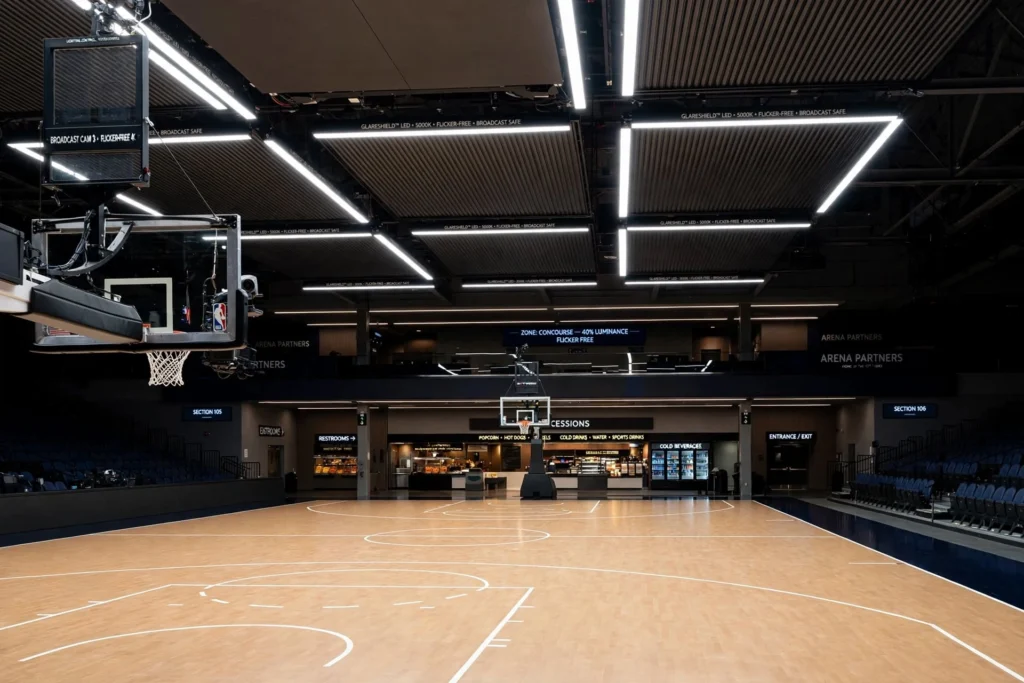
LED systems can also be zoned so that the playing surface, seating areas, corridors, concessions, and training spaces operate independently.
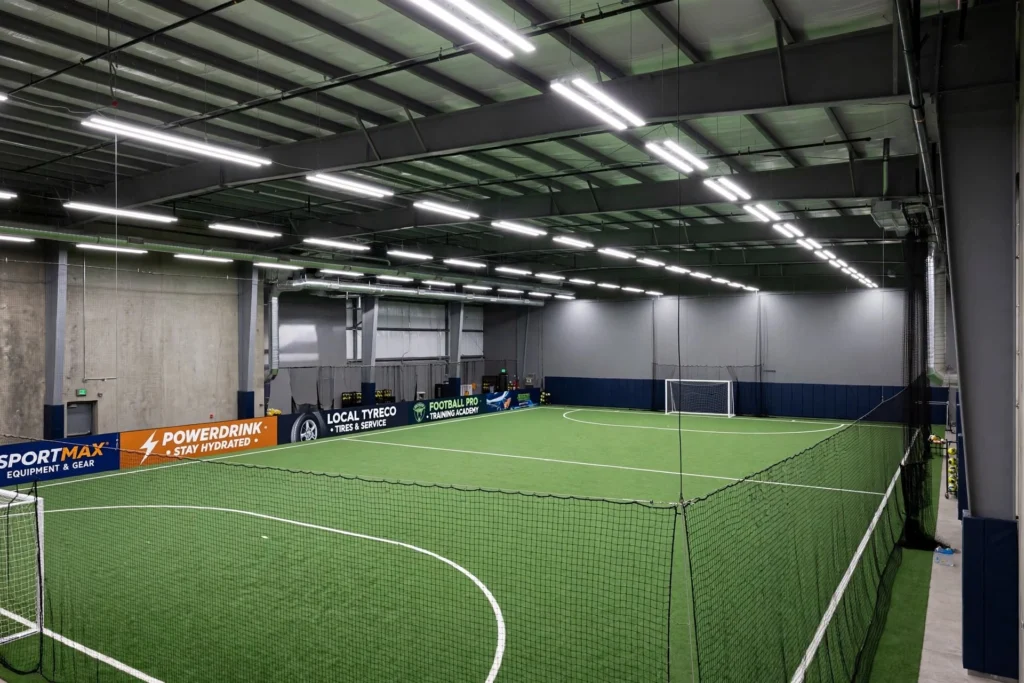
Lighting for Indoor Football and Futsal
Indoor football and futsal facilities generally have larger playing areas than many court-based sports.
The lighting system therefore needs to provide broad and consistent coverage.
High-bay LED luminaires with suitable optical distributions can provide efficient illumination across the pitch.
Wall reflections, ceiling height, netting, structural beams, and advertising boards should be considered during design.
Lighting should also support player safety by minimising shadows and dark areas.
Lighting for Badminton Courts
Badminton is particularly demanding because the shuttlecock can move quickly through the upper visual field.
Glare and inconsistent illumination can make it difficult for players to follow the shuttle.
Lighting should therefore be designed with careful attention to fixture placement and direct viewing angles.
A professional design can use suitable ceiling-mounted or high-level LED fixtures to provide consistent illumination while reducing distracting glare.
Lighting for Volleyball Courts
Volleyball players frequently track the ball vertically.
The lighting strategy should therefore provide suitable illumination throughout the volume above the court rather than concentrating only on the floor.
Uniformity and glare control are particularly important.
LED luminaires can be positioned to create a balanced visual environment while maintaining comfortable spectator conditions.
Lighting for Indoor Tennis
Indoor tennis facilities require careful consideration of court dimensions, ceiling height, player sightlines, and ball visibility.
Lighting should minimise direct glare and shadows across the court.
Fixtures with controlled beam distributions can help create consistent illumination.
Where multiple courts operate within one hall, zoning can allow individual areas to be illuminated according to occupancy.
Indoor Cricket Lighting
Indoor cricket training centres often use large spaces with nets and high ceilings.
Lighting should illuminate both the playing area and the vertical environment.
This is important because players track the ball through different trajectories.
Fixtures need to be positioned to avoid distracting glare while providing consistent illumination throughout the training zone.
Durability is also important where sports equipment could potentially come into contact with luminaires.
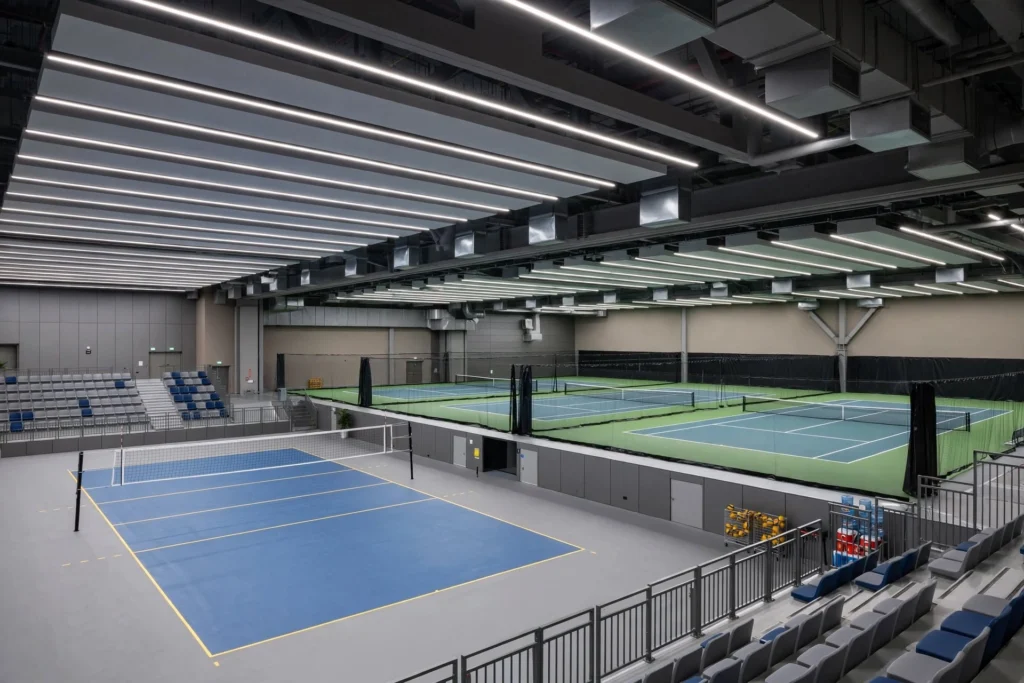
Multipurpose Sports Arena Lighting
Many UAE sports facilities are designed for multiple activities.
A single venue may host:
Basketball, volleyball, futsal, badminton, exhibitions, school events, ceremonies, competitions, and community programmes.
In such environments, flexible lighting controls are highly valuable.
Different scenes can be programmed for training, competition, cleaning, events, spectator use, and maintenance.
This reduces the need to operate the complete lighting system at maximum output at all times.
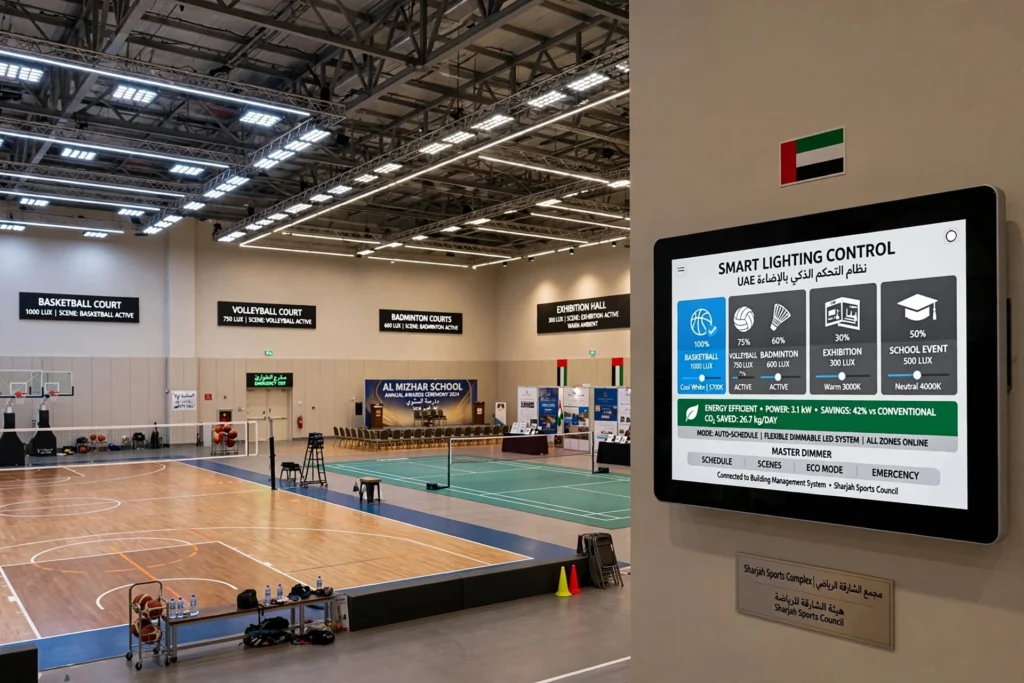
Smart Lighting Controls for Sports Venues
Smart lighting systems can improve both operational flexibility and energy performance.
Lighting controls may include:
Dimming, occupancy sensors, scheduling, scene selection, wireless controls, daylight sensors, and central management platforms.
A facility manager can create different lighting scenes for different activities.
For example, a training session may require a different lighting level from a professional match.
Cleaning staff may need only selected zones.
Unused areas can be switched off automatically.
Energy Efficiency of LED Sports Lighting
Sports arenas can consume significant amounts of electricity because they often operate for long hours and require high illumination levels.
LED lighting can help reduce energy demand compared with older lighting technologies.
Additional savings may be achieved through:
Dimming, occupancy-based control, scheduling, zoning, daylight integration, and efficient optical design.
Energy savings depend on the existing system, operating schedule, fixture efficiency, control strategy, and required illumination.
The best results come from treating lighting as a complete system rather than focusing only on replacing lamps.
LED Lighting and HVAC Loads
Lighting contributes heat to an indoor environment.
In air-conditioned sports facilities, reducing unnecessary lighting heat can potentially reduce cooling demand.
This relationship is particularly relevant in Dubai and Abu Dhabi, where cooling systems operate extensively during hot periods.
Energy-efficient LED lighting can therefore contribute to the wider building energy strategy.
Lighting, HVAC, building automation, and occupancy controls can be coordinated to improve overall operational efficiency.
Lighting for Spectator Areas
Spectator seating does not necessarily require the same lighting level as the playing surface.
A well-designed arena can create separate lighting zones for:
Courts, spectator seating, walkways, entrances, corridors, hospitality areas, concessions, changing rooms, and back-of-house spaces.
During a match, the playing area can receive the primary illumination while spectator areas operate at a lower or differently controlled level.
During cleaning or event setup, the lighting scene can be changed accordingly.
Entrance and Lobby Lighting
The entrance creates the first impression of a sports venue.
Lobby lighting can combine:
LED downlights, linear fixtures, decorative luminaires, digital signage illumination, wall washing, and architectural lighting.
Brand colours can be reinforced through carefully controlled lighting effects where appropriate.
The entrance should also provide comfortable illumination for ticketing, reception, security screening, and wayfinding.
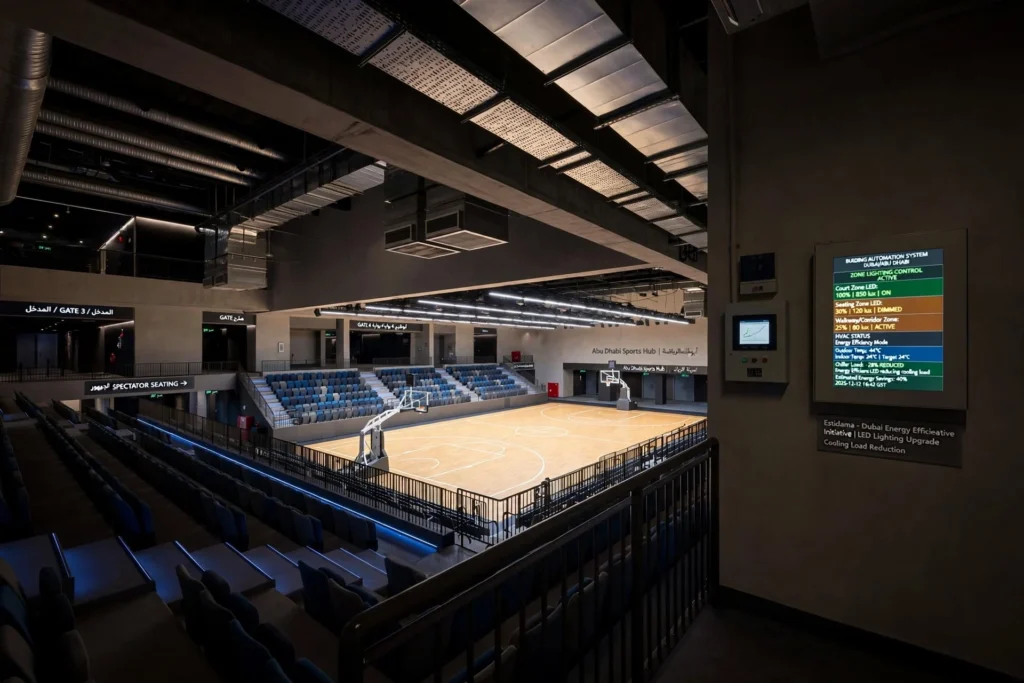
Digital Signage and Sports Arena Lighting
Modern arenas increasingly use digital signage, LED video walls, scoreboards, advertising screens, and interactive displays.
Ambient lighting should be coordinated with these technologies.
Excessive glare can make screens difficult to view, while poor contrast can reduce their visual impact.
Lighting designers should consider screen locations when positioning fixtures.
This is particularly important around:
Scoreboards, sponsor displays, digital advertising panels, reception screens, and media areas.
Emergency Lighting and Safety
Sports facilities require appropriate emergency lighting and exit signage to support safe evacuation.
Emergency systems should illuminate evacuation routes, stairs, exits, circulation areas, and other relevant spaces in accordance with applicable safety requirements.
These systems need regular testing and maintenance.
Emergency lighting should be integrated into the overall electrical design rather than treated as an afterthought.
Impact Resistance and Fixture Protection
Some sports environments expose lighting equipment to potential physical impact.
Balls and other sporting equipment can reach ceiling-mounted fixtures.
Where necessary, luminaires should be selected with suitable protection and durability characteristics.
Protective guards or impact-resistant fixtures may be appropriate depending on the sport and facility configuration.
The IP rating and mechanical protection should be evaluated based on the environmental conditions.
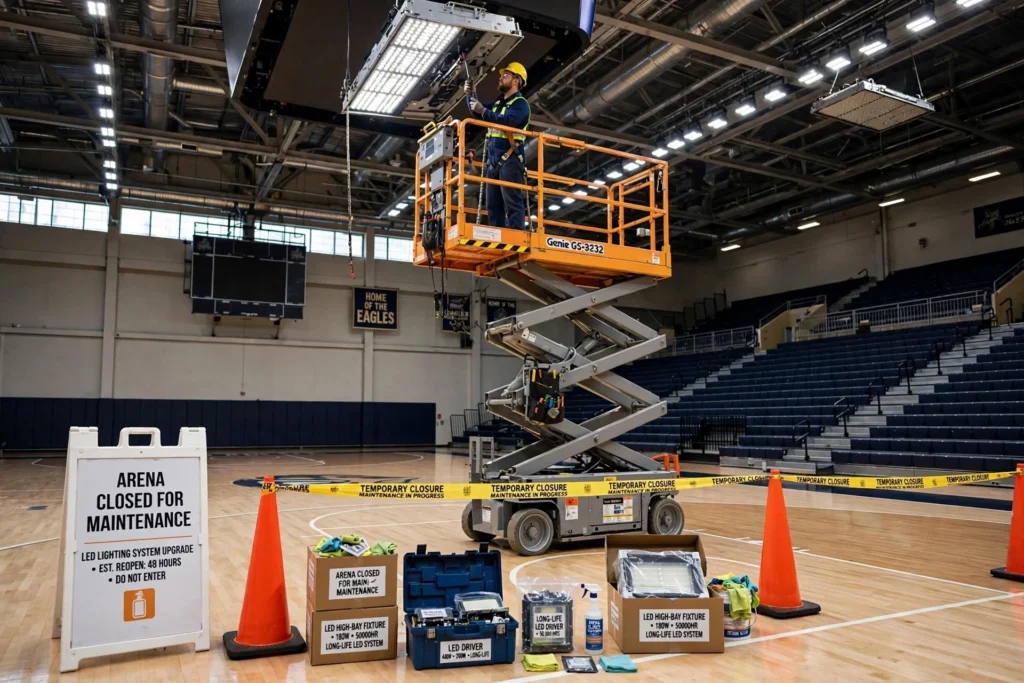
Lighting Maintenance in Sports Arenas
Maintenance can be challenging in facilities with high ceilings.
Replacing a failed fixture may require specialised access equipment, lifting platforms, or temporary closure of part of the venue.
Long-life LED systems can reduce replacement frequency.
However, maintenance planning remains essential.
Facility managers should consider:
Fixture accessibility, cleaning, driver replacement, spare parts, control system support, warranty, inspection schedules, and emergency lighting testing.
A maintenance strategy should be developed alongside the original lighting design.
Lighting Design for Sports Training Facilities
Training facilities often have different operating patterns from professional competition venues.
They may operate throughout the day with changing occupancy levels.
Smart controls can allow lighting levels to be adjusted based on activity.
For example, selected training zones can operate independently instead of illuminating the entire building.
This can reduce unnecessary energy consumption.
School and University Sports Halls
Educational institutions in Dubai, Abu Dhabi, Sharjah, and other UAE locations often use multipurpose indoor sports halls.
These facilities may host physical education classes, sports clubs, competitions, assemblies, and community activities.
Lighting should therefore be flexible and durable.
Simple scene-based controls can allow staff to select appropriate settings without needing specialist technical knowledge.
Sports Lighting in Dubai
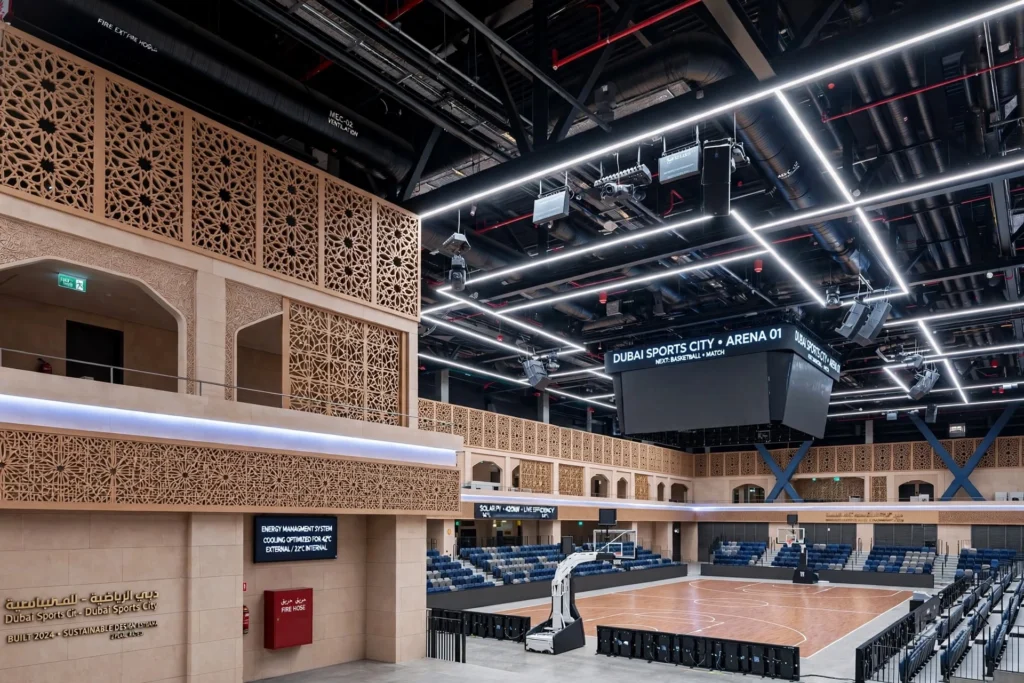
Dubai’s growing sports and entertainment sector has created demand for modern indoor facilities.
Venues across areas such as Dubai Sports City, Meydan, Al Quoz, Jumeirah, Dubai Marina, and Downtown Dubai can have different architectural and operational requirements.
Sports lighting projects in Dubai should consider local climate, energy efficiency, maintenance access, building services coordination, and applicable authority requirements.
For large facilities, lighting should be coordinated with architectural, electrical, mechanical, fire-safety, audiovisual, and structural systems.
Sports Lighting in Abu Dhabi and Sharjah
Abu Dhabi has a broad range of sports clubs, schools, training facilities, community venues, and large event spaces.
Sharjah also has established sporting infrastructure and indoor recreational facilities.
Across the UAE, the fundamental lighting principles remain similar, but each project requires a site-specific design.
Building geometry, ceiling structure, operating hours, sport type, and local requirements should guide fixture selection and layout.
Photometric Planning for Sports Arenas
Photometric calculations are essential for professional sports lighting.
Lighting designers can model the venue before installation to assess:
Illuminance, uniformity, glare, light distribution, mounting height, fixture spacing, and energy performance.
Simulation can help identify potential dark areas or excessive brightness before construction begins.
This reduces the risk of expensive changes after installation.
Choosing the Right LED Sports Lighting System
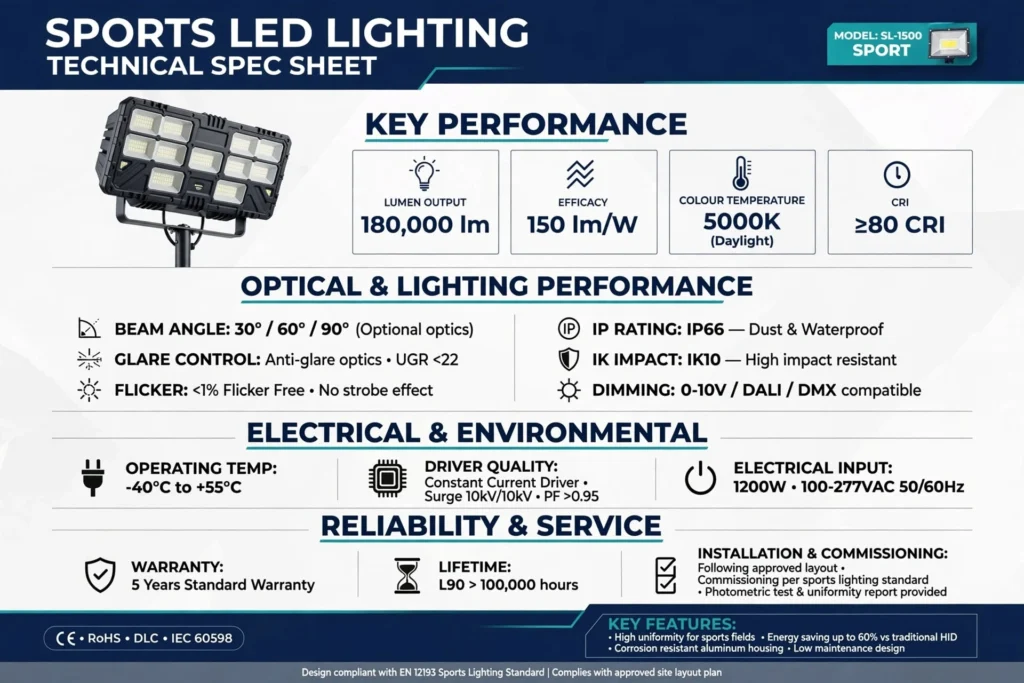
Selecting a suitable system requires more than comparing wattage and price.
Important specifications can include:
Lumen output, efficacy, colour temperature, CRI, beam angle, glare control, flicker performance, IP rating, impact resistance, dimming compatibility, operating temperature, driver quality, warranty, and expected lifetime.
The appropriate specification depends on the sport, venue size, mounting height, competition level, and broadcasting requirements.
Professional Installation and Commissioning
Even a high-quality LED fixture can perform poorly if installed incorrectly.
Installation should follow the approved lighting layout and manufacturer requirements.
After installation, the system should be inspected and commissioned.
Commissioning can include checking illumination levels, controls, emergency systems, fixture alignment, dimming performance, and overall operation.
For sports facilities, final testing should ideally occur with the actual playing conditions and furniture or equipment in place.
Future of LED Lighting in Indoor Sports
The future of sports lighting is moving toward increasingly connected and intelligent systems.
Wireless control, real-time energy monitoring, automated scheduling, occupancy detection, advanced dimming, and integration with building management systems can provide greater operational control.
Professional venues may also require sophisticated lighting for broadcasting, slow-motion video, high-resolution photography, and immersive spectator experiences.
Architectural LED systems can further transform arenas during ceremonies, presentations, concerts, and special events.
Frequently Asked Questions
What type of LED lighting is best for an indoor sports arena?
The appropriate LED system depends on the sport, ceiling height, playing area, required illumination, and competition level. High-bay fixtures with controlled optics are common in large venues, while specialised sports luminaires may be preferable where glare, flicker, and broadcast performance are critical.
Why is uniformity important in sports lighting?
Uniform illumination helps players see the playing surface and moving objects consistently. Significant differences between bright and dark areas can create visual discomfort and make fast-moving sports more difficult to follow.
Is LED lighting suitable for televised sports?
Yes, appropriately specified LED lighting can be suitable for televised and professionally recorded sports. Fixtures should be evaluated for colour quality, flicker performance, illumination levels, and camera requirements.
Can sports arena LED lights be dimmed?
Many modern LED systems support dimming when compatible drivers and controls are specified. Dimming can create different scenes for training, competition, cleaning, events, and maintenance.
Does LED lighting reduce sports facility energy costs?
LED technology can reduce lighting energy consumption compared with less efficient legacy systems. Additional savings can come from occupancy controls, scheduling, dimming, zoning, and efficient lighting design.
Conclusion
LED lighting for indoor sports arenas requires a carefully engineered approach that balances athlete performance, spectator comfort, safety, energy efficiency, maintenance, and visual quality.
The best system is designed around the specific sport and venue rather than selected solely according to fixture wattage. Uniformity, glare control, colour rendering, flicker performance, beam distribution, mounting height, and maintenance access all influence the final result.
For UAE sports facilities, efficient lighting is particularly valuable because venues often operate in heavily air-conditioned environments and may have long operating schedules.
Whether the project involves a professional arena, school sports hall, indoor football centre, badminton academy, basketball court, fitness facility, or multipurpose venue, modern LED technology can provide a flexible foundation for high-quality illumination.
With professional photometric planning, smart controls, appropriate fixture selection, and coordinated installation, an indoor sports facility can achieve a lighting environment that supports clear visibility, comfortable viewing, efficient operation, and a better overall sporting experience.