Lighting in a fashion boutique is not simply about making the store bright enough for customers to see products. In a well-designed retail environment, LED lighting influences how colors appear, how fabrics look, where customers focus their attention, how premium the store feels, and how effectively merchandise is presented. For fashion retailers, the lighting system becomes part of the brand experience. A luxury boutique in Dubai Mall may require a very different lighting strategy from a contemporary fashion store in City Walk, Jumeirah, Dubai Marina, Abu Dhabi, or Sharjah. The products, interior finishes, ceiling height, window design, brand identity, and customer journey all influence the lighting specification.
A professional boutique lighting plan therefore needs to combine color rendering, color temperature, beam angle, illuminance, glare control, accent lighting, ambient lighting, display lighting, energy efficiency, and architectural integration.
Why LED Lighting Is Important for Fashion Boutiques
Fashion retail depends heavily on visual presentation. Customers need to evaluate the actual color, texture, finish, fit, and detailing of garments before making a purchase.
Poor lighting can make premium merchandise appear flat, create unwanted shadows, distort colors, or make fitting-room mirrors less flattering.
LED technology provides retailers with greater control over these factors.
Modern LED fixtures can be selected according to:
- Color temperature
- Color Rendering Index (CRI)
- R9 performance
- Beam angle
- Luminous output
- Dimming capability
- Glare characteristics
- Fixture design
- Energy efficiency
- Control compatibility
The objective is not to install the highest number of lights. The objective is to put the right amount of light in the right location.
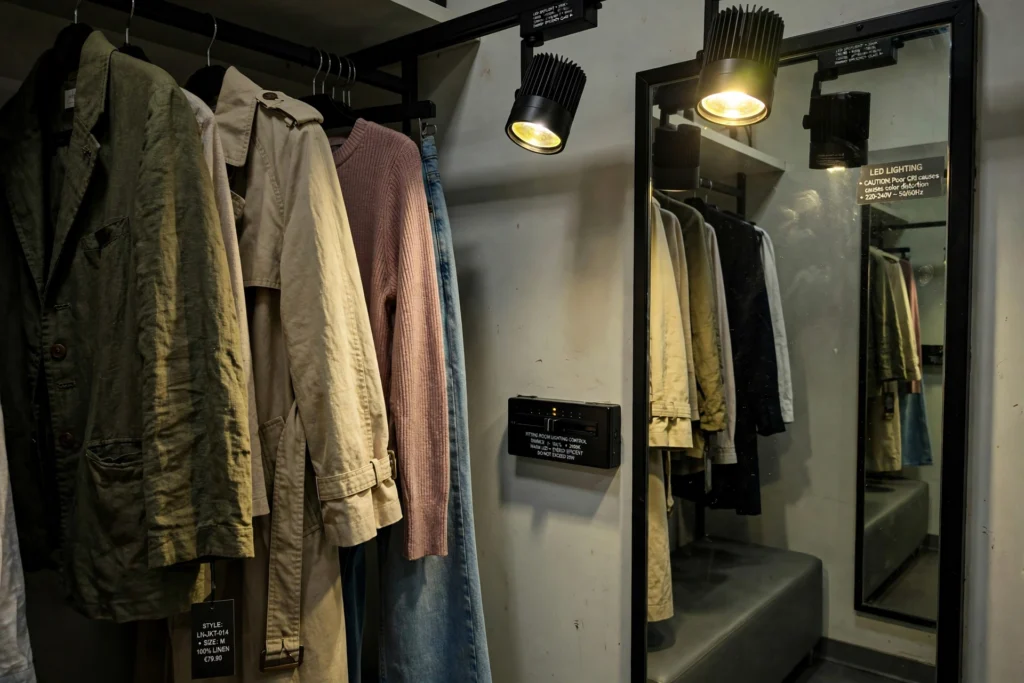
Color Rendering Is Critical for Fashion Retail
One of the most important technical considerations for fashion boutiques is color rendering.
CRI measures how accurately a light source reveals colors compared with a reference illuminant. For fashion stores, high color rendering is particularly valuable because customers need to see garments as accurately as possible.
However, CRI alone does not tell the complete story.
The R9 value, which relates strongly to saturated red reproduction, can also be relevant because skin tones, leather, cosmetics, warm textiles, and certain garment colors can be affected by poor spectral performance.
For premium fashion environments, selecting high-quality LED products with strong color rendering can improve the visual presentation of merchandise.
Choosing the Right Color Temperature
Color temperature is another major design decision.
LED lighting is commonly available in different correlated color temperatures, such as:
2700K, 3000K, 3500K, 4000K, and higher.
Warm white around 2700K–3000K can create a sophisticated and intimate atmosphere.
Around 3000K–3500K can provide a balanced appearance suitable for many contemporary fashion environments.
Cooler temperatures can produce a cleaner, more energetic appearance but may not suit every fashion brand.
The correct selection depends on the brand identity, interior materials, merchandise, and desired customer experience.
A luxury boutique featuring wood, brass, marble, and warm neutral colors may benefit from a warmer lighting environment, while a minimalist contemporary store may use a more neutral specification.
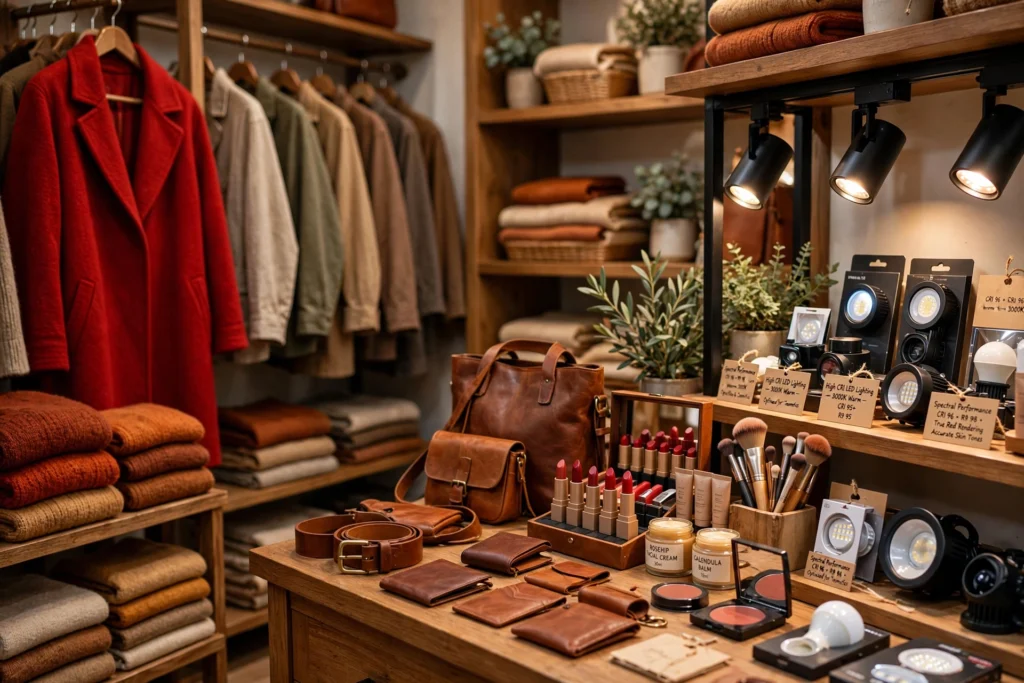
Ambient Lighting Creates the Base Layer
Ambient lighting provides the general illumination throughout the boutique.
It should allow customers to navigate the store comfortably without creating excessive brightness or visual fatigue.
Common fixtures include:
- Recessed LED downlights
- Surface-mounted LED fixtures
- Linear LED lighting
- Track lighting
- Architectural ceiling fixtures
Ambient lighting should be coordinated with the store’s architecture.
For example, a boutique with a high ceiling may require a different lighting distribution from a compact retail unit.
Uniform brightness is not always desirable in fashion retail. A completely flat lighting environment can remove visual hierarchy.
Instead, the lighting designer can create a base layer and then use accent lighting to emphasize important merchandise.
Accent Lighting Makes Merchandise Stand Out
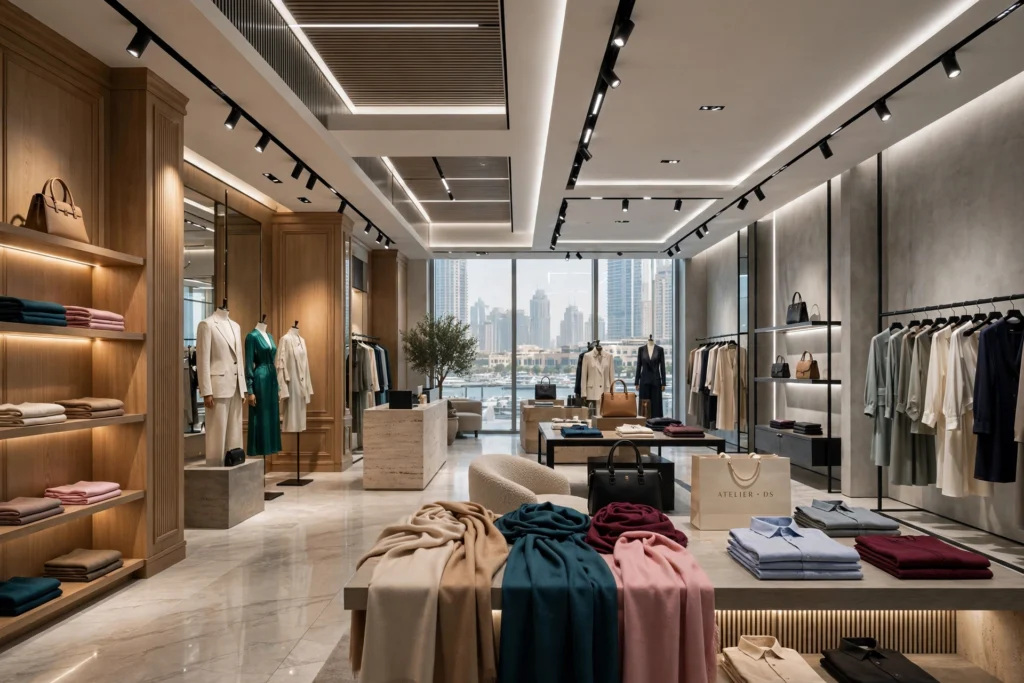
Accent lighting is used to draw attention toward selected products, displays, mannequins, shelves, or architectural features.
This is particularly effective in fashion retail because customers naturally respond to visual contrast.
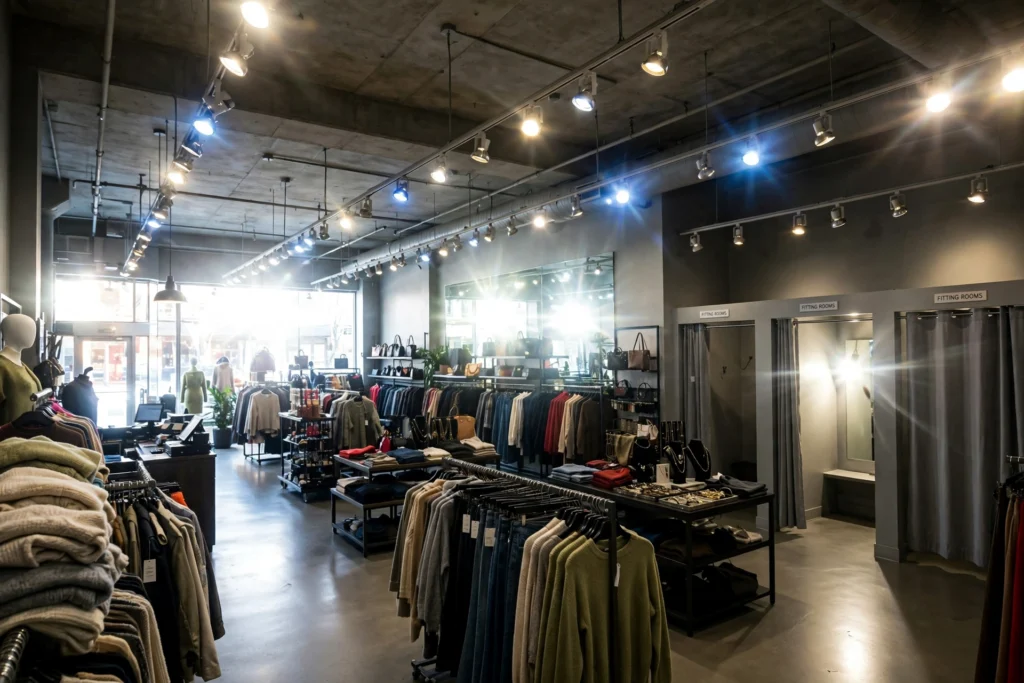
Track-mounted LED spotlights can be aimed toward:
Mannequins, feature walls, new collections, accessories, footwear displays, handbags, and promotional installations.
The key is controlled contrast.
If everything is equally illuminated, nothing receives special attention.
A carefully designed boutique may therefore use moderate ambient illumination with stronger, carefully positioned accent lighting over hero products.
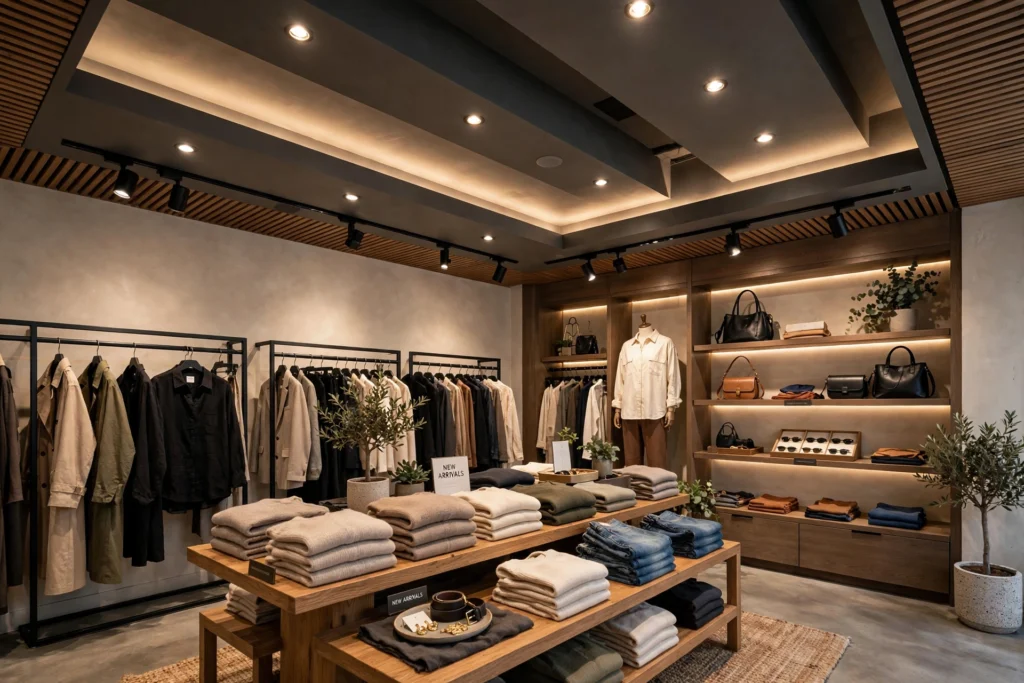
Beam Angle Changes the Appearance of the Store
Beam angle determines how widely light spreads from a fixture.
Narrow beams can create focused highlights.
Medium beams can illuminate mannequins and display areas.
Wide beams can provide broader illumination.
For fashion boutiques, beam selection should correspond to the display distance and product size.
A narrow beam aimed from too close a distance can create harsh highlights and strong shadows.
A wide beam used where a focused accent is required may dilute the visual impact.
Professional lighting design therefore considers fixture position, ceiling height, mounting distance, beam angle, aiming angle, and target surface together.
Track Lighting for Flexible Fashion Displays
Fashion merchandise changes regularly.
A boutique may move mannequins, racks, tables, and displays according to:
- New collections
- Seasonal campaigns
- Sales
- Product launches
- Promotional events
- Holiday merchandising
This makes adjustable track lighting particularly useful.
Track-mounted LED spotlights allow the retailer to redirect light when merchandise moves.
This flexibility can reduce the need for major electrical modifications whenever the store layout changes.
For retailers in Dubai Mall, Mall of the Emirates, Yas Mall, City Centre Mirdif, and Abu Dhabi shopping districts, flexibility can be particularly useful because merchandising strategies may change frequently.
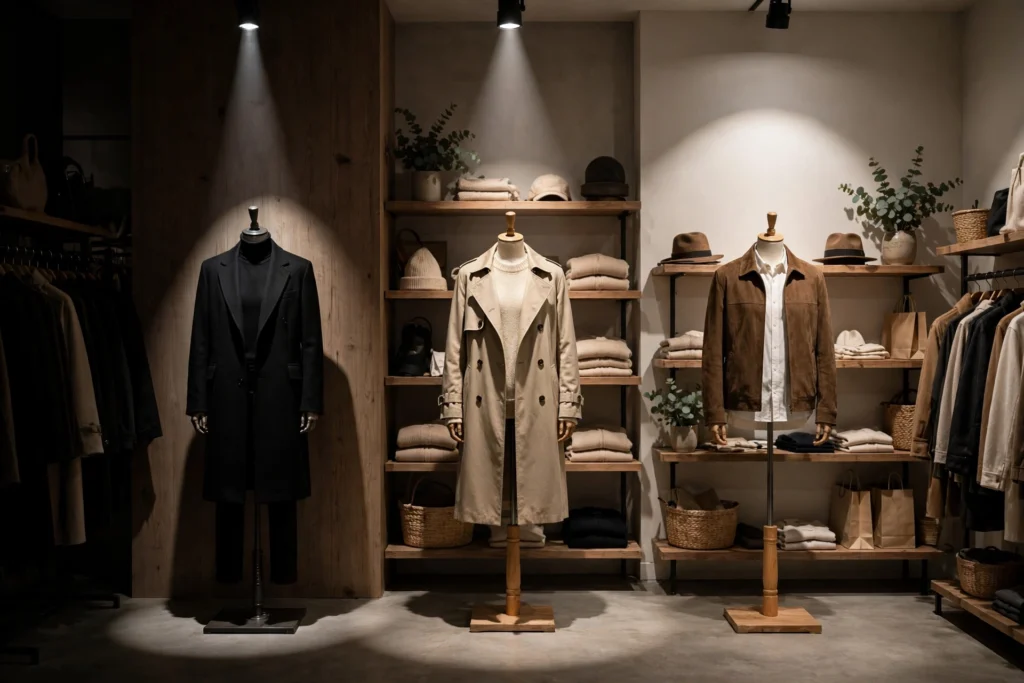
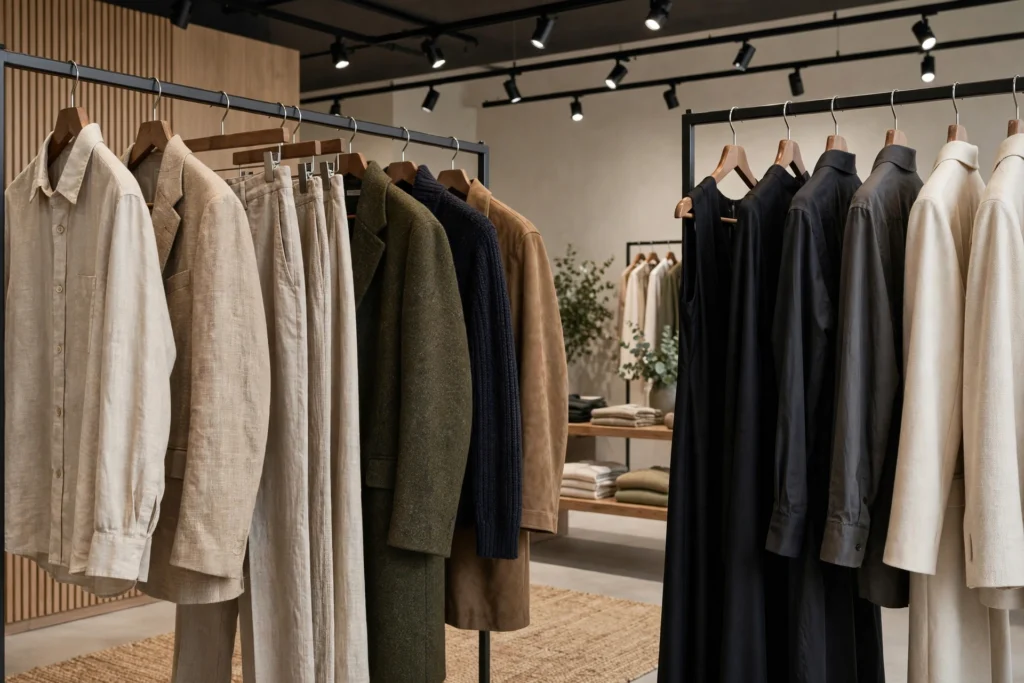
Lighting for Clothing Racks
Clothing racks require enough illumination to reveal fabric details without creating excessive glare.
Vertical surfaces are particularly important because garments are generally displayed vertically.
A common mistake is focusing only on horizontal floor illumination.
A lighting designer should consider vertical illuminance, because customers primarily look at garments, displays, and people rather than the floor.
Well-positioned track lights can illuminate clothing racks from appropriate angles and reduce excessive shadowing between garments.
For premium collections, high-quality color rendering becomes even more important.
LED Lighting in Fashion Boutique Fitting Rooms
Fitting rooms require special attention because customers evaluate how garments look on their bodies.
Poorly positioned ceiling lights can create deep shadows around the face and body.
Excessively cool or harsh light can also produce an unattractive visual effect.
A better approach can combine carefully positioned overhead lighting with vertical or side illumination.
The goal is to provide flattering but accurate illumination.
Lighting around mirrors should minimize strong facial shadows while maintaining realistic color appearance.
This is one area where the technical quality of the LED system directly affects the customer’s experience.
Mirror Lighting Needs Careful Design
Mirror lighting is not simply about installing lights directly above a mirror.
A single overhead source can create shadows under the eyes, nose, and chin.
Side illumination or a combination of appropriately positioned fixtures can provide more balanced facial lighting.
The exact solution depends on the mirror dimensions, room geometry, ceiling height, wall finishes, and fixture characteristics.
In high-end boutiques, mirror lighting should be treated as part of the customer experience design, not as an afterthought.
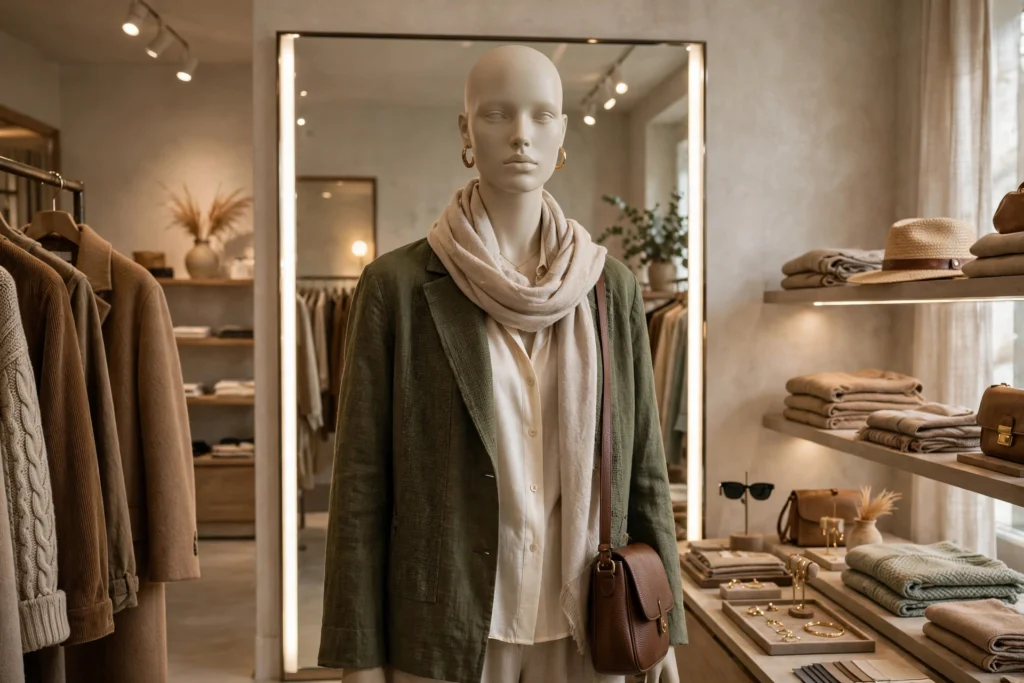
Lighting for Mannequins
Mannequins are often used to communicate the visual identity of a collection.
They should therefore receive deliberate accent lighting.
The light should reveal:
- Garment color
- Fabric texture
- Silhouette
- Accessories
- Layering
- Product details
The fixture should generally be positioned to avoid unwanted shadows across the face and clothing.
Multiple light sources can sometimes create a more balanced appearance than a single overhead spotlight.
Lighting for Shelves and Accessories
Accessories such as handbags, shoes, watches, belts, and jewelry require smaller-scale lighting.
Linear LED profiles, cabinet lighting, miniature spotlights, and integrated display lighting can be used depending on the furniture design.
The light source should remain visually discreet while highlighting the merchandise.
For luxury retail, integrating lighting into display furniture can create a clean architectural appearance.
Energy Efficiency Matters in UAE Retail
Fashion boutiques often operate for long hours.
Lighting may remain operational throughout the trading day, which makes energy efficiency important.
LED technology generally provides significant efficiency advantages compared with older lighting technologies, particularly when combined with effective controls.
Retailers can improve energy performance through:
- High-efficiency LED fixtures
- Dimming
- Occupancy sensors where appropriate
- Daylight-responsive controls
- Scheduled lighting
- Zoning
- Smart lighting controls
However, energy efficiency should not be evaluated only by wattage.
The relevant comparison is useful light output, visual performance, operating hours, maintenance requirements, and total lifecycle cost.
Smart Lighting Controls for Fashion Boutiques
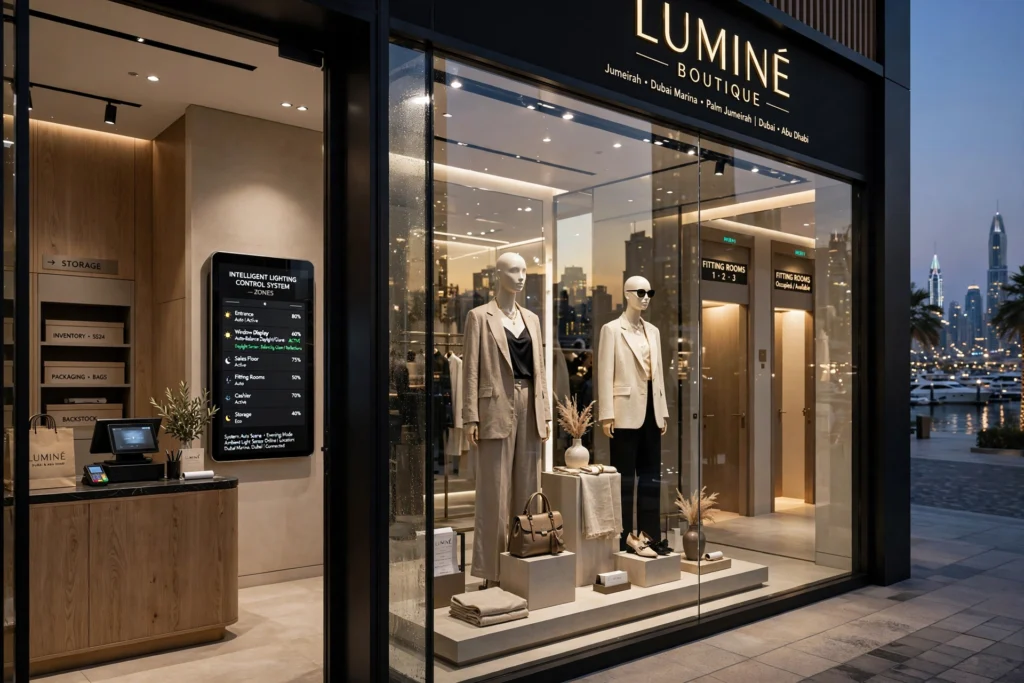
Modern retail lighting can incorporate intelligent control systems.
Lighting can be divided into zones such as:
Entrance, window display, sales floor, fitting rooms, cashier area, storage, and feature displays.
Each zone can then have appropriate operating schedules.
For example, window display lighting may operate before and after the main store lighting schedule to attract customers during evening hours.
Dimming can also allow the store to adjust the atmosphere for different times of day.
For larger retail environments, integration with building management systems (BMS) may provide additional control possibilities.
Window Display Lighting in Dubai
The storefront is the first visual interaction many customers have with a boutique.
Window displays therefore deserve dedicated lighting.
The challenge is balancing interior illumination with external daylight.
During bright daytime conditions, the lighting requirements may be very different from the evening environment.
A poorly illuminated window can disappear against strong exterior light.
At night, excessive brightness can create glare or reflections on the glass.
Boutiques in Downtown Dubai, Jumeirah, Dubai Marina, Palm Jumeirah, and Abu Dhabi can benefit from designing storefront lighting according to the surrounding environment and viewing distance.
Lighting Design for Luxury Fashion Boutiques
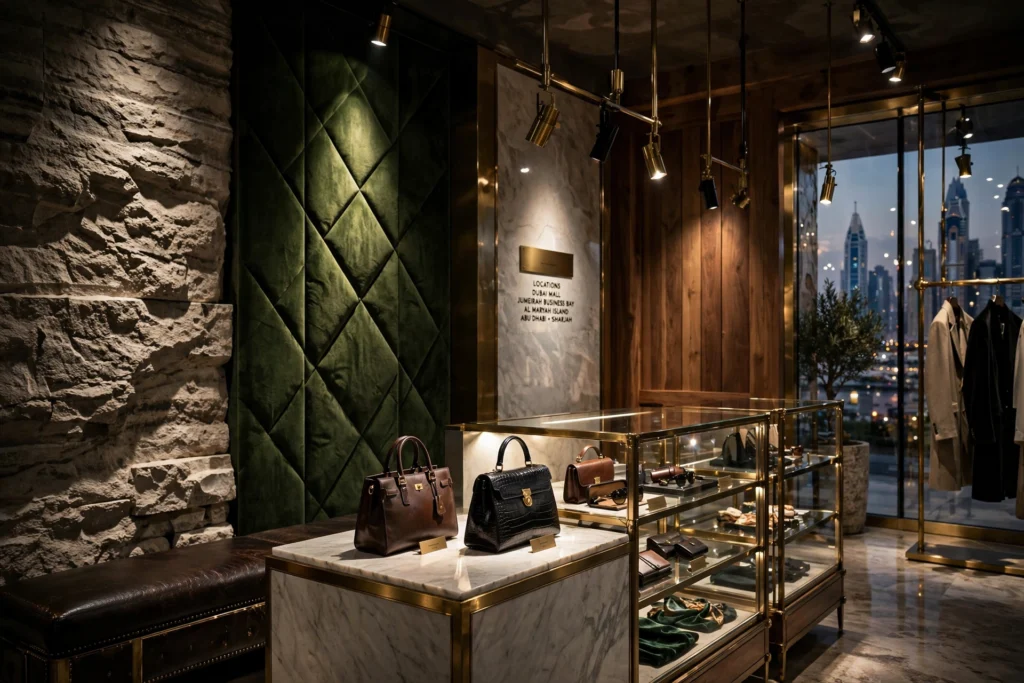
Luxury retail generally benefits from visual hierarchy rather than uniform brightness.
Materials such as:
Marble, brass, timber, glass, leather, stone, velvet, and textured wall finishes
can respond very differently to light.
A good lighting design should reveal these materials while maintaining the brand’s desired atmosphere.
For example, grazing light can emphasize wall textures, while narrow accent beams can highlight individual products.
The result should feel intentional rather than simply bright.
LED Lighting for Different UAE Boutique Locations
The local context can influence design decisions.
A fashion boutique in Dubai Mall may operate within a highly controlled luxury retail environment where architectural integration and glare control are critical.
A boutique in Jumeirah may have a more intimate storefront and stronger architectural relationship with the surrounding neighborhood.
A fashion store in Business Bay may be located within a mixed-use commercial development and require a modern, flexible lighting system.
A boutique in Abu Dhabi’s Al Maryah Island may have premium retail requirements similar to other luxury commercial environments.
In Sharjah, lighting requirements may vary significantly depending on whether the store is located in a shopping mall, high street, or standalone commercial property.
The lighting specification should therefore respond to the individual space rather than simply following a generic retail template.
Common Fashion Boutique Lighting Mistakes
Several lighting problems appear repeatedly in retail environments.
Too Much Light
More light does not necessarily mean better product visibility.
Excessive illumination can create glare and reduce visual contrast.
Poor Color Rendering
Low-quality LEDs can make garments look different from their appearance under natural light.
Incorrect Beam Angles
A beam that is too narrow or too wide can create poor distribution.
Excessive Glare
Visible LED sources or badly positioned spotlights can make customers uncomfortable.
Poor Fitting-Room Lighting
This can negatively affect the customer’s perception of both the clothing and the shopping experience.
No Lighting Flexibility
Fixed lighting becomes problematic when merchandise layouts change.
Ignoring Vertical Surfaces
Lighting only the floor does not adequately illuminate clothing and displays.
How to Plan LED Lighting for a New Boutique
A professional approach starts with the store layout.
The lighting designer should review:
Floor area, ceiling height, display locations, fitting rooms, mirrors, windows, entrances, merchandise categories, architectural finishes, and customer circulation.
Next, define lighting layers:
- Ambient illumination
- Accent lighting
- Display lighting
- Feature lighting
- Mirror and fitting-room lighting
- Window display lighting
The next stage is fixture selection.
Consider CRI, R9, CCT, beam angle, lumen output, glare rating, dimming, color consistency, and mounting method.
Finally, conduct lighting calculations and, where practical, evaluate a physical sample before final installation.
Working With a Fashion Boutique LED Lighting Solutions Supplier
For retailers, selecting the correct supplier is important because the lighting system involves more than supplying fixtures.
A technically capable supplier should understand retail lighting, LED specifications, color rendering, beam distribution, lighting controls, installation requirements, and commercial project coordination.
For a new boutique, the supplier may need to coordinate with:
- Interior designers
- Architects
- Electrical contractors
- MEP consultants
- Shopfitters
- Retail managers
- Signage contractors
This coordination helps prevent conflicts between lighting fixtures, ceilings, display furniture, air-conditioning equipment, sprinklers, and other building services.
Businesses searching for a suitable fashion boutique LED lighting solutions supplier should therefore evaluate technical capability alongside product availability.
Final Thoughts
Fashion boutique lighting should be treated as a combination of retail design, visual merchandising, electrical engineering, and customer-experience strategy.
The strongest LED lighting systems do not simply make a boutique brighter. They help customers see products accurately, guide attention toward important merchandise, improve fitting-room experiences, enhance architectural finishes, reinforce brand identity, and reduce unnecessary energy consumption.
For UAE retailers, the lighting design should also respond to the local environment and property type. A luxury boutique in Dubai Mall, Downtown Dubai, Palm Jumeirah, or Al Maryah Island may require highly controlled architectural lighting, while stores in Jumeirah, Sharjah, Abu Dhabi, or other commercial districts may have different spatial and operational requirements.
The most effective approach is to design the lighting around the merchandise and customer journey first, then select the LED technology that supports those objectives.
When CRI, R9, color temperature, beam angle, glare, vertical illumination, accent lighting, controls, energy efficiency, and fixture placement are considered together, LED lighting becomes much more than an electrical requirement—it becomes a practical tool for creating a stronger fashion retail environment.