LED Strip Lighting at Building Scale Across the UAE
Across the UAE, LED strip lighting has moved far beyond decorative accenting into a core architectural and commercial building system. Developers, facade consultants, and fit out contractors now specify linear LED strip systems to define the identity of entire buildings, illuminate multi floor atriums, and deliver the controlled architectural lighting that distinguishes a landmark development from an ordinary one. For commercial buildings in Dubai, Sharjah, and Abu Dhabi, the question is no longer whether to use LED strip lighting, but how to specify it correctly for performance, longevity, and visual impact at scale.
This guide examines LED strip lighting from the perspective of the commercial building, the property developer, and the MEP consultant responsible for delivering a project that performs reliably for a decade or more in demanding Gulf conditions. It covers facade integration, atrium and lobby applications, hospitality and commercial buildings, car park and circulation use, smart control, and the technical specification factors that separate a successful building scale installation from a costly failure.
Facade and Building Envelope Illumination
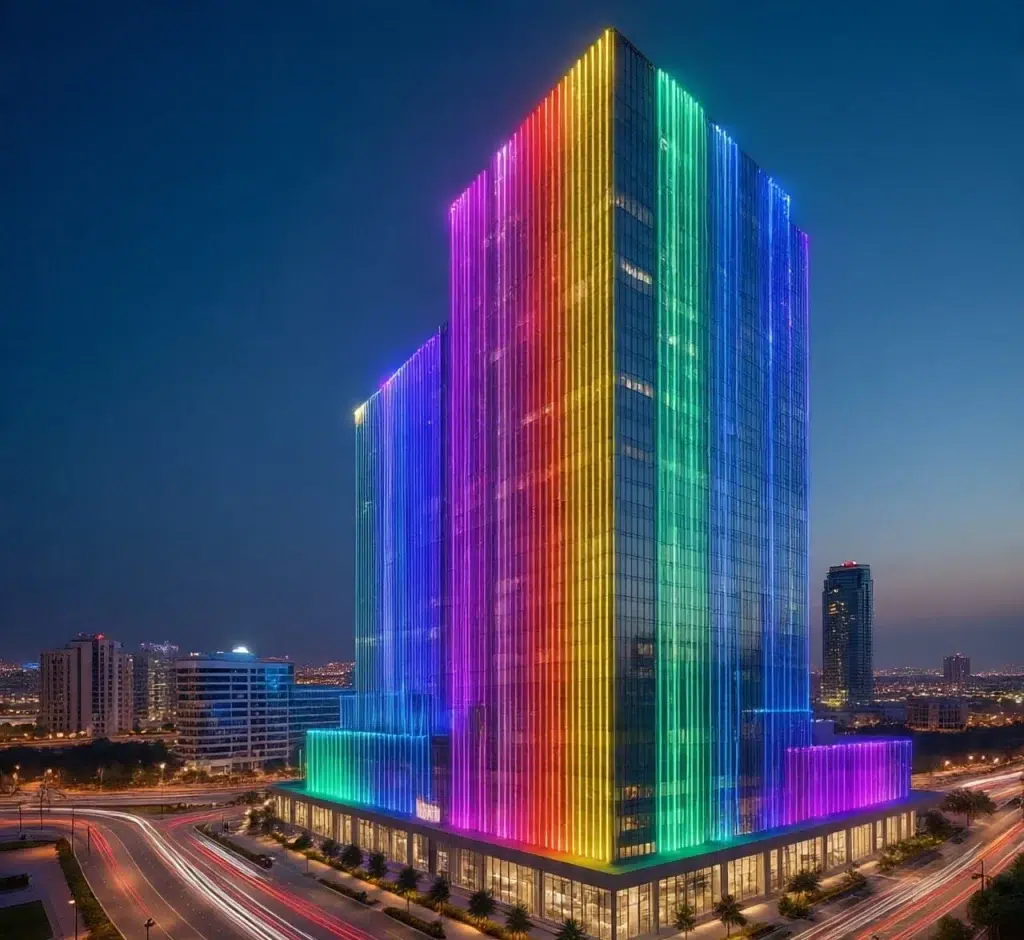
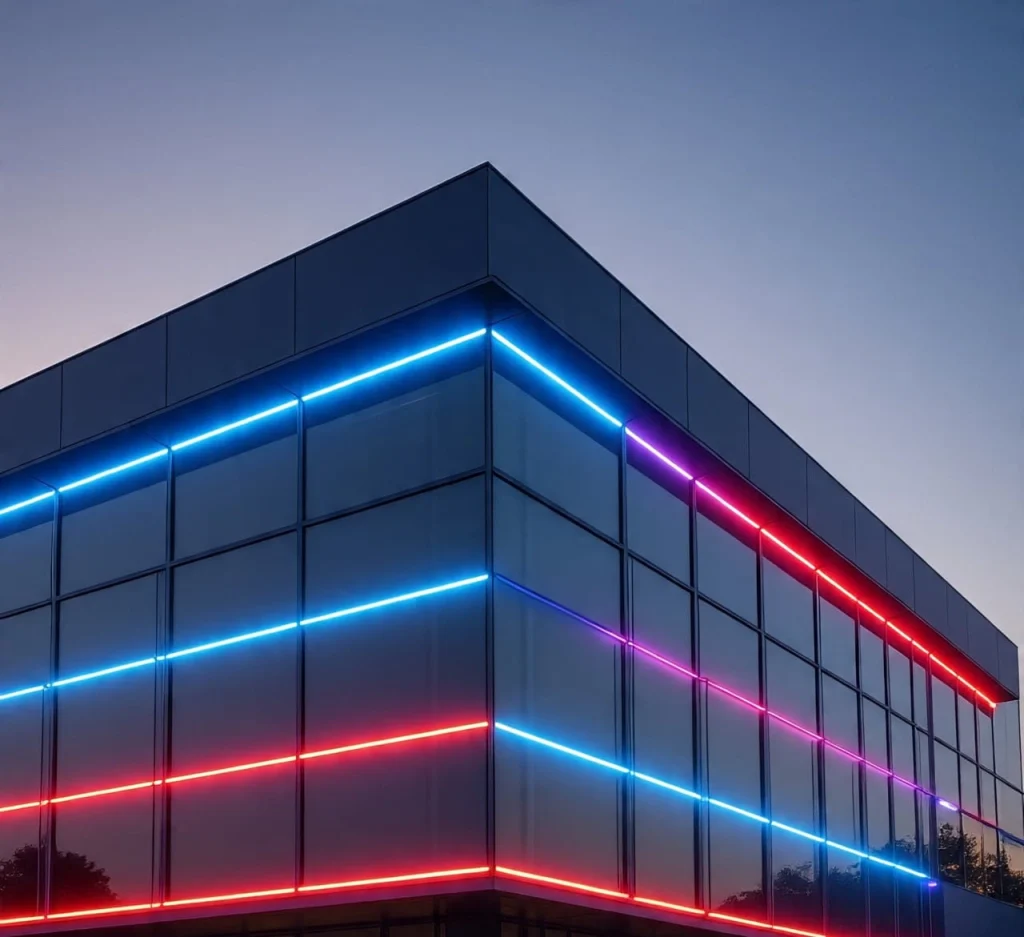
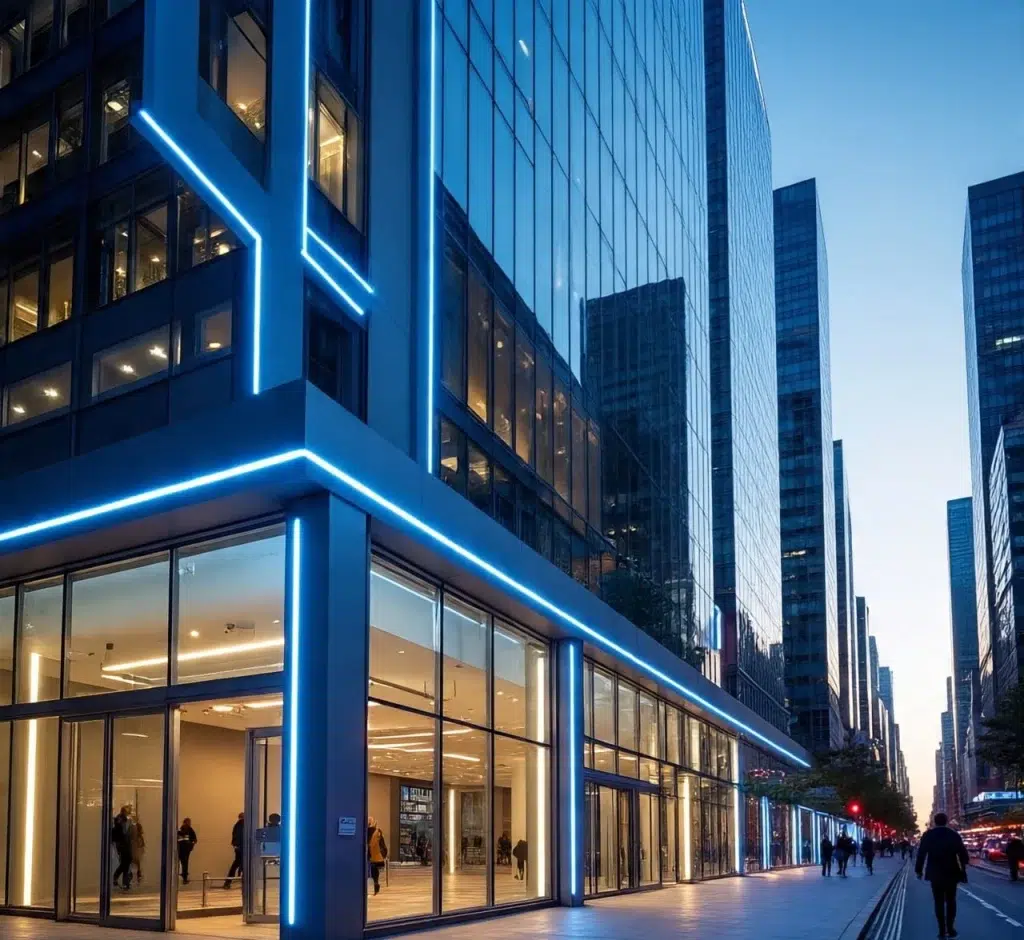
Building facade lighting is one of the most visible and commercially valuable applications of LED strip systems in the UAE. A well lit facade transforms a commercial tower into a recognisable landmark, supports tenant brand visibility, and adds measurable value to a development in a competitive property market. Linear LED strip systems mounted in facade reveals, balcony edges, and vertical architectural fins create continuous lines of light that trace the geometry of a building against the night sky, giving a development a distinctive identity that photographs well and reinforces its market positioning.
For facade applications, IP67 and IP68 rated strips are essential. The building envelope is exposed to direct sun, blowing sand, humidity, and occasional rain, and only fully sealed strip systems survive these conditions across a realistic service life. Colour temperature consistency is equally critical at facade scale, because any variation between production batches becomes glaringly visible across a continuous illuminated edge spanning dozens of metres. Developers specifying facade strip lighting should always request tight colour binning and batch matching documentation. For broader exterior schemes, facade strip lighting is frequently combined with LED flood lights for building facades to layer wash and linear effects across the envelope.
Atrium, Lobby and Vertical Circulation Spaces
Commercial building atriums and lobbies are the spaces where first impressions are formed, and LED strip lighting is the primary tool designers use to shape them. Continuous cove lighting around atrium perimeters, illuminated handrails along feature staircases, and recessed strip details in reception desks all rely on professional grade LED strip systems. In a multi floor commercial atrium, strip lighting installed in each floor edge can create a dramatic vertical rhythm that emphasises the scale and quality of the space and draws the eye upward through the volume.
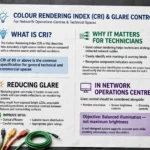
High colour rendering matters here. Lobby and atrium finishes, marble, timber veneer, brushed metal, and feature stone, only read as premium under light that renders their colour and texture faithfully. A CRI 90 or higher strip specification ensures these expensive materials appear at their best to every visitor and tenant. Lobby strip lighting integrates naturally with recessed LED downlights for commercial lobbies and architectural LED spotlights for feature walls, building the layered scheme that defines a premium commercial entrance.
Hospitality Buildings and Mixed Use Towers
Hospitality buildings place particular demands on strip lighting, because the entire commercial proposition of a hotel rests on atmosphere. Across hotel lobbies, restaurant ceilings, spa environments, and guest corridors, warm white strip lighting in carefully concealed coves creates the layered, inviting environment that drives guest satisfaction and repeat bookings. In mixed use towers that combine hotel, residential, and commercial floors, a coordinated strip lighting strategy maintains a coherent design language as occupants move between very different functional environments within a single building.
Specifying strip lighting for hospitality buildings requires attention to dimming and control, because the lighting must transform across the day from bright morning service to intimate evening ambience. High quality dimmable strip systems paired with scene control deliver this flexibility. The warm hospitality palette is reinforced throughout the building with LED strip lights for hotel interiors and decorative LED pendant lights for hotel lobbies, creating the complete atmospheric scheme premium hospitality demands.
Commercial Buildings and Shopping Centre Developments
Commercial buildings and shopping centre developments use strip lighting both architecturally and commercially. Architecturally, strip systems define mall circulation routes, illuminate feature ceilings, and create the bright, welcoming environment that encourages dwell time. Commercially, strip lighting within individual commercial units illuminates merchandise, shopfront fascias, and display zones with the high colour rendering that makes products appear their most attractive to shoppers.
For mall developers and commercial landlords, providing quality base building strip lighting in common areas, and clear strip lighting standards for tenant fit out, ensures a consistent, premium environment across the development. Commercial strip lighting works in concert with directional LED track lights for commercial units and ambient LED panel lights for back of house areas to deliver the complete commercial lighting environment.
Car Parks, Service Cores and Functional Building Areas
Not every strip lighting application in a commercial building is architectural. In car parks, service corridors, plant rooms, and back of house circulation, LED strip and linear systems deliver practical, efficient illumination that keeps a building operating safely and economically. Strip lighting integrated into car park bulkheads or used for wayfinding edge marking improves safety and navigation in large multi storey car parks across UAE commercial developments, where clear visual guidance reduces accidents and improves the user experience.
For these functional areas, IP65 rated strips with robust aluminium channel protection are appropriate, balancing durability against cost. Functional building strip lighting is typically specified in 4000K neutral white for clear, comfortable visibility, and is frequently combined with LED batten lights for car parks to provide the primary illumination layer while strips handle edge definition and wayfinding.
Specifying LED Strip Systems for Building Projects
Building scale LED strip specification rests on several technical pillars that MEP consultants and developers must address at design stage. Voltage selection is the first: 24V systems are strongly preferred for commercial buildings because they support longer continuous runs with less voltage drop than 12V alternatives, reducing the number of power injection points needed across a large installation. Driver quality is the second: commercial building installations demand drivers with power factor correction above 0.9 and robust thermal design, because driver failure is the single most common cause of premature strip lighting failure in the field.
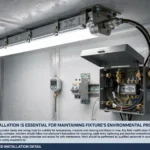
Thermal management through aluminium channel mounting is the third pillar, and it is non negotiable in UAE conditions. Heat is the enemy of LED longevity, and strips mounted without adequate heat sinking degrade rapidly in Gulf ambient temperatures. The fourth pillar is control integration. Modern commercial buildings increasingly require DALI or addressable control of architectural lighting, enabling scene programming, energy management, and integration with the building management system across the whole development.
Smart Control and Building Management Integration
The value of building scale strip lighting multiplies when it is integrated with intelligent control. DALI and addressable RGBW strip systems allow a commercial building to programme lighting scenes, change facade colour for events and national celebrations, and coordinate architectural lighting with the building management system. For a landmark commercial tower, the ability to transform the facade colour scheme for a national day or a corporate event is a meaningful asset that differentiates the building and supports tenant engagement.
Intelligent control also delivers energy management. Strip lighting that dims in response to daylight, switches according to occupancy, or follows a programmed schedule consumes only the energy a building genuinely needs. These capabilities position strip lighting as part of the smart building infrastructure that premium UAE developments now treat as standard, working alongside smart automation for commercial buildings to deliver a coordinated, efficient, and responsive environment.
Energy Performance and Sustainability at Building Scale
For a commercial building operator, the energy consumed by architectural and functional lighting across an entire development is a meaningful operating cost and a significant element of the building carbon footprint. LED strip systems consuming a fraction of the energy of the legacy lighting they replace contribute directly to lower running costs and support the sustainability certifications increasingly demanded by premium tenants and required by UAE building regulations.
When integrated with daylight sensing and occupancy control, building strip lighting can be dimmed or switched in response to real conditions, further reducing consumption without compromising the architectural effect. These energy management capabilities are a core reason developers across Dubai and Abu Dhabi now treat intelligent LED lighting as standard infrastructure. For the ambient lighting layer in commercial interiors, strip systems work alongside LED panel lights for office floors to deliver complete, energy efficient building lighting.
Avoiding Common Building Strip Lighting Failures
Several recurring mistakes undermine building scale strip lighting installations in the UAE, and awareness of them protects a project. Specifying strips with inadequate IP rating for their exposure is the most common, leading to early failure of facade and external installations. Neglecting thermal management is the second, accelerating lumen depreciation in Gulf conditions. Mixing production batches without colour binning control is the third, producing visible colour variation across continuous runs. Undersizing drivers and ignoring voltage drop across long runs is the fourth, producing dim ends and unreliable performance.
Each of these failures is avoidable with correct specification and a quality supply partner. Engaging a knowledgeable distributor at design stage, confirming IP ratings, thermal design, colour consistency, and driver sizing, ensures a building strip lighting installation that performs as designed across its full service life rather than disappointing within months of handover.
Why UAE Developers Partner With Tricircle for Building Strip Lighting
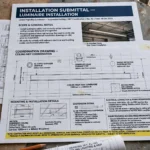
Delivering LED strip lighting at building scale requires more than a product catalogue. It requires consistent product quality across large quantities, technical documentation for authority submissions, and a supply partner able to schedule deliveries against a construction programme. As an authorised OPPLE distributor, Tricircle supplies commercial buildings across the UAE with certified, batch consistent LED strip systems, complete with the aluminium channels, drivers, and control components that professional building installations require.
Our commercial team works with developers, facade consultants, and MEP contractors from specification through delivery, providing the photometric data, compliance certificates, and project pricing that large building projects demand. To discuss LED strip lighting for a commercial building, facade, or development across Dubai, Sharjah, or Abu Dhabi, contact our team at aysha@tricirclegroup.ae or call +971 50 578 1325.