Understanding Strip Lighting From the Ground Up
For commercial specifiers who deploy strip lighting without a detailed technical understanding of it, a clear explanation of the technology supports better decisions. LED strip lighting appears simple, a flexible board of diodes, but the factors that determine its quality and reliability reward closer understanding. This guide explains strip lighting from the ground up for the architects, MEP consultants, and procurement teams who specify it across UAE commercial and hospitality projects.
It covers the construction of a strip, the characteristics that determine its quality, and the technical factors that influence the success of an installation, equipping the specifier to evaluate strip products and installations on substance rather than appearance.
The Construction of an LED Strip
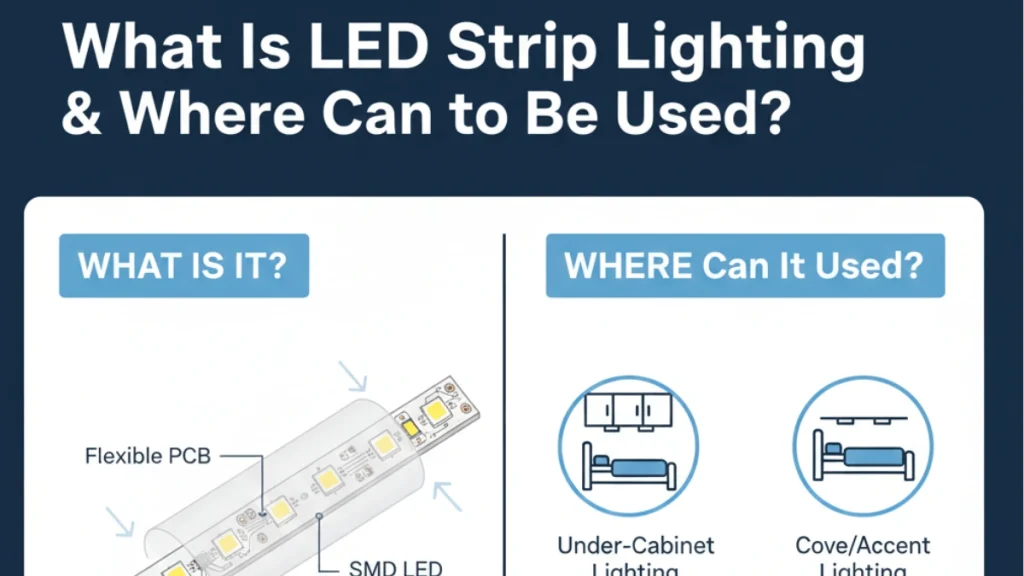
An LED strip is a flexible printed circuit board carrying a regular array of light emitting diodes, resistors, and conductors, with an adhesive backing for mounting. The diodes are spaced along the board, and the strip can be cut at defined points between them to suit the required length. The quality of the circuit board, the diodes, and the conductors all influence the performance and reliability of the strip.
Higher quality strips use thicker copper conductors that carry current with less voltage drop, better diodes that deliver consistent output, and more robust construction that endures. These differences, invisible at a glance, distinguish strips that perform reliably from those that disappoint, and they reward the specifier who understands what to look for.
Diode Quality and Light Output
The diodes are the heart of the strip, and their quality determines the light output, efficiency, colour, and longevity of the system. Quality diodes deliver consistent output, accurate colour, and stable performance across a long life, while inferior diodes vary in output and colour and degrade more quickly. The diode quality is among the most important factors in the performance of a strip.
Specifiers cannot always assess diode quality directly, but they can specify strips from recognised manufacturers who use quality diodes and document their performance. The reputation of the manufacturer and the completeness of the documentation are reliable indicators of the diode quality the strip employs.
LED Density and Visual Uniformity
The density of diodes along a strip, expressed in diodes per metre, determines the uniformity of the light it delivers. Higher density strips place the diodes closer together, delivering a more uniform line of light with less visible dotting, particularly important where the strip is viewed closely or through a diffuser. Standard density suits general applications, while high density serves premium and close viewed installations.
Choosing density to suit the application and viewing distance is fundamental to visual quality. A strip of insufficient density in a demanding application reveals individual diodes and disappoints, while appropriate density delivers the seamless glow that quality installations require, as found across our LED strip lights for commercial projects.

Colour Temperature and Rendering
Strip lighting is available across colour temperatures from warm to cool, and in colour changing variants. The colour temperature sets the character of the light, with warm temperatures favoured for hospitality and cooler temperatures for functional applications. Colour rendering, expressed as CRI, determines how faithfully the light reveals colours, with high CRI specified where material and merchandise colour must read accurately.
Specifying colour temperature and rendering to suit the application is essential to a successful installation. The wrong colour temperature undermines the intended atmosphere, while poor colour rendering makes materials and merchandise appear dull. Attention to these characteristics ensures the strip lighting serves the space as intended.
Voltage and Electrical Considerations
Strip lighting operates at low voltage, typically 12 or 24 volts direct current, supplied by a driver that converts the mains supply. The voltage affects the practical run length, with 24 volt systems supporting longer runs with less voltage drop. The electrical design, the driver sizing, the run length, and the power injection where needed, determines whether the strip delivers consistent brightness along its length.
Understanding these electrical considerations helps the specifier ensure the installation is designed correctly. Voltage drop along an overlong run produces dim ends, while an undersized driver fails prematurely. Correct electrical design, addressed at specification stage, is essential to reliable, uniform strip lighting.
Ingress Protection and Environment
The ingress protection rating of a strip determines the environments it suits. Standard strips suit dry indoor applications. Sealed IP65 strips resist splashing and suit kitchens and bathrooms. Fully encapsulated IP68 strips withstand submersion and suit pools and water features. Matching the protection to the environment is essential to durable, safe performance.
Specifying the correct protection avoids both the early failure of underspecified strips and the unnecessary cost of overspecification. Understanding the IP rating system and the demands of each environment allows the specifier to match the strip to the application reliably across a commercial project.
Aluminium Channels and Heat Management
Aluminium channels are integral to quality strip installations, providing heat management, optical diffusion, and protection. The channel conducts heat away from the strip, a critical function in UAE conditions where heat shortens LED life. The diffuser cover blends the individual diodes into a uniform line of light, while the channel protects the strip and provides a finished appearance.
For commercial installations, the channel is not optional but essential to both performance and appearance. Understanding its role helps the specifier recognise that a professional strip installation comprises the strip, the channel, the diffuser, and the driver working together, not the strip alone.
Common Specification Mistakes
Several recurring mistakes undermine strip installations. Specifying insufficient density for a close viewed application reveals the diodes. Neglecting thermal management shortens life. Undersizing drivers or overlong runs produce dim ends. Specifying inadequate ingress protection causes early failure in demanding environments. Each is avoidable with an understanding of the technology and a disciplined specification.
Awareness of these common mistakes protects a project from the disappointing installations they cause. The specifier who understands density, thermal management, electrical design, and ingress protection can avoid the pitfalls that catch the inexperienced and deliver strip lighting that performs reliably.
Specifying With Technical Confidence
An understanding of strip lighting technology allows the specifier to evaluate products and installations on the factors that genuinely determine quality, diode quality, density, electrical design, thermal management, and protection, rather than on appearance or price alone. This technical literacy is the best protection against poor outcomes.
Combined with a supplier who provides quality products and complete documentation, this understanding ensures the strip lighting installation performs as intended across its life. As an authorised OPPLE distributor, Tricircle supports specifiers with the products and technical information that confident specification requires.
Strip Lighting Support From Tricircle
If you are specifying strip lighting for a commercial or hospitality project in the UAE and want technical support, our team can help. We provide the product information, technical documentation, and complete systems, strips, channels, diffusers, and drivers, that professional installations require, supplied in project quantities.
To discuss the technical specification of strip lighting for your project, contact our team at aysha@tricirclegroup.ae or call +971 50 578 1325. We support specifiers across Dubai, Sharjah, Abu Dhabi, and the wider UAE.
Strip Lighting and Architectural Detailing
Strip lighting has become a defining tool of architectural detailing in commercial interiors, used to articulate edges, reveal forms, and create the layered light that distinguishes considered design. Concealed within reveals and coves, the strip itself remains unseen while its light defines the architecture, a discipline that demands both quality products and careful detailing by the design team.
For architects, understanding the capabilities and constraints of strip lighting allows it to be detailed effectively into the architecture. The most successful installations result from early integration of the lighting into the architectural detail, rather than its later addition, making strip lighting a consideration from the outset of the design.
Matching Strip Systems to Project Budgets
Strip lighting is available across a range of quality and price, and matching the system to the project budget and requirements is part of effective specification. Premium applications justify high density, high CRI, quality strip systems, while less demanding applications may be served by more economical products. Understanding the requirements of each application allows the budget to be allocated where it delivers the most value.
For developers and contractors managing project budgets, this matching ensures quality is invested where it matters, in the visible, premium, close viewed applications, while economy is exercised where it is appropriate. A knowledgeable supplier supports this allocation with products across the quality and price range.
Bringing Strip Lighting Specification Together
Specifying strip lighting successfully brings together an understanding of the technology, the requirements of the application, and the practicalities of installation. The construction and quality of the strip, its density, colour, and protection, the electrical design, the thermal management, and the installation all contribute to the result. Addressing each ensures the installation delivers the intended effect reliably across its life.
This integrated approach, considering the strip, its supporting components, and its installation as a complete system, is what delivers professional strip lighting. As an authorised OPPLE distributor, Tricircle supports specifiers with complete systems and the technical guidance that brings strip lighting specification together successfully across UAE commercial and hospitality projects.
The Role of the Driver
The driver converts the mains supply to the low voltage direct current the strip requires, and its quality and sizing are critical to reliable performance. The driver must be rated for the connected load with adequate headroom, designed for the thermal conditions of its location, and matched to any dimming system. Driver failure is a common cause of strip lighting problems, making driver quality an important specification consideration.
Specifying quality drivers, correctly sized and appropriately located, protects the reliability of the installation. The driver is as important as the strip itself to a successful installation, and it deserves equal attention in the specification.