Understanding the Technology Behind Linear Lighting
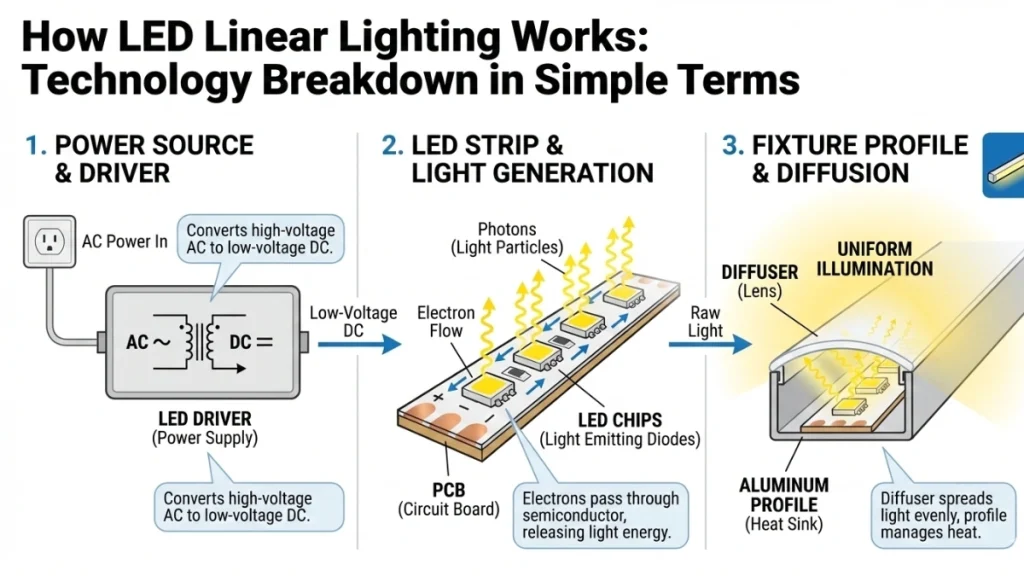
Understanding how LED linear lighting works helps commercial specifiers, architects, MEP consultants, and procurement teams, make better product decisions and evaluate performance claims accurately. A specification grounded in genuine technical understanding selects products that perform, while one based on marketing claims and unit price often disappoints. This guide explains the core technology of LED linear lighting relevant to commercial specification in the UAE, without the engineering depth required only of product designers.
It covers the components that determine real world performance, the LED module, the driver, the optical system, and the thermal design, and explains how each influences the suitability and longevity of a linear installation in commercial buildings.
The LED Module and Luminous Efficacy
At the heart of a linear luminaire is the LED module, an array of light emitting diodes mounted on a circuit board. The efficacy of this module, measured in lumens per watt, determines how efficiently it converts electrical energy into light, and it directly affects the energy performance and compliance of the installation. Commercial grade linear systems achieve high system efficacy when the module, driver, and optics work together efficiently.
Specifiers should compare efficacy at the complete luminaire level, including driver and optical losses, rather than at the bare component level, because a high efficacy chip can deliver disappointing real world performance once driver and optical losses are accounted for. System efficacy is the figure that matters for energy calculations and for satisfying the lighting power density limits of UAE green building regulations.
The Driver and Power Quality
The driver converts mains alternating current into the controlled direct current the LED modules require, and its quality is decisive for the performance and longevity of the luminaire. Driver failure is the most common cause of LED luminaire failure in the field, often well before the LED modules themselves reach end of life. Commercial grade drivers use robust components, power factor correction above 0.9, and thermal designs that endure the conditions of UAE ceiling voids.
Driver quality also determines flicker performance. Flicker free operation, important in offices and educational environments where high frequency flicker causes headaches and eye fatigue, depends on a well designed constant current driver. Specifying luminaires with quality drivers and documented flicker performance protects both the occupant experience and the reliability of the installation, qualities found in LED linear lights for commercial offices.

The Optical System and Visual Quality
The optical system, comprising the diffuser, internal reflectors, and the geometry of the LED array, shapes the light the luminaire delivers and determines its visual quality. The diffuser distributes light and controls the luminance that reaches the eye, while reflectors direct light efficiently to where it is needed. Together they determine the distribution, glare characteristics, and appearance of the luminaire.
Different optical designs suit different applications. Low luminance diffusers deliver the glare controlled light offices require. Prismatic optics deliver the higher intensity output commercial favours. Opalescent diffusers deliver the soft, uniform light appropriate to hospitality. Specifying the optical system to suit the application is essential to delivering light that serves the space well.
Thermal Design and Service Life
LED performance and longevity depend on temperature, and thermal design is how a luminaire manages it. The heat generated by the LED modules and driver must be conducted away to keep component temperatures within safe limits. Quality linear luminaires use aluminium housings and thermal pathways designed to dissipate this heat effectively, maintaining performance and extending service life.
In UAE conditions, where ceiling void temperatures reach high levels in summer, thermal design is especially critical. A luminaire validated for high ambient operation maintains its performance and life where a product optimised for cooler climates would suffer accelerated degradation. Thermal design is a key differentiator between products that endure in Gulf conditions and those that fail early.
Colour Binning and Consistency
Individual LEDs vary slightly in colour temperature and output, and manufacturers sort them into bins of similar characteristics, a process called binning. The tightness of the binning determines the colour consistency of luminaires assembled from a production run. For large commercial installations, where any visible variation between adjacent luminaires undermines the result, tight binning, a MacAdam three step tolerance or better, is essential.
Specifiers should request binning documentation for large linear installations to ensure the colour consistency the project requires. This is one of the technical details that separates a professional commercial installation from one that disappoints, and it is readily addressed by specifying products from a manufacturer with disciplined binning control.

Control Compatibility and Dimming
The way a linear luminaire integrates with control systems depends on its driver. Drivers are available for DALI, 0 to 10 volt, and phase cut dimming, each suited to different applications. Commercial buildings requiring building management integration specify DALI drivers, while simpler applications may use 0 to 10 volt or phase cut control. Confirming driver and control compatibility at specification stage is essential to reliable dimming.
Smooth, flicker free dimming across the full range depends on matching the driver to a compatible control system. The dimming problems that occasionally affect installations, flicker at low levels, minimum load issues, audible noise, arise from incompatibility, not from inherent LED limitations, and are avoided by correct specification.
Putting the Technology Together
A quality linear luminaire is the result of the module, driver, optics, and thermal design working together. A weakness in any one undermines the whole, a poor driver shortens life regardless of module quality, inadequate thermal design degrades performance regardless of efficacy, poor optics waste good light. Understanding this interdependence helps specifiers recognise that genuine quality lies in the complete, well engineered luminaire rather than in any single headline figure.
This understanding also explains why products that appear similar on a specification sheet can perform very differently in service. The quality of the integration, invisible on paper, is what determines real world performance, and it is best assured by specifying products from a recognised manufacturer with full technical documentation.
Specifying With Confidence
Armed with an understanding of the technology, specifiers can evaluate linear products on the factors that genuinely determine performance, system efficacy, driver quality, optical design, thermal validation, and colour consistency, rather than on unit price alone. This technical literacy protects against the disappointing installations that result from selecting products on headline figures and lowest cost.
As an authorised OPPLE distributor, Tricircle supplies linear systems with complete technical documentation, supporting specifiers in making confident, well informed decisions for commercial projects across the UAE. Our team provides the photometric, driver, and thermal data that informed specification requires.

Reading a Linear Luminaire Datasheet
The datasheet is where the technical character of a linear luminaire is documented, and reading it well is a core specification skill. Key figures include system efficacy in lumens per watt, the colour temperature and CRI, the UGR rating, the IP rating, the rated life and lumen maintenance, and the control compatibility. Understanding what each figure means, and how it relates to the application, allows the specifier to evaluate products on substance rather than presentation.
A complete datasheet, supported by photometric files, evidences a manufacturer confident in the performance of the product. Sparse or incomplete documentation should prompt caution, as it often accompanies products whose real world performance does not bear close examination. The quality of the documentation is itself a signal of the quality of the product.
Lumen Maintenance and Rated Life
LEDs do not fail abruptly like lamps; they gradually dim over time, and rated life expresses the point at which output has fallen to a defined proportion of the initial value. The L80 figure, for example, indicates the hours at which the luminaire still delivers eighty percent of its initial output. Understanding lumen maintenance allows the specifier to anticipate the long term performance of the installation and to plan for it.
For commercial buildings, where consistent illumination across the building life matters, specifying luminaires with strong lumen maintenance ensures the installation continues to perform as designed for many years. This long term performance is a key advantage of quality LED systems and a factor that distinguishes them from products that dim noticeably within a few years of installation.
The Role of the Heat Sink
The heat sink, often the aluminium body of the luminaire itself, is the component that conducts heat away from the LED modules and dissipates it. Its design, the surface area, the material, the thermal pathways, determines how effectively the luminaire manages temperature, and therefore its performance and life in service. In UAE conditions, where ambient temperatures are high, an effective heat sink is essential.
Specifiers cannot always assess heat sink design directly, but they can specify products from manufacturers who design for high ambient operation and document their thermal performance. The presence of a substantial, well designed aluminium body is a visible indicator of serious thermal engineering, while flimsy construction suggests inadequate thermal management.
Why Technical Understanding Protects the Project
The value of understanding linear technology lies in the protection it provides against poor decisions. A specifier who understands efficacy, driver quality, optics, thermal design, and lumen maintenance can evaluate products on the factors that determine performance, rather than being swayed by headline figures or lowest price. This understanding is the best defence against the disappointing installations that result from uninformed procurement.
For commercial projects, where the consequences of poor lighting decisions persist for decades, this technical literacy is a genuine asset. Combined with a supply partner who provides complete documentation and honest technical advice, it ensures the lighting installation serves the building well across its full service life.
Technical Support From Tricircle
If you are specifying LED linear lighting for a commercial project in the UAE and want technical support grounded in genuine product understanding, our team can help. We provide the efficacy, driver, optical, thermal, and colour consistency documentation that informed specification requires, supplied with certified OPPLE linear systems in project quantities.
To discuss the technology and specification of linear lighting for your project, contact our team at aysha@tricirclegroup.ae or call +971 50 578 1325. We support specifiers across Dubai, Sharjah, Abu Dhabi, and the wider UAE.