Police stations, fire stations, ambulance centres, emergency command centres, civil defence facilities, and other public safety buildings operate differently from ordinary commercial properties. These facilities may remain active 24 hours a day, require reliable illumination during night operations, and contain areas where clear visibility is essential for staff, visitors, vehicles, equipment, and emergency response activities.
For these environments, LED lighting provides an efficient and flexible solution for interior, exterior, security, parking, circulation, operational, and emergency lighting applications. Modern LED luminaires can provide consistent illumination while reducing electrical consumption, maintenance requirements, and heat generation compared with older lighting technologies.
In the UAE, energy-efficient lighting is particularly relevant because buildings operate in a demanding climate and cooling systems represent a significant part of building energy consumption. UAE green-building guidance requires energy-efficient lighting approaches for public buildings, while Dubai’s Al Sa’fat system promotes improved energy and electrical-system efficiency.
For organizations planning new emergency facilities or upgrading existing police and emergency service buildings, LED lighting should therefore be considered as part of the overall electrical, architectural, security, and building-management strategy.
Why LED Lighting Is Important in Emergency Service Buildings
Emergency service facilities cannot be treated like ordinary offices. A police station may include reception areas, interview rooms, offices, evidence-related spaces, vehicle bays, corridors, staircases, control rooms, parking areas, and external access routes. A fire station may include apparatus bays, sleeping facilities, equipment rooms, training spaces, workshops, and administrative areas.
Ambulance stations and emergency medical facilities can have similarly varied requirements, including vehicle parking, dispatch areas, staff spaces, equipment storage, circulation areas, and operational zones.
LED technology can provide different optical distributions, colour temperatures, lumen outputs, mounting configurations, and control options for these spaces. Instead of using one lighting fixture throughout an entire facility, a properly designed system can match the luminaire to the activity and environment.
This approach can improve visual comfort and operational visibility while supporting energy-management objectives.
LED Lighting for Police Stations
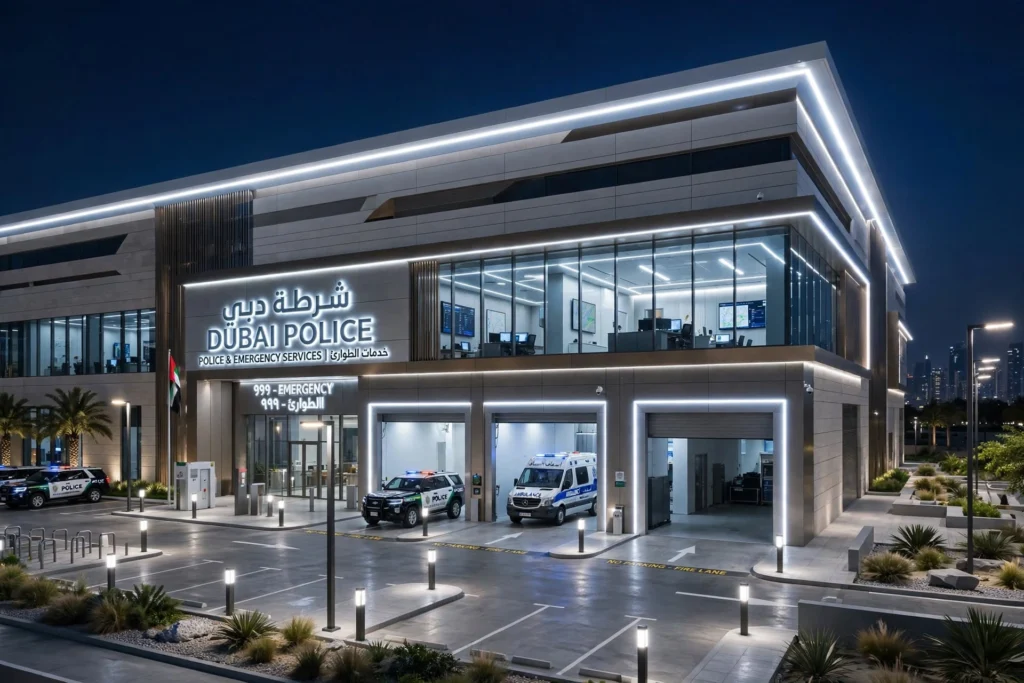
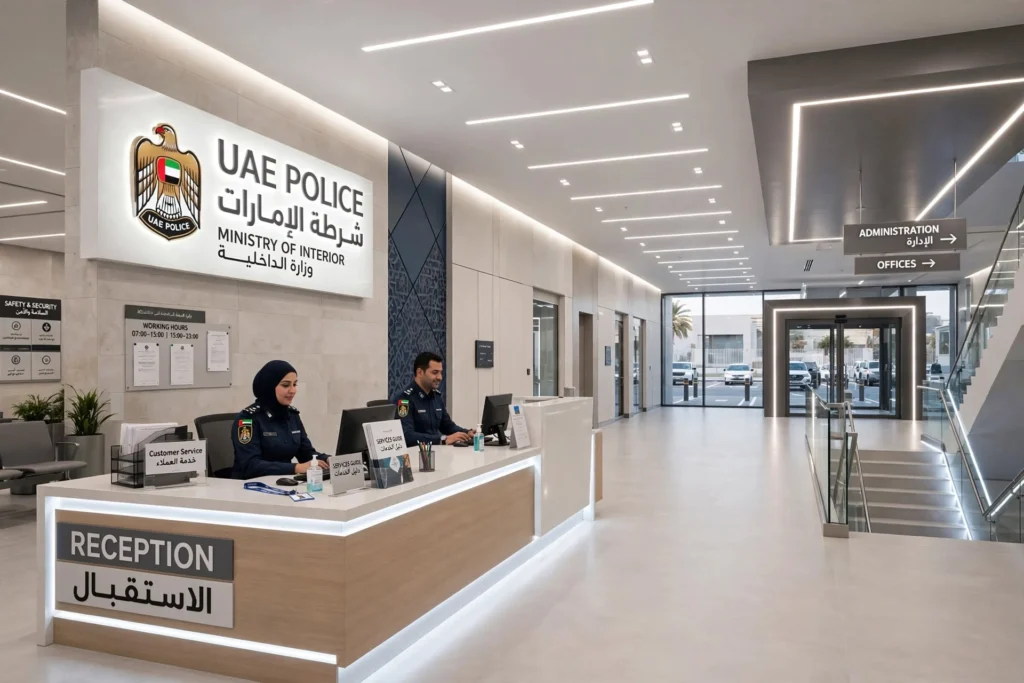
Police facilities require lighting that supports public interaction, administrative work, circulation, security, and continuous building operation. Reception areas should appear clear and welcoming, while corridors, staircases, entrances, parking areas, and external pathways require appropriate illumination for safe movement.
Inside administrative offices, LED panel lights, recessed luminaires, linear LED fixtures, and other commercial lighting systems can provide uniform illumination. In higher-activity areas, LED high-bay or industrial luminaires may be appropriate depending on ceiling height and environmental conditions.
Police station entrances can use architectural LED fixtures to provide consistent illumination around doors, signage, pedestrian routes, and reception areas. External wall-mounted luminaires and appropriately designed floodlights can provide wider-area illumination where required.
The lighting design should avoid unnecessary glare and excessive contrast. Uniform illumination can make spaces easier to navigate and can improve visual comfort for staff working long shifts.
LED Lighting for Fire Stations
Fire stations have particularly demanding lighting requirements because emergency vehicles can be dispatched at any hour. Apparatus bays require bright, uniform illumination so personnel can safely access equipment, inspect vehicles, prepare protective gear, and perform routine maintenance.
LED high-bay lights are commonly suitable for large fire-station vehicle bays because they can provide substantial illumination from high mounting positions. Linear high-bay systems may also be considered where a long, continuous lighting pattern is useful.
Exterior LED lighting can illuminate driveways, vehicle circulation areas, pedestrian routes, equipment zones, and building entrances. The design should balance visibility with glare control and avoid unnecessary light spill into neighbouring properties or public areas.
For fire stations in locations such as Al Quoz, Jebel Ali, Dubai Investment Park, Ras Al Khor, Mussafah, Sharjah Industrial Area, and other industrial or mixed-use districts, lighting designers may need to account for high ceilings, large vehicle movements, dust exposure, outdoor conditions, and extended operating hours.
LED Lighting for Ambulance and Emergency Medical Facilities
Ambulance facilities require lighting for vehicle bays, dispatch areas, staff rooms, equipment storage, circulation routes, entrances, and external access areas. LED luminaires can provide reliable illumination while supporting the continuous operation of these facilities.
Vehicle bays can benefit from durable LED fixtures with suitable ingress protection where dust, moisture, cleaning procedures, or outdoor exposure are concerns. Interior areas can use LED panels, linear luminaires, downlights, or other application-specific fixtures.
Lighting should also be coordinated with other building systems. For example, emergency lighting, fire alarm systems, access control, CCTV, public-address systems, and building management systems may all operate within the same facility.
A coordinated electrical design helps ensure that normal lighting and life-safety systems remain appropriately separated and controlled according to applicable requirements.
Emergency Lighting and Safe Egress
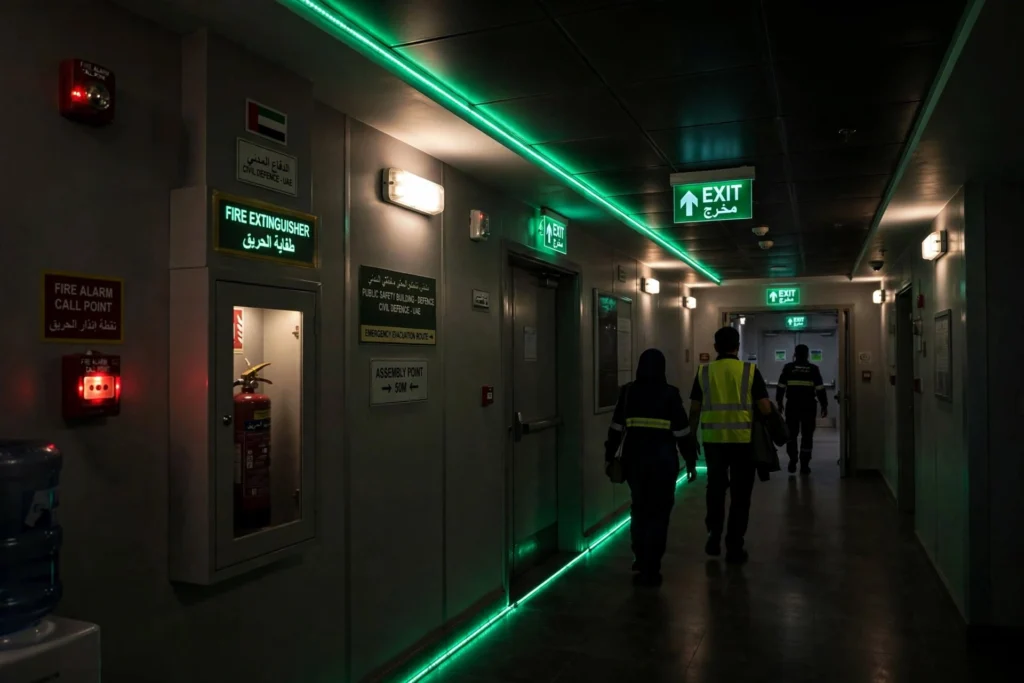
Emergency lighting is one of the most important aspects of lighting design in public safety buildings. Normal lighting can be affected by electrical failures, equipment faults, fire incidents, or other emergencies. Emergency illumination provides visibility for occupants moving toward exits and helps identify important safety equipment and escape routes.
Dubai Civil Defence guidance states that emergency lighting serves functions including identifying escape routes, providing illumination for safe movement, helping locate fire alarm call points and firefighting equipment, and supporting safety operations.
Dubai Building Code guidance also addresses emergency lighting for means of egress and exterior routes from exit discharge areas. It states that emergency lighting should conform to the applicable UAE Fire and Life Safety Code requirements.
For this reason, emergency lighting should not simply be treated as additional decorative lighting. It should be designed as part of the building’s life-safety strategy by qualified professionals and coordinated with applicable authority requirements.
LED Exterior Lighting for Police and Emergency Facilities
The exterior environment around an emergency service building is just as important as its interior. Entrances, vehicle routes, pedestrian paths, parking areas, building façades, loading zones, and equipment areas may require carefully planned lighting.
Outdoor LED floodlights, wall packs, bollards, street-style luminaires, canopy lights, and area lights can be selected according to the application.
The objective is not to make every external area excessively bright. Good exterior lighting focuses illumination where it is needed while controlling glare, shadows, light spill, and unnecessary energy consumption.
This is especially important in urban UAE locations where emergency facilities may be close to residential developments, commercial buildings, roads, or other public infrastructure.
Dubai’s green-building guidance also addresses exterior lighting power density and lighting controls, reinforcing the importance of efficient exterior lighting design.
LED Lighting for Emergency Vehicle Bays
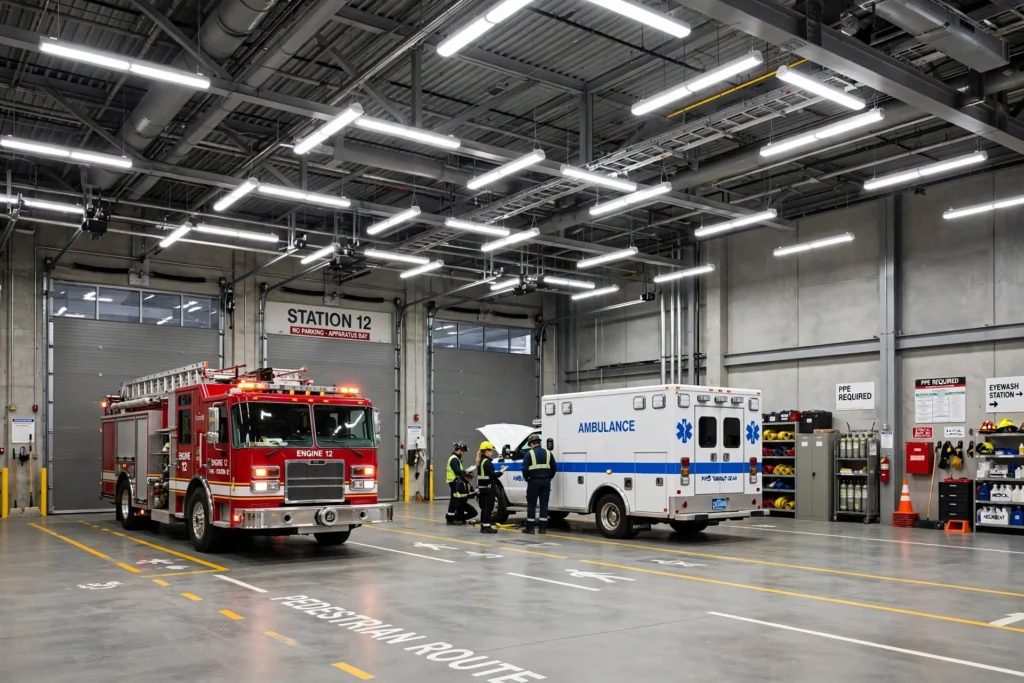
Vehicle bays are among the most important spaces in fire stations and ambulance facilities. These areas often have high ceilings, large doors, concrete surfaces, vehicle exhaust exposure, and frequent movement.
LED high-bay lighting can provide strong illumination across large floor areas while allowing designers to select beam angles appropriate for the height and arrangement of the facility.
The lighting layout should consider vehicle positions, doors, equipment storage, pedestrian routes, work areas, and potential shadow zones. Poorly positioned fixtures can create dark areas even when the overall lumen output appears high.
For maintenance teams, a properly designed lighting system can also make inspection and routine work easier by providing more consistent illumination across the vehicle bay.
Energy Efficiency and Operating Costs
One of the strongest reasons to consider LED lighting for emergency facilities is energy efficiency. Public safety buildings may operate continuously, meaning lighting can contribute significantly to annual electricity consumption.
LED luminaires can reduce connected lighting loads compared with older systems, particularly when combined with intelligent controls and appropriate lighting-power-density calculations.
The UAE’s national green-building guidance specifies energy-efficient lighting requirements for public buildings, including LED or equivalent high-efficiency lighting and lighting-power-density criteria.
Dubai’s Al Sa’fat system also promotes energy efficiency and improved performance of electrical and mechanical systems.
However, energy savings should not come from simply reducing illumination below an appropriate level. The correct approach is to improve efficiency while maintaining suitable illumination, uniformity, visual comfort, and safety.
LED Lighting Controls and Automation
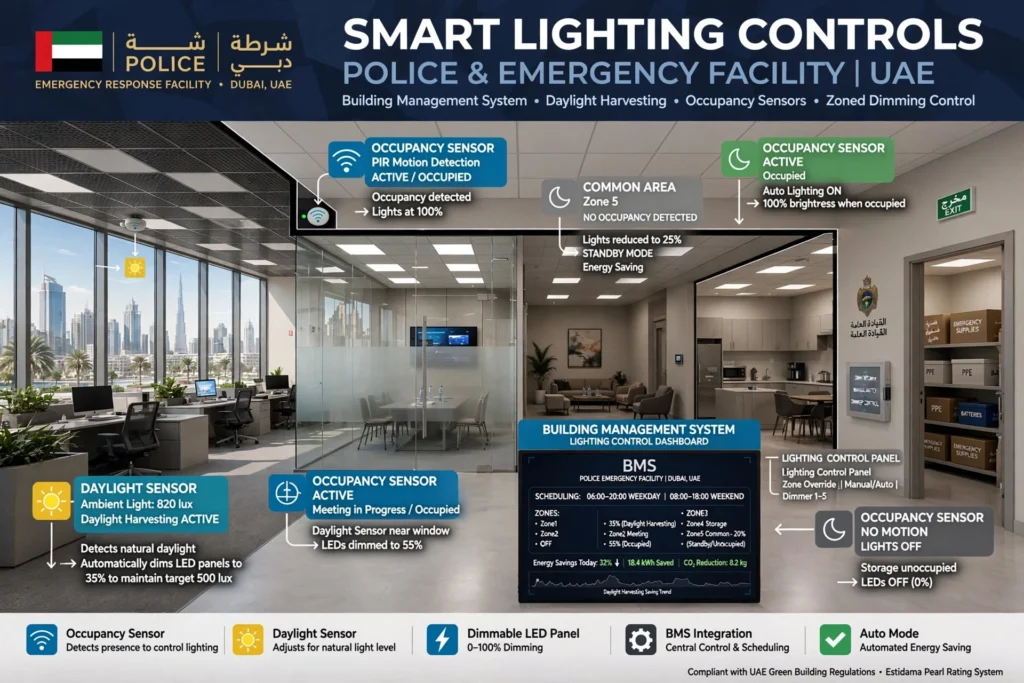
Lighting controls can further improve the efficiency of police stations, fire stations, and ambulance facilities. Different areas operate according to different schedules, so keeping every luminaire at maximum output throughout the day may be unnecessary.
Occupancy sensors can control lighting in suitable spaces such as offices, meeting rooms, storage areas, staff rooms, and other intermittently occupied spaces. Daylight sensors can reduce artificial lighting where sufficient natural light is available.
Time scheduling can also be used in appropriate areas. Dimming systems may provide additional flexibility where the lighting design and application permit it.
Dubai Building Code guidance requires lighting controls that allow lighting to be switched off when daylight is sufficient or areas are unoccupied, while common areas that are not regularly occupied can have lighting automatically reduced. Safety lighting is treated separately from ordinary energy-saving controls.
Integration With BMS and Smart Building Systems
Modern emergency facilities increasingly use integrated building technologies. LED lighting can form part of a wider Building Management System (BMS) or lighting-control network.
A smart lighting system may provide centralized monitoring, scheduling, dimming, fault reporting, occupancy-based control, and energy-use information. Digital control systems can allow facility managers to identify lighting faults more quickly and understand how different areas are consuming electricity.
Other relevant technologies include DALI lighting control, occupancy sensors, daylight sensors, smart switches, programmable controls, wireless lighting controls, IoT sensors, energy meters, and centralized facility management platforms.
For larger government and emergency service campuses, integration can provide additional visibility into building performance without requiring staff to manually inspect every lighting circuit.
Colour Temperature, Glare and Visual Comfort
LED selection is not only about wattage and brightness. Colour temperature, colour rendering, glare, beam angle, uniformity, flicker, and optical distribution should also be considered.
Emergency service personnel may work for extended periods, so uncomfortable glare or inconsistent lighting can negatively affect the working environment. Offices and staff areas can use lighting designed for visual comfort, while operational spaces may require different optical characteristics.
Colour rendering is also relevant where staff need to distinguish colours, equipment markings, signs, uniforms, indicators, or other visual details.
The best lighting specification therefore considers the actual function of each room rather than selecting one LED product for the entire building.
Durable LED Fixtures for UAE Conditions
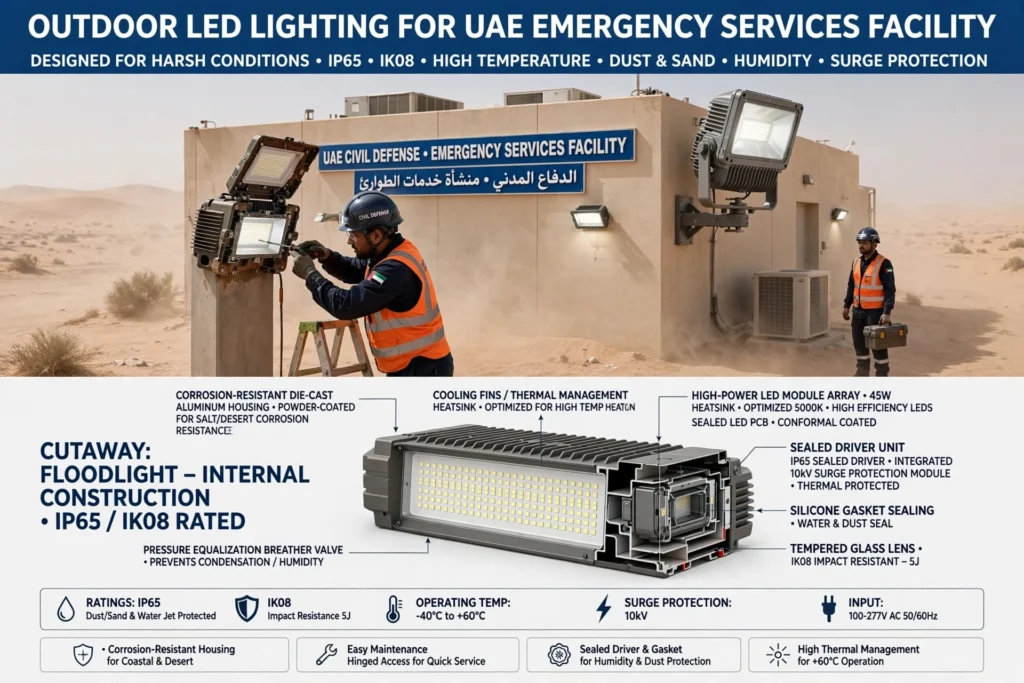
UAE environmental conditions can be demanding for outdoor and semi-outdoor lighting. High temperatures, dust, sand, humidity, and frequent cleaning can affect lighting equipment.
For external areas and exposed emergency-service environments, designers should consider appropriate IP ratings, IK ratings, thermal management, corrosion resistance, surge protection, driver quality, operating temperature, and maintenance accessibility.
A high-quality LED fixture with appropriate protection can be more suitable for a demanding environment than a low-cost product selected purely on initial purchase price.
Maintenance teams should also consider replacement availability, driver accessibility, warranty terms, spare parts, and expected service life.
Lighting for Emergency Command Centres
Emergency command centres and control rooms require particularly careful lighting design. These spaces may operate continuously and contain multiple displays, communication systems, computers, radios, monitoring equipment, and workstations.
Lighting should provide adequate visibility without creating excessive reflections on monitors or distracting glare. Dimmable LED systems can provide greater control when staff need to work with multiple digital screens.
Task lighting can supplement general ambient illumination at workstations, while emergency lighting should remain available according to applicable life-safety requirements.
The lighting design should be coordinated with the room’s operational technology, acoustic design, HVAC system, fire protection, electrical distribution, and communications infrastructure.
Maintenance and Lifecycle Planning
LED lighting generally reduces routine lamp replacement compared with older lighting technologies, but LED systems still require maintenance. Dust accumulation on lenses, damaged fixtures, driver failures, control-system faults, and electrical connection problems can affect performance.
Regular inspection should cover luminaires, emergency lights, batteries or emergency power arrangements, sensors, controls, drivers, electrical connections, and illumination performance.
Emergency lighting systems require particular attention because they are part of life-safety infrastructure. Dubai Civil Defence guidance addresses emergency lighting systems and monitoring arrangements, including monitored emergency lighting approaches.
Maintenance schedules should therefore be established according to the building’s risk profile, equipment specifications, manufacturer recommendations, and applicable authority requirements.
LED Lighting for Police and Emergency Buildings Across the UAE
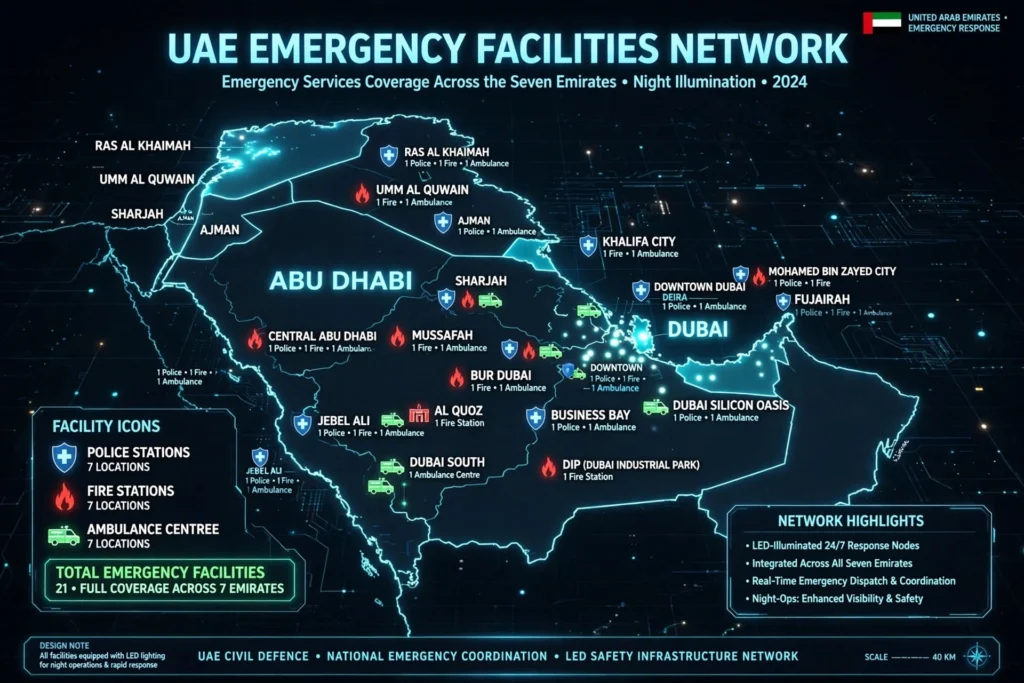
LED lighting solutions can support emergency facilities throughout Dubai, Abu Dhabi, Sharjah, Ajman, Ras Al Khaimah, Fujairah, and Umm Al Quwain.
In Dubai, facilities in areas such as Downtown Dubai, Deira, Bur Dubai, Al Quoz, Jebel Ali, Dubai South, Business Bay, Dubai Silicon Oasis, and Dubai Investment Park may have different architectural and operational conditions.
Abu Dhabi facilities in areas such as Mussafah, Khalifa City, Mohamed Bin Zayed City, and central Abu Dhabi may similarly require lighting designs adapted to building type, outdoor conditions, and operational requirements.
Sharjah and the Northern Emirates also have government facilities, fire stations, police buildings, ambulance centres, and public-service infrastructure where energy-efficient lighting can contribute to reliable building operation.
Local regulations and authority requirements should always be verified for the specific emirate and facility before procurement or installation.
How to Select LED Lighting for Emergency Service Buildings
The selection process should begin with a lighting assessment rather than simply choosing fixtures based on wattage. The assessment should consider the building layout, ceiling height, room function, occupancy patterns, existing electrical infrastructure, emergency-power strategy, maintenance requirements, and applicable regulations.
A professional lighting design can then determine the required lumen output, mounting arrangement, beam distribution, colour characteristics, controls, emergency lighting requirements, and lighting power density.
For larger facilities, a lighting simulation can help identify dark zones, excessive brightness, glare, and uniformity issues before installation.
The specification should also include product quality, warranty, driver reliability, thermal performance, ingress protection, control compatibility, and availability of replacement components.
The Role of LED Lighting in Safer and More Efficient Public Facilities
Lighting is an important part of the infrastructure supporting police stations, fire stations, ambulance centres, emergency command centres, and civil defence facilities. A well-designed LED system can combine energy efficiency with dependable illumination, appropriate visual comfort, smart controls, and long-term maintainability.
For organizations developing or upgrading emergency facilities, LED lighting emergency service buildings should be considered as part of a broader electrical and building-performance strategy rather than as an isolated product purchase.
When combined with suitable lighting controls, emergency illumination, BMS integration, energy monitoring, and professional maintenance, LED technology can help public safety facilities operate efficiently while maintaining the visibility required for staff, visitors, vehicles, and emergency operations.
The most effective solution is always application-specific. Lighting levels, emergency systems, controls, equipment specifications, and authority approvals should be determined by qualified lighting and electrical professionals according to the building’s function and applicable UAE requirements.