Dubai Marina is one of Dubai’s most recognizable high-rise districts, combining residential towers, offices, hotels, restaurants, retail spaces and waterfront developments. Commercial towers in this area operate in a demanding environment where lighting needs to support business operations, architectural appearance, energy efficiency and occupant comfort at the same time.
For offices, retail units, reception areas, corridors, parking facilities and external building spaces, LED lighting provides a practical alternative to older fluorescent, halogen and conventional discharge lighting systems. Modern LED technology can deliver consistent illumination while offering better control, longer operating life and opportunities for reducing energy consumption.
Choosing lighting for a commercial tower in Dubai Marina requires more than selecting fixtures with a high lumen output. Building layout, ceiling height, glass façades, working hours, lighting controls, colour temperature, maintenance access and the visual character of the property all need to be considered.
Why LED Lighting Is Important for Dubai Marina Commercial Towers
Commercial towers in Dubai Marina typically contain multiple areas with different lighting requirements. An office workspace needs comfortable illumination for employees, while a reception lobby may require architectural lighting that creates a stronger first impression.
Retail spaces, restaurants, meeting rooms, lift lobbies, corridors, staircases and parking areas each require their own lighting approach. A single fixture type cannot provide the best result throughout an entire building.
LED systems allow commercial property owners and facility managers to select different fixture designs, beam angles, colour temperatures and control strategies for individual spaces. This makes LED lighting suitable for both functional illumination and architectural applications.
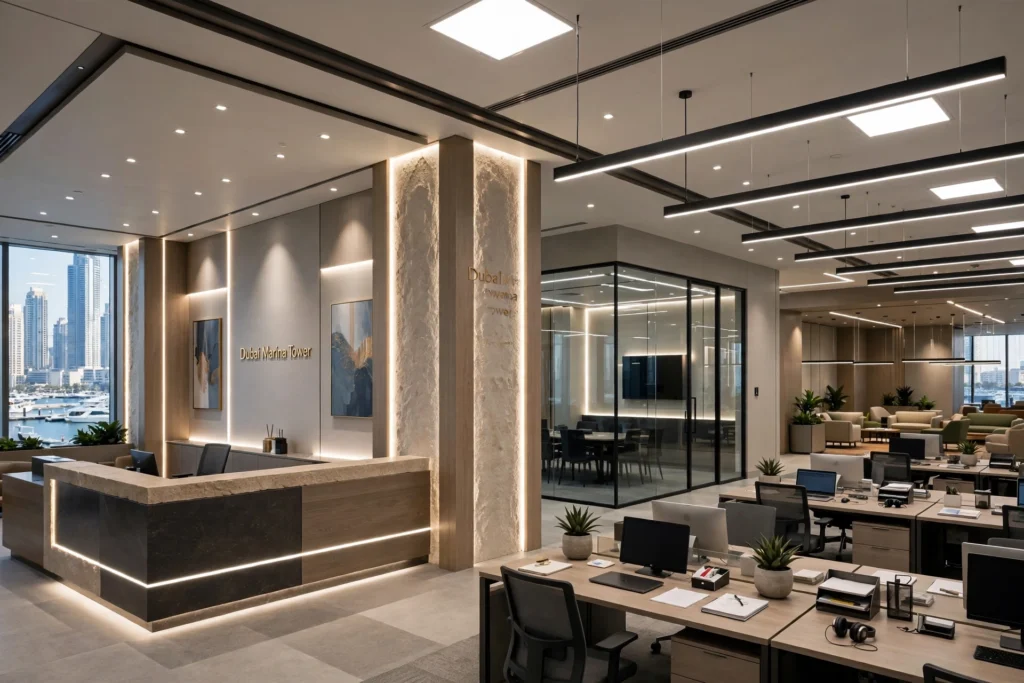
LED Office Lighting for Dubai Marina Towers
Office floors require lighting that supports concentration, computer-based work, meetings and general circulation. Excessive glare can make screens uncomfortable to view, while insufficient illumination can reduce visual comfort.
LED panel lights, recessed fixtures, linear luminaires and suspended LED systems are commonly suitable for office environments. The final selection should consider ceiling configuration, desk arrangement, natural daylight and the type of work performed.
Open-plan offices in Dubai Marina may benefit from lighting layouts that provide relatively consistent illumination across workstations while allowing meeting rooms, breakout spaces and reception areas to use different lighting levels.
LED Lighting for Reception and Lobby Areas
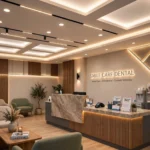
The lobby is often the first interior space visitors experience when entering a commercial tower. Lighting therefore contributes to both functionality and the building’s visual identity.
Large commercial lobbies can use recessed downlights, linear LEDs, architectural strips, wall-washing fixtures and feature lighting to highlight reception desks, columns, artwork and branded surfaces.
In Dubai Marina, where many buildings have contemporary architecture and premium interiors, lighting can be integrated into ceilings, wall panels and decorative features without creating a visually cluttered appearance.
Architectural LED Lighting for Commercial Buildings
LED technology is particularly useful for architectural lighting because fixtures are available in compact forms and can be integrated into building details.
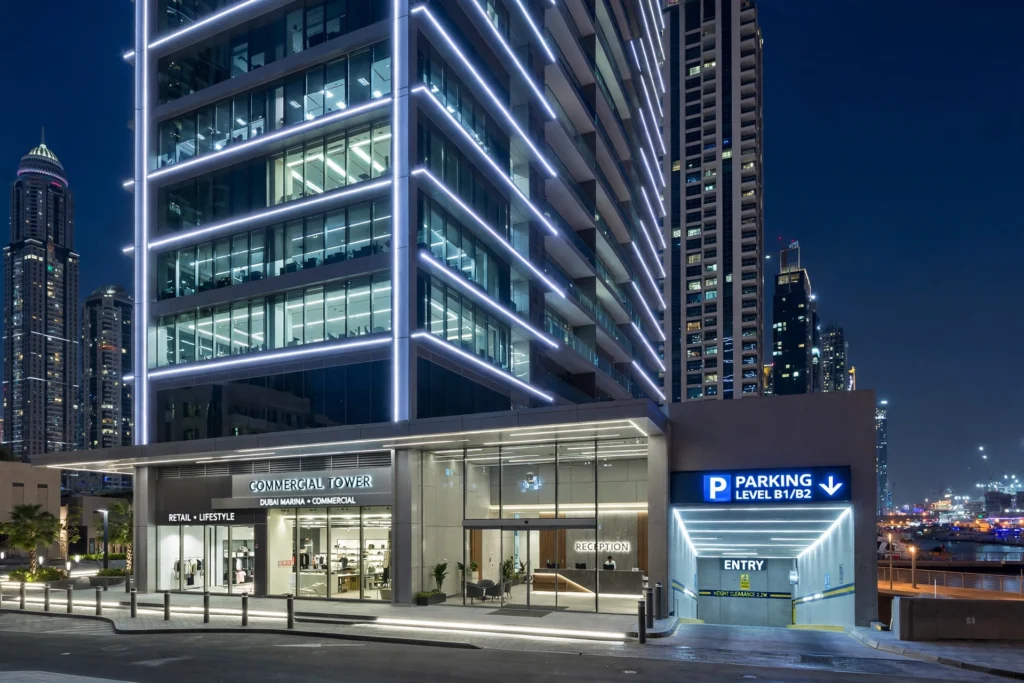
Architectural LED systems can highlight façade elements, entrance canopies, columns, signage and landscape features. Properly designed illumination can make a commercial tower visually distinctive after sunset.
However, façade lighting should be planned carefully. Excessive brightness, uncontrolled glare or poorly aimed fixtures can negatively affect neighbouring properties, pedestrians and drivers. The objective should be controlled architectural visibility rather than simply increasing brightness.
Energy Efficiency in Dubai Commercial Buildings
Lighting can represent a meaningful portion of electricity consumption in commercial properties, particularly where lights operate for long hours.
LED luminaires generally convert a greater proportion of electrical energy into usable light than older technologies. They can also be paired with occupancy sensors, daylight sensors, timers and building automation systems to reduce unnecessary operating hours.
For a commercial tower with offices operating throughout the week, even small improvements in lighting controls can become significant when applied across hundreds of fixtures.
LED Lighting and Building Management Systems
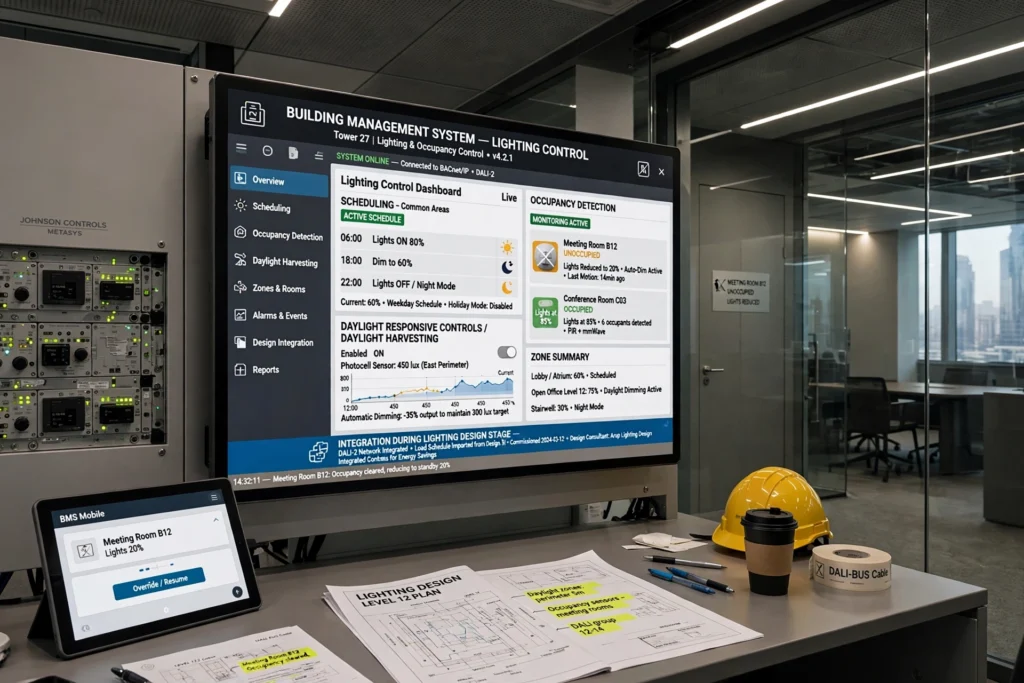
Modern commercial towers increasingly use Building Management Systems to monitor and control building services. Lighting can form part of this wider building automation strategy.
LED fixtures can work with compatible control systems to schedule lighting, adjust output, detect occupancy and integrate with other building functions.
For example, meeting rooms may automatically reduce lighting when unoccupied, while common areas can use scheduled operation. Daylight-responsive controls can also adjust artificial lighting where sufficient natural light enters through windows.
Integration should be considered during the lighting design stage rather than added as an afterthought.
Colour Temperature for Commercial Offices
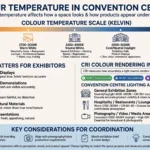
Colour temperature influences the appearance and atmosphere of a commercial space. Cool white lighting can create a crisp, energetic environment, while neutral white can provide a balanced appearance suitable for many offices.
Warm lighting may be more appropriate for hospitality areas, lounges, restaurants and certain decorative spaces.
There is no universal colour temperature for an entire commercial tower. The best approach is to select lighting according to the function of each area and maintain visual consistency within connected spaces.
LED Lighting for Dubai Marina Retail Spaces
Retail environments use lighting not only to illuminate products but also to influence customer attention and the overall shopping experience.
Track lights, adjustable spotlights, linear fixtures and accent LEDs can highlight merchandise, displays, signage and architectural details.
Colour rendering is particularly important in retail. A high-quality LED with good colour rendering can make clothing, food, cosmetics, furniture and other products appear more natural under artificial light.
Lighting should therefore be evaluated by more than wattage and brightness. Beam angle, colour rendering, glare control and fixture positioning can have a major impact on the finished environment.
LED Lighting for Restaurants and Cafés
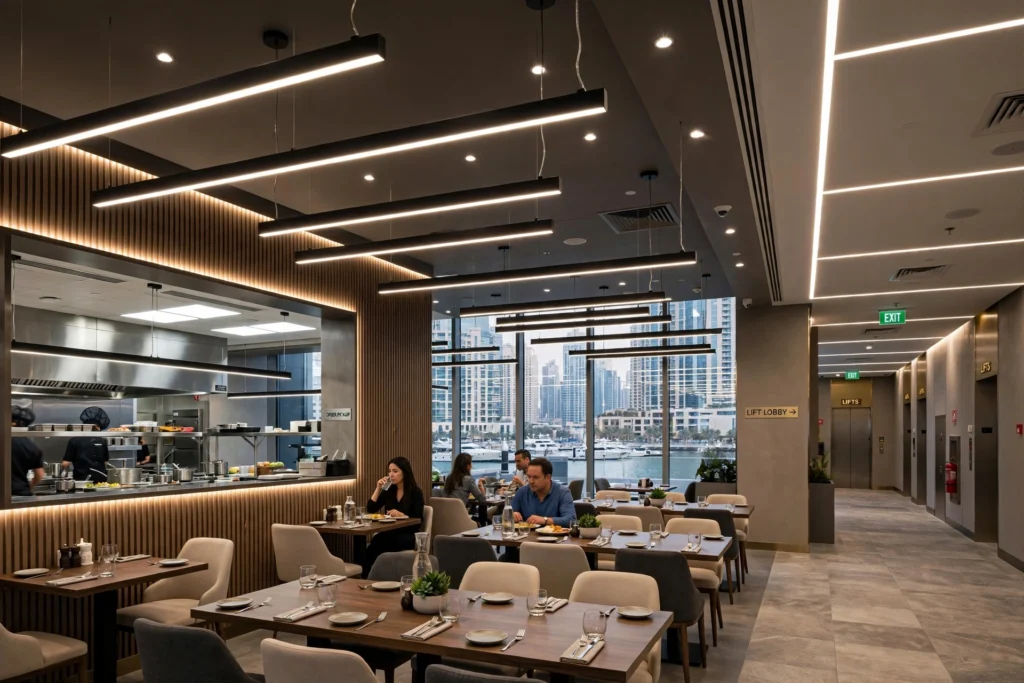
Dubai Marina has a strong hospitality presence, with restaurants and cafés operating across waterfront developments and commercial properties. Lighting can influence ambience, table visibility and customer experience.
Restaurants often benefit from layered lighting that combines general illumination with decorative and accent lighting. Pendant fixtures, recessed LEDs, wall lighting and concealed strips can create different visual zones.
Kitchen and back-of-house areas have different functional requirements from dining areas. Lighting must support safe working conditions while remaining practical to clean and maintain.
LED Lighting for Corridors and Lift Lobbies
Commercial towers contain extensive circulation areas that require reliable illumination throughout operating hours. Corridors and lift lobbies should be sufficiently illuminated for safe movement while avoiding unnecessary energy consumption.
Recessed downlights, linear LED fixtures and compact surface-mounted luminaires can be used depending on ceiling construction.
Because these areas may operate for long periods, efficiency and maintenance become particularly important. Long-life LED fixtures can reduce the frequency of lamp replacement and associated access work.
Emergency and Exit Lighting
Commercial buildings require dedicated emergency lighting and exit signage to support safe evacuation during power interruptions or emergency situations.
Emergency luminaires should be designed and installed according to the applicable building, fire-safety and electrical requirements. Battery-backed emergency LED fixtures can provide illumination when normal electrical power is unavailable.
Emergency lighting should not be treated as ordinary decorative lighting. Testing, inspection, battery condition and correct placement are important parts of ongoing facility management.
LED Lighting for Parking Areas
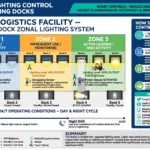
Commercial towers in Dubai Marina commonly include basement or podium parking areas. Parking facilities require lighting that provides visibility for vehicles and pedestrians while operating for extended periods.
LED high-bay fixtures, linear luminaires and parking-specific systems can provide efficient illumination across large areas. Occupancy-based controls can reduce output or switch lighting modes in areas with low activity, provided the control strategy remains appropriate for safety requirements.
Lighting should cover vehicle lanes, pedestrian routes, ramps, entrances, staircases and access points without creating excessive glare.
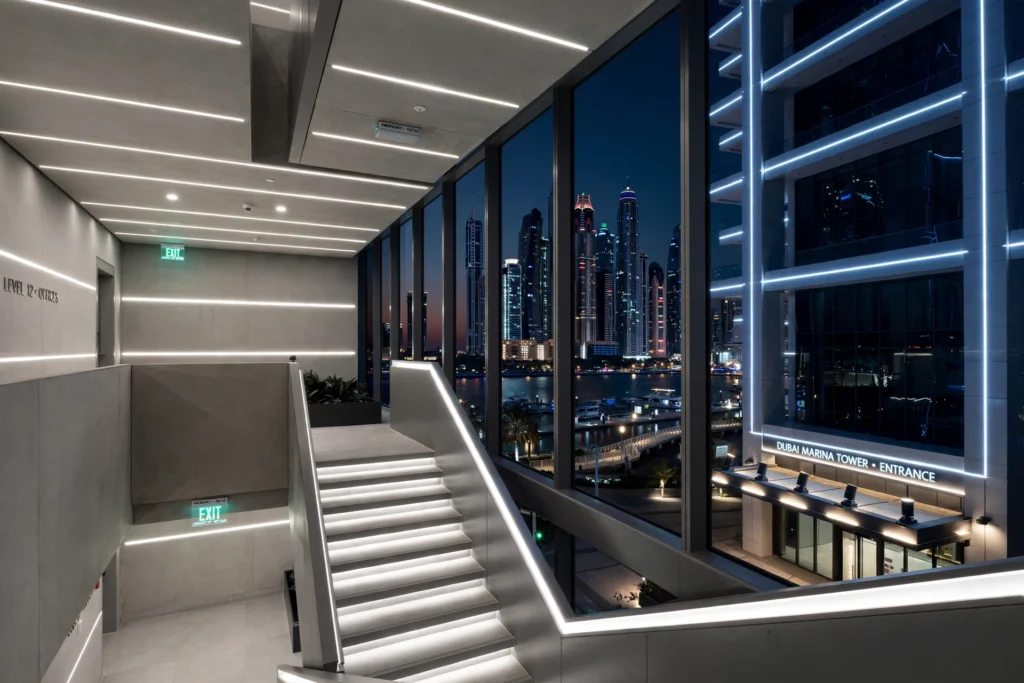
LED Lighting for Staircases
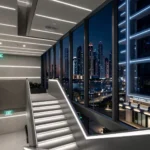
Staircases need consistent illumination because changes in visibility can increase the risk of trips and falls. LED fixtures can be installed on ceilings, walls, landings or integrated into architectural details.
The lighting design should minimise dark areas and harsh shadows, particularly around steps and landings.
Emergency illumination requirements should also be incorporated where applicable. A well-designed staircase lighting system should remain functional and easy to maintain throughout the building’s operating life.
Exterior and Façade LED Lighting
The exterior appearance of a commercial tower can be enhanced through carefully controlled LED illumination. Façade lighting may highlight architectural lines, entrance structures, signage or landscape elements.
Dubai Marina’s waterfront environment makes nighttime visual presentation particularly important for businesses that want their properties to remain visible after sunset.
However, exterior fixtures must withstand heat, humidity, dust and exposure to outdoor conditions. Appropriate IP ratings, fixture materials and installation methods should be selected according to the application.
LED Lighting and Dubai’s Climate
Dubai’s hot climate affects electrical and lighting equipment, particularly fixtures installed outdoors or in areas exposed to elevated temperatures.
Heat management is therefore an important part of LED selection. Fixture housing, heat dissipation, driver quality and installation conditions can influence long-term performance.
Outdoor fixtures should also be protected against dust and moisture where necessary. Selecting equipment based purely on appearance or initial price can lead to premature failures if environmental conditions are ignored.
Glare Control in High-Rise Offices
Commercial towers often have large windows that provide significant natural daylight. While daylight is beneficial, strong sunlight can create reflections on computer screens and increase visual discomfort.
Artificial LED lighting should complement the building’s natural light rather than competing with it. Diffusers, appropriate beam angles, fixture positioning and dimming controls can help manage glare.
Lighting layouts should also be coordinated with workstation orientation and interior blinds or shading systems.
LED Lighting for Meeting Rooms
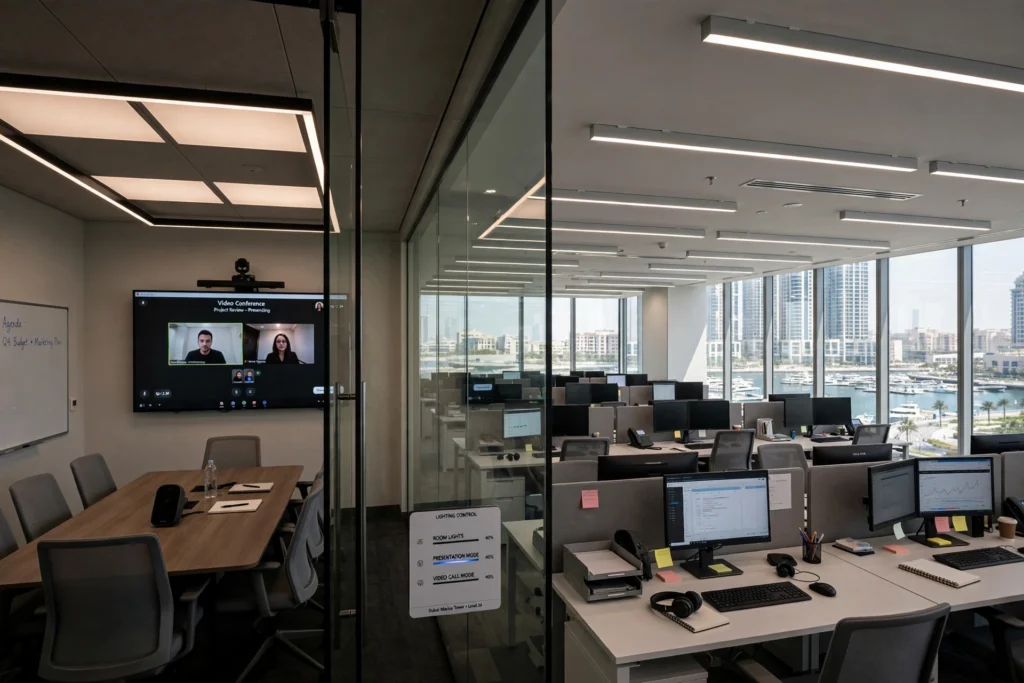
Meeting rooms require flexible lighting because they may be used for presentations, video conferences, training sessions and discussions.
A combination of general illumination and controllable accent lighting can make the space more adaptable. Dimming can be useful during presentations, while adequate facial illumination is important for video conferencing.
Lighting controls should be straightforward for occupants. Overly complicated systems can result in users leaving lights at inappropriate settings.
LED Lighting for Open-Plan Workspaces
Open-plan offices require careful spacing of luminaires to achieve consistent illumination. Fixture placement should correspond to desk layouts, partitions and circulation areas.
As office layouts change, lighting can become misaligned with workstations. Modular LED systems can make future modifications easier.
Lighting design should also account for computer monitors, reflective surfaces and natural daylight from the building façade.
LED Lighting for Commercial Signage
Signage is an important part of commercial visibility in Dubai Marina. LED modules and linear LED systems can illuminate channel letters, backlit signs, light boxes and architectural branding.
The selected LEDs should provide consistent brightness without visible hotspots. Proper power supplies and ventilation are also important for illuminated signage.
For businesses operating in commercial towers, signage lighting should complement the building rather than creating excessive brightness or visual competition with neighbouring businesses.
LED Lighting Maintenance for Commercial Towers
Even high-quality LED systems require maintenance. Dust can accumulate on fixtures, diffusers and heat-dissipation surfaces, while electrical connections and control components may require periodic inspection.
A maintenance programme should include visual inspection, cleaning, testing of controls and checking for failed or flickering fixtures.
Commercial property managers should maintain records of lighting failures and replacements. Repeated failures in the same area may indicate an underlying electrical, thermal or installation problem rather than isolated fixture defects.
Retrofitting Existing Commercial Lighting
Many Dubai commercial buildings still contain older fluorescent or conventional lighting systems. Retrofitting these areas with LED fixtures can improve efficiency and simplify maintenance.
However, replacing lamps one-for-one is not always the best solution. A lighting assessment can determine whether fixture positioning, illumination levels and controls should also be improved.
In some offices, a complete LED retrofit may allow the number of fixtures to be reduced while maintaining suitable illumination. The result depends on the existing layout and the characteristics of the replacement products.
How to Choose LED Fixtures for a Dubai Marina Tower
Fixture selection should begin with the purpose of the space. Consider the required illumination, ceiling height, mounting method, beam angle, colour temperature, colour rendering and glare control.
For outdoor applications, evaluate IP protection, environmental resistance and heat management. For interior areas, consider ceiling design, cleaning requirements and accessibility.
Commercial projects should also consider driver quality, warranty support, spare parts and long-term availability. Selecting fixtures from a reliable lighting supplier can make future replacement and maintenance considerably easier.
Why Professional LED Lighting Design Matters
A commercial tower may contain hundreds or thousands of lighting points. Small design errors can therefore become expensive when repeated throughout the building.
Professional lighting design can evaluate room dimensions, ceiling heights, surface reflectance, natural daylight, fixture spacing and control requirements before installation.
For large projects in Dubai Marina, coordination between lighting designers, electrical contractors, interior designers, facility managers and other building-services teams can reduce conflicts during installation.
LED Lighting for Dubai Marina
The right LED Lighting for Dubai Marina commercial properties should balance energy efficiency, visual comfort, architectural appearance, reliability and maintainability. A modern LED system can support office productivity, retail presentation, hospitality ambience, parking visibility and the overall identity of a high-rise commercial building.
Dubai Marina properties also need lighting systems capable of operating reliably under local environmental conditions. Equipment should therefore be selected according to its application instead of relying solely on wattage, price or appearance.
Frequently Asked Questions
Is LED lighting suitable for Dubai Marina commercial towers?
Yes. LED technology can be used across offices, retail units, restaurants, corridors, parking areas, lobbies, façades and other commercial spaces. The specific fixture should be selected according to the area’s lighting and environmental requirements.
How can LED lighting reduce energy consumption?
LED fixtures can provide efficient illumination while working with occupancy sensors, daylight controls, timers and building automation. These controls can reduce unnecessary lighting operation in low-occupancy areas.
What colour temperature is best for an office?
Neutral or cool white lighting is commonly considered for office environments, but the appropriate choice depends on the workspace, interior design, screen usage and desired atmosphere.
Can LED lighting be connected to a BMS?
Compatible LED lighting controls can be integrated with Building Management Systems. The required control protocol and hardware should be determined during the design stage.
Is LED façade lighting suitable for Dubai buildings?
Yes, provided fixtures are designed for outdoor use and selected with appropriate environmental protection, heat management and installation requirements.
How often should commercial LED lighting be maintained?
Maintenance frequency depends on the building, fixture type, operating hours and environmental conditions. Regular inspections and cleaning can help identify failures and performance issues before they become widespread.
Can old fluorescent lights be replaced with LEDs?
Yes, but the best approach depends on the existing fixture and electrical arrangement. Some systems can use retrofit solutions, while others benefit from complete fixture replacement.
Does LED lighting work well in parking areas?
LED lighting is commonly suitable for parking facilities because it can provide efficient illumination for long operating periods. Occupancy controls may also be considered where appropriate.
Final Thoughts
Lighting plays a major role in how a commercial tower operates and how visitors experience the property. In Dubai Marina, where high-rise architecture, offices, retail, hospitality and waterfront developments exist side by side, commercial lighting needs to deliver both practical performance and a strong visual presence.
A successful LED project begins with understanding the building rather than simply selecting fixtures. Office floors, lobbies, retail spaces, parking areas, façades and emergency routes all require different lighting considerations.
With appropriate fixture selection, professional installation, intelligent controls and planned maintenance, LED lighting can provide reliable illumination, support energy-management objectives and enhance the appearance of Dubai Marina commercial properties for years to come.