Convention centres and exhibition venues require lighting systems that can handle very different activities throughout the day. A large exhibition hall may host a trade show in the morning, a corporate conference in the afternoon, and an evening event requiring a completely different atmosphere. The lighting system therefore needs to support visibility, flexibility, energy management, safety, branding, and the practical requirements of exhibitors and event organisers.
LED lighting has become an important part of modern convention-centre and exhibition-venue design because LED fixtures can be selected for different areas, mounting heights, illumination requirements, and control strategies. From exhibition halls and conference rooms to registration desks, corridors, loading areas, meeting rooms, and outdoor entrances, a coordinated lighting plan can improve how visitors, exhibitors, staff, and event teams use the venue.
For venues in Dubai and across the UAE, lighting design also needs to consider long operating hours, high visitor numbers, air-conditioning loads, maintenance access, event schedules, and the expectations associated with major business and entertainment destinations.
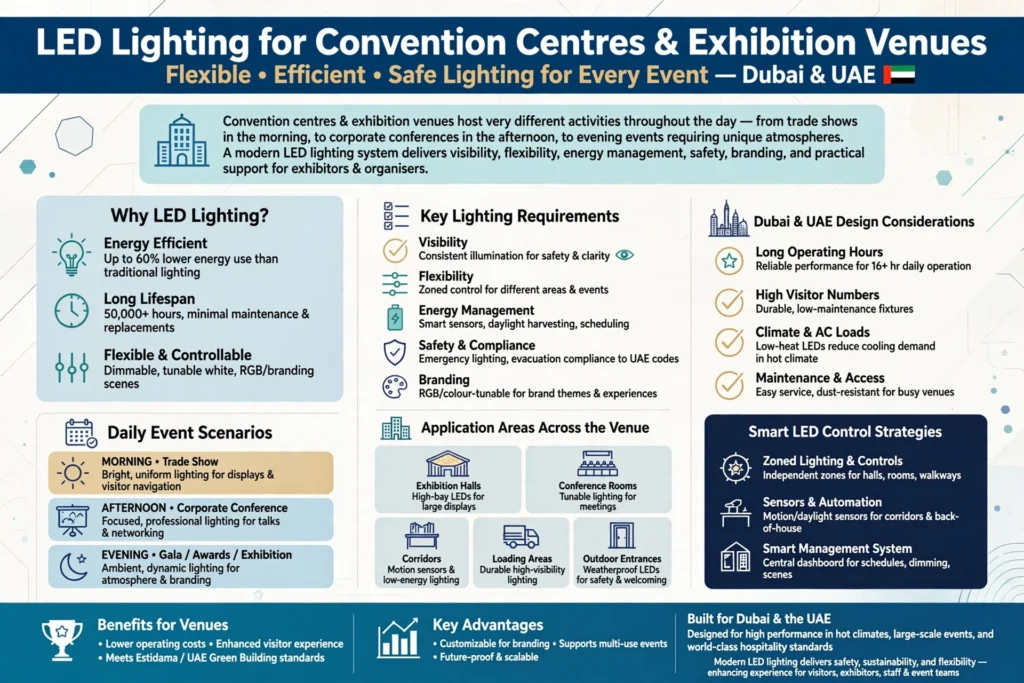
Why LED Lighting Matters in Convention Centres
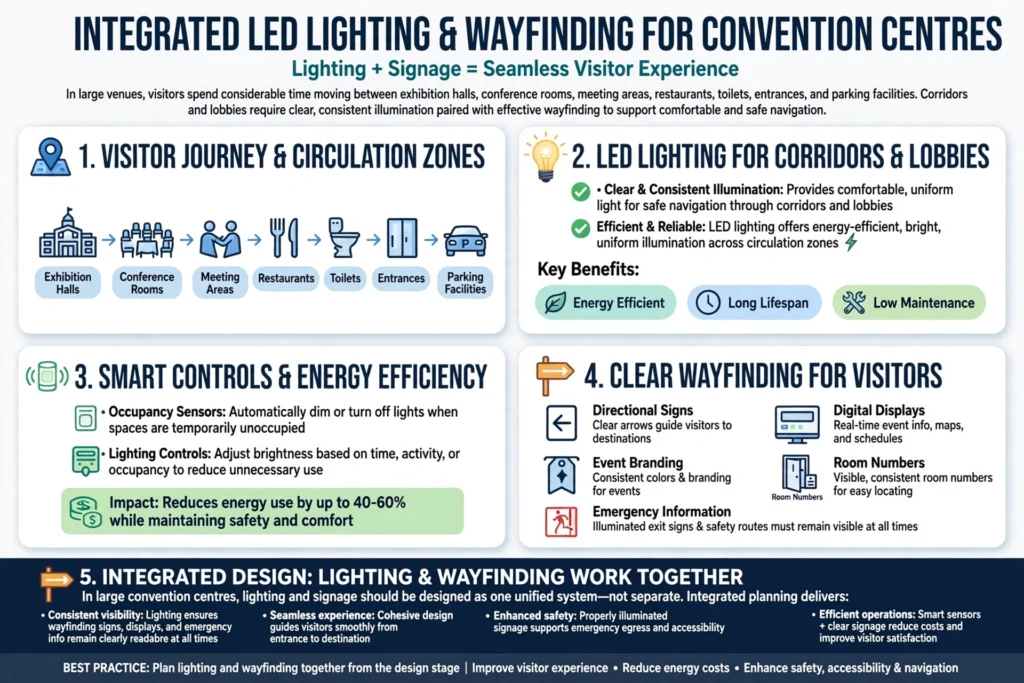
Convention centres are large, multi-purpose buildings with complex lighting requirements. Unlike a conventional office, a venue may need to accommodate thousands of visitors, temporary exhibition stands, product demonstrations, presentations, networking areas, media activity, catering operations, and large-scale events.
LED technology allows different zones to be illuminated according to their function. High-output fixtures can provide general illumination in large halls, while linear LED systems, downlights, spotlights, panels, and architectural fixtures can support specific areas.
A well-planned system can also allow operators to control lighting according to occupancy and event requirements. Exhibition halls do not necessarily need to operate at the same lighting level when they are empty as they do when an event is open to visitors.
This makes lighting control an important part of modern venue management.
Exhibition Hall Lighting
Exhibition halls are among the most demanding areas to illuminate because they typically have large floor areas and high ceilings. The lighting system needs to provide sufficient visibility across aisles, booths, walkways, signage, and service areas.
High-bay LED fixtures are commonly considered for spaces with substantial mounting heights. Their selection should be based on the hall dimensions, ceiling height, mounting position, required illumination levels, beam distribution, and the activities taking place below.
Uniformity is particularly important. Excessively bright areas next to dark sections can make navigation and visual presentation less comfortable. A properly designed layout distributes illumination across the usable floor area while reducing unnecessary glare.
Exhibition organisers may also require different lighting scenes for setup, opening hours, dismantling, cleaning, and maintenance. A controllable LED system can support these operational changes.
Lighting for Exhibition Booths
Although the venue provides general lighting, individual exhibitors often require additional illumination for their stands. Products, graphics, logos, displays, counters, and demonstration areas may each require different lighting treatments.
LED spotlights can highlight specific products, while linear LED fixtures can provide even illumination across counters or display walls. LED modules and strips can also be incorporated into custom exhibition structures.
The relationship between venue lighting and booth lighting should be considered during event planning. Excessive contrast between the hall and individual stands can affect photography, video recording, and visitor experience.
Exhibitors may also use lighting as part of their visual identity. Cool white, neutral white, or warmer lighting can be selected according to the brand, product category, and design concept.
Conference and Auditorium Lighting
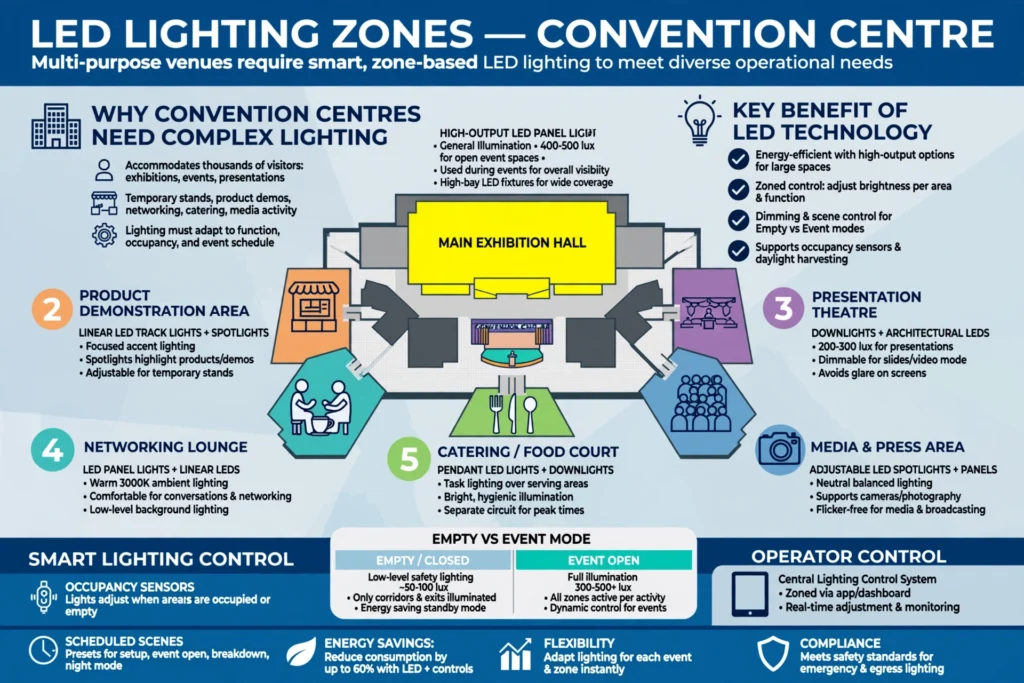
Convention centres frequently include conference rooms, auditoriums, seminar rooms, and presentation spaces. These environments require lighting that supports both audience visibility and presentation technology.
A conference room may need bright general illumination during networking sessions but lower lighting levels during presentations. A speaker on stage may require controlled illumination while projection screens or LED walls need to remain visible.
LED fixtures with appropriate dimming and control capabilities can help create different lighting scenes. This is particularly useful when a venue hosts multiple types of events throughout the year.
Lighting design should also account for glare. Poorly positioned fixtures can create reflections on presentation screens, glass surfaces, laptops, and cameras.
Stage and Event Lighting
Large conventions often combine exhibition activities with keynote speeches, award ceremonies, product launches, entertainment, and corporate presentations.
Event lighting can include stage wash lighting, accent fixtures, architectural illumination, decorative lighting, and programmable systems. These should be coordinated with the permanent building lighting so that temporary event equipment can be installed safely and efficiently.
LED technology is widely used in event environments because fixtures can provide different lighting effects while supporting flexible control. However, permanent venue lighting and specialist entertainment lighting serve different purposes and should be specified according to their intended applications.
For major events, lighting control systems can help operators create preset scenes for presentations, breaks, announcements, and closing periods.
Registration Areas and Entrance Lighting
The entrance is an important part of the visitor journey. Convention-centre entrances and registration zones need sufficient illumination for visitors to read event information, locate registration counters, identify directional signs, and move through the facility.
LED downlights, linear fixtures, pendant systems, and architectural lighting can be combined to create a welcoming entrance without compromising visibility.
Registration counters may also require additional task lighting. Event staff need to read documents, scan tickets, operate computers, issue badges, and communicate with visitors throughout long working periods.
Lighting should therefore be designed around both visitor experience and staff requirements.
Corridors, Lobbies and Circulation Areas
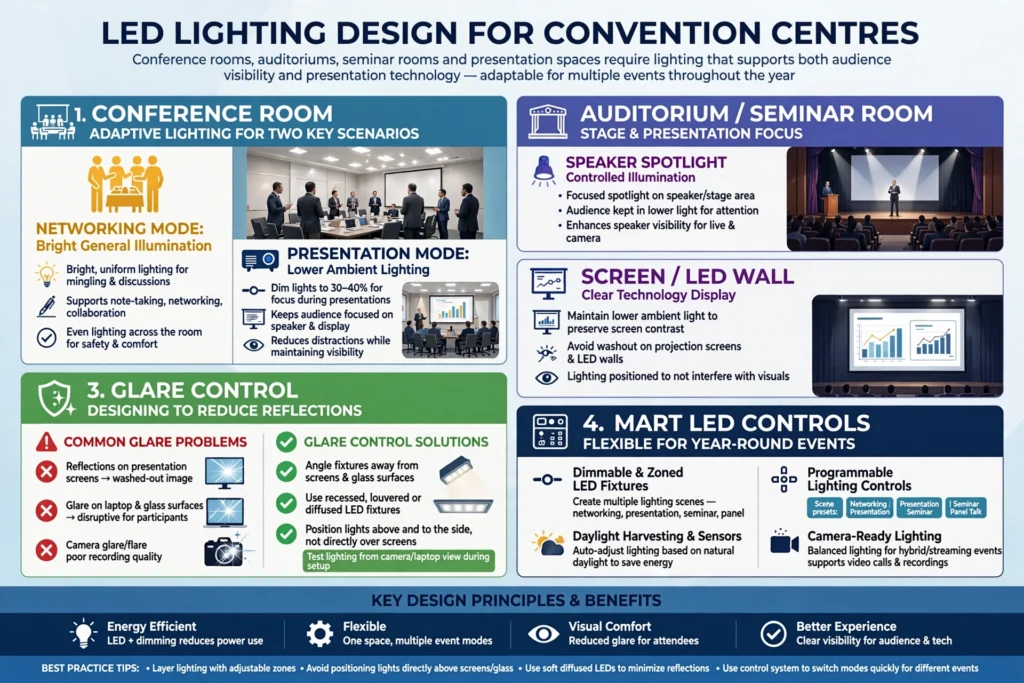
Visitors can spend considerable time moving between exhibition halls, conference rooms, meeting areas, restaurants, toilets, entrances, and parking facilities. Corridors and lobbies need clear and consistent illumination to support comfortable navigation.
LED lighting can provide efficient general illumination in these circulation zones. Occupancy sensors and lighting controls may also be used in selected areas to reduce unnecessary operation when spaces are temporarily unoccupied.
Wayfinding should be considered alongside lighting. Directional signs, digital displays, event branding, room numbers, and emergency information need to remain clearly visible.
In a large venue, lighting and signage should work together rather than being designed as separate systems.
Loading Docks and Back-of-House Areas
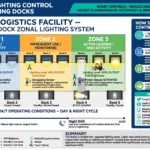
Convention centres depend heavily on back-of-house operations. Exhibitors and contractors may move exhibition materials, machinery, display structures, crates, AV equipment, and other items through loading bays and service corridors.
These areas require practical lighting designed for operational visibility. LED high-bay or industrial fixtures can be considered according to ceiling height, mounting conditions, vehicle movement, and working activities.
Loading docks may require additional attention because trucks, forklifts, contractors, and venue staff operate in the same environment. Lighting should support safe movement and visibility without creating excessive glare for drivers or operators.
Maintenance teams should also have suitable illumination around electrical rooms, plant areas, storage rooms, and technical spaces.
Emergency and Safety Lighting
Safety lighting is an essential consideration for public venues. Convention centres can accommodate large numbers of people, making clear evacuation routes and emergency information particularly important.
Emergency lighting and illuminated exit signs should be designed according to applicable building codes, fire and life-safety requirements, and local authority requirements.
Permanent general lighting and emergency lighting perform different functions. A venue should not rely on ordinary decorative or architectural fixtures as a substitute for compliant emergency systems.
Emergency luminaires should be positioned according to the approved design, particularly around exits, staircases, corridors, changes in floor level, fire equipment, and designated escape routes.
Colour Temperature for Exhibition Venues
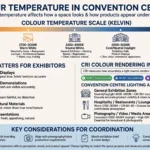
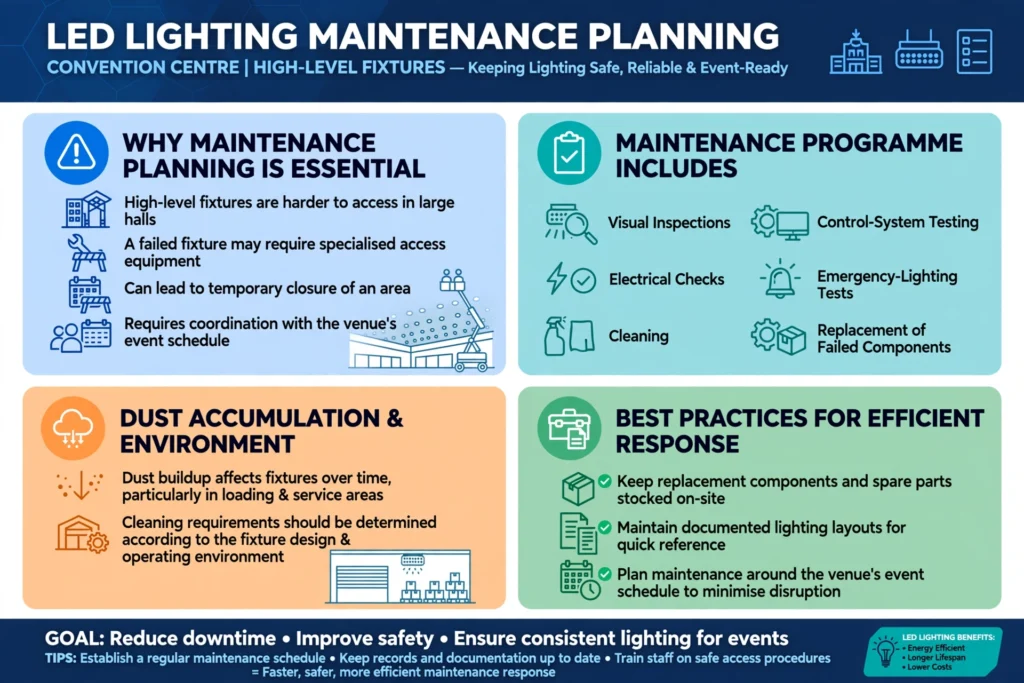
Colour temperature influences how a space looks and how products appear under artificial light. Convention centres may use different colour temperatures depending on the area and purpose.
Neutral or daylight-oriented lighting can support general exhibition environments where accurate product visibility and a clean commercial appearance are important. Warmer lighting may be appropriate for hospitality areas, restaurants, lounges, and selected architectural spaces.
The choice should be coordinated with exhibition requirements, interior finishes, branding, photography, video production, and event design.
For exhibitors, consistent colour rendering can also matter. Product demonstrations, fashion displays, artwork, architectural materials, and food presentations can all respond differently to lighting.
Energy Efficiency in Large Venues
Convention centres can operate for long hours and contain thousands of lighting fixtures. Energy consumption can therefore become a significant operational consideration.
LED lighting can help reduce energy demand compared with older lighting technologies, but actual savings depend on fixture efficiency, operating schedules, controls, maintenance, and the existing system being replaced.
Lighting controls can provide additional opportunities. Occupancy sensors, scheduling, dimming, daylight-responsive controls, and central building-management integration can allow lighting to operate according to actual requirements.
For a large exhibition hall, even small reductions in unnecessary operating hours can become significant when applied across a large number of fixtures.
Smart Lighting and Building Management Systems
Modern convention facilities increasingly integrate lighting with building management systems (BMS). A central control platform can provide operators with information about lighting zones and allow scheduled operation.
Integration can support event-based lighting schedules. For example, a hall can have one scene during setup, another during visitor hours, and another during overnight maintenance.
BMS integration can also allow lighting to work alongside HVAC, occupancy management, energy monitoring, and other building services.
The exact control architecture depends on the venue’s infrastructure and the selected equipment. Lighting control should be planned during the design stage rather than treated as an afterthought.
LED Lighting and Digital Displays
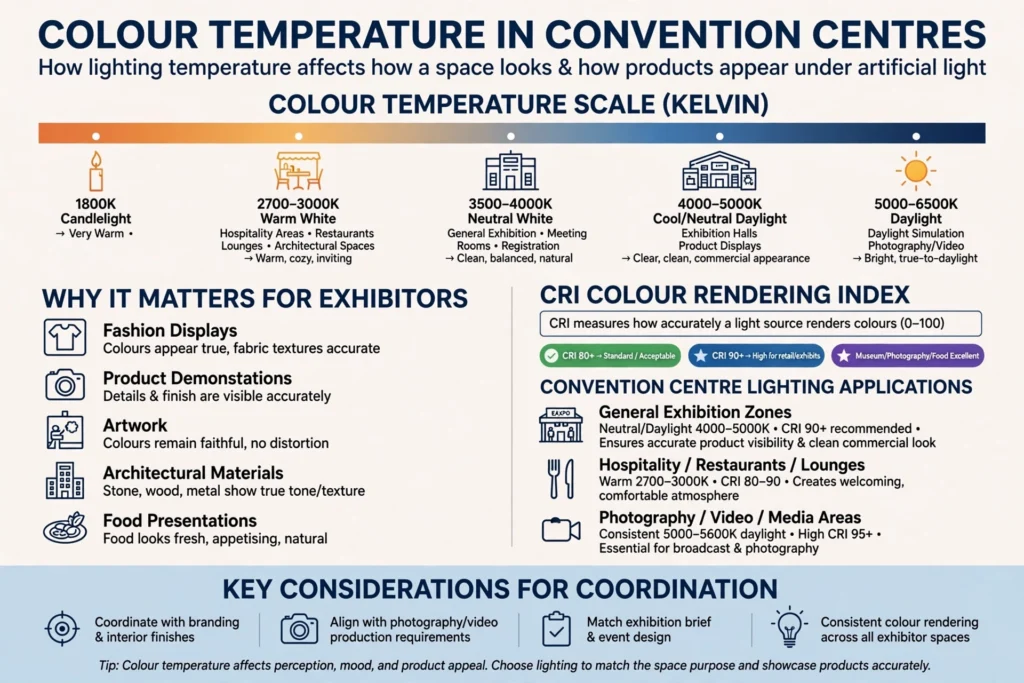
Modern exhibitions frequently combine physical displays with digital signage, LED video walls, interactive screens, and projection systems. Lighting needs to complement these technologies.
Excessive ambient illumination can affect the perceived contrast of some digital displays, while poorly positioned spotlights can create reflections on screens.
A coordinated design can create appropriate visual hierarchy between the exhibition booth, digital content, product displays, and surrounding architecture.
This is particularly relevant at technology exhibitions, corporate events, product launches, and trade shows where large LED screens are often central to the visitor experience.
Lighting for Photography and Video
Convention centres are increasingly used for media production, interviews, product launches, livestreams, and social-media content. Lighting therefore needs to consider cameras as well as human vision.
Flicker, colour consistency, glare, reflections, and uneven illumination can affect photographs and video footage. Venue operators should discuss media requirements with lighting designers when planning major upgrades.
Event organisers may also install temporary production lighting. Permanent LED systems should be coordinated with these temporary systems to avoid unnecessary conflicts.
Architectural and Feature Lighting
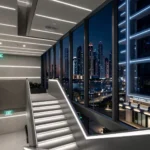
Beyond functional illumination, architectural lighting can help establish the identity of a convention centre. Feature ceilings, columns, entrances, staircases, reception walls, and architectural details can be highlighted using LED technology.
Linear LED fixtures, wall washers, recessed fixtures, accent lights, and concealed LED systems can create visual interest without compromising the primary lighting function.
In premium venues, architectural lighting may also change according to events, seasons, exhibitions, or corporate branding.
Programmable systems can provide additional flexibility, although controls should remain straightforward enough for venue operators to manage effectively.
LED Lighting for Dubai Convention Centres
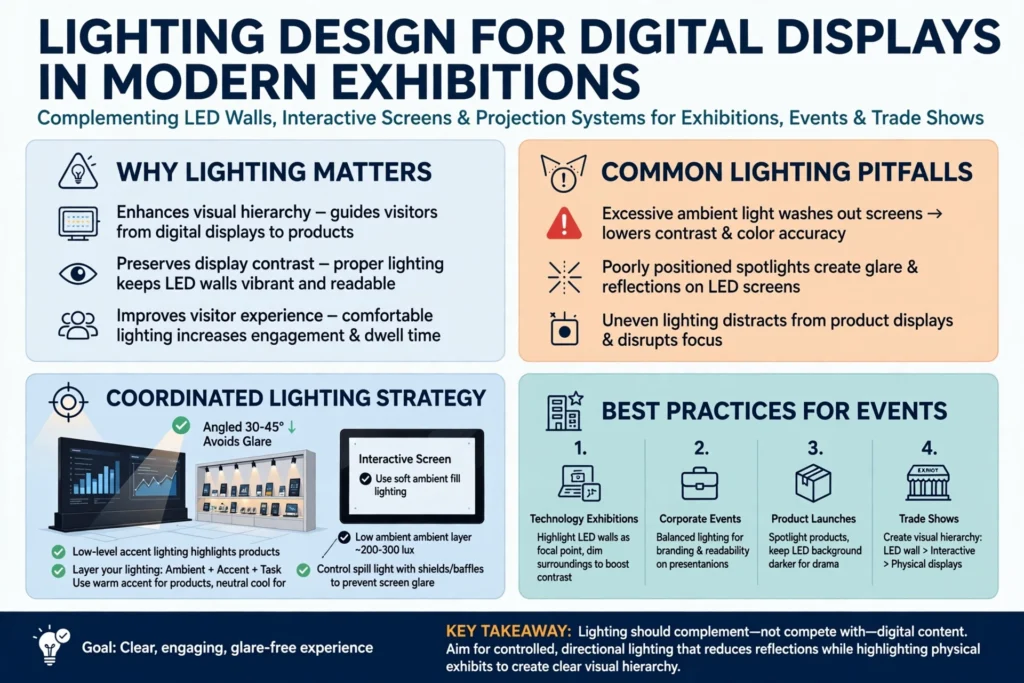
Dubai is an international business, tourism, exhibition, and events destination, with venues serving conferences, trade shows, product launches, government events, corporate meetings, and international exhibitions.
Facilities around areas such as Dubai World Trade Centre, Dubai International Convention and Exhibition Centre, Expo City Dubai, Dubai Marina, Business Bay, Downtown Dubai, and surrounding commercial districts may have different architectural and operational requirements.
Lighting systems in these environments need to support high visitor volumes, long operating periods, temporary event installations, and demanding maintenance schedules.
The UAE climate also makes environmental considerations important. Equipment located in loading areas, entrances, parking zones, or semi-outdoor spaces should be selected according to the conditions where it will operate.
Lighting for Abu Dhabi Exhibition Venues
Abu Dhabi also has major venues supporting exhibitions, conferences, government events, corporate functions, and international trade activities.
Facilities such as Abu Dhabi National Exhibition Centre (ADNEC) serve a wide range of event requirements, making adaptable lighting important.
Lighting designs for Abu Dhabi venues should similarly consider large exhibition halls, conference rooms, hospitality areas, entrances, service areas, and event infrastructure.
The exact lighting specification should be developed according to the venue’s architecture, applicable regulations, operating requirements, and event programme.
Selecting an LED Lighting Supplier
Selecting lighting equipment for a convention centre is different from choosing fixtures for a small commercial space. The supplier should understand the technical and operational requirements of large-scale projects.
A professional LED Lighting for Convention Centre Supplier can support projects involving exhibition halls, conference facilities, high-bay lighting, architectural illumination, emergency lighting, retail-style displays, and event environments.
Before purchasing, project teams should evaluate fixture specifications, lumen output, efficacy, colour temperature, colour rendering, beam angle, dimming capability, control compatibility, operating temperature, ingress protection where applicable, warranty conditions, and maintenance requirements.
Exact specifications should always be checked against the manufacturer’s current technical documentation.
Maintenance of Convention Centre LED Lighting
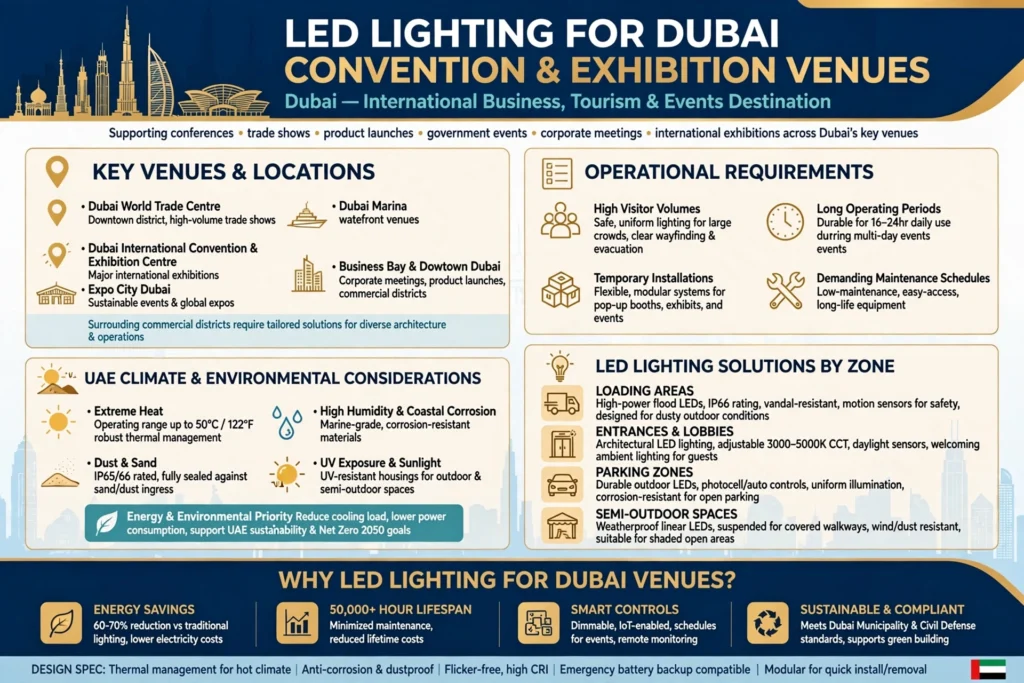
Maintenance planning is essential because access to high-level fixtures can be more complicated in large halls. A failed fixture may require specialised access equipment, temporary closure of an area, or coordination with the venue’s event schedule.
A maintenance programme can include visual inspections, electrical checks, cleaning, control-system testing, emergency-lighting tests, and replacement of failed components.
Dust accumulation can affect fixtures over time, particularly in loading and service areas. Cleaning requirements should be determined according to the fixture design and operating environment.
Keeping replacement components and documented lighting layouts available can also help maintenance teams respond more efficiently.
How to Plan a Convention Centre Lighting Upgrade
A lighting upgrade should begin with an assessment of the existing system. The project team can review fixture types, energy consumption, operating hours, maintenance records, illumination levels, control systems, and areas where users experience lighting problems.
The next stage is to identify the requirements of each zone. Exhibition halls, conference rooms, entrances, corridors, loading areas, offices, hospitality spaces, and technical rooms may require different lighting solutions.
A lighting layout can then be developed around mounting heights, fixture spacing, beam distribution, required illumination, control zones, and electrical infrastructure.
Where possible, a representative area can be tested before a complete venue-wide installation. This allows stakeholders to assess illumination quality, glare, colour appearance, and operational controls.
Conclusion
LED lighting for convention centres and exhibition venues needs to balance visibility, flexibility, energy management, safety, aesthetics, and long-term maintenance. Large venues require different lighting solutions for exhibition halls, conference rooms, stage areas, entrances, corridors, loading docks, meeting rooms, hospitality zones, and emergency routes.
In Dubai and Abu Dhabi, these requirements are particularly relevant to venues serving international exhibitions, corporate events, conferences, trade shows, and large public gatherings.
A successful lighting project begins with understanding how each space is used. High-bay fixtures, LED panels, linear lighting, spotlights, architectural LEDs, emergency luminaires, lighting controls, and BMS integration can then be selected according to the actual requirements of the facility.
For venue owners, facility managers, exhibition organisers, and contractors, investing in a properly planned LED lighting system can create a more adaptable and manageable environment while supporting the operational demands of modern convention and exhibition facilities.