Resort landscape LED lighting plays an important role in creating attractive outdoor environments, improving nighttime visibility, and enhancing the guest experience. From luxury beachfront resorts and desert retreats to golf resorts, landscaped gardens, swimming pools, and outdoor dining areas, a well-designed lighting system helps hospitality properties remain welcoming, functional, and visually appealing after sunset.
In the United Arab Emirates, landscape lighting is especially important because resorts operate in environments influenced by high daytime temperatures, intense sunlight, dust, humidity, and, in coastal locations, salt-laden air. Choosing the right LED landscape lights helps hotels and resorts illuminate pathways, palm trees, water features, outdoor lounges, terraces, and architectural details while managing energy consumption and maintenance requirements.
Modern resort landscape lighting combines LED technology, architectural lighting, smart controls, glare management, weather-resistant fixtures, and carefully planned illumination levels. The objective is not simply to make an outdoor area brighter. It is to create a comfortable atmosphere that complements the landscape, supports safe movement, and reflects the resort’s brand identity.
What Is Resort Landscape LED Lighting?
Resort landscape LED lighting refers to the use of light-emitting diode (LED) fixtures to illuminate outdoor spaces within hospitality properties. These systems may include garden lights, pathway bollards, in-ground uplights, tree spotlights, wall washers, underwater lights, step lights, deck lights, and architectural floodlights.
Unlike basic outdoor illumination, resort landscape lighting is planned around the guest journey. Lighting designers consider how visitors arrive at the property, walk through landscaped gardens, approach restaurants, relax beside swimming pools, and move between villas or accommodation buildings.
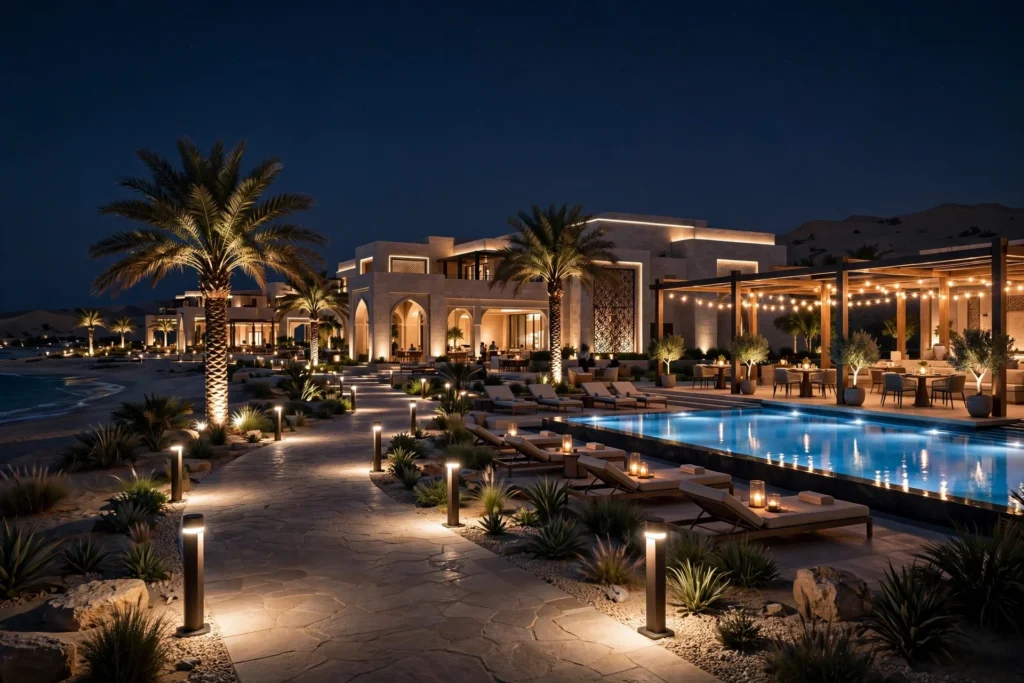
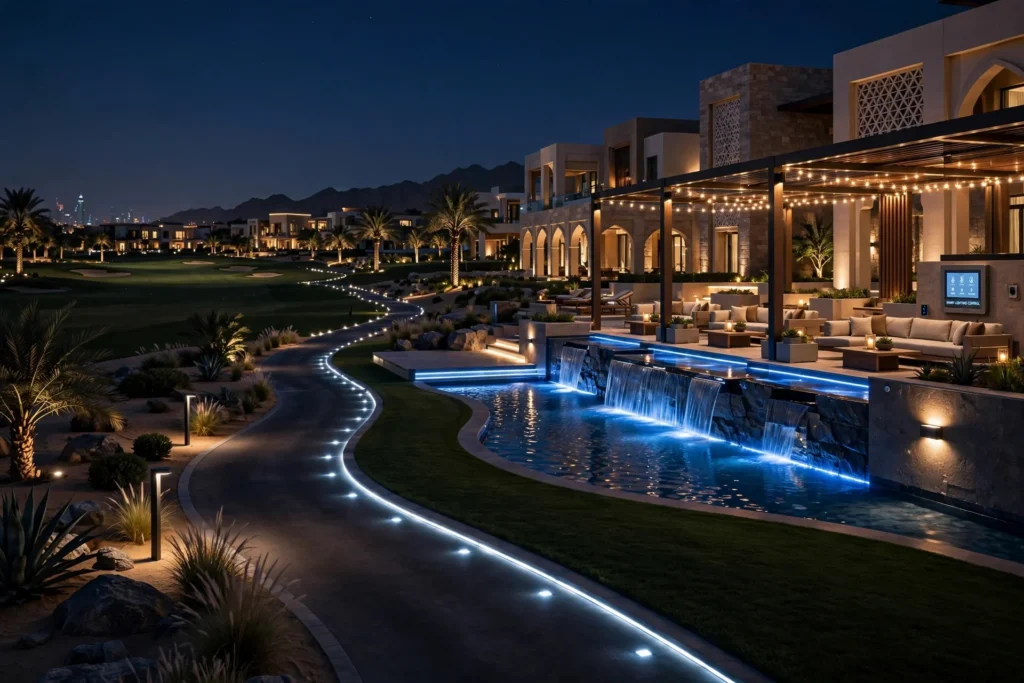
For example, a luxury resort in Dubai may use warm-white LED uplights to highlight date palms, low-level bollard lights along garden paths, concealed linear lighting beneath outdoor seating, and controlled façade lighting to emphasize architectural features.
Each fixture serves a specific purpose. Combining these elements creates visual depth without making the landscape look excessively bright or cluttered.
Why Landscape Lighting Matters for Resorts
Outdoor spaces are a major part of the hospitality experience. Guests may use gardens, terraces, pool decks, outdoor restaurants, walking trails, and landscaped courtyards well into the evening.
Without appropriate lighting, these areas may become difficult to navigate and lose much of their visual appeal after sunset. A carefully planned LED lighting system allows resorts to make better use of their outdoor facilities while creating distinct atmospheres for different activities.
Landscape lighting can also strengthen a property’s identity. A beachfront resort may emphasize palm trees, water reflections, and coastal pathways, while a desert resort may use subtle illumination to complement natural stone, sand-coloured architecture, and native vegetation.
For hospitality operators in Dubai, Abu Dhabi, Ras Al Khaimah, and Fujairah, effective outdoor lighting can support guest comfort, evening dining, leisure activities, and the overall presentation of the property.
Benefits of LED Lighting for Resort Landscapes
Lower Energy Consumption
LED lighting is widely used in hospitality projects because it can deliver useful illumination with relatively low electricity consumption compared with many traditional lighting technologies. Actual savings depend on the existing fixtures, required light output, operating hours, control strategy, and installation design.
Resorts often have extensive outdoor areas containing dozens or hundreds of lighting fixtures. Pathways, gardens, parking areas, poolside zones, façades, and outdoor restaurants may require lighting every evening.
Replacing inefficient fixtures with appropriately specified LEDs can reduce the electricity required to provide the desired illumination. Timers, astronomical time switches, occupancy sensors in suitable areas, and dimming controls can further reduce unnecessary operation.
Longer Service Life and Reduced Maintenance
Outdoor lighting maintenance can be expensive when fixtures are installed across large landscaped grounds. Replacing lamps in tall palm trees, maintaining fittings beside water features, or accessing lights in difficult-to-reach locations may require specialist equipment and labour.
Quality LED fixtures can offer long service life when they are correctly selected, installed, and operated within their rated conditions. Their lifespan depends on factors such as driver quality, junction temperature, moisture protection, electrical supply, and thermal management.
For resorts, durable fixtures and accessible installation details can reduce maintenance visits and help keep landscaped areas consistently illuminated.
Better Control of Light Colour and Intensity
LED technology offers a wide choice of colour temperatures, beam angles, optical distributions, and dimming capabilities.
Warm-white lighting can create a relaxing atmosphere around resort gardens, villas, outdoor lounges, and restaurants. Neutral-white lighting may be suitable for certain service areas and functional routes where clear visibility is important.
Different beam angles allow designers to highlight a palm tree, illuminate a pathway, wash a wall, or distribute light across a wider outdoor area.
Selecting the correct light distribution is particularly important because excessive brightness can cause glare, disturb guests, and reduce the visibility of surrounding landscape features.
Lighting Resort Gardens and Landscaped Areas
Gardens often form the visual centre of a resort’s outdoor environment. They may contain ornamental plants, mature trees, flower beds, stone features, sculptures, and decorative water elements.
LED landscape lighting can highlight these features while preserving a natural appearance. Narrow-beam spotlights can accent individual trees, while wider-beam fixtures can illuminate planting beds or create a gentle wash across a textured wall.
Ground-mounted uplights are frequently used to illuminate palm trunks and tree canopies. However, the fixture should be positioned carefully to avoid glare into guest rooms, outdoor seating areas, or neighbouring properties.
Garden lighting should also account for plant growth. A fixture that illuminates a small shrub today may become obstructed as the vegetation develops. Accessible mounting positions and adjustable optics make future maintenance easier.
In UAE resorts, designers should consider local plant species, irrigation systems, soil conditions, and exposure to dust when choosing fixture locations and enclosures.
LED Pathway Lighting for Guest Safety
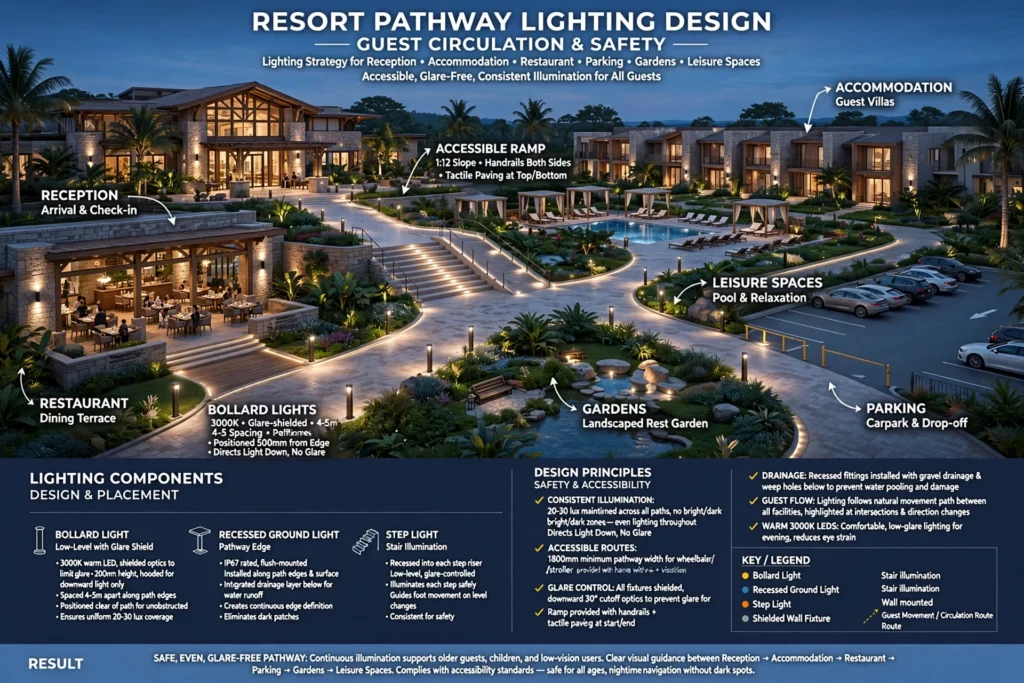
Pathway lighting helps guests move between reception areas, accommodation, restaurants, parking facilities, gardens, and leisure spaces.
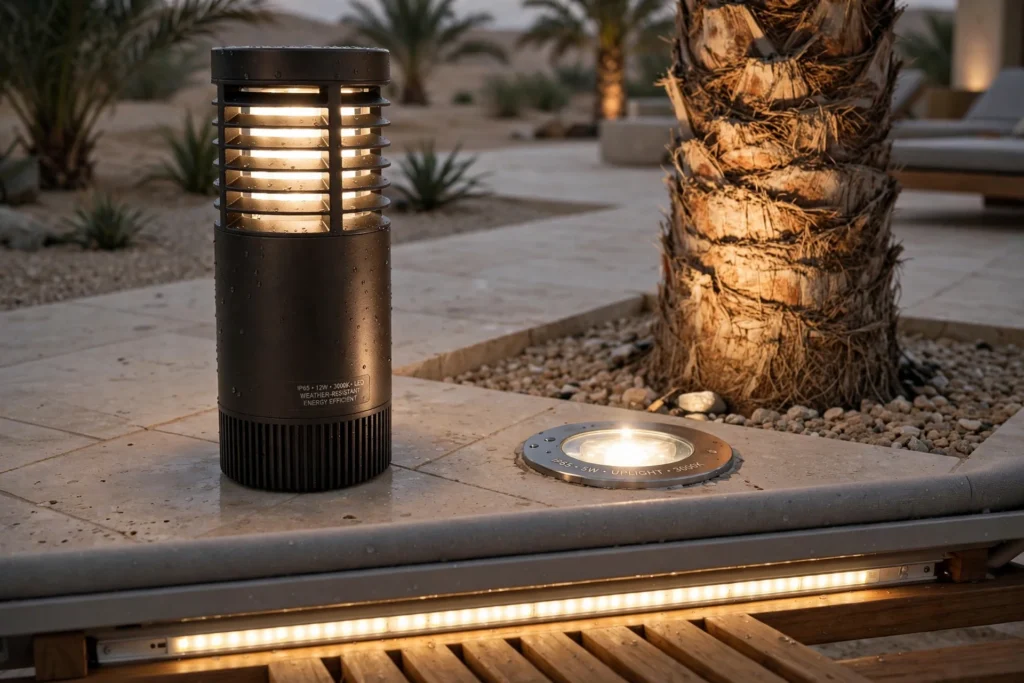
Low-level bollard lights, recessed ground lights, step lights, and shielded wall fixtures can provide useful illumination without overwhelming the landscape.
A good design emphasizes changes in level, steps, ramps, pathway edges, intersections, and transitions between different surfaces. Lighting should be distributed consistently enough to help guests recognize the route ahead without creating distracting bright and dark patches.
Bollard lights should be positioned to limit glare and avoid obstructing pedestrian movement. Recessed fittings require suitable drainage and installation details to prevent standing water from affecting the equipment.
Resorts should also consider accessibility requirements and the needs of older guests, children, and people with reduced vision. The appropriate illumination levels should be established through a lighting design that reflects the local requirements and the intended use of each pathway.
Palm Tree and Architectural Feature Lighting
Palm trees are prominent landscape features at many UAE resorts. Illuminating their trunks and canopies can create a recognizable tropical or coastal atmosphere, particularly around hotel entrances, courtyards, pools, and outdoor restaurants.
LED spotlights can be positioned at the base of selected trees, with beam angles chosen to match trunk height and canopy shape. The objective is to emphasize the tree’s natural form rather than produce an excessively bright or flat appearance.
Architectural features may include entrance portals, stone walls, columns, pergolas, decorative screens, and façade details. LED wall washers, linear fixtures, and adjustable spotlights can emphasize texture and create visual separation between buildings and surrounding greenery.
Care should be taken to avoid unnecessary light spill into guest rooms and the night sky. Shielded optics, careful aiming, and appropriate dimming help preserve the intended atmosphere.
Swimming Pool and Water Feature Lighting
Swimming pools, fountains, reflecting ponds, and decorative water features can become focal points in resort landscapes after dark.
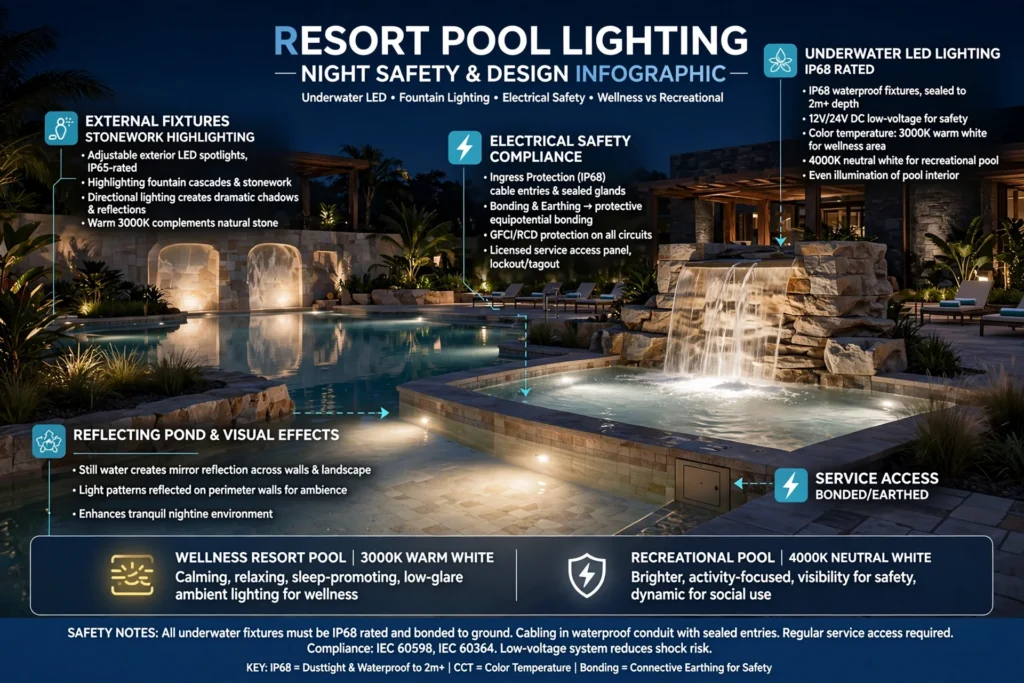
Underwater LED lights can illuminate pool interiors, while carefully positioned external fixtures can highlight fountains, cascades, and surrounding stonework. Reflections may also create attractive visual effects across nearby walls and landscaped surfaces.
Water-related lighting requires particular attention to electrical safety. Fixtures must be specifically rated for the intended underwater or wet-location application, and the installation must follow applicable electrical regulations and manufacturer instructions.
Designers should consider suitable ingress protection, cable entries, bonding and earthing arrangements where applicable, protective electrical devices, and access for servicing. Underwater fittings should never be treated as ordinary outdoor lights.
The colour temperature and brightness should also complement the pool’s finish, surrounding materials, and intended atmosphere. A quiet wellness resort may benefit from subtle white lighting, while a recreational pool may use a different lighting approach appropriate to the activity.
Outdoor Restaurants, Terraces and Lounge Areas
Outdoor dining and lounge spaces require lighting that supports both comfort and functionality. Guests should be able to see menus, food, table settings, and walking routes without experiencing harsh glare.
Warm-white LED downlights, wall lights, concealed linear lighting, pendant fixtures designed for outdoor use, and carefully shielded landscape lights can create a welcoming environment.
The lighting design should distinguish between task lighting and ambient lighting. Tables may require enough illumination for dining, while surrounding planting and architectural features can remain softly lit.
Dimmable systems are particularly useful for restaurants that serve breakfast, lunch, and dinner outdoors. Lighting scenes can be adjusted for different service periods, private events, and special occasions.
For coastal resorts, fixtures should be selected according to their exposure to humidity, wind-driven rain, and salt-laden air. Suitable corrosion-resistant materials and maintenance procedures can help preserve appearance and performance.
Choosing the Right LED Colour Temperature
Colour temperature, measured in kelvins (K), influences how outdoor spaces look and feel.
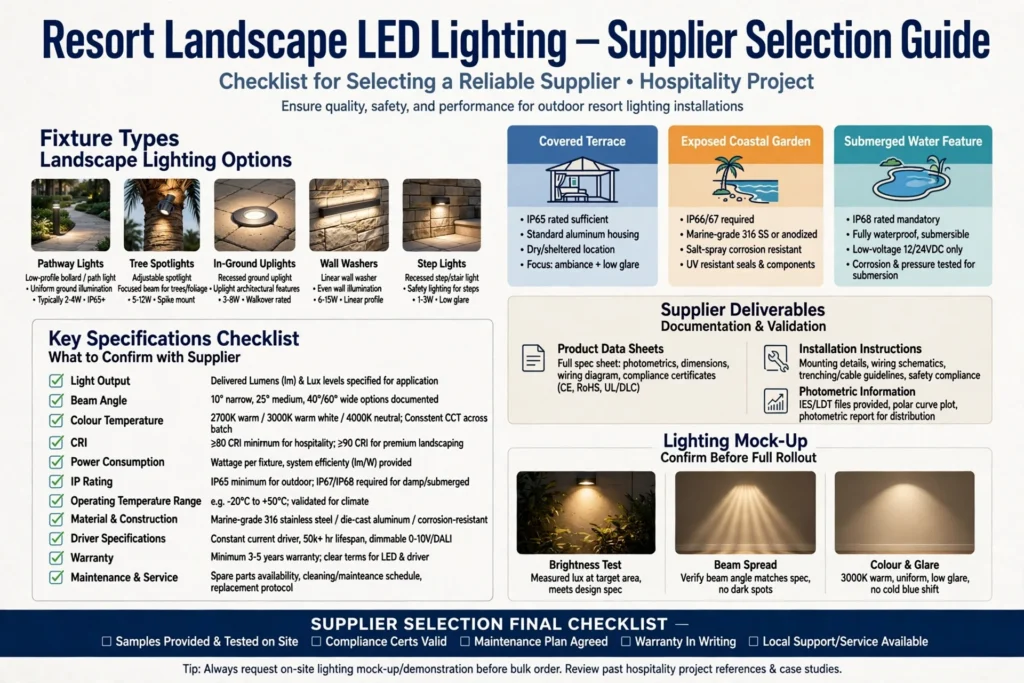
Warm-white lighting, commonly around 2700K to 3000K, is often suitable for resort gardens, outdoor restaurants, villas, and relaxation areas. It can complement timber, beige stone, natural textures, and warm architectural finishes.
Neutral-white lighting, often around 3500K to 4000K, may suit selected functional areas where a more neutral appearance is preferred. The appropriate choice depends on the landscape materials, surrounding lighting, visual task, and design concept.
Using too many unrelated colour temperatures across one property can make the landscape feel inconsistent. Resorts should establish a lighting palette that connects pathways, gardens, façades, dining areas, and guest facilities.
Colour rendering is another important consideration. A suitable colour rendering index (CRI) helps plants, food, materials, and architectural finishes appear more natural. Fixture selection should consider the actual lighting application rather than relying on colour temperature alone.
Weatherproofing and Durability in the UAE Climate
Outdoor LED lighting in the UAE must be selected for the conditions in which it will operate.
High ambient temperatures can affect LED drivers and electronic components. Dust may accumulate on lenses and heat-dissipation surfaces, while irrigation water and humidity can create moisture-related problems. Coastal resorts may also experience salt exposure that accelerates corrosion in unsuitable materials.
The IP rating indicates protection against the ingress of solid objects and water under defined test conditions. The required rating depends on the installation location, including whether the fixture is sheltered, exposed to rain, installed in the ground, or submerged.
IP ratings alone do not establish suitability for every environment. Material quality, corrosion resistance, operating temperature range, UV resistance, cable glands, seals, drainage, and installation workmanship also matter.
Resorts near the Arabian Gulf, including coastal properties in Dubai, Abu Dhabi, and Ras Al Khaimah, should pay particular attention to corrosion resistance and manufacturer guidance for marine or salt-exposed environments.
Smart Lighting Controls for Resort Landscapes
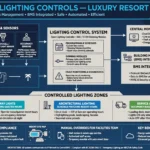
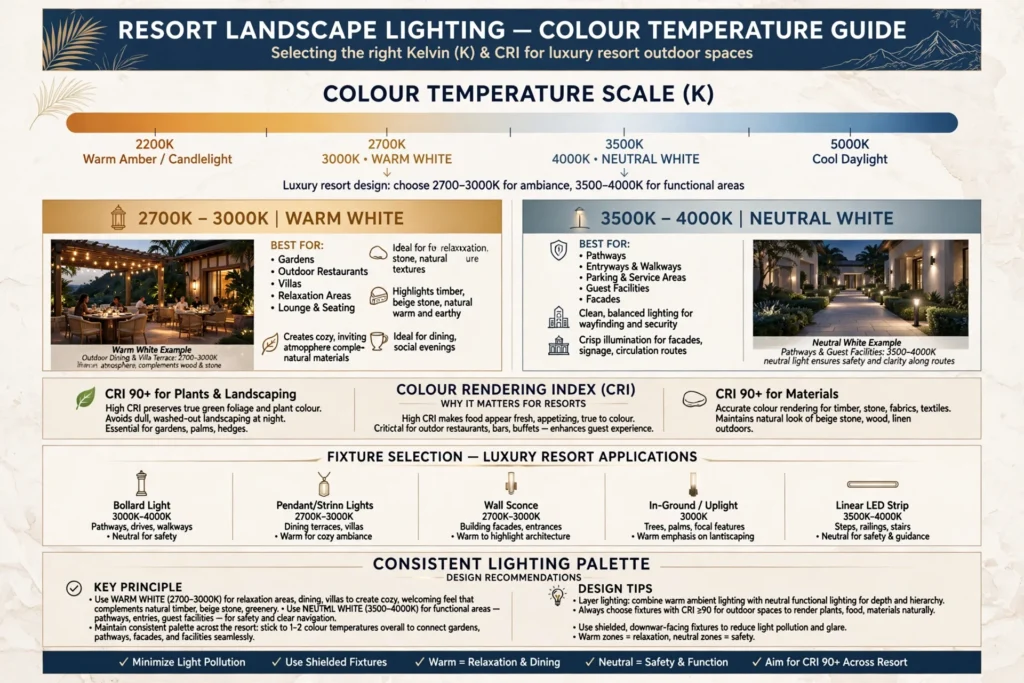
Smart lighting controls help hospitality operators manage large outdoor lighting installations more efficiently.
A control system may use astronomical time clocks, programmable schedules, dimming modules, photocells, occupancy sensors, or integration with a building management system (BMS). The most suitable solution depends on the size of the property, the lighting infrastructure, and operational requirements.
For example, pathway lights may operate at a normal evening level and dim during quieter hours where safe and appropriate. Architectural lighting can follow a schedule that matches the resort’s operating hours, while service areas can use occupancy-based controls when suitable.
Larger resorts may integrate lighting with central monitoring platforms to simplify scheduling and identify equipment faults. However, controls should be designed to remain practical for the facilities team, with manual overrides and clear procedures for maintenance.
Automation should never compromise safe circulation, emergency lighting requirements, or the visibility needed in operational areas.
Reducing Light Pollution and Protecting the Night Environment
Good landscape lighting is not about illuminating every surface. Excessive outdoor light can cause glare, spill into guest rooms, disturb nearby properties, and affect wildlife.
Resorts should use fixtures with suitable shielding and optical distributions, direct light toward the intended surfaces, and avoid unnecessary upward illumination. Dimming and scheduling can reduce light levels when outdoor spaces are less active.
Properties near desert habitats, beaches, or environmentally sensitive landscapes should consider the effects of artificial light on nocturnal wildlife. Sea turtle nesting areas, where relevant, may require specialist lighting measures that follow local environmental guidance.
A well-designed scheme uses light selectively. Highlighting a few important trees, pathways, and architectural elements can create a more refined atmosphere than illuminating the entire landscape at maximum brightness.
Energy Efficiency and Return on Investment
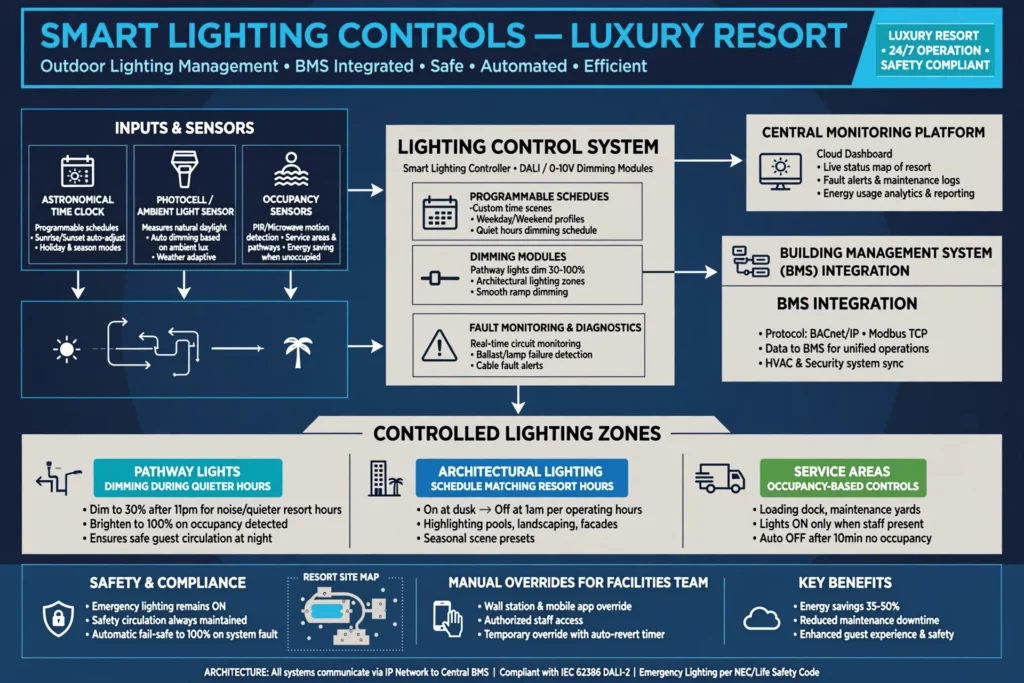
The financial value of resort landscape LED lighting depends on the installation’s size, existing technology, operating schedule, electricity tariff, maintenance costs, and control strategy.
A useful assessment compares the energy consumption of the existing system with the proposed LED solution. It should also account for driver efficiency, actual operating hours, dimming behaviour, and any additional controls.
Maintenance savings may contribute to the return on investment, particularly where existing lamps require frequent replacement or access equipment. However, the savings should be calculated using realistic service-life assumptions and local labour costs.
Resorts can prioritize upgrades in high-use areas, such as entrance drives, pathways, pool decks, and outdoor restaurants, before moving to less frequently used landscape zones. This phased approach can help distribute capital expenditure while improving the guest experience.
An effective lighting plan considers the total cost of ownership rather than comparing fixtures by purchase price alone.
Resort Landscape LED Lighting in Dubai and Across the UAE
The UAE’s hospitality sector includes beachfront resorts, desert retreats, luxury hotels, golf properties, wellness resorts, and urban hospitality developments. Each environment has different lighting requirements.
In Dubai, landscaped hospitality properties around Palm Jumeirah, Dubai Marina, Jumeirah Beach, Downtown Dubai, and Dubai Creek Harbour may require coordinated lighting for gardens, arrival areas, outdoor dining, water features, and architectural façades.
Abu Dhabi properties around Saadiyat Island, Yas Island, and the wider coastal area may need lighting schemes that balance guest comfort, architectural design, coastal exposure, and environmental considerations.
In Ras Al Khaimah and Fujairah, resorts surrounded by mountains, beaches, or natural landscapes may prioritize pathway visibility, low-glare lighting, and durable fixtures suited to local environmental conditions.
Properties in Sharjah and other emirates can also benefit from LED landscape lighting designed around their specific landscape, operating hours, and maintenance requirements. The correct design should reflect the property’s actual site conditions rather than apply the same fixture specification everywhere.
How to Choose a Resort Landscape LED Lighting Supplier
Selecting the right supplier is important for achieving a reliable and visually consistent installation. Hospitality projects may involve many fixture types, different mounting methods, control systems, and environmental requirements.
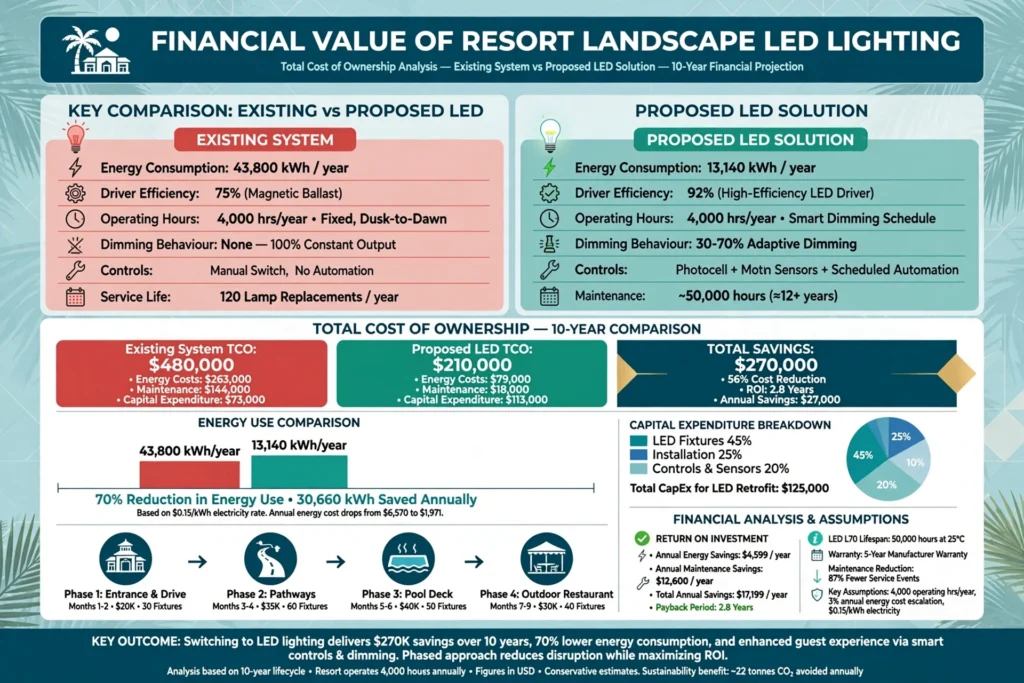
A suitable supplier should be able to help specify pathway lights, tree spotlights, in-ground uplights, wall washers, step lights, and other outdoor fixtures according to the project requirements.
Before making a selection, confirm the fixture’s light output, beam angle, colour temperature, CRI, power consumption, IP rating, operating temperature range, material construction, driver specifications, warranty, and maintenance arrangements.
The supplier should also consider the installation environment. A fixture intended for a covered terrace may not be appropriate for an exposed coastal garden or a submerged water feature.
For a hospitality project, working with a Resort Landscape LED Lighting Supplier can help coordinate product selection with the lighting design, environmental conditions, energy targets, and maintenance requirements.
Where possible, request product data sheets, installation instructions, photometric information, and sample fixtures for review before finalizing a large order. A lighting mock-up can help confirm brightness, beam spread, colour appearance, and glare before installation across the entire property.
Installation and Maintenance Best Practices
Correct installation is essential to the performance and service life of resort landscape LED lighting.
Fixtures should be mounted according to the manufacturer’s instructions, with suitable cable protection, electrical connections, drainage, and access for maintenance. Underground and in-ground installations need particular care because water accumulation, soil conditions, and irrigation systems can affect performance.
Outdoor electrical work should be performed by qualified professionals in accordance with applicable local requirements. Pool and underwater lighting must follow the specific electrical safety requirements for those environments.
After installation, establish a maintenance schedule that includes cleaning lenses, checking seals and cable entries, inspecting corrosion, verifying aiming, testing controls, and checking for damaged fixtures.
Vegetation should also be managed so that growing branches and leaves do not block light or create unwanted shadows. Periodic night-time inspections help identify glare, uneven illumination, failed fittings, and areas that need adjustment.
A documented maintenance plan can help facilities teams maintain consistent lighting while reducing unexpected failures.
Final Thoughts
Resort landscape LED lighting combines energy-efficient technology, outdoor durability, architectural enhancement, and guest-focused design. When correctly planned, it can make gardens, pathways, palm trees, pool areas, outdoor restaurants, and resort entrances more attractive and functional after sunset.
The most effective systems balance visual impact with glare control, suitable colour temperatures, environmental protection, smart controls, and practical maintenance. In the UAE, careful fixture selection is especially important because heat, dust, humidity, irrigation, and coastal conditions can influence outdoor lighting performance.
For resort owners, developers, hospitality operators, landscape architects, and lighting consultants, the best solution is one that fits the property’s design, supports safe movement, manages operating costs, and remains reliable over time.
A coordinated LED landscape lighting strategy can help create memorable outdoor spaces while supporting energy management and the long-term performance of the resort’s lighting infrastructure.