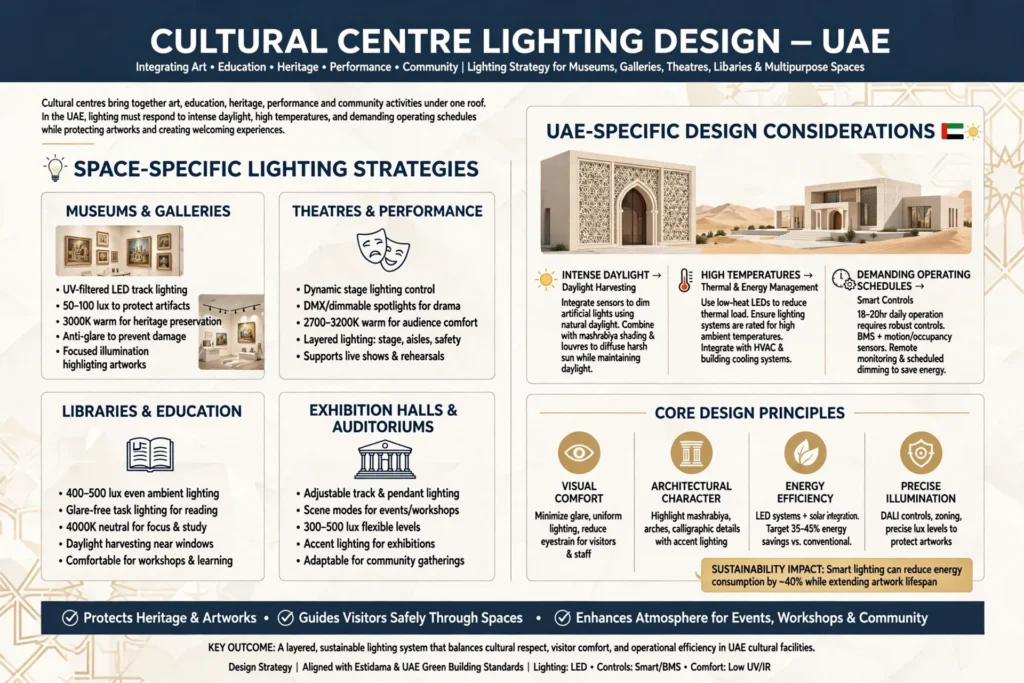
Cultural centres bring together art, education, heritage, performance and community activities under one roof. From museums and galleries to theatres, libraries, exhibition halls and multipurpose auditoriums, each space requires a different lighting strategy. Effective cultural centre lighting design combines visual comfort, architectural character, energy efficiency and precise illumination to create environments that support visitors while protecting artworks and improving the overall experience.
In the UAE, cultural facilities also need to respond to local architectural styles, intense daylight, high temperatures and demanding operating schedules. A carefully planned lighting system can highlight architectural details, guide visitors through the building and create the right atmosphere for exhibitions, performances, workshops and public events.
What Is Cultural Centre Lighting Design?
Cultural centre lighting design is the planned use of ambient, accent, architectural, decorative and task lighting throughout a cultural facility. The objective is not simply to make rooms bright. Lighting needs to respond to the purpose of each area, the materials used in the interior, visitor movement, artwork protection requirements, architectural features and the activities taking place.
A successful design may combine LED downlights, linear lighting, track lights, wall washers, spotlights, recessed fixtures, pendant luminaires, facade lighting and intelligent lighting controls. These systems can work together to create different lighting scenes for exhibitions, performances, conferences, educational programmes and evening events.
Why Lighting Matters in Cultural Centres
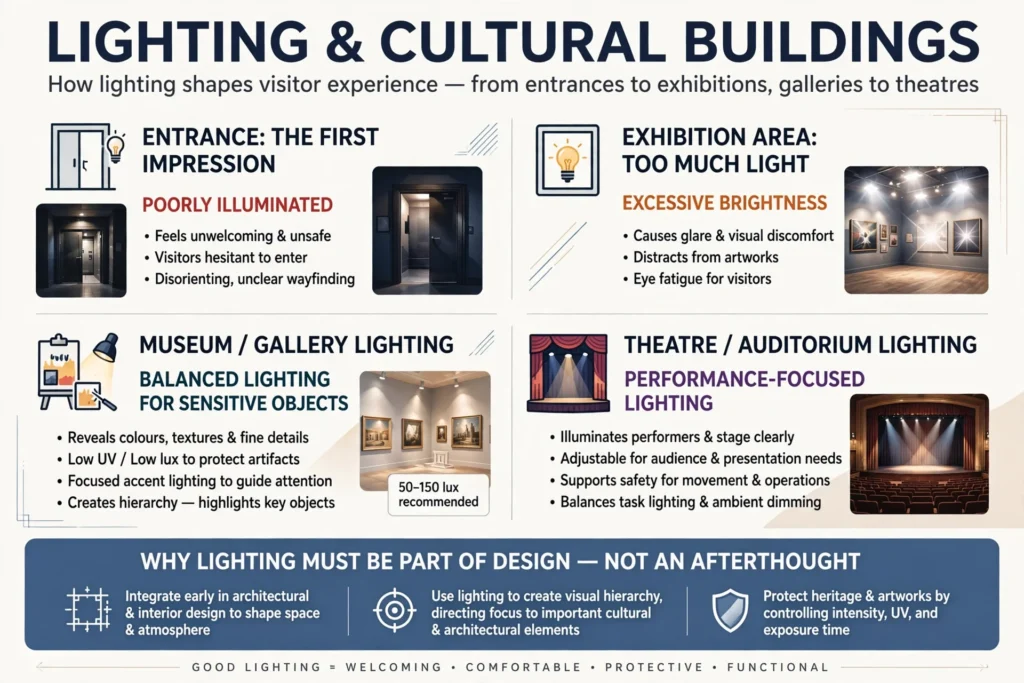
Lighting has a direct influence on how visitors perceive a cultural building. A poorly illuminated entrance can feel unwelcoming, while excessive brightness in an exhibition area can reduce visual comfort and distract from artworks. Good lighting creates hierarchy by directing attention toward important architectural and cultural elements.
In a museum or gallery, lighting must reveal colours, textures and details without unnecessarily exposing sensitive objects to high levels of illumination. In a theatre or auditorium, the requirements are different because lighting needs to support performers, audiences, stage operations and presentations.
For this reason, lighting should be considered during architectural and interior design rather than treated as a final electrical installation.
Layered Lighting for Cultural Facilities
Layered lighting is one of the most effective approaches for cultural centre interiors. It combines several lighting types so that the facility can respond to different activities and moods.
Ambient lighting provides general illumination for circulation areas, lobbies, classrooms, offices and public spaces. Accent lighting creates visual emphasis around artworks, displays, sculptures and architectural features. Task lighting provides focused illumination for reading areas, workshops, reception counters and educational spaces.
Architectural lighting can reveal columns, arches, textured walls, ceilings and other design elements. Decorative lighting can then contribute to the identity of the cultural centre while providing additional visual interest.
Combining these layers allows operators to reduce or increase individual lighting components instead of illuminating the entire building at the same intensity.
Entrance and Reception Lighting
The entrance is the first point of visual contact between visitors and a cultural centre. Lighting should establish a clear transition between the exterior and interior while making entrances, reception desks and information points easy to identify.
Linear LED lighting can emphasise architectural lines, while recessed downlights can provide comfortable general illumination. Wall washing can highlight feature walls or cultural artwork without creating excessive glare.
At entrances exposed to strong UAE sunlight, lighting design should also consider the transition between outdoor brightness and indoor illumination. A controlled lighting environment can make the transition more comfortable for visitors entering the building.
Museum and Gallery Lighting
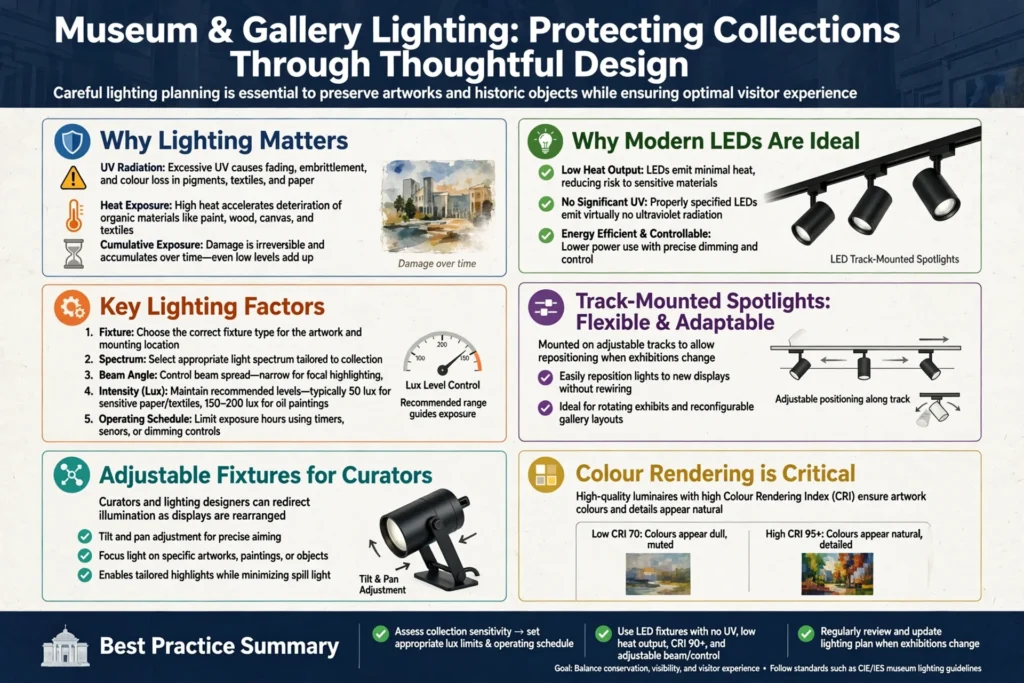
Museum and gallery lighting requires particularly careful planning because artworks and historic objects can be sensitive to light exposure. Excessive ultraviolet radiation, heat and cumulative exposure can contribute to deterioration of certain materials.
Modern LED luminaires are often suitable because they can provide controlled illumination with low heat output and no significant ultraviolet emission when appropriately specified. However, the correct fixture, spectrum, beam angle, intensity and operating schedule still need to be selected according to the collection.
Track-mounted spotlights provide flexibility because exhibitions can change over time. Adjustable fixtures allow curators and lighting designers to redirect illumination when displays are rearranged.
Colour rendering is also important. High-quality luminaires with appropriate colour-rendering performance can help visitors see artwork colours and material details more naturally.
Exhibition Hall Lighting
Exhibition halls frequently host temporary displays, trade exhibitions, cultural programmes and travelling collections. Their lighting systems therefore need to be flexible.
A combination of track lighting and general ambient illumination can provide a practical solution. Track-mounted fixtures can be moved or adjusted as exhibition layouts change, reducing the need for major electrical modifications.
Dimming capability is particularly valuable. Different exhibitions may require different illumination levels, and event organisers may need separate lighting scenes for visitor hours, installation periods and evening functions.
Auditorium and Theatre Lighting
Auditoriums and theatres have some of the most technically demanding lighting requirements within cultural facilities. The lighting system may need to support audience seating, stage areas, backstage spaces, entrances, emergency routes and presentations.
Audience lighting should provide sufficient visibility without distracting from the stage. Step lights and aisle lighting can improve circulation and safety while maintaining a subdued atmosphere during performances.
Stage environments require specialist theatrical lighting equipment and control systems. These may include profile fixtures, Fresnel fixtures, moving lights, LED stage fixtures and programmable control consoles.
For multipurpose cultural centres, lighting controls should allow the auditorium to transition between theatre performances, conferences, lectures, film screenings and community events.
Library and Reading Area Lighting
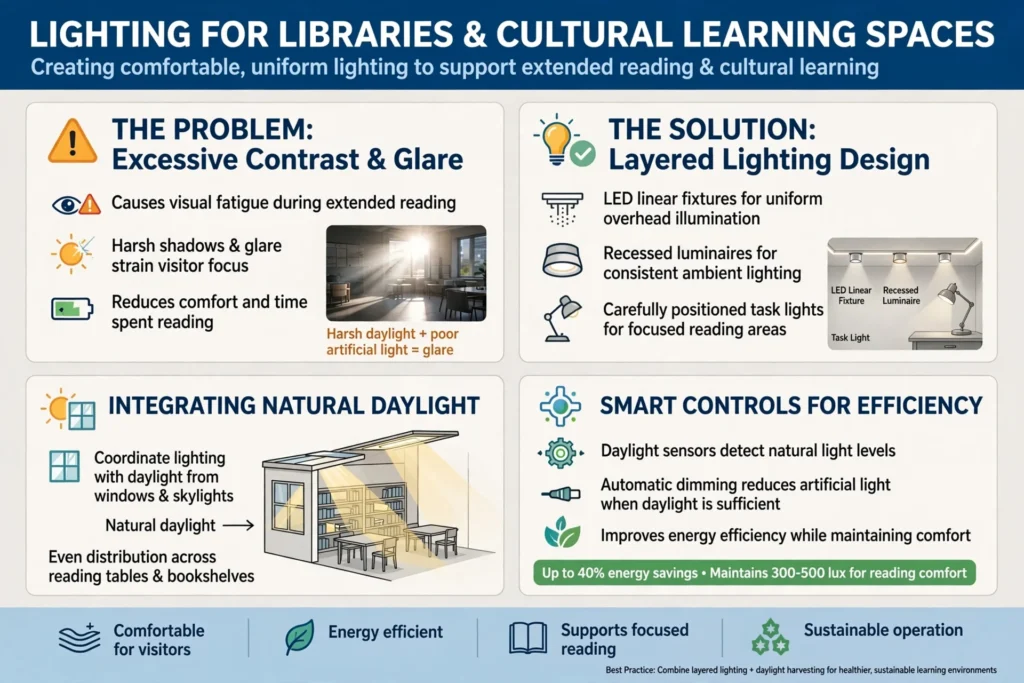
Libraries and cultural learning spaces require comfortable, uniform lighting. Excessive contrast and glare can cause visual fatigue when visitors read for extended periods.
LED linear fixtures, recessed luminaires and carefully positioned task lights can create even illumination across reading tables and shelves. Lighting should also be coordinated with daylight entering through windows and skylights.
In modern cultural centres, daylight sensors and dimming controls can reduce artificial lighting when natural light provides sufficient illumination. This can improve energy efficiency while maintaining comfortable reading conditions.
Multipurpose Hall Lighting
Many cultural centres contain multipurpose halls used for workshops, seminars, exhibitions, community meetings and public events. A fixed lighting arrangement may not be suitable because every activity has different requirements.
A flexible lighting system with multiple circuits, dimming zones and programmable scenes allows the room to be quickly adapted. General lighting can be used for workshops, softer illumination for cultural events and presentation-focused lighting for seminars.
Lighting controls can also allow facility managers to operate different areas independently, reducing unnecessary energy consumption.
Architectural Lighting for Cultural Buildings
Architectural lighting can transform the appearance of a cultural centre after sunset. It can highlight building geometry, entrances, columns, arches, courtyards, screens and distinctive facade materials.
Facade lighting should be designed carefully so that architectural features are enhanced without creating excessive glare or unwanted light spill. Wall grazing can reveal textured surfaces, while wall washing provides a more uniform appearance.
In the UAE, architectural lighting is particularly valuable for cultural buildings that operate into the evening. The lighting can help create a recognizable nighttime identity while complementing the surrounding urban environment.
Heritage and Traditional Architecture Lighting
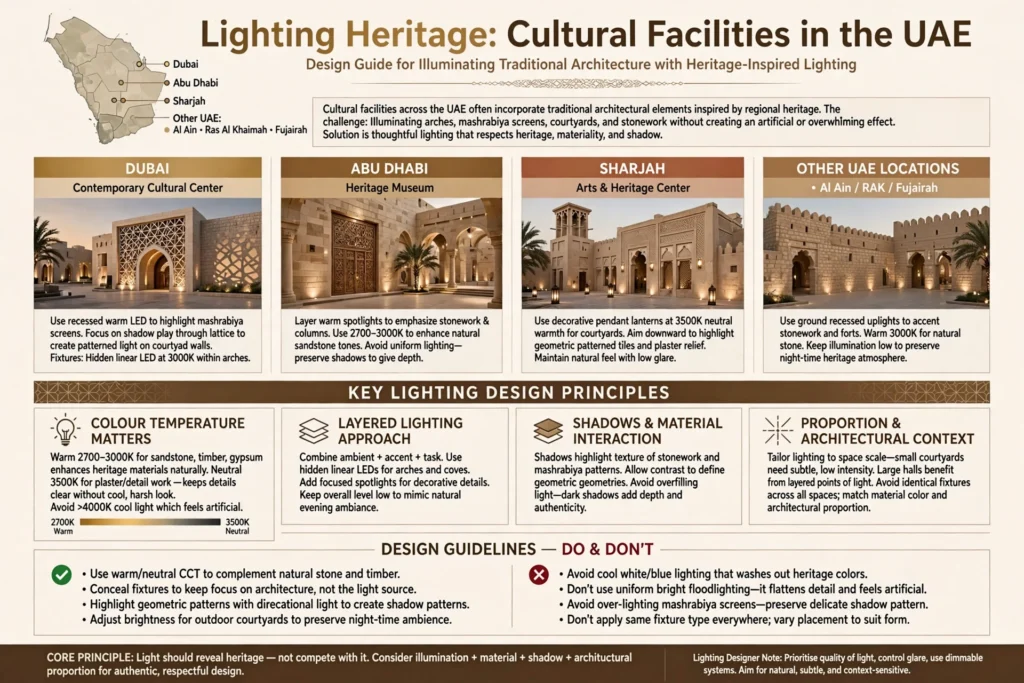
Cultural facilities in Dubai, Abu Dhabi, Sharjah and other UAE locations may incorporate traditional architectural elements inspired by regional heritage. Lighting can be used to emphasise geometric patterns, arches, courtyards, mashrabiya-inspired screens, stonework and decorative details.
The challenge is to illuminate these features without making them appear artificial or visually overwhelming. Warm or neutral colour temperatures can often support heritage-inspired interiors, depending on the materials and design concept.
Lighting designers should consider the relationship between illumination, material colour, shadows and architectural proportions rather than applying identical fixtures throughout the building.
Cultural Centre Lighting in Dubai
Dubai has a wide range of cultural, educational, artistic and exhibition facilities, from modern galleries and performance spaces to heritage destinations and multipurpose venues. Cultural centre lighting in Dubai therefore needs to support both contemporary architecture and traditional design influences.
Facilities in areas such as Downtown Dubai, Al Quoz, Dubai Design District, Al Fahidi and surrounding cultural districts can have very different architectural requirements. A contemporary gallery may need precise track lighting, while a heritage-focused facility may require concealed architectural illumination.
The city’s high visitor traffic and long operating hours also make energy management and maintenance important considerations.
Cultural Centre Lighting in Abu Dhabi
Abu Dhabi has invested heavily in museums, arts, cultural institutions and public spaces, making lighting an important part of the visitor experience. Cultural developments around Saadiyat Island, the city centre and other cultural districts require lighting systems capable of supporting exhibitions, public events and architectural presentation.
In large cultural buildings, lighting controls can help operators manage multiple zones, exhibition areas, public circulation spaces and event venues independently. Efficient LED systems can also help reduce operational energy demand over the long term.
Cultural Centre Lighting in Sharjah
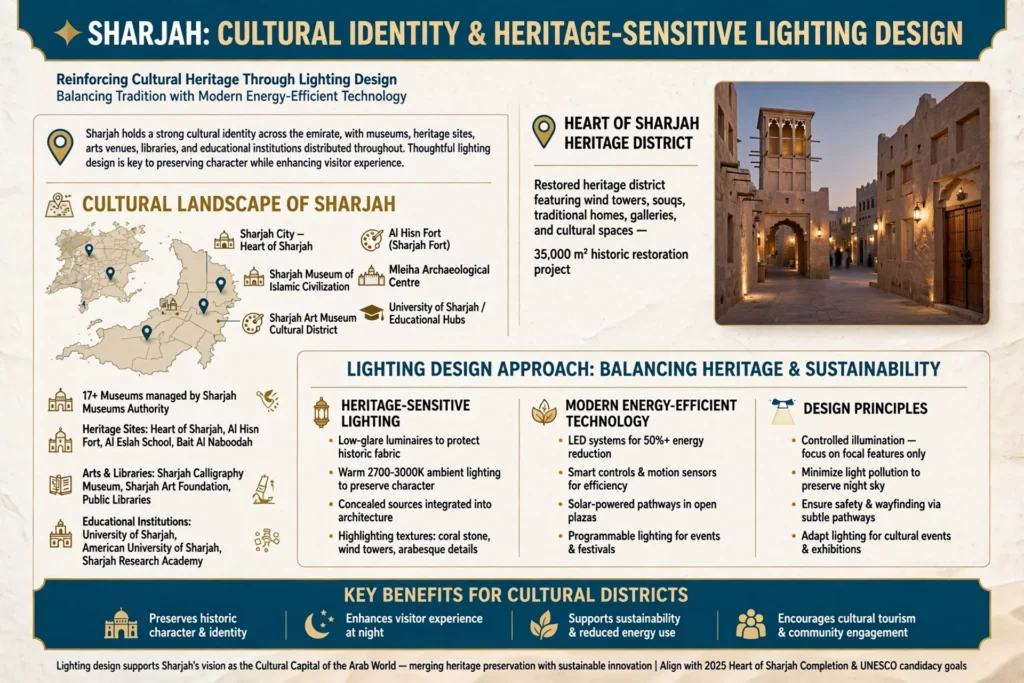
Sharjah has a particularly strong cultural identity, with museums, heritage sites, arts venues, libraries and educational institutions distributed across the emirate. Lighting design can help reinforce this identity by carefully presenting cultural collections and architectural environments.
Areas around Heart of Sharjah and other cultural districts may require a balance between heritage-sensitive lighting and modern energy-efficient technology. Low-glare luminaires, concealed sources and carefully controlled architectural illumination can preserve the character of historic environments.
LED Lighting for Cultural Centres
LED technology has become a major component of modern cultural centre lighting because it offers energy efficiency, long service life, controllability and a broad range of fixture designs.
LED downlights, linear luminaires, track spotlights, wall washers, floodlights and architectural profiles can be integrated into different areas of a cultural facility. Dimmable LED systems can also support multiple lighting scenes.
However, selecting LED lighting should not be based solely on wattage. Colour rendering, beam distribution, glare control, lumen output, colour consistency, driver quality and maintenance requirements should also be evaluated.
Colour Temperature and Colour Rendering
Colour temperature affects the atmosphere of a cultural space. Warm white illumination can create an intimate environment, while neutral white light may be appropriate for galleries, educational areas and contemporary interiors.
Colour rendering is particularly important where visitors need to perceive artwork, textiles, paintings and cultural objects accurately. A suitable high-colour-rendering LED source can improve visual presentation and help preserve the intended appearance of exhibits.
The ideal specification should therefore be based on the collection, interior materials and architectural concept rather than applying one colour temperature throughout the entire building.
Smart Lighting Controls
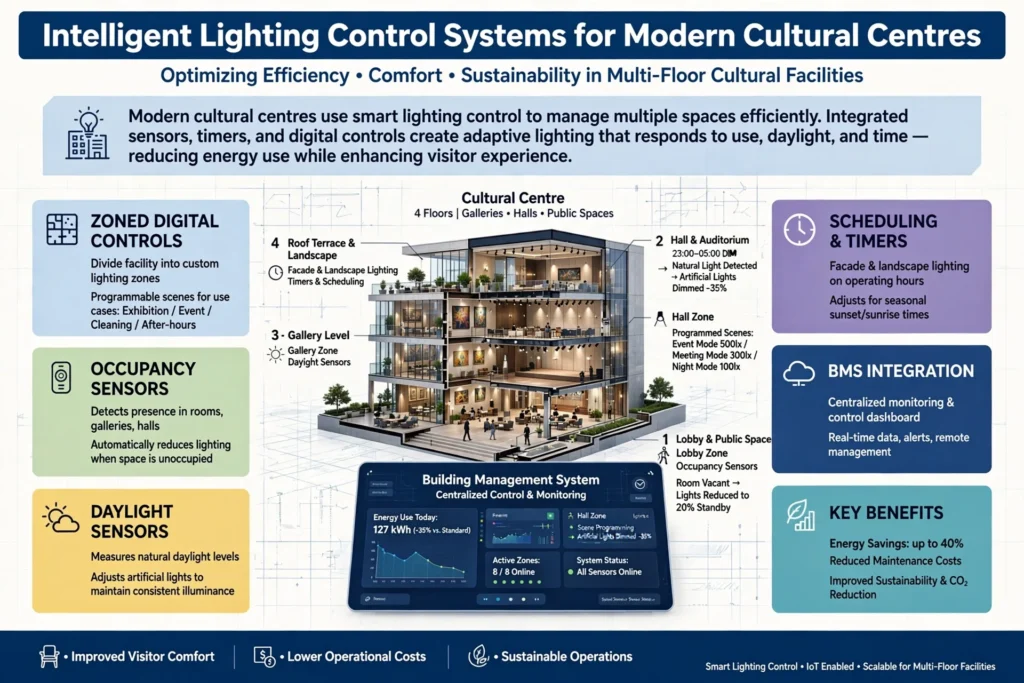
Modern cultural centres can benefit significantly from intelligent lighting control systems. Digital controls can divide a facility into zones and allow different lighting scenes to be programmed according to use.
Occupancy sensors can reduce lighting in rooms that are temporarily unoccupied. Daylight sensors can adjust artificial illumination according to available natural light. Timers and scheduling systems can control facade and landscape lighting according to operating hours.
Integration with a building management system can provide facility managers with centralized monitoring and control. This is especially useful in large cultural facilities with multiple floors, galleries, halls and public spaces.
Energy Efficiency and Sustainable Lighting
Energy efficiency is an important consideration for cultural centres because many facilities operate for long hours and contain large illuminated spaces. Efficient LED luminaires combined with lighting controls can reduce unnecessary electricity consumption.
Designers should consider the entire lighting system rather than focusing only on fixture efficiency. Correct lumen levels, zoning, daylight harvesting, occupancy detection and scheduling can all contribute to energy savings.
For UAE projects, energy-conscious lighting can complement broader sustainability goals and building standards such as Estidama and LEED, where applicable.
Glare Control and Visitor Comfort
Glare can significantly reduce the quality of a cultural experience. Direct glare from poorly positioned luminaires can make artworks difficult to view and create discomfort in seating, reading and circulation areas.
Optical accessories, appropriate beam angles, recessed fixtures, louvers and careful mounting positions can help control glare. Lighting designers should evaluate the relationship between luminaires, visitor sightlines, display cases and reflective surfaces.
Comfort should remain a priority even when dramatic architectural lighting is being used.
Emergency and Wayfinding Lighting
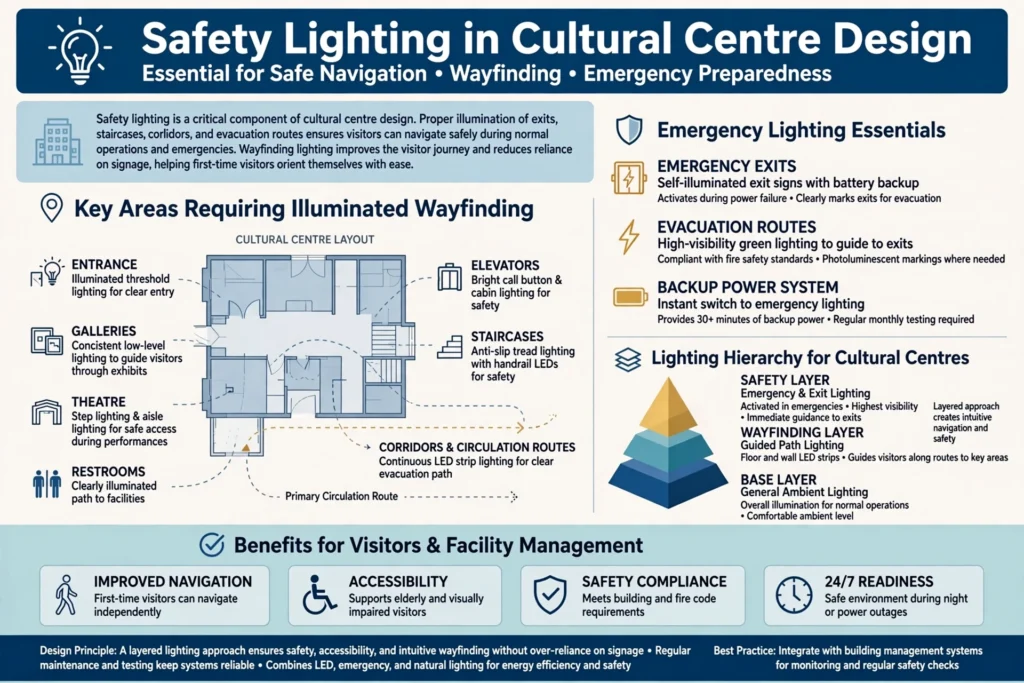
Safety lighting is another essential component of cultural centre design. Emergency exits, staircases, corridors and evacuation routes need appropriate illumination so visitors can navigate the building safely during normal operation and emergencies.
Wayfinding lighting can also improve the visitor journey. Entrances, galleries, theatres, restrooms, elevators and major circulation routes should be visually understandable without relying exclusively on signage.
A well-designed lighting hierarchy can make large cultural facilities easier to navigate, particularly for first-time visitors.
Outdoor and Landscape Lighting
Cultural centres often include courtyards, gardens, plazas, sculptures and pedestrian areas. Outdoor lighting should provide safe movement while reinforcing the architectural identity of the facility.
Bollards, in-ground fixtures, facade lights, wall washers and carefully aimed floodlights can illuminate landscape and architectural elements. The design should avoid unnecessary light pollution and excessive brightness.
Outdoor lighting in the UAE also needs equipment suitable for heat, dust, humidity and demanding environmental conditions. Appropriate ingress protection and durable materials can improve long-term reliability.
Lighting for Cultural Events
Cultural centres frequently host events beyond their normal daily activities. These may include art openings, conferences, book launches, performances, government functions, workshops and community celebrations.
Flexible lighting controls allow operators to create event-specific scenes without permanently changing the installation. Dimming, zoning and programmable presets can make the facility more adaptable and reduce the need for temporary lighting equipment.
This flexibility can increase the practical value of the lighting system throughout the building’s operational life.
Choosing a Cultural Centre Lighting Supplier
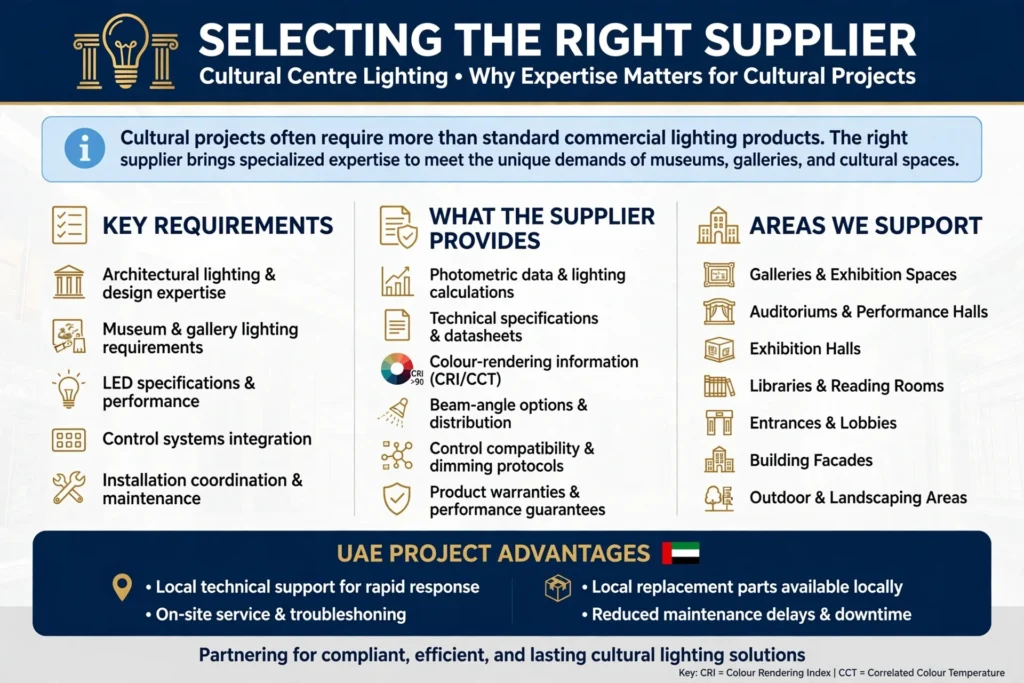
Selecting the right supplier is important because cultural projects often require more than standard commercial lighting products. The supplier should understand architectural lighting, museum and gallery requirements, LED specifications, control systems, installation coordination and maintenance.
A reliable Cultural Centre Lighting Supplier can help project teams select suitable luminaires for galleries, auditoriums, exhibition halls, libraries, entrances, facades and outdoor areas.
The supplier should also be able to provide photometric data, technical specifications, colour-rendering information, beam-angle options, control compatibility and product warranties. For large UAE projects, local technical support and replacement availability can also reduce maintenance delays.
Lighting Design and Maintenance Considerations
A lighting system should be designed with future maintenance in mind. Fixtures installed at excessive heights or in difficult-to-access locations can increase maintenance costs and operational disruption.
Long-life LED luminaires can reduce replacement frequency, but drivers and control equipment also need consideration. Facility managers should have access to product documentation, circuit information and control-system programming.
Regular cleaning is particularly important in dusty environments. Dust accumulation on luminaires and optical surfaces can gradually reduce light output and affect the visual appearance of the building.
How to Create an Effective Cultural Centre Lighting Strategy
The best approach starts with understanding how people will use the building. Designers should identify each functional zone, determine required illumination levels, study daylight availability and map important architectural and cultural features.
The next stage is selecting suitable fixture types and developing lighting layers. Photometric calculations can then help verify illumination, uniformity and glare performance.
Finally, lighting controls, energy performance, maintenance access and emergency requirements should be integrated into the design. Mock-ups and sample installations can be particularly valuable for galleries, heritage interiors and feature spaces where visual quality is critical.
Conclusion
Cultural centre lighting design is a combination of architecture, technology, visitor experience and operational performance. The right lighting system can make exhibitions easier to appreciate, improve auditorium experiences, highlight cultural architecture and create a welcoming environment for visitors.
For cultural facilities across Dubai, Abu Dhabi, Sharjah and the wider UAE, lighting should also account for local architecture, climate, operating patterns, energy efficiency and maintenance requirements. LED technology, intelligent controls, flexible track systems, architectural lighting and carefully selected colour-rendering specifications can provide a practical foundation for modern cultural facilities.
A specialist Cultural Centre Lighting Supplier can support the project from product selection and technical specifications through lighting layouts, controls, installation coordination and ongoing maintenance. When these elements are considered together, lighting becomes more than illumination—it becomes an important part of the cultural centre’s architecture, identity and visitor experience.