Industrial facilities in Ras Al Khaimah require lighting systems that can handle demanding operating conditions while providing safe, consistent, and energy-efficient illumination. Factories, warehouses, workshops, logistics centres, manufacturing plants, cold stores, yards, loading areas, and industrial compounds all have different lighting requirements.
LED technology has become an important option for industrial facilities because modern LED luminaires can provide high light output, long operating life, directional distribution, instant illumination, and compatibility with lighting controls. However, selecting industrial LED lighting is not simply a matter of replacing older lamps with LED bulbs. The fixture type, mounting height, beam angle, colour temperature, ingress protection, environmental conditions, controls, electrical infrastructure, and maintenance strategy all need to be considered.
For businesses operating in Ras Al Khaimah, a properly planned industrial lighting solution can improve visibility across production and storage areas while supporting workplace safety, operational efficiency, and long-term maintenance planning.
Why Industrial Lighting Matters in Ras Al Khaimah
Ras Al Khaimah has a diverse industrial economy that includes manufacturing, construction-related industries, logistics, building materials, ceramics, food production, warehouses, workshops, and industrial services.
Areas such as Al Ghail Industrial Zone, Al Hamra Industrial Zone, Al Jazeera Al Hamra, Al Nakheel, Ras Al Khaimah Economic Zone, and other industrial clusters contain facilities with very different operational requirements.
A warehouse storing packaged goods does not need exactly the same lighting arrangement as a metal fabrication workshop or manufacturing plant.
Lighting therefore needs to be designed around the building’s actual activities, ceiling height, equipment arrangement, storage racks, working hours, environmental conditions, and safety requirements.
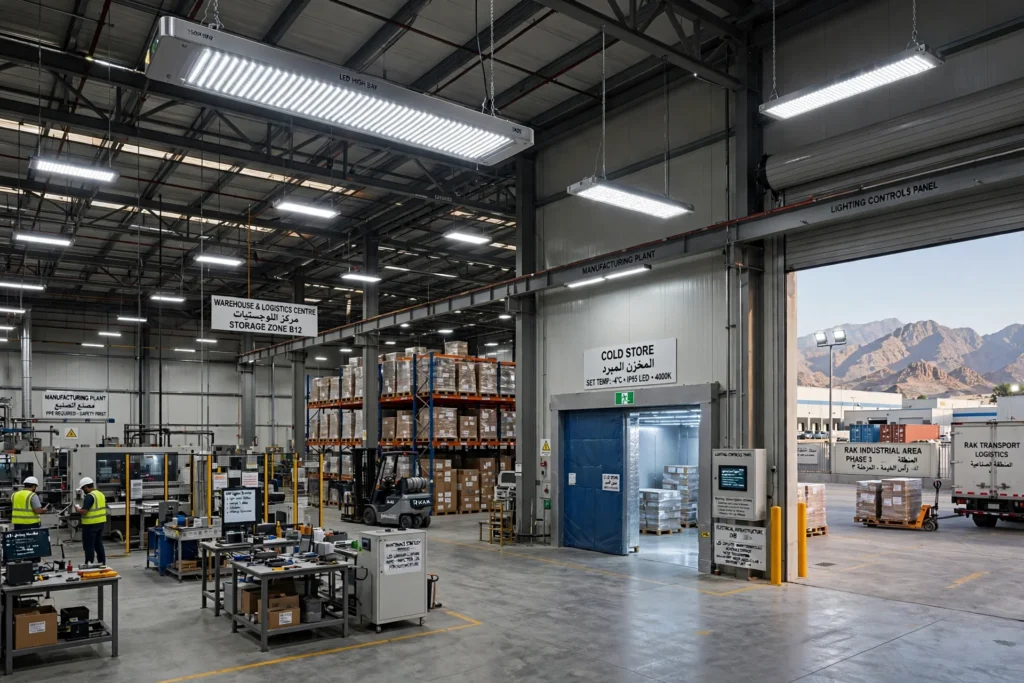
What Is Industrial LED Lighting?
Industrial LED lighting refers to LED luminaires designed for demanding environments such as factories, warehouses, workshops, production areas, distribution centres, garages, and outdoor industrial spaces.
Common industrial LED products include high-bay lights, low-bay lights, LED floodlights, linear high bays, LED battens, wall-mounted luminaires, street and area lights, bulkhead fixtures, emergency lighting, and specialist explosion-protected products where required.
Unlike conventional lamps, LED luminaires use light-emitting diodes to produce illumination. Their design can provide controlled light distribution, allowing engineers to direct light toward floors, aisles, machinery, workstations, storage areas, or outdoor yards.
High-Bay LED Lighting for RAK Warehouses
High-bay lighting is commonly used in warehouses and industrial buildings with high ceilings.
Traditional low-output fixtures can result in insufficient illumination at floor level when installed at significant mounting heights. High-bay LED luminaires are designed to deliver concentrated or controlled light distribution from elevated positions.
The correct high-bay system depends on ceiling height, aisle width, racking configuration, required illumination, mounting method, and the photometric characteristics of the fixture.
For warehouses in Ras Al Khaimah, lighting designers should consider storage racks, forklifts, picking areas, loading zones, pedestrian routes, and emergency pathways when planning fixture positions.
LED Lighting for Manufacturing Facilities
Manufacturing environments can contain machinery, production lines, workstations, conveyors, inspection areas, and storage zones.
Lighting needs to support employees performing visual tasks without creating excessive glare or distracting reflections from metal surfaces.
The correct lighting distribution depends on the production process. A general factory floor may require broad uniform illumination, while inspection or precision assembly areas may require more focused task lighting.
The lighting design should therefore consider the visual requirements of each production activity rather than applying a uniform fixture arrangement across the entire building.
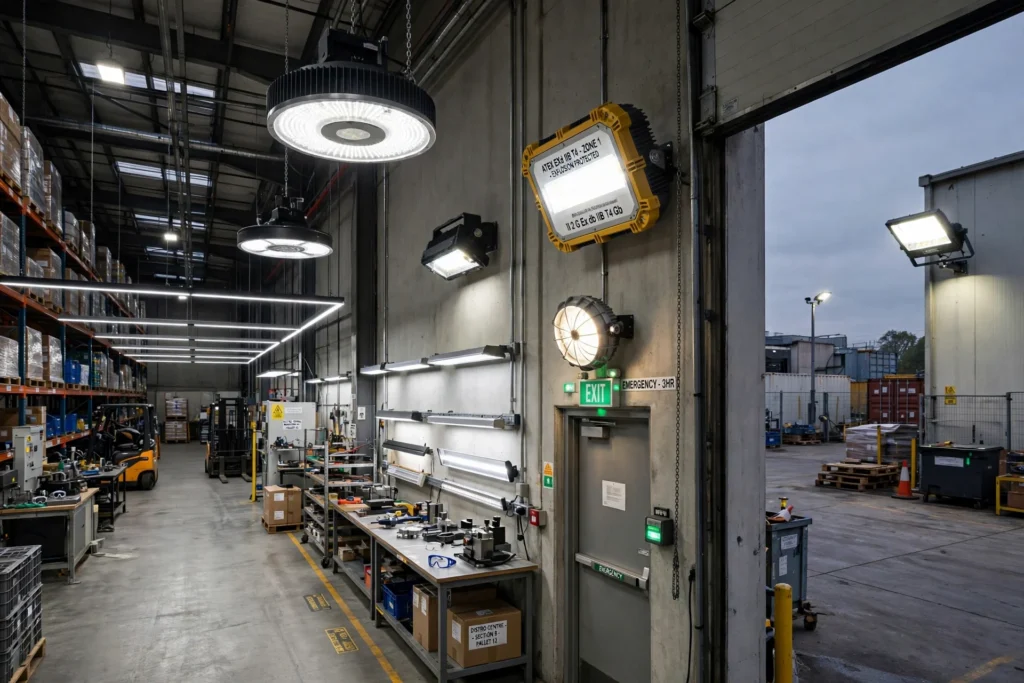
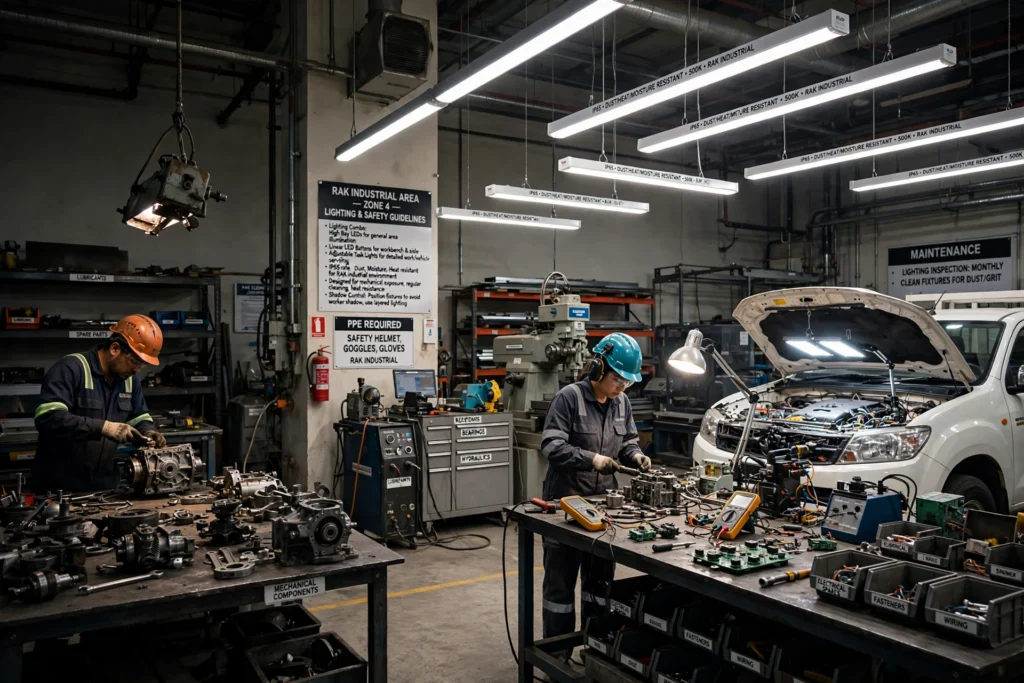
LED Lighting for Industrial Workshops
Workshops often require flexible lighting because employees may work on machinery, vehicles, tools, fabrication equipment, electrical systems, or mechanical components.
Shadow control is particularly important around workbenches and machinery. Poorly positioned fixtures can leave workers standing in their own shadow.
Linear LED fixtures, industrial battens, high bays, task lights, and adjustable fixtures can be combined depending on the workspace.
For workshops in RAK industrial areas, lighting should also be selected according to dust, heat, moisture, mechanical exposure, and cleaning requirements.
LED Lighting for Logistics and Distribution Centres
Logistics facilities require lighting for receiving, storage, picking, packing, dispatch, and loading activities.
Large distribution centres may have high ceilings and long storage aisles. High-bay LED systems can provide illumination across these areas while reducing the number of fixtures required compared with poorly planned conventional installations.
Lighting controls can also be useful in areas where occupancy varies throughout the day.
For example, warehouse aisles that are used intermittently may benefit from occupancy-based control strategies where the selected system supports this application.
LED Lighting for Loading Bays
Loading bays need clear visibility for workers, drivers, forklifts, pallet movement, and loading equipment.
Lighting should cover the transition between indoor and outdoor areas and should minimize dark zones around loading doors.
LED canopy lights, floodlights, wall-mounted fixtures, or suitable industrial luminaires may be used depending on the building design.
The lighting layout should also consider vehicle height, dock equipment, overhead doors, signage, cameras, and fire protection systems.
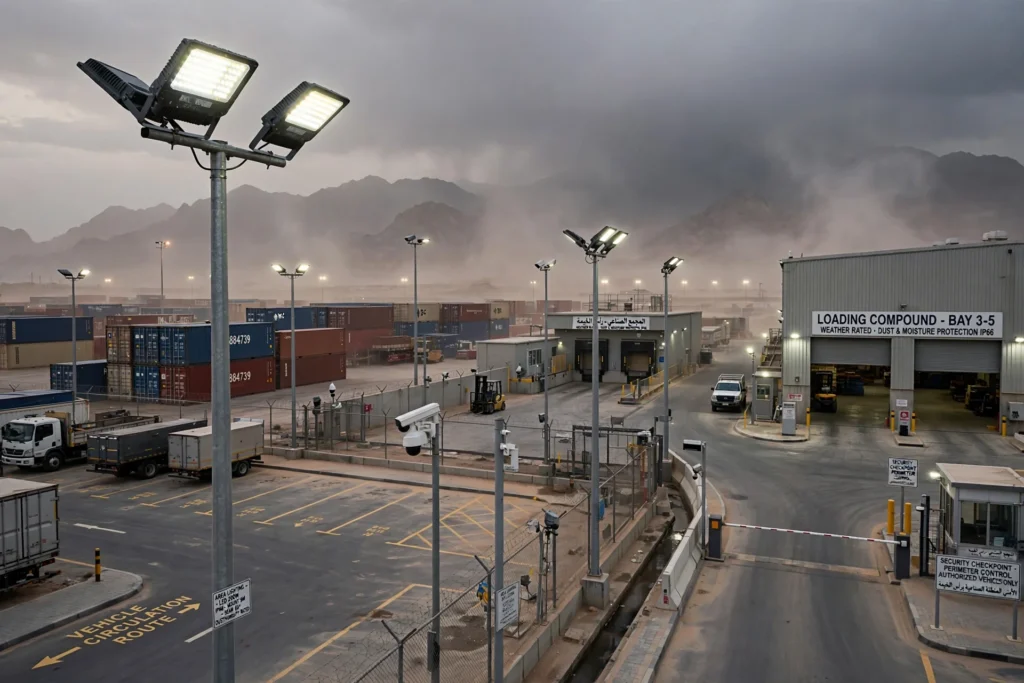
Outdoor Industrial Area Lighting
Industrial facilities often include large outdoor spaces such as storage yards, parking areas, service roads, loading compounds, security perimeters, and vehicle circulation routes.
Outdoor LED floodlights and area lights can provide controlled illumination across these spaces.
The choice of fixture should consider weather exposure, dust, moisture, mounting height, beam angle, glare, and required coverage.
For industrial sites in Ras Al Khaimah, outdoor lighting should also be planned with the local environment in mind, including heat, dust, humidity, and occasional heavy weather conditions.
Understanding IP Ratings for Industrial LED Lights
Ingress Protection, or IP rating, is an important consideration when selecting industrial LED luminaires.
The IP code indicates the degree of protection provided by an enclosure against solids and liquids.
For example, a fixture with a higher IP rating may provide greater protection against dust and water ingress than a lower-rated product, depending on its certified construction.
However, a higher IP rating should not automatically be treated as the only indicator of product suitability. The actual environment, installation location, cleaning method, temperature, chemical exposure, and manufacturer’s specifications should also be evaluated.
LED Lighting for Dusty Industrial Environments
Dust can affect industrial facilities involved in manufacturing, construction materials, ceramics, woodwork, packaging, and other processes.
Dust accumulation on or around lighting equipment can affect maintenance requirements and, depending on the environment and equipment design, thermal performance.
Industrial luminaires for dusty locations should be selected based on the actual environmental conditions and manufacturer ratings.
Where combustible dust may be present, specialist hazardous-area assessment may be necessary. Standard commercial LED fixtures should not be assumed to be suitable for hazardous environments.
Hazardous Area and Explosion-Protected Lighting
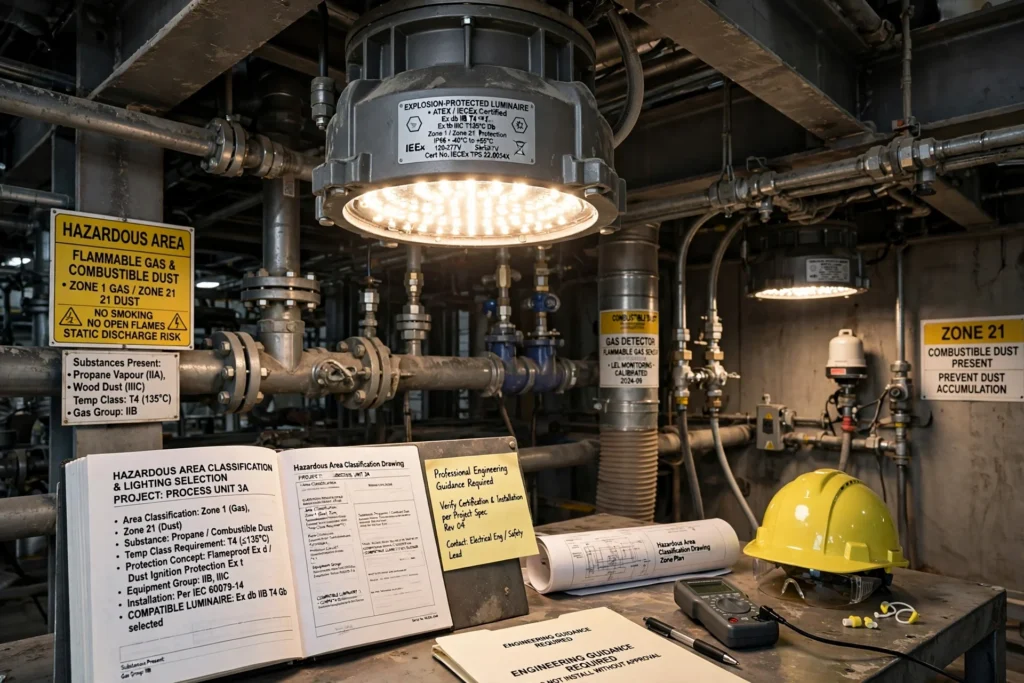
Some industrial processes can involve flammable gases, vapours, or combustible dust. These environments require specialist engineering consideration.
Explosion-protected or hazardous-area luminaires are designed and certified for specific applications and zones.
The correct equipment depends on the hazardous-area classification, substances present, temperature class, protection concept, and applicable project requirements.
Industrial facility owners should obtain professional engineering guidance before selecting lighting for hazardous locations.
LED Lighting and Energy Efficiency
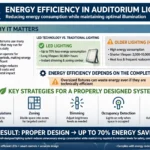
Energy consumption is a major consideration for industrial facilities because lighting can operate for long periods.
LED technology can reduce lighting energy consumption compared with many older lighting technologies, particularly when the complete system is properly designed.
However, actual savings depend on the existing installation, operating hours, fixture efficiency, lighting levels, controls, maintenance, and electricity usage.
Simply installing more powerful LED fixtures does not automatically create an efficient lighting system.
The objective should be to provide appropriate illumination where it is needed while avoiding excessive light output in low-use areas.
Lighting Controls for Industrial Buildings
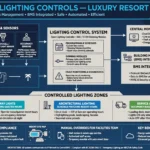
Industrial LED lighting can be combined with control systems to improve operational efficiency.
Depending on the application, controls may include:
- Occupancy sensors
- Motion sensors
- Daylight sensors
- Timers
- Dimming
- Zonal switching
- Central lighting controls
- Building management integration
For example, storage areas that are occupied only periodically may be controlled separately from continuously occupied production areas.
Control strategies should be carefully selected because industrial operations may involve forklifts, machinery, shift workers, and changing occupancy patterns.
Colour Temperature for Industrial Lighting
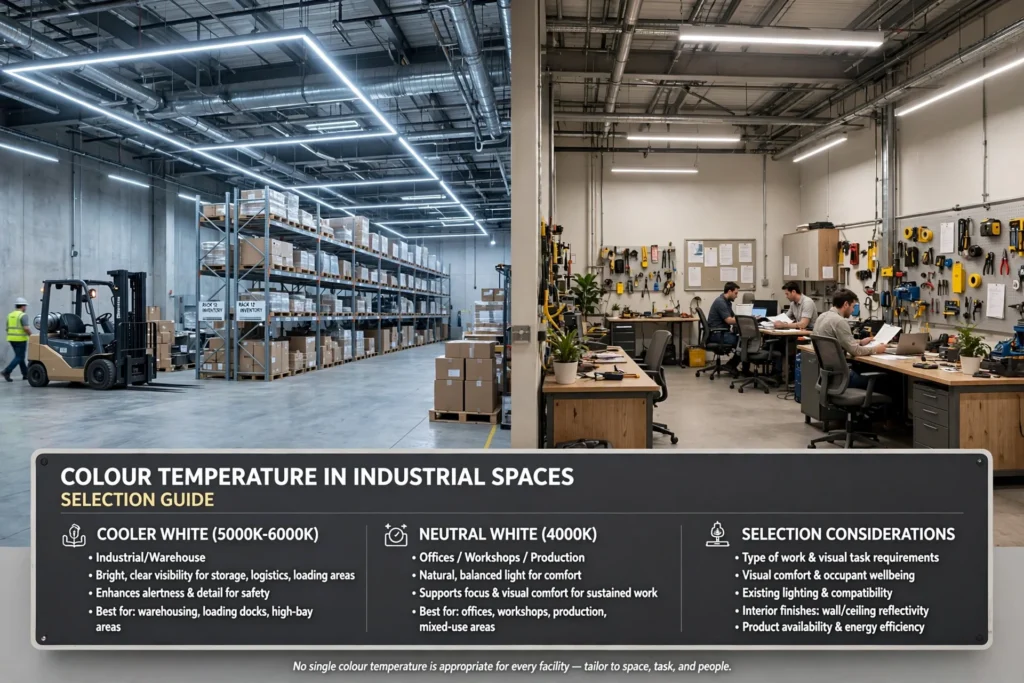
Colour temperature affects the visual appearance of an industrial space.
Cooler white LED lighting is commonly considered for industrial and warehouse environments because it can create a bright, clear visual environment. Neutral white may also be appropriate for offices, workshops, production spaces, and mixed-use industrial areas.
The final selection should consider the type of work, visual comfort, existing lighting, interior finishes, and product availability.
There is no single colour temperature that is appropriate for every industrial facility.
Colour Rendering and Industrial Tasks
Colour Rendering Index, or CRI, describes how accurately a light source renders colours compared with a reference source.
Higher colour rendering can be important where workers need to distinguish colours, inspect products, identify wiring, check finishes, or perform quality-control activities.
For general storage areas, the requirements may differ from precision inspection environments.
Lighting specifications should therefore be connected to the actual task performed under the light.
Beam Angles and Light Distribution
Beam angle is one of the most important factors in industrial lighting design.
A narrow distribution can direct light into specific areas, while a wider distribution can provide broader coverage.
For warehouse aisles, lighting distribution can be selected to direct illumination along storage areas rather than wasting light on unnecessary surfaces.
For open factories, broader distributions may provide more uniform coverage.
Photometric calculations can help determine whether the selected beam angle and mounting height produce suitable illumination at working level.
Lighting Calculations for RAK Industrial Projects
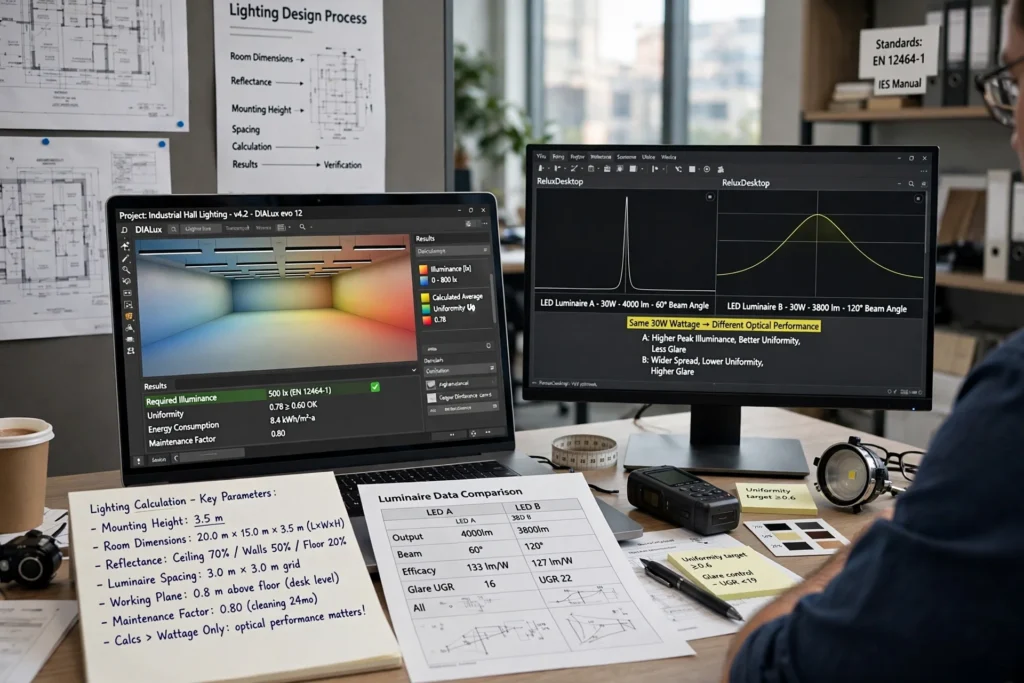
Lighting calculations help determine whether a proposed LED system can achieve the required illumination.
Professional lighting design may consider:
- Mounting height
- Room dimensions
- Reflectance
- Luminaire output
- Beam angle
- Spacing
- Maintenance factor
- Working plane
- Required illuminance
- Uniformity
- Glare
- Energy consumption
Tools such as DIALux and Relux can be used to model commercial and industrial lighting layouts.
A lighting calculation is more useful than choosing fixtures based only on wattage because two LED luminaires with the same wattage can have significantly different optical performance.
LED Lighting for Industrial Offices
Many industrial facilities contain administrative offices, meeting rooms, reception areas, control rooms, staff facilities, and security offices.
These spaces generally require a different lighting approach from production floors or warehouses.
Office areas may use LED panels, downlights, linear fixtures, task lighting, and daylight-responsive controls.
Lighting should also be coordinated with HVAC diffusers, ceiling systems, fire alarm devices, sprinklers, data infrastructure, and furniture layouts.
LED Lighting for Factory Production Lines
Production lines require lighting that follows the physical arrangement of machinery and workers.
If equipment is rearranged, the lighting system may need to be reviewed to ensure that work areas remain properly illuminated.
Linear LED systems can sometimes work well over long production areas because they can provide continuous or semi-continuous illumination.
Where machinery creates shadows, additional task lighting may be necessary.
The final design should consider the actual manufacturing process, equipment height, operator position, inspection requirements, and maintenance access.
Maintenance and Access for Industrial LED Systems
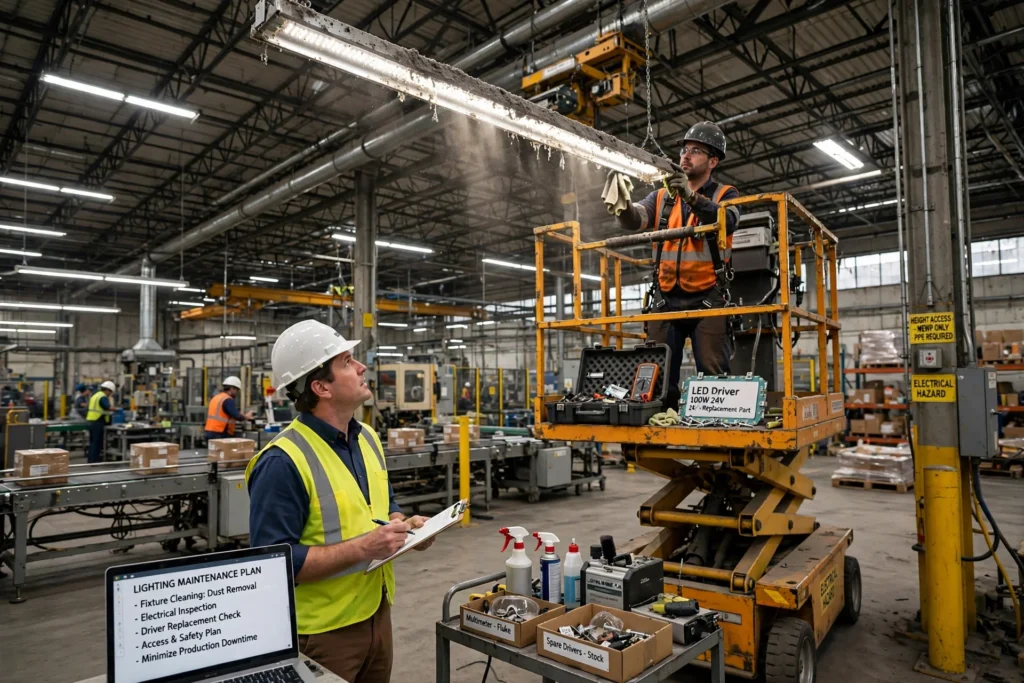
Long LED service life does not mean that lighting systems require no maintenance.
Industrial environments can accumulate dust and contaminants, and fixtures may eventually require cleaning, inspection, driver replacement, or electrical checks.
Mounting height is therefore an important maintenance consideration.
Lighting installed at significant height may require specialized access equipment such as mobile elevated work platforms or other safe access methods.
When planning an industrial lighting system, facility managers should consider how fixtures will be reached without unnecessarily disrupting production.
LED Lighting for RAK Industrial Yards
Outdoor yards may contain trucks, containers, pallets, machinery, construction materials, or finished products.
The lighting design should provide adequate visibility for vehicle movement and pedestrian safety while controlling glare toward nearby properties and roads.
Pole-mounted LED area lights and floodlights can be positioned to cover specific zones.
Lighting should also be coordinated with CCTV because excessive glare or poorly directed light can negatively affect camera images.
LED Lighting and CCTV Coordination
Security systems and lighting should be considered together.
CCTV cameras require sufficient illumination to capture useful images, particularly during nighttime operations. However, placing high-intensity floodlights directly within camera fields of view can create glare.
A coordinated design can position lighting to illuminate the monitored area while maintaining suitable camera visibility.
Industrial sites with perimeter security, loading bays, parking areas, and vehicle gates can particularly benefit from coordinated lighting and surveillance planning.
Emergency Lighting for Industrial Facilities
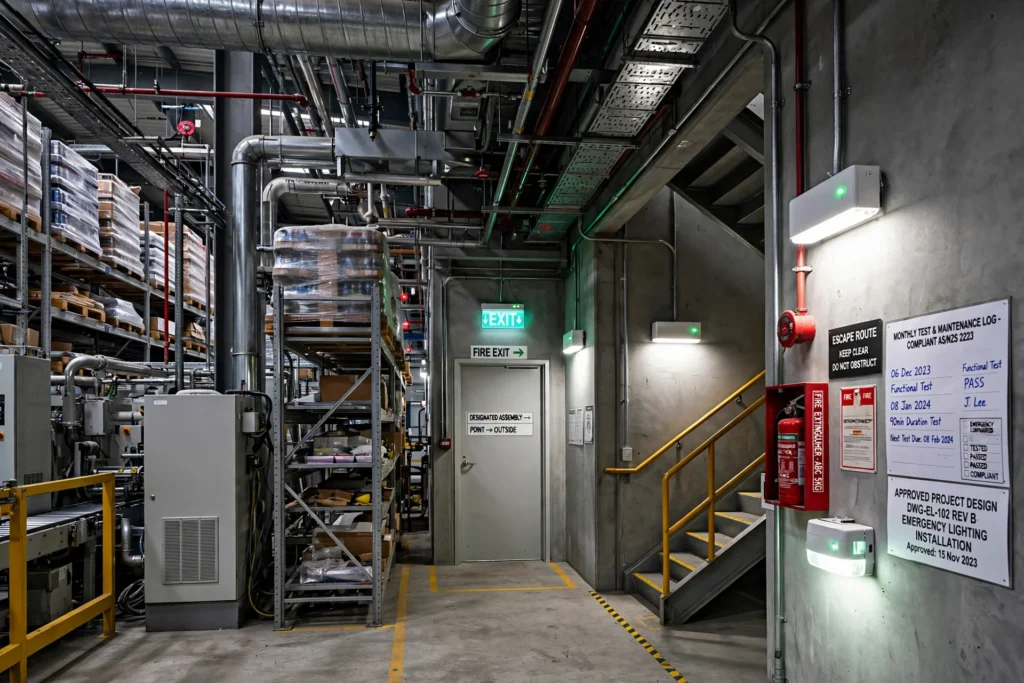
Industrial buildings should also include appropriate emergency lighting and exit signage based on the approved project design and applicable requirements.
Emergency luminaires may be required along escape routes, exits, staircases, corridors, and other designated areas.
Their positions need to be coordinated with machinery, racking, ceiling systems, fire protection equipment, and architectural elements.
Emergency lighting should be tested and maintained as part of the facility’s safety programme.
Lighting for Cold Stores and Temperature-Controlled Areas
Cold stores and refrigerated facilities present different environmental conditions from ordinary warehouses.
Lighting equipment should be selected according to the temperature range and environmental conditions specified by the manufacturer.
Moisture, condensation, cleaning procedures, and door openings can also affect the environment.
The fixture’s operating temperature range, ingress protection, construction, and maintenance requirements should be checked before installation.
Lighting for Food Processing Facilities
Food processing environments can have strict hygiene and cleaning requirements.
Lighting fixtures may need to withstand regular cleaning and environmental exposure while minimizing areas where dust or contaminants can accumulate.
The fixture design, mounting method, ingress protection, materials, and cleaning compatibility should be evaluated according to the facility’s operational requirements.
Food production facilities should also consider light quality for inspection and quality-control processes.
Lighting for RAK Industrial Areas
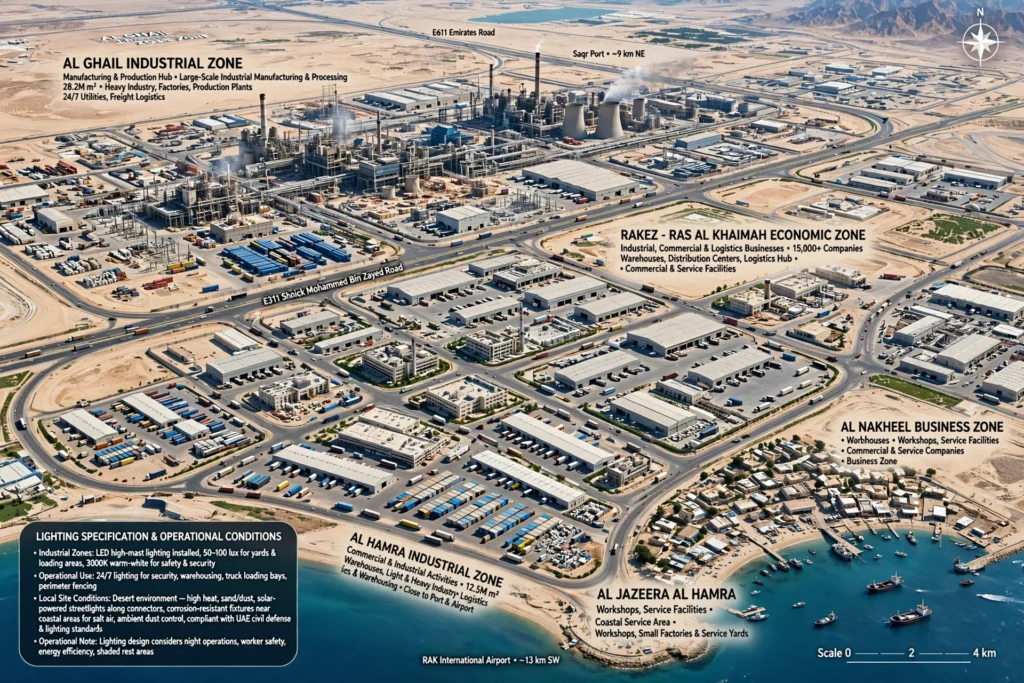
Ras Al Khaimah’s industrial activity extends across several locations and economic zones.
Industrial facilities in Al Ghail Industrial Zone may have manufacturing and production requirements, while Al Hamra Industrial Zone supports commercial and industrial activities. RAKEZ, the Ras Al Khaimah Economic Zone, is also associated with a wide range of industrial, commercial, and logistics businesses.
Other locations such as Al Jazeera Al Hamra, Al Nakheel, and surrounding industrial areas can contain warehouses, workshops, factories, and service facilities.
Local site conditions and operational use should always be considered when developing the lighting specification.
LED Lighting for Manufacturing in RAK
Manufacturing is an important part of Ras Al Khaimah’s industrial landscape, with facilities ranging from building materials and ceramics to food, engineering, and other production activities.
These environments can involve high ceilings, machinery, dust, heat, moving equipment, and long operating hours.
Industrial LED lighting should therefore be selected based on actual production conditions rather than simply choosing the cheapest fixture.
A professional lighting assessment can identify dark areas, excessive brightness, poor uniformity, inefficient fixtures, and maintenance problems.
How to Choose an Affordable Industrial LED Supplier
Cost is an important consideration for industrial businesses, but the initial purchase price should not be the only factor.
A low-cost fixture can become expensive if it has poor thermal management, unreliable drivers, inadequate environmental protection, limited warranty support, or difficult replacement requirements.
Businesses looking for an LED Lighting Affordable Supplier should compare the complete specification, including lumen output, efficacy, IP rating, operating temperature, driver quality, warranty, product availability, photometric data, and suitability for the intended environment.
This approach allows buyers to compare products based on lifecycle value rather than price alone.
Why Lumens Matter More Than Watts
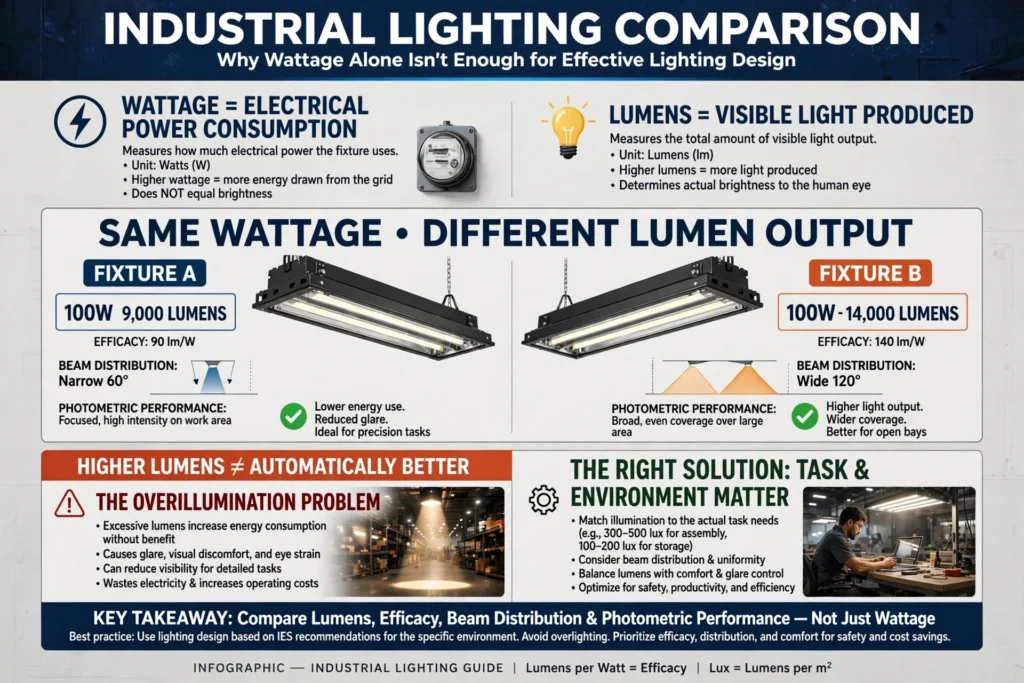
Wattage describes electrical power consumption, while lumens describe the amount of visible light produced by a luminaire.
Two fixtures with the same wattage can produce different lumen outputs.
For industrial applications, comparing lumens, efficacy, beam distribution, and photometric performance can provide more useful information than comparing wattage alone.
However, higher lumen output is not automatically better. Excessive illumination can increase energy consumption and glare without improving visibility.
The correct solution should provide suitable illumination for the actual task and environment.
Common Industrial Lighting Mistakes
One common mistake is installing fixtures based only on wattage.
Another is failing to consider mounting height and beam distribution. A fixture that works well in a low-ceiling workshop may not perform the same way in a high-bay warehouse.
Other problems include inadequate IP protection, poor glare control, insufficient emergency lighting, difficult maintenance access, and failure to coordinate lighting with racking or machinery.
Industrial lighting should be treated as an engineered building system rather than a collection of individual lamps.
Industrial Lighting and Long-Term Operating Costs
The real cost of an industrial lighting system includes purchase, installation, electricity, maintenance, replacement parts, downtime, and disposal.
An efficient LED system can potentially reduce operating costs through lower energy consumption and longer service life, but the actual financial outcome depends on the product and operating conditions.
For facilities running multiple shifts, even relatively small improvements in lighting efficiency can become significant over time.
Energy monitoring can help facility managers understand the actual performance of the lighting system after installation.
Planning an Industrial LED Lighting Upgrade
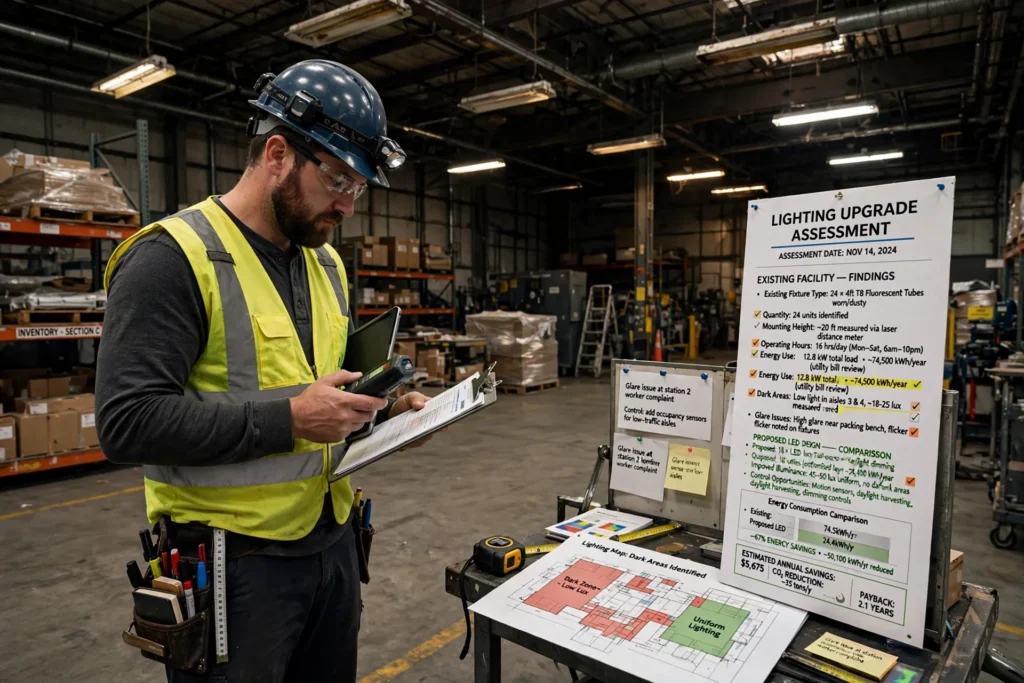
A lighting upgrade should begin with an assessment of the existing facility.
The assessment can identify:
- Existing fixture types
- Fixture quantities
- Mounting heights
- Operating hours
- Energy consumption
- Dark areas
- Glare problems
- Maintenance issues
- Environmental conditions
- Control opportunities
The proposed LED design can then be compared against the existing system.
This approach provides a more useful basis for evaluating potential energy savings and lighting improvements.
Frequently Asked Questions
What type of LED lighting is best for industrial warehouses?
High-bay LED lighting is commonly used for warehouses with high ceilings, but the correct fixture depends on mounting height, aisle configuration, required illumination, beam angle, racking, environmental conditions, and the manufacturer’s specifications.
Are LED lights suitable for Ras Al Khaimah factories?
LED lighting can be suitable for many industrial facilities in Ras Al Khaimah. The fixture should be selected according to temperature, dust, moisture, mounting conditions, operating hours, and the specific industrial process.
What IP rating should industrial LED lights have?
There is no single IP rating suitable for every industrial environment. The required protection depends on dust, water exposure, cleaning methods, humidity, and the location of the fixture.
Can LED lighting reduce industrial electricity costs?
LED systems can reduce lighting energy consumption compared with many older technologies, particularly when combined with efficient design and appropriate controls. Actual savings depend on the existing system and operating conditions.
Is high-bay lighting suitable for factories?
High-bay lighting can be suitable for factories with high ceilings. Fixture selection should consider machinery, working height, visual tasks, mounting position, beam angle, and required illumination.
What should I check before buying industrial LED lights?
Check lumen output, efficacy, beam angle, colour temperature, CRI, IP rating, operating temperature, driver specifications, warranty, photometric data, mounting method, controls, and suitability for the specific environment.
Conclusion
LED lighting for Ras Al Khaimah industrial projects requires more than selecting an energy-efficient lamp. Factories, warehouses, workshops, logistics centres, production facilities, industrial yards, and manufacturing plants all have different lighting requirements.
A successful industrial lighting system should consider illumination levels, high-bay applications, beam distribution, IP protection, environmental conditions, energy efficiency, controls, emergency lighting, maintenance access, CCTV coordination, and the actual work performed within the facility.
For businesses operating in Al Ghail Industrial Zone, Al Hamra Industrial Zone, RAKEZ, Al Jazeera Al Hamra, Al Nakheel, and other RAK industrial areas, a properly planned LED system can support safer working conditions, better visibility, efficient operations, and predictable maintenance.
The most effective approach is to assess the facility first, calculate the required lighting performance, select suitable industrial luminaires, coordinate installation with existing services, and evaluate the complete lifecycle cost rather than focusing only on the initial fixture price.