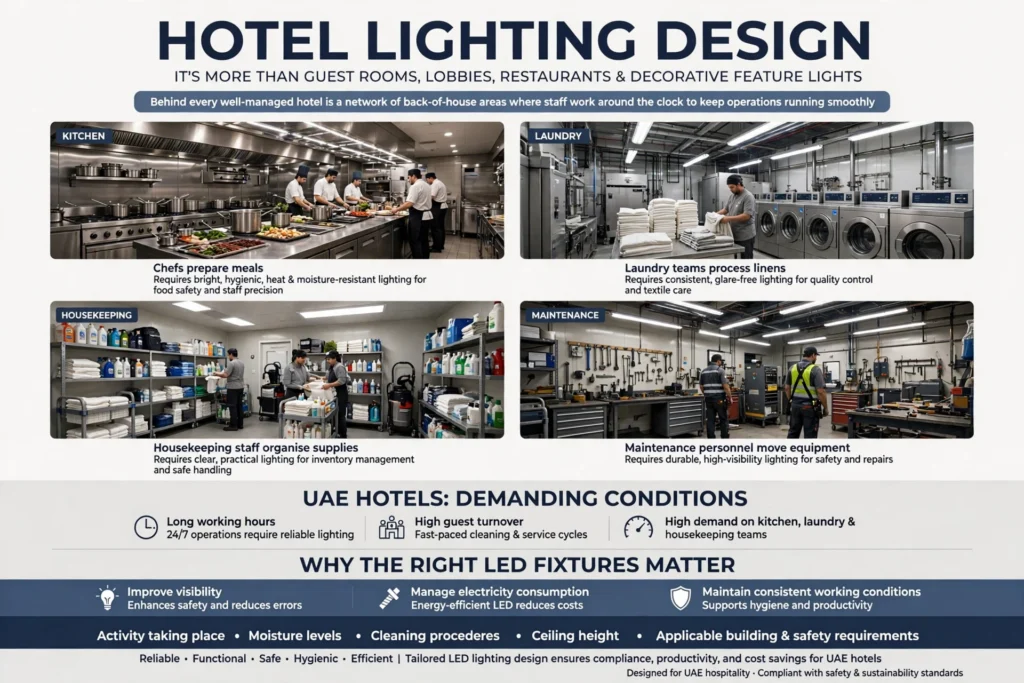
Hotel lighting design involves much more than guest rooms, lobbies, restaurants and decorative feature lights. Behind every well-managed hotel is a network of back-of-house areas where chefs prepare meals, laundry teams process linens, housekeeping staff organise supplies and maintenance personnel move equipment. These spaces require reliable, functional lighting that supports staff safety, hygiene, productivity and operational efficiency.
In the UAE, hotels operate under demanding conditions, with long working hours, high guest turnover and significant demands on kitchen, laundry and housekeeping teams. Choosing the right LED fixtures for these areas helps hotel operators improve visibility, manage electricity consumption and maintain consistent working conditions. The correct solution depends on the activity taking place, moisture levels, cleaning procedures, ceiling height and applicable building and safety requirements.
What Is Back-of-House Lighting in a Hotel?
Back-of-house lighting refers to illumination installed in operational areas that guests do not normally access. These areas include commercial kitchens, food preparation rooms, dishwashing stations, laundry rooms, linen stores, housekeeping pantries, staff corridors, maintenance workshops, loading bays and plant rooms.
Unlike decorative lighting in hotel lobbies or guest lounges, back-of-house lighting prioritises visual performance, durability, cleanability and dependable operation. Staff must be able to identify ingredients, read labels, inspect surfaces, handle equipment and move through corridors without unnecessary shadows or glare.
A well-planned lighting system also supports the hotel’s wider building management strategy. LED luminaires, occupancy sensors, timers and building management system (BMS) integration can help control energy use without compromising essential illumination or emergency lighting provisions.
Why Hotel Back-of-House Lighting Requires Special Attention
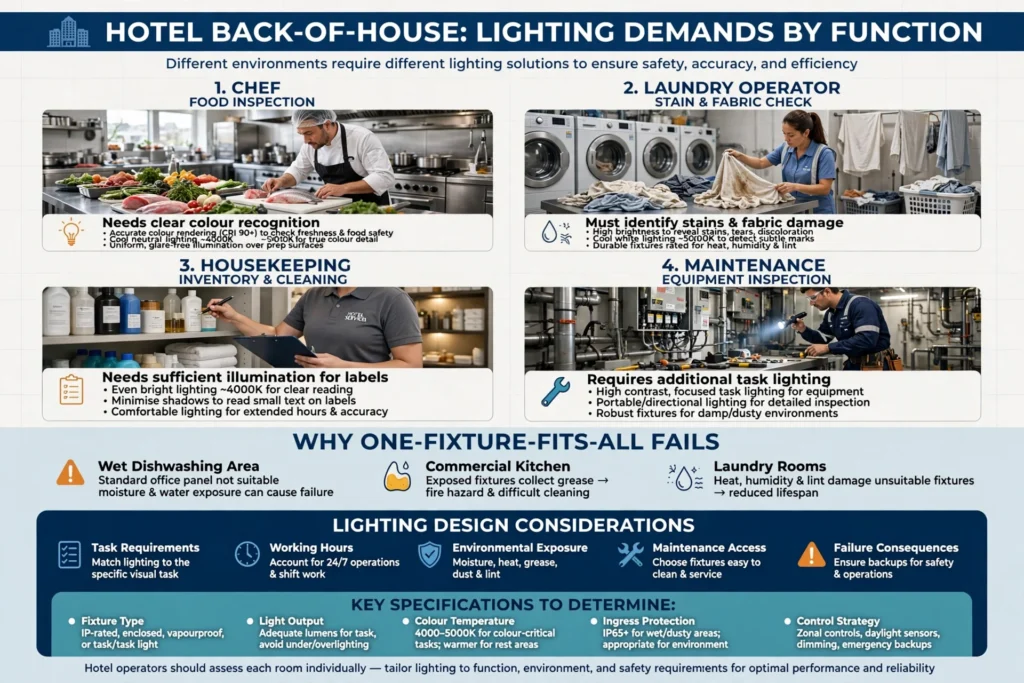
Hotel back-of-house environments have different lighting demands depending on their functions. A chef inspecting food needs clear colour recognition, while a laundry operator must identify stains and fabric damage. A housekeeping employee needs sufficient illumination to read inventory labels, and maintenance staff may require additional task lighting when inspecting electrical or mechanical equipment.
Installing the same type of fixture throughout the building can create problems. A standard office panel may not be suitable for a wet dishwashing area, while an exposed fixture can collect grease in a commercial kitchen. In laundry rooms, heat, humidity and lint may affect equipment performance if the selected luminaire and installation are unsuitable.
Hotel operators should therefore assess each room individually. Lighting design should consider task requirements, working hours, environmental exposure, maintenance access and the consequences of a lighting failure. These factors help determine fixture type, light output, colour temperature, ingress protection and control strategy.
Commercial Kitchen Lighting: Visibility, Hygiene and Food Preparation
Commercial kitchens require consistent illumination across preparation counters, cooking lines, sinks, storage shelves and cleaning stations. Chefs and kitchen assistants work with sharp knives, hot surfaces, liquids and complex equipment, making clear visibility essential for safe operations.
LED battens, sealed linear luminaires and suitable recessed fixtures can provide uniform illumination when selected for the environment. Their positioning should reduce shadows on worktops and prevent staff from blocking the light with their bodies. Additional task lighting may be appropriate for detailed food preparation, provided it is safe for the installation environment and does not interfere with cleaning or food safety.
The lighting layout should also account for stainless-steel counters, tiled walls and other reflective surfaces. Poorly positioned fixtures can create glare that makes it harder to inspect ingredients or read equipment displays. Diffused optics and carefully arranged luminaires can help control these reflections.
Choosing LED Fixtures for Grease and Heat
Cooking areas can expose luminaires to elevated temperatures, airborne grease, steam and frequent cleaning. Fixture selection should account for the actual ambient temperature, proximity to cooking equipment, cleaning chemicals and the possibility of water spray.
Sealed luminaires with smooth, easy-to-clean surfaces are often suitable for demanding kitchen areas, but the correct design depends on the exposure. An ingress protection (IP) rating indicates protection against dust and water under specified test conditions; it does not automatically establish resistance to grease, heat, chemicals or every cleaning method.
Fixtures installed near ovens, grills and extraction hoods must be suitable for the temperatures they will experience. Where a luminaire could be exposed to grease deposits or intense heat, the design team should verify the manufacturer’s installation instructions and relevant fire and electrical requirements.
Colour Rendering for Food Preparation
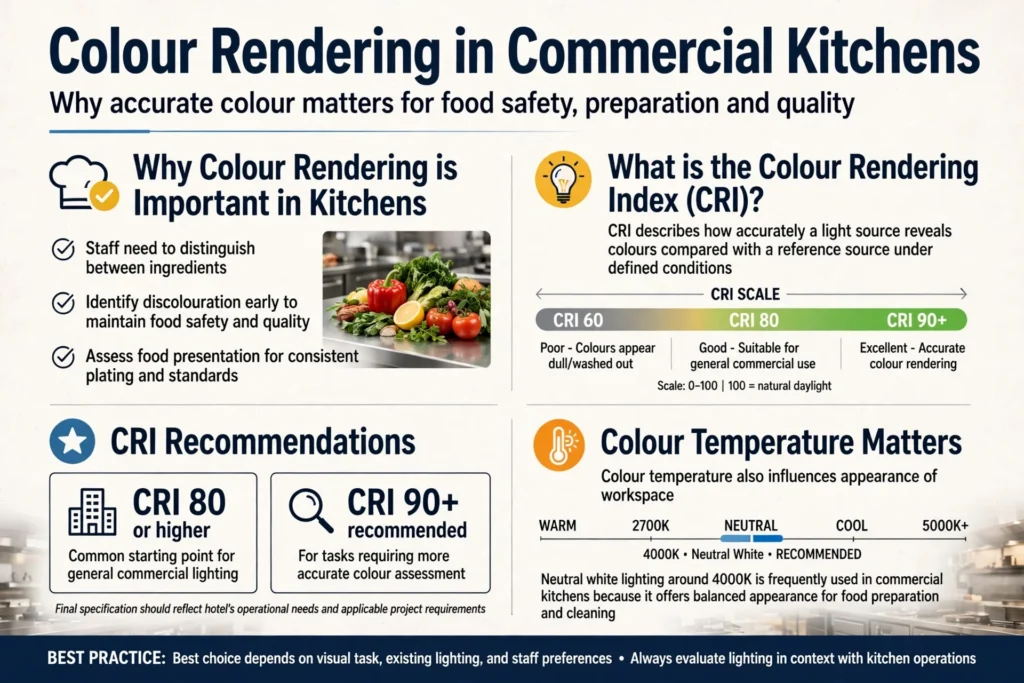
Colour rendering is important in kitchens because staff need to distinguish between ingredients, identify discolouration and assess food presentation. The colour rendering index (CRI) describes how accurately a light source reveals colours compared with a reference source under defined conditions.
A CRI of 80 or higher is a common starting point for general commercial lighting, while tasks requiring more accurate colour assessment may benefit from higher-CRI products. The final specification should reflect the hotel’s operational needs and applicable project requirements.
Colour temperature also influences the appearance of the workspace. Neutral white lighting around 4000K is frequently used in commercial kitchens because it offers a balanced appearance for food preparation and cleaning. The best choice depends on the visual task, existing lighting and staff preferences.
Laundry Room Lighting: Managing Humidity, Heat and Lint
Hotel laundry rooms process towels, bed linen, uniforms, tablecloths and other textiles throughout the day. Staff sort soiled linen, operate washing machines, load dryers, inspect fabrics, fold clean items and organise deliveries. These activities require dependable lighting across equipment areas, worktables and storage shelves.
LED linear fixtures can provide broad, uniform illumination in laundry rooms with high ceilings or long equipment rows. Where workers inspect stains, tears or fabric quality, additional task lighting may be useful. Lighting should be positioned to minimise shadows across folding tables and sorting stations.
Laundry areas can contain warm, humid air and airborne lint. The chosen luminaires should be compatible with the room’s environmental conditions and cleaning practices. In areas subject to moisture, the appropriate IP rating and installation method must be confirmed. Where lint accumulation is possible, accessible fixtures and a planned cleaning schedule help reduce maintenance problems.
Lighting for Linen Inspection and Folding
Linen inspection requires staff to identify marks, damaged fibres and inconsistencies in fabric condition. Uneven illumination can hide defects or make inspection slower. Uniform light distribution across inspection tables supports a more consistent process.
Task lighting should be selected to complement the general lighting rather than create isolated bright spots. A suitable combination of ambient and task illumination can help workers inspect fabric while maintaining comfortable visual conditions throughout the room.
Lighting colour quality is also relevant. Consistent colour rendering can help staff distinguish between white linen, coloured fabrics and visible stains. However, lighting cannot replace established laundry inspection procedures or quality-control standards.
Selecting Durable Fixtures for Laundry Operations
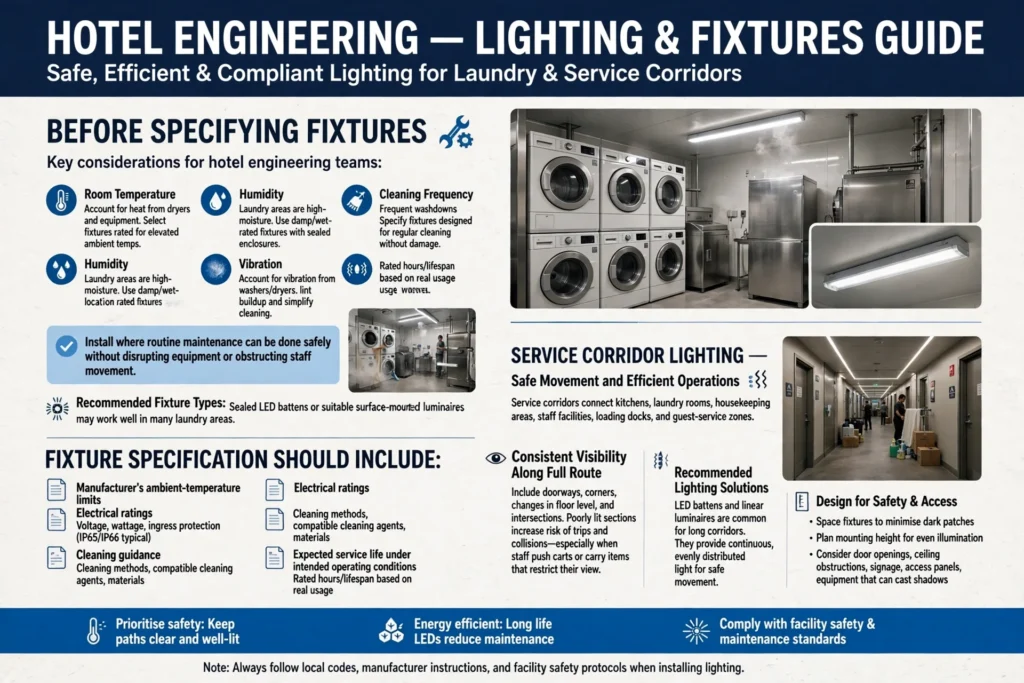
Before specifying fixtures, hotel engineering teams should consider room temperature, humidity, lint accumulation, vibration and cleaning frequency. Fixtures should be installed where routine maintenance can be carried out safely without disrupting equipment or obstructing staff movement.
Sealed LED battens or suitable surface-mounted luminaires may work well in many laundry areas. The specification should include the manufacturer’s ambient-temperature limits, electrical ratings, cleaning guidance and expected service life under the intended operating conditions.
Service Corridor Lighting: Safe Movement and Efficient Operations
Service corridors connect kitchens, laundry rooms, housekeeping areas, staff facilities, loading docks and guest-service zones. Employees use these routes to transport food, cleaning supplies, linen carts, waste containers and maintenance equipment.
Corridor lighting should deliver consistent visibility along the full route, including doorways, corners, changes in floor level and intersections. Poorly lit sections can increase the risk of trips and collisions, especially when staff push carts or carry items that restrict their view.
LED battens and linear luminaires are common options for long corridors because they can provide continuous, evenly distributed light. Their spacing and mounting height should be designed to minimise dark patches. Designers should also consider door openings, ceiling obstructions, signs, access panels and equipment that could cast shadows.
Preventing Glare and Dark Spots
Excessive contrast between bright and dark areas can make movement uncomfortable, particularly when employees move between different workspaces. Glare from exposed LED sources can also reduce visual comfort and make signs or door labels harder to read.
Diffused optics, appropriate mounting positions and consistent fixture spacing can help improve visibility. Lighting calculations should evaluate the working plane and corridor floor, rather than relying only on the total wattage or number of fixtures.
Emergency routes require particular attention. Normal corridor lighting and emergency lighting serve different purposes, and the design must preserve the required emergency illumination when the normal power supply fails.
Recommended Lighting Levels for Hotel Back-of-House Areas
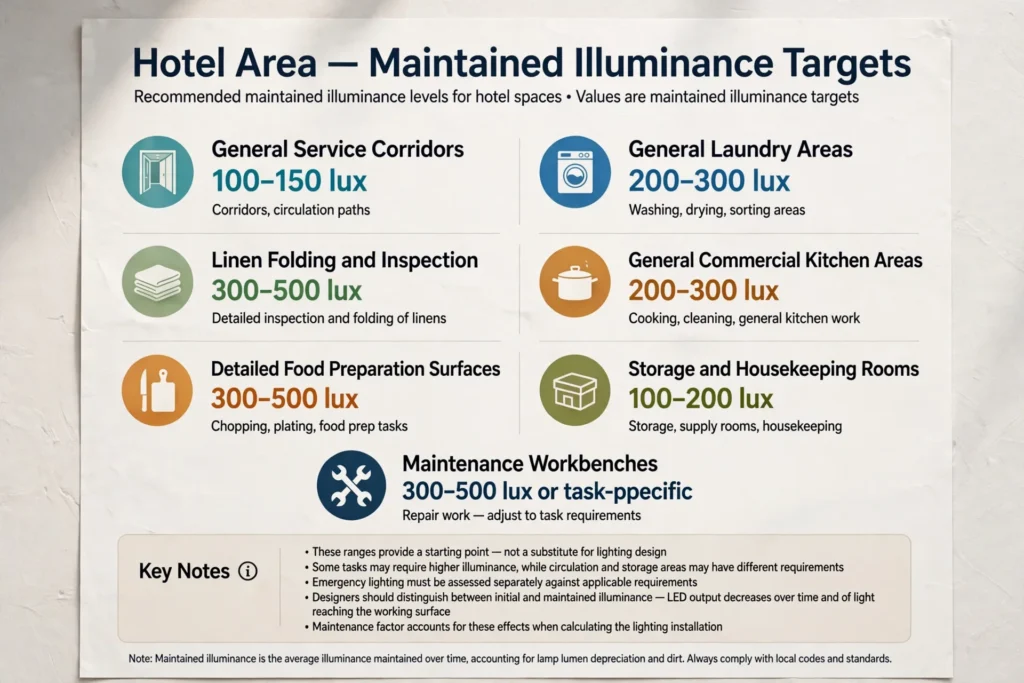
Lighting levels are usually expressed in lux, which measures illuminance on a surface. The correct target depends on the task, the room layout, mounting height, surface reflectance, visual requirements and applicable standards.
The following figures are preliminary planning examples, not universal code requirements. A qualified lighting designer should confirm maintained illuminance targets using the applicable local regulations, relevant standards and the hotel’s specific operating requirements.
| Hotel area | Illustrative maintained illuminance |
|---|---|
| General service corridors | 100–150 lux |
| General laundry areas | 200–300 lux |
| Linen folding and inspection | 300–500 lux |
| General commercial kitchen areas | 200–300 lux |
| Detailed food preparation surfaces | 300–500 lux |
| Storage and housekeeping rooms | 100–200 lux |
| Maintenance workbenches | 300–500 lux or task-specific |
These ranges provide a starting point for discussion, not a substitute for a lighting design. Some tasks may require higher illuminance, while circulation and storage areas may have different requirements. Emergency lighting must be assessed separately against the applicable requirements.
Designers should also distinguish between initial and maintained illuminance. LED output decreases over time, and dirt can reduce the amount of light reaching a working surface. A maintenance factor accounts for these effects when calculating the lighting installation.
Choosing the Right LED Colour Temperature and CRI
Colour temperature affects how warm or cool white light appears. Commercial kitchens, laundry rooms and service corridors often use neutral or cool white lighting to support visibility, although the most suitable choice varies by task and the hotel’s overall lighting strategy.
Around 4000K is a practical starting point for many functional work areas. A cooler option may be appropriate where the visual environment or equipment requires it, while consistency across connected spaces can help staff adapt when moving between rooms.
Colour rendering should match the work being performed. CRI 80 or higher is commonly considered for general operational areas, while food inspection and fabric-quality tasks may justify higher performance. Specifications should identify both colour temperature and CRI rather than describing a fixture simply as “bright white.”
Glare control, uniformity and light distribution are equally important. A high-output fixture can still perform poorly if it creates harsh reflections or leaves work surfaces unevenly illuminated.
IP Ratings, Electrical Safety and Cleaning Requirements
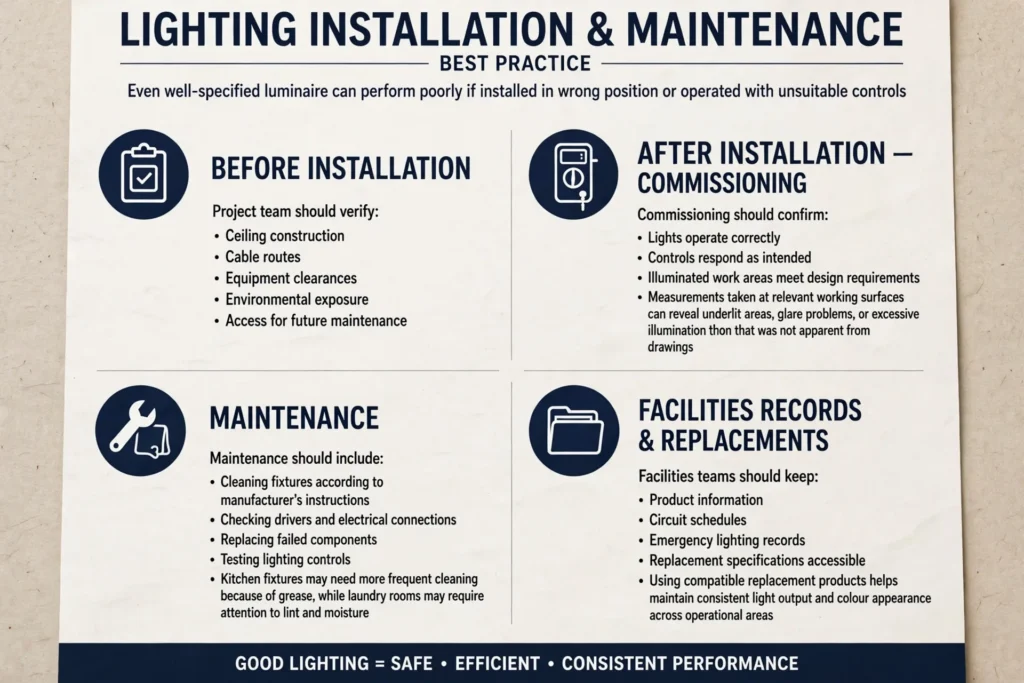
Back-of-house lighting must be selected according to the environmental conditions in each room. The IP code classifies protection provided by an enclosure against the ingress of solid objects and water. Different areas may require different levels of protection depending on splash exposure, washdown procedures, dust and airborne particles.
For example, a dry storage room may not need the same enclosure as a dishwashing station exposed to water spray. The designer should identify the likely exposure and select a fixture with a suitable rating, installation method and manufacturer’s approval for that environment.
A higher IP rating does not automatically mean that a fixture can withstand high temperatures, strong detergents, grease deposits or pressure washing. These conditions require separate verification. Electrical installation, earthing, circuit protection and maintenance access should comply with applicable UAE requirements and the relevant authority’s approval process.
Where food hygiene is important, fixture construction should also support effective cleaning and minimise locations where dirt can accumulate. The selected product must be appropriate for the room’s actual hygiene and operational requirements.
Energy-Efficient Lighting Controls for Hotel Operations
Hotel back-of-house areas may operate for long periods, particularly in large properties with 24-hour kitchens, laundry facilities and housekeeping operations. LED technology can reduce electricity consumption compared with less efficient lighting when properly designed and installed.
However, energy performance depends on more than fixture wattage. Lighting controls, operating schedules, occupancy patterns, maintenance and the amount of light delivered to the working plane all affect the final result.
Occupancy Sensors in Service Areas
Occupancy sensors can switch or dim lighting when a space is not being used. They may be suitable for storage rooms, selected housekeeping areas, maintenance rooms and occasional-use corridors.
Sensor selection and placement matter. PIR sensors detect changes in infrared energy and may not reliably detect stationary occupants. Microwave sensors detect movement using radio waves and can be more sensitive in some situations, but their coverage must be controlled to avoid unwanted activation through adjacent areas or partitions.
In busy kitchens and laundry rooms, automatic shutoff should not interrupt work or create unsafe conditions. A suitable time delay, manual override or controlled dimming strategy can help accommodate the way staff use the space. Essential lighting and required emergency systems must not depend on ordinary occupancy controls.
Integrating Lighting with a Building Management System
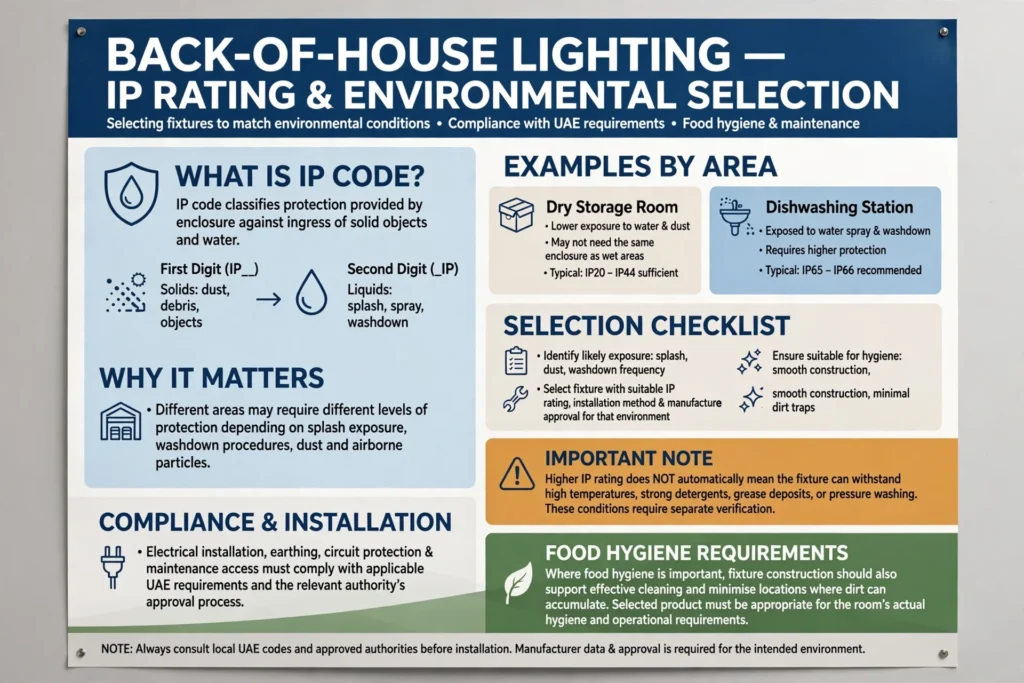
A building management system can coordinate lighting schedules, monitor selected circuits and provide visibility into energy use. Where the project supports it, lighting controls can integrate through protocols such as DALI-2 or appropriate building automation interfaces.
Hotels with multiple operational zones may use scheduled control for service corridors, stores and back offices while keeping continuously occupied work areas at suitable levels. Integration should be planned with the hotel’s facilities team to ensure that control sequences are understandable, faults can be identified and staff can override settings when needed.
Energy savings should be calculated from the actual operating schedule, connected load and control strategy. Avoid assuming a fixed percentage saving without project-specific measurements.
Emergency Lighting and Staff Safety
Emergency lighting is an essential part of hotel life-safety planning. Back-of-house corridors, escape routes, stairways and other designated areas may need emergency illumination so employees can leave the building safely during a normal power failure.
The emergency lighting design should follow the applicable UAE fire and life-safety requirements, local authority approvals and relevant standards. It may use self-contained emergency luminaires or a suitable central battery arrangement, depending on the project design.
Emergency fittings, exit signs, testing arrangements and backup duration must be selected according to the applicable requirements. Normal LED lighting with an occupancy sensor is not a substitute for compliant emergency lighting.
Maintenance teams should have a documented inspection and testing programme. Faults should be recorded and corrected promptly, and any changes to corridor layouts or escape routes should trigger a review of the emergency lighting arrangement.
Lighting Design for UAE Hotels: Dubai, Abu Dhabi and Sharjah
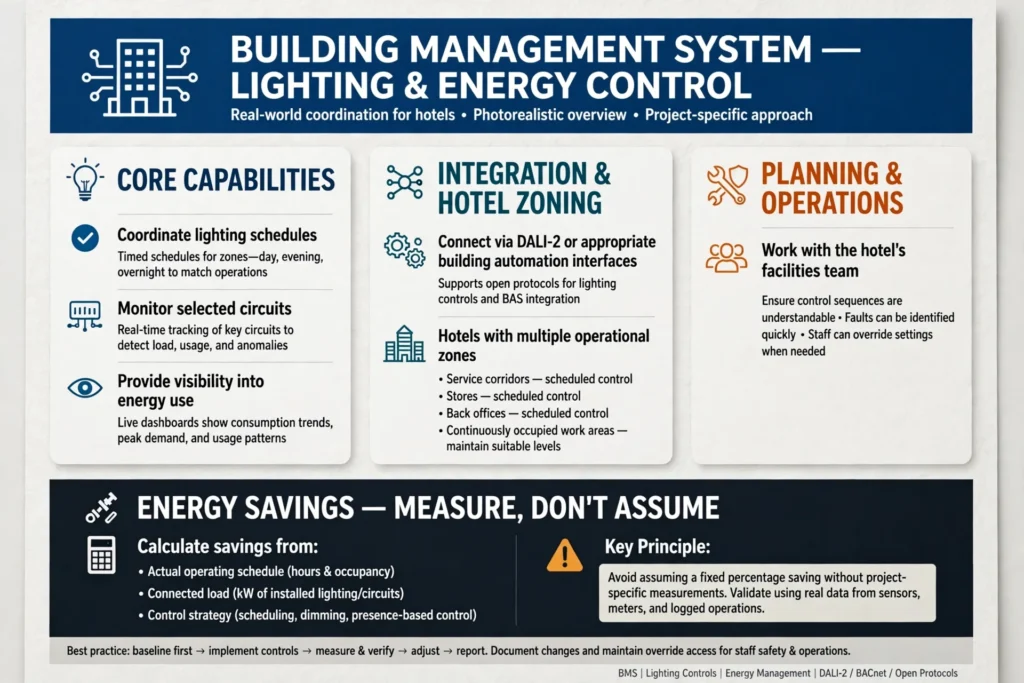
Hotels across Dubai, Abu Dhabi and Sharjah operate a wide range of properties, from business hotels and airport hotels to beach resorts, serviced apartments and large hospitality developments. Their back-of-house lighting needs vary according to kitchen capacity, laundry arrangements, operating hours and building services design.
In Dubai, hotels around Downtown Dubai, Business Bay, Dubai Marina and the Deira hospitality district may have different space constraints and operational layouts. Compact service corridors can require careful coordination between luminaires, ductwork, sprinkler systems, cable trays and access panels.
Abu Dhabi hospitality properties, including hotels serving business, leisure and event guests, may need lighting strategies that support extensive service operations and long operating schedules. In Sharjah, hotels and serviced accommodation properties also benefit from durable, efficient lighting designed around their actual room functions and maintenance capabilities.
Across the UAE, project teams should coordinate lighting specifications with the consultant, MEP contractor, facilities manager and relevant approval authorities. Climate-controlled interiors do not eliminate the need to consider humidity, heat from equipment, cleaning methods or the conditions of kitchens and laundry rooms.
How to Select a Hotel Back-of-House Lighting Supplier
Selecting a supplier involves more than comparing fixture prices or advertised wattage. Hotel operators and project consultants should check whether the proposed luminaires match the environmental conditions, illumination targets and operating requirements of each space.
A suitable supplier should be able to provide photometric data, product datasheets, IP ratings, colour temperature, CRI, power consumption, control compatibility and warranty details. For larger projects, lighting calculations or a Dialux/Relux simulation can help evaluate illuminance, uniformity, glare and fixture spacing before installation.
When comparing products, review lumen output, efficacy in lumens per watt, driver quality, flicker performance, thermal management and access to replacement components. The expected service life should be considered alongside the manufacturer’s conditions and warranty, rather than treated as a guarantee of maintenance-free operation.
Hotels planning new construction, refurbishment or energy upgrades can review suitable options through a Lighting for Hotel Back-of-House Supplier when evaluating lighting products for kitchens, laundry rooms, service corridors and other operational spaces. The final selection should be based on project specifications, verified technical information and the conditions at the installation site.
Installation, Commissioning and Maintenance
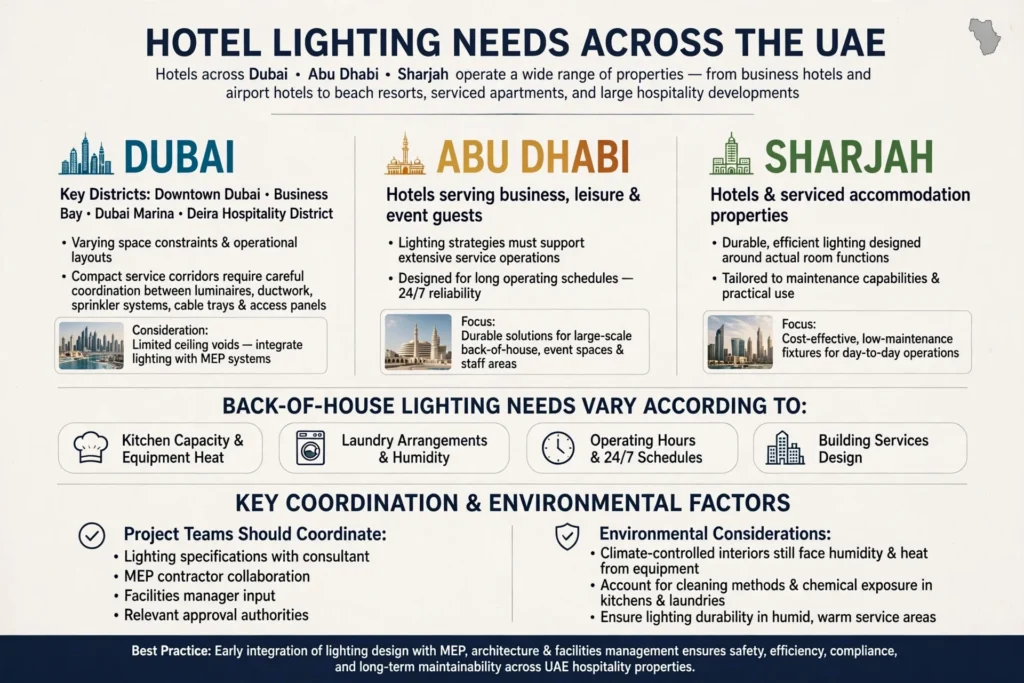
Even a well-specified luminaire can perform poorly if it is installed in the wrong position or operated with unsuitable controls. Before installation, the project team should verify ceiling construction, cable routes, equipment clearances, environmental exposure and access for future maintenance.
After installation, commissioning should confirm that the lights operate correctly, controls respond as intended and the illuminated work areas meet the design requirements. Measurements taken at relevant working surfaces can reveal underlit areas, glare problems or excessive illumination that was not apparent from the drawings.
Maintenance should include cleaning fixtures according to the manufacturer’s instructions, checking drivers and electrical connections, replacing failed components and testing lighting controls. Kitchen fixtures may need more frequent cleaning because of grease, while laundry rooms may require attention to lint and moisture.
Facilities teams should keep product information, circuit schedules, emergency lighting records and replacement specifications accessible. Using compatible replacement products helps maintain consistent light output and colour appearance across operational areas.
Common Hotel Back-of-House Lighting Mistakes
One common mistake is selecting fixtures based only on wattage. Wattage measures electrical input, not how effectively light reaches a work surface. Lumen output, beam distribution, mounting height, spacing and room reflectance must also be considered.
Another mistake is using the same fixture in dry corridors, wet dishwashing areas and high-temperature kitchen zones without checking the environmental requirements. This can lead to premature failures, difficult cleaning and unnecessary replacement costs.
Poor sensor placement is another problem. Lights may switch off while staff are still working, or remain on because sensors detect movement in neighbouring spaces. Controls should be tested under actual operating conditions before handover.
Finally, hotels sometimes overlook emergency lighting, maintenance access and long-term replacement availability. Considering these requirements during design can reduce operational disruption and help maintain safe, consistent illumination throughout the building.
Conclusion
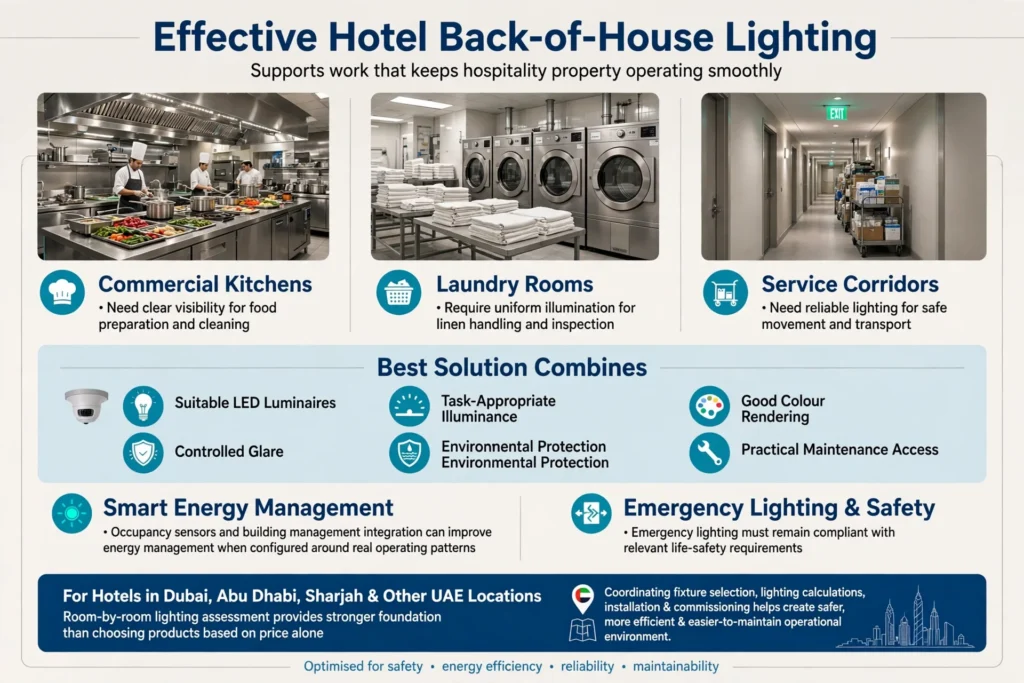
Effective hotel back-of-house lighting supports the work that keeps a hospitality property operating smoothly. Commercial kitchens need clear visibility for food preparation and cleaning, laundry rooms require uniform illumination for linen handling and inspection, and service corridors need reliable lighting for safe movement and transport.
The best solution combines suitable LED luminaires, task-appropriate illuminance, good colour rendering, controlled glare, appropriate environmental protection and practical maintenance access. Occupancy sensors and building management integration can improve energy management when configured around real operating patterns, while emergency lighting must remain compliant with the relevant life-safety requirements.
For hotels in Dubai, Abu Dhabi, Sharjah and other UAE locations, a room-by-room lighting assessment provides a stronger foundation than choosing products based on price alone. Coordinating fixture selection, lighting calculations, installation and commissioning helps create a safer, more efficient and easier-to-maintain operational environment.
Frequently Asked Questions
What type of lighting is best for hotel commercial kitchens?
Suitable LED battens, sealed linear luminaires and other commercial fixtures can work well when selected for the kitchen’s heat, grease, moisture and cleaning conditions. Uniform illumination, glare control and appropriate colour rendering are important. The final choice should reflect the specific cooking and preparation activities.
How many lux are needed in a hotel laundry room?
A general laundry area may use a preliminary target of around 200–300 lux, while detailed linen inspection and folding tasks may require approximately 300–500 lux. These are planning examples, not universal requirements. A lighting designer should confirm the maintained illuminance needed for the actual tasks and applicable standards.
What IP rating should hotel kitchen lighting have?
There is no single IP rating suitable for every kitchen. The correct rating depends on the risk of dust, splashes, water spray and cleaning procedures. Areas exposed to frequent washdown may need more protection than dry preparation or storage spaces. The complete fixture specification must also address heat, grease and chemical compatibility.
Is LED lighting energy-efficient for hotel service corridors?
LED lighting can reduce electricity consumption compared with less efficient technologies, particularly where service corridors operate for long periods. Proper fixture selection, effective lighting controls, correct scheduling and regular maintenance help determine the actual savings.
Can occupancy sensors be used in hotel back-of-house areas?
Yes. Sensors can be useful in selected stores, housekeeping rooms and occasional-use areas. Busy kitchens, laundry rooms and safety-critical routes need careful control design to prevent lights switching off unexpectedly. Emergency lighting must remain independent of ordinary occupancy-based shutoff.
Why is emergency lighting important in hotel service corridors?
Emergency lighting helps occupants and employees navigate designated escape routes when normal power fails. The system must be designed, installed, inspected and tested according to the applicable UAE fire and life-safety requirements and relevant authority approvals.