Hospitality lighting is one of the most important elements in the design of hotels, restaurants, resorts, cafés, lounges, and other guest-focused environments. Good lighting does much more than illuminate a space. It influences how guests perceive architecture, furniture, food, materials, colors, branding, comfort, and even the overall quality of their experience.
In the United Arab Emirates, hospitality lighting requires an especially considered approach. Hotels and restaurants operate in a competitive environment where design, comfort, technology, and memorable guest experiences can influence customer expectations. Properties in Dubai, Abu Dhabi, Sharjah, Ras Al Khaimah, and other UAE destinations also need lighting systems that perform reliably in demanding climatic and operational conditions.
A successful hospitality lighting strategy combines ambient lighting, accent lighting, task lighting, decorative lighting, architectural lighting, LED technology, lighting controls, color temperature, color rendering index (CRI), glare management, energy efficiency, and smart automation.
The objective is not simply to make a property bright. The objective is to create the right visual environment for every guest interaction.
Why Lighting Matters in Hospitality Design
Lighting can change the perceived character of a hospitality environment within seconds.
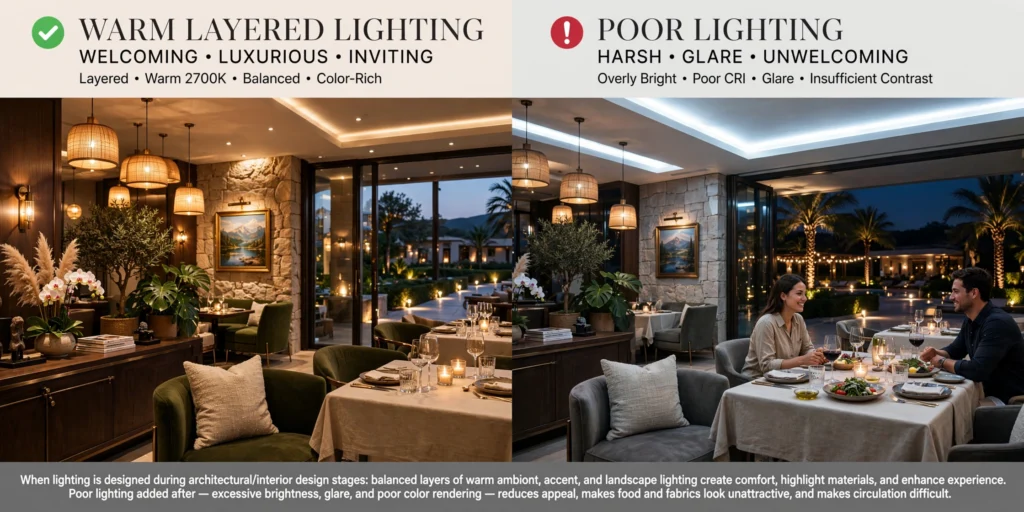
A hotel lobby with warm layered lighting can feel welcoming and luxurious. A restaurant with carefully controlled accent lighting can create intimacy around dining tables. A resort can use landscape lighting to make outdoor spaces feel inviting after sunset.
Poor lighting can have the opposite effect.
Excessive brightness can create discomfort and glare. Insufficient illumination can make circulation areas difficult to navigate. Poor color rendering can make food, fabrics, artwork, and architectural materials appear less attractive.
This is why lighting should be considered during the architectural and interior design stages rather than added after the space has been completed.
Understanding the Different Layers of Hospitality Lighting
Professional hospitality lighting usually combines several lighting layers.
Ambient lighting provides general illumination throughout a space.
Task lighting provides focused illumination for activities such as reading, working, food preparation, reception operations, or grooming.
Accent lighting highlights specific objects or architectural elements such as artwork, feature walls, sculptures, merchandise, or landscaping.
Decorative lighting contributes to the visual identity of the interior through chandeliers, pendants, wall sconces, and statement fixtures.
Architectural lighting can be integrated into ceilings, walls, floors, steps, niches, and architectural details.
Combining these layers creates depth instead of producing a flat environment where every surface has the same level of illumination.
Hospitality Lighting for Hotel Lobbies
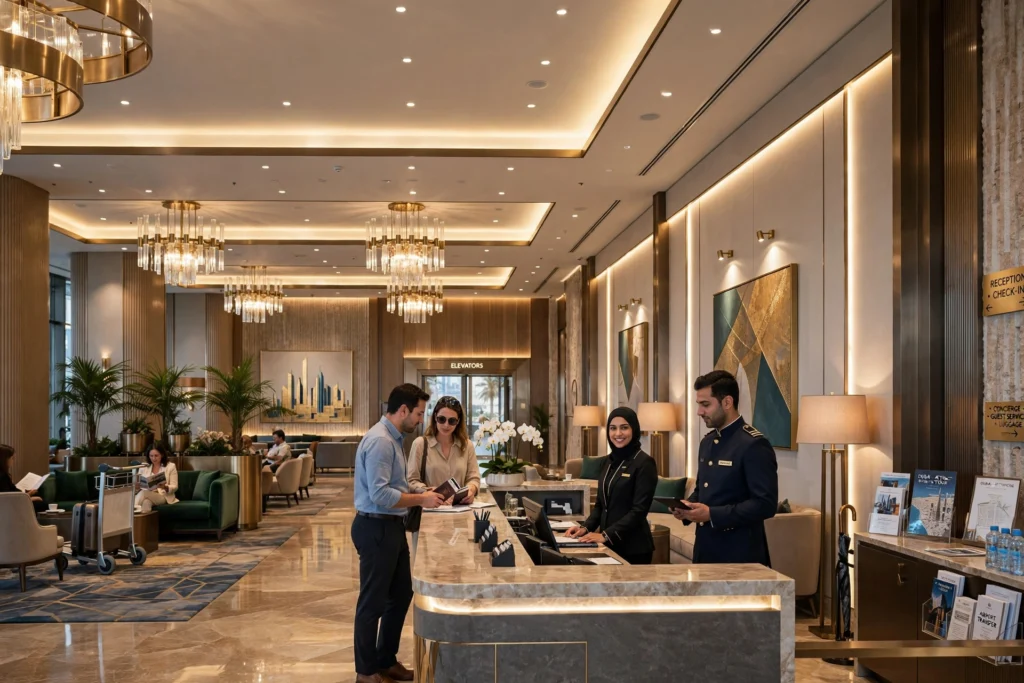
The hotel lobby is often the first major interior space experienced by a guest.
Lighting needs to create a strong arrival experience while supporting practical activities such as check-in, waiting, navigation, and concierge services.
A hotel lobby may combine recessed downlights, concealed cove lighting, decorative chandeliers, wall washers, floor lamps, accent lighting, and architectural linear LEDs.
The reception desk should receive sufficient task illumination without producing uncomfortable glare for guests or reception staff.
Feature walls and artwork can be highlighted with carefully positioned accent fixtures.
The goal is to create a hierarchy where important architectural and functional elements receive appropriate visual emphasis.
Luxury Hotel Lobby Lighting in Dubai
Dubai’s hospitality market includes luxury hotels, resorts, serviced apartments, boutique properties, and business hotels.
Luxury environments often benefit from sophisticated lighting rather than excessive illumination.
A large chandelier can provide a dramatic focal point in a double-height lobby.
Linear lighting can emphasize architectural geometry.
Wall washing can reveal the texture of marble or stone.
Warm accent lighting can create a sense of intimacy around lounge seating.
For high-end properties, lighting fixtures should also complement materials such as marble, brass, bronze, timber, glass, natural stone, decorative plaster, and luxury textiles.
The lighting design should make these materials look intentional and refined.
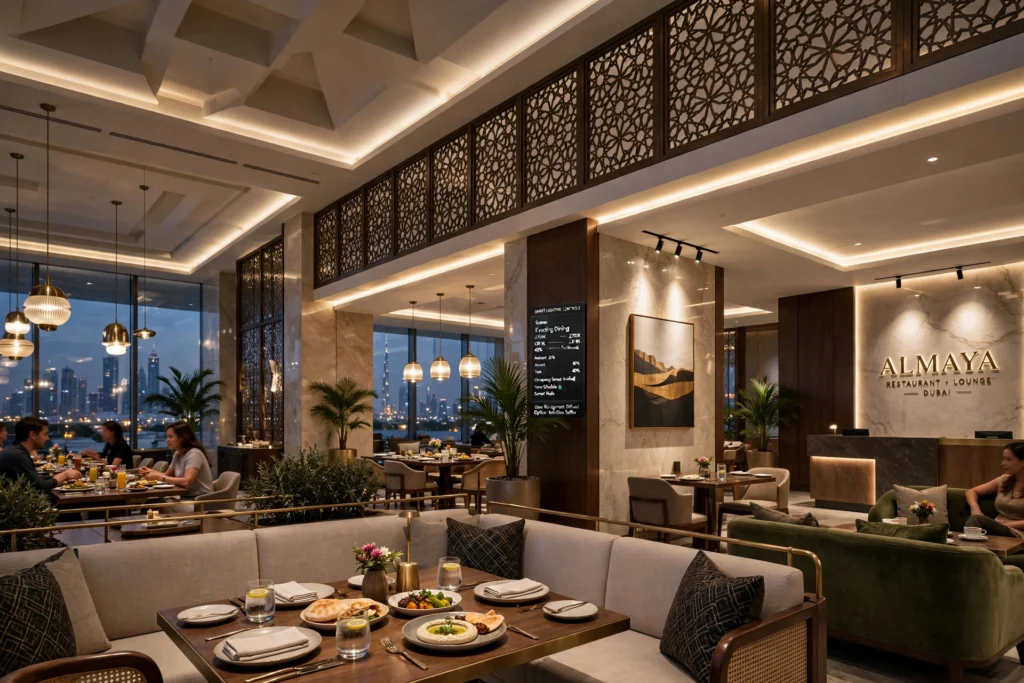
Restaurant Lighting Design
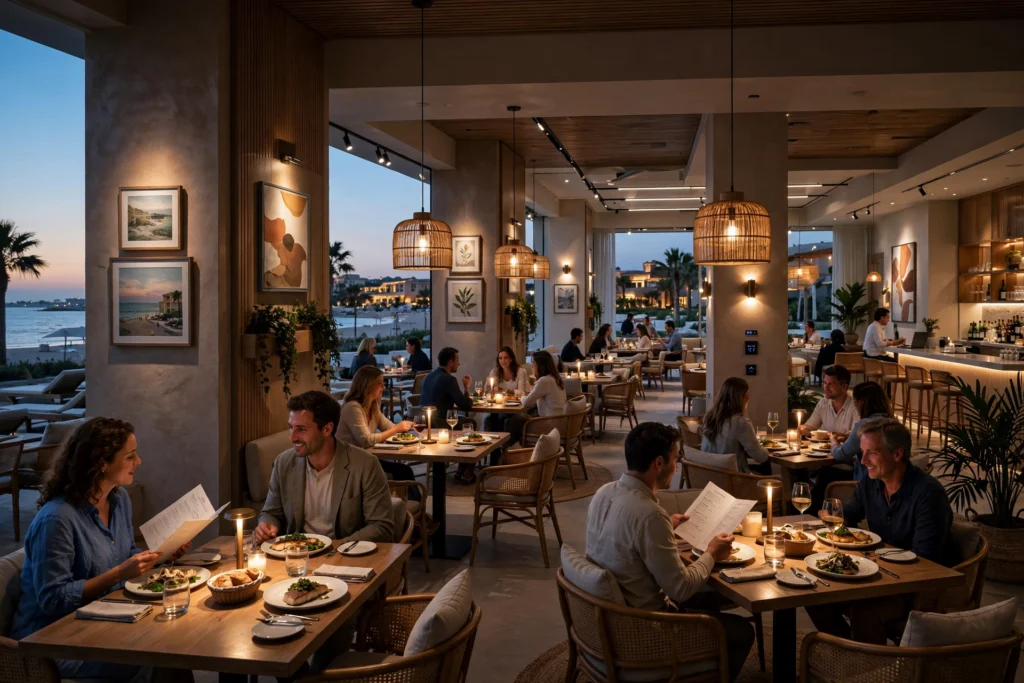
Restaurant lighting needs to balance atmosphere with functionality.
Guests need enough light to comfortably read menus, see food, communicate with companions, and move safely through the space.
At the same time, restaurants often benefit from a more intimate atmosphere than offices or retail environments.
Lighting can be used to create visual zones.
Dining tables can receive focused illumination while surrounding areas remain slightly darker.
Decorative pendants can define individual tables.
Wall lighting can create depth.
Accent lighting can highlight artwork or architectural features.
The restaurant’s concept should determine the lighting character.
A fine-dining restaurant may use sophisticated, low-glare lighting.
A casual café may require brighter and more energetic illumination.
A beach resort restaurant may combine warm decorative lighting with landscape illumination.
Lighting for Hotel Restaurants and Bars
Bars and hotel restaurants often operate for extended hours, meaning lighting needs to adapt throughout the day.
A space may require brighter illumination during breakfast and a more atmospheric environment during evening service.
Dimmable lighting systems can support these changes.
Lighting scenes can be programmed for different operating periods.
For example, a breakfast scene can provide higher ambient illumination, while an evening dining scene can emphasize decorative and accent lighting.
This creates flexibility without requiring staff to manually adjust individual fixtures.
Resort Lighting in the UAE
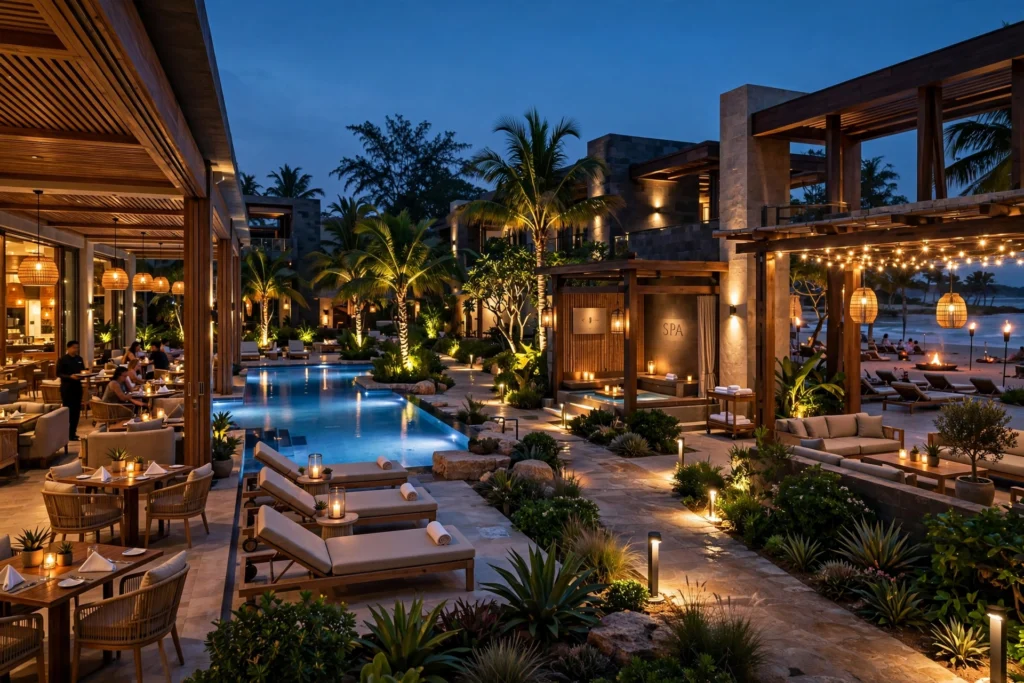
Resorts present different lighting challenges because they combine indoor and outdoor environments.
A resort may include hotel rooms, restaurants, pools, gardens, walkways, terraces, spas, lounges, beach areas, and entertainment spaces.
Outdoor lighting should provide safe navigation while preserving the atmosphere of the property.
Pathway lighting can guide guests.
Landscape lighting can highlight trees and architectural elements.
Pool lighting can create visual interest.
Terrace lighting can make outdoor dining areas more comfortable after sunset.
However, outdoor fixtures need to be selected according to environmental conditions, including humidity, dust, temperature, and exposure to water.
Hospitality Lighting and Guest Experience
Lighting influences mood and perception.
Warm light can create a comfortable and relaxing atmosphere.
Cooler light can feel more energetic and functional.
However, color temperature should not be selected in isolation.
The interior materials, natural daylight, activity, property concept, and desired atmosphere should all be considered.
A hotel bedroom, for example, needs different lighting from a conference room.
A spa needs different lighting from a commercial kitchen.
A restaurant dining area needs different lighting from a parking entrance.
The lighting strategy should therefore follow the purpose of each space.
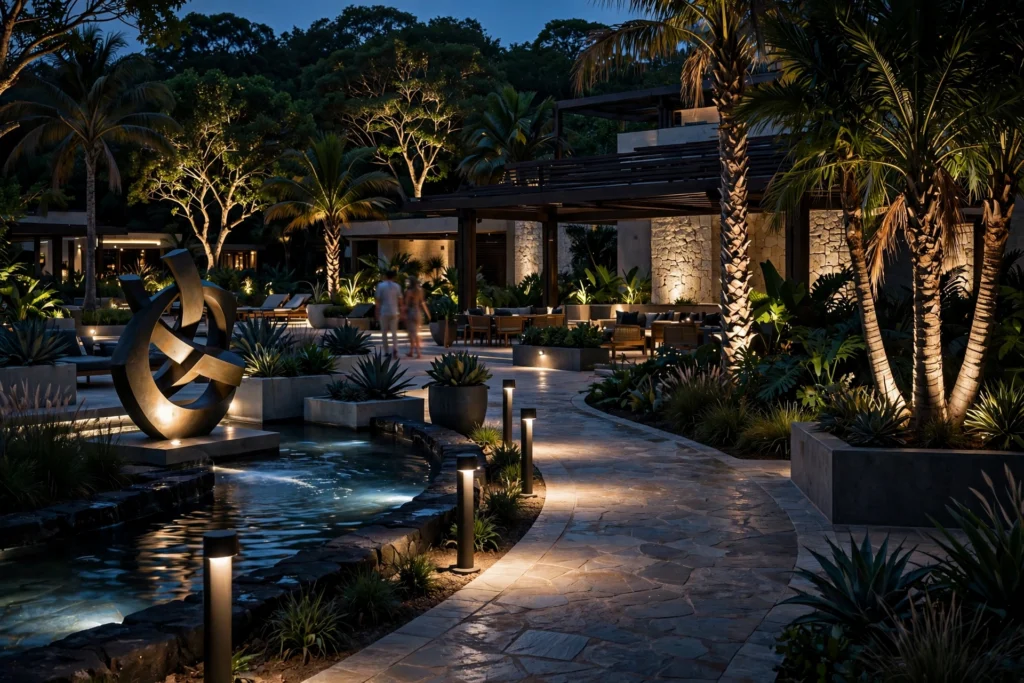
Color Temperature in Hospitality Lighting
Color temperature is generally expressed in Kelvin (K).
Lower color temperatures typically create warmer, more amber-toned light.
Higher color temperatures generally produce cooler-looking light.
Hospitality environments frequently use warm or neutral-warm lighting to create comfortable atmospheres, although the appropriate specification depends on the application.
Guest rooms, restaurants, lounges, and reception environments may benefit from warmer lighting.
Service areas, kitchens, storage areas, and certain operational spaces may require different illumination characteristics.
Consistency is also important.
Mixing incompatible color temperatures within the same visual zone can make the environment appear uncoordinated.
Why CRI Matters in Hotels and Restaurants
The Color Rendering Index (CRI) indicates how accurately a light source reveals colors compared with a reference source.
High-quality color rendering is particularly important in restaurants because food presentation is part of the guest experience.
It is also valuable in hotels where interior materials, artwork, textiles, skin tones, and finishes need to appear natural.
A marble wall, wooden surface, artwork, or plated dish can look significantly different under different light sources.
For premium hospitality interiors, lighting specifications should therefore consider CRI alongside wattage and color temperature.
LED Lighting for Hospitality Projects
LED technology has become an important part of modern hospitality lighting because of its efficiency, controllability, long operating life, compact form factor, and design flexibility.
LED fixtures can be integrated into:
- Recessed downlights
- Spotlights
- Linear profiles
- Cove lighting
- Pendant fixtures
- Wall washers
- Step lighting
- Under-counter lighting
- Decorative fixtures
- Landscape lighting
- Exterior architectural lighting
LED systems can also support dimming and smart control technologies when compatible components are specified.
For hotels operating continuously, efficient lighting can contribute to reduced electricity consumption and lower maintenance requirements.
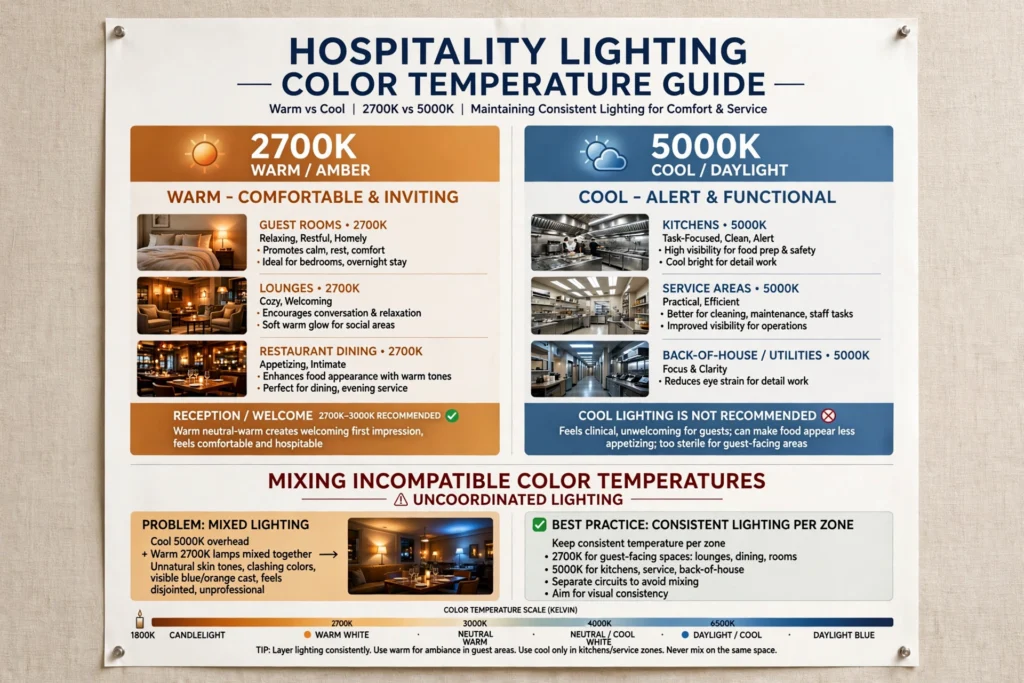
Linear LED Lighting in Hospitality Interiors
Linear lighting is particularly useful for contemporary hospitality architecture.
It can be installed along ceilings, walls, corridors, furniture, reception counters, staircases, and architectural details.
A concealed linear LED profile can create a continuous glow without exposing the light source directly.
This can emphasize architectural geometry while maintaining a clean appearance.
In hotel corridors, linear lighting can create visual direction.
In restaurants, it can highlight ceiling structures.
In reception areas, it can emphasize the shape of a custom desk.
The integration should be planned during construction so that profiles, drivers, wiring, and access points remain properly concealed.
Lighting Hotel Guest Rooms
Guest-room lighting needs to accommodate several activities.
Guests may sleep, read, work, dress, relax, use electronic devices, or prepare for the day.
A well-designed room may include bedside reading lights, general ceiling illumination, wardrobe lighting, desk lighting, vanity lighting, decorative lamps, and bathroom illumination.
Controls should be easy to understand.
Guests should not have to search for multiple switches to create a comfortable lighting environment.
Bedside controls can improve convenience, particularly in higher-end hotels.
Motion sensors can also be used in selected areas such as wardrobes or bathrooms when appropriate.
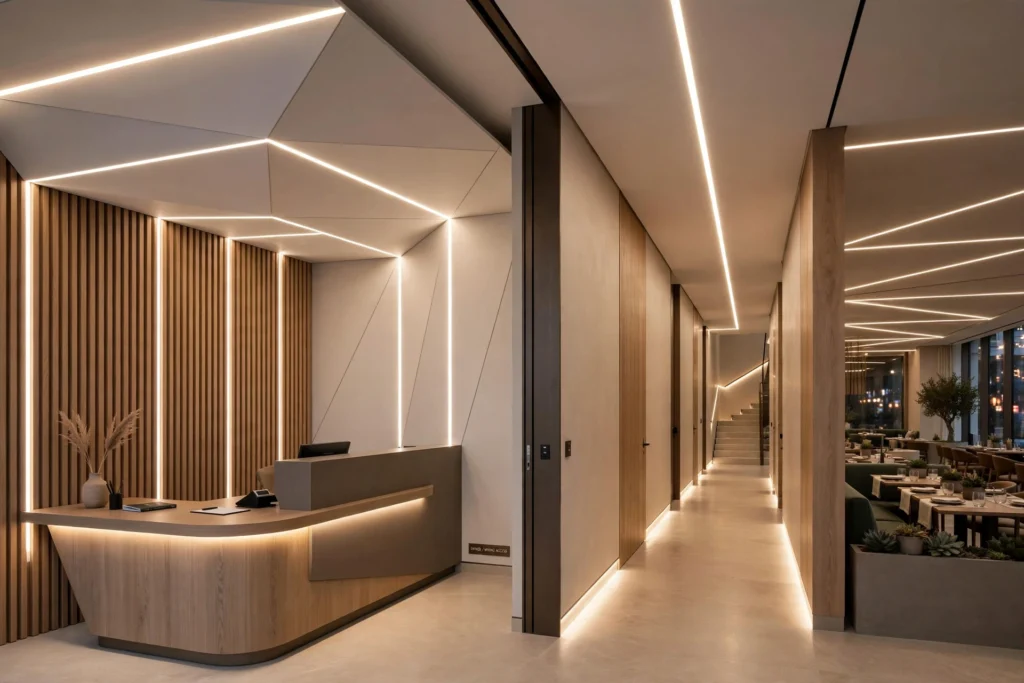
Bathroom and Vanity Lighting
Hotel bathrooms require careful lighting because guests use mirrors for grooming.
Lighting positioned around or beside the face can reduce shadows compared with relying entirely on a ceiling-mounted fixture.
High-quality color rendering is also valuable in bathrooms.
Lighting should also be appropriate for wet-area conditions and installed according to applicable electrical safety requirements.
A luxury bathroom may combine mirror lighting, recessed ceiling fixtures, decorative wall lighting, shower illumination, and concealed architectural lighting.
Corridor and Staircase Lighting
Hotel corridors should provide safe and comfortable navigation without feeling excessively bright.
Wall lights, recessed fixtures, linear LEDs, and indirect lighting can be used to create visual rhythm.
Staircases require careful illumination of steps and transitions.
Step lighting can improve visibility while also becoming an architectural feature.
Lighting should avoid excessive glare, especially in locations where guests are walking or changing direction.
Lighting for Hospitality Facades
Exterior lighting helps establish a hotel’s identity after sunset.
Architectural facade lighting can emphasize building geometry, entrance structures, columns, signage, or landscape features.
The design should avoid excessive brightness and unnecessary light spill.
Careful beam angles can direct illumination toward intended surfaces.
This creates visual impact while helping maintain a controlled nighttime environment.
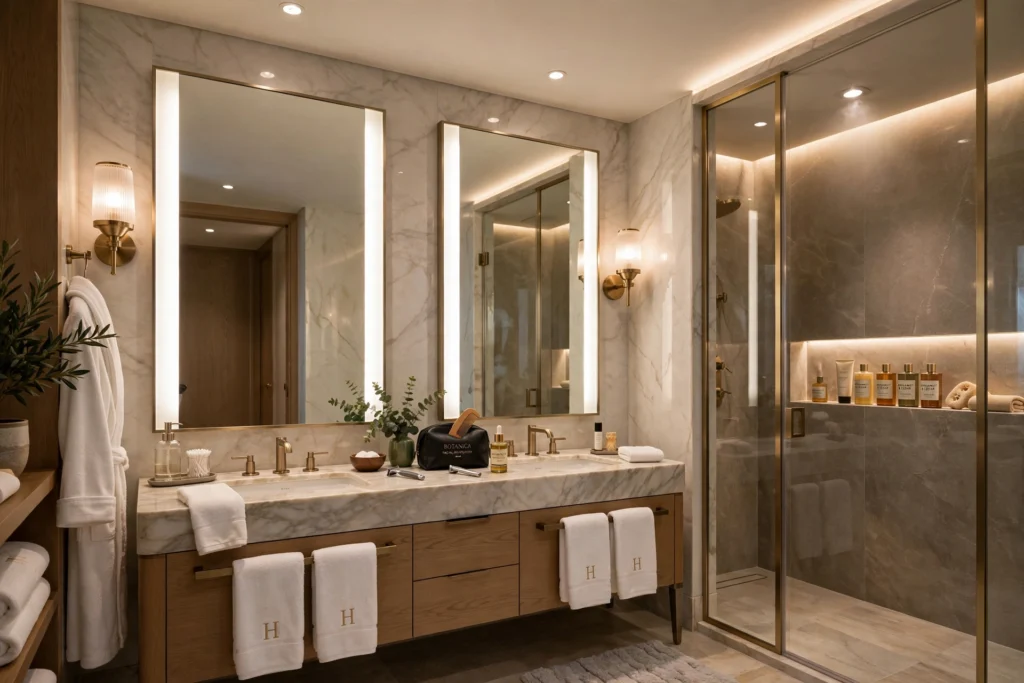
Landscape Lighting for Hotels and Resorts
Landscape lighting can transform gardens and outdoor hospitality spaces.
Trees, palms, pathways, water features, sculptures, planters, and architectural elements can be selectively illuminated.
The strongest landscape designs avoid lighting every object equally.
Instead, they create layers of brightness and shadow.
This produces depth and allows guests to move naturally through the space.
Outdoor lighting fixtures should be selected for durability and suitable ingress protection based on their installation environment.
Lighting for Outdoor Restaurants and Terraces
Outdoor dining has become an important part of hospitality design in the UAE.
Restaurants, hotels, rooftop lounges, and resorts may operate outdoor seating areas for significant portions of the year.
Lighting needs to provide sufficient visibility while maintaining the intended atmosphere.
Pendant lights, wall sconces, festoon-style decorative fixtures, recessed lights, bollards, and concealed LED systems can all be used depending on the architectural concept.
Fixtures should be positioned so that they do not shine directly into guests’ eyes.
Smart Lighting Controls for Hospitality
Modern hospitality projects can use lighting control systems to improve flexibility and efficiency.
Systems may include dimming, occupancy sensors, daylight sensors, timers, scene control, centralized management, and integration with building automation systems.
A hotel can create different lighting scenes for different operational periods.
A restaurant can change lighting levels between lunch and dinner.
A conference facility can adjust lighting according to event requirements.
Smart controls can also help facilities teams monitor and manage lighting across larger properties.
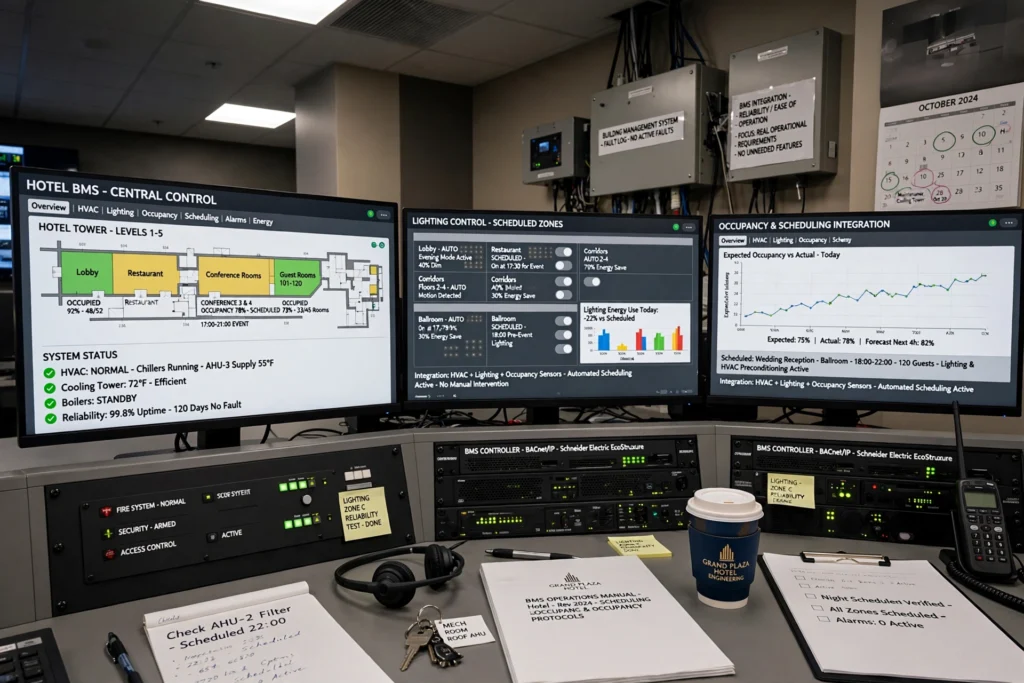
Integration With Building Management Systems
Large hotels and commercial hospitality properties often use Building Management Systems (BMS) to monitor and control building services.
Lighting can potentially integrate with HVAC, occupancy information, scheduling, and other building systems.
For example, lighting in selected areas can be scheduled according to expected occupancy.
This type of integration should be designed carefully to ensure reliability and ease of operation.
The goal is not to add technology simply because it is available. Technology should solve a real operational requirement.
Energy Efficiency in UAE Hospitality Lighting
Hotels and resorts can have substantial lighting requirements because many areas operate for long periods.
Energy-efficient lighting design should therefore consider both fixture efficiency and operational control.
LED luminaires, occupancy sensors, daylight-responsive controls, dimming, scheduling, and centralized monitoring can all contribute to more efficient operation.
However, efficiency should not come at the expense of guest comfort.
Reducing light levels excessively may save energy but can create poor visibility and an undesirable atmosphere.
A better strategy is to provide the appropriate amount of light for each task and control it intelligently.
Lighting and UAE Climate Conditions
Outdoor and semi-outdoor hospitality lighting must account for the UAE environment.
High temperatures, dust, humidity, and exposure to sunlight can affect lighting equipment.
For coastal properties, salt-laden air can create additional challenges for external equipment and metal finishes.
Fixture selection should therefore consider environmental exposure, ingress protection, thermal management, materials, and maintenance access.
For outdoor installations, the product specification should match the actual environment rather than relying solely on general-purpose fixtures.
Lighting for Different Hospitality Locations Across the UAE
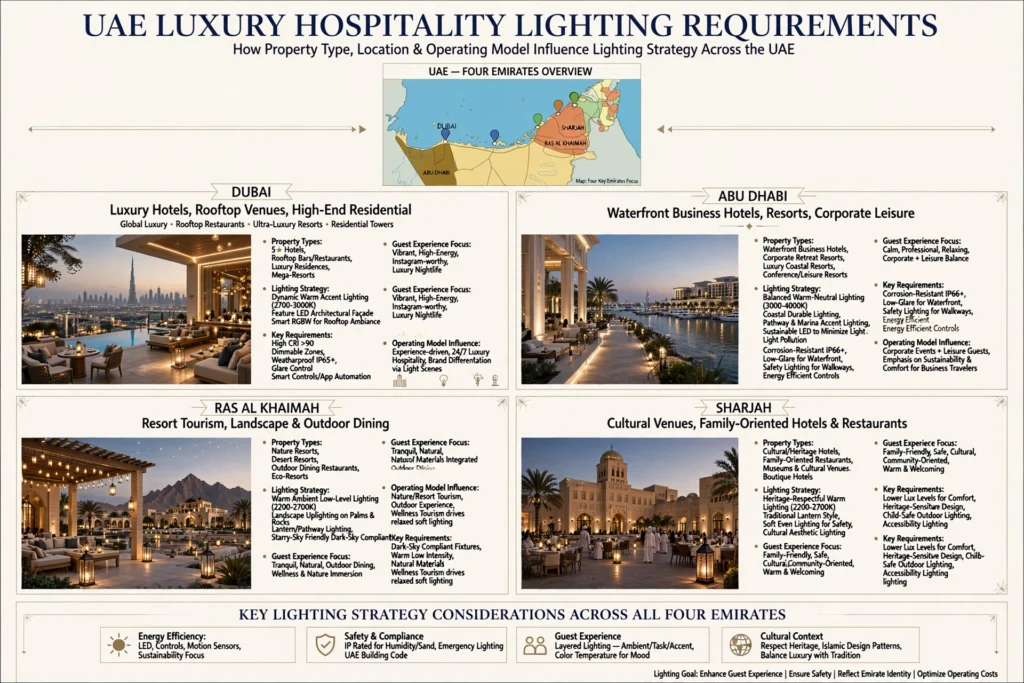
Hospitality lighting requirements can differ considerably between emirates and property types.
In Dubai, luxury hotels, restaurants, rooftop venues, resorts, and high-end residential hospitality environments may emphasize sophisticated architectural lighting and guest experience.
Abu Dhabi includes luxury hotels, waterfront properties, business hotels, restaurants, and resorts where lighting must support both leisure and corporate hospitality.
Ras Al Khaimah has a strong resort and tourism environment where landscape, outdoor dining, and architectural lighting can contribute significantly to guest experience.
Sharjah combines hotels, restaurants, cultural venues, and family-oriented hospitality spaces with different design requirements.
The property’s location, architecture, target market, and operating model should influence the lighting strategy.
Choosing the Right Hospitality Lighting Partner
Selecting lighting equipment is only one part of a successful project.
Hospitality operators, architects, interior designers, consultants, contractors, and developers should consider product quality, technical specifications, warranty support, availability, compatibility, installation requirements, and after-sales service.
A reliable hospitality lighting supplier should be able to support project requirements with appropriate commercial lighting products and technical information.
For larger projects, coordination between the lighting supplier, MEP consultant, interior designer, electrical contractor, and project management team can help prevent compatibility and installation problems.
Common Hospitality Lighting Mistakes
One common mistake is using the same lighting approach throughout an entire property.
A hotel lobby, restaurant, guest room, kitchen, corridor, spa, and outdoor terrace have completely different requirements.
Another mistake is selecting fixtures based only on appearance.
A decorative fitting may look attractive but provide inadequate illumination or create excessive glare.
Other problems include poor color rendering, inconsistent color temperature, insufficient dimming capability, exposed wiring, inaccessible drivers, inadequate outdoor protection, and poor maintenance planning.
Good lighting design considers the entire lifecycle of the installation.
How to Plan a Hospitality Lighting Project
A successful lighting project should begin with an understanding of the property.
The design team should evaluate architecture, interior materials, room functions, natural daylight, occupancy, operating hours, brand identity, maintenance requirements, and energy objectives.
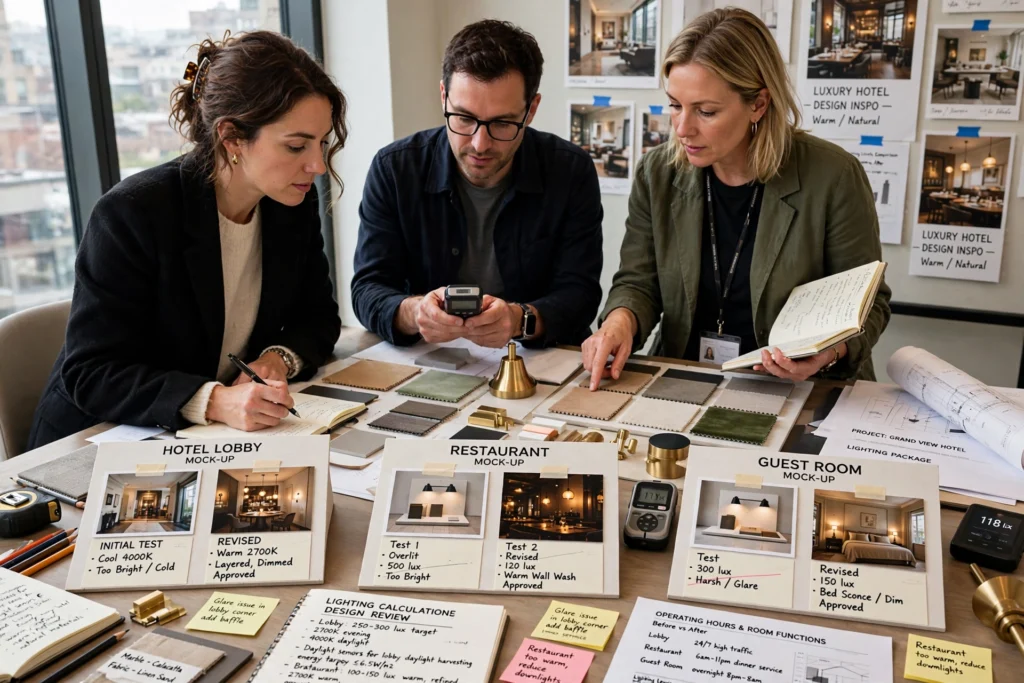
Lighting calculations can help determine whether proposed fixtures provide appropriate illumination.
Mock-ups and sample installations can be useful for high-profile spaces.
A hotel lobby, restaurant, or guest room may look significantly different once the actual fixtures, finishes, and lighting levels are combined.
Testing important areas before full installation can help identify problems early.
The Future of Hospitality Lighting in the UAE
Hospitality lighting is becoming increasingly integrated with architecture, automation, energy management, and guest experience.
Future projects are likely to place greater emphasis on adaptable lighting, connected controls, efficient LED systems, human comfort, architectural integration, and data-driven building management.
The focus is also moving away from simply increasing brightness.
Modern hospitality environments need lighting that is comfortable, purposeful, efficient, visually engaging, and adaptable.
This is particularly important in a market such as the UAE, where hospitality properties compete heavily on design and experience.
Conclusion
Hospitality lighting design for hotels, restaurants, and resorts requires a balance between aesthetics, functionality, energy efficiency, guest comfort, and technical performance.
The strongest projects combine ambient, task, accent, decorative, and architectural lighting to create a layered environment. LED technology provides flexibility for everything from hotel guest rooms and restaurant tables to reception areas, facades, landscapes, pools, corridors, and outdoor terraces.
Color temperature, CRI, glare control, dimming, lighting controls, smart systems, and environmental protection should all be considered during the planning stage.
In Dubai, Abu Dhabi, Sharjah, Ras Al Khaimah, and other UAE hospitality markets, lighting can become an important part of the overall guest experience. A well-designed system does not simply illuminate a hotel or restaurant. It reveals architectural materials, creates atmosphere, supports navigation, highlights branding, improves functionality, and helps visitors feel comfortable within the space.
The most successful hospitality lighting strategy is therefore one that brings architecture, interior design, technology, operations, and human experience together into one coherent lighting environment.