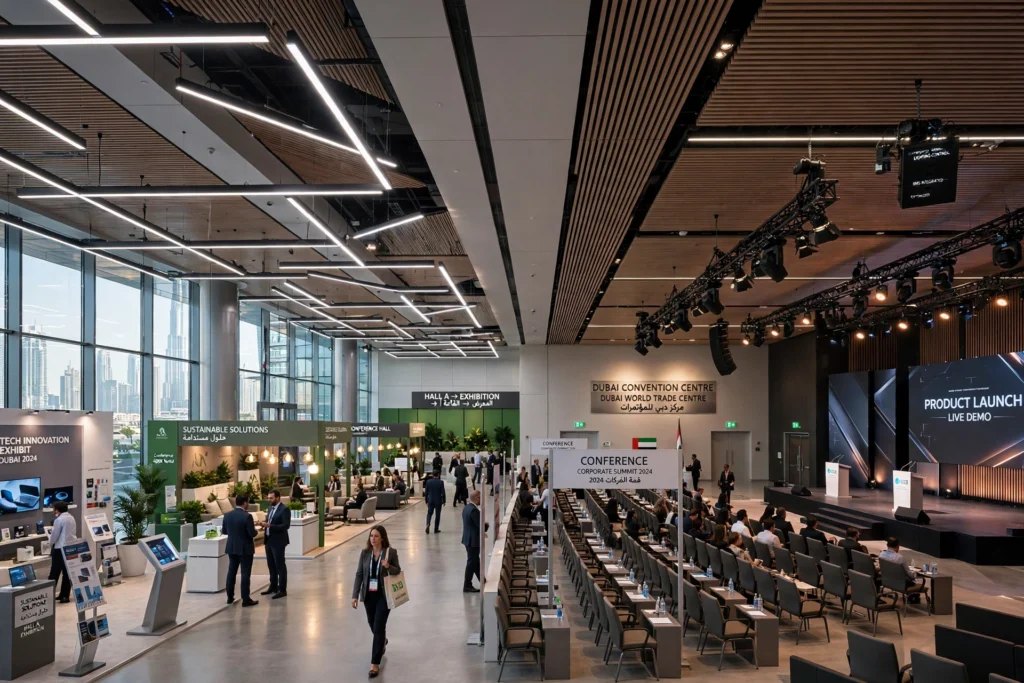
Convention centre lighting design is about much more than making a large venue bright. Modern convention centres need lighting that supports exhibitions, conferences, product launches, stage performances, networking events, media production, hospitality and visitor movement. A well-designed lighting system should provide visual comfort, flexibility, energy efficiency and reliable control across different spaces.
In the UAE, convention venues often host international exhibitions, corporate conferences, government events, entertainment programmes and large-scale trade shows. Facilities in Dubai and Abu Dhabi therefore need lighting systems capable of adapting quickly between different event formats. Effective design considers illuminance, colour temperature, glare, colour rendering, controls, emergency lighting, architectural features and integration with building management systems.
What Is Convention Centre Lighting Design?
Convention centre lighting design is the planning and specification of artificial and natural lighting throughout a large event facility. It can include exhibition hall lighting, conference room lighting, auditorium lighting, stage lighting, lobby illumination, registration areas, corridors, meeting rooms, hospitality areas, loading zones and back-of-house spaces.
Unlike ordinary commercial lighting, convention centres require highly flexible systems. One hall may be used for a technology exhibition during the day and a corporate gala or product launch in the evening. Lighting therefore needs to support different brightness levels, colour requirements and visual environments without requiring extensive physical changes.
Designers typically consider LED luminaires, linear lighting, high-bay fixtures, spotlights, downlights, wall washers, architectural lighting, emergency luminaires, occupancy sensors, daylight controls and programmable lighting systems.
Why Lighting Matters in Convention Centres
Lighting influences how visitors experience a venue from the moment they enter. Entrance areas and reception zones need welcoming illumination, while exhibition halls require practical lighting that allows products, graphics and displays to remain visible.
Conference spaces have additional requirements because speakers, presentation screens, cameras and audiences must all work within the same visual environment. Excessive glare can affect presentations and video conferencing, while poor colour rendering can make products and branded displays appear inaccurate.
For exhibition organisers, lighting can also affect photography and video production. Events are increasingly shared through social media, livestreaming and professional media coverage, making consistent and controllable illumination an important part of venue design.
Exhibition Hall Lighting
Exhibition halls are among the most demanding areas in a convention centre. They can contain hundreds of individual booths, large displays, suspended signs, digital screens and temporary structures.
A good exhibition hall lighting system provides sufficient general illumination while allowing exhibitors to add their own task and accent lighting. High-bay LED fixtures are commonly considered for large spaces because they can deliver broad, efficient illumination from considerable mounting heights.
The lighting layout should also consider column locations, ceiling structures, suspended banners, exhibition rigging and temporary booth walls. Poorly positioned luminaires can create shadows or glare when exhibitors install tall structures.
For venues hosting frequent exhibitions, programmable lighting zones can make it easier to create different layouts for trade shows, conferences, public events and maintenance activities.
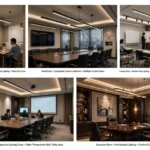
Conference and Meeting Room Lighting
Conference rooms require a more controlled lighting environment than large exhibition halls. Participants need comfortable illumination for reading documents, communicating with other attendees and viewing presentation screens.
Direct lighting should be positioned carefully to reduce reflections on displays and avoid excessive brightness behind speakers. Indirect or diffused lighting can help create a more comfortable visual environment.
Dimmable LED fixtures allow venue operators to adjust illumination depending on whether a room is being used for a presentation, workshop, meeting or networking session.
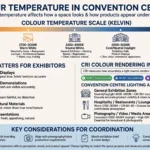
Colour temperature is another consideration. Neutral white lighting around the 3500K–4000K range is commonly suitable for professional environments, although the appropriate specification depends on the room, finishes, daylight conditions and event requirements.
Auditorium and Conference Stage Lighting
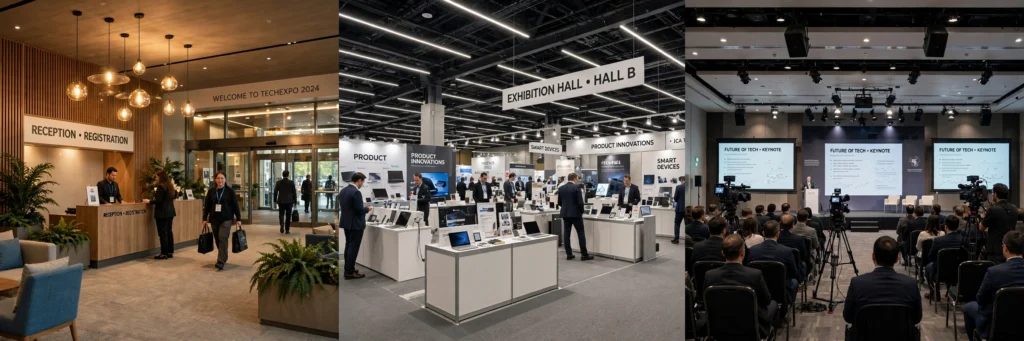
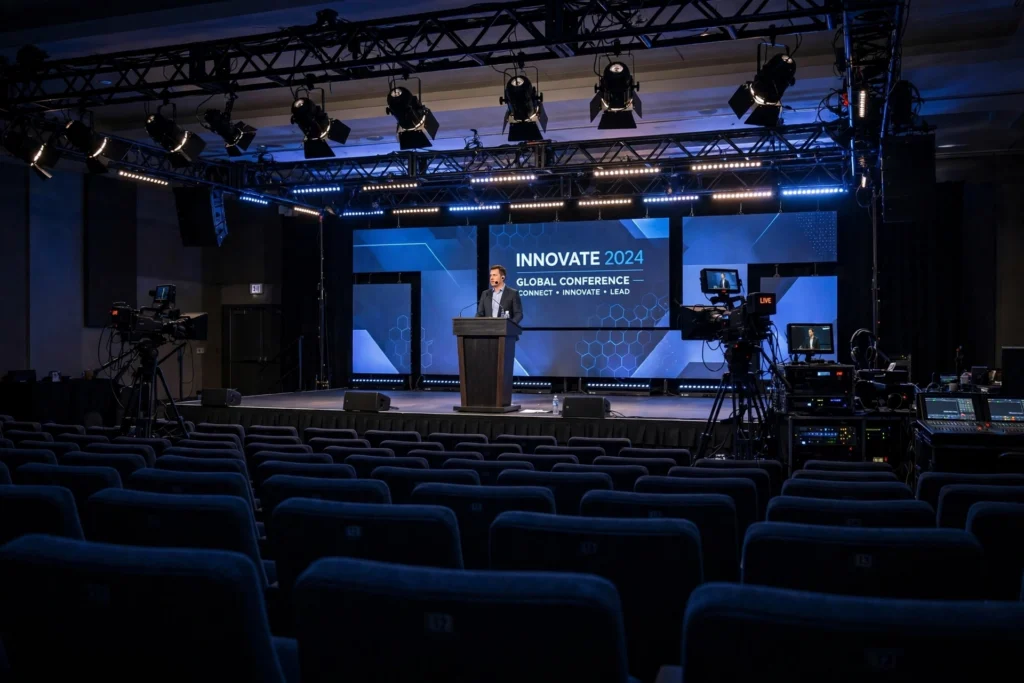
Auditoriums and conference stages require lighting that serves both the audience and the production team. General audience illumination may need to be reduced during presentations, while the stage requires controlled lighting for speakers, performers and branded backgrounds.
Stage lighting can include profile fixtures, Fresnel fixtures, LED panels, wash lights and other professional event lighting equipment. These systems are normally planned separately from the building’s general illumination but should work together operationally.
For corporate conferences, lighting should provide clear visibility of speakers without creating harsh shadows. For television, photography and livestreaming, colour consistency and flicker performance become particularly important.
Lobby and Entrance Lighting
The entrance is one of the first areas visitors experience. Convention centre lobbies often include registration desks, digital signage, information counters, branding walls and hospitality areas.
Lighting can be layered to provide general illumination, accent lighting and architectural emphasis. Downlights can provide ambient illumination, while linear LEDs or wall washers can highlight architectural surfaces and branding.
In large UAE venues, entrances may also experience significant visitor traffic during major exhibitions. Lighting therefore needs to remain comfortable and reliable throughout long operating hours.
Registration and Reception Area Lighting
Registration zones need clear visibility because visitors may be checking badges, scanning QR codes, collecting event materials or speaking with staff.
Uniform illumination is useful around counters and registration desks. Lighting should avoid strong shadows across faces and documents, particularly when identification or event credentials are being checked.
Digital displays and LED screens are also common in registration areas. Their brightness should be considered when positioning surrounding luminaires so that screens remain readable without excessive contrast or glare.
Lighting for Exhibition Booths
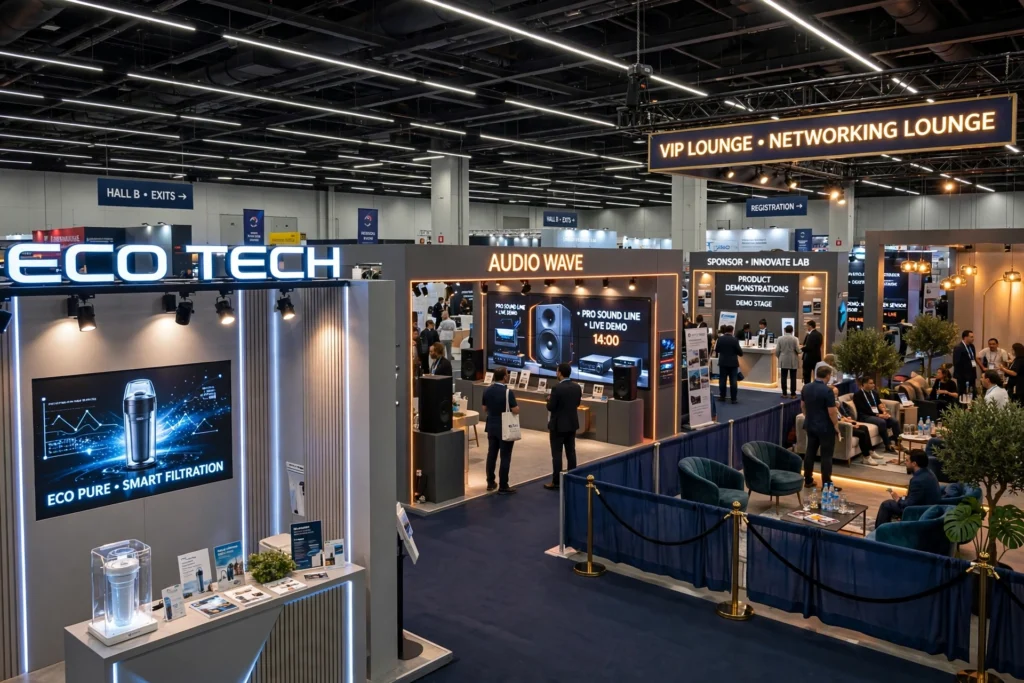
Although exhibitors often provide their own booth lighting, the convention centre’s base lighting still influences the overall environment.
Exhibitors may use spotlights, linear LEDs, illuminated signage, LED displays and architectural lighting to attract attention to their products. The surrounding hall lighting should therefore provide a consistent baseline without overpowering booth-specific illumination.
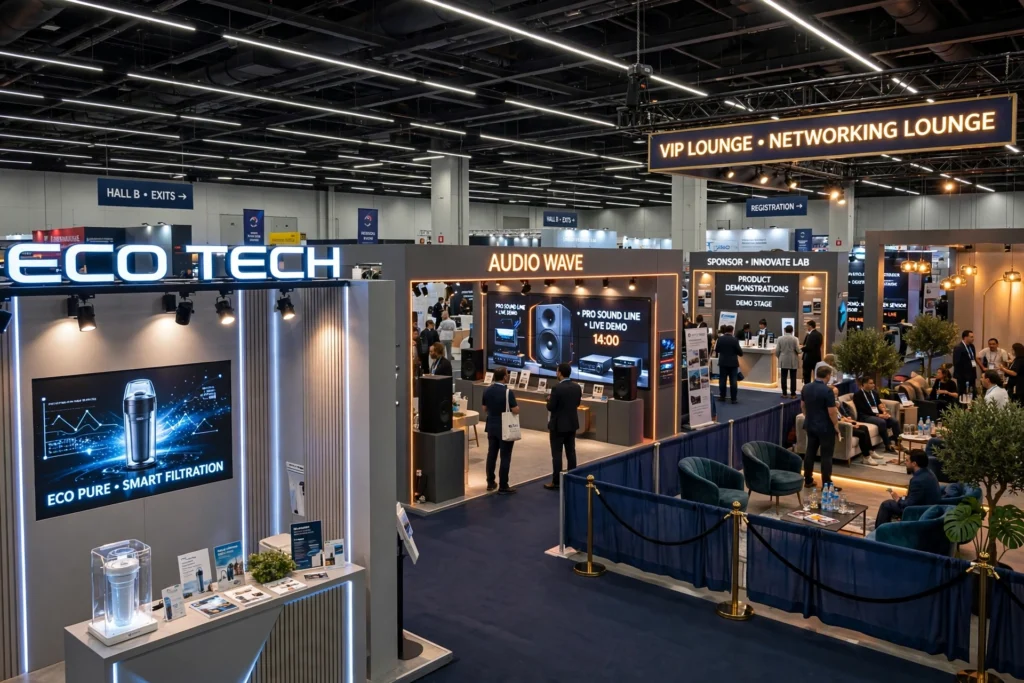
For premium exhibitions, organisers may also use controlled lighting zones to create different atmospheres for VIP areas, product demonstrations, networking lounges and sponsor installations.
LED Lighting for Convention Centres
LED technology is now widely used for large commercial and event facilities because it offers high efficiency, long operating life and extensive control possibilities.
LED luminaires can be specified for high-bay applications, downlights, linear fixtures, wall washing, architectural accents, emergency lighting and feature installations.
Another advantage is controllability. DALI, DMX and other lighting-control technologies can allow different fixtures or zones to be programmed according to venue requirements.
However, choosing LED lighting is not simply a matter of selecting the highest wattage or brightest fixture. Designers should evaluate lumen output, beam angle, colour temperature, colour rendering, glare, mounting height, operating environment and control compatibility.
Lux Levels and Lighting Uniformity
Illuminance is generally measured in lux and describes the amount of light reaching a surface. Different convention centre spaces require different lighting conditions.
An exhibition floor, meeting room, corridor, stage and service area should not necessarily have identical illumination. The design should instead establish appropriate levels for the activities performed in each space.
Uniformity is equally important. A venue with bright areas and deep shadows can feel uncomfortable and may create practical problems for visitors, exhibitors and event staff.
Lighting calculations and photometric simulations can help designers determine whether the proposed luminaires will deliver suitable coverage before installation.
Glare Control
Glare is a major consideration in convention centre lighting. High ceilings, polished floors, digital displays, glass surfaces and large presentation screens can all increase the potential for uncomfortable reflections.
UGR, or Unified Glare Rating, is commonly used when evaluating glare in interior lighting applications. The appropriate target depends on the room type and visual tasks.
Good glare control can involve suitable beam angles, diffusers, optical designs, fixture positioning, and lighting levels. It is particularly important in conference rooms, meeting spaces, and media areas.
Colour Rendering and Colour Temperature
Colour rendering affects how accurately people see colours under artificial light. This matters in exhibitions where companies display products, packaging, artwork, textiles, vehicles and branded materials.
CRI, or Colour Rendering Index, is one commonly used measure of colour rendering. Higher-quality lighting with appropriate colour rendering can help products and finishes appear more natural.
Colour temperature also influences the atmosphere. Cooler white lighting may create a crisp environment suitable for some exhibitions, while neutral white can provide a balanced appearance for conferences and corporate spaces.
The important consideration is consistency. Mixing visibly different colour temperatures in the same visual zone can make a professional venue appear disjointed.
Daylight Integration
Some convention centres have large glazed entrances, skylights or perimeter windows that introduce daylight into public spaces.
Daylight can improve visitor comfort and reduce the need for artificial lighting under suitable conditions. However, uncontrolled daylight can also create glare and uneven illumination.
Lighting controls can respond to changing daylight levels by dimming selected LED zones. This can reduce unnecessary energy consumption while maintaining appropriate illumination.
Designers should consider the orientation of glazing, solar exposure, window treatments, reflective surfaces and event schedules when integrating daylight.
Smart Lighting Controls
Large convention facilities can benefit from intelligent lighting controls because different spaces are rarely used in exactly the same way every day.
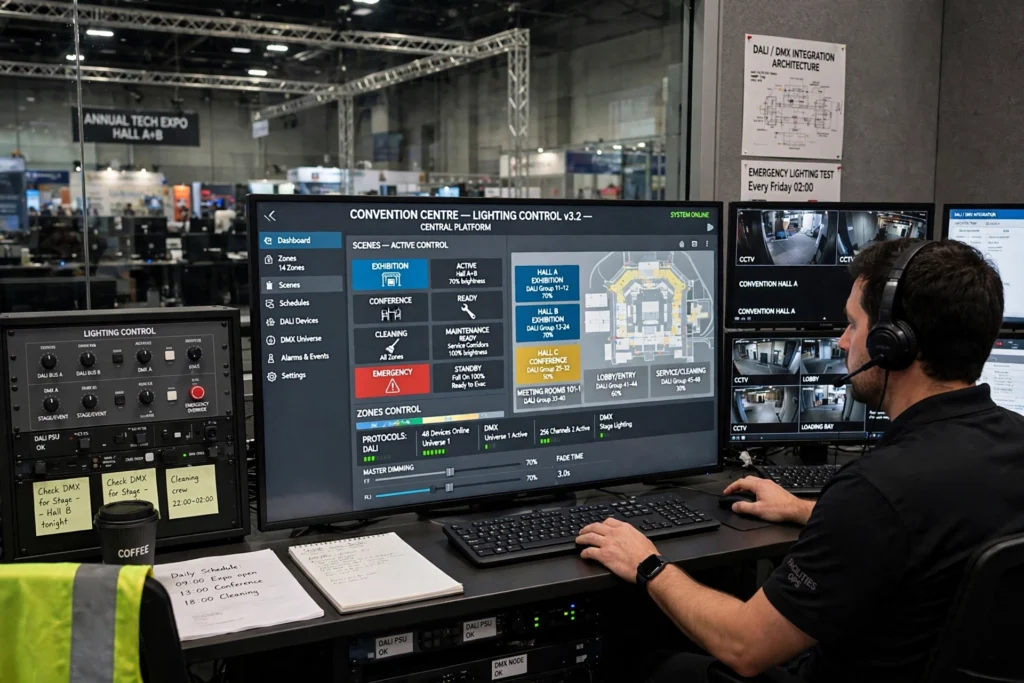
A central control platform can allow operators to manage lighting zones, schedules, scenes and dimming levels. Preset scenes can be created for exhibitions, conferences, cleaning, maintenance, public events and emergency situations.
DALI-based systems can provide individual or grouped control of compatible luminaires. DMX is frequently associated with entertainment and stage environments where more dynamic control is required.
The selected control architecture should match the operational needs of the venue rather than adding technology simply for its own sake.
Integration With Building Management Systems
Convention centre lighting can also interact with a Building Management System (BMS). Integration can help facility teams monitor and manage lighting alongside HVAC, energy consumption and other building services.
For example, lighting schedules can correspond with event bookings and operating hours. Occupancy information can also support automatic control in meeting rooms, offices, corridors and service areas.
BMS integration is particularly valuable for large facilities because energy savings can accumulate across thousands of operating hours and extensive floor areas.
Emergency and Safety Lighting
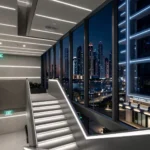
Safety lighting is an essential part of convention centre planning. Large venues have complex circulation routes, multiple entrances and exits, staircases, service corridors and high visitor numbers.
Emergency lighting and illuminated exit signs help occupants identify safe routes during power interruptions or emergency situations. Systems should be designed and maintained according to applicable local requirements and the building’s approved life-safety strategy.
Emergency lighting should not be treated as an afterthought. It needs to be coordinated with architectural layouts, fire exits, corridors, stairs and public circulation paths.
Back-of-House and Loading Area Lighting
Convention centres also contain areas that visitors may rarely see but which are essential to event operations.
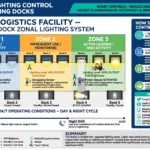
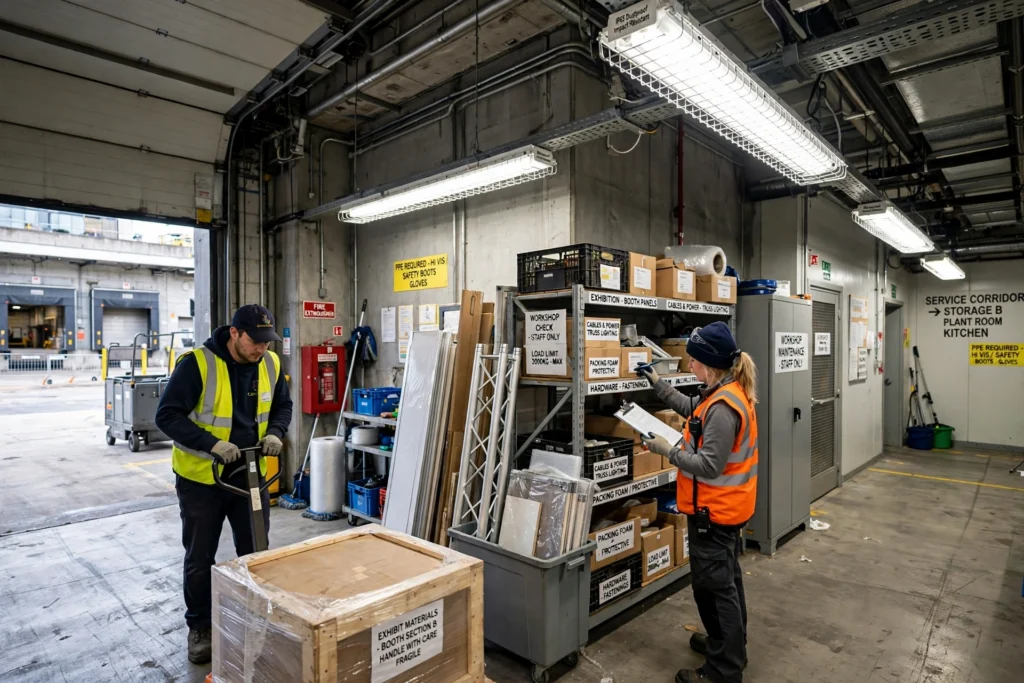
Loading docks, storage rooms, service corridors, kitchens, workshops, plant rooms and staging areas require practical lighting designed around their specific tasks.
Loading areas need sufficient illumination for staff handling equipment, exhibition materials and temporary structures. High-bay or industrial LED fixtures may be appropriate depending on ceiling height and environmental conditions.
Durability, maintenance access and protection from dust or mechanical impact should be considered when selecting luminaires for these spaces.
Lighting for Digital Displays and LED Screens
Modern convention centres frequently use digital signage, LED video walls and interactive displays for event information and advertising.
Lighting around these displays should be balanced carefully. Excessive ambient brightness can reduce perceived screen contrast, while strong reflections can make content difficult to view.
At the same time, the surrounding environment should not be so dark that visitors experience uncomfortable transitions between the display and surrounding areas.
A coordinated approach between architectural lighting and digital signage can create a more consistent visitor experience.
Energy Efficiency in Convention Centre Lighting
Energy consumption is an important consideration because convention centres can operate over long hours and contain very large illuminated areas.
LED technology can reduce lighting energy consumption compared with older lighting technologies, particularly when combined with appropriate controls.
Energy efficiency measures can include zoning, dimming, occupancy sensors, daylight harvesting, scheduling and efficient optical design.
However, energy savings should not come at the expense of appropriate illumination. The objective is to provide the required visual environment with the least unnecessary energy consumption.
Lighting Design for Dubai Convention Centres
Dubai hosts a wide range of international exhibitions, conferences and business events. Major venues such as Dubai World Trade Centre and Expo City Dubai serve large numbers of exhibitors and visitors throughout the year.
Convention centre lighting in Dubai must therefore accommodate frequent event changes, long operating schedules and different requirements from international organisers.
Areas such as Downtown Dubai, Business Bay and Dubai Marina also contain hotels, corporate venues and mixed-use developments that regularly support conferences, meetings and business events. Lighting design needs to work across both dedicated exhibition halls and smaller event environments.
Convention Centre Lighting in Abu Dhabi
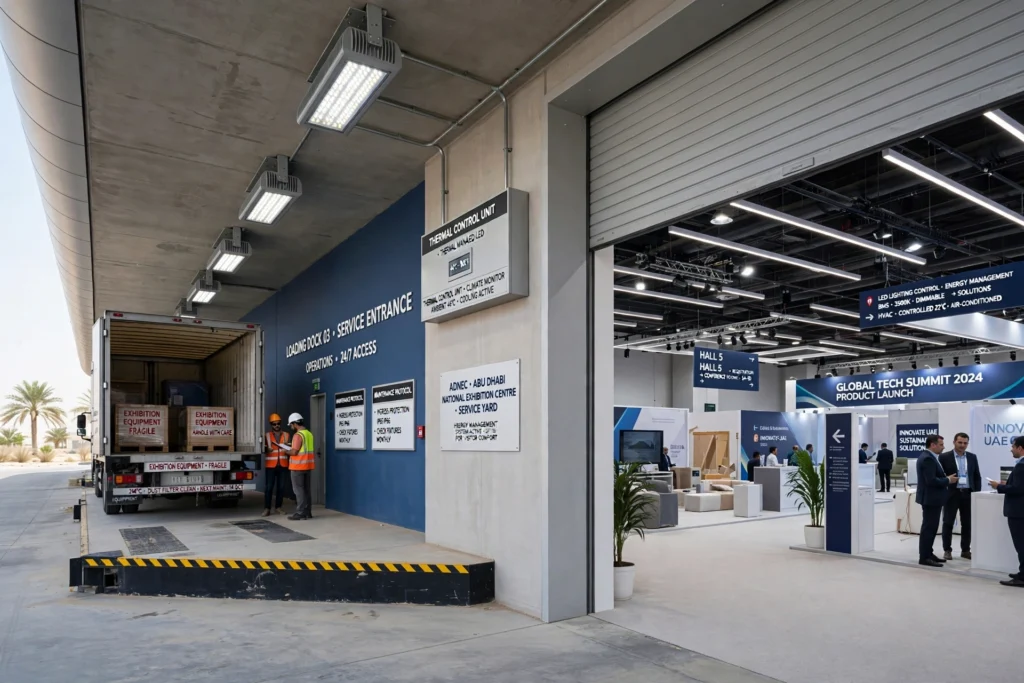
Abu Dhabi is another major UAE market for exhibitions, conferences and large-scale events. Abu Dhabi National Exhibition Centre (ADNEC) is an important venue within the emirate’s business-event infrastructure.
Lighting systems in Abu Dhabi convention and exhibition environments need to support trade shows, government events, corporate conferences, product launches and international gatherings.
The design should consider operational flexibility, energy management, visitor comfort and integration with other building services.
Lighting Considerations for UAE Climate and Operations
The UAE climate creates additional considerations for lighting equipment, particularly where fixtures are installed in semi-exposed areas, entrances, loading docks or spaces connected to outdoor environments.
High ambient temperatures can affect equipment performance depending on fixture design and installation conditions. Dust accumulation can also influence maintenance requirements.
Convention facilities should therefore consider fixture quality, thermal management, ingress protection where appropriate, cleaning schedules and access for maintenance.
Indoor air-conditioned halls provide a more controlled environment, but service areas and external zones may have very different operating conditions.
Lighting for Corporate Events and Product Launches
Product launches and corporate events often require lighting that can be adjusted rapidly to match branding and presentation requirements.
Dimmable fixtures, colour-changing systems and programmable controls can support different event scenes. Architectural lighting can also be used to highlight branding walls, stage backgrounds, entrance features and sponsor areas.
The lighting design should still maintain a professional visual environment rather than relying entirely on decorative effects.
Choosing a Convention Centre Lighting Supplier
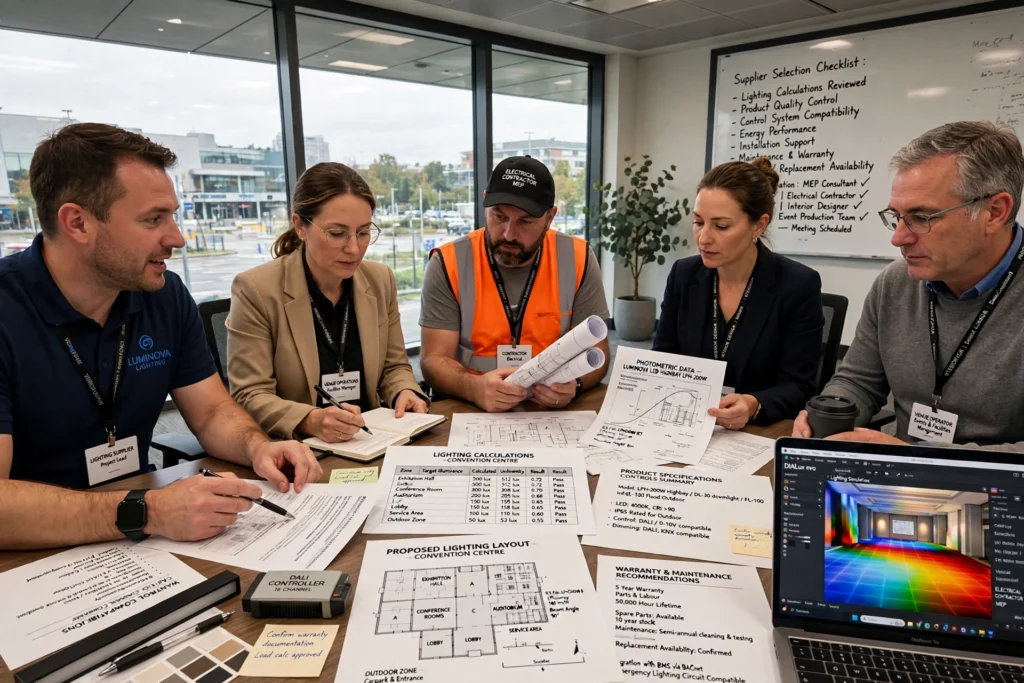
Selecting the right Convention Centre Lighting Supplier involves more than comparing fixture prices. Venue operators should consider lighting calculations, product quality, control compatibility, energy performance, installation support, maintenance requirements and replacement availability.
A capable supplier should understand the difference between exhibition halls, conference rooms, auditoriums, lobbies, service areas and outdoor zones. They should also be able to coordinate with electrical contractors, interior designers, MEP consultants, event production teams and facility managers.
For a major project, it is useful to request photometric data, proposed layouts, product specifications, control information, warranty details and maintenance recommendations before final selection.
Common Convention Centre Lighting Design Mistakes
One common mistake is treating the entire venue as a single lighting zone. Different spaces have different visual requirements, so a single lighting level is rarely appropriate.
Another problem is choosing fixtures based only on wattage. Wattage describes electrical consumption, not the complete visual performance of a luminaire.
Ignoring glare is another frequent issue, particularly around screens and polished architectural finishes.
Poor maintenance access can also create long-term operational problems. Fixtures installed at considerable heights should be positioned with realistic maintenance procedures in mind.
Finally, lighting controls should be planned early. Adding controls after installation can be more complicated and expensive than coordinating them during the original electrical and lighting design.
How to Plan a Convention Centre Lighting Project
A successful project normally begins with understanding how each space will be used. The design team can then identify lighting levels, fixture types, colour requirements, control zones and maintenance considerations.
The next stage may involve lighting calculations and photometric modelling. This helps evaluate fixture spacing, mounting height, uniformity and potential glare before installation.
The electrical design should then coordinate power distribution, emergency systems, controls and BMS integration where required.
After installation, aiming, programming and commissioning are important. The finished system should be tested under realistic operating conditions, including different event scenarios where possible.
Future Trends in Convention Centre Lighting
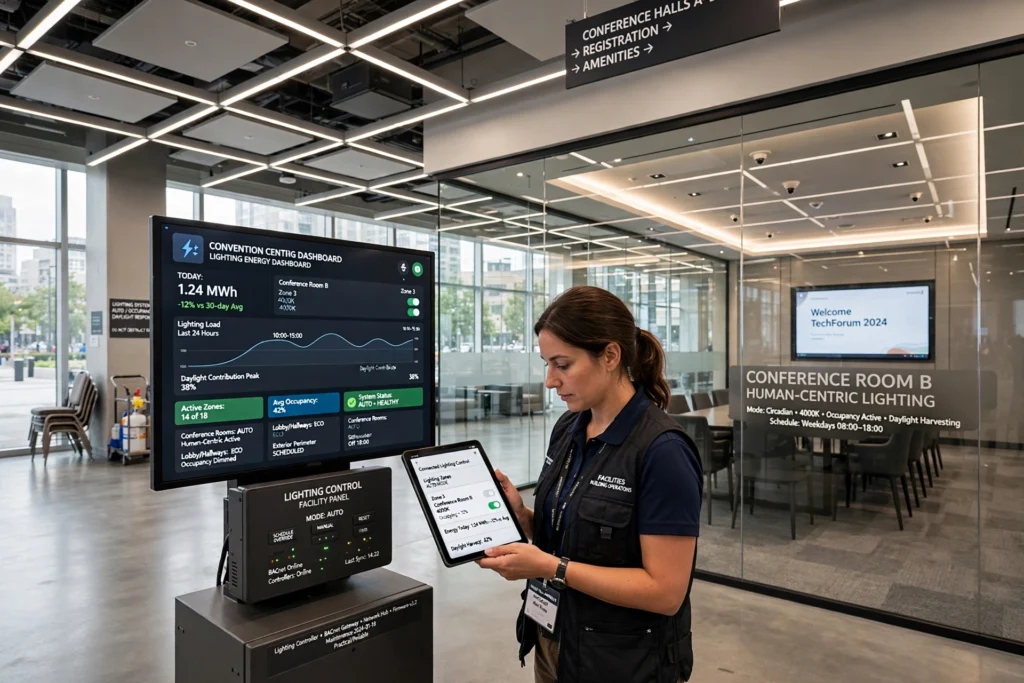
Convention centres are increasingly becoming technology-rich environments. Lighting is moving toward more connected and programmable systems that can respond to occupancy, daylight, event schedules and facility-management requirements.
Human-centric lighting concepts may also become more relevant in conference and workplace areas, although implementation should be based on the actual use of each space.
Wireless controls, digital monitoring, energy dashboards and connected building systems can provide facility managers with greater visibility into lighting performance.
The most successful approach is not necessarily the most technologically complex one. A well-designed system should be reliable, understandable and practical for the venue’s operating team.
Frequently Asked Questions
What is the purpose of convention centre lighting design?
Convention centre lighting design provides appropriate illumination for exhibitions, conferences, stages, meeting rooms, lobbies, registration areas, circulation routes and service spaces while supporting visitor comfort, energy efficiency and operational flexibility.
What type of lighting is commonly used in exhibition halls?
Large exhibition halls may use LED high-bay fixtures, linear systems or other wide-area LED luminaires. The appropriate solution depends on ceiling height, hall dimensions, required illuminance, mounting conditions and event layout.
Why is glare control important in convention centres?
Glare can make presentation screens difficult to view and cause discomfort for visitors. Proper fixture positioning, optical design, dimming and appropriate lighting levels can help control glare.
Can convention centre lighting connect to a BMS?
Yes. Compatible lighting-control systems can be integrated with building management systems to support scheduling, monitoring, energy management and coordinated operation with other building services.
Is LED lighting suitable for convention centres?
LED lighting is widely suitable for convention centres because it can provide efficient illumination, long operating life, controllability and a wide range of fixture types for different spaces.
How does lighting affect exhibition booths?
The base lighting of an exhibition hall influences the visibility of booth graphics, products and displays. Exhibitors can then supplement venue lighting with spotlights, linear LEDs and other display-specific fixtures.
What should be considered when selecting convention centre lighting?
Important considerations include illuminance, uniformity, glare, colour rendering, colour temperature, fixture efficiency, mounting height, control compatibility, maintenance access, operating environment and applicable safety requirements.
Conclusion
Convention centre lighting design requires a coordinated approach across exhibition halls, conference rooms, auditoriums, stages, lobbies, registration areas, circulation routes and back-of-house spaces. The objective is to create a flexible environment that can change with the event while maintaining visual comfort, safety, energy efficiency and reliable operation.
For UAE venues, the design should also consider Dubai and Abu Dhabi’s demanding event schedules, large exhibition formats, digital displays, smart building technologies and local environmental conditions. Combining efficient LED luminaires with appropriate controls, BMS integration, emergency lighting and professional commissioning can create a lighting system capable of supporting the changing requirements of modern convention facilities.