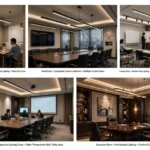
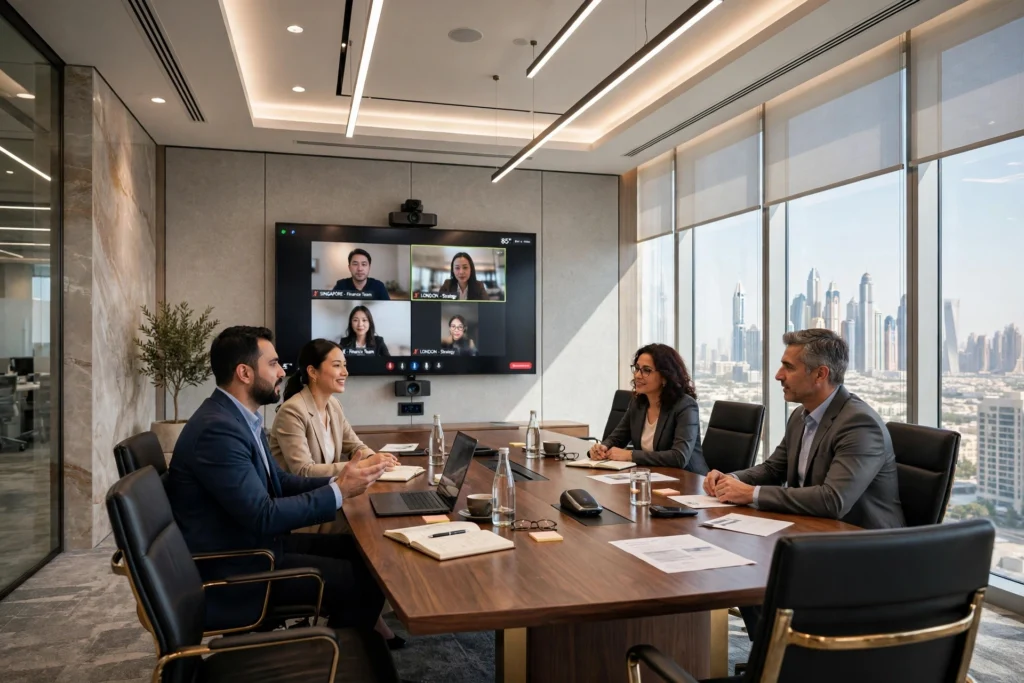
Meeting room lighting has a direct impact on how people communicate, read documents, use screens and participate in video conferences. A meeting room needs more than simply enough light to see the table. Good lighting should provide appropriate illuminance, visual comfort, controlled glare, balanced brightness and good colour rendering while working with daylight, presentation screens and digital conferencing equipment.
For offices in Dubai, Abu Dhabi, Sharjah and other UAE business centres, meeting room lighting should be designed around the actual function of the space. A boardroom used for executive presentations may require a different lighting strategy from a small collaboration room or a training room with multiple screens.
International lighting standards such as EN 12464-1 are commonly used as a reference for indoor workplace lighting, while local requirements also need to be considered. In Dubai, the Dubai Municipality’s building regulations and Al Sa’fat green-building system form part of the regulatory environment for new buildings. Dubai Municipality states that Al Sa’fat includes mandatory requirements for new buildings and is intended to improve energy efficiency, building performance and occupant wellbeing.
What Are Meeting Room Lighting Standards?
Meeting room lighting standards establish the performance requirements and design principles used to create suitable visual conditions for meetings, presentations, collaboration and office work.
Important lighting parameters include illuminance measured in lux, uniformity, glare, colour rendering, colour temperature, light distribution and control of daylight.
For office environments, EN 12464-1 provides guidance for workplace lighting and visual conditions. The appropriate target depends on the activity and visual task rather than simply the room name. A meeting room used for document work, presentations and computer-based collaboration therefore needs to be evaluated according to how the space is actually used.
Lighting design should also consider walls, ceilings, furniture, screens and other surfaces because brightness relationships influence visual comfort.
How Many Lux Does a Meeting Room Need?
Illuminance is measured in lux and describes how much light reaches a surface.
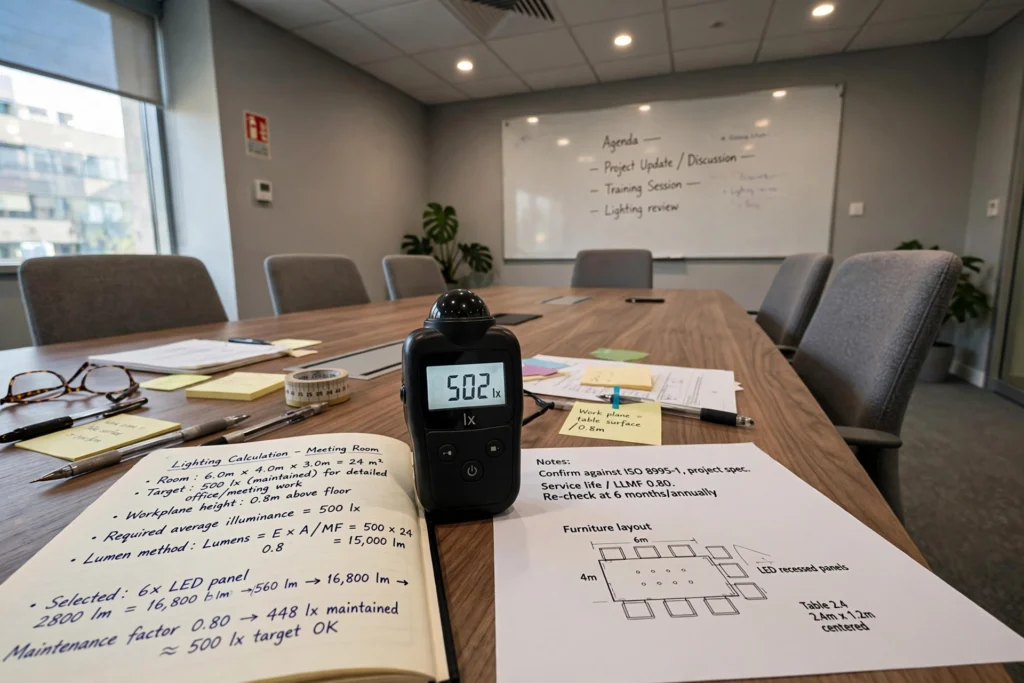
For many conventional office activities, 500 lux is a commonly referenced maintained illuminance level for detailed office work and visual tasks. However, the exact requirement for a meeting room should be confirmed against the applicable lighting standard, project specification and room function rather than treating 500 lux as a universal legal requirement.
A meeting room used primarily for discussion may require a different lighting approach from a room used for drawing, detailed paperwork or training. Lighting calculations should therefore consider the work plane, furniture layout, room dimensions and activities taking place.
The target should also be maintained over the expected service life of the lighting installation rather than measured only when new luminaires are installed.
Understanding Maintained Illuminance
Lighting designers distinguish between initial illuminance and maintained illuminance.
New LED luminaires can produce higher light output when first installed. Over time, factors such as LED lumen depreciation, dust accumulation and room conditions can reduce available light.
A professional lighting design therefore considers maintenance factors when calculating the required number and output of luminaires.
This is particularly important for large corporate offices in Dubai, Business Bay, Downtown Dubai, Dubai Internet City and DIFC, where meeting rooms can remain heavily used throughout the working week.
Regular cleaning, inspection and replacement planning can help maintain the intended lighting performance.
Glare Control in Meeting Rooms
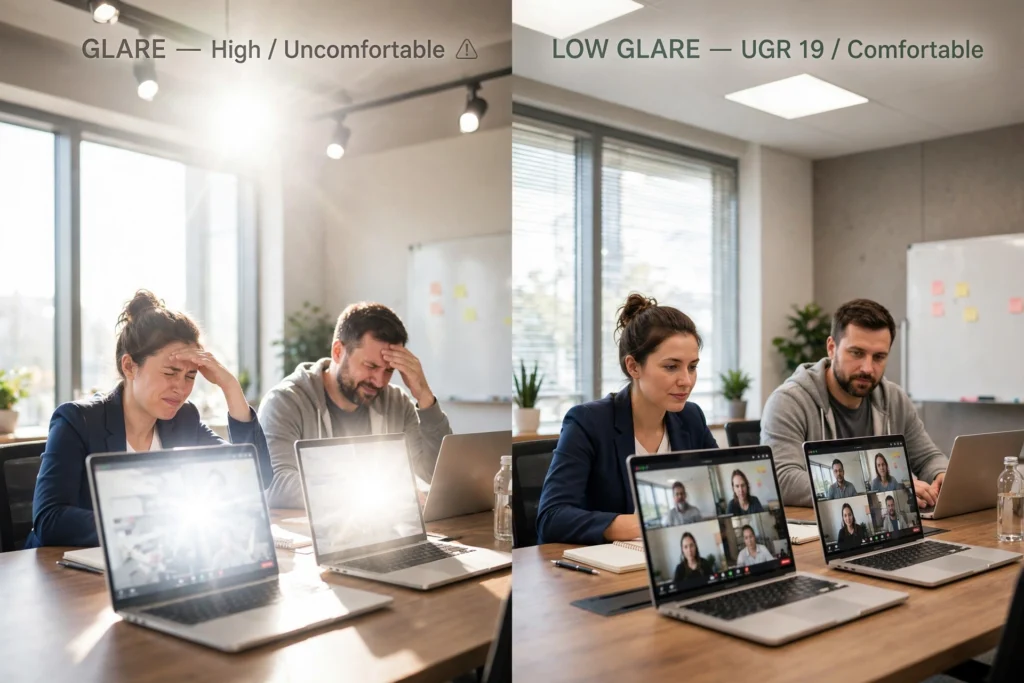
Glare is one of the most important issues in meeting room lighting. Excessive glare can make occupants uncomfortable and can interfere with computer screens and video conferencing.
Unified Glare Rating, or UGR, is one of the parameters used to evaluate discomfort glare from indoor lighting installations. Office lighting designs commonly target low glare, with UGR 19 frequently referenced for office visual tasks under EN 12464-1-based design approaches.
The exact target should be confirmed for the particular task and project specification.
Luminaire selection, optical design, mounting height, room geometry and viewing direction all affect glare. A luminaire with excellent efficiency can still be unsuitable for a meeting room if its light distribution produces uncomfortable bright sources in the occupants’ field of view.
Lighting for Video Conferencing
Modern meeting rooms increasingly function as video-conferencing spaces. Cameras need sufficient and balanced illumination to reproduce faces naturally.
Poor lighting can create dark eye sockets, strong facial shadows, overexposed backgrounds or uneven skin tones.
For video conferencing, lighting should illuminate faces from an appropriate direction rather than placing a strong light directly behind participants.
Linear LED luminaires, recessed panels, indirect lighting and carefully positioned supplementary fixtures can be combined depending on the room design.
The camera position should be considered during lighting design. A room may look comfortable to people sitting around a table but produce poor images on a conference camera if the lighting direction is incorrect.
Colour Rendering and CRI
Colour Rendering Index, or CRI, indicates how accurately a light source renders colours compared with a reference source.
Meeting rooms can benefit from good colour rendering because people view documents, presentation graphics, skin tones, product samples and brand colours under the lighting.
A high-quality commercial LED system with good colour rendering can help create a more natural appearance.
For modern office environments, designers commonly consider LED products with CRI 80 or higher, while applications requiring more accurate colour representation may specify higher performance.
The required CRI should be determined by the room’s function and project specification.
Choosing the Right Colour Temperature
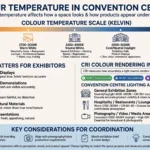
Colour temperature is expressed in Kelvin.
Meeting rooms commonly use neutral or cool-neutral white lighting because it can provide a professional appearance and work well for office activities.
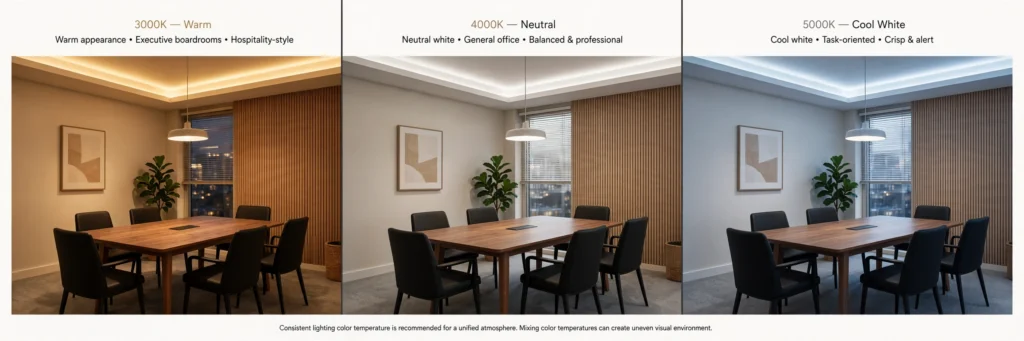
Typical commercial options include approximately 3000K, 4000K and 5000K, although the appropriate selection depends on the interior design and intended atmosphere.
3000K produces a warmer appearance and can work well in executive boardrooms, hospitality-style meeting spaces and premium interiors.
4000K provides a neutral white appearance and is widely suitable for general office environments.
5000K appears cooler and may be appropriate for certain task-oriented environments, although it can feel visually harsher if used without considering the interior design.
Consistency is important. Mixing significantly different colour temperatures within the same meeting room can create an uneven visual environment.
Daylight and Meeting Room Lighting
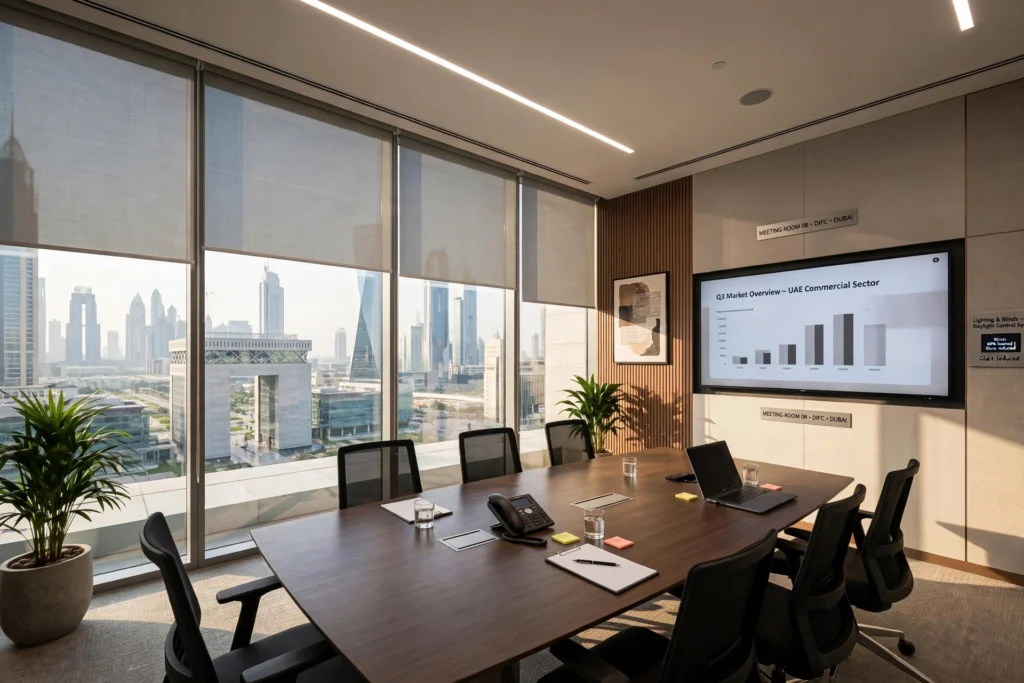
Many UAE offices have large glazed façades that introduce significant daylight. Natural light can improve the visual quality of a meeting room, but it also creates challenges.
Direct sunlight can cause glare on laptops and presentation screens. Strong daylight from windows can also produce uneven brightness between people sitting near windows and those farther inside the room.
Window orientation, blinds, solar-control glazing and lighting controls should therefore be considered together.
A meeting room in Downtown Dubai with extensive glazing may need a different lighting strategy from an internal meeting room with no windows.
The objective is not to eliminate daylight but to integrate it with artificial lighting so the room remains visually comfortable throughout the day.
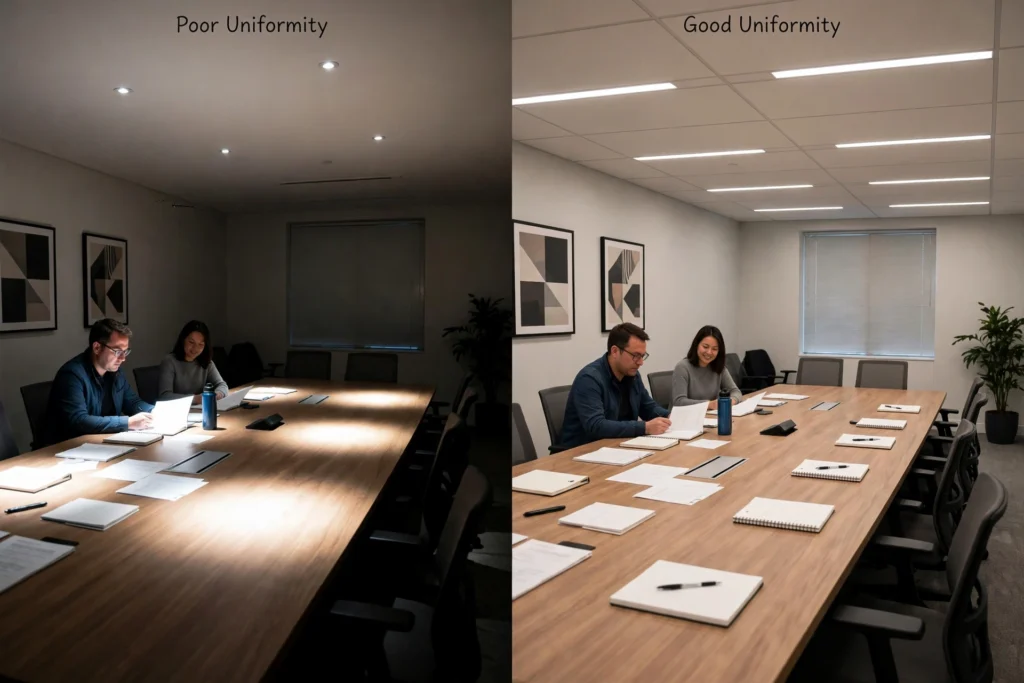
Lighting Uniformity
Uniformity describes how consistently light is distributed across the relevant area.
Poor uniformity can create bright patches and darker areas across a meeting table or room. This can be uncomfortable and can make documents and faces appear inconsistently illuminated.
Uniformity depends on luminaire spacing, beam angle, mounting height, ceiling height and room geometry.
Linear LED fixtures and well-designed recessed luminaires can provide broad and controlled light distribution. The actual result should be verified through lighting calculations and, where appropriate, on-site measurements.
Lighting the Meeting Table
The meeting table is usually the main visual task area in a conference room.
The lighting should provide sufficient illumination across the table without creating harsh reflections on glossy surfaces. Pendant fixtures, linear suspended luminaires, recessed fixtures and indirect lighting can all be used depending on the architectural design.
The position of luminaires should also account for the location of laptops, documents and presentation materials.
A glossy conference table can reflect ceiling luminaires directly into people’s eyes or cameras. Using suitable optics and positioning the fixtures outside problematic reflection angles can improve comfort.
Wall and Vertical Surface Lighting
Meeting room lighting should not focus exclusively on the horizontal table surface.
Walls are important because people look at vertical surfaces during presentations, conversations and video calls. Balanced vertical illumination can improve the overall visual environment.
EN 12464-1-based office lighting guidance also considers wall and ceiling illuminance as part of the visual environment. TRILUX’s explanation of the standard notes minimum vertical illuminance considerations for office spaces and emphasizes balanced luminance distribution.
Accent lighting can also be used to highlight company logos, architectural features or presentation walls, but decorative lighting should not create distracting brightness differences.
Lighting for Presentation Screens
Meeting rooms increasingly use large displays, LED screens, projectors and interactive presentation systems.
Excessive light falling directly onto a screen can reduce perceived contrast and make presentations harder to view.
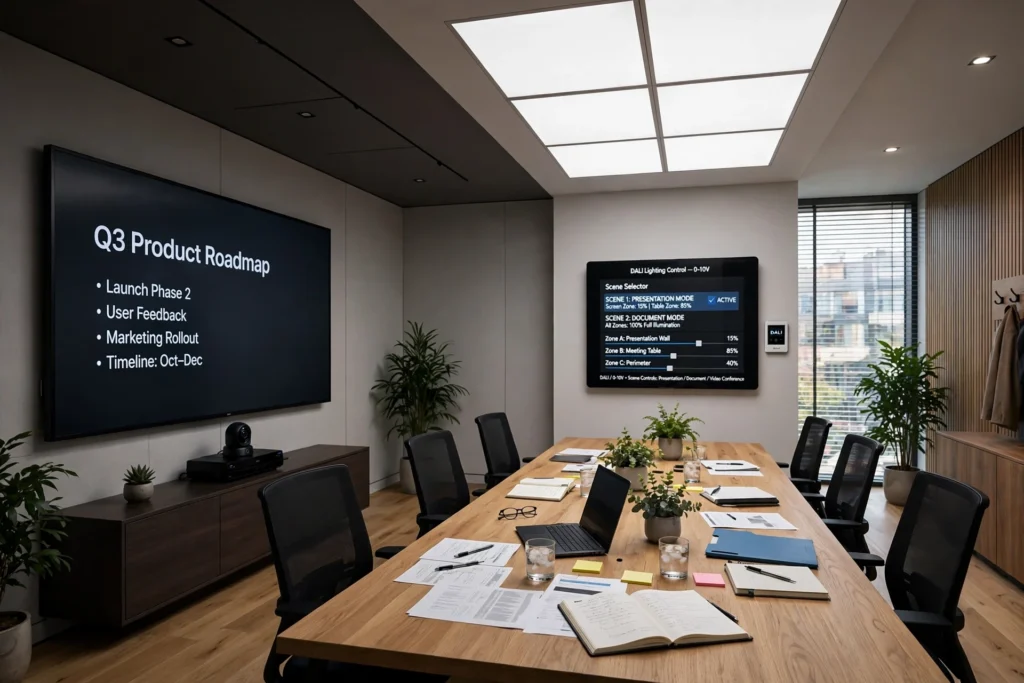
This does not mean the entire room should be made dark. Instead, lighting should be zoned so that the presentation wall can be controlled independently from the seating and discussion areas.
Dimmable LED lighting can be especially useful. During presentations, the lights near the screen can be reduced while the meeting table remains sufficiently illuminated for participants.
Dimmable LED Lighting
Dimming gives meeting rooms flexibility.
A single fixed lighting level is rarely ideal for every activity. A room may need full illumination for document work, reduced lighting for presentations and balanced front lighting for video conferencing.
DALI-based lighting controls, 0–10V systems and other control technologies can provide different levels of dimming depending on the installation.
Scene controls can allow users to select predefined modes such as:
Meeting mode: balanced general lighting for discussion.
Presentation mode: reduced lighting near the display while maintaining useful illumination elsewhere.
Video conference mode: controlled front lighting for faces.
Cleaning mode: higher general illumination for housekeeping.
Occupancy and Daylight Sensors
Lighting controls can reduce unnecessary energy consumption by responding to occupancy and available daylight.
Occupancy sensors can switch or dim lighting when meeting rooms are unoccupied. This is particularly useful because meeting rooms are often booked for longer periods but may not remain occupied continuously.
Daylight sensors can reduce artificial lighting when sufficient natural light is available.
The control strategy should be carefully commissioned. Overly aggressive sensor settings can cause lights to switch or dim unexpectedly during meetings, which can be distracting.
Energy Efficiency and Dubai Green Building Requirements
Energy efficiency is increasingly important in commercial lighting design.
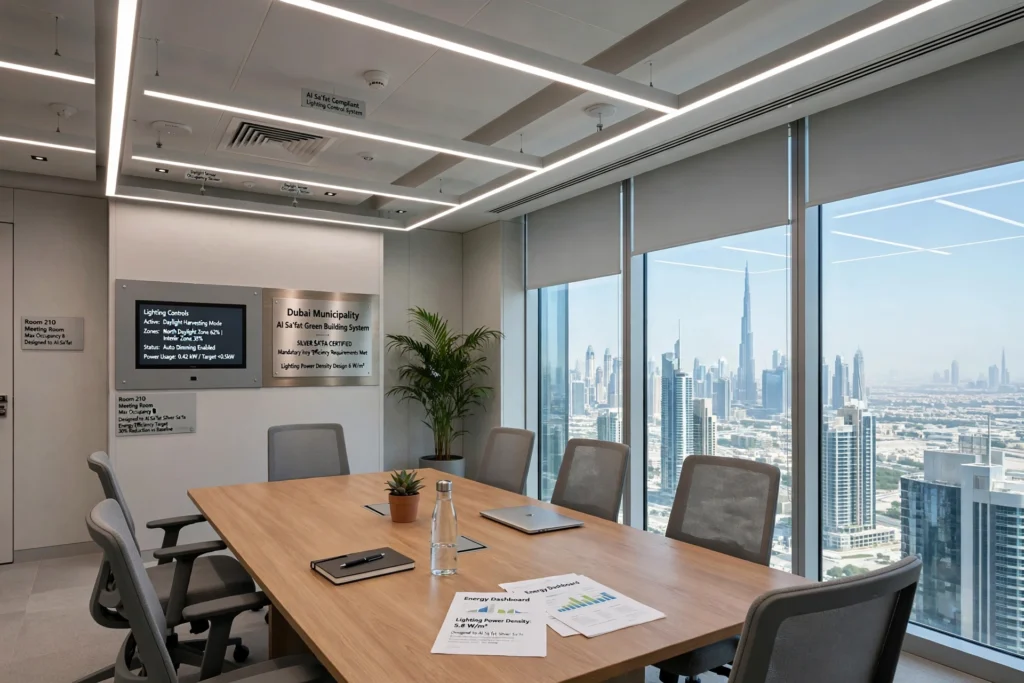
Dubai’s green-building framework includes requirements and performance objectives related to energy efficiency, building systems and occupant wellbeing. Dubai Municipality states that the Al Sa’fat system replaced the earlier Green Building Regulations and includes mandatory requirements for new buildings to achieve the Silver Sa’fa, with additional requirements for higher classifications.
For meeting rooms, energy-efficient LED luminaires combined with appropriate controls can reduce unnecessary lighting energy consumption.
Lighting power density, controls, daylight integration and equipment efficiency should be evaluated as part of the overall building design rather than treating the luminaire alone as the sustainability strategy.
Emergency Lighting in Meeting Rooms
Normal meeting-room lighting and emergency lighting serve different purposes.
Emergency lighting is intended to provide illumination when the normal lighting supply fails and to support safe movement and evacuation.
Meeting rooms should therefore incorporate emergency lighting and exit signage according to the applicable fire and life-safety requirements for the building.
Emergency luminaires should be positioned and maintained as part of the building’s overall emergency lighting system.
The final design should be coordinated with the relevant authority requirements, fire strategy and approved electrical drawings.
Smart Lighting and BMS Integration
Modern commercial offices increasingly integrate lighting with building management systems.
A BMS can provide monitoring and control for selected lighting systems, while dedicated lighting-control platforms can manage scenes, occupancy, daylight response and scheduling.
Integration can be valuable in large offices with many meeting rooms because facility managers can monitor operating schedules and identify areas where lighting remains active unnecessarily.
In large UAE developments, smart controls can also support broader building energy-management strategies.
Meeting Room Lighting for Different Room Types
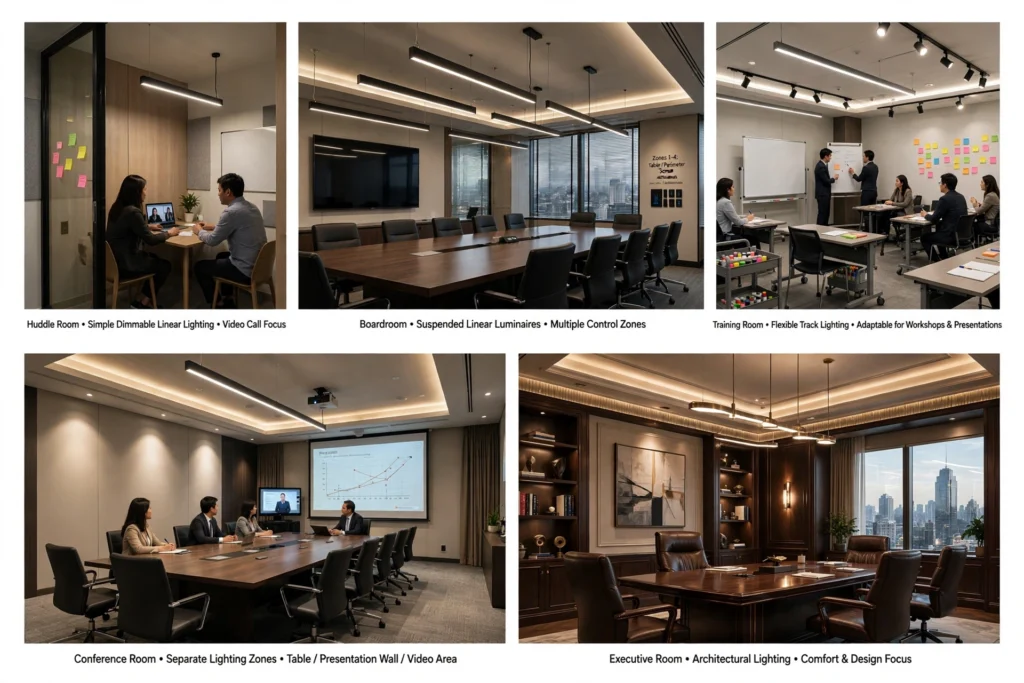
Not every meeting room should use the same lighting design.
A small huddle room may require simple dimmable linear lighting with good facial illumination for video calls.
A large boardroom may use suspended linear luminaires, architectural lighting and multiple control zones.
A training room may require flexible lighting because participants switch between writing, presentations and group activities.
A conference room may need separate lighting zones for the table, presentation wall and video-conferencing area.
An executive meeting room may prioritize architectural appearance alongside visual comfort.
This task-based approach creates better results than selecting luminaires based only on wattage or appearance.
Common Meeting Room Lighting Mistakes
Several design mistakes can reduce the performance of an otherwise modern meeting room.
Using overly bright fixtures without considering glare can create uncomfortable conditions. Installing luminaires directly above screens can produce reflections. Choosing inconsistent colour temperatures can make the room look visually unbalanced.
Another common problem is relying only on horizontal illuminance. Faces, walls and screens also require consideration.
Poor control zoning can make presentations difficult because the entire room may dim together.
Finally, selecting lighting fixtures before finalizing the furniture layout can result in luminaires being positioned incorrectly over the conference table or camera area.
How to Choose a Meeting Room Lighting Supplier
A professional supplier should understand both lighting products and the requirements of commercial spaces.
When evaluating a Meeting Room Lighting Supplier, consider the supplier’s ability to provide lighting calculations, photometric data, suitable LED luminaires, glare-controlled optics, colour consistency and compatible lighting controls.
The supplier should also understand the difference between general office lighting, presentation lighting, decorative lighting and emergency lighting.
For larger UAE projects, coordination with the MEP consultant, interior designer, electrical contractor and facility-management team is important.
Meeting Room Lighting in Dubai, Abu Dhabi and the UAE
The UAE has a diverse commercial property market, from corporate offices in Downtown Dubai and Business Bay to financial workplaces in DIFC and technology-focused offices in Dubai Internet City.
Abu Dhabi also has major commercial districts and large office developments where meeting rooms are an important part of workplace design. Sharjah and other emirates have similarly diverse office, education, government and commercial facilities.
Local environmental conditions make daylight control particularly important. Strong sunlight entering through large glazed façades can affect screen visibility and visual comfort, so lighting design should be coordinated with blinds, glazing and interior finishes.
Lighting Calculations and Commissioning
A professional lighting project should not rely solely on a product catalogue.
Lighting calculations can evaluate illuminance, uniformity and glare-related parameters before installation. The room’s dimensions, ceiling height, surface reflectance, furniture layout and luminaire photometry can all influence the calculation.
After installation, commissioning and measurement can verify that the installed system performs as intended.
This process can identify issues such as insufficient illumination, excessive brightness, uneven distribution or incorrect control settings.
Frequently Asked Questions
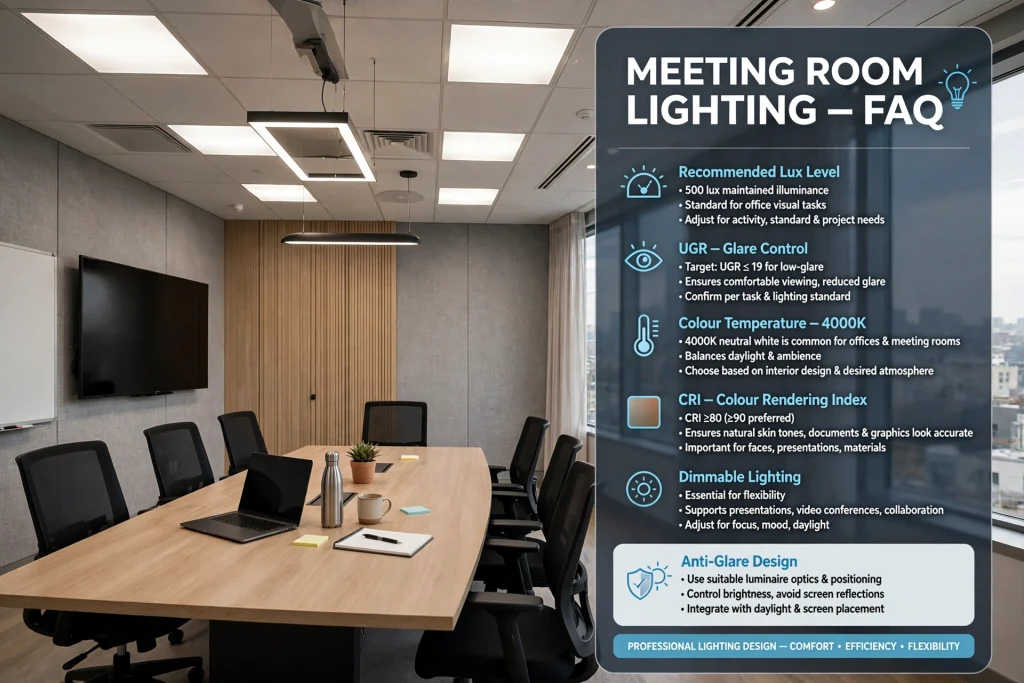
What is the recommended lux level for a meeting room?
A 500-lux maintained illuminance level is commonly referenced for office visual tasks, but the appropriate meeting-room target depends on the activity, applicable standard and project requirements.
What UGR should meeting room lighting have?
UGR 19 is a commonly referenced low-glare target for office visual tasks. The exact requirement should be confirmed for the relevant task and lighting standard.
Is 4000K suitable for meeting rooms?
4000K is a common neutral-white option for offices and meeting rooms. The final colour temperature should consider the interior design, daylight and intended atmosphere.
Why is CRI important in a meeting room?
Good colour rendering helps people see faces, documents, presentation graphics and other colours more naturally.
Should meeting room lights be dimmable?
Dimming is highly useful because meetings, presentations, video conferences and collaborative work require different lighting conditions.
How can meeting rooms reduce glare?
Glare can be reduced through suitable luminaire optics, positioning, controlled brightness, appropriate mounting and integration with daylight and screen locations.
Conclusion
Meeting room lighting standards are about much more than achieving a particular lux value. A successful lighting design combines illuminance, uniformity, glare control, colour rendering, colour temperature, daylight management and flexible controls.
For UAE offices, these considerations become particularly important because meeting rooms increasingly support video conferencing, large displays, presentations and collaborative work at the same time.
LED technology, dimming, occupancy sensors, daylight controls and smart lighting systems can help create flexible and energy-efficient meeting spaces. In Dubai, lighting design should also be coordinated with the applicable Dubai Building Code and Al Sa’fat requirements, which form part of the regulatory framework for new buildings.
Whether the project is a boardroom in DIFC, a corporate office in Business Bay, a technology workplace in Dubai Internet City or a commercial facility in Abu Dhabi, the lighting should be designed around the actual activities performed in the room.
The most effective approach is to combine standards-based lighting calculations with practical consideration of people, screens, cameras, furniture, daylight and building controls. This creates meeting rooms that are comfortable for occupants, effective for communication and appropriate for modern UAE workplaces.