Loading docks are among the busiest areas of warehouses, logistics centres, factories, retail distribution facilities and commercial buildings. Trucks arrive and leave, forklifts move between loading bays, workers handle pallets, and deliveries may continue during early mornings, evenings or overnight hours. Because of this constant activity, proper lighting is essential for visibility, safety, productivity and smooth vehicle movement.
LED lighting has become a practical choice for loading dock environments because modern LED fixtures can provide high brightness, directional illumination, long operating life and improved energy efficiency. However, choosing the right lighting system involves more than replacing old fluorescent or metal-halide fixtures with LED lamps. Loading dock lighting needs to consider mounting height, vehicle access, weather exposure, shadows, glare, colour temperature, controls and the layout of the loading area.
For warehouses and logistics facilities in Dubai, Abu Dhabi, Sharjah and other parts of the UAE, these considerations become even more important. A well-designed loading dock lighting system can support safer operations while reducing unnecessary electricity consumption and maintenance requirements.
Why Loading Dock Lighting Matters
A loading dock combines people, vehicles, equipment and goods within a relatively concentrated working area. Workers may need to read delivery documents, inspect packaging, operate dock levellers or guide trucks while forklifts and pallet trucks move nearby. Poor visibility can make these activities more difficult.
Good lighting helps workers see loading bay doors, ramps, dock edges, pallets, vehicle interiors, warning signs and pedestrian routes. It can also make it easier to identify damaged packaging, read labels and inspect shipments before they enter a warehouse.
Lighting is particularly important where a facility operates around the clock. A logistics centre in Dubai Industrial City, Jebel Ali or Al Quoz may handle deliveries during daylight and after sunset. The lighting system therefore needs to provide consistent illumination regardless of the time of day.
What Are LED Lighting Solutions for Loading Docks?
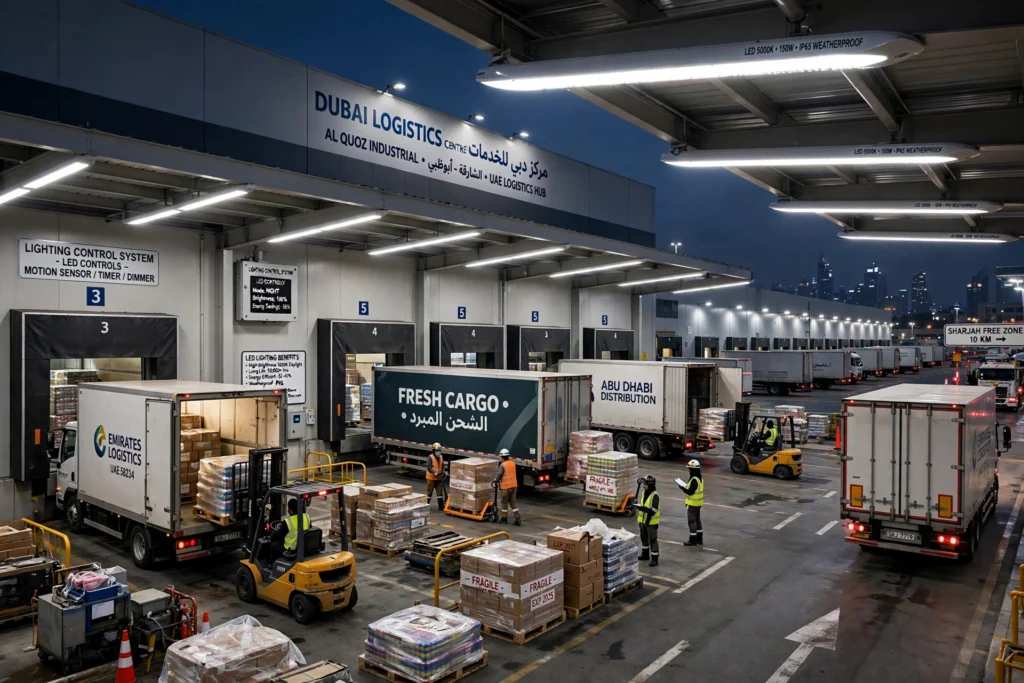
Loading dock LED lighting solutions include different types of fixtures and lighting systems designed for areas where goods are loaded and unloaded from trucks. Depending on the facility, the system may include high-bay LED lights, canopy fixtures, dock lights, floodlights, wall-mounted fixtures, linear LED systems, emergency lighting and motion-controlled luminaires.
The correct combination depends on the physical design of the dock. An enclosed loading bay may require high-output fixtures mounted to the ceiling, while an external loading apron may require weather-resistant floodlights or canopy lighting.
Some facilities also use adjustable dock lights positioned near individual loading doors. These fixtures can illuminate the inside of a truck or trailer without requiring excessive lighting across the entire loading area.
High-Bay LED Lighting for Loading Areas
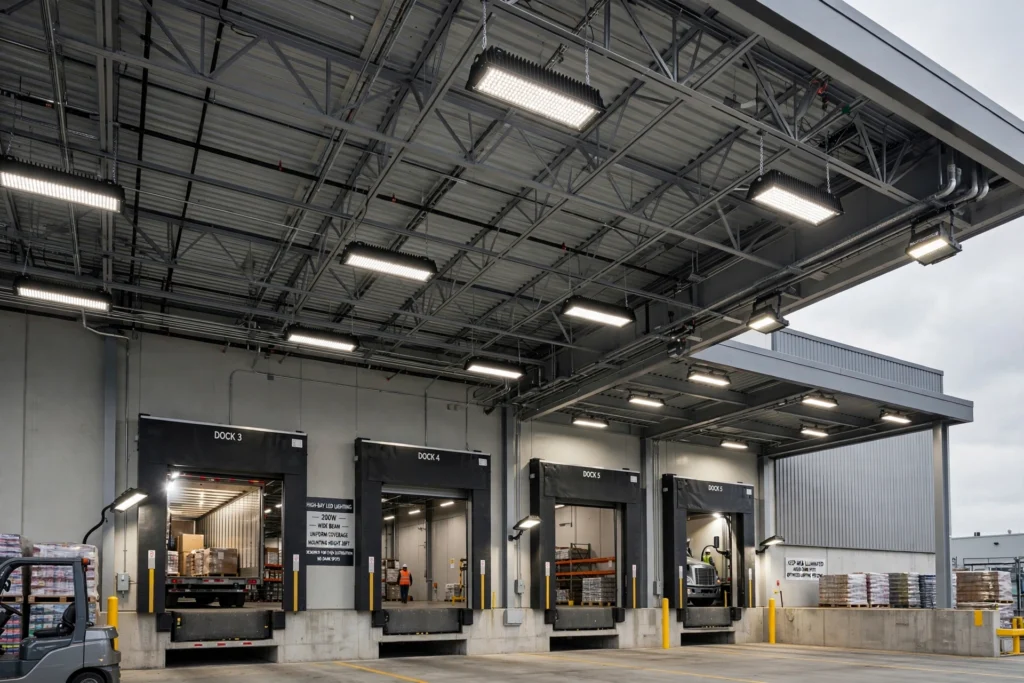
High-bay LED fixtures are commonly used in warehouses and industrial buildings with high ceilings. They are designed to distribute substantial amounts of light over large areas while maintaining efficient operation.
For loading docks with high roof structures, high-bay lighting can provide general illumination across multiple loading positions. Optical distribution should be selected according to the building dimensions, mounting height and location of work areas.
A narrow beam may be useful where light needs to reach a specific area, while a wider distribution can provide more uniform coverage. The objective is to avoid extremely bright spots surrounded by dark areas.
LED Dock Lights for Truck Loading
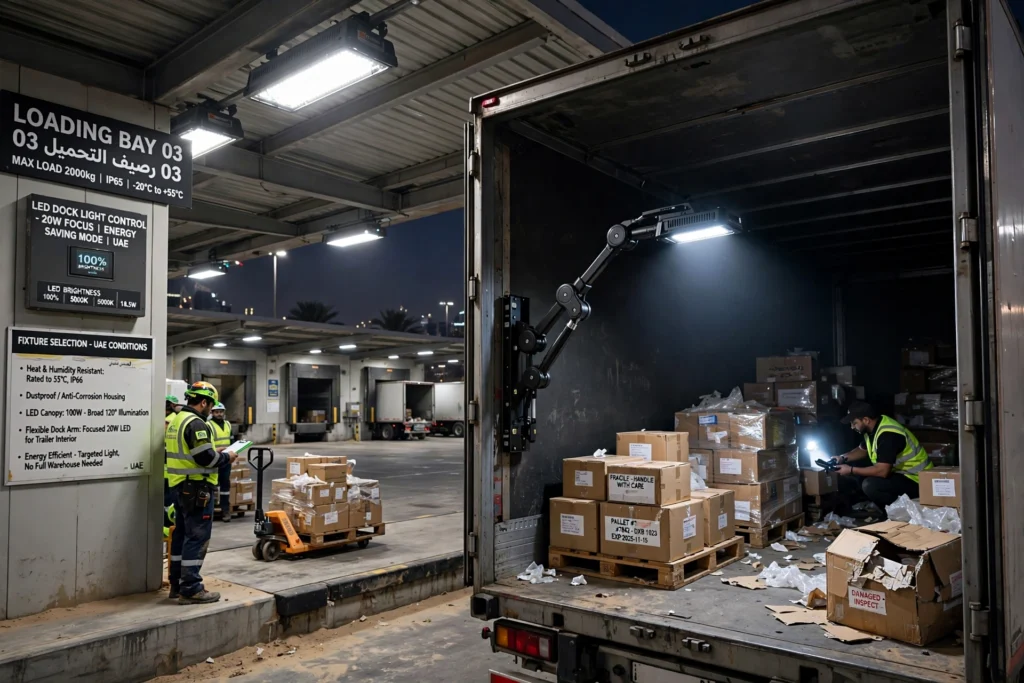
Dock lights are designed specifically to illuminate the interior of trucks and trailers during loading and unloading. A flexible arm allows the light head to be positioned according to the vehicle configuration.
This is useful because the interior of a trailer can become significantly darker than the loading dock itself. Workers may need to identify pallets, packages, labels and damaged goods inside the vehicle.
LED dock lights can provide focused illumination without requiring the entire warehouse to be illuminated at maximum brightness. This can improve visibility while supporting more efficient use of electricity.
LED Canopy Lighting for Loading Bays
Many loading docks have covered areas where trucks park underneath a roof or canopy. These spaces require lighting that can withstand dust, temperature variations and occasional exposure to moisture.
LED canopy fixtures can provide broad illumination across the vehicle access area. They are particularly useful for facilities where loading activity takes place during the evening or overnight.
For external docks in the UAE, fixture selection should take local environmental conditions into account. Heat, dust and humidity can affect lighting equipment, particularly when fixtures are installed in exposed locations.
LED Floodlights for External Loading Areas
Large distribution centres may have loading yards where trucks queue before reaching individual docks. Floodlights can provide wide-area illumination across these external spaces.
The positioning of floodlights is important. Poorly aimed fixtures can create glare for drivers or illuminate areas that do not require high light levels. Proper optical control helps direct light toward the working zone.
External loading yards in locations such as Jebel Ali, Dubai Investment Park, Dubai Industrial City and Al Quoz may require lighting that works reliably through long operating hours and demanding environmental conditions.
Choosing the Right Colour Temperature
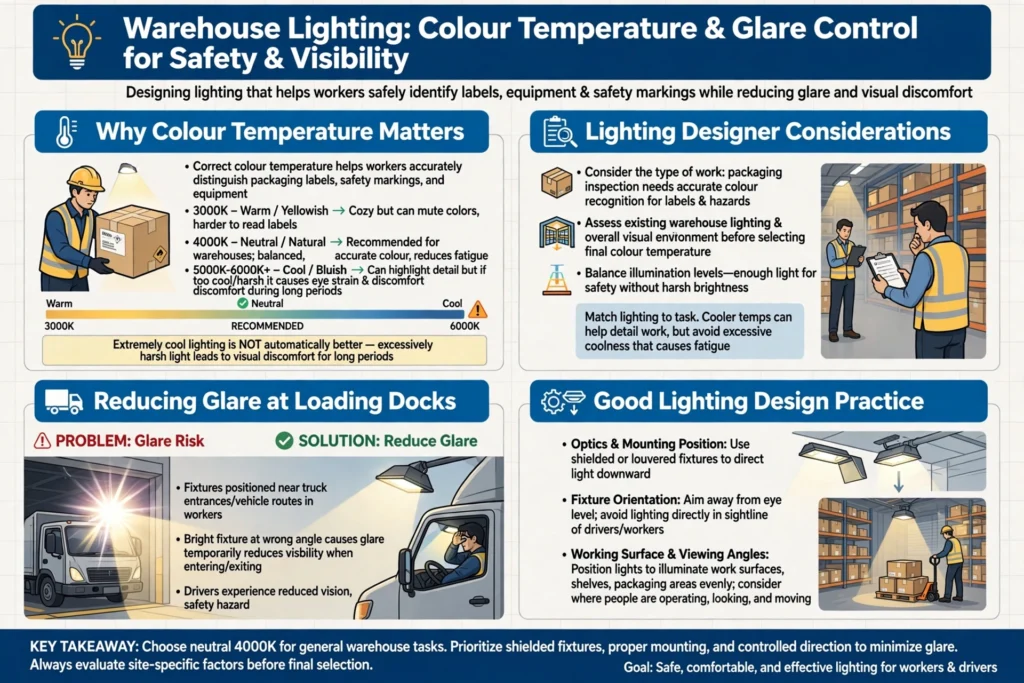
Colour temperature influences how a loading dock appears and how clearly objects can be seen. Neutral and cool-white LED lighting are commonly considered for industrial environments because they provide a clear appearance.
A suitable colour temperature can help workers distinguish packaging, labels, safety markings and equipment. However, extremely cool lighting is not automatically better. Excessively harsh light may create visual discomfort, particularly when workers spend long periods in the area.
The lighting designer should consider the type of work being performed, existing warehouse lighting and the visual environment before selecting the final colour temperature.
Reducing Glare Around Loading Docks
Glare can become a serious problem when lighting is positioned near truck entrances, vehicle routes or workers’ normal lines of sight. A fixture that appears bright from the wrong angle can temporarily reduce visibility.
This is particularly important for drivers entering or leaving a loading bay. Lighting should provide sufficient illumination without creating unnecessary visual discomfort.
Optics, mounting position, fixture orientation and shielding can all influence glare. A professional lighting layout should therefore consider both the working surface and the viewing angles of people operating in the area.
Uniform Lighting Is More Important Than Maximum Brightness
A common mistake is to focus entirely on installing extremely powerful lights. More brightness does not necessarily mean better lighting.
A loading dock can still have poor visibility if some areas are extremely bright while others remain dark. Uneven illumination can create strong contrast and make it harder for workers to adjust between different areas.
Uniform lighting creates a more predictable visual environment. This can be especially useful where workers move repeatedly between the warehouse, loading dock and vehicle interior.
Loading Dock Lighting and Worker Safety
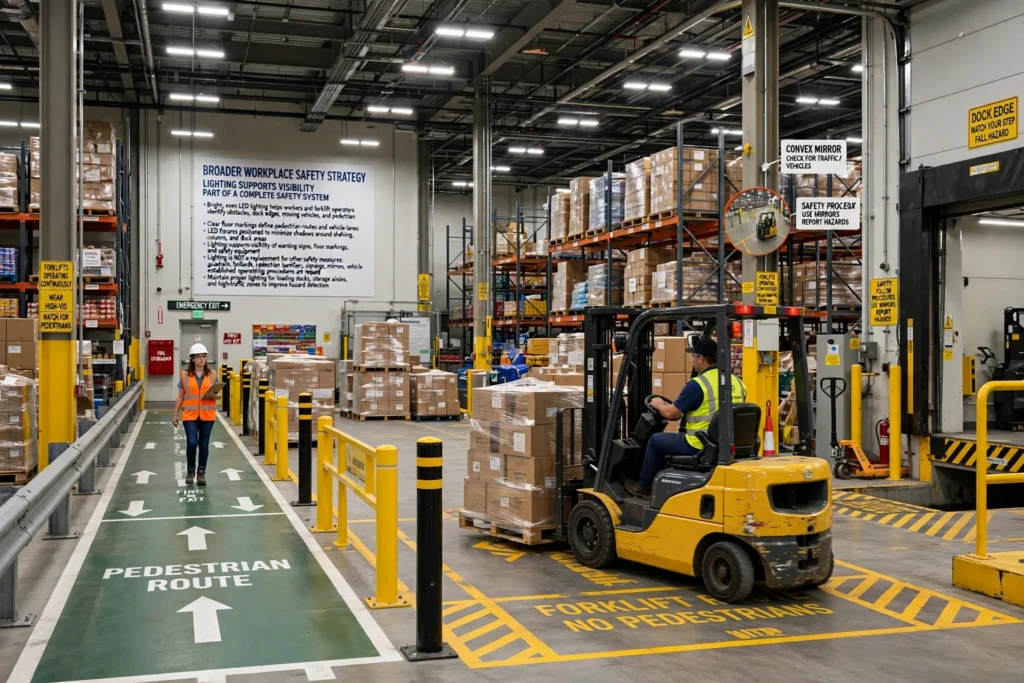
Lighting is one component of a broader workplace safety strategy. Clear visibility can help workers identify obstacles, dock edges, moving vehicles and pedestrian routes.
Good illumination can also support the visibility of warning signs, floor markings, emergency exits and safety equipment. In busy facilities, this can help workers navigate the space more confidently.
However, lighting should not be treated as a replacement for other safety measures. Guardrails, bollards, pedestrian barriers, signage, mirrors, vehicle warning systems and appropriate operating procedures may also be required.
LED Lighting for Forklift Operating Areas
Forklifts operate continuously in many warehouses and distribution centres. Their routes may cross loading docks, storage aisles and vehicle access areas.
Lighting should allow forklift operators to identify pedestrians, pallets, dock equipment and changes in floor level. Shadows created by structural elements or incorrectly positioned fixtures can reduce visibility.
LED fixtures should therefore be positioned to minimize shadows in important traffic and working zones. The layout should account for shelving, columns, dock doors, overhead structures and vehicle movements.
Emergency Lighting at Loading Docks
Loading areas should also consider emergency illumination. If normal power is interrupted, workers need sufficient visibility to move safely toward designated exits and emergency routes.
Emergency lighting may be integrated into the wider facility lighting strategy or installed as dedicated emergency fixtures. Exit signs, emergency luminaires and backup power systems should be considered as part of the building’s overall safety design.
For commercial and industrial properties in the UAE, emergency lighting requirements should be coordinated with applicable building, fire and safety regulations.
Motion Sensors and Smart Lighting Controls
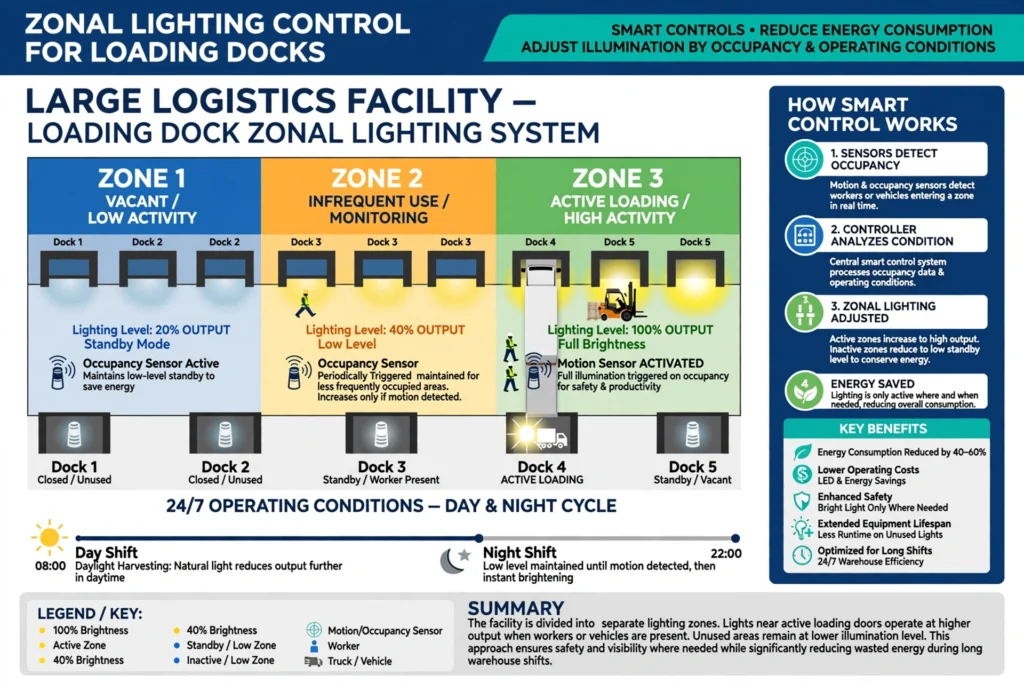
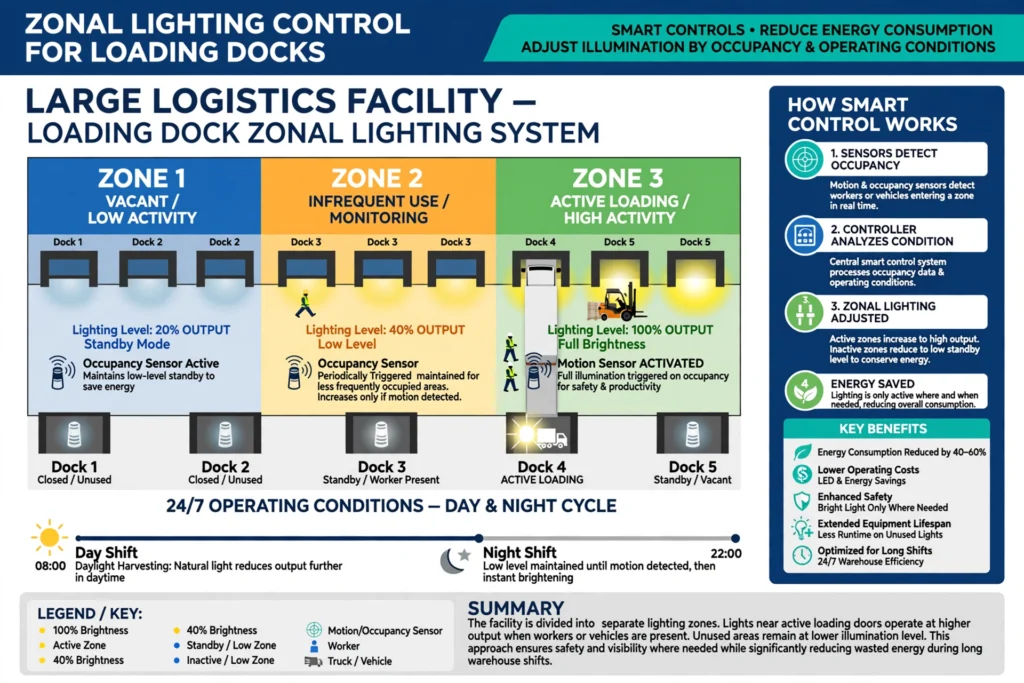
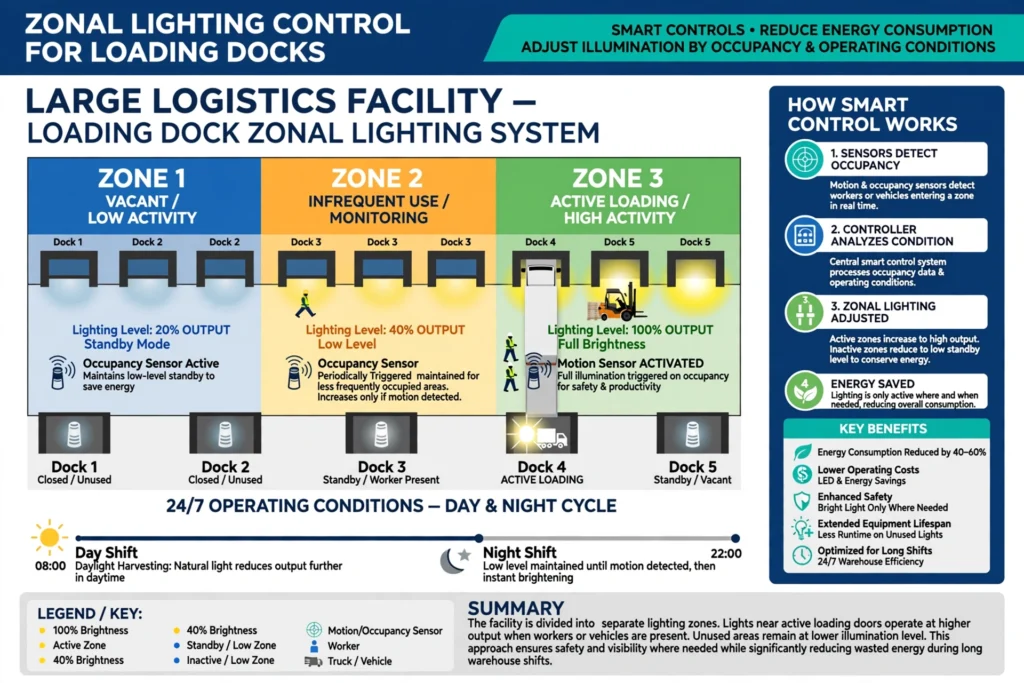
Loading docks do not always require full lighting output throughout the day. Smart controls can help reduce energy consumption by adjusting illumination according to occupancy and operating conditions.
Motion sensors can activate lighting when workers or vehicles enter an area. Occupancy sensors can also be used in less frequently occupied loading zones.
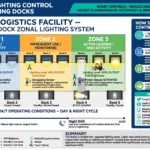
In a large logistics facility, lighting controls can divide the loading dock into separate zones. Lights near active loading doors can operate at higher output while unused areas remain at a lower level.
This approach can be particularly useful for warehouses operating long shifts.
Integrating LED Lighting with Building Management Systems
Modern commercial and industrial buildings increasingly use Building Management Systems to monitor and control building services. Lighting can be integrated into these systems alongside HVAC, energy monitoring and other building controls.
A connected lighting system can provide information about operating hours, energy consumption and fixture performance. Facility managers may use this information to identify areas where lighting schedules or operating levels can be adjusted.
For large logistics facilities in Dubai, integration with building automation can support centralized control across warehouses, offices, parking areas and loading zones.
Energy Efficiency in Warehouse Loading Areas
Loading docks may operate for many hours every day, which means lighting can contribute significantly to a facility’s electricity consumption.
LED technology generally offers higher efficiency than many older conventional lighting technologies. When combined with appropriate controls, zoning and scheduling, the potential energy savings can become more significant.
Instead of keeping every fixture operating at maximum output continuously, a facility can use different lighting levels according to occupancy and operating requirements.
Energy efficiency should therefore be considered at the system level rather than based only on the wattage of an individual lamp.
LED Lighting for Cold Storage Loading Docks
Cold storage and temperature-controlled logistics facilities have additional lighting requirements. Loading zones may connect directly to refrigerated warehouses, chilled rooms or freezer areas.
LED fixtures can be selected for applications where temperature conditions are different from a standard warehouse. Fixture specifications should be checked for the intended operating environment.
Lighting colour quality and reliability can also be important because workers may need to inspect food products, packaging and shipping labels in demanding conditions.
Lighting for Logistics and Distribution Centres
Large distribution centres often contain multiple loading docks operating simultaneously. A typical facility may have dozens of loading doors, truck lanes, pedestrian routes and staging areas.
The lighting design should therefore be scalable. Fixtures can be arranged into zones corresponding to loading doors, warehouse sections and vehicle routes.
This makes it easier to maintain consistent illumination and manage energy use across the entire facility. It also allows lighting maintenance to be planned without unnecessarily affecting the whole building.
Loading Dock Lighting for Retail Warehouses
Retail warehouses and fulfilment centres require fast movement of products from receiving areas to storage and dispatch zones.
Good lighting can support barcode scanning, package inspection, pallet handling and dispatch operations. It also helps workers identify product information during receiving.
In Dubai’s retail and e-commerce environment, warehouses may handle large volumes of goods and operate extended hours. Lighting systems need to support these operational demands without creating excessive maintenance requirements.
LED Lighting for Factories and Manufacturing Facilities
Manufacturing facilities may combine loading docks with production areas, storage zones and raw-material receiving areas.
Lighting requirements can differ between these zones. A loading dock may need broad illumination for vehicle movement, while a production area may require more focused lighting for detailed tasks.
Separating lighting zones allows the facility to match illumination with the activity taking place in each space rather than applying the same lighting configuration everywhere.
Choosing an IP Rating for External Loading Docks
External loading docks can be exposed to dust, humidity and occasional water. The appropriate ingress protection rating should therefore be considered when selecting fixtures.
The required rating depends on the installation environment and level of exposure. A fixture installed beneath a protected canopy may have different requirements from one directly exposed to outdoor conditions.
For UAE projects, environmental conditions should be assessed before finalizing the fixture specification.
Heat and Dust Considerations in the UAE
Dubai and other UAE locations experience high temperatures and dusty conditions for significant parts of the year. Lighting equipment installed in warehouses, loading yards and industrial areas must therefore be suitable for the environment.
Thermal management is particularly important for LED fixtures. Excessive operating temperatures can affect component performance and longevity if a product is not designed for the application.
Dust accumulation can also affect fixtures over time. A practical maintenance plan should include inspection and cleaning where necessary.
Lighting for Jebel Ali Logistics Facilities
Jebel Ali is one of Dubai’s major logistics and industrial areas, with warehouses, distribution centres, freight operations and commercial facilities. Loading docks in this environment may experience continuous truck traffic and extended operating hours.
Lighting layouts need to accommodate vehicle movement, loading doors, pedestrian areas and external yards. Durable fixtures, controlled glare and appropriate illumination distribution can help support these demanding applications.
Loading Dock Lighting in Dubai Industrial City
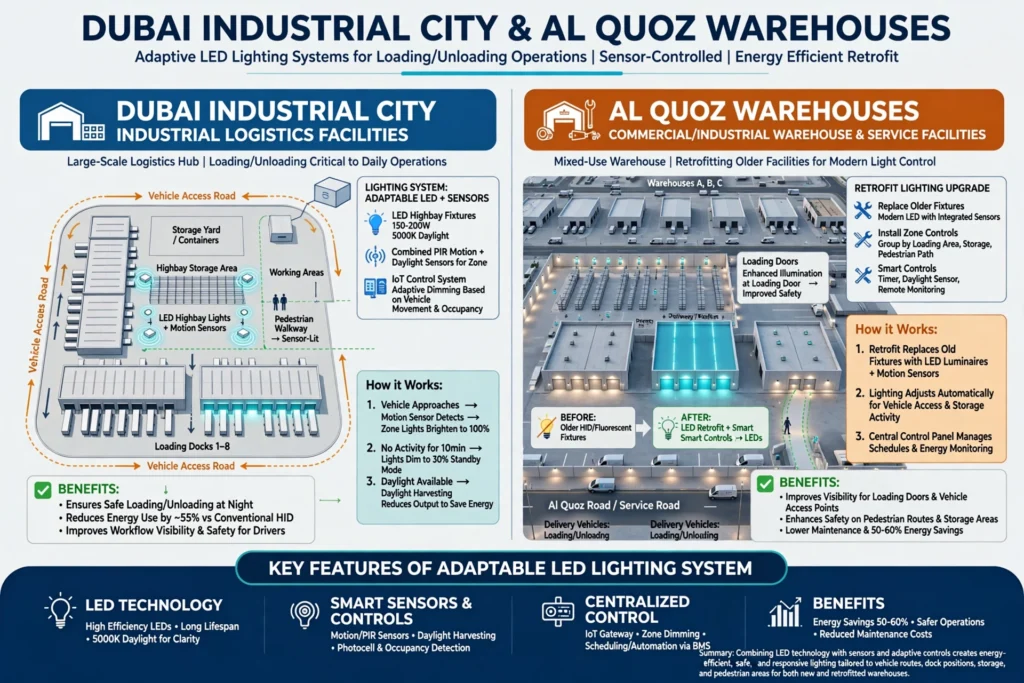
Dubai Industrial City contains industrial and logistics facilities where loading and unloading form an important part of daily operations.
Facilities operating in this environment can benefit from lighting systems designed around actual vehicle routes, dock positions and working areas. LED technology can be combined with sensors and controls to create a more adaptable lighting system.
Lighting for Al Quoz Warehouses
Al Quoz contains a mixture of commercial, industrial, warehouse and service facilities. Many properties have loading areas where goods move between delivery vehicles and storage spaces.
The right lighting system can help improve visibility around loading doors, vehicle access points, storage areas and pedestrian routes. Retrofitting older fixtures with LED technology may also provide an opportunity to modernize lighting controls.
Loading Dock Lighting in Abu Dhabi and Sharjah
The same principles apply to logistics and industrial facilities across Abu Dhabi and Sharjah. Warehouses, factories, distribution centres and commercial properties require lighting that matches the building layout and operating conditions.
In Sharjah industrial areas, for example, loading zones may combine external yards with enclosed warehouses. Abu Dhabi facilities may include larger industrial compounds with multiple buildings and vehicle routes.
A site-specific lighting assessment is therefore more useful than choosing fixtures based only on the building type.
Retrofitting Existing Loading Dock Lighting
Many warehouses still operate older fluorescent, metal-halide or high-pressure sodium lighting systems. A retrofit can replace inefficient fixtures with modern LED alternatives while improving light distribution.
Before a retrofit, the existing mounting points, wiring, ceiling height, fixture condition and illumination levels should be reviewed.
A good retrofit should not simply replace every old fixture with an LED fixture of similar wattage. The new system should be redesigned where necessary to improve distribution, reduce glare and eliminate poorly illuminated areas.
How to Plan a Loading Dock LED Lighting Project
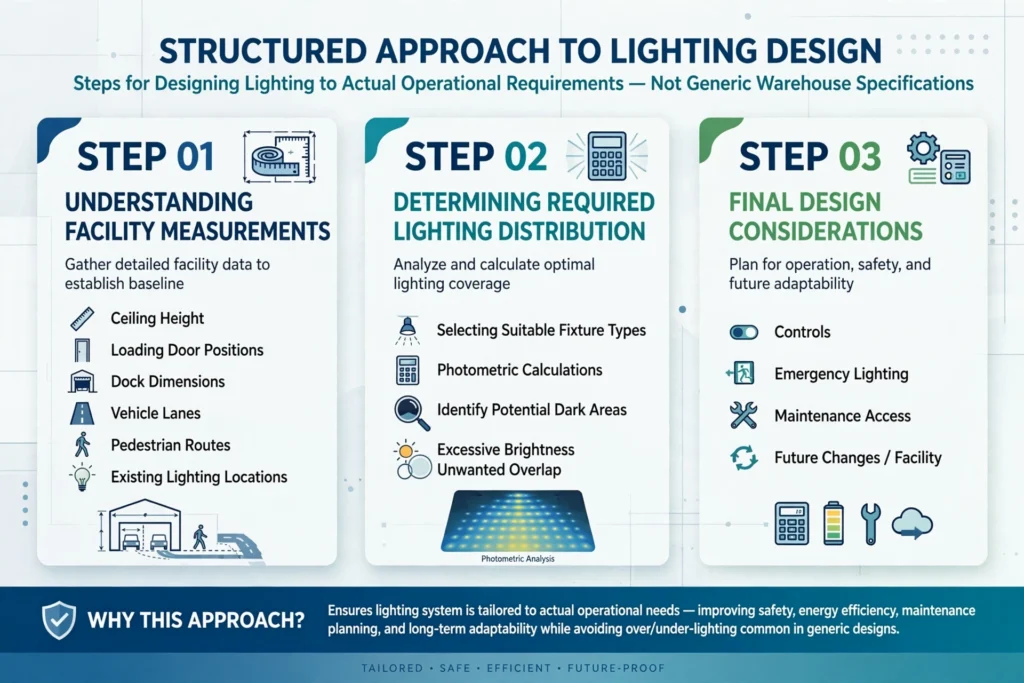
The first step is understanding the facility. Measurements should include ceiling height, loading door positions, dock dimensions, vehicle lanes, pedestrian routes and existing lighting locations.
The next stage is determining the required lighting distribution and selecting suitable fixture types. Photometric calculations can help identify potential dark areas, excessive brightness and unwanted overlap.
The final design should also consider controls, emergency lighting, maintenance access and future changes to the facility.
This structured approach helps ensure that the lighting system is designed for the actual operational requirements rather than based on generic warehouse specifications.
Working With an LED Lighting Solutions Supplier
Selecting the right supplier can influence the quality and long-term performance of a loading dock lighting project. A supplier should be able to discuss fixture specifications, optical distribution, colour temperature, controls, environmental ratings and installation requirements.
For larger UAE projects, it is useful to work with a provider that can support product selection, lighting calculations and project coordination rather than simply supplying individual lamps.
A professional LED Lighting Solutions Supplier can help match fixtures to different zones, including loading docks, warehouses, external yards, offices and parking areas.
Maintenance Requirements for LED Loading Dock Lighting
LED fixtures typically require less routine lamp replacement than traditional lighting technologies, but they still need maintenance.
Fixtures should be inspected periodically for dust accumulation, physical damage, loose connections and changes in light output. External fixtures may require more frequent cleaning depending on their environment.
A planned maintenance schedule can also identify failed drivers, damaged housings or control-system problems before they affect a larger area.
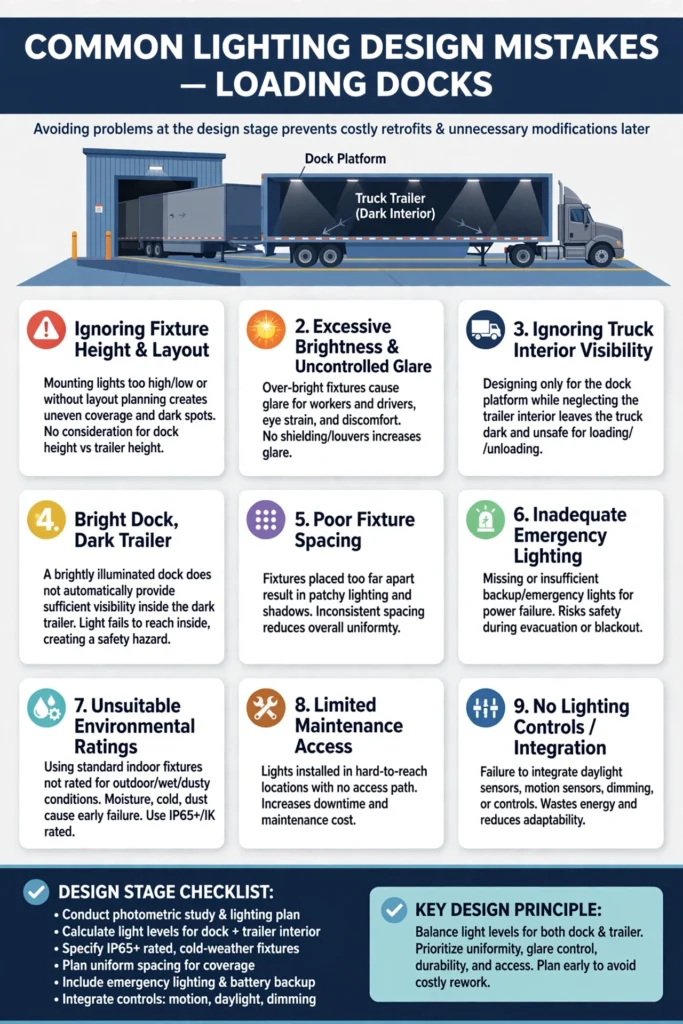
Common Loading Dock Lighting Mistakes
One common mistake is installing fixtures without considering the height and layout of the building. Another is using excessive brightness without controlling glare.
Ignoring truck interiors is another problem. A brightly illuminated dock does not automatically provide sufficient visibility inside a dark trailer.
Other issues include poor fixture spacing, inadequate emergency lighting, unsuitable environmental ratings, limited maintenance access and failure to integrate lighting controls.
Avoiding these problems at the design stage can prevent unnecessary modifications later.
What Should You Look for in a Loading Dock LED Fixture?
A suitable fixture should match the installation environment, mounting height and required light distribution. Important specifications may include lumen output, efficacy, colour temperature, beam angle, ingress protection, operating temperature and expected service life.
For industrial applications, mechanical durability is also important. Fixtures installed close to vehicle movement should be positioned and protected carefully to reduce the risk of accidental damage.
The best product is therefore not necessarily the fixture with the highest lumen rating. It is the fixture that provides appropriate illumination for the actual application.
Benefits of a Well-Designed LED Loading Dock
A properly designed system can provide several operational benefits. Better visibility can support safer movement of workers and vehicles, while consistent illumination can make loading and inspection activities easier.
LED technology can also reduce lighting-related energy consumption compared with older systems, particularly when combined with occupancy sensors and intelligent controls.
Long operating life can reduce the frequency of lamp replacement, which is valuable in facilities where accessing high ceilings or busy loading zones can interrupt operations.
Final Thoughts
Loading dock lighting needs to balance visibility, safety, efficiency, durability and operational practicality. LED technology provides a flexible foundation for achieving these objectives, but the quality of the result depends on the design, fixture selection and installation.
From Jebel Ali logistics centres and Dubai Industrial City warehouses to commercial distribution facilities in Al Quoz, Dubai Marina and other UAE locations, each loading dock has different requirements. High-bay fixtures, dock lights, canopy luminaires, floodlights, emergency lighting and smart controls can be combined according to the site’s layout.
A properly planned LED system does more than make a loading dock brighter. It creates a more consistent visual environment for workers, drivers and equipment while supporting long-term facility efficiency and maintenance planning.
Frequently Asked Questions
What type of LED lighting is best for a loading dock?
High-bay fixtures, canopy lights, dock lights and floodlights can all be suitable depending on the loading dock layout. The best combination depends on ceiling height, loading door arrangement, vehicle movement and whether the area is indoor or outdoor.
Are LED lights suitable for outdoor loading docks?
Yes. LED fixtures designed for outdoor applications can be used for external loading areas. The fixture’s environmental protection, temperature rating, mounting position and ingress protection should be appropriate for the installation conditions.
Can motion sensors be used with loading dock LED lights?
Yes. Motion and occupancy sensors can be used to control lighting in suitable areas. They can reduce unnecessary operating time by increasing illumination when activity is detected.
How can loading dock lighting reduce energy consumption?
Energy consumption can be reduced through efficient LED fixtures, zoning, occupancy sensors, dimming, scheduling and integration with building management systems. The overall design is more important than simply selecting low-wattage lamps.
Why is uniform lighting important in a loading dock?
Uniform lighting helps reduce strong contrasts between bright and dark areas. This can make it easier for workers and drivers to see obstacles, equipment, vehicles and goods while moving through the facility.
Do loading docks need emergency lighting?
Emergency lighting may be required depending on the building, occupancy and applicable safety requirements. Emergency routes, exits and relevant working areas should be assessed as part of the overall building safety design.
Can old warehouse lights be replaced with LED fixtures?
Yes. Many older lighting systems can be upgraded through LED retrofit projects. However, the existing layout should be assessed first so the new system can improve illumination rather than simply replacing fixtures one-for-one.
How often should loading dock LED lights be maintained?
Maintenance frequency depends on the environment and operating conditions. Regular inspections can identify dust, physical damage, failed components and lighting-control issues before they become larger problems.
Is LED lighting suitable for Dubai warehouses?
LED lighting can be suitable for Dubai warehouses when fixtures are correctly specified for the installation environment. Heat, dust, mounting height, ventilation and outdoor exposure should all be considered during product selection.
How do I choose the right loading dock lighting system?
Start by assessing the dock dimensions, ceiling height, loading doors, vehicle routes, pedestrian areas, working activities and operating schedule. A lighting assessment can then determine appropriate fixture types, positioning, output and controls.