Maintaining Linear Lighting Across the Building Life
For facility managers responsible for commercial buildings across the UAE, the maintenance of the lighting installation is an ongoing concern that affects cost, appearance, and the experience of occupants. LED linear lighting, while far lower in maintenance than the systems it replaced, still benefits from informed maintenance that maximises its life and sustains its performance. This guide examines linear lighting maintenance for the facility managers who keep commercial buildings performing.
It covers the factors that affect linear lighting life, the maintenance practices that sustain performance, and the strategies that minimise the cost and disruption of maintenance across the operating life of the commercial building in the demanding UAE environment.
Why Maintenance Matters for Facility Managers
Lighting maintenance affects the facility manager in several ways. The cost of maintenance contributes to the building operating budget, the disruption of maintenance affects occupants, and the appearance of the lighting affects how the building presents. Failed or degraded lighting undermines the environment and the perception of the building, making its maintenance a genuine concern for the facility manager.
Understanding the factors that affect lighting maintenance, and adopting practices that sustain performance and minimise intervention, allows the facility manager to control the cost and disruption of lighting maintenance while keeping the building presenting well. This informed approach to maintenance is part of effective facility management across commercial buildings.
Thermal Management and Lifespan
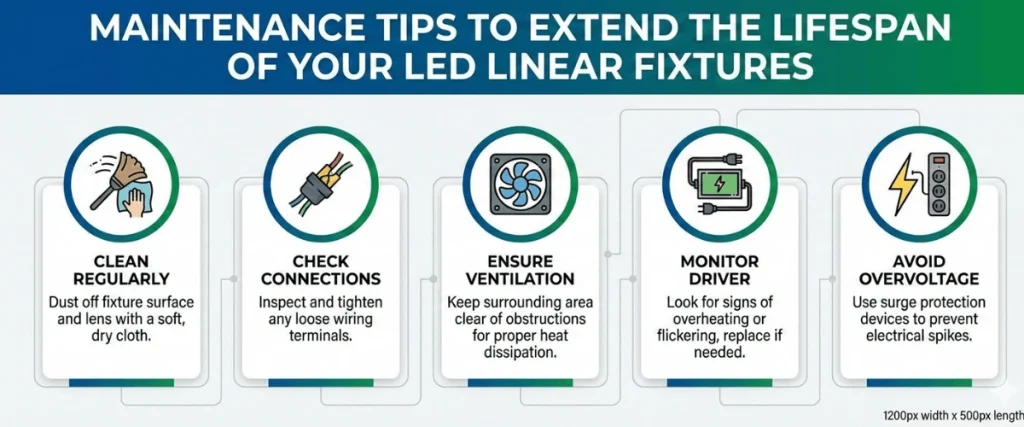
Heat is the principal factor affecting LED lighting life, and managing it is central to maximising lifespan in UAE conditions. Ceiling void temperatures, ventilation, and the thermal design of the fixtures all affect the operating temperature and therefore the life of the lighting. Facility managers should ensure ceiling void ventilation is maintained and fixtures are not obstructed, supporting their thermal performance.
Attention to the thermal environment of the lighting, maintaining ventilation and avoiding obstruction, supports the longevity of linear lighting in the demanding UAE climate. Lighting operating at lower temperatures lasts longer, making the thermal environment a factor the facility manager can influence to extend the life of the installation.
Cleaning and Optical Maintenance
Dust accumulation on linear fixtures, a significant factor in the dusty UAE environment, reduces light output over time. This gradual reduction can be mistaken for fixture degradation when it is actually surface contamination. Regular cleaning of fixture surfaces and diffusers maintains the designed light output, avoiding the perceived dimming that dust accumulation causes and the unnecessary replacement it might prompt.
Incorporating periodic fixture cleaning into the maintenance schedule, appropriate to the dust conditions of the building, sustains the light output of the installation. This simple maintenance, removing accumulated dust from fixtures and diffusers, maintains the lighting performance and avoids the unnecessary intervention that mistaking contamination for degradation might cause.
Driver Maintenance and Replacement
The driver is typically the first component of a linear fixture to fail, often before the LED modules reach end of life. Fixtures with accessible, replaceable drivers allow the driver to be replaced, extending the life of the fixture and avoiding full replacement. Understanding this, and specifying and maintaining fixtures with replaceable drivers, extends the serviceable life of the installation.
For facility managers, the ability to replace a failed driver rather than the whole fixture is a significant maintenance advantage, reducing cost and waste. Maintaining a stock of compatible drivers and replacing them as they fail extends the life of the installation cost effectively, a practical maintenance strategy for linear lighting.
Understanding Lumen Depreciation
LED fixtures dim gradually over their life, a process called lumen depreciation, eventually reaching the point at which replacement is warranted. Understanding the lumen depreciation of the installation allows the facility manager to anticipate when replacement will be needed and to plan for it, rather than being surprised by gradually declining illumination across the building.
Monitoring the lighting and understanding its lumen depreciation supports informed maintenance planning. The facility manager who understands how the lighting depreciates can plan replacement at the appropriate point, maintaining the illumination of the building while managing the cost and timing of replacement across the installation life.
Planned Versus Reactive Replacement
Lighting replacement can be reactive, replacing fixtures as they fail, or planned, replacing fixtures across an area at a scheduled point in their life. For large commercial buildings, planned replacement maintains consistent illumination and enables efficient, scheduled maintenance, while reactive replacement produces inconsistent lighting and inefficient piecemeal intervention. Planned replacement is generally preferred for large installations.
Adopting a planned replacement strategy for large commercial buildings maintains consistent lighting and enables efficient maintenance scheduling. This proactive approach, replacing the lighting across an area before failures accumulate, delivers better appearance and more efficient maintenance than reactive replacement of individual fixtures as they fail across the building.

Group Replacement and Consistency
Group replacement, replacing all the fixtures in an area together, maintains the consistency of the lighting and avoids the appearance variations that piecemeal replacement causes. When individual fixtures are replaced among older ones, differences in output and colour become visible. Group replacement avoids this, maintaining a consistent appearance across the area and the building.
For facility managers concerned with the appearance of the building, group replacement maintains the consistency that piecemeal replacement undermines. Planning replacement on a group basis, area by area, sustains the uniform appearance of the lighting and avoids the visible variations that detract from the quality of the commercial environment.
Emergency Lighting Testing
Emergency lighting requires periodic testing and maintenance to satisfy the safety regulations that govern commercial buildings in the UAE. Monthly function tests and annual discharge tests of battery systems verify the emergency lighting will perform when needed, and the results must be documented to satisfy civil defence inspection. This testing is a regular obligation of the facility manager.
Maintaining the emergency lighting testing programme, conducting and documenting the required tests, ensures the building satisfies its safety obligations and the emergency lighting performs when needed. This regular maintenance, essential to life safety compliance, is a core responsibility in the maintenance of commercial building lighting across the UAE.
Documentation and Maintenance Records
Effective lighting maintenance depends on documentation, records of the installation, the fixtures and drivers, the maintenance performed, and the testing conducted. This documentation supports informed maintenance, enables the sourcing of compatible replacements, and evidences compliance. Maintaining good records is part of the effective maintenance of the commercial building lighting.
For facility managers, comprehensive maintenance documentation supports the efficient, informed maintenance of the lighting across the building life. Records of the installation and its maintenance enable better decisions, easier sourcing of replacements, and demonstrable compliance, contributing to the effective management of the lighting installation over time.
Spares and Compatible Replacements
Maintaining a stock of compatible spares, fixtures, drivers, and components, enables prompt maintenance without the delay of sourcing replacements. For large installations, holding appropriate spares supports rapid response to failures and the planned replacement programme. Sourcing compatible replacements from the original supplier ensures consistency with the existing installation.
Specifying and sourcing from a supplier who can provide consistent, compatible replacements over time supports the long term maintenance of the installation. Maintaining appropriate spares and a relationship with the supplier ensures the facility manager can maintain the lighting promptly and consistently across the building life.
Access and Safety in Maintenance
Lighting maintenance, particularly at height, requires safe access, and the practicality of access affects the cost and ease of maintenance. Installations designed with maintenance access in mind are easier and safer to maintain, while those with inaccessible fittings present difficulties. Considering access in maintenance planning ensures the lighting can be maintained safely and efficiently.
For facility managers, safe and practical maintenance access is essential to maintaining the lighting without excessive cost or risk. Planning maintenance with appropriate access equipment and methods, and specifying installations with maintenance access in mind, supports the safe, efficient maintenance of the lighting across the commercial building.
Extending Service Life
The strategies of thermal management, regular cleaning, driver replacement, and planned maintenance together extend the service life of the linear lighting, maximising the value of the installation. An installation maintained with attention to these factors delivers longer, more reliable service than one neglected, reducing the lifecycle cost and sustaining the performance across the building life.
Adopting these maintenance strategies allows the facility manager to extend the life and sustain the performance of the linear lighting, maximising its value across the building life. This informed maintenance, attentive to the factors that affect lighting life, is part of the effective stewardship of the commercial building and its systems.
The Cost of Effective Maintenance
Effective maintenance has a cost, but it is outweighed by the value it delivers, extended life, sustained performance, consistent appearance, and assured compliance. Neglecting maintenance to save cost proves a false economy, producing premature failures, inconsistent lighting, and compliance risks. Investing appropriately in maintenance delivers value across the building life.
For facility managers balancing maintenance budgets, recognising the value that effective maintenance delivers supports appropriate investment in it. The cost of maintenance is repaid in extended life, sustained performance, and avoided problems, making effective maintenance a sound investment in the lighting installation and the building it serves.

Maintenance Support From Tricircle
Supporting the maintenance of linear lighting across the building life requires a supplier who can provide consistent, compatible products and replacements over time. As an authorised OPPLE distributor, Tricircle supplies linear lighting and compatible replacements across UAE commercial buildings, supporting facility managers in maintaining their installations over the long term.
To discuss linear lighting supply, replacements, or maintenance support for your commercial building, contact our team at aysha@tricirclegroup.ae or call +971 50 578 1325. We support facility managers across Dubai, Sharjah, Abu Dhabi, and the wider Emirates with consistent, quality lighting products.