For most commercial buildings in the UAE, lighting runs for ten, twelve, or even twenty-four hours a day, and in a climate where cooling already dominates the energy bill, every watt of inefficient lighting is paid for twice: once to produce the light, and again to remove the heat it adds to the space. For a building owner or facility manager looking at an operating budget, that makes an LED lighting retrofit one of the fastest, lowest-risk efficiency projects available. This guide explains where the savings come from, how the economics work, and how to run a retrofit properly across an existing UAE building or portfolio.
Why Retrofit Now
Older buildings across Dubai, Abu Dhabi, and Sharjah are still lit with fluorescent tubes, metal halide and high-pressure sodium lamps, and first-generation fittings that draw far more power than a modern LED equivalent for the same light. Replacing them is no longer a question of if, but when, for three reasons.
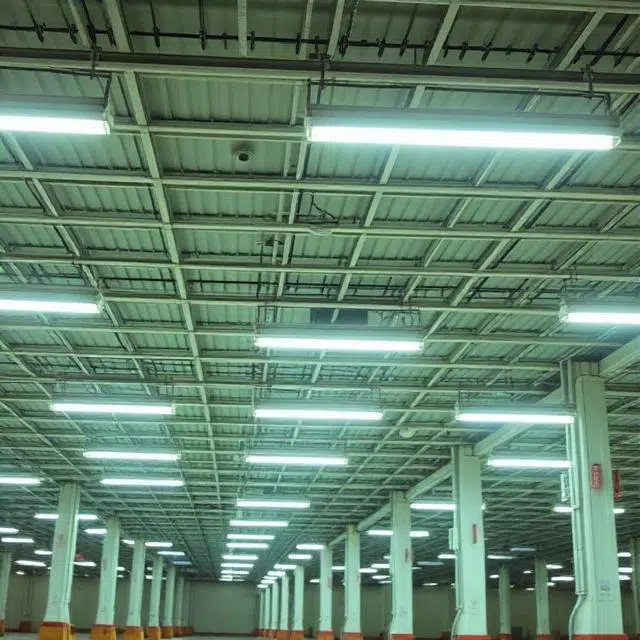
First, energy cost. LED conversion typically cuts lighting energy by 50 to 70 percent, and because LEDs run cooler, they also reduce the cooling load the lighting imposes, compounding the saving in the Gulf. Second, government direction. The Dubai Demand Side Management strategy and programmes supported by Etihad ESCO actively push building efficiency, and lighting is one of the simplest measures to deliver. Third, maintenance. Legacy lamps fail often, and replacing them, especially at height in warehouses and car parks, is a recurring labour cost that a long-life LED retrofit largely eliminates.
The Economics: Payback, Energy, and Maintenance
A retrofit business case rests on three savings stacked together.
The largest is energy. If a building runs 1,000 fluorescent battens at 50 watts each for twelve hours a day, replacing them with 25-watt LED equivalents halves the lighting draw immediately. Across a year of continuous operation, that is a substantial, measurable reduction on the DEWA, ADDC, or SEWA bill.
The second is cooling. Every watt of lighting heat removed is a watt the air-conditioning no longer has to fight. In the UAE, where cooling can be the single biggest energy load in a building, this secondary saving is real and is too often left out of the business case.
The third is maintenance. LED fittings rated for 30,000 to 50,000 hours outlast the fluorescent and discharge lamps they replace many times over. For a facility manager, that means fewer relamping call-outs, less scaffolding and access equipment, and fewer disruptions to tenants and operations.
Stack the three together and a typical commercial retrofit pays back its capital cost within a short period, after which the savings drop straight to the bottom line for the remaining life of the fittings.
Where the Biggest Savings Hide
A smart retrofit is targeted, not blanket. An audit usually finds the best returns concentrated in a few areas.
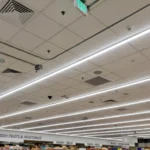
Offices, schools, and clinics are still full of fluorescent T8 and T5 tubes in recessed and surface fittings. These are the easiest, highest-volume win: modern LED tubes that replace existing fluorescent fittings drop straight into the same fixtures, often without rewiring, and immediately halve the energy per fitting while improving light quality.
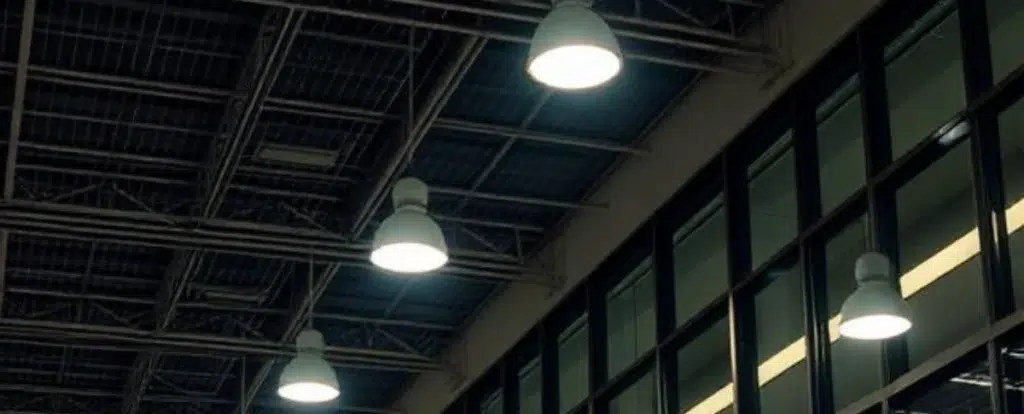
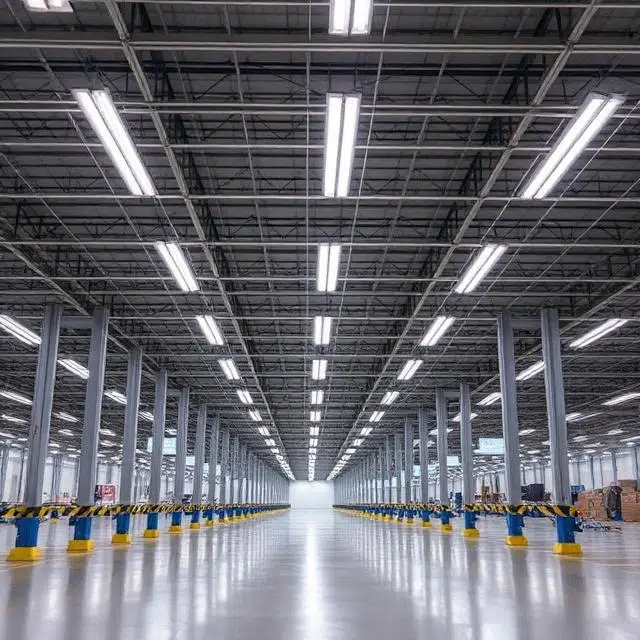
Warehouses, factories, and logistics facilities are typically lit by metal halide or high-pressure sodium high bays that draw 250 to 400 watts each and take minutes to restrike after a power dip. Swapping these for LED high bays of 100 to 200 watts delivers some of the largest single-fitting savings in any building, along with instant-on operation and far better uniformity for safe, productive work.
Car parks and service areas run their lighting around the clock, which makes even a modest per-fitting saving enormous over a year, and adding sensors here multiplies the benefit.
Outdoor, facade, and landscape lighting using old floodlights and discharge lamps is both inefficient and maintenance-heavy, and weatherproof LED replacements rated for the Gulf climate cut both costs while improving appearance.
Beyond the Bulbs: Controls and Sensors
The fittings are only half the opportunity. A large share of wasted lighting energy comes from lighting empty or daylit spaces, and that is solved with controls rather than hardware alone.
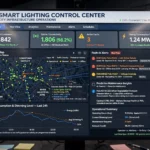
Adding occupancy and microwave sensors to car parks, corridors, warehouses, and back-of-house areas means light is produced only when and where it is needed. Daylight harvesting dims fittings near windows and atria when natural light is sufficient. Where a building has, or is gaining, a building management system, integrating lighting over an open protocol such as DALI-2 allows scheduling, zoning, and monitoring across the whole estate. Controls often deliver a further 20 to 40 percent saving on top of the LED conversion itself, and they are far cheaper to add during a retrofit than afterwards.
Quality Matters, Especially in a Retrofit
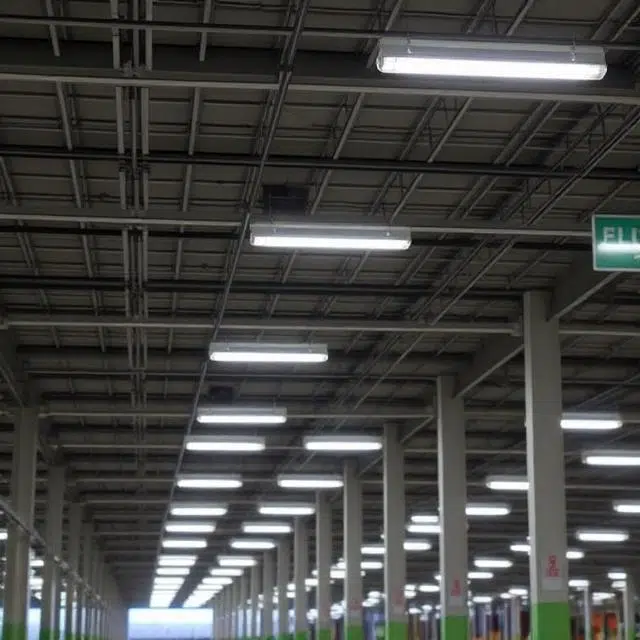
The temptation in any retrofit is to chase the lowest unit price, but in lighting this almost always costs more over the life of the project. Cheap, unbranded LED lamps frequently overstate their lumen output, drift in colour, lack surge protection, and carry no meaningful warranty, which means they fail early and unevenly, leaving a building with patchy, mismatched lighting and a second bill.
A retrofit worth doing uses fittings with genuine, verified efficacy in lumens per watt, a stated L70 lumen-maintenance figure so you know how the light holds up over time, appropriate colour rendering for the space, and surge-protected drivers built for the demanding UAE supply and heat. Tight colour consistency, measured in MacAdam ellipses, keeps hundreds of replaced fittings looking like one uniform installation rather than a patchwork. Specifying MOIAT-conformant, tier-one product is what turns a retrofit from a short-term cost cut into a long-term asset improvement.
The Retrofit Process, Step by Step
A well-run retrofit follows a clear sequence that controls risk and proves the savings.
- Lighting audit. Survey the existing fittings, hours of use, light levels, and energy draw, area by area, to identify where the savings and the priorities are.
- Design and business case. Specify the LED replacements and controls for each area, then model the energy, cooling, and maintenance savings against the capital cost to produce a clear payback.
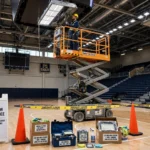
- Pilot installation. Convert a representative area first, measure the result, and confirm light quality and savings before committing the whole building. This step builds confidence and irons out any practical issues.
- Phased rollout. Replace the rest of the building in phases that minimise disruption to tenants and operations, area by area and circuit by circuit.
- Commissioning and measurement. Set up and program the controls, then verify the achieved light levels and energy reduction so the savings are documented, not just assumed.
Owners and facility managers who want this run as a managed process can start with a professional lighting audit and design service that turns an existing building into a costed, prioritised retrofit plan.
Compliance and Incentives
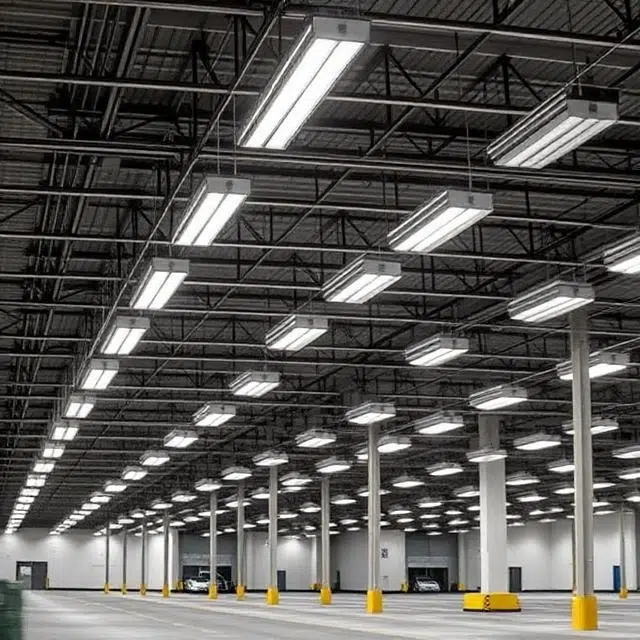
A retrofit is also a chance to bring a building up to current standards. The improved efficiency directly lowers the Lighting Power Density that authorities assess and supports the goals of green-building frameworks such as Al Sa’fat in Dubai and the Estidama Pearl Rating System in Abu Dhabi. Where escape-route and emergency fittings are being replaced, the retrofit should bring them in line with BS 5266-1 and Dubai Civil Defence requirements. And because efficiency programmes backed by Etihad ESCO and the Dubai Demand Side Management strategy actively encourage these upgrades, a well-documented retrofit aligns the building with the direction the market and the regulators are already moving.
Choosing a Retrofit Partner
The success of a retrofit depends heavily on the partner delivering it. The qualities that matter are an authorised source of tier-one product with real warranties, the stock depth to supply a whole building or portfolio consistently from the same production lots, the technical knowledge to audit a building and specify the right replacement for each space, and the ability to deliver and support the rollout in phases that fit an occupied, operating building. A partner who can provide the photometric data, certificates, and documentation also makes it straightforward to prove the savings and satisfy any green-building or authority requirement.
Conclusion
In the UAE, an LED lighting retrofit is one of the rare building upgrades that pays for itself, often quickly, and then keeps paying through lower energy, lower cooling, and lower maintenance for years. The key is to do it properly: audit the building, target the biggest savings, add controls where they count, insist on genuine quality, and roll it out in measured phases with a capable partner. Done that way, a retrofit does not just cut a cost line; it improves the comfort, appearance, and value of the building for everyone who uses it.
If you manage or own a commercial, industrial, or hospitality building in the UAE, our team can audit your existing lighting and build a costed retrofit plan that shows exactly what you will save and how quickly.