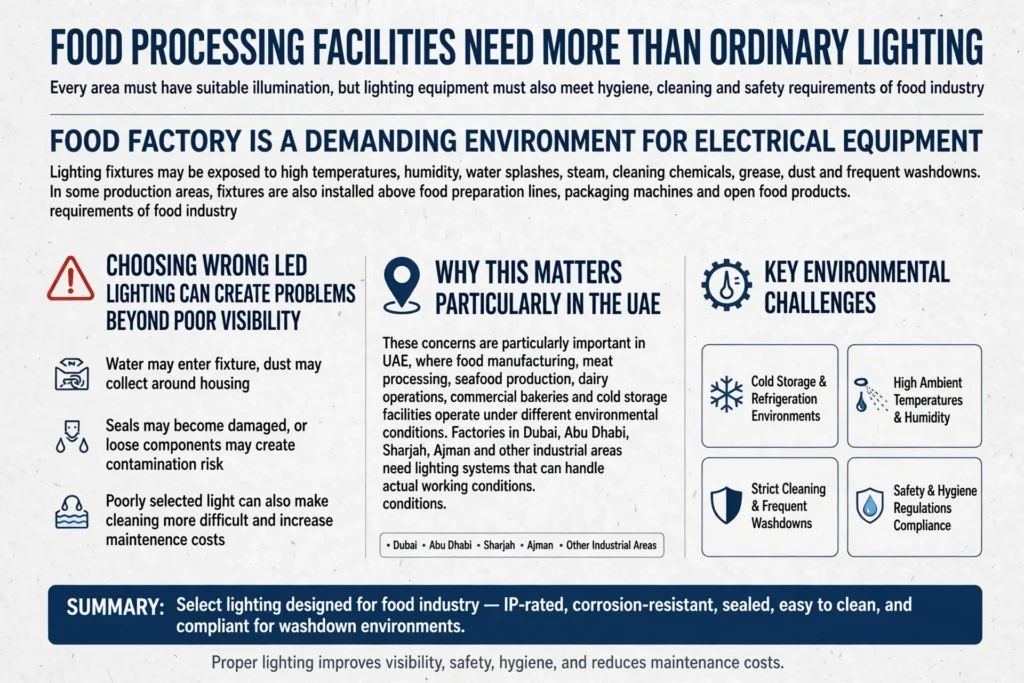
Food processing facilities need more than ordinary lighting. Every area must have suitable illumination, but the lighting equipment must also meet the hygiene, cleaning and safety requirements of the food industry.
A food factory is a demanding environment for electrical equipment. Lighting fixtures may be exposed to high temperatures, humidity, water splashes, steam, cleaning chemicals, grease, dust and frequent washdowns. In some production areas, fixtures are also installed above food preparation lines, packaging machines and open food products.
Choosing the wrong LED lighting can create problems that go beyond poor visibility. Water may enter the fixture, dust may collect around its housing, seals may become damaged, or loose components may create a contamination risk. A poorly selected light can also make cleaning more difficult and increase maintenance costs.
These concerns are particularly important in the UAE, where food manufacturing, meat processing, seafood production, dairy operations, commercial bakeries and cold storage facilities operate under different environmental conditions.
Factories in Dubai, Abu Dhabi, Sharjah, Ajman and other industrial areas need lighting systems that can handle their actual working conditions. High ambient temperatures, humidity, refrigeration environments and strict cleaning routines all influence fixture selection.
The right approach is to consider lighting as part of the wider food safety and factory design system. It should support workers, help maintain clean production areas and provide reliable performance throughout the operating life of the facility.
This guide explains how to select LED lighting for food processing facilities in the UAE, including hygiene requirements, IP ratings, cleanroom lighting, fixture materials, colour temperature, illumination levels, cleaning methods and maintenance considerations.
Why LED Lighting Is Important in Food Processing Facilities
Lighting plays an important role in almost every stage of food production.
Workers need clear visibility when inspecting raw ingredients, operating machinery, preparing food, checking packaging and maintaining production equipment. Poor lighting can make these tasks more difficult and increase the chance of mistakes.
For example, employees working on a meat processing line need to identify the condition of meat, check cutting surfaces and notice any unwanted material. Workers in a bakery need sufficient light to inspect dough, baked products and packaging. In dairy production, lighting helps staff monitor filling machines, containers and processing equipment.
LED lighting offers several advantages for these environments.
Modern LED fixtures can provide good illumination while using less electricity than many traditional lighting systems. They also have a long rated service life, produce less unwanted heat than many conventional alternatives and are available in different designs for demanding industrial environments.
However, not every LED fitting is suitable for a food factory.
An ordinary office LED panel may work well in an administrative area but may not be suitable above a wet production line. Similarly, an open industrial high-bay fitting may not be appropriate in an area where workers regularly use high-pressure cleaning equipment.
The application must determine the lighting specification.
A suitable system should provide consistent illumination, resist the expected environmental conditions, allow easy cleaning and minimise the possibility of contamination.
Understanding Hygiene Requirements for Food Factory Lighting
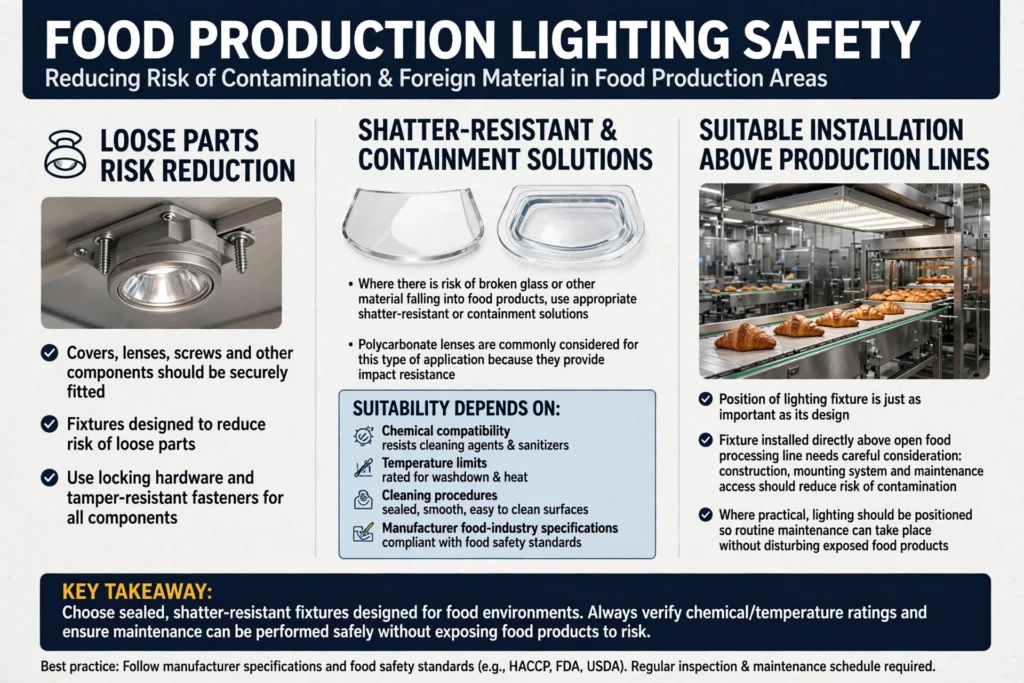
Hygiene is one of the most important considerations when selecting lighting for food processing facilities.
Food production areas must be designed and maintained to reduce contamination risks. Lighting fixtures are part of the building environment, so their design and installation should support the facility’s cleaning and hygiene procedures.
A poorly designed fixture may collect dust, moisture, grease or food particles. If its housing has gaps, damaged seals or exposed components, cleaning becomes more difficult.
The fixture may also become a source of contamination if parts break, coatings deteriorate or components become loose.
For this reason, food processing lighting should be selected with the following principles in mind.
Smooth and Easy-to-Clean Surfaces
Lighting fixtures in food production areas should have surfaces that are easy to clean.
Smooth external housings help prevent dust, grease and food residue from collecting around unnecessary joints and edges.
Fixtures with complicated external shapes, deep grooves or exposed fasteners may take longer to clean. They can also create areas where dirt and moisture remain after routine washing.
A well-designed food factory light should have a simple external construction that supports the cleaning method used at the facility.
Stainless steel housings or suitable coated metal enclosures may be appropriate depending on the production environment. The choice should consider corrosion resistance, cleaning chemicals and the manufacturer’s specifications.
Sealed Construction
A sealed LED fixture helps prevent water, dust and other contaminants from entering its internal components.
This is particularly important in wet processing areas, where equipment may be exposed to regular washing.
Sealed construction also helps protect the LED driver, electrical connections and internal components from environmental damage.
However, the quality of the seal matters. A high IP rating printed on a product specification sheet does not remove the need to check the complete fixture construction, including cable entries, gaskets, connectors and installation accessories.
Secure Covers and Components
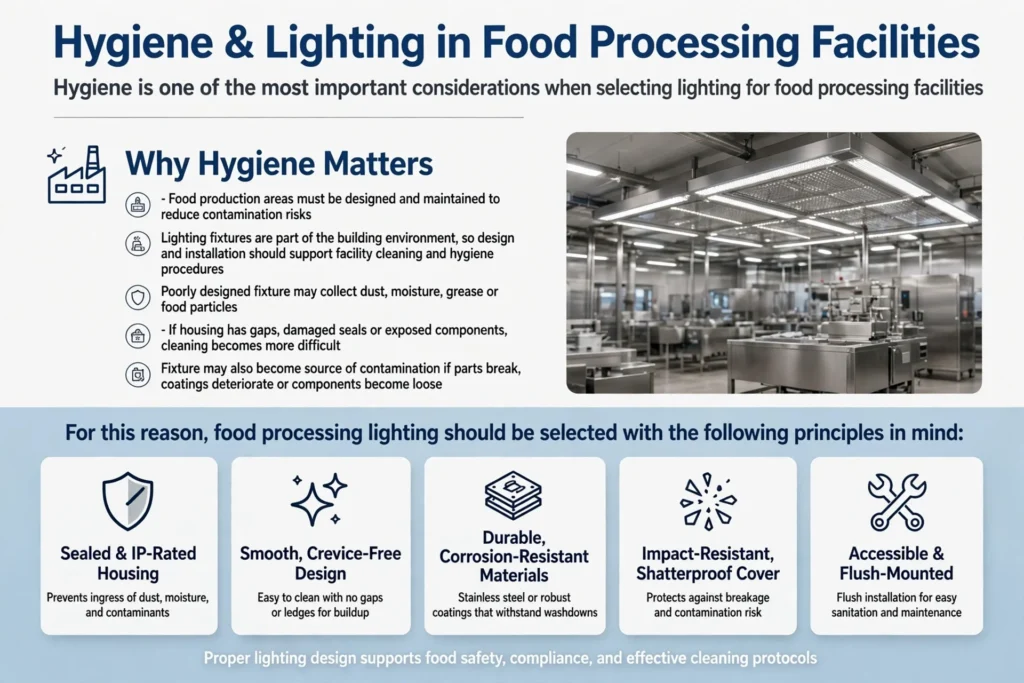
In food production areas, fixtures should be designed to reduce the risk of loose parts.
Covers, lenses, screws and other components should be securely fitted and suitable for the operating environment.
Where there is a risk of broken glass or other material falling into food products, use appropriate shatter-resistant or containment solutions.
Polycarbonate lenses are commonly considered for this type of application because they provide impact resistance. However, their suitability depends on chemical compatibility, temperature limits, cleaning procedures and the manufacturer’s food-industry specifications.
Suitable Installation Above Production Lines
The position of a lighting fixture is just as important as its design.
A fixture installed directly above an open food processing line needs careful consideration. Its construction, mounting system and maintenance access should reduce the risk of contamination.
Where practical, lighting should be positioned so that routine maintenance can take place without disturbing exposed food products.
The facility’s hygiene risk assessment should determine the appropriate fixture type, mounting arrangement and protective measures.
Understanding IP Ratings for Food Processing LED Lights
IP ratings are among the most important specifications to check when selecting LED lighting for a food processing plant.
IP stands for Ingress Protection. The rating describes how well an electrical enclosure protects against the entry of solid objects and water under specified test conditions.
The rating usually contains two digits.
The first digit relates to protection against solid objects and dust. The second digit relates to protection against water.
For food processing facilities in the UAE, the correct rating depends on the location of the fixture and the cleaning conditions.

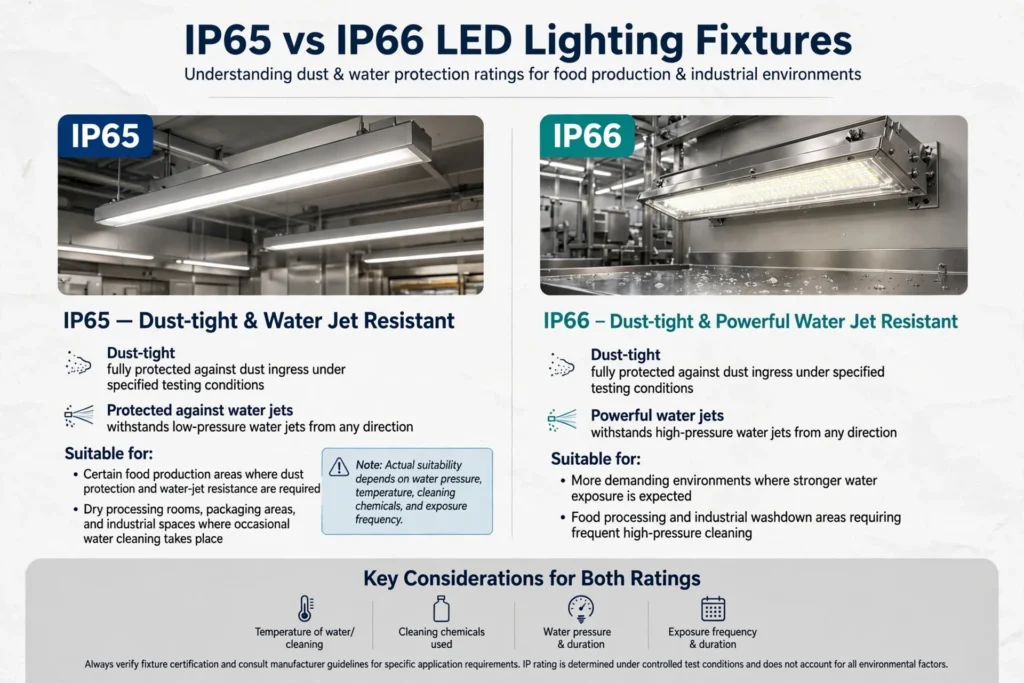
IP65 LED Lighting
IP65 fixtures are dust-tight and protected against water jets under the specified testing conditions.
They may be suitable for certain food production areas where dust protection and water-jet resistance are required.
For example, an IP65 LED fixture may be considered for some dry processing rooms, packaging areas and industrial spaces where occasional water cleaning takes place.
However, the actual suitability depends on the water pressure, temperature, cleaning chemicals and exposure frequency.
IP66 LED Lighting
IP66 fixtures provide dust-tight protection and resistance to powerful water jets under specified test conditions.
They may be suitable for more demanding environments where stronger water exposure is expected.
This rating can be relevant in certain food processing and industrial washdown areas.
IP67 LED Lighting
IP67 fixtures are dust-tight and offer protection against temporary immersion in water under specified testing conditions.
They may be considered in locations where temporary immersion is a possible environmental risk.
However, IP67 does not automatically mean that a fitting is suitable for routine high-pressure washdown.
IP69K LED Lighting
IP69K is associated with protection against high-pressure, high-temperature water-jet cleaning under specified test conditions.
It is particularly relevant when selecting lighting for demanding washdown environments.
Food processing plants that use intensive cleaning procedures may need to consider IP69K-rated luminaires, provided the complete product is tested and suitable for the actual cleaning process.
An important point: IP ratings do not automatically confirm chemical resistance, corrosion resistance, hygienic design or food-contact compliance.
A fitting can have a high IP rating but still have unsuitable external materials or seals for a particular food production environment.
| IP rating | Main protection | Potential application |
|---|---|---|
| IP65 | Dust-tight and water jets | Selected dry and light-washdown areas |
| IP66 | Dust-tight and powerful water jets | More demanding wet processing areas |
| IP67 | Dust-tight and temporary immersion | Areas with temporary immersion risks |
| IP69K | Dust-tight and high-pressure, high-temperature water jets | Intensive washdown environments |
Always check the manufacturer’s actual test documentation and the cleaning requirements of the facility before making a final selection.
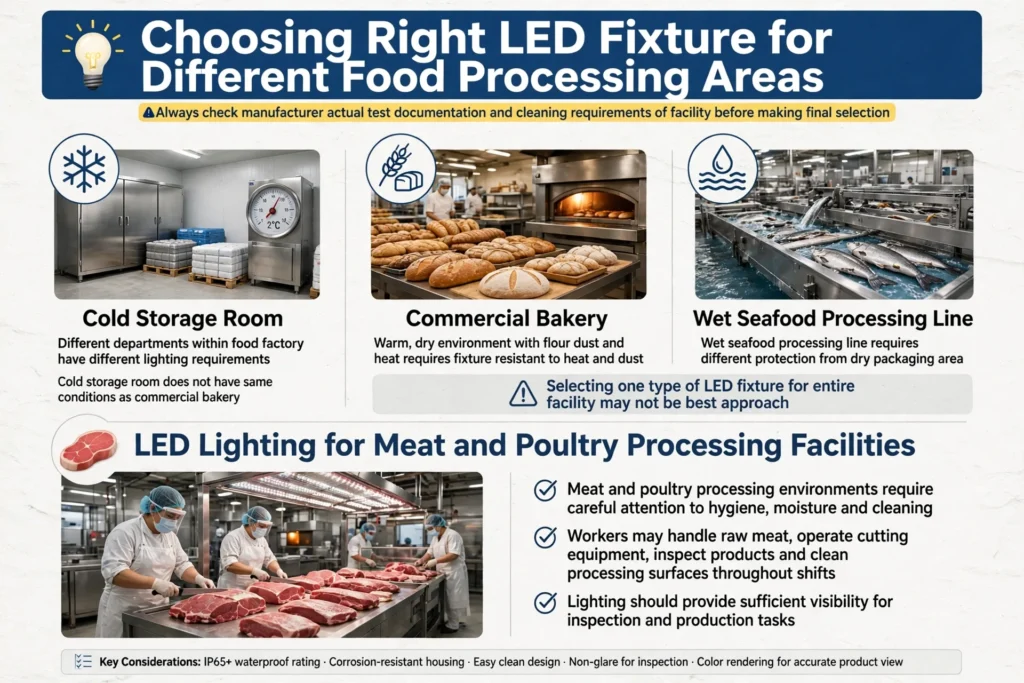
Choosing the Right LED Fixture for Different Food Processing Areas
Different departments within a food factory have different lighting requirements.
A cold storage room does not have the same conditions as a commercial bakery. A wet seafood processing line requires different protection from a dry packaging area.
Selecting one type of LED fixture for the entire facility may not be the best approach.
LED Lighting for Meat and Poultry Processing Facilities
Meat and poultry processing environments require careful attention to hygiene, moisture and cleaning.
Workers may handle raw meat, operate cutting equipment, inspect products and clean processing surfaces throughout their shifts.
Lighting should provide sufficient visibility for inspection and production tasks.
Sealed linear LED luminaires are often worth considering for these environments. They can provide continuous illumination along processing lines while reducing exposed gaps and unnecessary external surfaces.
The fixture should have a suitable ingress protection rating, durable housing and a lens that can withstand the cleaning conditions.
In areas where open food products are handled, shatter-resistant construction or suitable protective measures should also be considered.
The lighting layout should avoid creating dark areas around machinery, cutting stations and inspection points.
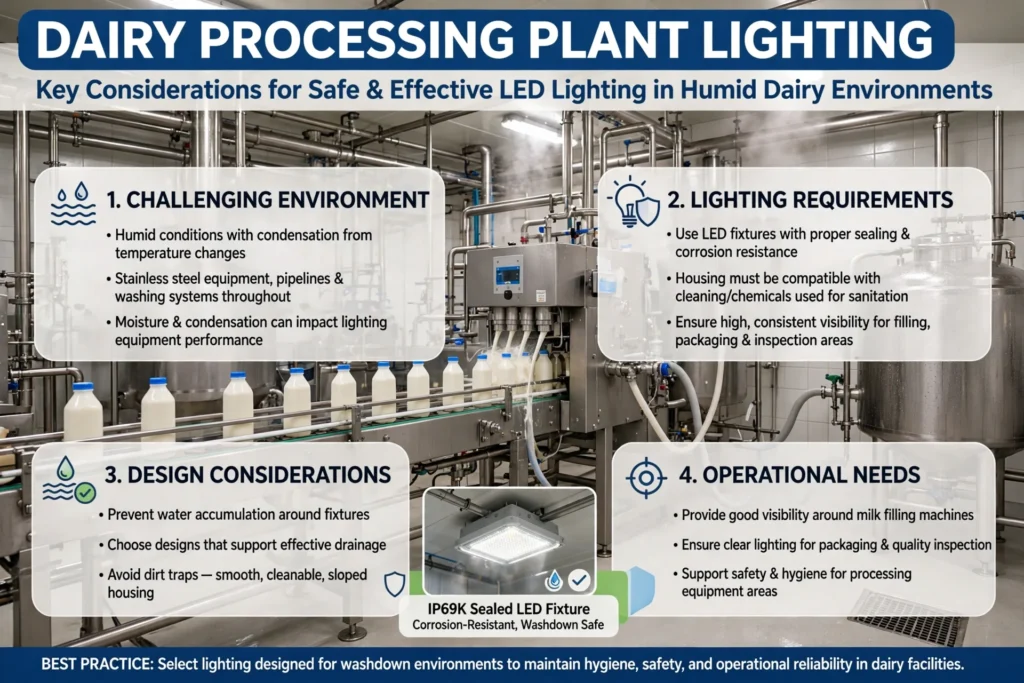
LED Lighting for Dairy Processing Plants
Dairy processing plants often contain humid environments, stainless steel equipment, filling machines, pipelines and washing systems.
Moisture and condensation can affect lighting equipment, particularly in areas with temperature changes.
LED fixtures used in dairy facilities should have suitable sealing and corrosion resistance.
The housing should be compatible with the cleaning chemicals used by the facility.
Another important consideration is the prevention of water accumulation around the fixture.
Where possible, select designs that support effective drainage and do not create unnecessary dirt traps.
Lighting should also provide good visibility around milk filling, packaging, inspection and processing equipment.
LED Lighting for Seafood and Fish Processing Facilities
Seafood processing environments can be particularly demanding because of water, moisture, cleaning chemicals and potentially corrosive conditions.
Salt and saline residues can accelerate corrosion in unsuitable metal components.
This makes fixture housing and external hardware selection especially important.
Stainless steel construction may be appropriate in certain areas, but the specific stainless steel grade and finish should be checked against the actual cleaning chemicals and environmental exposure.
The lens material, seals, cable glands and mounting brackets should also be considered.
For wet seafood processing lines, high-ingress-protection luminaires may be required depending on the cleaning process.
LED Lighting for Commercial Bakeries
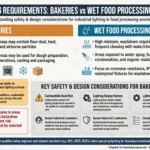
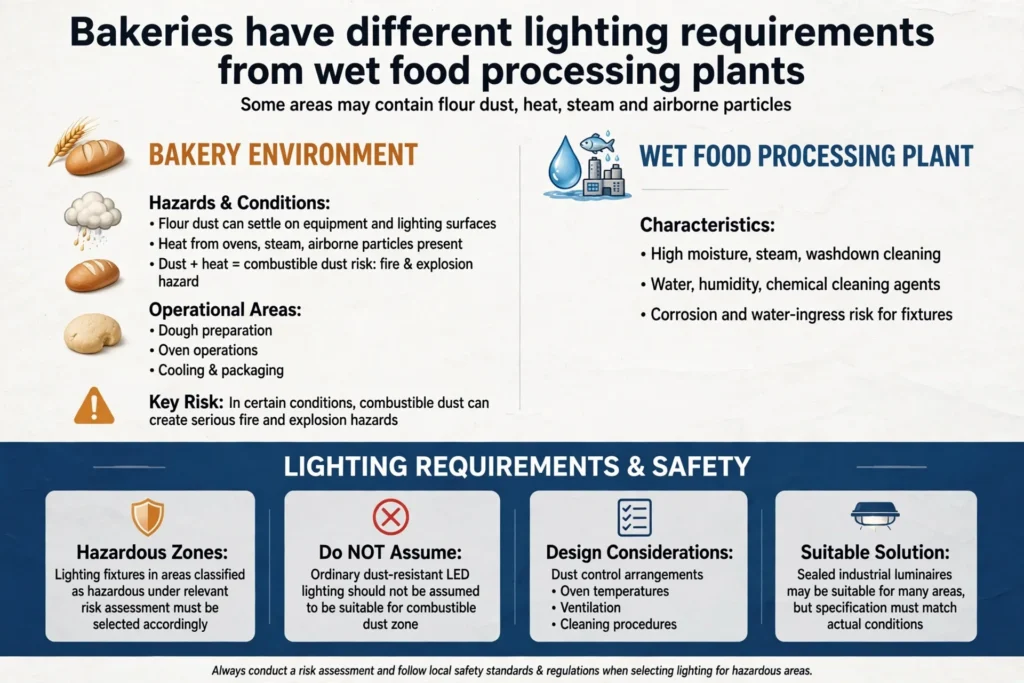
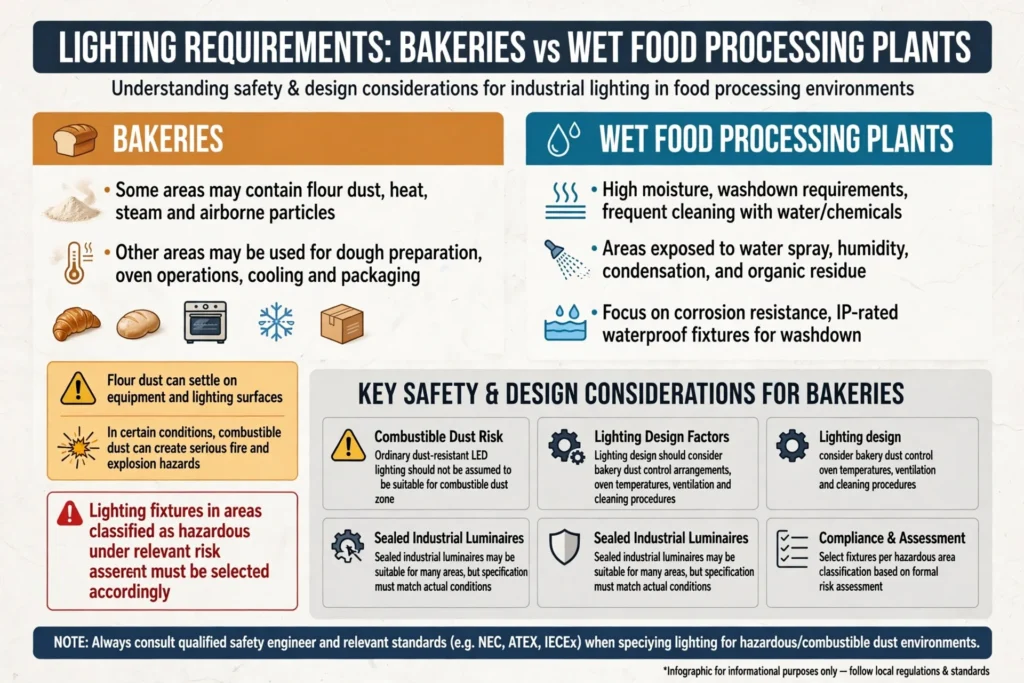
Bakeries have different lighting requirements from wet food processing plants.
Some areas may contain flour dust, heat, steam and airborne particles. Other areas may be used for dough preparation, oven operations, cooling and packaging.
Flour dust can settle on equipment and lighting surfaces. In certain conditions, combustible dust can create serious fire and explosion hazards.
Lighting fixtures in areas classified as hazardous under the relevant risk assessment must be selected accordingly. Ordinary dust-resistant LED lighting should not be assumed to be suitable for a combustible dust zone.
The lighting design should consider the bakery’s dust control arrangements, oven temperatures, ventilation and cleaning procedures.
Sealed industrial luminaires may be suitable for many areas, but the specification must match the actual conditions.
LED Lighting for Food Packaging Facilities
Food packaging departments require clear and consistent lighting for product inspection, labelling, filling, sealing and quality control.
Employees may need to identify damaged packaging, incorrect labels, missing seals and printing defects.
Lighting should minimise harsh shadows and provide sufficient colour rendering for visual inspection.
Sealed linear LED fixtures are often suitable for packaging environments, depending on hygiene and washdown requirements.
For automated production lines, the lighting layout should also consider machinery height, moving equipment and operator positions.
The aim is to provide consistent illumination without creating unnecessary glare or dark spots.
Recommended Lighting Levels for Different Food Factory Areas
The required lighting level depends on the type of work being carried out.
A storage room does not need the same illumination as a quality inspection station. Similarly, a food preparation area needs sufficient light for workers to see product details, equipment surfaces and possible contamination.
Illuminance is measured in lux (lx). One lux represents one lumen of light falling on one square metre of a surface.
For UAE food processing projects, lighting levels should be checked against the applicable emirate’s food safety requirements and the relevant lighting design standards.
For example, the Ras Al Khaimah food establishment requirements specify at least 110 lux in food stores and 320 lux or above in food processing, display and inspection areas, depending on process control requirements. Dubai’s Food Code includes different minimum levels for different activities, including 500 lux for certain work involving unpackaged high-risk foods and cutting equipment. These figures should not be treated as one universal requirement for every factory. Sanad+1
The following table provides practical starting points for discussing lighting design. Final values must be confirmed through the applicable regulations and a proper lighting calculation.
| Food facility area | Indicative lighting level |
|---|---|
| General food storage | 110–150 lux |
| Cold storage and chillers | 110–200 lux |
| General processing areas | 300–500 lux |
| Food preparation stations | 300–500 lux |
| Quality inspection areas | 500 lux or as required |
| Packaging and labelling | 300–500 lux |
| Machine operation areas | 300–500 lux |
| Cleaning and sanitation areas | 200–300 lux |
| Corridors and circulation areas | 100–200 lux |
These are indicative design ranges, not a substitute for statutory requirements or a project-specific lighting calculation.
Why Consistent Illumination Matters
A food processing facility should not have bright spots in one area and dark corners in another.
Uneven illumination can make it harder for employees to inspect products and operate machinery safely.
For example, a worker inspecting packaged food may have difficulty identifying damaged packaging if the workstation has strong shadows.
The lighting designer should consider fixture spacing, mounting height, beam angle, ceiling reflectance and the position of machinery.
A professional lighting layout can help achieve more consistent illumination across the working area.
Colour Temperature and Colour Rendering in Food Manufacturing
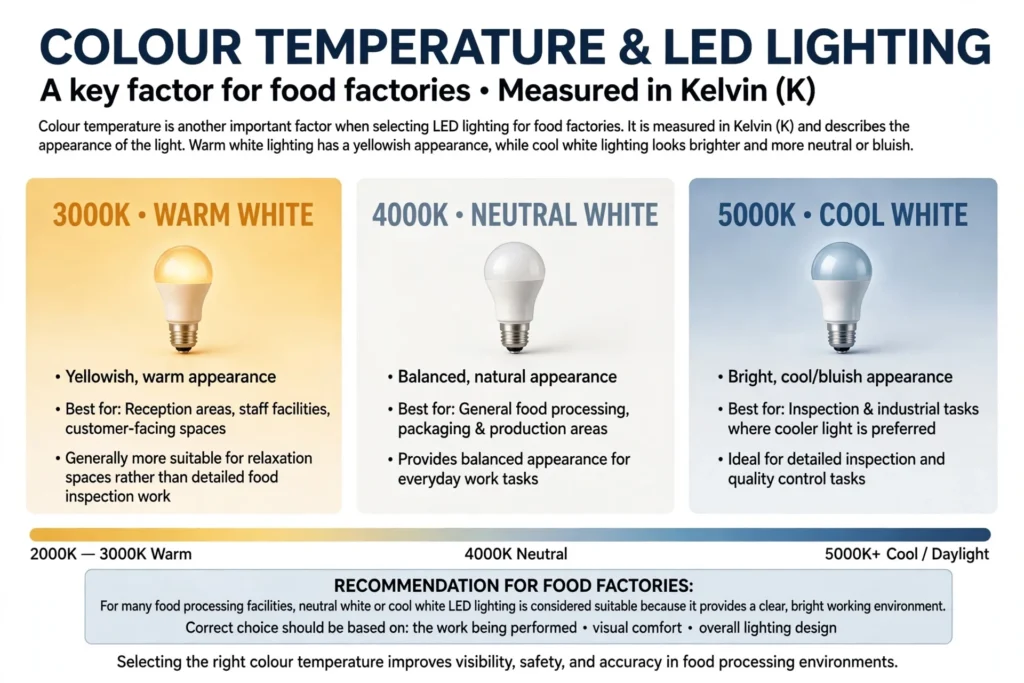
Colour temperature is another important factor when selecting LED lighting for food factories.
It is measured in Kelvin (K) and describes the appearance of the light.
Warm white lighting has a yellowish appearance, while cool white lighting looks brighter and more neutral or bluish.
For many food processing facilities, neutral white or cool white LED lighting is considered suitable because it provides a clear working environment.
Common options include:
3000K warm white: This is generally more suitable for reception areas, staff facilities and some customer-facing spaces than detailed food inspection work.
4000K neutral white: This can provide a balanced appearance for general food processing, packaging and production areas.
5000K cool white: This can be useful for certain inspection and industrial tasks where a cooler appearance is preferred.
The correct choice should be based on the work being performed, visual comfort and the lighting design.
Why Colour Rendering Index Matters
Colour Rendering Index (CRI) measures how accurately a light source reveals colours compared with a reference light source.
This is important in food production because workers sometimes need to assess the appearance of ingredients and finished products.
For example, a quality inspector may need to identify changes in the colour of meat, vegetables, fruit or baked goods.
A low-quality light source can make some colours appear different from their actual appearance.
For many food manufacturing applications, a CRI of 80 or higher is a practical starting point. Where accurate colour inspection is important, a higher CRI may be appropriate.
However, CRI alone does not guarantee accurate food colour assessment. The light spectrum, product characteristics and inspection conditions also matter.
Selecting the Right LED Fixture Housing and Material
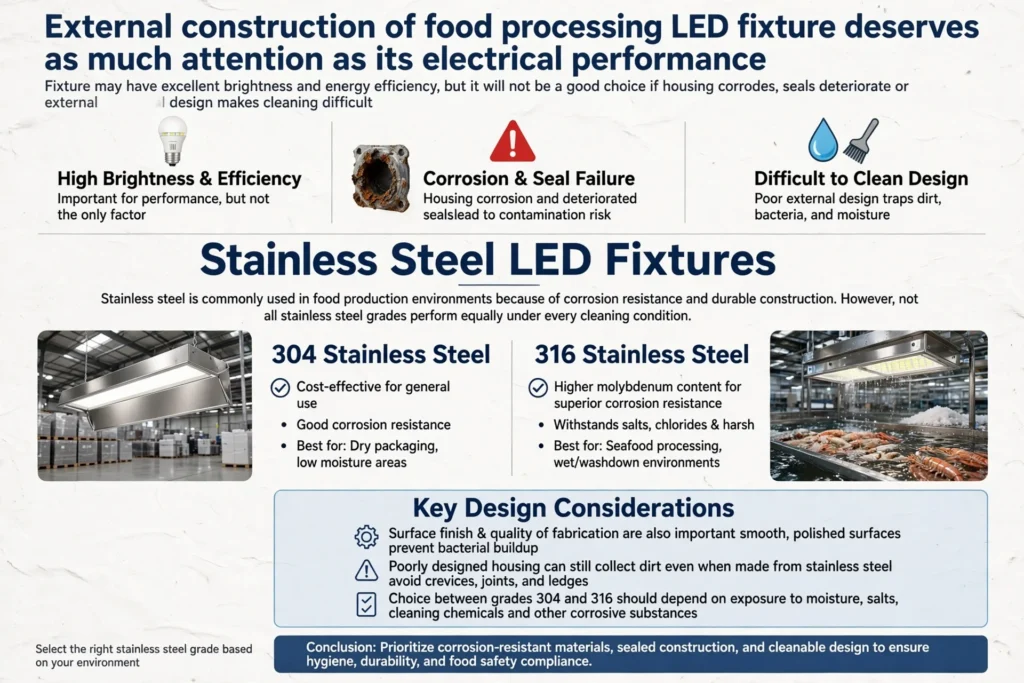
The external construction of a food processing LED fixture deserves as much attention as its electrical performance.
A fixture may have excellent brightness and energy efficiency, but it will not be a good choice if its housing corrodes, its seals deteriorate or its external design makes cleaning difficult.
Stainless Steel LED Fixtures
Stainless steel is commonly used in food production environments because of its corrosion resistance and durable construction.
However, not all stainless steel grades perform equally under every cleaning condition.
The choice between grades such as 304 and 316 should depend on exposure to moisture, salts, cleaning chemicals and other corrosive substances.
For example, a seafood processing facility may need greater corrosion resistance than a dry packaging warehouse.
The surface finish and quality of fabrication are also important. A poorly designed housing can still collect dirt even when it is made from stainless steel.
Polycarbonate LED Diffusers
Polycarbonate is often used for LED lenses and protective covers.
It offers good impact resistance and can reduce the risk associated with broken glass.
This makes it worth considering for lighting installed above food production and packaging lines.
However, the material must be suitable for the cleaning chemicals, temperature conditions and operating environment.
Some chemicals can cause stress cracking, surface deterioration or loss of clarity over time.
Always check chemical compatibility with the manufacturer’s documentation.
Aluminium LED Housings
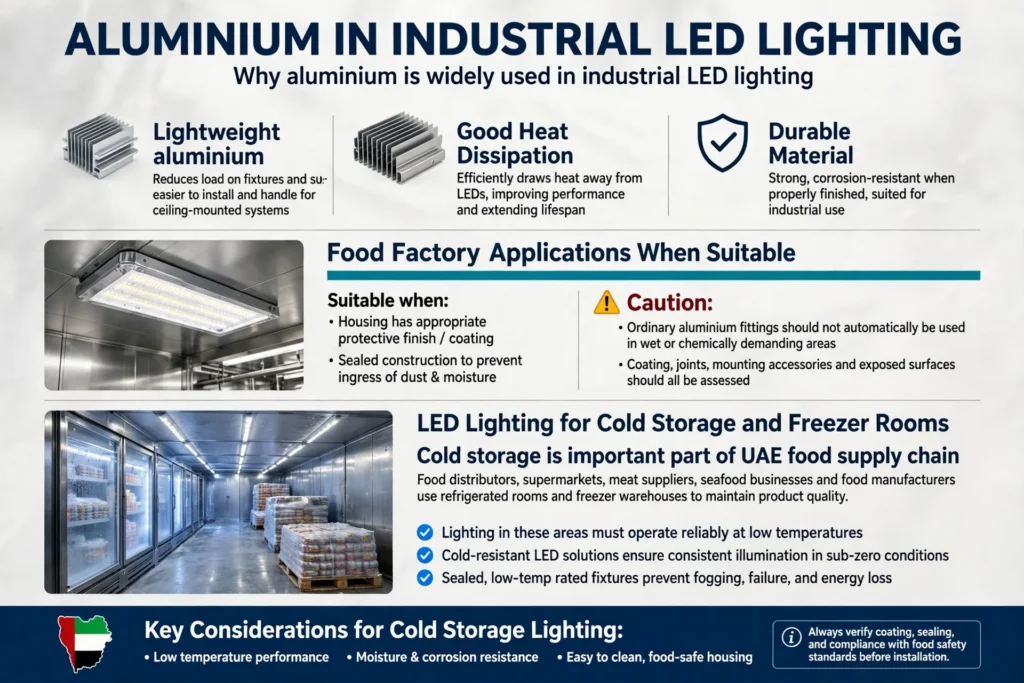
Aluminium is widely used in industrial LED lighting because it is lightweight and provides good heat dissipation.
It can be suitable for certain food factory applications when the housing has an appropriate protective finish and sealed construction.
However, ordinary aluminium fittings should not automatically be used in wet or chemically demanding areas.
The coating, joints, mounting accessories and exposed surfaces should all be assessed.
LED Lighting for Cold Storage and Freezer Rooms
Cold storage is an important part of the UAE food supply chain.
Food distributors, supermarkets, meat suppliers, seafood businesses and food manufacturers use refrigerated rooms and freezer warehouses to maintain product quality.
Lighting in these areas must operate reliably at low temperatures.
Ordinary indoor LED fixtures may not be suitable for freezer environments because their operating temperature range may not match the actual conditions.
Before selecting a fixture, check its minimum and maximum operating temperatures.
Condensation and Moisture
Temperature changes can create condensation around lighting equipment.
For example, when a cold storage room is opened and warmer humid air enters, moisture may form on surfaces and equipment.
If the lighting fixture is not designed for these conditions, water may enter through weak seals or cable connections.
Suitable sealed LED fixtures can help reduce this risk.
The design should also consider the position of the driver and electrical connections.
Cold-Temperature Performance
LED lighting can perform well in low-temperature environments, but the driver and other electrical components must be suitable for the application.
Check the manufacturer’s rated operating temperature rather than assuming that every LED product works in a freezer.
Emergency Lighting
Cold storage areas may also require emergency lighting to support safe movement during power interruptions.
Emergency lighting should be designed for the actual environmental conditions and maintained according to the applicable safety requirements.
Preventing Glare and Shadows in Food Processing Areas
High brightness does not always mean good lighting.
A poorly positioned LED fitting can create glare, reflections and unwanted shadows.
This can affect worker comfort and make visual inspection more difficult.
For example, stainless steel machinery can reflect light directly towards an employee’s eyes. This may cause discomfort during long working hours.
Glare can also appear on polished production surfaces, packaging materials and transparent machine guards.
To prevent these issues, the lighting designer should consider the direction of light, fixture positioning, diffuser design and beam distribution.
Linear LED fixtures can provide useful uniform illumination over production lines.
High-bay LED luminaires may be suitable for warehouses and large food manufacturing halls with high ceilings, provided their protection and hygienic design are appropriate.
Where visual inspection is important, lighting should be positioned to minimise shadows around the inspection surface.
The goal is not simply to install more powerful lights. It is to distribute light properly across the working environment.
How to Clean and Maintain LED Lighting in Food Factories
Cleaning is a regular part of food manufacturing operations.
Food factories may follow daily, weekly or scheduled sanitation procedures depending on the type of production and the facility’s hygiene management system.
Lighting equipment should be selected with these cleaning routines in mind.
A fixture that is difficult to access or clean can create unnecessary maintenance work.
Follow the Manufacturer’s Cleaning Instructions
Never assume that every waterproof LED fixture can be cleaned using the same chemicals or pressure.
The cleaning method must match the product’s technical specification.
Some fixtures can withstand certain water-jet conditions but may not be compatible with strong alkaline cleaners, acidic detergents or concentrated disinfectants.
Check the permitted chemical types, concentrations, temperature and contact time.
Switch Off Power Before Cleaning
Electrical safety should always be considered during cleaning and maintenance.
Follow the manufacturer’s isolation procedure and the facility’s lockout/tagout arrangements where applicable.
Cleaning staff should never open a fixture or remove electrical components while the equipment is energised.
Any electrical inspection or repair should be carried out by suitably qualified personnel.
Avoid Damaging Seals and Lenses
Cleaning equipment can damage LED fixtures if used incorrectly.
High-pressure water directed at an unsuitable angle may affect seals, cable entries or other vulnerable parts.
Abrasive brushes can scratch protective lenses.
Harsh chemicals may damage coatings or gaskets.
Use approved cleaning methods and inspect the fixture after cleaning where required.
Include Lighting in the Hygiene Inspection
Lighting should form part of the facility’s normal inspection programme.
Check for damaged lenses, loose fittings, corrosion, water ingress and deteriorating seals.
Also look for dirt accumulation around mounting brackets and cable entries.
If a fixture is damaged, assess whether it needs repair or replacement before returning the area to normal production.
The cleaning procedure should be documented as part of the facility’s wider hygiene management system.
LED Lighting and HACCP in Food Processing Facilities
HACCP stands for Hazard Analysis and Critical Control Points.
It is a systematic approach used by food businesses to identify, evaluate and control food safety hazards.
Lighting is not automatically a critical control point in every food factory. However, it can form part of the facility’s hygiene and contamination risk assessment.
For example, a light fixture installed above an exposed food conveyor may create a physical contamination risk if its lens breaks.
A damaged fitting may also allow dirt, water or insects to enter its housing.
These risks should be considered during facility design and maintenance planning.
A suitable lighting specification can support the facility’s HACCP-based food safety management system.
This may involve selecting shatter-resistant lenses, sealed housings, secure mounting systems and materials that can withstand the approved cleaning procedure.
The facility should also keep relevant technical documents, including product specifications, IP test information, cleaning instructions and maintenance records.
HACCP compliance does not come from installing an IP-rated LED fitting alone. It requires an overall food safety management approach.
UAE Food Safety Regulations and Lighting Considerations
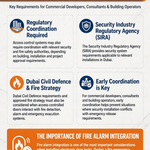
Food processing businesses in the UAE must consider the food safety requirements applicable to their location and activities.
Food safety responsibilities involve local authorities, including Dubai Municipality, Abu Dhabi Agriculture and Food Safety Authority (ADAFSA), and the relevant authorities in other emirates.
The UAE Government also identifies local municipalities and food safety authorities as responsible bodies for food safety oversight. U.AE+1
There are several important considerations when designing lighting for food production facilities.
Dubai Food Processing Facilities
Businesses operating in Dubai should consider the Dubai Food Code and applicable requirements issued by Dubai Municipality.
The food facility must provide suitable illumination for safe food production and cleaning.
The Dubai Food Code also addresses lighting intensity and protection against contamination from broken lighting components. dbs-dubai.com+1
Abu Dhabi Food Manufacturing Facilities
Food businesses in Abu Dhabi should consider the requirements of ADAFSA and applicable food safety legislation.
ADAFSA’s food safety requirements address adequate illumination and protection of lighting equipment and electrical wiring to support cleaning and reduce cross-contamination risks. ADAFSA
Sharjah and Other Emirates
Food processing facilities in Sharjah should consider the requirements of Sharjah Municipality and the relevant local food safety programme.
Other emirates may have their own applicable food establishment requirements.
For example, the published Ras Al Khaimah food establishment code provides specific lighting requirements for food stores, processing areas and inspection locations. Sanad+1
The important point is that a lighting specification should not be based on one general UAE requirement. The project team should confirm the current rules for the relevant emirate, facility type and food activity.
Energy Efficiency and Operating Costs of LED Lighting
Energy consumption is another important reason food factories are moving towards LED lighting.
Large manufacturing facilities may operate for long hours, sometimes across multiple shifts.
Lighting can therefore account for a meaningful part of the facility’s electricity consumption.
LED technology can help reduce this cost when compared with suitable older lighting systems.
However, energy savings depend on the complete lighting design, not simply the wattage printed on the fixture.
A proper comparison should consider:
- LED fixture wattage.
- Delivered light output in lumens.
- System efficacy in lumens per watt.
- Operating hours.
- Lighting controls.
- Maintenance requirements.
- Expected service life.
- Replacement and installation costs.
For example, installing high-wattage fixtures everywhere may increase electricity consumption without improving working conditions.
A better approach is to calculate the required illumination and select fixtures that deliver it efficiently.
Motion Sensors and Lighting Controls
Lighting controls can help reduce unnecessary energy use in areas that are not occupied continuously.
For example, motion sensors may be useful in selected storage rooms, maintenance areas and secondary corridors.
However, controls should not switch off lighting unexpectedly in active production areas.
Any lighting control system should be planned around the facility’s operating procedures and safety requirements.
Dimmable lighting may also be useful in certain spaces, provided the fixtures and control equipment are compatible.
How to Select the Best LED Lighting for a UAE Food Processing Facility
Selecting the correct lighting requires more than comparing prices and wattages.
A food manufacturer should consider the complete working environment before choosing a product.
For example, a dairy factory may need sealed lighting with strong moisture resistance, while a dry food packaging warehouse may require industrial high-bay LED fixtures with good light distribution.
The following factors should be considered before purchasing.
Understand the Production Environment
Start by identifying the type of food being processed and the conditions inside each department.
Check whether the area is dry, wet, humid, dusty, refrigerated or exposed to cleaning chemicals.
Also identify whether food is exposed or sealed during production.
This information helps determine the required fixture construction, IP rating and installation method.
Check the Technical Specifications
Do not select an LED fixture based only on its advertised wattage.
Review its lumen output, efficacy, colour temperature, CRI, operating temperature, ingress protection and electrical specifications.
Also check the rated service life and warranty conditions.
Review the Installation Height
The height of the ceiling affects how light reaches the working surface.
A high-ceiling manufacturing facility may need industrial LED high-bay lighting, while a lower production room may benefit from sealed linear luminaires.
A professional lighting calculation can help determine the number, spacing and mounting positions of fixtures.
Consider Future Maintenance
Lighting should be easy to inspect, maintain and replace without creating unnecessary disruption to food production.
Consider whether maintenance can be carried out safely, how electrical connections are accessed and whether replacement components will remain available.
For larger projects, it is also worth checking whether the supplier can provide technical assistance and replacement products.
Common Mistakes When Selecting LED Lights for Food Factories
Several lighting mistakes can create avoidable costs for food manufacturers.
One common mistake is selecting ordinary commercial LED panels for wet processing areas. These fixtures may not have the sealing or construction required for regular washdown.
Another mistake is assuming that IP65 automatically means a fixture is suitable for every food factory. The cleaning method, chemical exposure and installation conditions must also be considered.
Some businesses choose lighting based only on the initial purchase price. A cheaper fixture may have unsuitable materials, poor seals or limited technical support, resulting in higher maintenance costs later.
Other common mistakes include installing lights without proper lighting calculations, ignoring glare, using unsuitable lenses, overlooking cold-storage temperature requirements and failing to protect fixtures installed above exposed food products.
There is also a risk of selecting fixtures without checking their cleaning chemical compatibility.
These mistakes can be avoided by reviewing the complete application before ordering.
Why Work With an Experienced LED Lighting Supplier?
A food processing facility needs lighting products that match its operational requirements.
An experienced lighting supplier should understand the differences between ordinary commercial lighting and specialist industrial applications.
The supplier should be able to discuss IP ratings, fixture construction, LED drivers, colour rendering, illumination requirements and installation conditions.
This is particularly important for larger projects where the wrong product selection can affect an entire production area.
An experienced supplier can also help the project team review product datasheets, compare suitable fixture options and identify technical requirements before purchasing.
With 20 years of Lrd Lighting Selling, the focus should be on selecting suitable LED lighting products for the actual application rather than simply recommending fixtures based on price or appearance.
For UAE food manufacturing projects, this means considering the needs of production facilities in Dubai, Abu Dhabi, Sharjah, Ajman, Ras Al Khaimah and other industrial locations.
The right supplier should understand that a lighting solution for a seafood processing plant may be very different from one for a dry food warehouse or commercial bakery.
Final Thoughts on LED Lighting for Food Processing Facilities
LED lighting is an important part of a safe, clean and efficient food manufacturing environment.
However, choosing the right product requires careful attention to hygiene, fixture construction, water resistance, cleaning procedures, illumination levels and operating conditions.
Food factories in the UAE must consider their individual production requirements and applicable local food safety regulations before selecting lighting equipment.
Sealed LED linear fixtures, suitable high-bay luminaires, shatter-resistant diffusers and corrosion-resistant housings can all have a role in food manufacturing environments, depending on the application.
IP65, IP66 and IP69K ratings can help identify suitable levels of ingress protection, but they should always be assessed alongside the actual cleaning process and chemical compatibility.
The best lighting system is one that provides consistent visibility, supports hygiene procedures, reduces unnecessary energy consumption and remains reliable under daily operating conditions.
For food manufacturers, investing time in the lighting selection process can help prevent maintenance problems, reduce operational interruptions and support a better production environment.