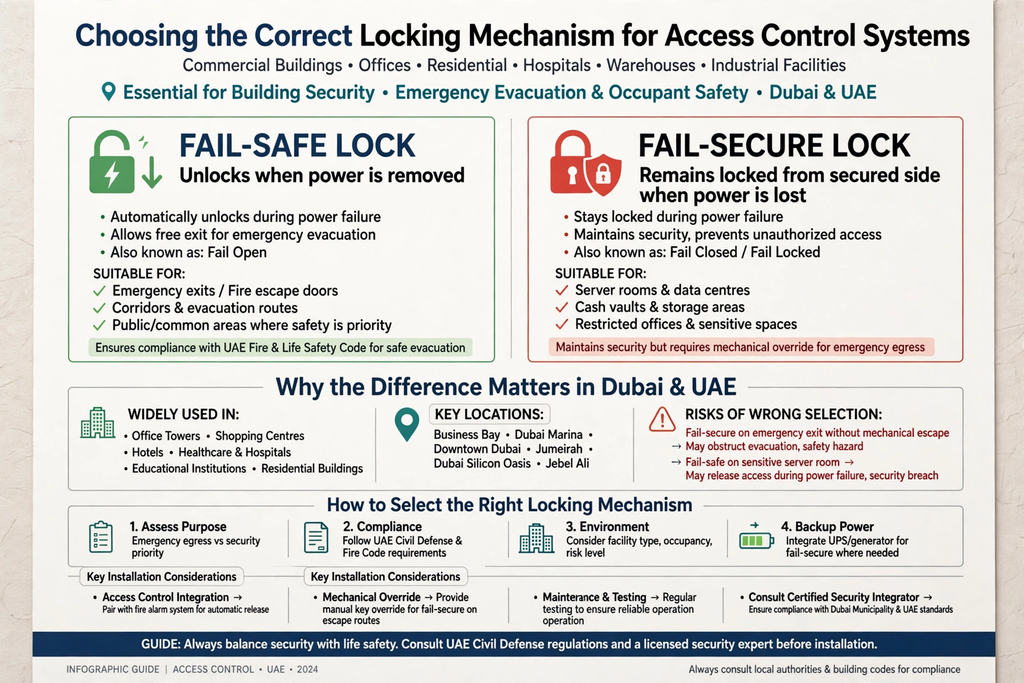
Choosing the correct locking mechanism is an important part of designing a reliable access control system for commercial buildings, offices, residential developments, hospitals, warehouses and industrial facilities. One of the most important decisions during access control planning is whether a door should use a fail-safe or fail-secure electric lock.
Both locking mechanisms are designed to control access through electronically operated doors. However, they behave differently when electrical power is interrupted. A fail-safe lock unlocks when power is removed, while a fail-secure lock remains locked from the secured side when power is lost. Understanding this difference is essential for maintaining building security without compromising emergency evacuation and occupant safety.
In Dubai and across the UAE, access control systems are widely used in office towers, shopping centres, hotels, healthcare facilities, educational institutions and residential communities. Buildings in areas such as Business Bay, Dubai Marina, Downtown Dubai, Jumeirah, Dubai Silicon Oasis and Jebel Ali often require different locking arrangements depending on the door’s purpose, occupancy and security requirements.
Selecting the wrong lock can create serious operational problems. A fail-secure lock installed on an emergency exit without an appropriate mechanical escape arrangement may obstruct evacuation. Similarly, a fail-safe lock installed on a sensitive server room may release access during a power failure if there is no suitable backup or additional security arrangement.
This guide explains how fail-safe and fail-secure locks work, their differences, suitable applications, installation considerations and how to select the right locking mechanism for different commercial doors.
What Is an Access Control Lock?
An access control lock is an electronically operated locking device connected to an access management system. It allows authorised individuals to enter a building or restricted area using credentials such as access cards, PIN codes, biometric identification, mobile credentials or other approved authentication methods.
Unlike conventional mechanical locks, electronic access control locks can be integrated with several building security components, including:
- Access control panels and controllers.
- RFID card readers and proximity readers.
- Biometric fingerprint and facial recognition readers.
- Electric strikes and electromagnetic locks.
- Door position sensors and request-to-exit devices.
- Fire alarm and emergency release interfaces.
- Building Management Systems (BMS), where supported.
The locking mechanism receives an electrical signal from the access control controller and changes its state according to the configured access permissions.
For example, an employee may present an access card at an office entrance. The reader verifies the credential, the controller authorises entry and the electric locking device releases the door for the permitted period.
However, the way the lock responds when electricity is interrupted depends on whether it is designed to operate as fail-safe or fail-secure.
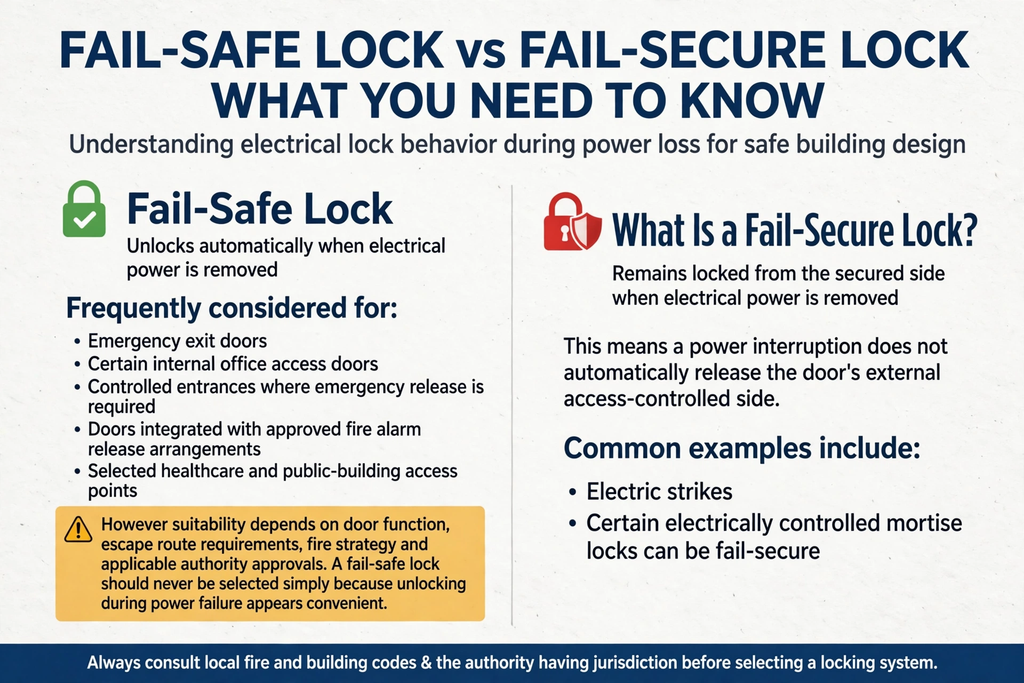
What Is a Fail-Safe Lock?
A fail-safe lock is designed to unlock when electrical power is removed.
In normal operation, the lock receives power and remains in its secured state. When power is interrupted, the locking mechanism releases, allowing the door to open from the controlled direction.
Electromagnetic locks, commonly known as maglocks, are a typical example of fail-safe locking devices.
A magnetic lock uses an electromagnetic force to hold a metal armature plate against the lock body. When electrical power is removed, the magnetic holding force disappears and the door can be released.
How Does a Fail-Safe Lock Work?
A typical fail-safe access control arrangement includes an electromagnetic lock, access control reader, controller, power supply and appropriate exit-release devices.
During normal operation, the electromagnetic lock receives continuous electrical power and keeps the door secured.
When an authorised person presents an access card, the controller temporarily interrupts power to the lock, allowing the door to open.
If the building experiences a power failure, the electromagnetic lock releases because it cannot maintain its magnetic holding force without electricity.
This behaviour can be useful where unlocking during a power interruption is necessary for an approved emergency egress strategy.
Common Applications of Fail-Safe Locks
Fail-safe locks are frequently considered for:
- Emergency exit doors.
- Certain internal office access doors.
- Controlled entrances where emergency release is required.
- Doors integrated with approved fire alarm release arrangements.
- Selected healthcare and public-building access points.
However, the suitability of a fail-safe lock depends on the door’s function, escape route requirements, fire strategy and applicable authority approvals.
A fail-safe lock should never be selected simply because unlocking during power failure appears convenient.
What Is a Fail-Secure Lock?
A fail-secure lock is designed to remain locked from the secured side when electrical power is removed.
This means a power interruption does not automatically release the door’s external access-controlled side.
Electric strikes and certain electrically controlled mortise locks can be configured for fail-secure operation, depending on their product design.
How Does a Fail-Secure Lock Work?
A fail-secure locking arrangement receives an electrical signal when access is authorised.
When an authorised user presents a valid card, PIN or biometric credential, the access control controller activates the locking mechanism and allows the door to open.
When power is removed, the lock remains secured from the outside or controlled side.
A person inside the room must still be able to exit through an appropriate mechanical handle, lever, panic hardware or other approved egress arrangement, depending on the door configuration.
This distinction is important: fail-secure does not mean that people should become trapped inside a room during a power failure.
Common Applications of Fail-Secure Locks
Fail-secure locks are commonly considered for:
- Server rooms.
- IT infrastructure rooms.
- Data storage areas.
- Restricted document storage rooms.
- Pharmaceutical storage areas.
- Security control rooms.
- Certain warehouse and industrial access doors.
These areas may require continued protection against unauthorised entry when the building’s electrical supply is interrupted.
The selected locking arrangement must still provide compliant emergency escape wherever people may occupy the space.
Fail-Safe vs Fail-Secure Locks: Key Differences
Although both locking systems are used in electronic access control installations, their behaviour during a power interruption is different.
The following comparison highlights the main differences.
| Feature | Fail-Safe Lock | Fail-Secure Lock |
|---|---|---|
| During power failure | Unlocks | Remains locked from the secure side |
| Main priority | Controlled release and emergency access | Maintaining security |
| Common hardware | Electromagnetic locks | Fail-secure electric strikes and electromechanical locks |
| Access during power loss | Controlled side becomes unlocked | Controlled side remains locked |
| Typical consideration | Emergency exits and approved egress arrangements | Restricted storage and security-sensitive areas |
| Fire alarm integration | Releases where required by the approved fire strategy | Depends on lock type, door function and approved configuration |
| Backup power | May maintain normal security until an emergency release | May maintain electronic access during an outage |
Important: Fail-safe and fail-secure describe the locking condition on the secured side. They do not automatically determine whether someone can escape from inside. Mechanical free egress, emergency release arrangements and fire alarm interfaces must be assessed separately.
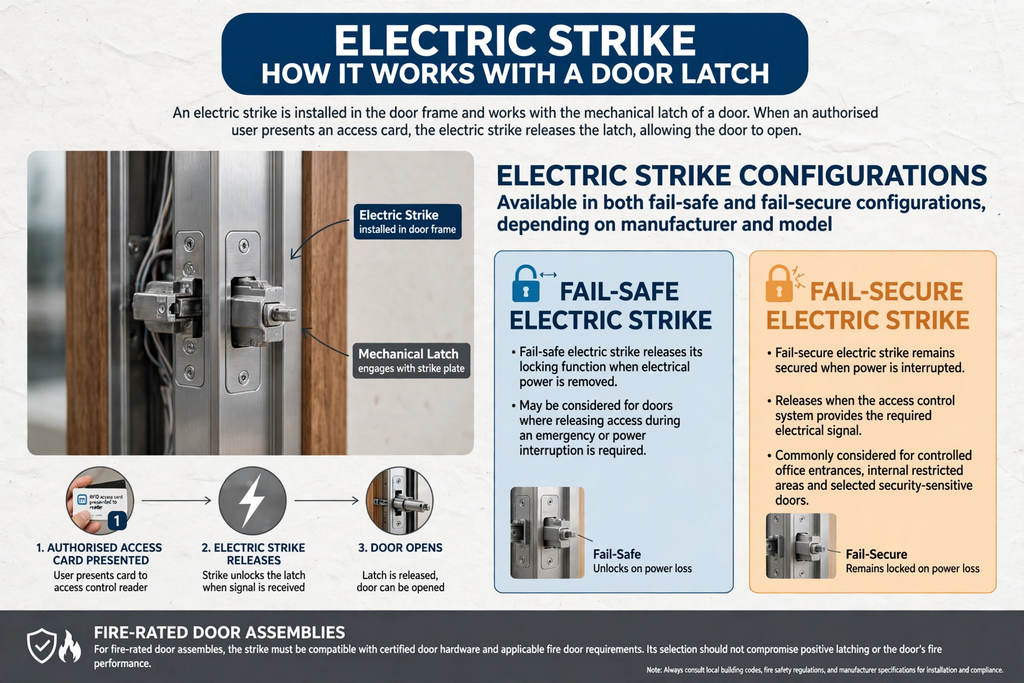
1. Fail-Safe vs Fail-Secure Electric Strikes
An electric strike is installed in the door frame and works with the mechanical latch of a door.
When an authorised user presents an access card, the electric strike releases the latch, allowing the door to open.
Electric strikes are available in both fail-safe and fail-secure configurations, depending on the manufacturer and model.
Fail-Safe Electric Strike
A fail-safe electric strike releases its locking function when electrical power is removed.
It may be considered for doors where releasing access during an emergency or power interruption is required by the approved design.
Fail-Secure Electric Strike
A fail-secure electric strike remains secured when power is interrupted. It releases when the access control system provides the required electrical signal.
This configuration is commonly considered for controlled office entrances, internal restricted areas and selected security-sensitive doors.
For fire-rated door assemblies, the strike must be compatible with the certified door hardware and applicable fire door requirements. Its selection should not compromise positive latching or the door’s fire performance.
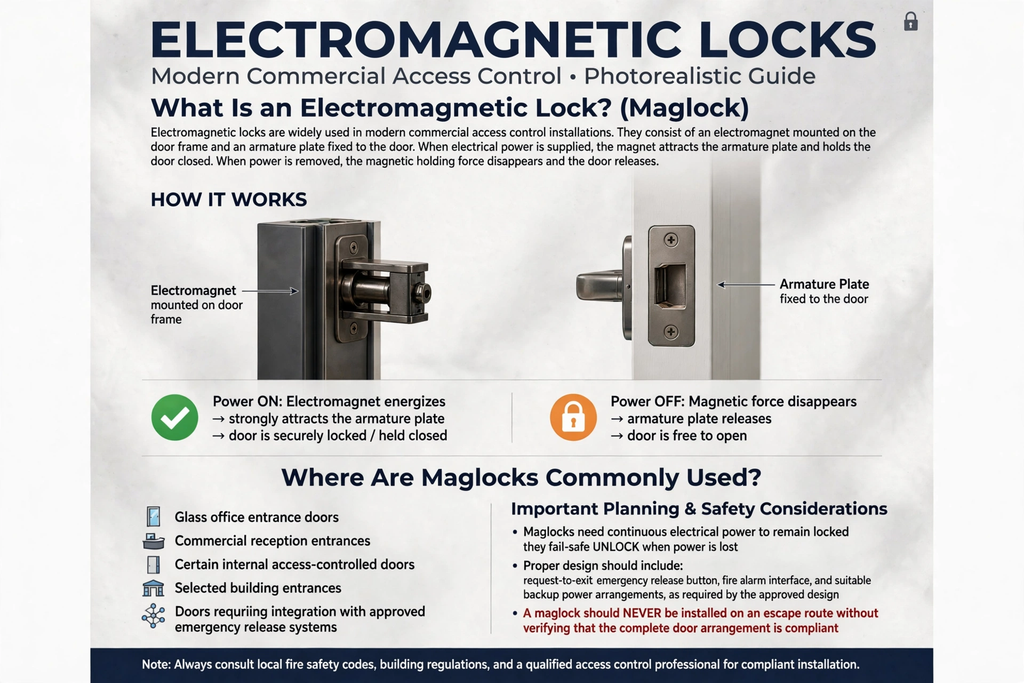
2. Fail-Safe Electromagnetic Locks (Maglocks)
Electromagnetic locks are widely used in modern commercial access control installations.
They consist of an electromagnet mounted on the door frame and an armature plate fixed to the door.
When electrical power is supplied, the magnet attracts the armature plate and holds the door closed.
When power is removed, the magnetic holding force disappears and the door releases.
Where Are Maglocks Commonly Used?
Maglocks may be suitable for:
- Glass office entrance doors.
- Commercial reception entrances.
- Certain internal access-controlled doors.
- Selected building entrances.
- Doors requiring integration with approved emergency release systems.
However, maglocks need careful planning because their operation depends on continuous electrical power.
A properly designed installation may include a request-to-exit sensor, emergency release button, fire alarm interface and suitable backup power arrangements, as required by the approved design.
A maglock should never be installed on an escape route without verifying that the complete door arrangement provides compliant emergency egress.
3. Fail-Secure Electromechanical Locks
Electromechanical locks combine conventional mechanical locking components with electronic access control functionality.
They may include motorised mortise locks, electrically controlled latch mechanisms and other electronic locking assemblies.
Depending on the product, these locks can be configured for fail-safe or fail-secure operation.
A fail-secure electromechanical lock maintains its secured condition from the controlled side when electrical power is removed.
Mechanical handles, cylinders and other approved release mechanisms can provide independent operation where required.
Suitable Applications
Electromechanical locks may be considered for:
- Controlled office doors.
- Restricted document storage.
- Security rooms.
- Certain industrial facilities.
- Approved high-security storage areas.
For particularly sensitive areas, the lock must be selected according to the security risk, emergency access arrangements and applicable authority requirements.
In Dubai, the 2025 Preventive Systems Manual specifically identifies certain sensitive facilities, including financial safes, hazardous-material storage, narcotics and restricted-medication storage, weapons and ammunition depots, and detention or quarantine facilities, for emergency self-locking arrangements using electromechanical locks. Dubai Data Protection+1
4. How to Select the Correct Lock for Different Commercial Doors
The correct locking mechanism depends on the purpose of the door, the people using it, the level of security required and whether it forms part of an emergency escape route.
A single locking solution should not automatically be used throughout an entire building.
Main Building Entrance Doors
Main entrances in commercial buildings require controlled access while allowing authorised visitors, employees and emergency personnel to enter and leave safely.
Glass entrance doors in office towers and commercial buildings may use electromagnetic locks where permitted by the approved design.
For buildings in Business Bay, Downtown Dubai and Dubai Marina, the access control arrangement should be coordinated with the entrance architecture, visitor management system and fire alarm strategy.
The design should also consider reception operations, emergency release, power backup and access during maintenance.
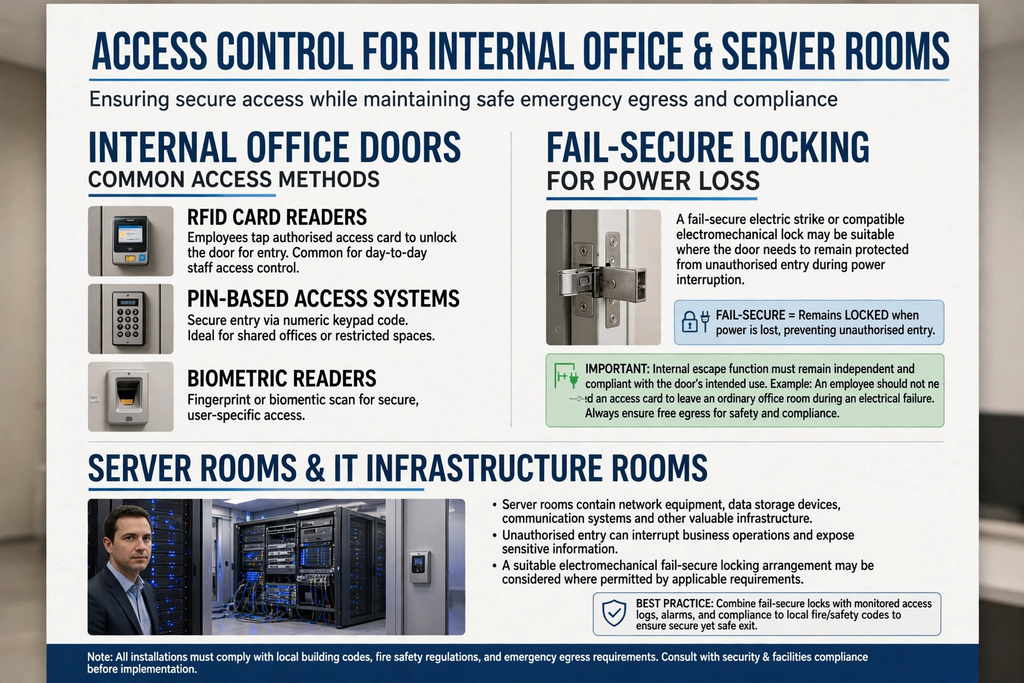
Office Interior Doors
Internal office doors are commonly connected to RFID card readers, PIN-based access systems or biometric readers.
A fail-secure electric strike or compatible electromechanical lock may be suitable where the door needs to remain protected from unauthorised entry during a power interruption.
However, the internal escape function must remain independent and compliant with the door’s intended use.
For example, an employee should not need an access card to leave an ordinary office room during an electrical failure.
Server Rooms and IT Infrastructure Rooms
Server rooms contain network equipment, data storage devices, communication systems and other valuable infrastructure.
Unauthorised entry can interrupt business operations and expose sensitive information.
A suitable electromechanical fail-secure locking arrangement may be considered where permitted by the applicable requirements.
The system can integrate RFID credentials, biometric authentication, access logs and door position monitoring.
Designers should also consider backup power, emergency access for authorised IT personnel and any applicable fire and evacuation requirements.
Emergency Exit Doors
Emergency exits require particular attention because they are directly associated with occupant safety.
The primary purpose of an emergency exit is to allow people to leave the building without unnecessary delay.
The locking arrangement must follow the approved fire and life safety strategy and relevant authority requirements.
Where fail-safe locking is required, the system should release through the specified emergency arrangements, including applicable fire alarm and power-failure interfaces.
Mechanical panic hardware or other approved escape mechanisms should remain functional as required.
A card reader must never become an obstacle to emergency evacuation.
Hospital and Healthcare Facility Doors
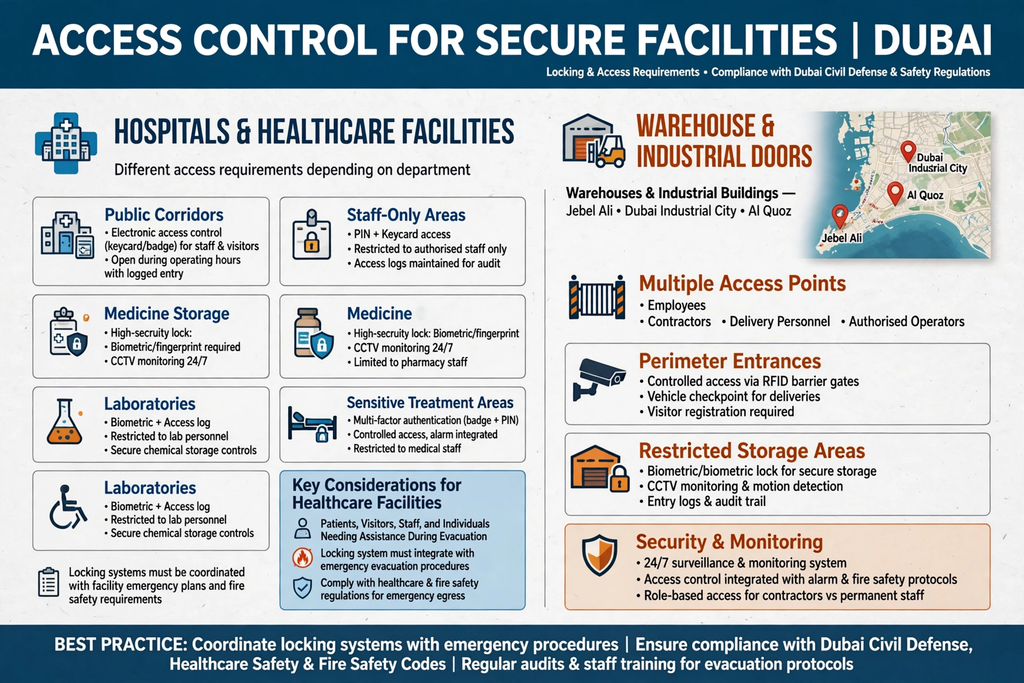
Hospitals and healthcare facilities have different access requirements depending on the department.
Public corridors, staff-only areas, medicine storage, laboratories and sensitive treatment areas may require different locking arrangements.
For example, a general staff entrance may use electronic access control, while restricted medicine storage may require a higher level of security.
Healthcare facilities must also consider patients, visitors, staff and people who may need assistance during evacuation.
The locking system should therefore be coordinated with the facility’s emergency procedures and relevant healthcare and fire safety requirements.
Warehouse and Industrial Doors
Warehouses and industrial buildings in Jebel Ali, Dubai Industrial City and Al Quoz may have multiple access points for employees, contractors, delivery personnel and authorised operators.
Perimeter entrances and restricted storage areas require controlled access and monitoring.
An appropriate fail-secure arrangement may help maintain security during a power interruption, provided the door’s emergency escape function remains compliant.
Large industrial doors may also require specialist locking hardware and safety interlocks rather than ordinary office door locks.
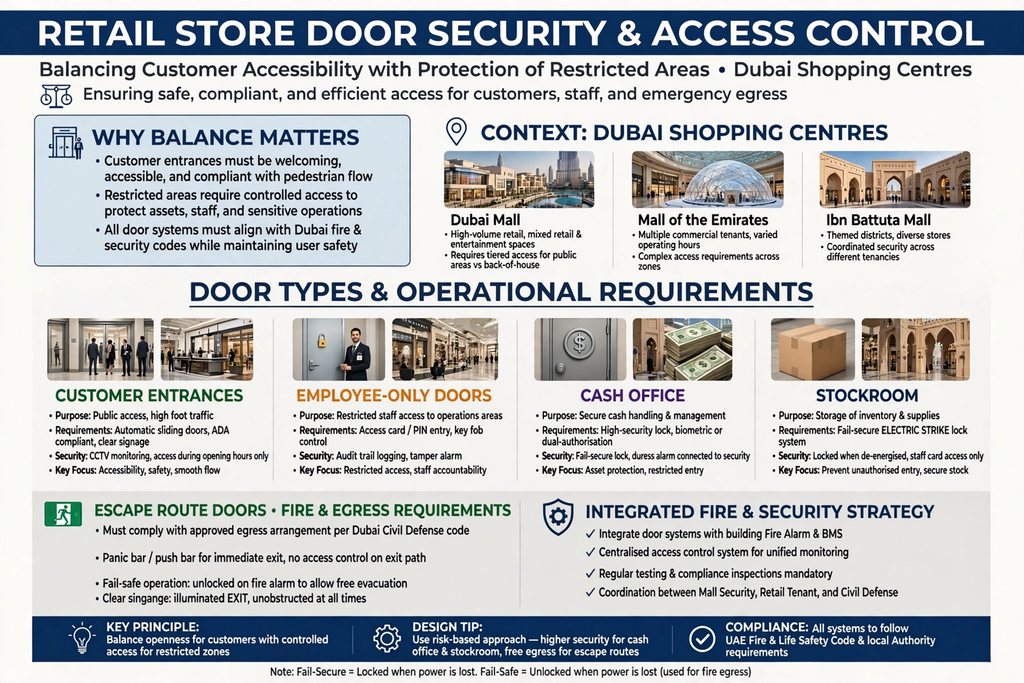
Retail Stores and Shopping Centres
Retail stores require a balance between customer accessibility and protection of restricted areas.
Customer entrances, employee-only doors, cash offices and stockrooms have different operational requirements.
For example, a staff-only stockroom may use a fail-secure electric strike, while a door forming part of an escape route must follow the approved egress arrangement.
Shopping centres in Dubai, including Dubai Mall, Mall of the Emirates and Ibn Battuta Mall, contain multiple commercial spaces with different access requirements. Individual door systems should be coordinated with the building’s overall fire and security strategy.
5. Dubai Access Control Requirements and Fire Safety Considerations
Access control installations in Dubai must consider both security requirements and building fire and life safety requirements.
The Dubai Building Code addresses electronic access control and locking systems on exit doors through the applicable UAE Life Safety Code provisions. KHDA
Additionally, Dubai Administrative Resolution No. 13 of 2025 approves the Preventive Systems Manual, which provides specific requirements for access control systems and locking mechanisms.
Some important requirements include:
- Access control systems must be compatible with fire alarm systems approved by the relevant authorities.
- Locking arrangements must support emergency opening where required.
- Electromagnetic and electromechanical locks are permitted within the applicable system requirements.
- Specific sensitive facilities have separate emergency self-locking provisions.
- Where emergency self-locking locks are used in places likely to be occupied, a manual emergency release feature is required under the specified conditions.
- System wiring and connections must be properly protected, identified and installed in suitable containment.
Dubai Data Protection+1
These requirements make it important to evaluate every controlled door individually rather than applying the same locking configuration throughout the building.
Coordination with Dubai Civil Defence and SIRA
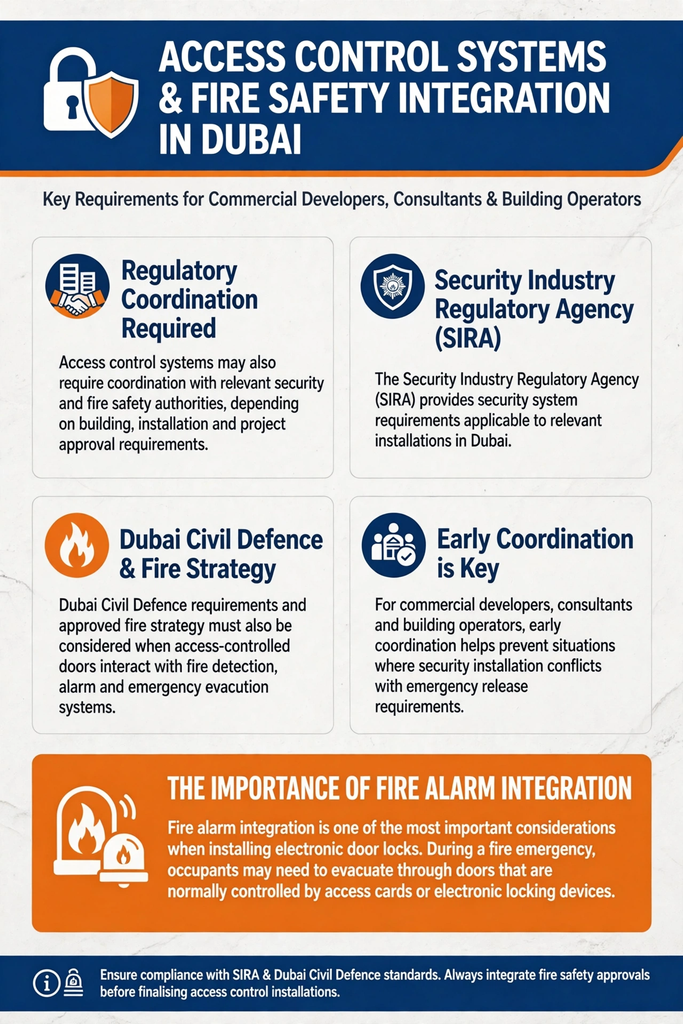
Access control systems may also require coordination with the relevant security and fire safety authorities, depending on the building, installation and project approval requirements.
The Security Industry Regulatory Agency (SIRA) provides security system requirements applicable to relevant installations in Dubai.
Dubai Civil Defence requirements and the approved fire strategy must also be considered when access-controlled doors interact with fire detection, alarm and emergency evacuation systems.
For commercial developers, consultants and building operators, early coordination helps prevent situations where a security installation conflicts with emergency release requirements.
6. The Importance of Fire Alarm Integration
Fire alarm integration is one of the most important considerations when installing electronic door locks.
During a fire emergency, occupants may need to evacuate through doors that are normally controlled by access cards or electronic locking devices.
If the locking system does not respond correctly to the approved fire alarm signal, evacuation can be delayed.
A properly designed integration connects the access control system with the building’s approved fire alarm and emergency release arrangements.
How Fire Alarm Integration Works
Under normal conditions, access control manages entry according to authorised credentials.
When the relevant fire alarm or emergency signal is activated, the configured release circuit operates according to the approved fire strategy.
Depending on the door and locking device, this may remove power from an electromagnetic lock or activate another approved release mechanism.
The system should be tested to confirm that the emergency signal reaches the intended doors and that the required release actually occurs.
Components Used in Emergency Door Release
Common components include:
Fire alarm control panel: Detects and communicates fire alarm conditions through the building’s approved fire detection system.
Access control panel: Manages user credentials, door permissions and locking commands.
Emergency release button: Provides a designated manual release function where required.
Request-to-exit sensor: Detects an authorised person approaching the door from the secured side.
Electromagnetic lock: Holds the door through magnetic force and releases when its power supply is interrupted.
Backup power supply: Maintains normal operation during selected electrical interruptions where appropriate, without overriding mandatory emergency release functions.
The exact arrangement depends on the door type, authority requirements and approved design.
7. Battery Backup and Power Failure Planning
Power failure is an important consideration in both fail-safe and fail-secure access control systems.
Fail-safe locks release when their electrical power is removed. Fail-secure locks remain locked from the controlled side, but the access control reader and controller may also stop working unless they have backup power.
A suitable backup power arrangement helps maintain normal system operation during temporary interruptions.
However, battery backup must never prevent an emergency release that is required by the fire strategy or applicable regulations.
For example, an office building may use an uninterruptible power supply (UPS) to maintain its access control panel, readers and selected locking devices during a short power interruption.
The emergency release circuits should remain independently functional according to the approved design.
Building operators should regularly inspect backup batteries, power supply connections and emergency release functions.
8. Common Mistakes When Selecting Fail-Safe and Fail-Secure Locks
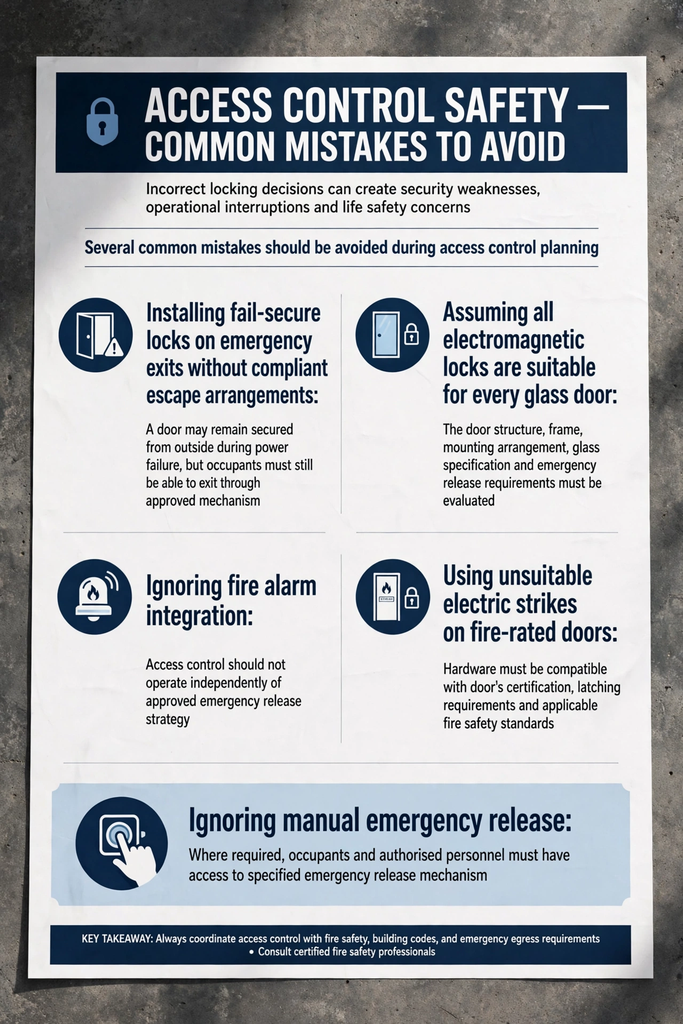
Incorrect locking decisions can create security weaknesses, operational interruptions and life safety concerns.
Several common mistakes should be avoided during access control planning.
Installing fail-secure locks on emergency exits without compliant escape arrangements: A door may remain secured from the outside during power failure, but occupants must still be able to exit through the approved mechanism.
Assuming all electromagnetic locks are suitable for every glass door: The door structure, frame, mounting arrangement, glass specification and emergency release requirements must be evaluated.
Ignoring fire alarm integration: Access control should not operate independently of the approved emergency release strategy.
Using unsuitable electric strikes on fire-rated doors: Hardware must be compatible with the door’s certification, latching requirements and applicable fire safety standards.
Ignoring manual emergency release: Where required, occupants and authorised personnel must have access to the specified emergency release mechanism.
Selecting locks only according to price: Holding force, operating voltage, duty cycle, door compatibility, environmental conditions and technical support should also be considered.
Failing to test the completed system: A lock may operate correctly during normal access but fail to release when the fire alarm or emergency circuit is activated.
Avoiding these mistakes requires proper planning, technical drawings, compatible hardware and professional commissioning.
9. Access Control Installation Checklist for Commercial Buildings
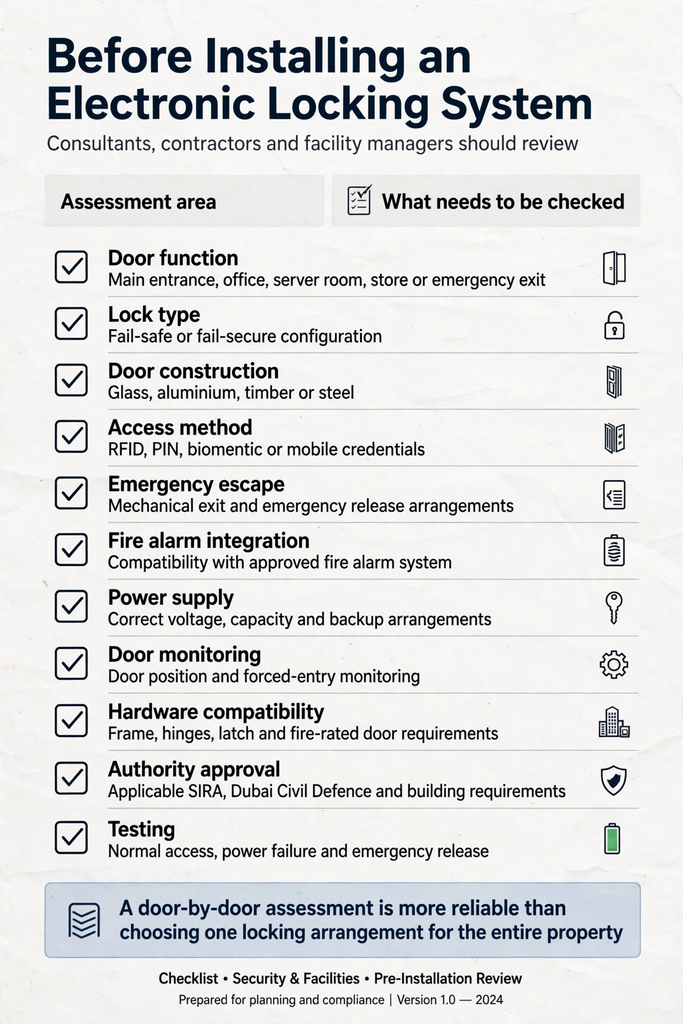
Before installing an electronic locking system, consultants, contractors and facility managers should review the following points.
| Assessment area | What needs to be checked |
|---|---|
| Door function | Main entrance, office, server room, store or emergency exit |
| Lock type | Fail-safe or fail-secure configuration |
| Door construction | Glass, aluminium, timber or steel |
| Access method | RFID, PIN, biometric or mobile credentials |
| Emergency escape | Mechanical exit and emergency release arrangements |
| Fire alarm integration | Compatibility with approved fire alarm system |
| Power supply | Correct voltage, capacity and backup arrangements |
| Door monitoring | Door position and forced-entry monitoring |
| Hardware compatibility | Frame, hinges, latch and fire-rated door requirements |
| Authority approval | Applicable SIRA, Dubai Civil Defence and building requirements |
| Testing | Normal access, power failure and emergency release |
A door-by-door assessment is more reliable than choosing one locking arrangement for the entire property.
10. How a Professional Access Control System Improves Building Security
A professionally designed access control system provides more than electronic door locking. It creates a coordinated security arrangement that helps building operators manage authorised entry, monitor restricted areas and respond to unusual access events.
Modern systems can integrate with CCTV surveillance, visitor management, biometric authentication, alarm systems and Building Management Systems.
For example, an office building in Business Bay may use card readers for employee entrances, biometric authentication for restricted IT rooms and monitored electronic locks for internal security doors.
A warehouse in Jebel Ali may require controlled perimeter access, staff credentials and door monitoring to manage contractor and delivery access.
These systems can also generate access records, allowing facility managers to review entry activity and investigate security incidents.
Businesses planning a wider Safety Control System in Dubai should consider access control, CCTV, alarm integration, emergency release and building security as connected parts of the overall safety and security design.
The most effective solution is one that supports operational security while maintaining the building’s approved fire and life safety arrangements.
Frequently Asked Questions About Fail-Safe and Fail-Secure Locks
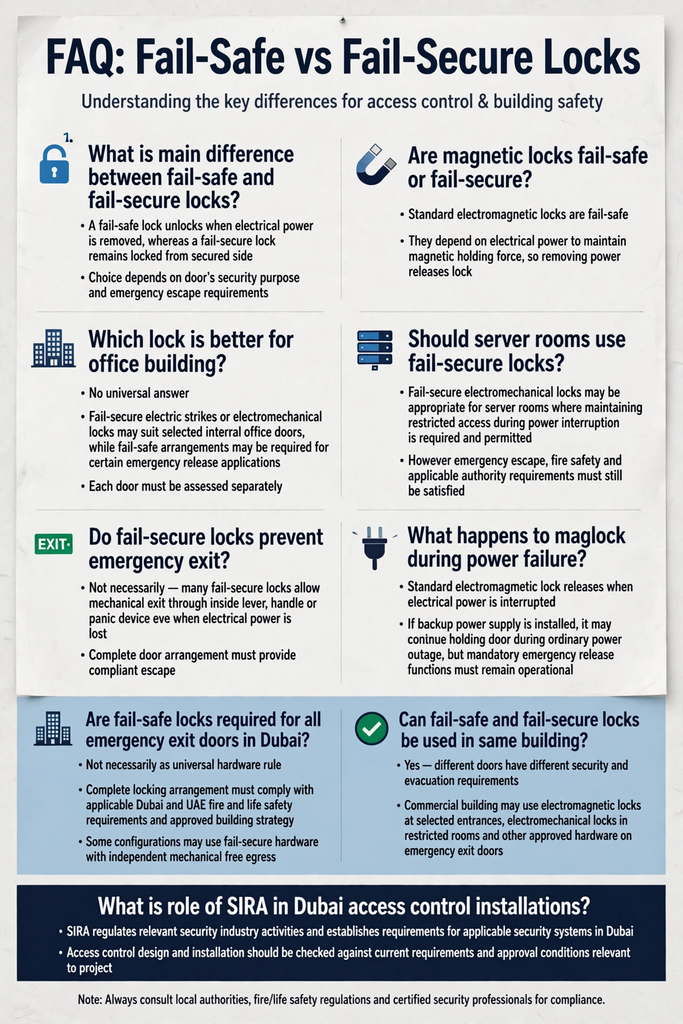
What is the main difference between fail-safe and fail-secure locks?
A fail-safe lock unlocks when electrical power is removed, whereas a fail-secure lock remains locked from the secured side. The choice depends on the door’s security purpose and emergency escape requirements.
Are magnetic locks fail-safe or fail-secure?
Standard electromagnetic locks are fail-safe. They depend on electrical power to maintain their magnetic holding force, so removing power releases the lock.
Which lock is better for an office building?
There is no universal answer. Fail-secure electric strikes or electromechanical locks may suit selected internal office doors, while fail-safe arrangements may be required for certain emergency release applications. Each door must be assessed separately.
Should server rooms use fail-secure locks?
Fail-secure electromechanical locks may be appropriate for server rooms where maintaining restricted access during a power interruption is required and permitted. However, emergency escape, fire safety and applicable authority requirements must still be satisfied.
Do fail-secure locks prevent emergency exit?
Not necessarily. Many fail-secure locks allow mechanical exit through an inside lever, handle or panic device even when electrical power is lost. The complete door arrangement must provide compliant escape.
What happens to a maglock during a power failure?
A standard electromagnetic lock releases when its electrical power is interrupted. If a backup power supply is installed, it may continue holding the door during an ordinary power outage, but mandatory emergency release functions must remain operational.
Are fail-safe locks required for all emergency exit doors in Dubai?
Not necessarily as a universal hardware rule. The complete locking arrangement must comply with the applicable Dubai and UAE fire and life safety requirements and the approved building strategy. Some configurations may use fail-secure hardware with independent mechanical free egress.
Can fail-safe and fail-secure locks be used in the same building?
Yes. Different doors have different security and evacuation requirements. A commercial building may use electromagnetic locks at selected entrances, electromechanical locks in restricted rooms and other approved hardware on emergency exit doors.
What is the role of SIRA in Dubai access control installations?
SIRA regulates relevant security industry activities and establishes requirements for applicable security systems in Dubai. Access control design and installation should be checked against the current requirements and approval conditions relevant to the project.
Building Safer Access Control Systems in Dubai
Selecting between fail-safe and fail-secure locks requires a clear understanding of door functionality, building security objectives and emergency evacuation requirements.
For commercial properties, office towers, warehouses, healthcare facilities and residential developments across Dubai, every access-controlled door should have a locking arrangement that matches its intended purpose.
Fail-safe locks provide automatic release when electrical power is removed, while fail-secure locks help maintain restricted access during power interruptions. Neither option is universally better. The correct choice depends on the door’s location, occupants, security classification and approved fire safety arrangements.
By combining suitable electronic locks, access control readers, fire alarm integration, backup power and professional commissioning, building owners can improve security without compromising occupant safety.