Hotel lighting is not limited to guest rooms, reception areas, restaurants, and decorative spaces. Behind every well-managed hotel is a network of operational areas where staff prepare meals, wash linen, transport supplies, maintain equipment, and coordinate daily services. These back-of-house spaces require carefully planned lighting to support safety, hygiene, productivity, and uninterrupted hotel operations.
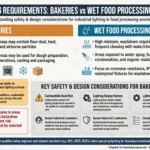
Hotel kitchens, laundry rooms, housekeeping stores, loading bays, staff corridors, maintenance workshops, and service passages have different lighting requirements. A commercial kitchen needs bright, uniform illumination for food preparation, while a laundry room requires lighting that helps employees identify stains, inspect fabrics, and operate industrial washing equipment safely. Service corridors need consistent visibility for staff moving linen carts, food supplies, cleaning equipment, and maintenance materials.
In Dubai and other UAE hospitality markets, lighting design must also consider long operating hours, high indoor temperatures in certain service environments, humidity, cleaning procedures, energy consumption, and maintenance accessibility. Selecting suitable LED luminaires, colour temperatures, ingress protection ratings, and lighting controls can improve the performance of these spaces.
This guide explains how to plan effective lighting for hotel back-of-house areas, including kitchens, laundry rooms, and service corridors, with practical considerations for hospitality projects across Dubai, Abu Dhabi, Sharjah, and the wider UAE.
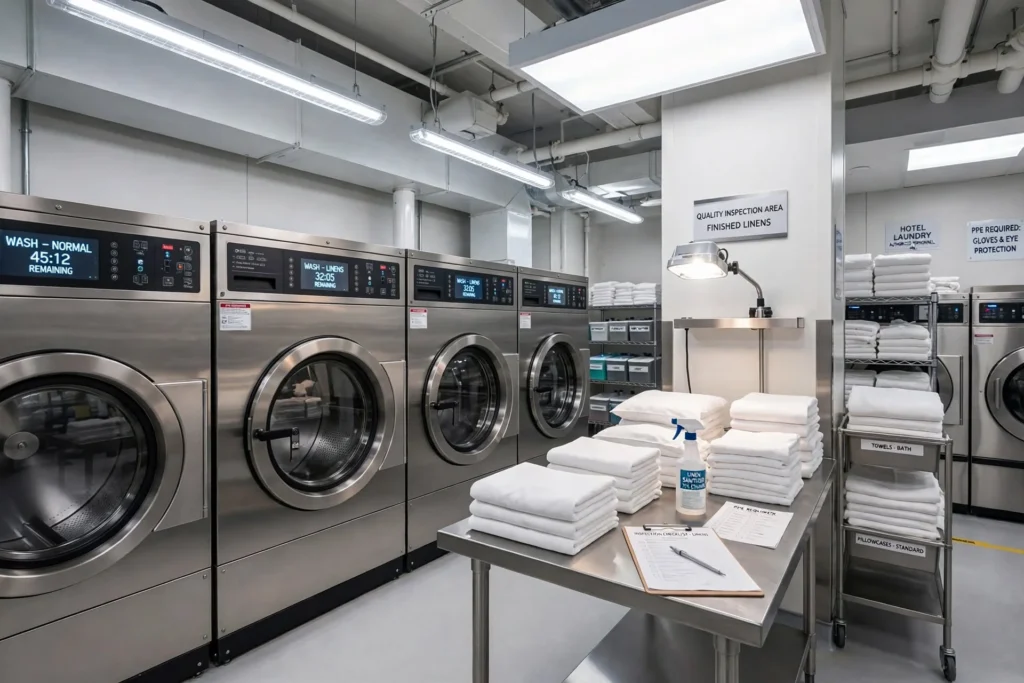
What Is Hotel Back-of-House Lighting?
Back-of-house lighting refers to the lighting systems installed in operational areas that are generally not accessible to hotel guests. These areas support the daily activities required to operate a hospitality property.
Typical back-of-house spaces include:
- Commercial kitchens and food preparation rooms
- Laundry and linen processing areas
- Housekeeping stores and pantries
- Staff changing rooms and facilities
- Service corridors and internal passageways
- Loading and receiving areas
- Maintenance workshops and plant rooms
- Waste management and storage areas
Unlike decorative lighting in hotel lobbies or guest rooms, back-of-house lighting prioritises functionality. Employees must be able to see clearly while performing tasks, identify potential hazards, clean surfaces, read equipment displays, and move safely between departments.
A well-designed lighting system should provide sufficient illumination without creating glare, harsh shadows, excessive heat, or unnecessary energy consumption. It should also be suitable for the cleaning and operating conditions of each space.
Why Proper Lighting Matters in Hotel Operational Areas
Hotels operate across multiple shifts, often 24 hours a day. Kitchen teams prepare food throughout service periods, laundry departments process large volumes of linen, and housekeeping employees move between floors while maintaining room readiness.
Poor lighting can affect these activities. Employees may struggle to inspect food, identify stains, read labels, or notice obstacles in corridors. Inadequate illumination can also make cleaning inspections difficult and increase the possibility of workplace accidents.
Good lighting supports several important operational requirements.
Workplace Safety and Visibility
Staff members frequently move through back-of-house areas carrying equipment, hot food containers, cleaning products, and heavy linen carts. Consistent illumination helps them identify wet floors, steps, obstacles, and changes in floor levels.
Lighting should be particularly reliable around staircases, loading bays, kitchen preparation stations, storage rooms, and maintenance areas. Emergency lighting must also be considered to maintain safe evacuation routes during a power failure.
Hygiene and Cleaning Standards
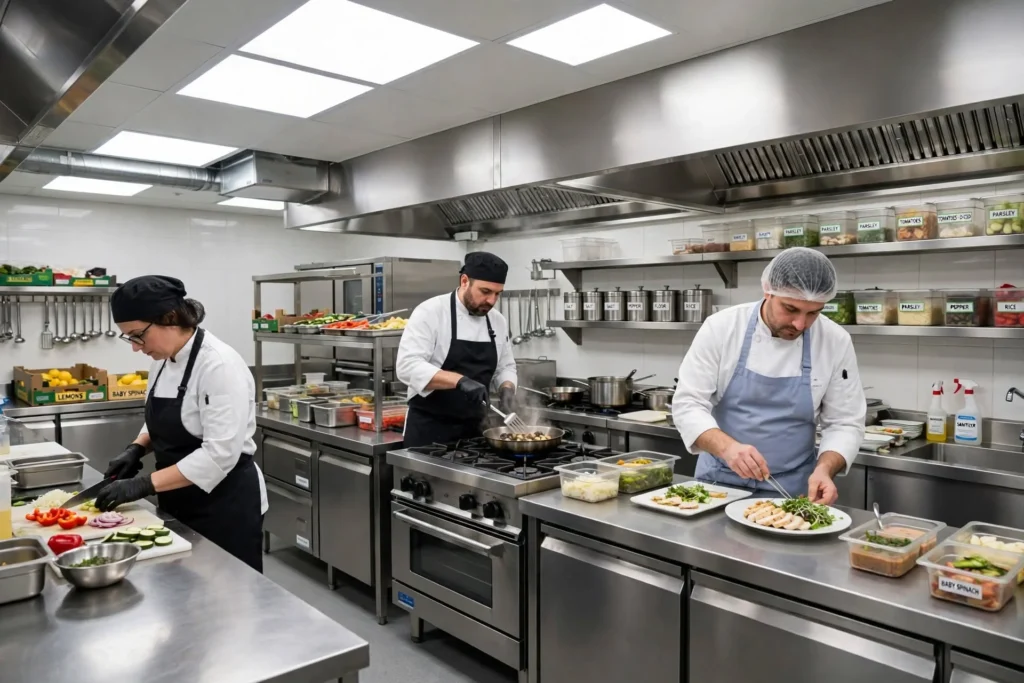
Hotels must maintain clean operational environments. Appropriate lighting helps cleaning teams identify grease deposits, dust, spills, food residue, and stains on surfaces.
In commercial kitchens and laundry facilities, lighting should support visual inspections without producing excessive glare or dark corners. Smooth, cleanable luminaire surfaces are also useful in areas where dust, grease, or moisture can accumulate.
Employee Productivity
Staff productivity depends partly on whether employees can see their work clearly. Proper illumination makes it easier to prepare ingredients, sort linen, inspect equipment, organise inventory, and complete housekeeping tasks.
A well-planned system also reduces unnecessary eye strain caused by poor visibility or uneven lighting.
Energy Efficiency and Operating Costs
Hotels often keep operational areas illuminated for extended periods. Replacing inefficient lighting with suitable LED fixtures can reduce electricity consumption and maintenance requirements.
However, energy savings depend on the selected products, operating hours, controls, installation quality, and maintenance practices. Occupancy sensors, daylight controls, and scheduled switching can provide additional savings where they suit the operating environment.
Commercial Kitchen Lighting Requirements
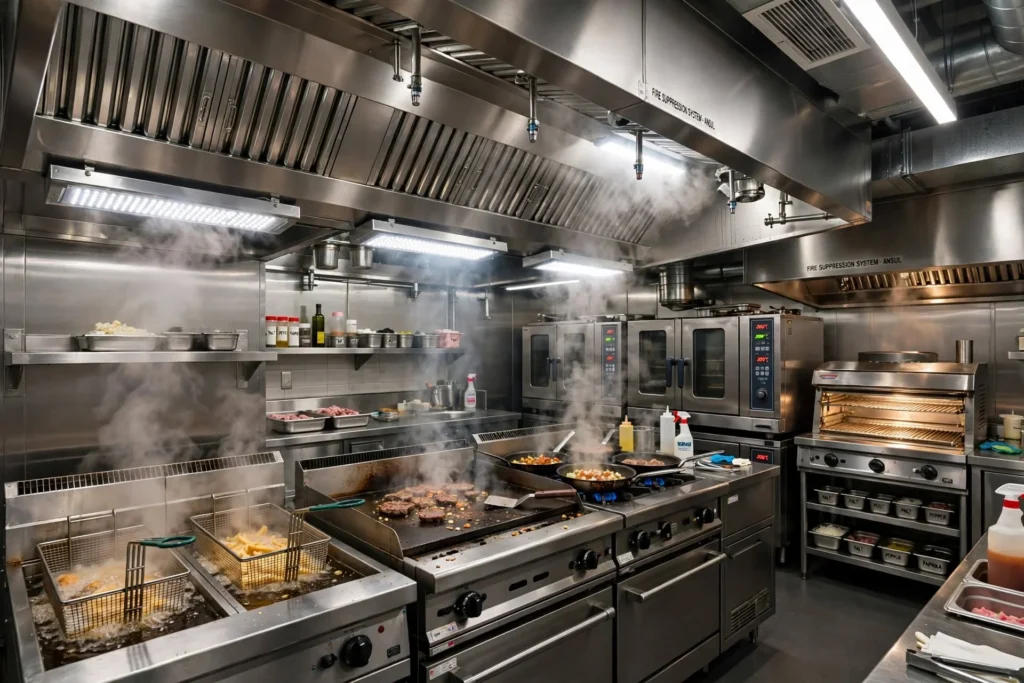
Commercial kitchens require dependable lighting because chefs and kitchen assistants work with sharp tools, hot surfaces, cooking equipment, and different food ingredients. Lighting should provide sufficient visibility across preparation counters, cooking stations, washing areas, storage spaces, and food dispatch zones.
A kitchen lighting design should consider the activities taking place in each zone rather than using identical fixtures throughout the entire room.
Food Preparation and Workstation Lighting
Food preparation areas need clear, uniform illumination so employees can inspect ingredients, measure quantities, cut vegetables, and prepare dishes accurately.
LED panel lights and suitable linear LED luminaires can provide general illumination, while task lighting may be used where additional visibility is required. Fixtures should be positioned to reduce shadows created by employees working at preparation counters.
The selected colour rendering index (CRI) is also important. A higher CRI helps staff distinguish food colours more accurately, which can be useful when inspecting ingredients and checking food presentation.
Cooking and Hot Equipment Zones
Cooking areas contain ovens, fryers, grills, extraction hoods, and other equipment that can produce heat, steam, and grease. Lighting fixtures installed near these locations must be suitable for the environmental conditions.
The design should consider luminaire temperature ratings, ingress protection, cleaning requirements, and manufacturer installation instructions. Fixtures should not interfere with extraction systems or create maintenance problems around kitchen equipment.
Where luminaires are installed inside or near extraction hoods, they must be specifically suitable for that application.
Dishwashing and Cleaning Areas
Dishwashing sections experience frequent water exposure, steam, splashes, and cleaning chemicals. Fixtures in these locations should have suitable ingress protection and corrosion-resistant construction.
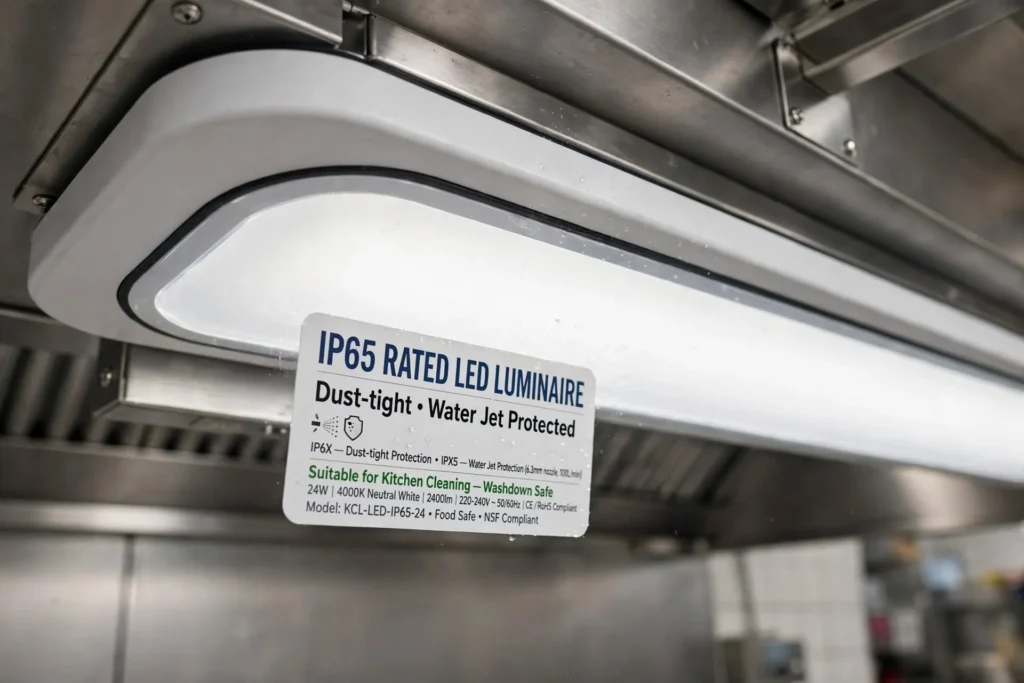
An IP rating indicates the level of protection against the entry of solid particles and water under defined test conditions. For example, an IP65-rated luminaire provides dust-tight protection and protection against water jets under specified test conditions. The correct rating should be selected according to the actual exposure and cleaning method.
Sealed LED fixtures with smooth surfaces can make routine cleaning easier and help reduce the accumulation of dust and moisture.
Cold Storage and Refrigerated Rooms
Walk-in refrigerators and cold storage rooms require lighting products designed to operate within the specified temperature range.
Standard indoor luminaires may not perform reliably in low-temperature environments. The lighting specification should therefore confirm operating temperature limits, driver compatibility, moisture protection, and suitability for cold-room conditions.
Good illumination allows employees to identify products, read labels, organise stock, and maintain safe movement inside storage areas.
Laundry Room Lighting for Hotels
Hotel laundry departments handle bed sheets, towels, uniforms, table linen, curtains, and other fabrics. Lighting must support several stages of the laundry process, from receiving dirty linen to washing, drying, ironing, folding, inspection, and storage.
Because laundry facilities contain moisture, heat, lint, and industrial machinery, lighting fixtures must be selected according to the specific conditions of each zone.
Linen Sorting and Inspection Lighting
Sorting areas require clear visibility to separate different types of linen and identify stains, damaged fabrics, or foreign objects.
Uniform lighting helps employees inspect textiles without relying on dark or poorly illuminated work surfaces. Colour rendering is also important because workers may need to identify discolouration, stains, and differences between fabric colours.
Linear LED lights or well-positioned LED panels can provide suitable general illumination. Additional task lighting may be useful at detailed inspection tables.
Washing and Drying Areas
Industrial washing machines and dryers generate heat, vibration, moisture, and lint. Lighting installations should account for these environmental factors.
Fixtures should have suitable protection against moisture and dust, while their mounting arrangements should prevent unnecessary exposure to vibration or physical damage.
Maintenance teams should also be able to access lighting equipment safely without interfering with laundry operations.
Ironing and Linen Folding Stations
Ironing and folding stations require consistent illumination across the working surface. Employees need to inspect fabric condition, remove wrinkles, fold linen accurately, and prepare items for storage or delivery.
Uneven lighting can create shadows across tables and make fabric inspection difficult. Suitable LED linear fixtures positioned along workstations can improve visibility and reduce distracting contrast.
Lighting for Hotel Service Corridors
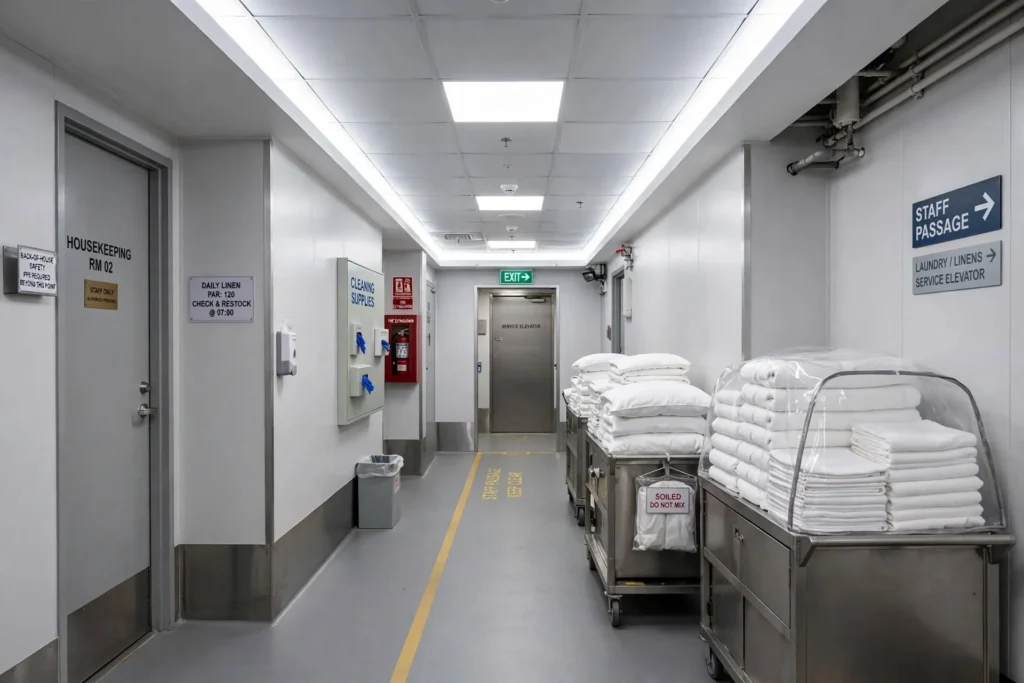
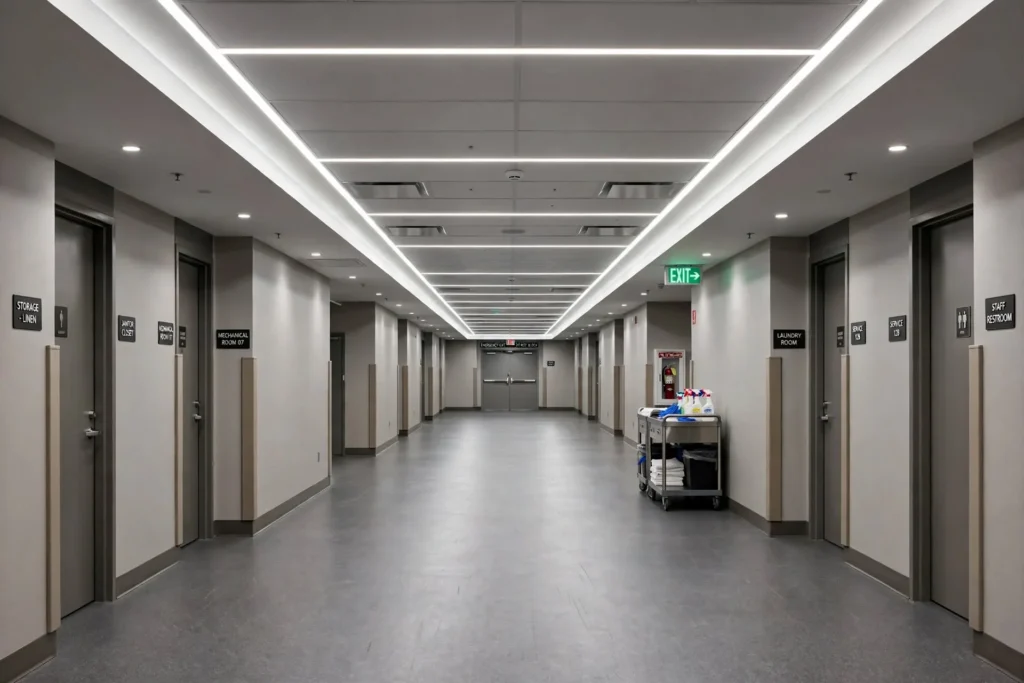
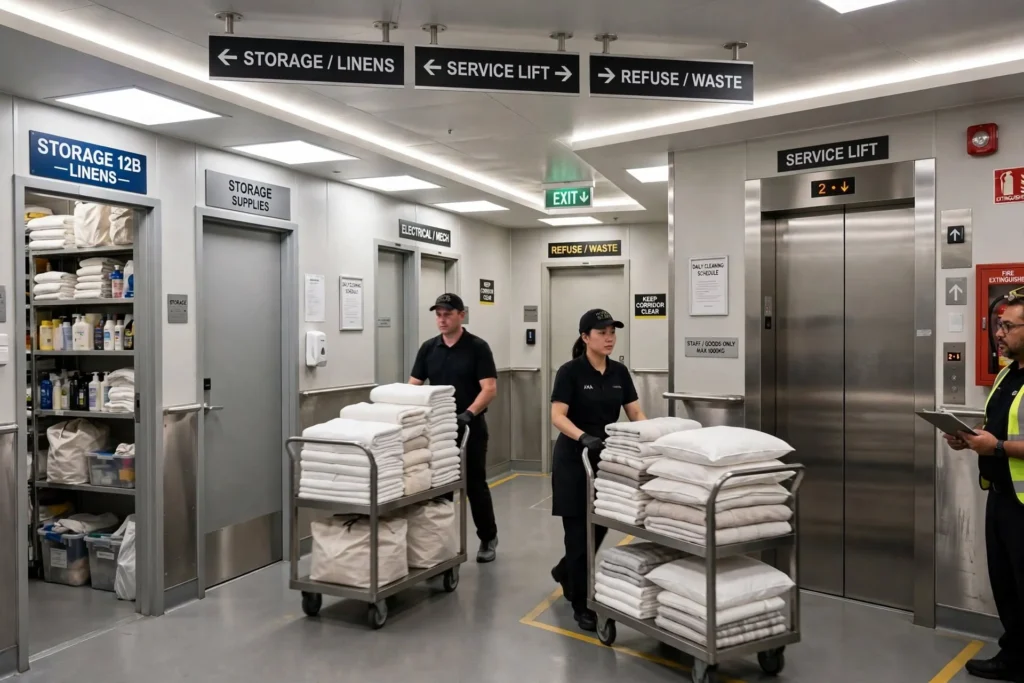
Service corridors connect kitchens, laundry rooms, housekeeping departments, storage areas, staff facilities, and loading zones. Although these spaces are not usually part of the guest experience, they are essential to hotel operations.
Employees use service corridors to move food supplies, linen, cleaning materials, maintenance equipment, and waste. Lighting should therefore provide consistent visibility along the full route.
Uniform Corridor Illumination
Long corridors can develop dark areas when luminaires are positioned too far apart or when their light distribution is unsuitable.
Linear LED fixtures, recessed luminaires, and surface-mounted LED panels can be used depending on ceiling construction and the required lighting layout.
Lighting designers should consider corridor width, ceiling height, surface reflectance, door positions, and potential obstructions. The aim is to achieve consistent illumination without creating excessive brightness near individual fixtures.
Lighting Around Doors and Intersections
Service corridors often contain access doors, storage entrances, lifts, and intersections. These locations need sufficient visibility so employees can identify people, equipment, and changes in direction.
Lighting should be planned to reduce shadows around doorways and avoid creating visual discomfort when staff move between spaces with different illumination levels.
Emergency and Exit Lighting
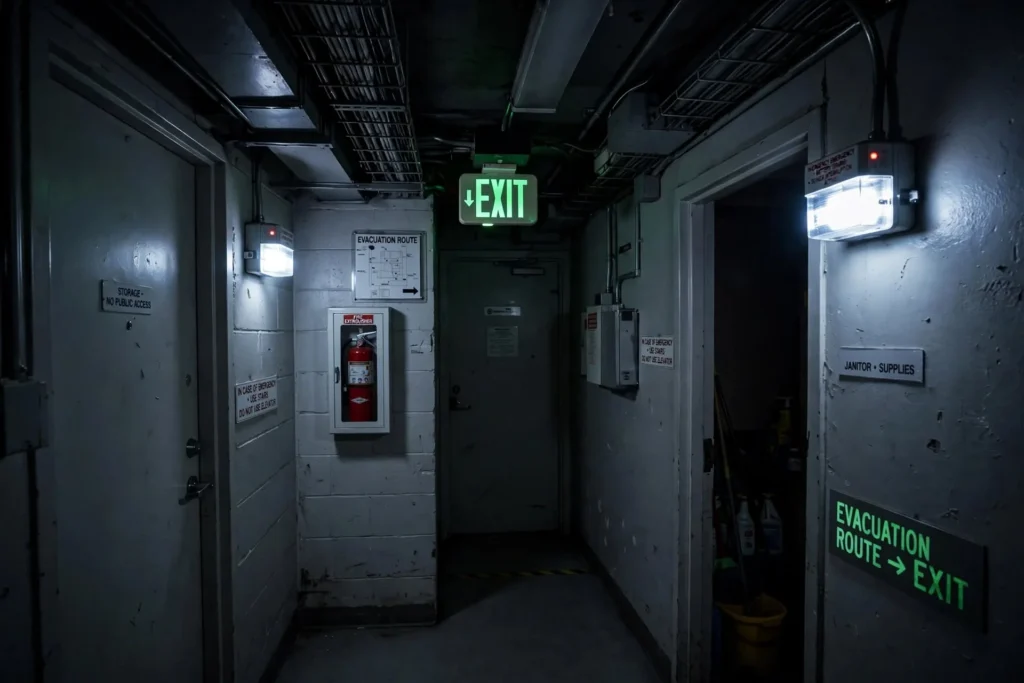
Emergency lighting is an important part of hotel life-safety planning. It helps maintain visibility along designated escape routes when normal power is interrupted.
Emergency luminaires and illuminated exit signs should be selected, installed, tested, and maintained in accordance with the applicable fire and life-safety requirements.
The design should coordinate with the hotel’s fire alarm system, emergency power arrangements, approved drawings, and relevant authority requirements.
Choosing the Right LED Fixtures for Hotel Back-of-House Areas
The performance of a hotel lighting installation depends on selecting luminaires that suit the actual working environment. Different operational spaces may require different fixture designs and technical specifications.
LED Panel Lights
LED panel lights are commonly used in offices, staff rooms, certain preparation areas, and other indoor spaces with suitable ceiling arrangements.
They provide broad light distribution and can create a clean appearance. However, panels should only be specified in locations where their construction and protection ratings are appropriate for the environment.
LED Linear Lights
Linear LED luminaires are useful for corridors, laundry workstations, storage areas, and long kitchen preparation counters.
Their elongated design can support consistent light distribution along work surfaces and circulation routes. They are available in different lengths, mounting styles, output levels, and optical configurations.
Waterproof and Dust-Resistant LED Lights
Sealed LED luminaires are often suitable for areas exposed to moisture, dust, and frequent cleaning.
The required protection level should be determined by the actual environmental conditions. A fixture selected for a dry storage room may not be appropriate for a washdown area or a humid laundry room.
Recessed and Surface-Mounted Fixtures
Recessed luminaires can create a neat ceiling appearance where suitable suspended or false ceilings are available. Surface-mounted fixtures are useful where ceiling construction does not allow recessed installation or where easier access is preferred.
Both options should be checked for maintenance access, heat dissipation, mounting strength, and compatibility with the ceiling material.
Understanding Colour Temperature, CRI, and Lux Levels
Lighting quality is influenced by more than brightness. Colour temperature, colour rendering, and illuminance all affect how a space looks and how effectively employees can perform their tasks.
Colour Temperature
Correlated colour temperature (CCT) describes the appearance of white light and is measured in kelvin (K).
Common options include:
- 3000K: Warm white light with a softer appearance.
- 4000K: Neutral white light suitable for many operational interiors.
- 5000K: Cooler white light often considered for detailed work environments.
Many hotel kitchens, laundry rooms, and service corridors use neutral or cool white lighting because it provides a practical working appearance. However, the final selection should consider the interior finishes, task requirements, visual comfort, and the hotel’s lighting design standards.
Colour Rendering Index
Colour Rendering Index (CRI) measures how accurately a light source renders colours compared with a reference source under defined conditions.
A CRI of 80 or above is commonly specified for general commercial lighting, while higher CRI options may be useful for food preparation and fabric inspection tasks.
The correct CRI should be included in the lighting schedule so that different areas receive suitable lighting performance.
Illuminance and Lux Levels
Illuminance measures the amount of light falling on a surface and is expressed in lux.
Different activities require different illuminance levels. A circulation corridor does not necessarily need the same lighting level as a detailed food inspection workstation.
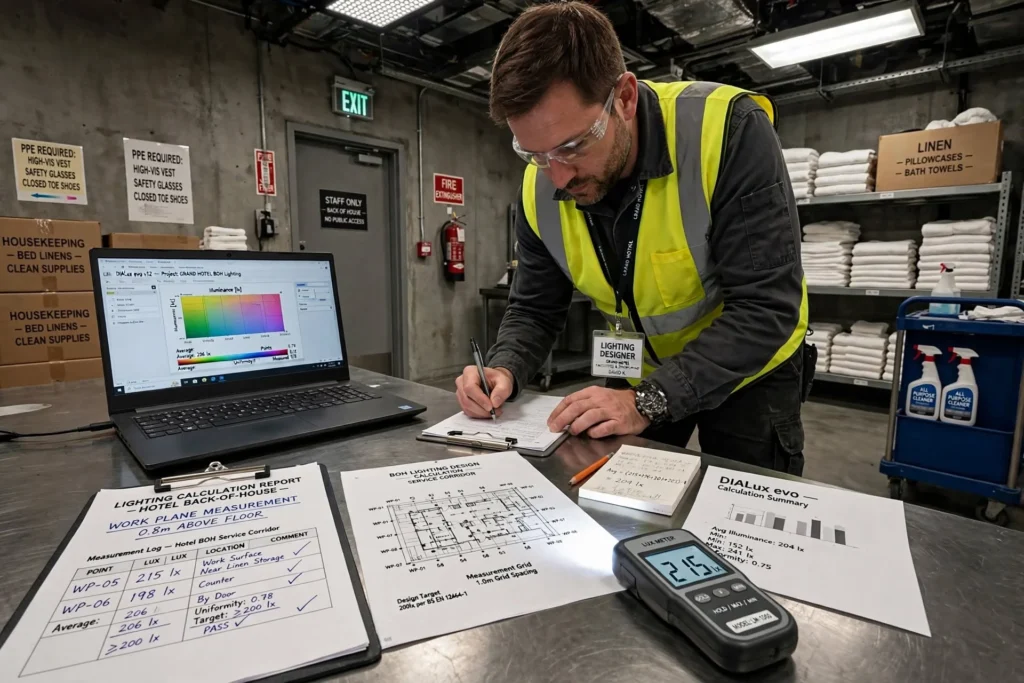
Lighting designers should calculate the required lux levels using applicable standards and project requirements. The design should also consider uniformity, glare, maintenance factors, and the position of working surfaces.
A professional lighting calculation can help identify whether the proposed number, spacing, and output of luminaires will achieve the intended results.
IP Ratings and Environmental Protection in Hotel Service Areas
Hotel back-of-house spaces are exposed to different environmental conditions. Commercial kitchens may contain grease and steam, laundry rooms can experience humidity and lint, and cleaning areas may be exposed to water and chemicals.
Ingress Protection (IP) ratings help specify how effectively an electrical enclosure protects against solid particles and water.
For example, IP44 provides protection against solid objects larger than 1 mm and water splashes from any direction under the relevant test conditions. IP65 provides dust-tight protection and protection against water jets.
These ratings should not be selected automatically for every area. The correct luminaire depends on exposure, cleaning methods, mounting location, and the manufacturer’s technical documentation.
Other considerations include corrosion resistance, impact resistance, operating temperature, electrical safety, and the suitability of materials used in the luminaire housing.
Energy-Efficient Lighting and Controls for Hotel Operations
Back-of-house areas can remain active for long periods, making energy efficiency an important part of hotel lighting design.
LED technology can reduce energy consumption compared with many older fluorescent and conventional lighting systems. LEDs can also reduce relamping frequency when suitable products are installed and operated within their rated conditions.
Lighting controls can provide additional benefits where they match the operational schedule.
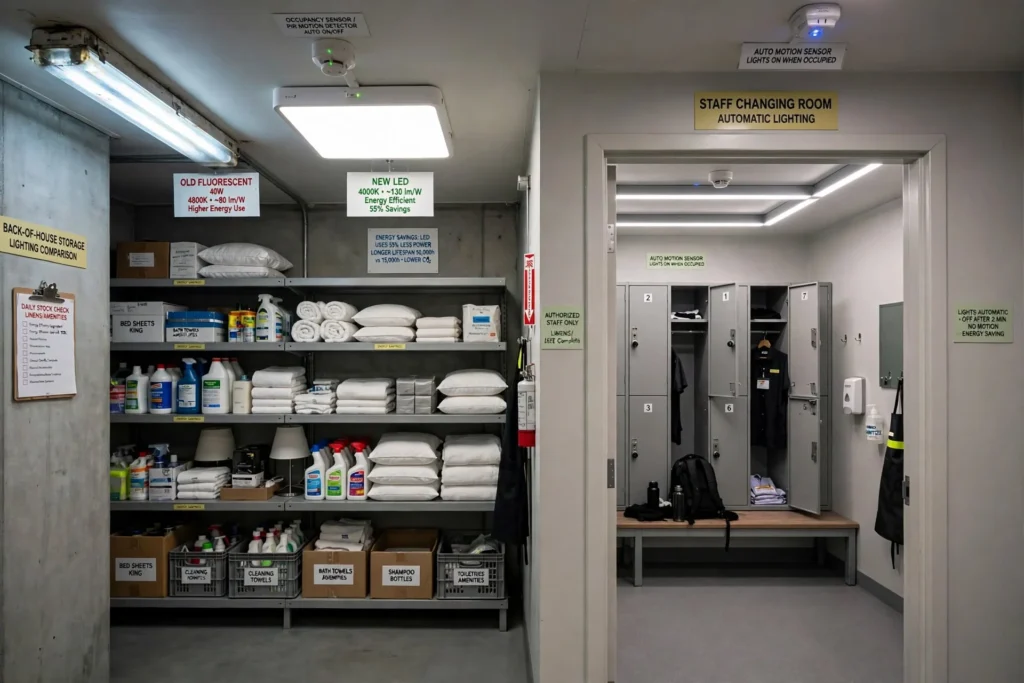
Occupancy Sensors
Occupancy sensors can automatically switch or dim lighting in spaces that are used intermittently, such as selected storage rooms, staff changing rooms, and maintenance areas.
They should be configured carefully in corridors and operational spaces where employees may remain stationary for extended periods or where sudden darkness could create a safety risk.
Daylight Sensors
Daylight-linked controls can reduce artificial lighting in areas with sufficient natural light, such as certain loading and receiving zones.
Sensor positioning and commissioning are important because incorrect settings can cause unnecessary switching or inconsistent illumination.
Scheduled Lighting Controls
Time schedules can support predictable operating patterns in staff areas, storage rooms, and selected service spaces.
However, essential operational lighting and emergency lighting should remain independent of ordinary energy-saving controls where required by the approved design.
Lighting Design Considerations for UAE Hotels
Hotels in Dubai, Abu Dhabi, Sharjah, and other UAE locations operate in a demanding hospitality environment. Lighting installations must be suitable for long operating hours, regular maintenance, and the conditions of individual service spaces.
Dubai Hotels and Hospitality Developments
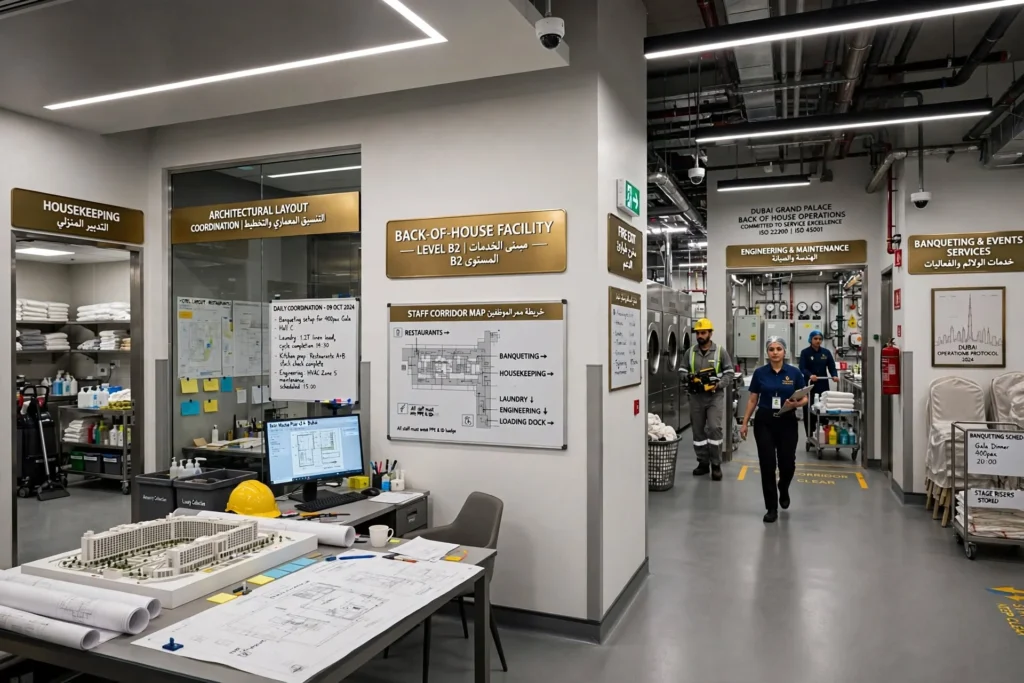
Hotels in Downtown Dubai, Business Bay, Dubai Marina, Palm Jumeirah, and Jumeirah often include extensive back-of-house facilities supporting restaurants, banqueting, housekeeping, laundry, and engineering departments.
Lighting design should coordinate with architectural layouts, mechanical services, fire protection systems, and operational workflows. Ceiling coordination is especially important in kitchens and laundry rooms, where extraction ducts, pipework, cable trays, and equipment may compete for space.
Abu Dhabi and Sharjah Hospitality Properties
Hotels and resorts in Abu Dhabi and Sharjah may have different operational layouts, building sizes, and service requirements.
Lighting specifications should be developed according to the actual property rather than copied from another project. The number of staff, equipment arrangement, ceiling height, working hours, and cleaning procedures all influence the final lighting design.
Coordination with MEP and BMS Systems
Back-of-house lighting should be coordinated with mechanical, electrical, and plumbing (MEP) services. This includes cable routes, distribution boards, ceiling coordination, emergency circuits, and equipment access.
Where a Building Management System (BMS) is used, suitable lighting controls may be integrated for scheduling, monitoring, and energy management. Compatibility between control protocols, drivers, sensors, and the BMS should be confirmed during design.
Common Mistakes in Hotel Back-of-House Lighting
One frequent mistake is treating all operational areas as identical. A laundry inspection station, commercial kitchen, and service corridor have different visual tasks and environmental conditions. Using the same luminaire and lighting level throughout can produce poor results.
Another mistake is selecting fixtures based only on initial purchase price. Low-quality luminaires may have shorter service life, inconsistent light output, poor driver performance, or unsuitable protection against moisture and dust.
Incorrect fixture placement can also create glare and shadows. In kitchens, this may affect food preparation, while in laundry rooms it can make stain inspection more difficult.
Ignoring maintenance access is another common issue. Lighting fixtures installed above machinery, extraction equipment, or difficult ceiling locations can become expensive to maintain.
Finally, failing to coordinate emergency lighting, BMS controls, and MEP services can create problems during installation and commissioning.
How to Plan a Hotel Back-of-House Lighting Project
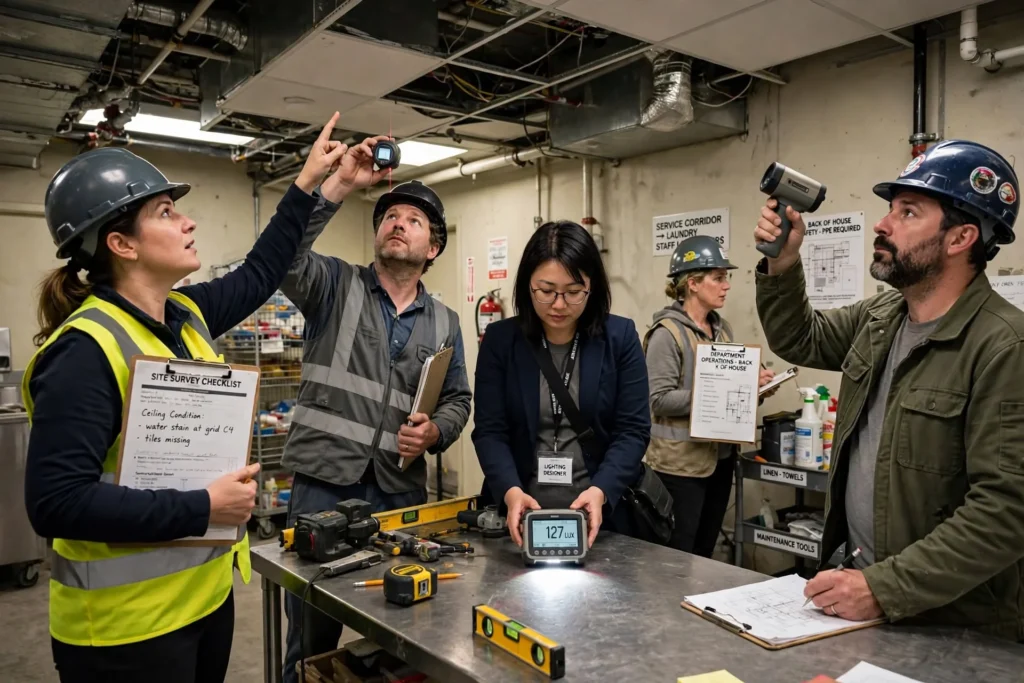
A successful project begins with a site survey and a clear understanding of how each department operates. The design team should identify the different spaces, ceiling conditions, working surfaces, environmental exposure, operating hours, and maintenance requirements.
The next step is to establish the lighting criteria for each zone. This includes target illuminance, uniformity, colour temperature, CRI, glare control, IP rating, and emergency lighting requirements.
Lighting calculations should then be completed using suitable photometric data from the proposed luminaires. Tools such as DIALux and Relux can help designers assess light distribution, illuminance, and uniformity before installation.
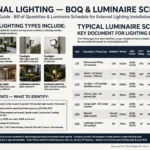
The specification should include the luminaire model, wattage, lumen output, efficacy, CCT, CRI, beam angle, IP rating, driver details, control compatibility, and warranty conditions.
Before full installation, sample fixtures or mock-ups can be useful in critical areas such as food preparation counters and linen inspection stations. This allows the hotel operator and design team to review the actual lighting effect.
During commissioning, the installation should be checked against approved drawings and project specifications. The team should verify switching, dimming, sensor operation, emergency lighting, and the performance of installed luminaires.
Hotels planning a new lighting installation or refurbishment can work with a specialist Lighting for Hotel Supplier to evaluate suitable LED products, technical specifications, and lighting solutions for different operational areas. Product selection should be based on the site’s actual requirements rather than relying on wattage or appearance alone.
Frequently Asked Questions About Hotel Back-of-House Lighting
What type of lighting is best for hotel kitchens?
LED linear lights and suitable sealed LED luminaires are common options for commercial kitchens. The selection depends on food preparation activities, ceiling conditions, heat, grease, moisture, cleaning procedures, and the required illuminance.
What colour temperature is suitable for hotel laundry rooms?
Neutral white lighting around 4000K is a common choice for laundry work areas because it provides a practical appearance for sorting, folding, and inspecting linen. The final specification should also consider CRI, visual comfort, and the hotel’s operational requirements.
Why are IP-rated LED lights important in hotel kitchens?
IP-rated luminaires provide defined protection against solid particles and water. This is important in areas exposed to splashes, steam, moisture, and cleaning procedures. The required IP rating depends on the actual exposure and installation conditions.
How can hotels reduce energy consumption in back-of-house lighting?
Hotels can use efficient LED luminaires, suitable occupancy sensors, daylight controls, and scheduled switching in appropriate spaces. Regular maintenance and correct commissioning also help ensure that lighting systems operate efficiently.
What is the difference between front-of-house and back-of-house lighting?
Front-of-house lighting focuses on guest-facing spaces such as lobbies, restaurants, reception areas, and guest rooms. Back-of-house lighting focuses on operational spaces such as kitchens, laundry rooms, staff corridors, loading bays, and maintenance areas.
Should hotel service corridors have emergency lighting?
Emergency lighting should be included where required by the applicable life-safety design and regulations. It supports safe movement and evacuation when normal electrical power is interrupted. Installation and testing should follow the approved project requirements.
Can hotel lighting be integrated with a Building Management System?
Yes. Compatible lighting controls can be integrated with a BMS for scheduling, monitoring, and energy management. The selected drivers, sensors, controllers, and communication protocols must be compatible with the building’s control architecture.
Creating Safer and More Efficient Hotel Operations Through Better Lighting
Hotel back-of-house lighting plays a direct role in the daily performance of kitchens, laundry departments, housekeeping teams, and service corridors. These areas need lighting that supports accurate work, safe movement, hygiene inspections, and reliable operations throughout the day.
A successful design considers more than brightness. It brings together LED efficiency, colour rendering, illuminance, uniformity, glare control, IP protection, emergency lighting, and maintenance access. It also accounts for the specific demands of hospitality properties in Dubai, Abu Dhabi, Sharjah, and other UAE locations.
By selecting suitable luminaires and coordinating lighting with MEP systems, building controls, and operational requirements, hotel owners and facility managers can create back-of-house environments that