Museum and art gallery lighting plays an important role in how visitors experience paintings, sculptures, photographs, historical artefacts, installations, and cultural collections. Good lighting does more than make an exhibition space bright. It helps visitors see colours accurately, understand details, focus on important objects, and move comfortably through the gallery while protecting sensitive collections from unnecessary light exposure.
For museums, galleries, cultural centres, and exhibition spaces in the UAE, lighting design also needs to consider architecture, climate, energy efficiency, visitor experience, and modern exhibition technology. From adjustable LED spotlights to track lighting, wall washers, linear luminaires, accent lighting, and carefully controlled ambient illumination, every fixture should support the artwork rather than compete with it.
Why Museum and Art Gallery Lighting Requires Special Planning
Museum lighting is different from conventional commercial lighting because the objective is not simply to achieve a particular brightness level. The lighting system must balance visual comfort, colour accuracy, conservation requirements, architectural character, and visitor engagement.
Paintings, textiles, manuscripts, photographs, wood, paper, pigments, and other materials can be sensitive to light exposure. Excessive ultraviolet radiation, infrared radiation, heat, or prolonged illumination can contribute to deterioration. A professionally designed museum lighting system therefore considers the characteristics of the collection before determining fixture type, beam angle, colour temperature, intensity, and operating schedule.
Art galleries also require flexibility because exhibitions change regularly. A lighting arrangement suitable for large paintings may not work for sculptures or multimedia installations. Adjustable track lighting and directional LED fixtures allow curators and lighting designers to reposition illumination as displays change.
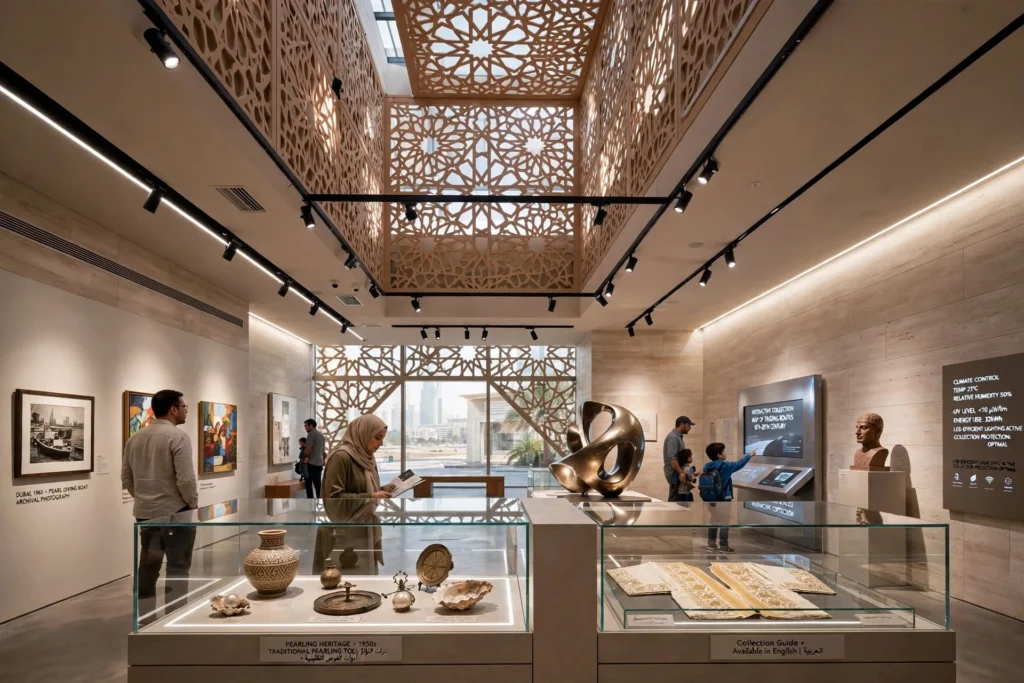
The Role of LED Lighting in Museums and Galleries
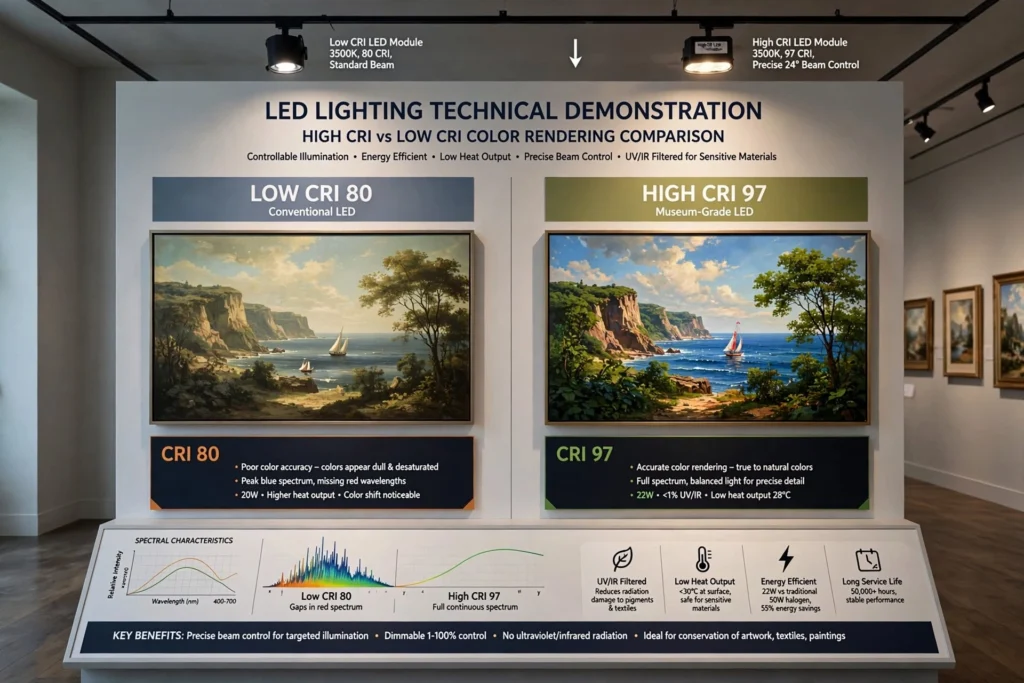
LED lighting has become an important solution for modern museums and art galleries because it provides controllable illumination while supporting energy efficiency. Compared with many traditional light sources, modern LED luminaires can offer low heat output, precise beam control, long service life, and excellent colour rendering.
A key consideration is the Colour Rendering Index (CRI), which indicates how accurately a light source reveals colours compared with a reference source. High-CRI lighting can help visitors perceive the subtle colours and details of artwork more naturally.
Modern museum lighting may also use LEDs with carefully selected spectral characteristics to reduce unnecessary radiation that could affect sensitive materials. However, fixture selection should always be based on the specific conservation requirements of the collection rather than assuming that every LED product is automatically suitable for museum use.
Colour Temperature and the Appearance of Artwork
Colour temperature affects the visual atmosphere of an exhibition space and can influence how visitors perceive artwork. It is generally measured in Kelvin (K).
Warm white lighting can create a softer and more intimate atmosphere, making it suitable for certain historic collections, sculptures, interiors, and cultural displays. Neutral white lighting can provide a balanced appearance for many contemporary galleries and mixed collections. Cooler light can create a crisp, modern environment but may not be appropriate for every artwork.
There is no universal colour temperature that works for every museum. The correct selection depends on the artwork, gallery architecture, wall colour, materials, exhibition concept, and curator’s objectives.
For this reason, professional lighting design often involves testing different colour temperatures before final installation. The goal is to reveal the artwork naturally while maintaining visual consistency throughout the exhibition.
Track Lighting for Flexible Exhibition Displays
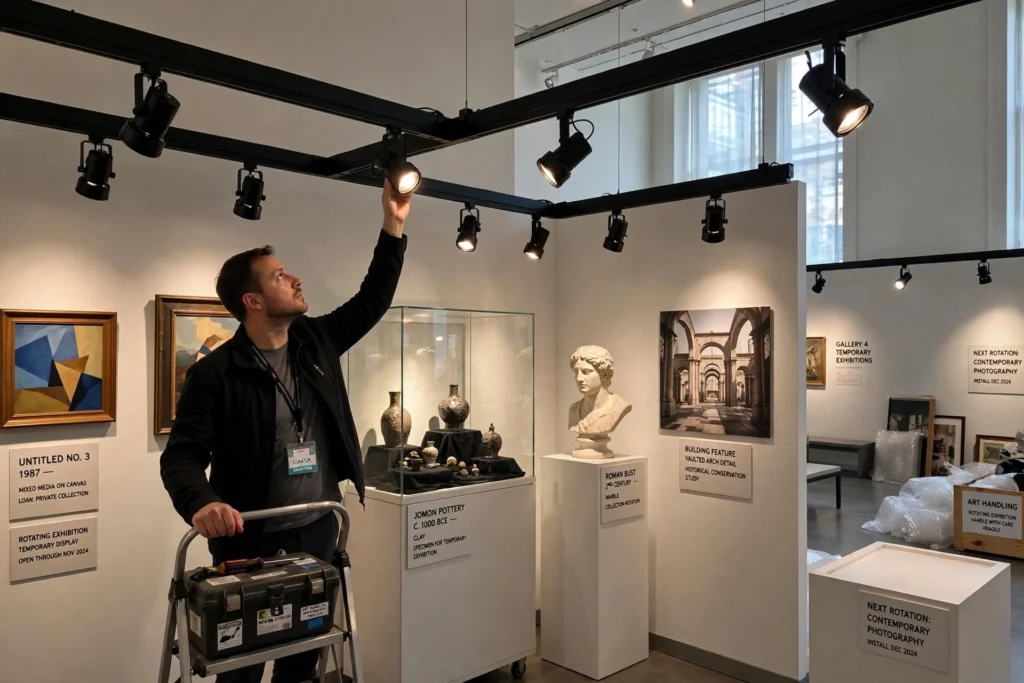
Track lighting is one of the most flexible solutions for museums and art galleries. Fixtures can be mounted on an electrified track and repositioned when the exhibition layout changes.
Adjustable track spotlights can direct light precisely toward paintings, sculptures, display cases, architectural features, or information panels. This flexibility is especially useful for temporary exhibitions where artworks are frequently replaced.
Track lighting can also reduce the need for major electrical modifications when a gallery layout changes. Instead of installing a completely new lighting system, the existing track infrastructure can support different fixture positions and beam directions.
For galleries hosting rotating exhibitions, this adaptability can reduce installation time while giving curators greater control over the visitor experience.
Accent Lighting for Paintings and Sculptures
Accent lighting is used to create visual emphasis. In an art gallery, it can help direct visitor attention toward important pieces or specific areas of an exhibition.
Directional spotlights can illuminate a painting without unnecessarily lighting the surrounding wall. Narrow beam angles can create concentrated highlights, while wider beams can provide more uniform illumination across larger artwork.
Sculptures require a different approach because they are three-dimensional. Lighting from multiple directions can reveal form, texture, depth, and shadow. A single frontal light source may flatten a sculpture, while carefully positioned accent lights can make its shape more visually engaging.
Lighting designers therefore consider the physical dimensions and surface characteristics of every major display rather than applying identical lighting to the entire exhibition.
Wall Washing and Uniform Gallery Illumination
Wall washing provides broad, relatively even illumination across vertical surfaces. It can be useful in galleries displaying paintings, photographs, posters, or collections arranged across large walls.
A well-designed wall-washing system can reduce distracting bright spots and dark patches. It also creates visual continuity when multiple artworks are displayed together.
Wall washers, linear LED fixtures, and appropriately positioned track luminaires can all contribute to this effect. The spacing between fixtures, mounting height, beam angle, wall distance, and surface finish should be considered during design.
Uniform illumination is particularly useful where the exhibition concept requires visitors to view multiple works as a collection rather than focusing exclusively on individual pieces.
Lighting for Museum Display Cases
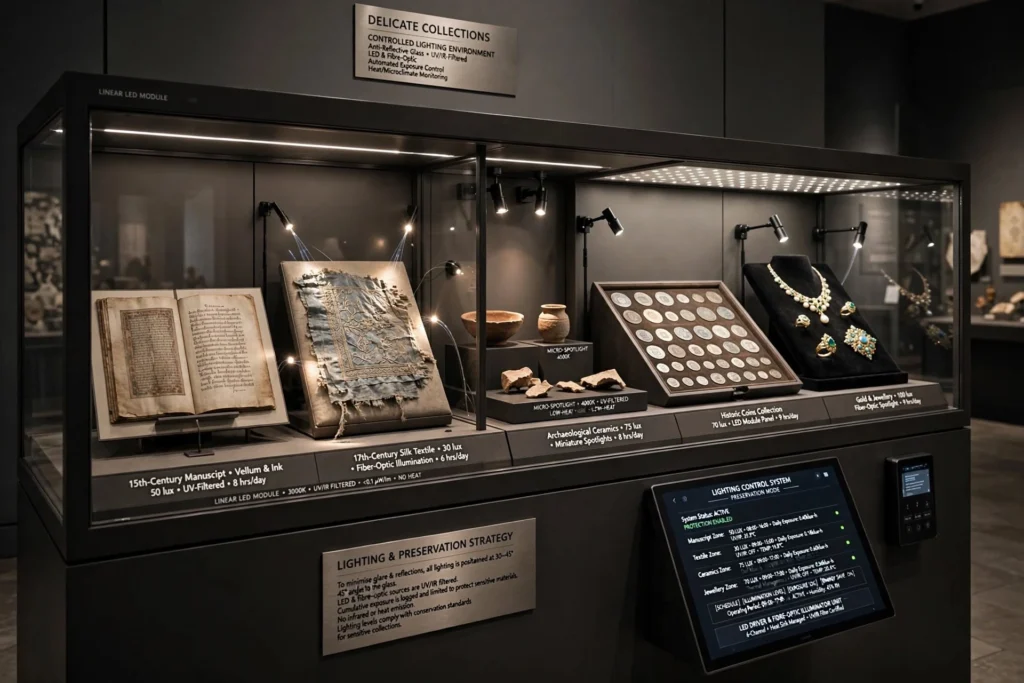
Display cases often contain some of the most delicate museum collections, including manuscripts, jewellery, archaeological artefacts, textiles, coins, ceramics, and historical documents.
Case lighting must provide sufficient visibility while controlling heat, glare, reflections, and potentially damaging radiation. LED modules, miniature spotlights, linear LED systems, and fibre-optic solutions can be used depending on the display case design.
Lighting should generally be positioned to minimise reflections on glass or acrylic surfaces. Excessive brightness can also create glare that makes it difficult for visitors to see objects clearly.
In high-value or highly sensitive collections, lighting controls can allow illumination levels and operating periods to be carefully managed.
Conservation and Light Exposure
One of the most important differences between museum lighting and ordinary architectural lighting is the need to consider conservation.
Light exposure can contribute to fading, colour changes, and degradation in light-sensitive materials. Paper, textiles, photographs, manuscripts, dyes, and some pigments may be particularly vulnerable.
Museum professionals therefore consider factors such as illuminance, exposure duration, spectral distribution, and material sensitivity. Instead of simply asking how bright an object should be, conservation-focused lighting asks how much light exposure is appropriate for the particular collection.
Occupancy sensors, timed lighting, dimming systems, and exhibition scheduling can help reduce cumulative exposure when appropriate.
The lighting strategy should be developed in consultation with curators and conservation professionals for sensitive collections.
Glare Control and Visitor Comfort
Lighting should help visitors see artwork without causing discomfort. Glare can occur when visitors directly see a bright light source or when intense illumination reflects from glass, polished surfaces, display cases, or artwork.
Poorly controlled glare can make an exhibition uncomfortable and can prevent visitors from seeing important details.
Optical accessories such as honeycomb louvers, snoots, lenses, reflectors, shields, and carefully selected beam angles can improve glare control. Fixture positioning is equally important.
Lighting should be evaluated from the visitor’s actual viewing position. A luminaire that appears acceptable from the floor plan may create reflections when viewed from a particular angle.
Lighting Design for Contemporary Art Galleries
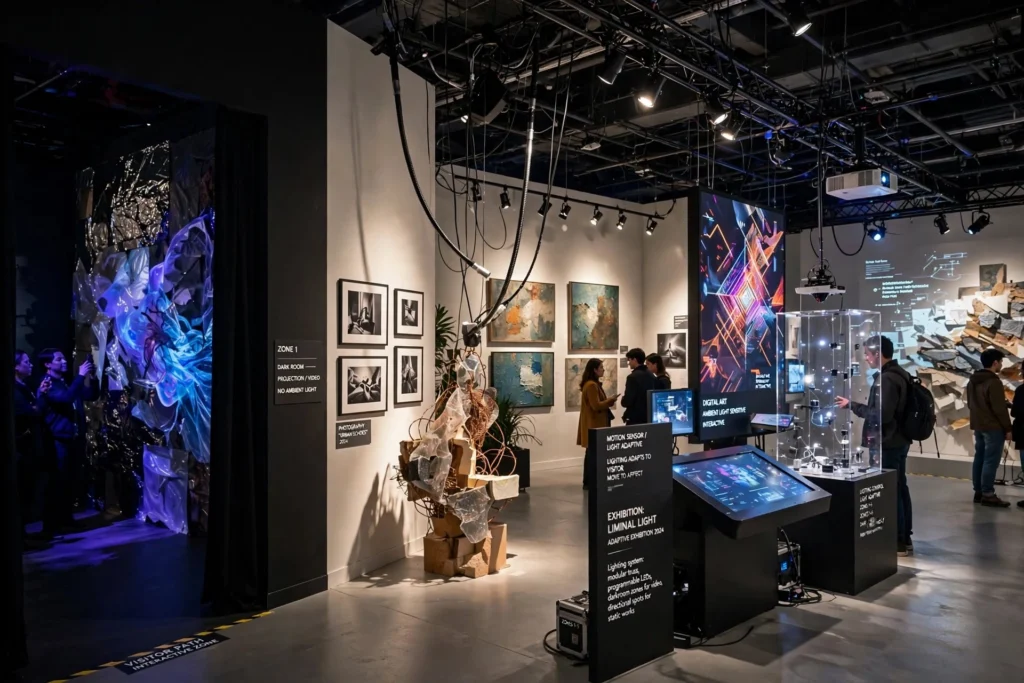
Contemporary art exhibitions can present unique lighting challenges because they may combine paintings, sculpture, photography, video, digital art, interactive installations, projection, and unconventional materials.
A contemporary gallery may need flexible lighting infrastructure capable of supporting changing exhibition concepts. Some installations may require almost complete darkness, while others need high-quality directional illumination.
Digital artwork may also be affected by surrounding light. Excessive ambient illumination can reduce the perceived contrast of screens and projections.
For multimedia exhibitions, lighting design should therefore consider the interaction between architectural illumination, screens, projectors, interactive displays, and visitor movement.
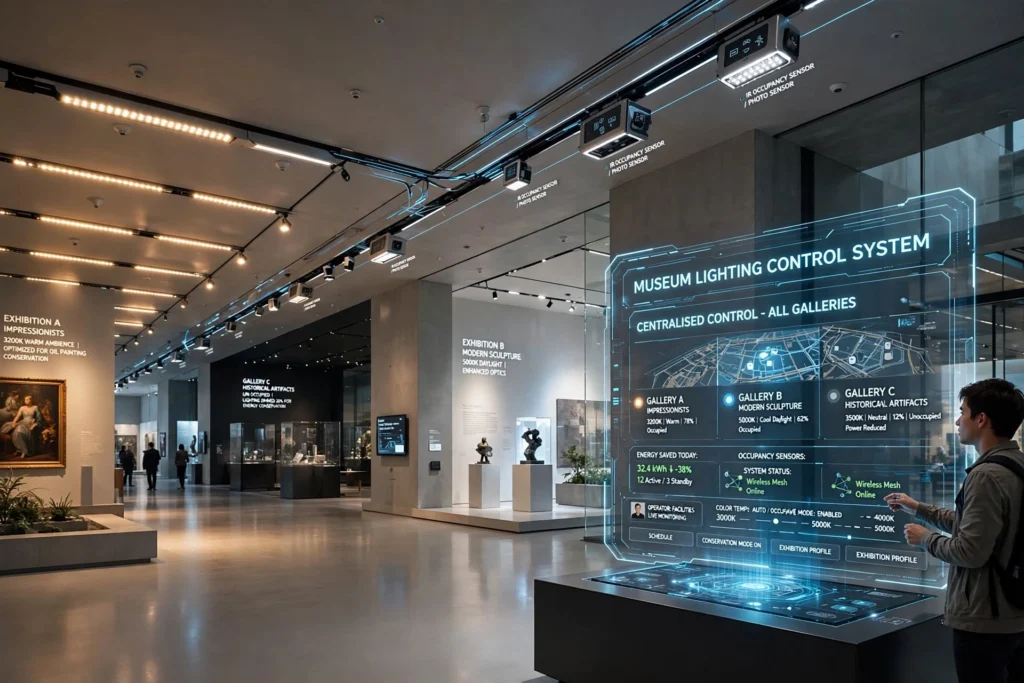
Museum Lighting and Smart Building Controls
Modern cultural facilities increasingly integrate lighting with intelligent building management systems. Digital controls can allow staff to manage lighting zones, dimming levels, operating schedules, occupancy detection, and energy consumption.
A smart lighting system can divide an exhibition space into multiple zones. Curators or facility teams can then adjust lighting according to the requirements of individual galleries.
Integration with building management systems can also support broader facility operations, including HVAC, security, energy monitoring, and environmental controls.
This is particularly valuable for large museums where thousands of lighting fixtures may operate across galleries, storage areas, offices, public spaces, and exhibition halls.
Energy Efficiency in Museum and Gallery Lighting
Museums often operate for long hours and may contain hundreds or thousands of luminaires. Energy-efficient lighting can therefore have a meaningful effect on operating costs.
LED technology can reduce energy consumption compared with older lighting technologies, while dimming and occupancy controls can further reduce unnecessary operation.
Energy efficiency should not compromise conservation or visual quality. A good design considers the actual illumination required in each space and avoids excessive lighting.
Lighting calculations, zoning, daylight integration, and intelligent controls can help cultural facilities achieve a balance between energy performance and visitor experience.
Daylight and Natural Light Management
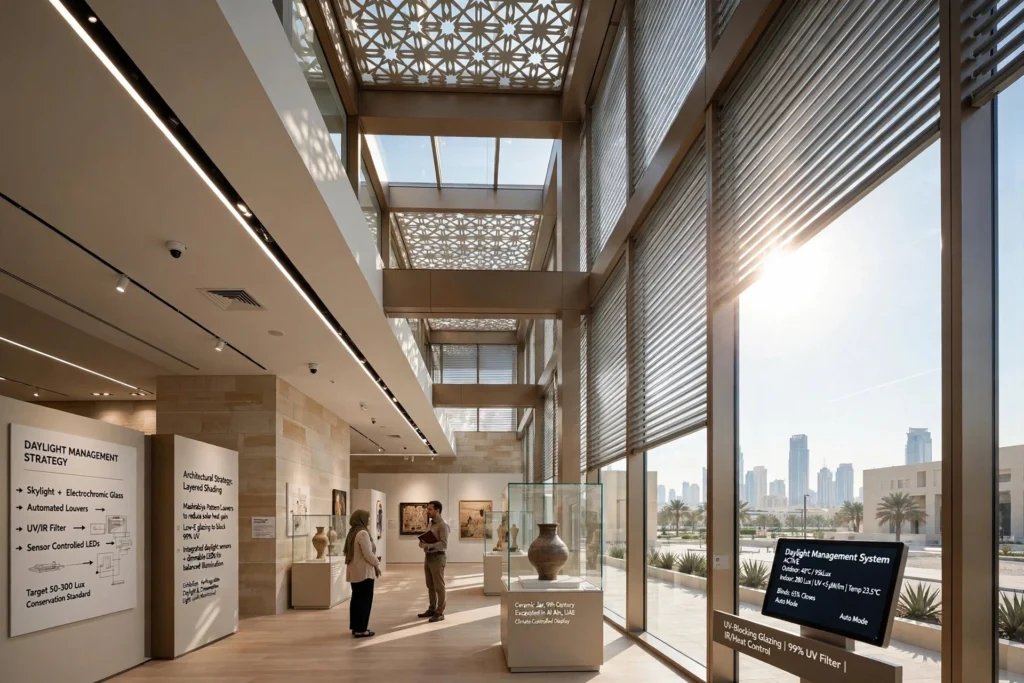
Natural daylight can create an attractive architectural environment, but it requires careful management in museums and galleries.
Direct sunlight can produce excessive brightness, glare, heat, and potentially damaging radiation. Large windows and skylights may therefore require blinds, shades, UV-control glazing, filtering systems, or other architectural strategies.
Some galleries intentionally use controlled daylight as part of the exhibition design. In such situations, artificial lighting can supplement natural illumination to maintain consistency throughout the day.
The relationship between daylight and artificial lighting should be considered during the architectural and exhibition design stages rather than treated as an afterthought.
Museum Lighting in Dubai and the UAE
The UAE has developed a strong cultural and tourism ecosystem, with museums, galleries, cultural districts, heritage destinations, art institutions, and large-scale exhibitions attracting visitors throughout the year.
In Dubai, cultural and creative destinations such as Alserkal Avenue and the wider Dubai arts ecosystem demonstrate the importance of adaptable exhibition environments. Abu Dhabi is also home to major cultural destinations including Louvre Abu Dhabi and the Saadiyat Cultural District.
The UAE’s strong emphasis on architecture, tourism, art, design, and cultural experiences means lighting has become an important part of creating memorable interiors.
Local environmental conditions also make energy-efficient lighting particularly valuable. High outdoor temperatures and extensive air-conditioning requirements mean that efficient electrical systems can contribute to overall building performance.
Lighting for Heritage Museums and Cultural Exhibitions
Heritage museums often display objects connected to local history, traditional craftsmanship, archaeology, architecture, and cultural identity. Lighting should enhance these objects while preserving an appropriate atmosphere.
Warm or neutral illumination can sometimes complement traditional materials such as wood, stone, metal, ceramics, and textiles. However, the choice should be based on the specific collection and exhibition narrative.
Architectural lighting can also highlight entrances, arches, columns, display niches, traditional patterns, and other features without overpowering the exhibits.
For heritage environments, lighting becomes part of storytelling. It can help visitors understand the relationship between objects, spaces, historical periods, and cultural themes.
How to Choose an Art Gallery Lighting Supplier
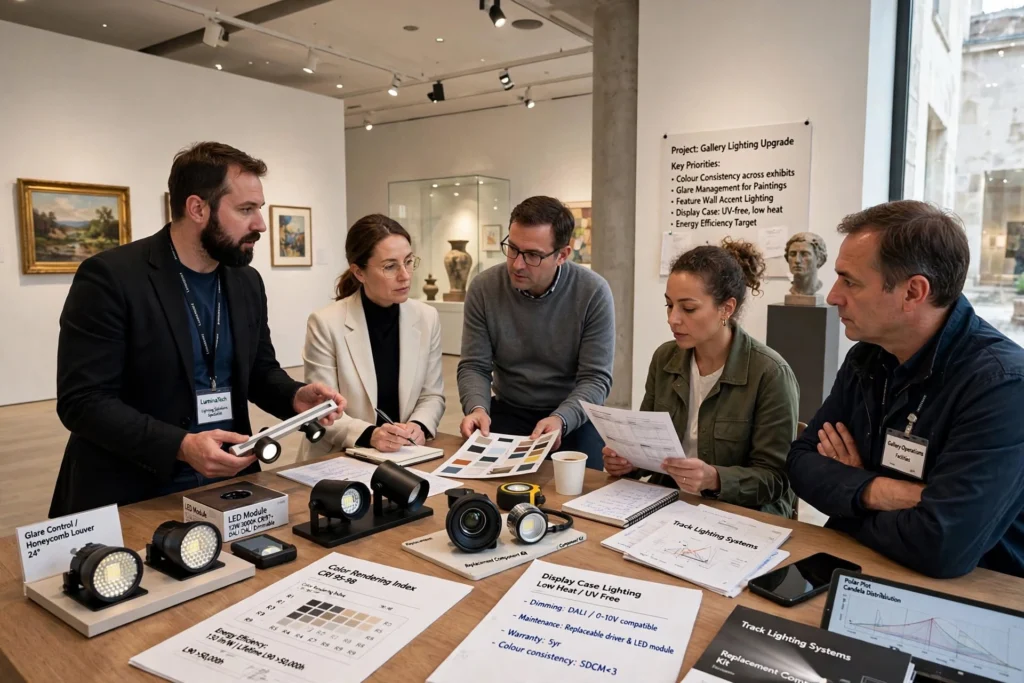
Selecting the right lighting partner is important because museum and gallery projects require more than standard commercial light fixtures. The supplier should understand LED technology, colour rendering, beam control, track lighting, accent lighting, glare management, energy efficiency, and the practical requirements of exhibition environments.
An experienced art gallery lighting supplier can help identify suitable luminaires for paintings, sculptures, display cases, feature walls, and architectural spaces while considering the gallery’s layout and operational requirements.
Project teams should also evaluate fixture quality, optical performance, colour consistency, dimming compatibility, maintenance requirements, warranty support, and availability of replacement components.
Common Lighting Mistakes in Museums and Galleries
One common mistake is using the same lighting intensity throughout an entire exhibition. Different objects have different visual and conservation requirements.
Another problem is excessive glare caused by poorly positioned spotlights or reflective display cases. Low-quality LEDs can also create inconsistent colour rendering or unwanted colour shifts.
Over-lighting is another issue. A brighter gallery is not necessarily a better gallery. Excessive illumination can reduce visual hierarchy and may increase light exposure for sensitive collections.
Poor flexibility can also create problems when exhibitions change. Fixed fixtures may require costly modifications, whereas track-mounted and adjustable solutions can adapt more easily.
Creating a Better Visitor Experience Through Lighting
Effective gallery lighting should guide visitors naturally through the exhibition. It can establish focal points, create visual hierarchy, reveal architectural details, and support the story being presented.
Lighting levels can vary between spaces to create transitions. A darker room can increase the impact of a brightly presented object, while a softly illuminated gallery can create a calm environment for visitors to study artwork.
The best lighting is often the lighting visitors do not consciously notice. Instead, they notice the artwork, architecture, details, and overall experience.
Future Trends in Museum and Gallery Lighting
Museum lighting is becoming increasingly connected, flexible, and data-driven. Smart controls, wireless systems, tunable white lighting, advanced LED optics, occupancy sensors, and digital monitoring are changing how cultural facilities manage illumination.
Tunable lighting can allow colour temperature to be adjusted for different exhibitions or environments. Connected systems can provide centralised control across multiple galleries, while sensors can help reduce lighting in unoccupied areas.
Future museum lighting will likely place even greater emphasis on conservation, energy efficiency, visitor engagement, flexibility, and integration with smart building technologies.
Final Thoughts on Museum and Art Gallery Lighting
Museum and art gallery lighting is a combination of technology, conservation, architecture, design, and visitor experience. The right system can reveal the colour and texture of artwork, emphasise important artefacts, reduce glare, improve energy efficiency, and create a comfortable environment for visitors.
From high-CRI LED spotlights and adjustable track lighting to wall washers, display-case illumination, smart controls, and architectural lighting, every component should serve a clear purpose.
For museums and galleries across Dubai, Abu Dhabi, Sharjah, and the wider UAE, a carefully planned lighting strategy can support both cultural preservation and modern visitor expectations. As the UAE continues to strengthen its position as a global destination for art, culture, tourism, and design, professionally designed exhibition lighting will remain an important part of creating high-quality cultural spaces.