Introduction
Modern metro stations and public transport hubs are among the most complex public infrastructure projects in today’s cities. They serve thousands of passengers every day while operating for extended hours under demanding environmental conditions. Lighting is no longer simply an architectural feature that illuminates platforms and waiting areas; it has become an essential engineering system that directly influences passenger safety, operational efficiency, energy consumption, maintenance costs, and the overall travel experience.
Across the UAE, rapid urban development has accelerated investment in public transportation infrastructure. Projects such as the Dubai Metro, Route 2020, Dubai Tram, Etihad Rail, and integrated transport terminals have transformed the way residents and visitors move throughout the country. Stations located in Business Bay, BurJuman, Union, Dubai Marina, Jebel Ali, Expo City Dubai, Dubai South, DIFC, Al Qusais, Deira, Abu Dhabi, Sharjah, and surrounding developments require advanced commercial LED lighting systems capable of delivering reliable performance throughout the year.
Unlike conventional commercial buildings, transport facilities operate almost continuously. They experience constant passenger movement, changing daylight conditions, heavy pedestrian traffic, emergency situations, maintenance activities, and varying operational requirements. Professional LED lighting design ensures every part of the facility remains safe, comfortable, energy-efficient, and compliant with modern engineering standards.
This article explains why commercial LED lighting has become the preferred solution for metro stations and transport hubs while exploring the engineering principles that support long-term infrastructure performance.
Why Lighting Is Critical in Public Transport Infrastructure
Every transport facility depends on visibility. From the moment passengers enter a station until they board a train or bus, lighting influences navigation, safety, accessibility, security, and passenger confidence.
A well-designed lighting system helps commuters identify entrances, ticket counters, escalators, elevators, emergency exits, information displays, platform edges, pedestrian crossings, and wayfinding signage without confusion. Good visibility also supports station staff responsible for maintenance, cleaning, security, and daily operations.
Poor lighting can create dark zones, increase accident risks, reduce CCTV image quality, and negatively affect the overall passenger experience. For this reason, lighting engineers carefully calculate illumination levels, glare control, colour temperature, and fixture placement to achieve consistent visibility throughout the facility.
Because metro stations remain operational for long hours every day, lighting systems must also maintain stable performance while minimizing maintenance interruptions and energy consumption.
Understanding Modern Metro Station Infrastructure
Today’s metro stations are sophisticated engineering environments that combine transportation systems with architectural, mechanical, electrical, and digital technologies.
A typical station consists of entrances, pedestrian walkways, ticketing halls, fare gates, concourses, retail areas, passenger waiting zones, escalators, elevators, staircases, platforms, platform screen doors, equipment rooms, emergency exits, ventilation systems, fire safety equipment, electrical switch rooms, communication systems, CCTV surveillance, and Building Management Systems (BMS).
Large transport hubs may also include bus interchanges, taxi ranks, park-and-ride facilities, bicycle parking, EV charging stations, pedestrian bridges, underground tunnels, and commercial retail spaces.
The lighting system must integrate seamlessly with every one of these environments while supporting both passenger movement and operational efficiency.
Advantages of LED Lighting for Metro Stations
Commercial LED lighting has become the preferred technology for transport infrastructure because it delivers superior performance compared with conventional fluorescent, metal halide, or sodium lighting systems.
One of its greatest advantages is energy efficiency. Metro stations consume significant electricity due to their long operating hours. Replacing traditional lighting with LED luminaires substantially reduces electricity consumption while lowering operating costs.
LED fixtures also generate considerably less heat, reducing the load placed on HVAC systems responsible for maintaining comfortable indoor temperatures. This contributes to improved energy efficiency throughout the station.
Another major advantage is long service life. High-quality commercial LED luminaires often exceed 50,000 operating hours, reducing maintenance frequency in locations where replacing fixtures may disrupt passenger movement.
Instant illumination, stable light output, excellent colour consistency, and compatibility with intelligent lighting controls make LED technology particularly suitable for modern transport infrastructure.
Passenger Safety Begins with Proper Lighting Design
Passenger safety is the primary objective of every metro lighting system.
Lighting designers evaluate pedestrian movement patterns to ensure platforms, staircases, concourses, escalators, elevators, ticketing areas, and exits remain clearly visible throughout the day and night.
Platform edges require carefully controlled illumination to improve visibility while avoiding excessive glare that could distract passengers or train operators.
Emergency exits, escape routes, pedestrian tunnels, and evacuation corridors require continuous illumination supported by emergency lighting systems connected to backup power supplies.
Proper lighting also improves accessibility for elderly passengers, children, and individuals with visual impairments by increasing contrast, reducing shadows, and improving overall visibility.
Rather than simply making spaces brighter, professional lighting design creates safe environments where passengers can move confidently under all operating conditions.
Different Areas Require Different Lighting Solutions
Each area within a transport hub serves a different purpose and therefore requires its own lighting strategy.
Entrance plazas and pedestrian pathways benefit from durable outdoor LED luminaires capable of resisting dust, humidity, and changing weather conditions.
Ticketing halls require bright, evenly distributed lighting that allows passengers to read ticket machines, information displays, and digital signage comfortably.
Retail spaces inside stations often use warmer lighting to create welcoming commercial environments, while platforms generally require neutral white lighting that provides excellent visibility without producing excessive glare.
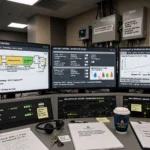
Equipment rooms, electrical switch rooms, maintenance workshops, control centres, and service corridors require task-oriented illumination that supports engineering and maintenance activities.
Professional lighting designers carefully balance illumination levels across these different environments while maintaining visual consistency throughout the station.
Smart Lighting Systems Improve Operational Efficiency
Modern transport facilities increasingly integrate LED lighting with Building Management Systems (BMS), SCADA platforms, and Energy Management Systems to improve operational efficiency.
Intelligent lighting controls automatically adjust brightness according to passenger traffic, daylight availability, station operating hours, and maintenance requirements.
Motion sensors and occupancy sensors activate lighting only where required, reducing unnecessary energy consumption during quieter periods.
Daylight sensors installed near station entrances automatically reduce artificial lighting when sufficient natural daylight is available, improving overall energy performance.
DALI and KNX lighting control systems allow facility managers to monitor fixture status, detect faults, schedule maintenance, adjust illumination levels, and optimize energy usage from centralized control rooms.
These intelligent technologies significantly reduce operating costs while extending the lifespan of lighting equipment.
Lighting Supports CCTV and Security Systems
Security remains a critical component of every public transport network.
High-quality LED lighting enhances CCTV image quality by providing uniform illumination with excellent colour rendering and minimal flicker. Better image quality allows security personnel to identify passengers, monitor station activity, investigate incidents, and respond more effectively during emergencies.
Well-lit platforms, pedestrian tunnels, waiting areas, parking facilities, and station entrances also discourage vandalism while improving passenger confidence, particularly during evening operating hours.
Modern transport authorities increasingly integrate lighting, CCTV surveillance, access control systems, emergency communication equipment, and fire detection systems into a unified security infrastructure that improves both operational efficiency and public safety.