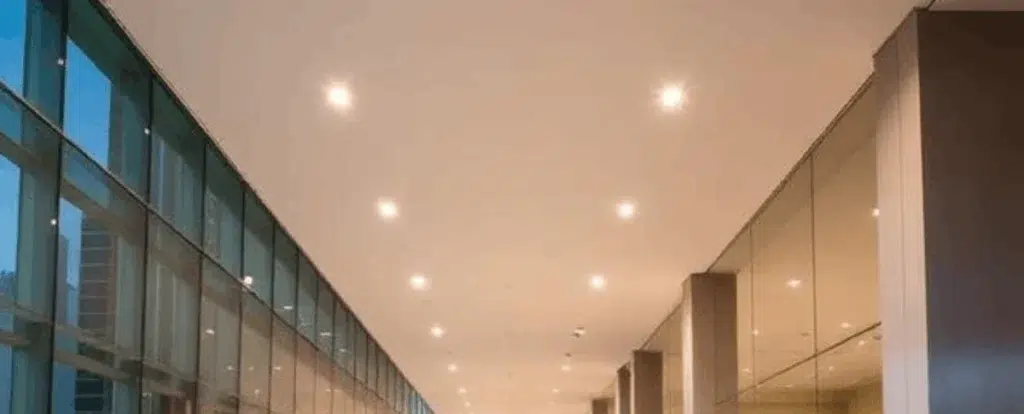
For a developer, consultant, or main contractor, lighting is rarely the biggest line in the budget, but it is one of the most visible, most regulated, and most frequently value-engineered packages on a project. Get it right and the building reads as premium, passes authority approval first time, and runs at a low energy cost for decades. Get it wrong and you inherit glare complaints, failed inspections, mismatched colour across floors, and early fixture failures in the Gulf heat. This guide walks through how to specify and procure LED lighting for a commercial project in the UAE the right way, from the first lighting brief to delivery on site.
Start With the Lighting Brief and the Standards
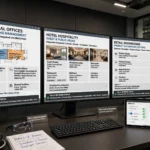
Every good lighting package begins with a clear brief tied to recognised standards, not with a product catalogue. The international reference for interior lighting is EN 12464-1, which sets the maintained illuminance (lux), uniformity, and glare limits for each type of space. An open-plan office targets around 500 lux on the working plane with a Unified Glare Rating (UGR) below 19, a warehouse aisle needs far less, and a jewellery counter or hotel lobby is judged more on colour quality and atmosphere than raw lux.
Three numbers should anchor every line of your specification:
- Illuminance (lux): the light level required for the task in that space.
- UGR: the visual-comfort ceiling, critical anywhere people look at screens.
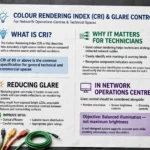
- CRI (Ra): colour rendering, with 80 acceptable for general areas and 90-plus for spaces where materials, food, or finishes must look true.
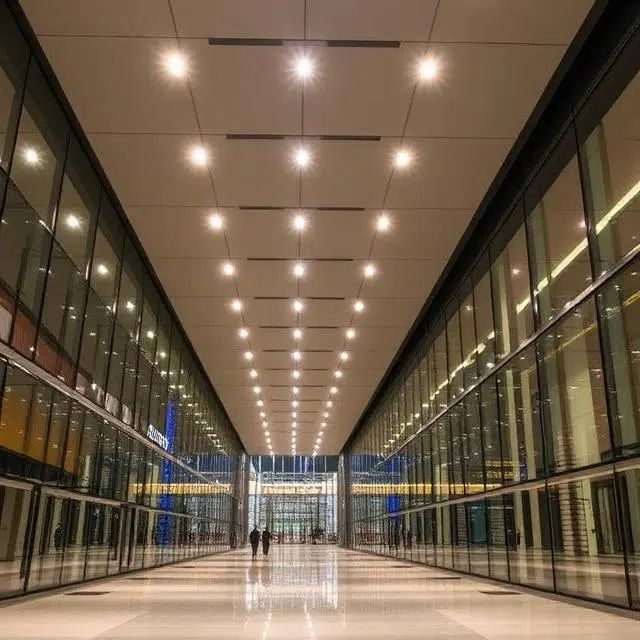
Defining these per space, ideally in a simple room-by-room table, turns a vague “we need good lighting” into a measurable brief that a supplier can quote against and an authority can approve.
Understand the UAE Compliance Landscape Early
This is where UAE projects differ from generic specifications, and where many teams lose time. Lighting touches several authorities, and the requirements should shape the design from day one rather than being bolted on before submission.
- DEWA, ADDC, and SEWA approve the electrical load. Your lighting design must respect the Lighting Power Density (LPD), the watts of lighting per square metre, that the authority and the green-building system permit. Efficient fixtures are not optional here; they are how you stay inside the cap while still hitting your lux targets.
- Al Sa’fat (Dubai) and the Estidama Pearl Rating System (Abu Dhabi) are the green-building frameworks. Both reward low LPD, good controls, and efficient sources, and both will ask for calculations and product data to prove it.
- MOIAT (formerly ESMA) governs energy-efficiency and safety conformity for lighting products sold in the Emirates. Specifying conformant product protects you at customs and on site.
- Dubai Civil Defence (DCD) and the BS 5266-1 standard govern emergency and escape-route lighting. This is a life-safety requirement, not a nicety, and it must be designed into the scheme from the start.
Where a developer is pursuing LEED or WELL certification, the lighting evidence (photometric files, efficacy, controls, and even circadian considerations) feeds directly into those credits. Knowing which frameworks apply before you specify saves an expensive redesign later.
Build a Proper Lighting Schedule and BOQ
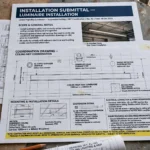
The document that holds the whole package together is the lighting schedule, the structured list that becomes part of the Bill of Quantities (BOQ). A weak schedule, just “downlight, 100 no.”, invites every supplier to quote a different product and makes fair comparison impossible. A strong schedule fixes the important parameters while leaving room for compliant alternatives.
For each fixture type, the schedule should state the mounting and format, wattage and lumen output, colour temperature and CRI, beam angle or distribution, IP and IK rating, control method (on/off, dimmable, DALI), and emergency function where required. Quantities should be tied to the lighting layout drawings so nothing is missed and nothing is double-counted.
A precise schedule does three things at once: it lets you compare quotations like for like, it gives the authority the detail it needs to approve, and it tells your supplier exactly what to stock and deliver. If you want help turning a brief into a fully specified, compliant schedule, our team offers expert lighting design and specification support for UAE projects of every scale.
Specify the Right Products for the UAE Environment
A product that performs beautifully in a European showroom can fail quickly in a Dubai car park or rooftop. The Gulf climate, extreme heat, intense sun, dust, and humidity, must drive the specification of anything exposed.
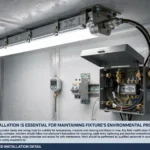
- Ingress protection: indoor fittings can be IP20, but anything outdoor, in a car park, or in a washdown area needs IP65 or IP66, and in-ground uplights need IP67.
- Thermal and surge resilience: specify drivers rated for high ambient temperatures and fitted with surge protection, because the UAE supply and the heat are hard on electronics. This single detail separates fixtures that last from fixtures that fail in their second summer.
- Colour consistency: for any space with many fittings, demand tight colour binning (measured in MacAdam ellipses) so that hundreds of downlights or panels read as one uniform installation rather than a patchwork.
- Controls: design dimming and control (DALI-2, occupancy sensing, daylight harvesting) into the scheme. Controls are where a lot of the energy saving and the green-building credit actually comes from, and they are far cheaper to plan now than to retrofit.
Sourcing these across indoor, outdoor, decorative, and architectural categories from a single, consistent source keeps quality uniform across the building. You can review the full range of project LED lighting to see how the categories fit a complete commercial scheme.
Demand the Right Documentation From Your Supplier
On a professional project, the paperwork is part of the product. Before you commit to a fixture, your supplier should be able to provide the photometric IES files for DIALux verification, the manufacturer data sheets, the MOIAT and CE or RoHS conformity certificates, and a clear written warranty. For emergency fittings, you also need the evidence that they meet the maintained-duration and DCD requirements.
This documentation is not bureaucracy. It removes risk from every stakeholder: the consultant can trust the calculations, the contractor can prove compliance at inspection, and the client knows the installed lighting will deliver what was promised. If a supplier cannot readily produce IES files and certificates, that is a signal to look elsewhere.
Choose a Lighting Partner, Not Just a Price
The cheapest quotation often becomes the most expensive package once delays, mismatches, and replacements are counted. On a real project, the value of a lighting supplier lies in four things beyond unit price:
- Authorised, tier-one product. An authorised distributor of a established manufacturer gives you traceable quality and genuine warranty support, not grey-market stock of unknown origin.
- Stock depth and consistency. Large projects need the same product, from the same production lot, delivered in volume. A partner who can guarantee consistency protects the uniform appearance of the finished building.
- Delivery scheduling. Lighting that arrives too early clutters the site; too late and it holds up handover. A capable partner delivers in phases aligned to the construction programme, often organised area by area and circuit by circuit.
- Single-point accountability. Sourcing the whole package, indoor, outdoor, decorative, controls, and emergency, from one partner means one number to call when something needs resolving, instead of chasing five suppliers.
These are the qualities that separate a transactional vendor from a genuine project partner, and they matter most precisely when a project is under programme pressure.
Value-Engineer Without Losing Quality
Value engineering is a normal part of any UAE project, but it is where lighting quality is most often quietly damaged. The goal is to reduce cost without reducing the performance the brief and the authorities require.
Done well, value engineering means improving efficacy so you need fewer or lower-wattage fittings, rationalising the number of distinct fixture types to gain better pricing and easier maintenance, and choosing the right specification for each space rather than over-specifying everywhere. Done badly, it means swapping in unbranded fittings with inflated lumen claims, poor colour consistency, no surge protection, and no real warranty, which simply moves the cost from the capital budget to the maintenance budget and the client’s reputation. A supplier with real product knowledge can identify genuine savings while protecting the outcomes that matter.
Plan Delivery, Phasing, and Site Coordination
The final stage where projects gain or lose time is logistics. Lighting should be procured early enough to secure stock and lead time, then called off in phases that match the build. Coordinating delivery with the installation contractor, confirming that the fittings match the approved schedule before they ship, and supporting the team during installation and commissioning all keep the lighting works on track. Commissioning, the aiming, testing, and programming of controls, is what ensures the installed scheme finally performs the way it was designed to before the client ever sees it.
Common Mistakes to Avoid
A few errors recur across UAE projects often enough to flag directly:
- Specifying to lux alone and ignoring UGR, glare, and colour quality.
- Treating compliance (DEWA load, Al Sa’fat or Estidama, DCD emergency) as a final-stage submission rather than a design driver.
- Using indoor-grade or cool-climate fittings outdoors and watching them fail in the heat.
- Accepting “equivalent” products without IES files, certificates, or a real warranty.
- Choosing on unit price alone and absorbing the hidden cost in delays, mismatches, and early failures.
Conclusion
Specifying and procuring LED lighting for a UAE commercial project is a disciplined process: define the brief against EN 12464-1, design for DEWA, Al Sa’fat, Estidama, and DCD from the outset, build a precise lighting schedule, specify products that survive the Gulf climate, demand full documentation, and partner with a supplier who delivers consistent, certified product on programme. Teams that follow this path approve faster, build better, and hand over buildings that perform for years. Teams that shortcut it tend to pay the difference later, with interest.
If you are planning a commercial, hospitality, industrial, or residential development in the UAE, our team can help you specify a compliant, efficient, deliverable lighting package from concept to commissioning.